History

Boxer Muhammad Ali, ‘The Greatest of all Time,’ dies at 74

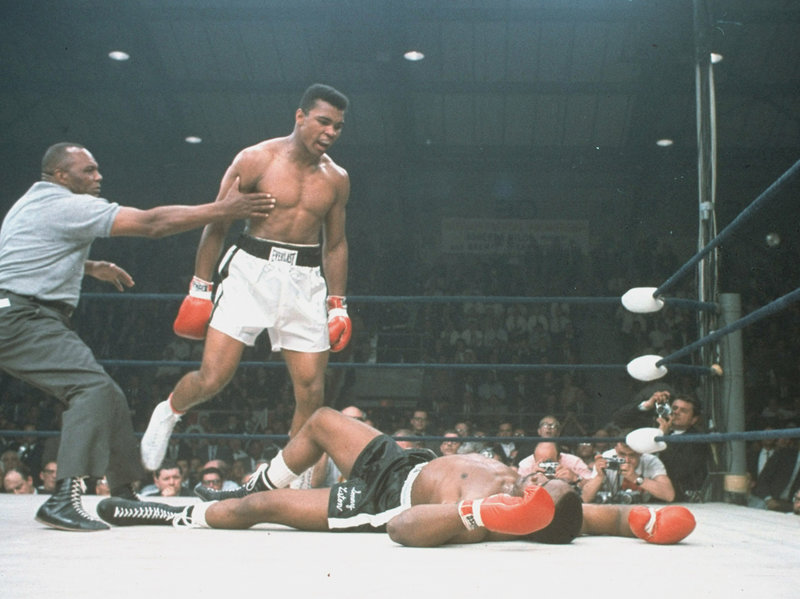
Muhammad Ali is held back by referee Joe Walcott after knocking out Sonny Liston in the first round of their championship bout in Lewiston, Maine, on May 25, 1965.
Muhammad Ali is held back by referee Joe Walcott after knocking out Sonny Liston in the first round of their championship bout in Lewiston, Maine, on May 25, 1965. (Photo courtesy of the Associated Press)

Muhammad Ali, the man considered the greatest boxer of all time, died late Friday at a hospital in Phoenix at age 74. He was battling respiratory problems.

He died of septic shock related to natural causes, with his family at his bedside, according to family spokesman Bob Gunnell.

Ali inspired millions by standing up for his principles during the volatile 1960s and by always entertaining — in the boxing ring and in front of a microphone.

Cassius Clay (Ali’s given name) won a gold medal at the Rome Olympics in 1960. He wanted more: a professional heavyweight championship. He arrived in Miami in October to work with legendary trainer Angelo Dundee. Dundee, who died in 2012, recalled the first day Clay showed up.

“Bounding up the steps of the Fifth Street gym, and the steps were pretty rickety, you know, all wood. Bouncing up, he said, ‘Angelo, line up all your bums. I’m gonna beat ’em all,’ ” Dundee said.

‘King Of The World’

Clay was 18: bounding, fearless, leading with his mouth.

“I’m not only a fighter. I’m a poet; I’m a prophet; I’m the resurrector; I’m the savior of the boxing world. If it wasn’t for me, the game would be dead,” he said.

Young Clay made boxing an art form. He was an original, a heavyweight who didn’tmove around the ring — he danced. He’d thrill the crowd with his quick scissor-step shuffle. On defense, he’d slip and slide, Dundee said, and then flick that jab.

“He had a jab that was like a snake,” he said.

Float like a butterfly, sting like a bee; rumble, young man, rumble. Boxing reporters never had so much fun.

As the mouth roared, the victories started piling up, all of it prelude to a 1964 battle against the big, bad bear: heavyweight champion Sonny Liston.

Liston was a fearsome opponent. Nobody believed the young Ali had a shot. But after six rounds, Liston was done. He didn’t come out for the seventh, and Clay was the new champion.

“I am the king of the world! … I’m pretty! … I’m a bad man! I shook up the world!” he exclaimed.

But the 22-year-old was just getting started.

A Polarizing Figure

After the Liston fight, Ali revealed he was a member of the black separatist movement Nation of Islam. He wanted to be called Muhammad Ali, a name he said was given to him by the group’s leader, Elijah Muhammad.

Muhammad Ali is held back by referee Joe Walcott after knocking out Sonny Liston in the first round of their championship bout in Lewiston, Maine, on May 25, 1965.
AP

“That’s my original name; that’s a black man name,” Ali said. “Cassius Clay was my slave name. I’m no longer a slave.”

Muhammad, the Nation of Islam leader, preached that integration and intermarriage were wrong and that white people were devils. It was an idea Ali defended in a 1971 TV interview.

“I’m gonna look at two or three white people who’re trying to do right and don’t see the other million trying to kill me? I’m not that big of a fool, and I’m not going to deny it,” he said. “I believe everything he [Muhammad] teach, and if the white people of a country are not the devil, then they should prove they’re not the devil.”

Ali became a polarizing figure in America. Many sportswriters vilified him. Black boxer Floyd Patterson said, “I don’t believe God put us here to hate one another. Cassius Clay is disgracing himself and the Negro race.”

To others, Ali became a loud and unapologetic symbol of black pride.

The Rev. Kwasi Thornell of Washington, D.C., was a teenager when Ali burst onto the scene.

“There was a great deal of excitement in seeing that because that was a boldness that many of us did not know,” says Thornell, who is African-American. “We were more encouraged by our parents to just go along with the system and not be bold and bodacious, as [Ali] was.”

Ali’s boldest move — and most controversial — came in 1967. At the height of the Vietnam War, he refused induction into the U.S. military, saying, “I ain’t got no quarrel with them Viet Cong.”

“My intention is to box, to win a clean fight. But in war, the intention is to kill, kill, kill, kill and continue killing innocent people,” he said.

Some called him a traitor. For those in a growing anti-war movement, Ali was a hero who paid a significant price. He was convicted of draft evasion, and though he avoided jail time, he was stripped of his heavyweight title and banned from boxing at the age of 25, just as he was entering his prime. It would be more than three years before Ali returned to the ring.

Rivalry With Frazier

Following his exile, Ali squared off against Joe Frazier, who became heavyweight champion in Ali’s absence. The March 1971 showdown was billed as the fight of the century.

Frazier won, handing Ali his first professional loss. It was also the first of three epic bouts between the two men. Frazier, with his boxer’s mashed face and snorting-bull style in the ring, could never equal Ali’s finesse and skill as a fighter. Nor could he match Ali’s wit, which often turned cruel when the subject was Frazier.

“You’ll also see why I say he’s a gorilla,” Ali said. “You’ll see how ugly he is, and how pretty I am.”

It was theater to Ali. But in a 2007 interview, Ali biographer Thomas Hauser said the words and frequent taunts were like broken glass in Frazier’s stomach. It’s one of the reasons, Hauser said, that even late in life, Frazier harbored ill will toward Ali.

“Even though Muhammad said to me that if God ever called him to a holy war, he wanted Joe Frazier fighting beside him,” Hauser said.

Undoubtedly, sports announcer Howard Cosell would have done the holy war’s play-by-play, as he did for many of Ali’s fights. The two men had a symbiotic relationship. Their interview sessions were more like hilarious jousting matches, with Ali needling the pedantic former lawyer, always threatening to tear off Cosell’s obvious toupee.

When it came to boxing IQ, none was higher than Ali’s. In 1974, against the menacing George Foreman, Ali used a tactic called the “rope-a-dope.” He stayed on the ropes, covering up, letting Foreman punch himself out. Then Ali struck quickly, knocked out Foreman and became champion a second time.

Parkinson’s Diagnosis

A year later, “The Thrilla in Manila” was the final fight in the Ali-Frazier trilogy. It was an awesome and horrible slugfest that ended with Ali winning, but admitting afterward, “It was the closest to death that I could feel.”

“This is too painful. It’s too much work. I might have a heart attack or something. I wanna get out … while I’m on top,” he said.

It would have been the perfect time to stop. But Ali kept fighting six more years. In the early 1980s, he was diagnosed with pugilistic Parkinson’s syndrome.

His last big public moment came in 1996, when he lit the flame at the Atlanta Summer Olympics. Shaking, his face frozen by a Parkinson’s mask, this was a new generation’s image of the man called the greatest of all time. But the sadness was mixed with global love.

Ali was the rare and perhaps only person who could go anywhere — Fifth Avenue in Manhattan, a marketplace in Latin America — and people would stop and point and smile.

Come Friday afternoon, many will again stop when a public procession and interfaith service are held for Ali in his hometown of Louisville, Ky. Family spokesman Gunnell says eulogies will be delivered by former President Bill Clinton, Billy Crystal and Bryant Gumbel. The funeral will be streamed on the internet, Gunnell says.

In his life, Ali traveled from a boxer’s cruelty to kindness. A man who stood up and shouted out for his principles ultimately embraced the quiet principle of spirituality. But in later years, his words muted by Parkinson’s, Ali was asked if he’d do it all over exactly the same, even if he knew in advance how he’d end up. The answer: “You bet I would.”

Activists remember oil and gas buyback in Kachemak Bay

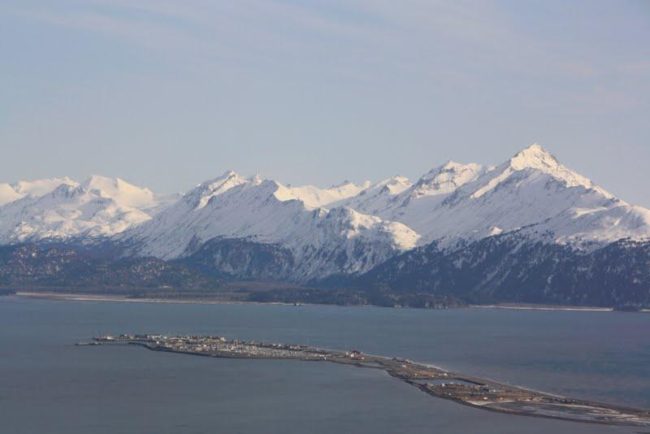
The Homer Spit on Kachemak Bay.
(Photo courtesy of KBBI)

The environmental nonprofit Cook Inletkeeper sponsored a panel discussion to commemorate the 40th anniversary of the Kachemak Bay oil and gas lease buyback. The buyback prevented oil and gas development in the Bay and protected it as a critical habitat area.

“It was a story. It was a David and Goliath; a little town in Homer at the end of the Sterling Highway, is under pressure from those big oil companies,” said Frank Tupper, who helped found the Kachemak Bay Defense Fund.

In one corner was David: a motley crew of commercial fisherman, Homer’s budding environmental movement — including Tupper — and other Homer residents desperate to protect Kachemak Bay. In the other were oil companies and the state of Alaska, which in December 1973 held a Lower Cook Inlet lease sale that opened up the bay to drilling and production activities.

What followed was a three-year battle fought in all three branches of state government and all aspects of the community. On May 25, Cook Inletkeeper sponsored a panel discussion to commemorate the 40th anniversary of these events.

“It was a local, human-scale fight over our human destiny with great characters and great arguments on all sides,” said Tom Kizzia, editor of the Homer News at the time,” said journalist, Tom Kizzia.

“Homer really changed as a consequence of what happened in that period. I think you can see a lot of what Homer became, was seeded and started to grow at that time,”

The seeds of environmentalism flourished from the fight, and the community became centered on tourism and fisheries, rather than oil and gas.

Loren Flagg was the commercial fisheries area biologist for Fish and Game when the lease sale was announced, and had all of two days to prepare comments.

“At that time the bay was producing 5 million pounds of shrimp a year, 2 million pounds of king crab, a half million pounds of tanner crab, and, of course, salmon, halibut. It was extremely, extreme(ly) valuable resources,” said Flagg.

But Gov. Bill Egan supported the sale, so it went ahead, much to the surprise of Homer residents. The sale had been announced through the usual governmental and industry channels, but not in a way that reached community members. Ken Moore fished crab, herring and salmon in the bay. He says fishermen felt like they didn’t have a say in the matter.

“No effort to find out if the people whose front yard it was all going to be in wanted it there. Or it didn’t seem that anybody really cared whether they did or not, it had happened already. And that just added insult to injury when you discovered what was going on,” said Moore.

Frank Tupper was making ends meet as a self-proclaimed hippie at the time, when a friend came by his trailer to tell him about the pending lease sale.

Frank Tupper was one of the founders of the Kachemak Bay Defense Fund. (Photo by Jenny Neyman/KBBI)
Frank Tupper was one of the founders of the Kachemak Bay Defense Fund.
(Photo by Jenny Neyman/KBBI)

“Neither one of us could believe that that would be possible, that people were not that stupid, that they wouldn’t just do it just for the dollars. Naïve we were, but, still, that’s what we thought because of this beautiful, intrinsic area that we live in. So I think I said to Chuck, ‘Well, dammit, there’s two of us, let’s get going.’ From the citizen side of it that was the beginning of going out and just beating the streets and talking to people, ‘Do you know what’s coming, do you know what’s coming?’” said Tupper.

Such was the grass roots of the community campaign that eventually gained national attention. Activists established the Kachemak Bay Defense Fund, led by Tupper. They joined forces with the North Pacific Fishermen’s Association, led by Moore, to spread the word of the oil incursion into the bay and raise money for a legal battle.

A popular tactic was to hold shrimp and crab feeds, serving up information and donation forms along with the shellfish.

“I would hold up a quart of oil and I would say — after they were wiping their mouths with the butter and the garlic and everything — I said, ‘Now, which would you prefer in the bay?’” said Tupper.

The fund helped pay for legal challenges to the leases. The issue made it to the Supreme Court. Warren Matthews was an attorney for the plaintiffs. They brought three challenges: Failure to give notice — they lost on that one; failure to make a reasoned decision that the lease sale was in the best interest of the state; and failure to conduct a study of potential impacts to be shared with affected communities. The court found merit in those two claims, but not enough to reverse the sale.

“A majority of the court said, ‘Well, you’re right, but do we want to disturb all these other leases that have been made in the past?’ They answered, ‘No. Therefore, we’re not going apply this ground to you, either,’” said Matthews.

But political tides were changing. Republican Jay Hammond was elected governor in 1974, in part on his conservationist platform to protect fisheries.

Homer fishermen, environmentalists and others had been fighting to protect Kachemak Bay from development after the state of Alaska held a lease sale for oil and gas exploration.

“We were fighting for our homeland; we were fighting for the bay, the intrinsic beauty of the area. So it wasn’t just a bunch of people with an ‘ist’ at the end — conservationist, environmentalist, developmentalist. It was people. People from a little town that had a common goal, and we fought like hell,” said Frank Tupper, of the Kachemak Bay Defense Fund.

Tupper’s group raised money to bring a legal challenge to the leases. Though the Supreme Court agreed with some of their arguments, it offered no practical relief, not wanting to step on a slippery slope that could affect many other leases already issued.

That left the state’s lawmakers and administration to settle the issue. Gov. Hammond submitted a bill to the Legislature in 1976 calling for a one-year moratorium on oil drilling in the bay, in which time the state could negotiate with the oil companies to buy back the leases. After that year, the state could reacquire the leases through eminent domain. Going forward, Kachemak Bay would be protected as a critical habitat area.

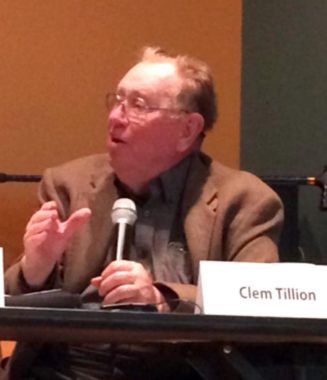
It was not an easy sell in the Legislature, with many Democrats still loyal to Gov. Bill Egan, who authorized the sale, or supportive of industry development in the state. Republican Legislator Clem Tillion, from Halibut Cove, was one of the main champions of the bill, both to protect fisheries and because the oil industry only paid 1 percent severance tax at the time. New legislation would impose taxes on the oil industry similar to what Texas required.

In his time in the Legislature, Clem Tillion helped pass a bill that protected Kachemak Bay from oil and gas drilling.
(Photo by Jenny Neyman/KBBI)

“Why would I give up one fish for something that doesn’t pay me anything? Those are my grandchildren and great-grandchildren’s resources. But I’m certainly not going to give it away,” Tillion said.

Chancy Croft was a Democrat lawmaker, but on the same side of the issue.

“By ’75 you had a Republican governor and a Legislature that was overwhelmingly Democrat. And, so, the question was, ‘Were a group of Democrats going to say that the former Democrat governor of Alaska was wrong in what he did?’ It turned out a majority were willing to say that,” Croft said.

As the clock wound down in the 1976 legislative session, Tillion was short three votes to get Hammond’s bill passed. Ironically, the oil industry provided the extra push needed.

The jack-up rig George Ferris had been towed to Mud Bay, along the Homer Spit, for repairs after it was damaged at Cape Kasilof early that year. By August, rumors were flying that the rig’s iron legs were stuck in the mud. In May, Shell Oil attempted to move the rig, but the legs failed to retract and the rig got swamped by the tide, spilling diesel fuel into the bay. The oil boom meant to contain any possible spills was stuck on deck. Another boom brought in to contain the spill turned out to be already dirty and released its own sheen into the water.

Kizzia, editor of the Homer News at the time, covered the fiasco.

“To this day you can find plenty of quotes from industry officials about the care that they were going to take if drilling went ahead. And as soon as there was actual trouble all the promises evaporated,” said Kizzia.

Most anyone on the fence about protecting the bay was pushed over by the resulting outrage.

“One of the biologists with Chevron testified that it would not be possible to spill enough oil to do harm in Kachemak Bay,” said Loren Flagg, the commercial fisheries area biologist for Fish and Game at the time. “As the Legislature was getting ready to vote, the George Ferris. And that was enough for the Legislature to change their votes.”

Homer was indelibly changed by these events, and those involved learned lifelong lessons.

“Trust but verify. Don’t take everything you hear,” said Flagg.

“Don’t give away that which lasts forever for something that’s going to be here a short time,” said Tillion.

“The belief in people power, in self-advocacy, in the strength that you as an American citizen has,” said Tupper.

The panel discussion panel discussion to commemorate the 40th anniversary the Kachemak Bay oil and gas lease buyback took place on Wednesday, May 25 at Islands and Ocean Visitor Center in Homer. Cook Inletkeeper plans to make a full recording of the discussion available on its website, at inletkeeper.org.

Editor’s note: In 2014, Soldotna Sen. Peter Micciche sponsored legislation that removed the area around the deep-water dock on the Homer Spit from the critical habitat area, allowing drill rigs to dock at the Homer port. Cook Inletkeeper objected to the change, but there was overwhelming political support and the legislation passed.

Governor declares June 3 Dutch Harbor Remembrance Day

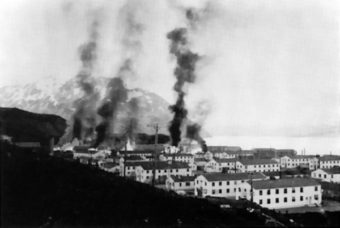
Buildings burning after the first Japanese attack on Dutch Harbor, Alaska (USA), 3 June 1942. (Public Domain photo by U.S. Army)

Governor Bill Walker has declared June 3rd to be recognized as Dutch Harbor Remembrance Day. Statewide all flags will fly at half-mast to recognize Japan’s World War II attack on Dutch Harbor.

The 1942 bombing was the first hostile action on Alaskan soil; 25 servicemen were killed.

Later on, Dutch Harbor was attacked again as well as the communities of Adak, Kiska, and Attu.

In response to the June 3rd strike, the United States uprooted Unangan people and sent them to internment camps in Southeast Alaska where they suffered from disease and malnutrition.

Governor Walker hopes Dutch Harbor Remembrance Day will honor the military who served and died defending the United States, and the Aleut people who died while interned.

Newtok Awaits Relocation Funding, More Than 30 Years After Flood Risk was Documented

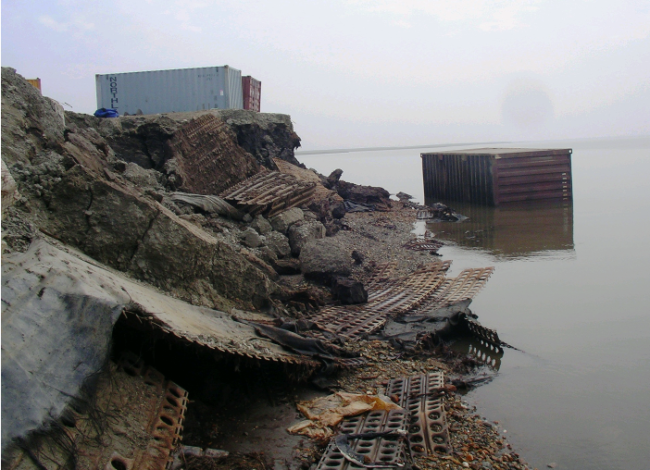
A steel storage container slid into the water after erosion chewed away at this bank in Newtok.
(Public Domain, Courtesy State of Alaska)

“I was scared, cause it looked so close … And you could just see these huge waves just come at you,” says Sabrina Warner, describing her fear of floodwaters sweeping over her home in the Alaskan coastal village of Newtok.

Warner says the Ninglick River had eroded so much land around her village of Newtok three years ago that she now fears powerful storms that hit Alaska’s western coast in the fall will flood the community. That’s why many say the people of Newtok could become Alaska’s first climate-change refugees. And it’s why Warner’s partner, Nathan Tom, told a reporter in 2013 he’s anxious to move his family to higher ground, up and out of the flood zone.

Nathan Tom talks with a reporter while his partner, Sabrina Warner, plays with a dog.
Nathan Tom talks with a reporter while his partner, Sabrina Warner, plays with a dog. (Courtesy NPR)

“I just can’t wait to move the houses or build our house,” she said.

Three years later, Warner, Tom and most of the other 350 people of Newtok are still waiting for federal and state help move the villagers to nearby Mertarvik – more than 30 years after the problem was first outlined in a 1984 study.

“I believe that within four years, Newtok will no longer be a viable community,” says Joel Niemayer the federal co-chair of the Denali Commission, the agency President Obama tapped to coordinate a response to the threat that climate change-driven flooding poses to Newtok and several other villages along Alaska’s coasts and rivers.

“Within four years, the river will be right next to the school,” Niemeyer said. “It’ll have already have gobbled up the community water source. And then not far behind, it’s the airport.”

He couldn’t say whether the agencies will be able to pull off this funding in time to build a new community before the river claims the land on which Newtok was built in 1958. That’s when the U.S. Bureau of Indian Affairs established the community on that site because it was as far up the Newtok River as the barge carrying materials to build a new school could go.

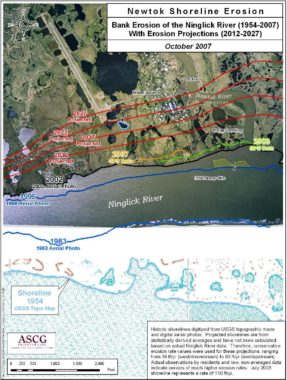
A 2007 map shows the steady erosion of land around Newtok, based on U.S. Geological Survey data, and projects the progression of the erosion toward the village. Credit State of Alaska

A 2007 map shows the steady erosion of land around Newtok, based on U.S. Geological Survey data, and projects the progression of the erosion toward the village.
(Public Domain, Courtesy State of Alaska)

“Relocation is very involved,” said Sally Cox, a planner with the state Division of Community and Regional Affairs. “And there are a lot of different things that have to happen.”

Cox has been involved in the Newtok relocation effort for years. She, like Niemeyer, both described a lengthy process that begins with a community deciding whether to move and if so where; then proceeds through years of planning, public interaction – and finally, getting funding.

“It’s a very slow process,” Cox said, “and government is very slow about responding to that need, especially because it costs so much money.”

How much money, neither Cox nor Niemeyer could say. Some estimate each relocation could cost hundreds of millions of dollars.


5,000-Year-Old Chinese Beer Recipe Revealed

Chinese beer brands on display at a supermarket. An ancient brewery discovered in China's Central Plain shows the Chinese were making barley beer with fairly advanced techniques some 5,000 years ago. Chris/Flickr
Chinese beer brands on display at a supermarket. An ancient brewery discovered in China’s Central Plain shows the Chinese were making barley beer with fairly advanced techniques some 5,000 years ago. (Creative Commons photo by Chris

A 5,000-year-old brewery has been unearthed in China.

Archaeologists uncovered ancient “beer-making tool kits” in underground rooms built between 3400 and 2900 B.C. Discovered at a dig site in the Central Plain of China, the kits included funnels, pots and specialized jugs. The shapes of the objects suggest they could be used for brewing, filtration and storage.

It’s the oldest beer-making facility ever discovered in China — and the evidence indicates that these early brewers were already using specialized tools and advanced beer-making techniques.

For instance, the scientists found a pottery stove, which the ancient brewers would have heated to break down carbohydrates to sugar. And the brewery’s underground location was important for both storing beer and controlling temperature — too much heat can destroy the enzymes responsible for that carb-to-sugar conversion, explains Patrick McGovern, a biomolecular archaeologist at the University of Pennsylvania Museum in Philadelphia, who was not involved in the current research.

“All indications are that ancient peoples, [including those at this Chinese dig site], applied the same principles and techniques as brewers do today,” says McGovern, who is known as the “Indiana Jones” of ancient fermented beverages.

The research group inspected the pots and jugs and found ancient grains that had lingered inside. The grains showed evidence that they had been damaged by malting and mashing, two key steps in beer-making. Residue from inside the uncovered pots and funnels was tested with ion chromatography to find out what the ancient beer was made of. The 5,000-year-old beer “recipe” was published on Monday in the journal Proceedings of the National Academy of Sciences.

The recipe included a mix of fermented grains: broomcorn millet, barley and Job’s tears, a chewy Asian grain also known as Chinese pearl barley. The recipe also called for tubers, the starchy and sugary parts of plants, which were added to sweeten and flavor the beer, the researchers write.

So what did this ancient beer taste like? The researcher leading the study, Jiajing Wang, an archaeologist from Stanford University, guessed “it would taste a bit sour and a bit sweet.”

Finding evidence of barley in the beer was surprising to the scientists. Scientists had never seen barley in China this early before. Although barley is now common throughout China, no one completely understands when and why it first made its way there.

Maybe it was about beer. As Wang tells The Salt in an email: “Barley was one of the main ingredient[s] for beer brewing in other parts of the world, such as ancient Egypt. It is possible that when barley was introduced from Western Eurasia into the Central Plain of China, it came with the knowledge that the crop was a good ingredient for beer brewing. So it was not only the introduction of a new crop, but also the movement of knowledge associated with the crop.”

McGovern says the new findings show that the Chinese became brewmasters early on: They were making barley beer in the same period as “the earliest chemically attested barley beer from Iran” and the “earliest beer-mashing facilities in Egypt,” as well as “the earliest wine-making facility in Armenia,” he writes in an email.

You don’t need a scientist to tell you that beer can be an important part of fostering social relationships. (Think happy hour.) Wang and her co-authors propose that beer production and consumption may have helped shaped the hierarchical societies in the Central Plain of China thousands of years ago. As McGovern notes, it would have been “an exotic ingredient” that elites could have used to impress their friends and stay in power — “much like when we serve up that $70,000 bottle of 1982 Pétrus from Bordeaux” today.

Copyright 2016 NPR. To see more, visit http://www.npr.org/.

Ketchikan Museum catalogs totem pole fragments

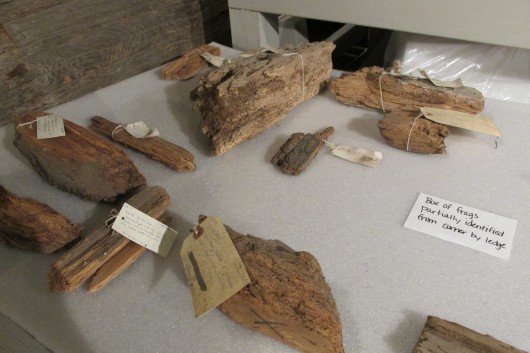
Fragments await cataloging. Many have fading, 40-year-old labels. (Photo by Maria Dudzak/KRBD)

Ketchikan Museum staff have been working to catalog, document and store totem pole fragments that have been in the museum’s collection for 40 years. The fragments can provide details lost on many of the larger poles.

Hayley Chambers is the museum department’s senior curator of collections. She said the Haida poles stored at the Totem Heritage Center came from Old Kasaan and the Tlingit poles from Tongass and Village Islands. The poles were collected in the 1960s and 70s. Fragments also were collected at that time, and pieces that have broken off the center’s poles over the past 40 years have been retained. Chambers said the fragments have been cared for at the center but never processed.

“It was an area of our collection’s care that was just in need. It was a great grant opportunity to help us address that,” Chambers said.

Fragments from the Chief Skowal pole. (Photo by Maria Dudzak/KRBD)

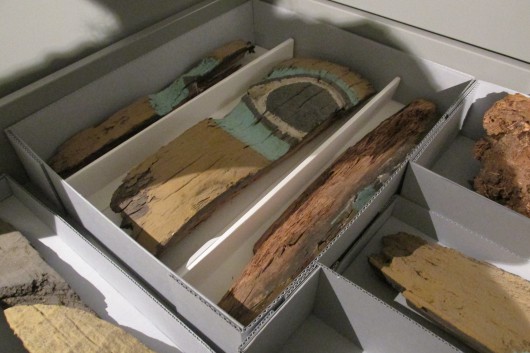
Chambers said the museum received a grant through the Statewide Museum Association and was able to purchase cabinets and archival-quality boxes to store the fragments. She said anything fully detached from the parent pole is considered a fragment.

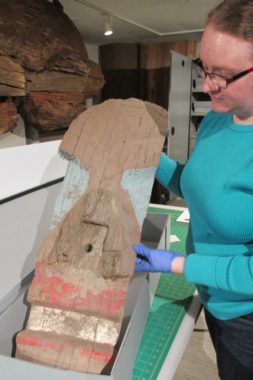
“A fragment can range in size from being a large, decorative element like a wing or a beak or a face, like this one,” Chambers said. “It can also go down to just a small sliver of wood.”

Hayley Chambers displays a fragment from the Coast Guard pole. (Photo by Maria Dudzak/KRBD)

Chambers said some pieces are unidentifiable, but many were labeled or have hints of color or carving marks that indicate they came from a larger piece. She said fragments are important because many show details no longer visible on most of the larger poles.

“It’s exciting to see what the pigment had looked like originally,” Chambers said. “I think things like that help to provide that visual for people …. A lot of that detail on older poles has been lost over time just as they’ve been outside and weathered and aged.”

Chambers said one of those poles is the Coast Guard Pole carved in the late 1800s. The pole came from Village Island, was moved to the Coast Guard Base on Annette Island and then transferred to the Totem Heritage Center in the late 1960s. Chambers said a found fragment was labeled, possibly at the time of collection, so the staff was able to match it to the proper pole.

“The pole today has no paint that’s really visible. There are some faint remnants of red paint (toward) the face of it,” Chambers said. “When we were unpacking our totem pole fragments, we found a large piece and it still has paint on it and it’s fairly vibrant paint. It’s red, blue and white paint. It’s really exciting to see that.”

Chambers said other fragments illustrate a carver’s unique signature and style. She said smaller, detached pieces also provide information on how different poles were constructed and assembled.

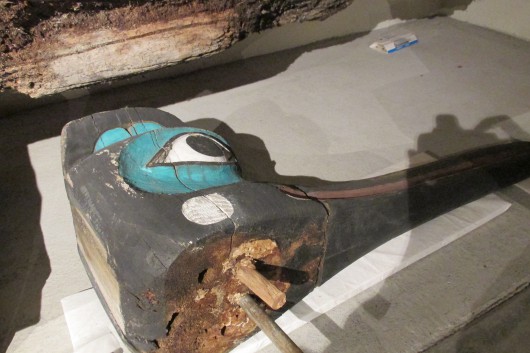
“Wings and beaks especially have had different methods of having them attached,” Chambers said. “Some have used bolts. Some have wooden pockets where pieces slide in and connect that way. Also, repairs are kind of interesting because repairs have changed quite a bit over time.”

A large fragment from the Chief Kyan Totem Pole showing a metal rod repair. (Photo by Maria Dudzak/KRBD)

Chambers said the museum has a few poles and fragments that show repairs using metal rods, a practice not done today. She said it’s interesting to see how conservation methods have changed over time.

Museum staff members have been helping to catalog and process the fragments. Administrative secretary Tara Hofmann said she knew Chambers needed help, but also is interested in any project where she can learn more about artifacts.

“It was also just very interesting to see what can happen to a totem pole and that we need to take care of them in every way, shape and form that we can,” Hofmann said. “Otherwise, we end up with pieces like this if we are not being as careful as we can in conserving those poles.”

A data sheet is filled out for each piece which is given a unique identification number. If possible, pieces are cleaned, but many are too fragile. Some are stored in clear archival bags while others are placed, unwrapped, in archival boxes. Hofmann said each piece is photographed and measured, and detailed descriptions and conditions noted. She said describing a piece can be difficult.

“I can talk about the color, I can talk about the strand trying to fall off here, the shape, where it points at one end and thickens on the other end,” Hofmann said. “But, unless there’s any sort of real carving or decoration, it’s basically just describing a piece of wood the best that you can.”

Chambers and Hofmann say they have processed most of the more than 100 fragments and plan to complete the project soon. Chambers said she is writing up cataloging and storage procedures so that the process can continue in the future.

The Totem Heritage Center is celebrating its 40th anniversary, and most of the fragments have been in storage that long. Chambers said it was a goal to give fragments the care they need and proper storage during this anniversary year.

Site notifications
Update notification options
Subscribe to notifications