History

Massive Structure Found ‘Hiding In Plain Sight’ At Ancient Site Of Petra

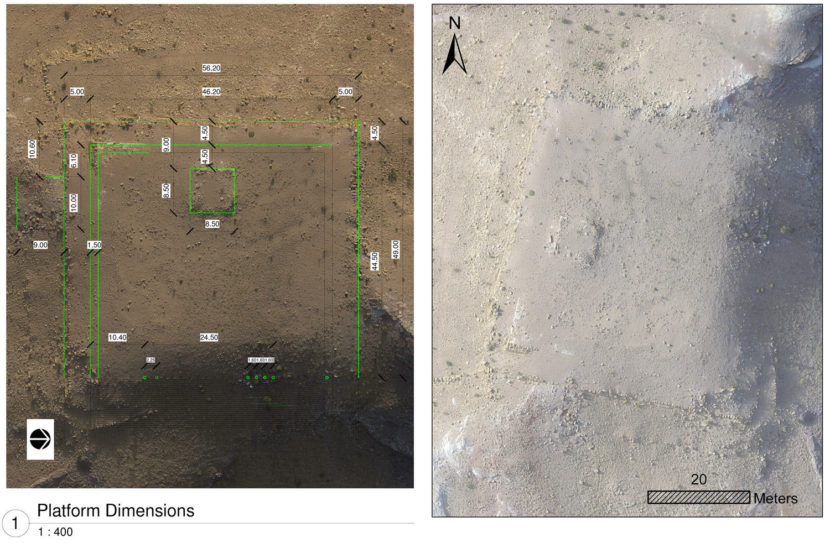
This composite of drone images shows architectural details and measurements (left) and a close-up view of a monumental structure near the center of Petra in Jordan. I. LaBianca/Graphics by J.Blanzy
This composite of drone images shows architectural details and measurements (left) and a close-up view of a monumental structure near the center of Petra in Jordan.
I. LaBianca/Graphics by J.Blanzy

Using Google Earth, satellite imagery and drones, researchers have discovered a monumental structure amid the world-famous ruins of Petra, Jordan.

It was apparently “hiding in plain sight” — a structure the size of an Olympic-size pool “just south of the city center, and archaeologists have missed this for 150, 200 years,” researcher Sarah Parcak tells The Two-Way. The area sees huge crowds of visitors, with half a million tourists descending on Petra annually.

The massive structure’s use remains a mystery, says Parcak of the University of Alabama, Birmingham. “We know it’s large, it’s significant, it’s important. It probably would have had some kind of a public function. … Could it be used for religious purposes? Was it some sort of public administrative structure? I wish I knew.”

Petra, a UNESCO world heritage site, is famed for its breathtaking structures cut directly into rose-colored rock faces. You might also recognize it as the setting of the climactic final scenes of Indiana Jones and the Last Crusade.

Sun peeks out of rain clouds to light up the famous monastery in Petra, Jordan. Sam McNeil/AP
Sun peeks out of rain clouds to light up the famous monastery in Petra, Jordan.
Sam McNeil/AP

Fittingly, Parcak has been called a “modern-day Indiana Jones.” She’s a space archaeologist, and as NPR has reported, she “uses satellite imagery to track looted ancient burial sites and find pyramids hidden under Egyptian cities.”

Parcak explains the Petra project to The Two-Way:

“When we started this project, the idea was to apply very high-resolution 0.5 meter, which is a foot and a half, satellite imagery to look for potential new features at Petra, just because it had never been done before.

“And we thought that maybe we’d find some small stone structures or roads, but we didn’t think at all that we would find anything large, just because Petra is a world heritage site and it’s been worked on intensively for nearly 200 years.”

When imagery of the large structure popped up, she “actually dismissed it initially.” But it was interesting enough to pass along to her colleague working on the ground in Petra, Christopher Tuttle, who found foundations and column bases at the site.

The structure itself comprises a small platform surrounded by a large rectangular platform. The smaller platform likely had a row of sandstone drum columns, and has a tiny structure on it measuring about 27 square feet — but the structure’s condition won’t be known until it’s excavated.

Parcak says the overall structure has no parallels in Petra: “In terms of the size of the structure, its shape, its orientation, where it’s located, there’s nothing else like it there.”

The researchers think it was built “when Petra was flourishing as the capital city of the Nabataean kingdom, possibly as early as the mid-second century B.C.E.,” as they wrote in a newly published paper in the Bulletin of the American Schools of Oriental Research.

As the paper says, the discovery has provoked numerous questions about its functions:

“The amount of effort to construct the site was massive, yet the focal building itself is quite small. The platform is located relatively close to the ancient city center but in a spot where easy access from the city center is not readily apparent.”

Some of the mystery might be cleared up during excavation, which Parcak says they are thinking of doing over the next couple of years.

Copyright 2016 NPR. To see more, visit http://www.npr.org/.

Fossils Suggest That Island Life Shrank Our ‘Hobbit’ Relatives

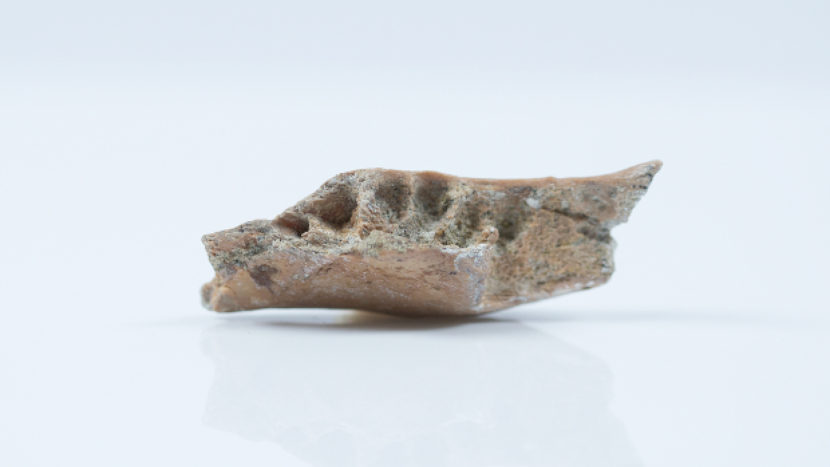
Among the hominin fossils found at the Mata Menge site on the Indonesian island of Flores was part of a lower jaw. Kinez Riza/Nature
Among the hominin fossils found at the Mata Menge site on the Indonesian island of Flores was part of a lower jaw.
Kinez Riza/Nature

It’s easy to think that evolution led inevitably to modern humans, the cleverest of apes. But there were some strange excursions along the way. Take, for example, the Hobbits.

That’s the nickname for a 3-foot-tall human relative that once lived in what is now Indonesia. A new discovery suggests that it was island life that created this dainty creature.

A reconstruction of Homo floresiensis by Atelier Elisabeth Daynes. Kinaz Riza/Nature
A reconstruction of Homo floresiensis by Atelier Elisabeth Daynes.
Kinaz Riza/Nature

Anthropologists first found the bones of the Hobbits in 2004 on the island of Flores. Their scientific name is Homo floresiensis.

They were chimp-size, with tiny brains and long arms, but they had stone tools and teeth much like ours. They lived about 60,000 years ago. Who were they? One idea had it that larger human ancestors from Africa — likely Homo erectus — ended up on this island. Then they shrank, because on islands, animals sometimes evolve to become smaller. But up to that point, there was no evidence that this “island dwarfism” applied to human ancestors, and people had a hard time accepting it.

“For some reason,” says Aida Gomez-Robles, an anthropologist at George Washington University, “when we saw that the same thing can happen to us, to humans, this is when people started to think, ‘Oh, my God, this is not possible.’ ” In fact, some scientists believed Hobbits were just modern humans with some abnormality, like microcephaly, that changed their head shape and made them smaller.

Scientists have now found more tiny, Hobbit-like bones on Flores. Some teeth and part of a lower jaw. Shockingly, the bones date back 700,000 years — way older than the first Hobbits and predating modern humans by hundreds of thousands of years.

Gerrit van den Bergh from Wollongong University in Australia says clearly, this was a long-standing population of very different human relatives.

“Human diversity could have been far greater than we have ever realized,” he says. Writing in the journal Nature, van den Bergh suggests that ancient human ancestors, probably Homo erectus, traveled from Africa to Asia. They reached this island, perhaps carried by a tsunami. He notes that the tsunami in Indonesia in 2004 did something like that.

“A week after that event,” he says, “several people were picked up out from the sea, some floating 60 kilometers from the coast, and they were just clinging to a tree.”

Once the Hobbits got to Flores, van den Bergh surmises, island dwarfism set in — they slowly got smaller. Scientists found fossil elephants on the island that also did that over time.

Despite their small brains, the Hobbits were smart enough to make stone tools. But Adam Brumm from Griffith University in Australia says they didn’t seem to get any smarter.

“This technology, whatever it was used for, essentially stayed the same for hundreds and hundreds of thousands of years on this island,” he says, “which is intriguing to say the least.”

Clearly, their kind lived long, but ultimately did not prosper.

Copyright 2016 NPR. To see more, visit http://www.npr.org/.

How Hawaii is setting an example for Tlingit language learners

Celebration kicks off in Juneau Wednesday. The biennial event brings together tribal citizens from across Southeast Alaska by plane, ferry, and even canoe for a four day a heritage festival.

Celebration is also a major gathering point for Native language speakers. Three sessions will be held throughout the week for Tlingit, Haida, and Tsimshian languages. One of the guests, Xh’unei Lance Twitchell, will be flying in from Hawaii.

Twitchell has been in Hilo, Hawaii since May. And he’s renting a room from Larry Kimura, the “godfather” of the Hawaiian language revitalization.

“It’s a very Hawaiian landscape. Very lush. It’s been raining quite a bit here,” Twitchell said over the phone.

The rain is not all Hawaii and Southeast Alaska has in common. Their indigenous languages were threatened by territorial legislation and English-only education policies in the 19th century. Twitchell estimates there are only 50 fluent Tlingit speakers left. A lot of them are over 70 years old.

“We want a simple mathematical equation: we make more speakers than we lose,” Twitchell said. “If you are not making new speakers, the language is going to die.”

Hawaii was in the same situation 40 years ago. So, Kimura and other supporters mobilized to build language medium schools, where students learn everything in Hawaiian.

It began with a preschool, then K-12 schools and in 1997, the University of Hawaii at Hilo created the College of Hawaiian Language, called Ka Haka ‘Ula o Ke’elikolani. All told, the system has 4,000 students — that’s 4,000 new speakers.

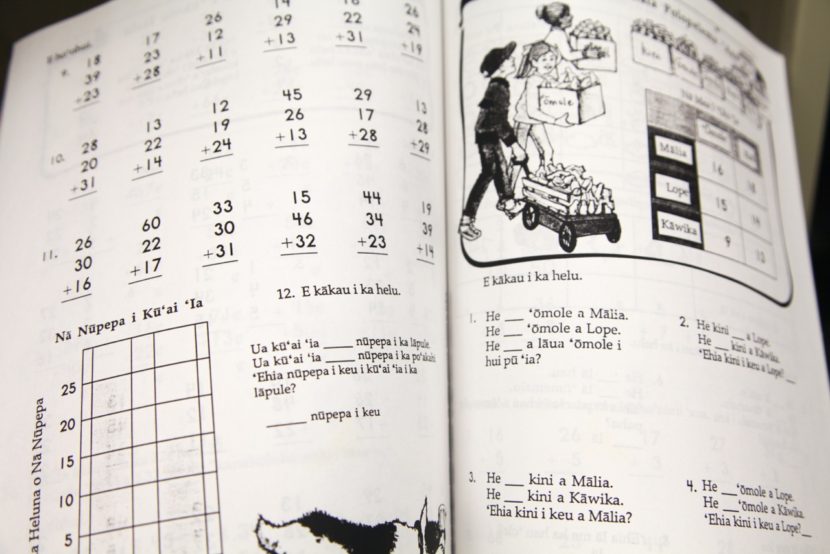
Hawaiian language curriculum. (Photo courtesy of Lance Twitchell)

Twitchell went to Hawaii for a doctoral program and he’s dedicated to replicating language immersion concepts in Southeast and to building schools for teaching Lingít.

“I think we have a very colonial structure, where in a lot of rural communities you’re bringing in teachers from outside of Alaska who don’t have any knowledge of Alaska people and I think Alaska Natives end up with a 50 percent graduation rate,” he said.

And in Hawaii? The graduation rate at Nawahi, a P-12 language medium school south of Hilo, is 100 percent. Twitchell first toured immersion schools in Hawaii in 2011. At one of the schools, he walked through the classrooms and to the gardens out back, where he found kids who knew the Hawaiian names for all the plants.

“That was a life changing moment to see that,” Twitchell said. “To see about 200 kids who were all fully fluent in Hawaiian, who were all using Hawaiian in this environment.”

As an English speaker, Twitchell had to keep quiet to protect the space.

“Which is the situation we want,” he said. “You want a realization that you can create an indigenous place where English becomes the foreign language and English becomes the language not of power, but indigenous language is the language of power.”

Just like in Hawaii, Twitchell wants to start with a preschool — “a language nest” for children ages 3-5 where they can learn and play in Tlingit.. The staff would include two fluent speakers, a teacher’s aide and lead instructor Mary Folletti.

Folletti was especially proud when her daughter began understanding colors. In Tlingit, the word for “blue” is translated as “the color of a blue jay.” Two-year-old Enza pointed that out to her mom and said:

“‘I wonder where “s’oow” is?’ And s’oow is the color of jade. So she does things like that that make me smile and proud of the way she’s thinking.

The preschool’s primary source of funding comes from the Central Council of the Tlingit and Haida Indian Tribes of Alaska. The delegation pledged $250,000 to the language department, though it will be up the executive council to determine how much of that will be allocated to the language nest. The project has a big fan in Paul Ongtooguk, an assistant professor at the University of Alaska Anchorage.

“If you become a fluent speaker of a language that’s in stress, you’ve become this crucial part of a bridge for the next generation,” Ongtooguk said.

He points out that Bethel has had a language immersion program since the 1970s, but the district has faced pushback from the state to prioritize English instruction over Yup’ik for standardized testing purposes. Ongtooguk said there’s an attitude among some educators that learning a Native language will hold students back.

“They’re of the view that in order to learn English you have to eradicate the Alaska Native Language for these students,” he said. “It’s a very bizarre thing. But it’s a part of American history, right?

Folletti said she’s heard the same argument and would have believed it, until she spoke to the educators in Hawaii. They said:

“‘We have 80% of them going off the college. Some are staying here. A lot are coming back and becoming teachers in the schools.’ So that right there is evidence to me you can’t have that argument. That it does work.

Eventually, Central Council wants to create a K-12 school with funding from the Bureau of Indian Education. But for now, teachers like Folletti and Twitchell are focusing their energies on the youngest speakers to bring Lingít back from the brink.

Correction: A previous version of this story identified Larry Kimura as the “grandfather” of Hawaiian language revitalization. He is actually considered the “godfather.” We’ve updated the story.

Live television coverage of Celebration on 360 North and 360north.org begins at 6 p.m. Wednesday. Celebration coverage continues from 9 a.m. to 10 p.m. through Saturday. For more Celebration news coverage, go to ktoo.org/celebration.

Hundred-year ‘treasure’ of Alaska history and culture opens in Juneau

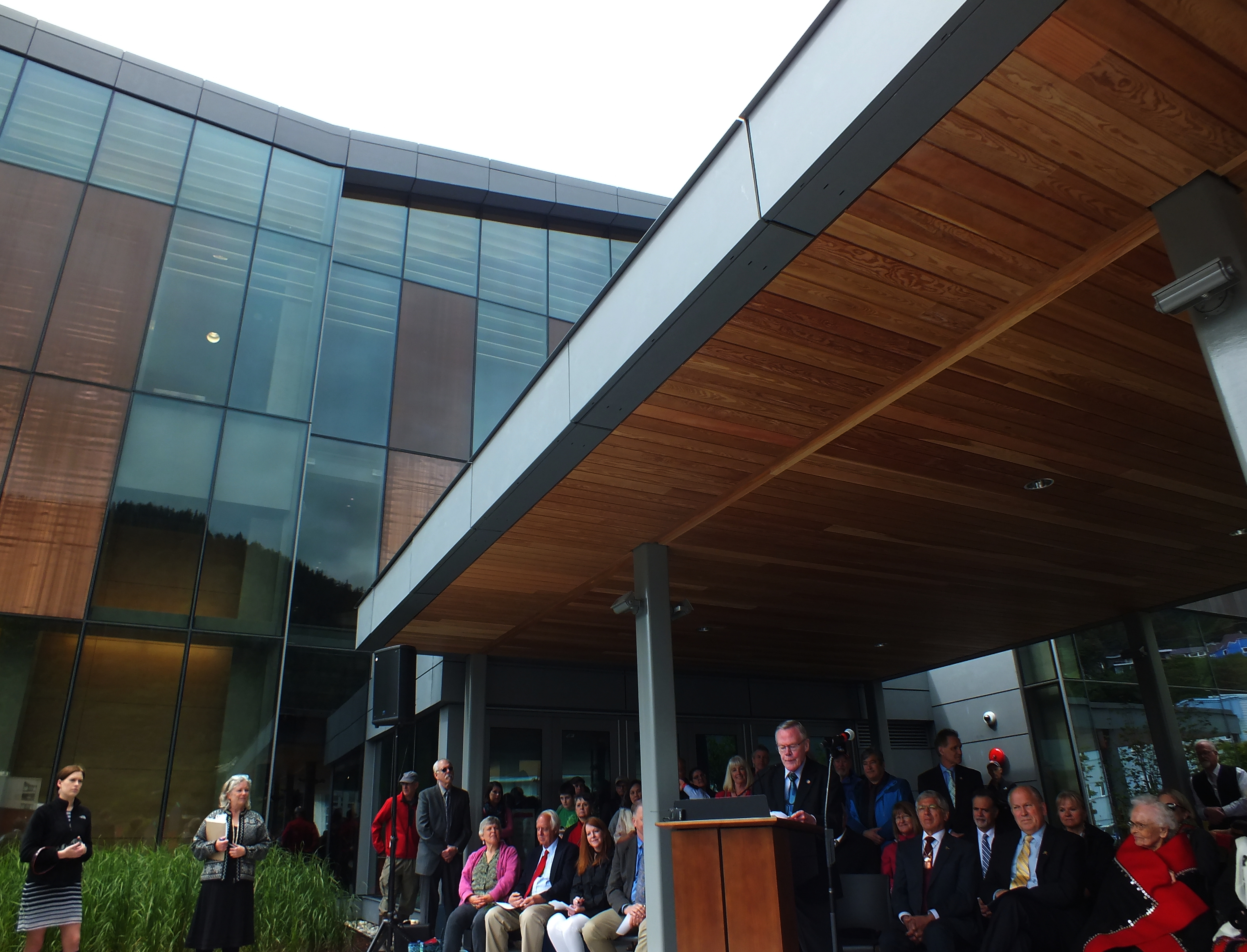
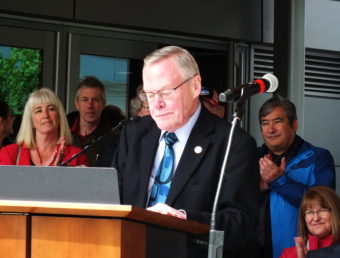
Juneau Sen. Dennis Egan addresses a crowd during grand opening of the Father Andrew P. Kashevaroff Library, Archives and Museum on June 6, 2016.
Juneau Sen. Dennis Egan addresses a crowd during the grand opening of the Father Andrew P. Kashevaroff Library, Archives and Museum on June 6, 2016. (Photo by Matt Miller/KTOO)

The new Father Andrew P. Kashevaroff Library, Archives and Museums is now open, and just in time for Celebration 2016, Southeast Alaska’s regular event of Alaska Native dance and culture.

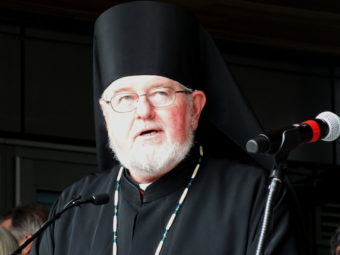
Monday’s ribbon cutting and grand opening of the downtown facility featured Kashevaroff’s great-grandchild. Mary Purvis described how Father Kashevaroff, a Russian Orthodox priest and original curator of the territorial library and museum in Juneau, was especially careful about being accurate while documenting Alaska’s culture and history.

“Grandpa Kashevaroff cared deeply about getting things right when the museum and library first started, he would be so pleased to know that the State of Alaska still cares about getting it right with this amazing new facility,” Purvis said.

Listen to the broadcast version of the story:


Planning for the new facility started long before 2002 when the State of Alaska purchased the property behind the old Alaska State Museum in downtown Juneau. The former museum, the library and historical collections located in the State Office Building, and the former archives were all running out of space. In addition, the archives building was literally splitting in half. State officials determined that consolidating all of the facilities into one building would be more efficient and help with the preservation of important Alaska artifacts and documents. The new facility was widely known as SLAM, or State Library, Archives and Museum until the legislature formally named the facility in 2015.

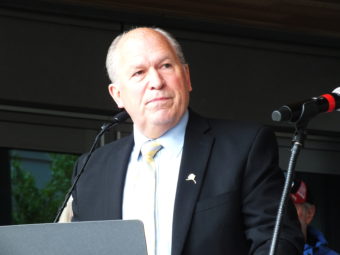
Gov. Bill Walker called it a “phenomenal” building and a “treasure.” He credited those who had the vision to create the $139 million facility when oil prices were still high.

“One thing I do say about this building: timing is everything. It was really good timing on somebody’s part. We can afford to cut the ribbon,” Walker said to laughter from the audience. “I applaud those who had the vision of this day, and they let nothing stop them.”

The project included construction of a new artifact vault and the transfer of artifacts. The old museum was demolished. The new facility includes administrative offices and public spaces.

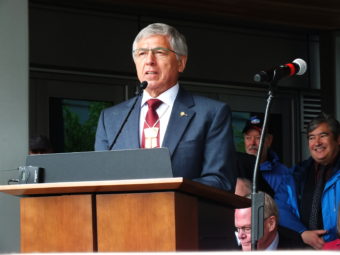
The SLAM building is expected to last a hundred years. Lt. Gov. Byron Mallott said it celebrates Alaska’s future and the vision and achievement of Alaskans.

“In coming days, we can celebrate both collectively, symbolically, and really when we say Alaska can build the most beautiful edifices, we can build the most incredible future, and we can do it together as this building is so emblematic of.”

Juneau Sen. Dennis Egan thanked governors and lawmakers from both sides of the political aisle and from outside the Capital City for their efforts in advocating for the 118,000 square foot facility.

“It took from 2002 to 2014, 4 governors, 2 senators, 6 representatives,” Egan said as he started listing off the various public officials. “Hey, it’s a big building!”

Marc Luiken, commissioner of the Department of Transportation and Public Facilities, said over half-a-million man hours of work went into the facility’s construction over the last three years.

“I think God has already provided some providence in the fact that they were able to do that without one lost time injury,” Luiken said. “That is huge for a project like this.”

Harborview School students in the Tlingit Culture, Language and Literacy program sang and danced, and – as the building is intended to benefit all future generations of Alaskans – they were given the honor of cutting the ribbon. The doors were then opened for the museum for those who attended the ceremony.

Tlingit elders Rosa Miller and Marie Olson kicked off Monday’s event by welcoming everyone to Áak’w Kwáan land.


Tlingit artist protests auction of Native artifacts in Paris

Haida mask. (Photo courtesy of the company Eve)
A Haida mask that went to auction in Paris. (Screenshot)

The Paris auction, orchestrated by the company Eve, wasn’t just about selling old relics. Members of the tribes whose ancestors made these artifacts say they are living beings and the spirits of their ancestors are inside of them.

Crystal Kaakeeyáa Worl was in Paris selling her own artwork when she heard about the auction. Worl, her brother and the owners of the gallery hosting them joined a crowd of about 20 people at the auction house to protest.

Worl said she was allowed to sit in on the auction but was warned she would be removed if she made trouble. She said she wouldn’t and sat down.

“For me to be in that room and see the items, I couldn’t get up close to them, I couldn’t touch them, but to see them from a distance and to let them know that I was there before they went into these private collectors’ homes  — that was meaningful.”

Worl said these sacred objects were made to identify clans and to document their history; they’re still used in special ceremonies today. She believes they are living people.

“Specifically, the Tlingit people, we don’t have a word for art. For our objects that were used for ceremony and objects that were sacred we called at.óow, which is our sacred objects, which the auction was selling a lot of those items,” Worl explained.

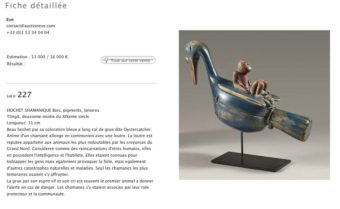
Chuck Smythe is the director of the Culture and History Department at the Sealaska Heritage Institute. He found about 10 Tlingit and Haida artifacts that were put on the auction block. A Tlingit piece was near the top of his stack of printouts. Smythe said it’s a shaman’s rattle.

Tlingit shaman's rattle.
A Tlingit shaman’s rattle that went to auction in Paris. (Screenshot)

“It’s item number 227,” Smythe said. “It was used in the past and continues to be used today as items which brings spirits to ceremonies, particularly helping spirits that benefit people.”

Smythe said, at auction, objects like the rattle typically sell anywhere between tens of thousands and hundreds of thousands of dollars. He’s heard of a war helmet that sold for just under $3 million. These objects may be sacred to Worl and tribes throughout America but, Smythe said, to collectors they’re just pieces of history, and the tribes who made them are dead and gone.

“They’re not aware of the living cultural communities that still use these items and have used them continuously,” Smythe said.

Smythe said, he remembers one instance when a foundation bought a number of Native American artifacts at auction in Paris and then returned them to the tribes. But, he said that was “highly unusual.”

As for international repatriation, he said the United Nations’ Universal Declaration of Human Rights has provisions to protect cultural property. But he said it is weak on enforcement.

In the United States, it’s illegal for federally funded museums, agencies and schools to sell sacred Native American objects. The Native American Graves Protection and Repatriation Act or NAGPRA requires sacred objects be returned to the tribes when they ask for them. The law doesn’t apply to private collectors and it doesn’t mean anything in France.

“What I learned in France is the only way we could withdraw or stall an item from being auctioned is to provide some kind of hard evidence for them that the item was stolen,” Worl said.

Worl said an Acoma Pueblo war shield was proven to have possibly been stolen and it was removed from the auction. As for the Tlingit at.óow, the fact they were in Paris was all the proof she needed.

Acoma Pueblo war shield.
An Acoma Pueblo war shield that may have been stolen was pulled from the Paris auction. (Photo courtesy of the company Eve)

“We would never sell an object like that. That is evidence that these were stolen items,” Worl said.

But that argument probably wouldn’t fly in French court. Worl said the auction house never responded to requests from around the U.S. to halt the auction and it didn’t acknowledge the protesters.

She believes the best way to prevent more Native artifacts from being sold abroad is to teach people about Native culture and explain how important their sacred objects are to them. She said that’s one of the reasons she protested.

“Maybe one of the buyers that was there that saw us, maybe they will decide to return the item they bought to the right community,” Worl said.


Women met the Pope in Rome to discuss female priesthood

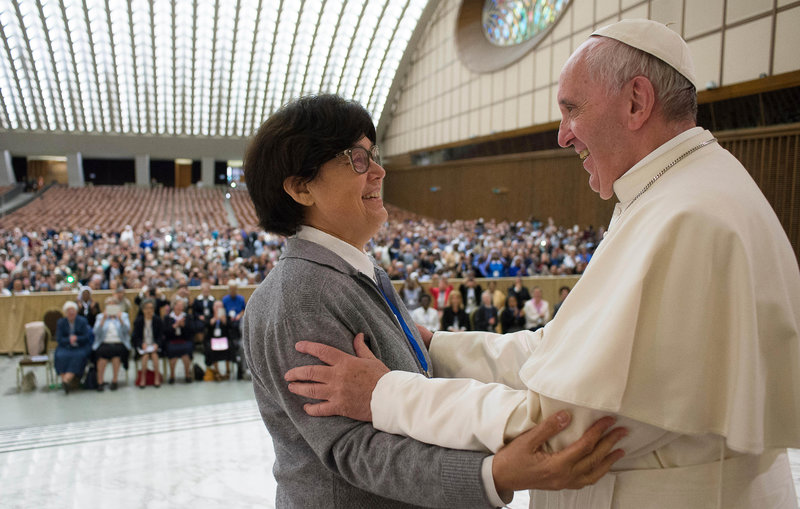
Pope Francis hugs Sister Carmen Sammut, a missionary sister of Our Lady of Africa, at the Vatican on May 12. The pope said he was willing to create a commission to study whether women can be deacons in the Catholic Church, signaling an openness to letting women serve in ordained ministry currently reserved to men.
(Photo courtesy of the Associated Press)

All across the Mediterranean, early Christian frescoes and bas reliefs carry the names of women deacons and even bishops — such as Phoebe, Helaria, Ausonia, Euphemia and Theodora.

Yet in 1994, Pope John Paul II not only decreed that women are definitively excluded from the priesthood, he even banned all discussion of the topic.

Pope Francis broke that taboo last month when he announced he would create a commission to study whether women can serve as deacons as they did in early Christianity.

Seizing this new sign of openness, supporters of a female priesthood converged on Rome this week, to coincide with the Vatican’s Jubilee for the all-male clergy.

Marinella Perroni, a theologian and New Testament scholar who teaches at a Pontifical College in Rome, was one of the participants on a panel. She recalled that John Paul’s 1994 edict even urged students to report errant teachers.

“In Rome, several professors were denounced to the congregation of the doctrine of the faith,” she said. “This had immediate consequences on their right to teach and it led to paralysis.”

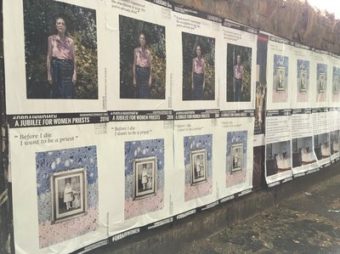
Posters touting the Women Priests Project along a wall.
(Photo by Sylvia Poggioli/NPR)

Father Tony Flannery, whose support for women priests was one reason the Vatican suspended him from public ministry, also took part in this week’s discussion. He rejected the claim that since Jesus’ disciples were male, only men can minister the sacraments in persona Christi,or “in the person of Christ.”

“Now that is such a ridiculous argument,” he said. “In fact, that argument has its rightful place back at the time of the flat earth and the persecution of Galileo.”

Panelist Jamie Manson, columnist and book editor at the National Catholic Reporter, said a female priesthood would be an important signal in a world where women suffer disproportionately from violence, poverty, lack of education and trafficking.

“Imagine if a church of one billion people, with this charismatic, rock star pope, suddenly said to the world, that women are equal to men,” Manson said. “Imagine the power that would have over cultures across the world, where this patriarchal idea of women’s subservience to men is at the root of all that women suffer globally.”

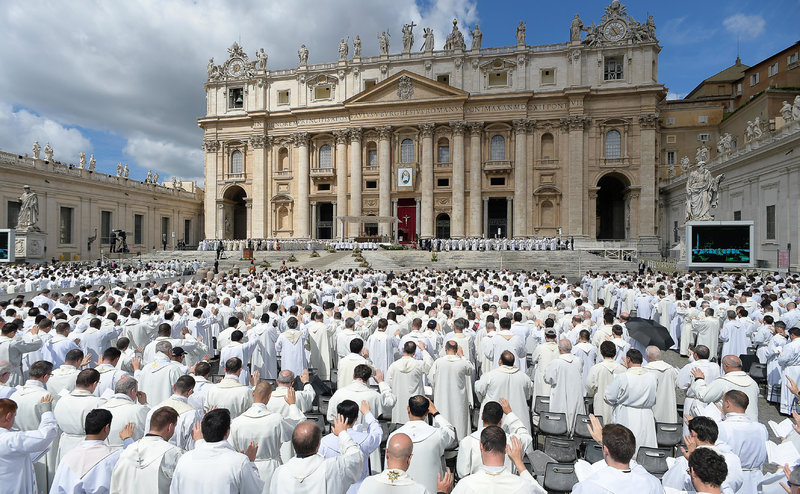
Pope Francis celebrates a Jubilee Mass for priests in St. Peter's Square at the Vatican on Friday.
Pope Francis celebrates a Jubilee Mass for priests in St. Peter’s Square at the Vatican on Friday.
(Photo courtesy of the Associated Press)

The next day, the organizers of the unofficial jubilee of women priests gathered in the shadow of St. Peter’s dome in their first official public demonstration in this city.

There are some 150 women worldwide who function as priests, in defiance of the Catholic Church. They perform baptisms and weddings and celebrate mass in house churches.

But after Pope Benedict issued a decree in 2010, all those women were automatically excommunicated from the church.

Some of those pioneering women priests also came to Rome this week, and they scored another first.

Janice Sevré-Duszynska, who was ordained by a bishop in Kentucky in 2008, says she and another woman were received by an official in the Secretariat of State, one of the Vatican’s top departments.

“We talked to a wonderful priest, we were able to give our letter to Pope Francis, our petition to lift our excommunciations and stop all punishments against our supporters as well as begin a dialogue with women priests,” she said.

While we spoke, police officers approached. A policewoman in civilian clothes asked, “You’re here to promote the role of women in the church? To let women become priests like men? Put them on an equal footing?”

When asked what she thought about this, she laughed and said, “Oh, I’m just a police officer.”

But it does seem the policewoman went out of her way for this group. She and her men escorted the protesting women all the way into St. Peter’s Square, where Pope Francis was preparing to celebrate mass for thousands of ordained male priests.

Site notifications
Update notification options
Subscribe to notifications