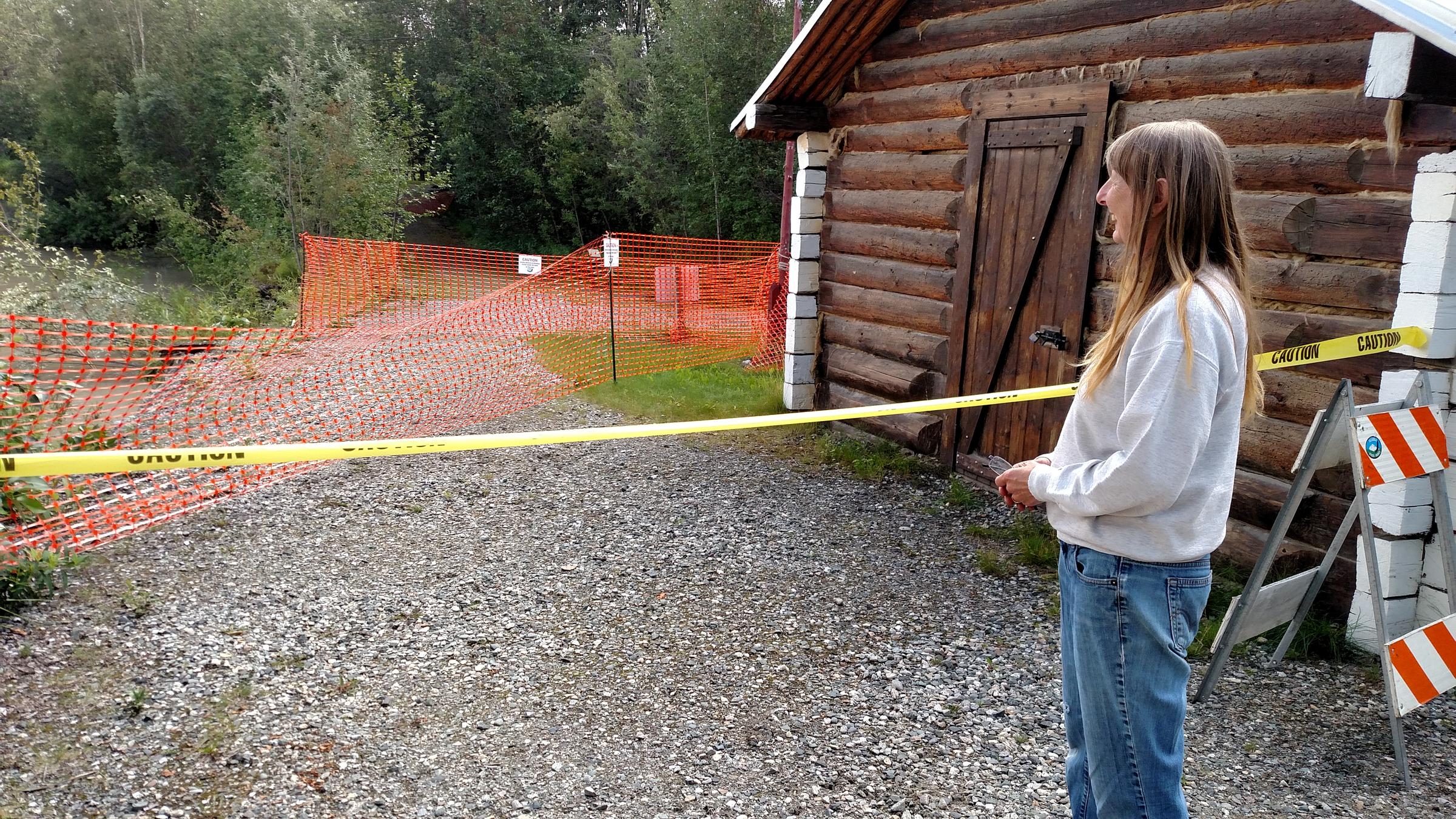
Delta Historical Society President Maureen Gardner watches the Tanana River, which is eroding its bank and threatening the old Telegraph Station living quarters. (Photo by Tim Ellis/KUAC)
Volunteers with Alaska State Parks and the Delta Historical Society have removed artifacts from a 110-year-old building at Big Delta State Historical Park. The agencies had planned to wait, to see if the Tanana River washed away more of the riverbank on which the building sits. But Sunday’s move was prompted by concerns over erosion accelerated by recent rains.
Delta Historical Society President Maureen Gardner said the group decided late last week to not wait for the erosion to cut to within 5 feet of the old structure that served as a living quarters for Signal soldiers a century ago. She said they decided instead to remove artifacts from the cabin-like structure as a precaution, before the rapidly eroding riverbank that’s now about 13 feet away creeps even closer.
“We got to the point where we just decided it was just best to take it, and get it out here right now,” Gardner said.
“We were highly concerned about how close the river is getting to the building, and how much erosion has occurred,” she added.
Gardner said before they moved the artifacts, volunteers photographed how they were arranged so they can rebuild the displays that depict the everyday life of the soldiers who operated the Washington-Alaska Military Cable and Telegraph System, or WAMCATS, from 1907 to 1926.
“The membership of the Delta Historical Society, at our meeting on Thursday, decided to get it out right now, and not have to worry about having an emergency situation and jeopardize the integrity of all the historical artifacts,” Gardner said.
Gardner said society members will now inventory the artifacts that are stored on the second floor of Rika’s Roadhouse, the main attraction at the park about eight miles north of Delta Junction. She said the erosion also threatens a stretch of trail that runs along the river. State Parks has barricaded about 300 feet of the trail, and Gardner said a local Parks worker had to close a bit more over the weekend.
The Prospector’s Trail was used by gold miners around the turn of the previous century to access claims up the Goodpaster River.
“The Shushanna Gold Rush, in 1913 I believe that was – this is the trail that they used,” Gardner said.
The Prospector’s Trail intersects with the larger Fairbanks-to-Valdez Trail, the basic route along which the Richardson Highway was built.
State Parks has applied for a $700,000 federal transportation grant that would pay for erosion-proofing the bank along which the trail runs. That also would protect the historic structure. State Parks Superintendent Brooks Ludwig said he’ll know by the end of the month whether the feds will award the grant.
Ludwig said the grant will require a $140,000 local match. He said the agency can’t afford that, because of Alaska’s budget crisis, so he’s planning to launch a 30-day online crowdfunding drive on Aug. 23. He said the agency will soon begin promoting the fund-raiser.
“We’re going to have it on our Facebook page,” Ludwig said, “we’ll have it on our website, we’ll have it on our Twitter account.”
Ludwig said if State Parks doesn’t get the grant, the agency will use proceeds from the crowdfunding to pay for stopgap erosion-proofing on the riverbank and, if needed, for moving the historic structure farther away from the river.
For one family, a proposal to build a 400-bed boarding school on the site of the former Wrangell Institute boarding school, which had a history of abusing students, is stirring up bad memories.
As an Alaska Native child living in Fairbanks in the ‘50s, Jim LaBelle wasn’t the most likely candidate to be sent to the Wrangell Institute. LaBelle thinks it was his troubled family life that landed him there.
“My younger brother and I were taken to the Fairbanks Airport in 1955 by our mother with an apology saying we had to go to the school,” said LaBelle.
LaBelle, who now lives in Anchorage, said his father passed away when he was 6, leaving him under the care of his alcoholic mother.
“I think I was 8 years old then, and my brother was 6. When we got to the airport in Fairbanks, we were quickly tagged with a yellow name tag with a metal twisty tie on it that had our name, our destination, our flights,” said LaBelle.
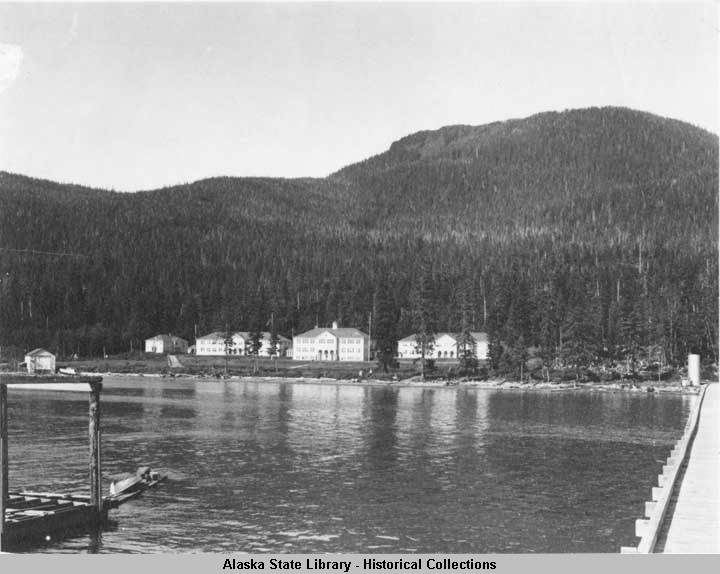
The Wrangell Institute, which opened in 1932, was one of two Bureau of Indian Affairs schools in the state. Students came from Nome, Barrow, Tok and other communities all over the state.
LaBelle said once he and his classmates arrived at the school, their heads were shaved. They were told in English to get into large, open-room showers. Staff scrubbed the children who could not bathe themselves. LaBelle said many children were confused, as they only spoke their Native languages.
“But we had each been given a set of numbers that were applied on our clothing, our sheets. We were given government issued clothes,” he said. “It doesn’t help if you didn’t remember your number. That’s how we got our mail, got our clothing washed and returned back to us.”
The BIA’s primary objective was to educate children who didn’t have schools in their villages.
Dianne Hirshberg is director of the Center for Alaska Education Policy Research at the University of Alaska Anchorage. She said others, such as LaBelle, were targeted for different reasons.
“There were a lot of students that had gone there because they were orphans, or their parents weren’t able to take care of them because of things like the tuberculosis epidemic that hit Alaska in the ‘50s and ‘60s,” said Hirshberg.
The abuses Hirshberg heard throughout her studies of U.S. Native boarding schools were numerous.
“At one point I was told about the dorm staff getting the older children to beat the younger children for speaking their language. So now you’re starting to set up a culture of violence amongst the students, not just the teachers or dorm people abusing the students,” she said. “To students being taken into rooms with adults and coming out crying without saying what happened.”
LaBelle said getting caught speaking a Native language or any other offense could lead to the belt line, one of many abusive techniques used at the institute.
“Your fellow students and friends would line up on either side of you in this row, and you were forced to run or walk through this line of students who were told to use their belts on you,” said LaBelle. “I can say I had to go through that belt line a number of times as a kid, other kids did as well. I used to witness some of that. I remember having to use my belt on other kids as well.”
But both LaBelle and Hirshberg say that didn’t happen to every child, and the conditions were better for some compared to home life in a village.
“There were people who talked about going to boarding school, including the Wrangell Institute, the first the time they got eyeglasses or had hearing problems diagnosed,” said Hirshberg. “So for some students, it was both in terms of the actual education and in terms of the other aspects of living in a structured environment, it was an improvement over where they were coming from.”
The BIA closed the Wrangell Institute in June of 1975, partially due to the Molly Hootch case. The lawsuit settlement forced the state to build schools in villages with eight students or more, decreasing the demand for boarding schools. The requirement was later increased to 10 students.
Now, 36 years later, the Alaska Native Science and Engineering Program is working with the community of Wrangell to build another 400-bed boarding school on the former Institute property. ANSEP is an accelerated learning program based at UAA that focuses on giving Alaska Native children a better shot at college success. ANSEP wants to expand from its curriculum of summer programs for children and support for UAA students.
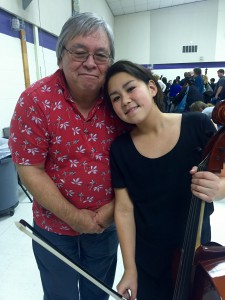
Jim and Lilani LaBelle. (Photo courtesy Marleah Labelle)
LaBelle’s 13-year-old granddaughter Lilani is part of ANSEP’s community of 2,000 students and alumni. She attended one of their summer camps earlier this year.
“My favorite part was probably making new friends. I also like making the computer. I thought that was really, really cool,” said Lilani.
Lilani said she enjoyed ANSEP’s challenging curriculum because the other kids were just as excited as she was to participate. She said she’s going back again next year.
“It’s not like going to science class and having a few people wanting to participate. They all want to be there, and they are all really smart. It makes it a lot easier and a lot more fun,” said Lilani. “Next year, I’m going to go to the acceleration academy for five weeks and start taking college courses.”
Lilani said she would be interested in attending an ANSEP-style high school. Lilani’s mother Marleah LaBelle and her grandfather agree it could be a great opportunity. But, both say the family’s history with the institute property would make the decision for Lilani to attend the school a difficult one.
“Absolutely, yeah. It would be hard, yeah. I believe in ANSEP. It’s an incredible program. It’s really about creating their future and creating opportunities for them that may not have existed before. It certainly wouldn’t be without some strong emotions,” said Marleah.
She said it could be a healing process for people like her father.
“Maybe this could be an opportunity to have more healing, more awareness. It could be a positive thing for the Alaska Native community,” said Marleah.
ANSEP is starting its first high school program in the Matanuska-Susitna school district this fall. Wrangell School Superintendent Patrick Mayer is leading a committee of borough and school officials as the process moves forward.
If the boarding school is built, Mayer said it will be part of Wrangell’s district. He said it will learn from the Mat-Su school and include the Native community in the planning process.
The Wrangell School Board, Borough Assembly and tribal government have all supported building the new facility.
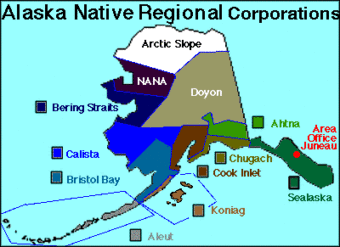
Alaska Native Regional Corporations Map. (Courtesy of the Department of Natural Resources)
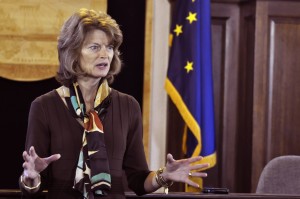
Alaska’s delegation to Congress writes bills every year to transfer or sell federal land to local governments and Native corporations. In late May, Sen. Lisa Murkowski sponsored one public land bill for Native corporations that’s particularly far-reaching — apparently more expansive than the senator intended.
Congress, in 1971 promised Cook Inlet Region Inc. more than a million acres of land. CIRI Senior Vice President for Land Ethan Schutt says the corporation is still trying to get its final 43,000 acres but all of the good, income-producing land in the region is spoken for.
“So we’re kind of fighting and scratching and clawing to find something that is reasonable and has economic potential to fulfill the 45-year-old promise made to our shareholders,” he said.
Schutt says CIRI has its eye on some federal acreage outside the region, but it needs a new law to make the government hand it over.
To help CIRI, Sen. Lisa Murkowski filed the ANCSA Improvement Act in May. The bill does a lot of things, but one section would open up vast amounts of land all over the state for CIRI to choose from. CIRI would be allowed to select land from National Wildlife Refuges and the National Petroleum Reserve-Alaska. National Parks, monuments and the Arctic Refuge would be off-limits.
Asked if there are other limitations in her bill, Murkowski thought there were. She said her bill would not allow CIRI to select from areas designated as “wilderness,” the federal category that receives the highest level of protection.
Sen. Lisa Murkowski (Photo by Skip Gray/360 North)
After further questions to her staff, a Murkowski spokesman later said nothing in the bill now would prevent CIRI from selecting wilderness, but he said the senator intends to add such limits later.
The CIRI legislation is just one part of a 12-part bill that would open up federal land for Native corporations to select, and in some cases, requires the government to convey it. One paragraph likely to attract attention would require the Interior secretary to give a small piece of the Arctic Refuge, near Kaktovik, to the Native corporation for that village.
Andy Moderow, state director of the Alaska Wilderness League, says the bill is a concern for conservation groups.
“Because of how broad the legislation is, many places that have earned protections over the years would be up for grabs,” he said.
Schutt, the CIRI vice president, doesn’t want to say yet what land they hope to obtain, but he says they are aiming for selections near other Native corporation land.
“Are we trying to engender additional controversy? Absolutely not,” Schutt said. “And we’re trying to look at areas that are potentially within wildlife refuges or NPR-A but not brand new holdings that are deep within the heart of some conservation unit.”
This isn’t the first time CIRI has tried to expand its land pool beyond the low-value land it says it was left with, which corporate lore describes as “mountain tops and glaciers.” In 1976 it won the right to select half its acreage from elsewhere in the state. Schutt, though, says that legislation has conditions that make it impractical for getting the final 43,000 acres. The 1976 law, for instance, says the secretary of the Interior must agree to give up the land CIRI selects. Murkowski’s new bill says the secretary can’t stand in CIRI’s way.
Murkowski’s committee, Senate Energy and Natural Resources, hasn’t had a hearing on the bill yet. Environmental groups are on the lookout for pieces of it that might be added as riders to other bills.
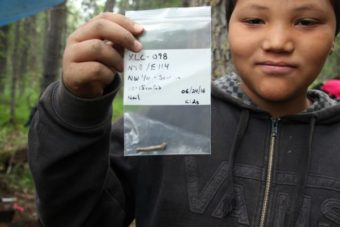
Archaeologist Randy Tedor shows kids how to sift through dirt at the “Quk Taz’Un” house site. (Photo by Hannah Colton, KDLG – Dillingham)
On the north shore of Lake Clark, there’s a place called Kijik. It’s the historic homeland of the Dena’ina Athabascans of the area, and also the site of a culture camp where youth and elders from the village of Nondalton came together last week. Dozens of abandoned homes dot the area.
“A little pushdown, flick out, and then you wanna keep going down the wall,” said Randy Tedor.
Tedor kneels in front of a 50-centimeter square of dirt. The bushy-bearded archeologist is showing a group of kids how to carefully excavate the quadrant.
“Excavation is an art,” he tells them, deftly pulling layers of soil loose.”
11-year-old Cordelle Balluta-Trefon puts down a metal detector he’s been playing with and gets to work in the dirt with a dustpan and a trowel.
After a while, Balluta-Trefon puts down the trowel and hands something to Tedor. It’s a tiny red speck.
“Good eye, man! I can’t believe you saw that” Tedor said laughing. “A little baby bead.”
That little bead, Tedor explained, is a huge clue. This type of glass bead was only manufactured in Europe after a certain date, so it helps archaeologists like Tedor figure out how old the site is. They think this house was occupied between 1840 and the 1880s.
As he explores more into the site, Balluta-Trefon said he’s getting a picture in his head, visualizing what it might have looked like when people lived here
“I don’t see people, but I just see a house. There’s a fire pit, there’s a storage room, a bedroom, that’s the front door over there,” Balluta-Trefon mused. “I’m still kinda putting the picture together.”
This curiosity is exactly what Tedor is trying to inspire; he wants the kids to wonder how people lived back then, maybe to realize that the people living on this land were, in many ways, just like us.
But like many old village sites in Alaska, this land, and its people have a troubled history.
Fur hunters and explorers from Russia started plundering Lake Clark’s Dena’ina villages in the late 1790s. Next came the Russian Orthodox missionaries, who by the 1830s were traveling around regularly to baptize and hold services in villages.
And of course, with this new contact came new diseases. Around 1900, measles and flu epidemics devastated the population at Kijik. The survivors moved down the lake to what is now the village of Nondalton, seeking better access to salmon runs and trading posts.
They left Kijik behind, along with a lakeshore full of graves and sad memories.
“They’re estimating up to 200 graves here,” said Karen Evanoff, a Dena’ina Athabascan cultural anthropologist with Lake Clark National Park. For five years she’s been working with the Nondalton Tribal Council and researchers to identify and mark the graves.
The work culminated in a blessing ceremony last summer.
“Close to a hundred people were here, and we combined the traditional way of spirituality and blessing with the Russian Orthodox way, so it was a huge celebration,” Evanoff said. “This is a healing place.”
There’s still controversy over the land at Kijik; parts of it are now owned by a Native allotment and a homesteader, who built structures on and around the church and grave sites. The Kijik Corporation has managed to buy a few acres back, and Evanoff said they hope to regain more of the land the people consider sacred.
“That’s part of the vision,” she said, “to clear this of the cabins and have some plaques here to identify who’s buried.”
Holding the culture camp here is another part of that healing process. Evanoff planned the camp along with Michelle Ravenmoon of Pope-Vanoy on Lake Iliamna
Michelle Ravenmoon (right), Nondalton elder Pauline Hobson (left) and kids sing a Dena’ina song at the end-of-camp potluck (Photo by Hannah Colton, KDLG – Dillingham)
“Of course, we want the kids to have a lot of fun and enjoy themselves and grow their self-confidence and pride,” Ravenmoon said. “But we also wanted to make sure they learn their history and their identity, where they come from, who they are.”
Each activity – from wood carving to caribou hide-tanning to language classes – is meant to help kids understand their Dena’ina culture.
“We’ve been very unsuccessful as Native people sending them out, preparing them for this outside world,” Ravenmoon said. “We give them computers, and we teach them (the) history of the United States, but we’ve taught them so little about who they are where they come from. I think it’s important for kids to know their history.”
A piece of that history lies in the ground at the archeological site, waiting for the kids to get their hands on it.
Up until recently, the archaeological site was known to scientists as “house pit XLC-098.” But Michelle and Karen were happy to share that the site is now being officially renamed: “Quk Taz’Un,” the same name as the culture camp.
It means “the sun is rising,” hopefully on a brighter future for the Dena’ina Athabascans of Lake Clark.
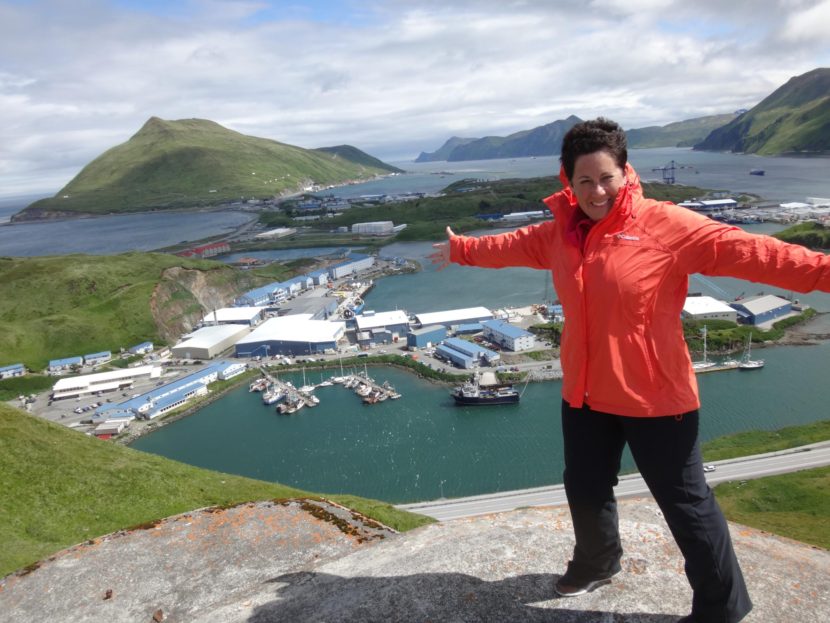
Karen Abel atop Bunker Hill. (Photo courtesy Karen Abel)
For Karen Abel, what started as learning more about her grandfather has grown into sharing the story of World War II’s Aleutian Island campaign. And it’s brought her over 6,000 miles from her home in Florida to see firsthand where he served 74 years ago.
Growing up in Winnipeg, Abel never heard about her grandfather’s service in the Royal Canadian Air Force. She didn’t know about the year — from June of 1942 to June of 1943 — Robert W. Lynch was stationed in the Aleutians as a member of the 111F Squadron.
After the war, his medals were in their living room and his uniform hung in the closet, but it’s just something the family never talked about. When he died, in 1996, she discovered his flight logs and photographs and became inspired to create a blog.
“Once I started to tell his story to other people and talk about the war in Alaska, most people had never heard about what happened here,” Abel said. “And that broke my heart that so many people were up here fighting and so many lives were effected and nobody knew their story.”
The blog grew and she began sharing the stories of other veterans of the Aleutian campaign. As a single mom with her own business, Abel cannot write every day. But, the project has blossomed into a part time job.
“Any spare chance I get I will probably be writing,” Abel said. “I have said that if I could get paid for this I would do this full time. That’s how much I love it.”
For her second trip to Alaska, Karen choose a two-week WWII historical tour through Valor Tours. It brought her from Adak, to Attu and back to Unalaska with stops in Kiska, Umnak and Chernofski.
“It’s like a living museum to go there and to see how things were,” Abel said. “And to see the guns. You get to touch them and feel them and see where they were placed in action. It’s not in a museum. It’s not behind glass. It was exactly as it was then.”
She was the first family member of a veteran to go on the trip.
“A lot of people will know about battles, they knew a lot about guns, strategy maybe,” Abel said. “I’m more interested in the effect war had on people. How people lived. Who was fighting. Who were the ones going in this brutally harsh desolate island and living and fighting.”
And the trip inspires her to keep writing.
“You know that you think this big journey might be the ending. You know, ‘Oh, I reached my goal. Oh, I made it to the Aleutian Islands.’ But for me it doesn’t feel like an ending. It feels like a beginning.”
Abel thinks her grandfather would be proud of her work.
“And he deserves to feel like that,” Abel said. “And they all deserve it. That’s why I write. They all deserve to feel proud and they all deserve to be heard.”
Her next big project is working alongside the Smithsonian Museum — in Washington D.C. — to develop an exhibit that shares the history of the Aleutian campaign. The museum is off to a good start, they already display a plane her grandfather flew.
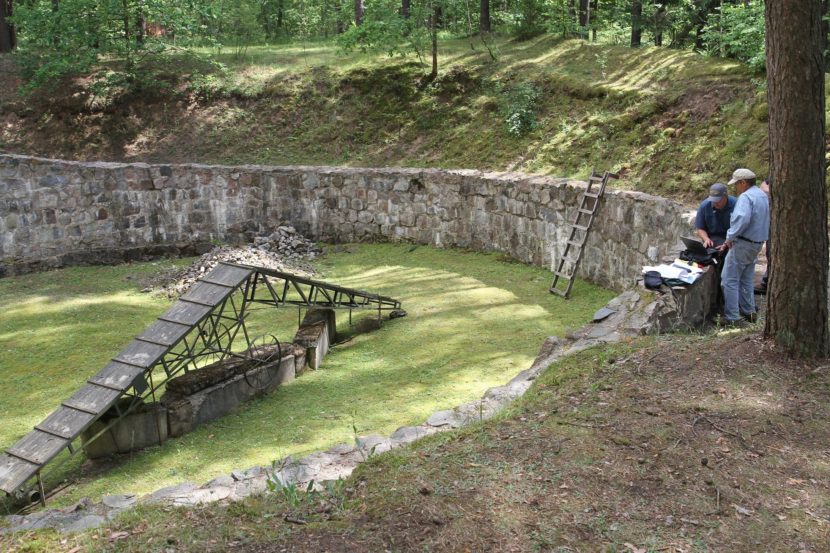
This is where the Burning Brigade was housed. The apparatus in the middle is not the original, but ones like it were used as ramps so that the bodies could be stacked high and set alight. All the pits at Ponar were originally dug by the Russians to store fuel. Ezra Wolfinger for Nova
Using advanced imaging technology, researchers in Lithuania have uncovered a tunnel that Jewish prisoners used to escape Nazi extermination pits.
By doing so, they have provided physical evidence of a well-known tale of heroism during the Holocaust — known before only through the testimony of 11 Jews who escaped.
For the past 72 years, teams have been searching for the tunnel at the Ponar massacre site, located in a forest about 6 miles from Vilnius.
“They’ve used every single normal form of exploration but the use of this noninvasive technology allowed us to go into burial pits — the areas are filled with graves — and not desecrate the gravesites,” Richard Freund, a University of Hartford professor of Jewish history and a leader of the expedition team, tells The Two-Way.
“This is one of the great stories of courage during the Holocaust that would not ever have been able to have been tracked but for the use of this geoscience,” he adds.
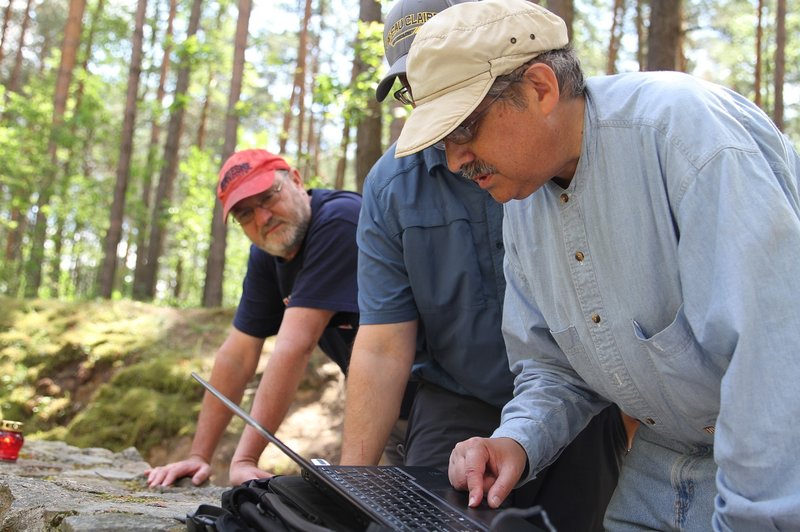
Richard Freund, University of Hartford (front); Harry Jol, University of Wisconsin, Eau Claire (middle); and Philip Reeder, Duquesne University (back), discuss where the next round of work will be conducted. Ezra Wolfinger for Nova
The extermination pits at the site hold the “remains of 100,000 people who were executed there by the Nazis, including 70,000 Jews shot and buried there from July 1941 through July 1944,” as the PBS series Nova reports in a statement.
The group of 80 prisoners who attempted to escape through the tunnel was known as the Burning Brigade. Freund explains, “They were from the local area and brought there for the most gruesome task of the entire Holocaust: These people were brought there, 80 Jews, to burn all the bodies that were there.” Russian troops were nearing the area in April 1944, he adds, and this was an attempt to destroy the evidence of Nazi crimes.
Freund says the Burning Brigade knew “in their heart of hearts that they were going to be the last victims — unless they got out.”
A civil engineer in the group came up with the daring plan to dig a tunnel out of their barracks, which was in a pit. “For 76 days, they used spoons, they used their hands, and they burned [bodies] all day and dug all night,” Freund says.
And on the last night of Passover, on one of the darkest nights of the month, they made their move. Only 11 made it out of the tunnel and through the forest to safety. They testified a year later at a crimes commission in the Soviet Union. “These people’s testimonies really are a document that now, with the physical evidence, is like solving a cold case after 72 years,” Freund adds.
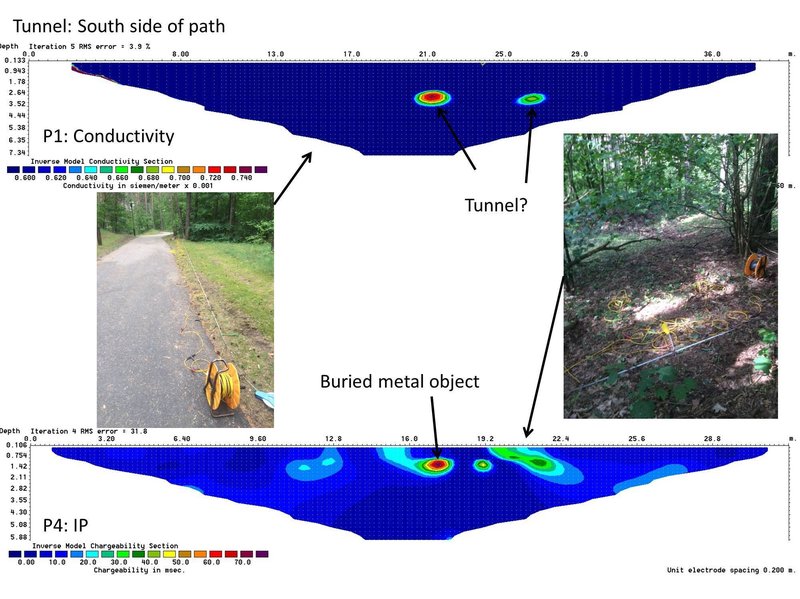
Electrical resistivity tomography image showing what the team believes is the tunnel’s “exit.” Richard Freund
The researchers used electrical resistivity tomography, which is also used in oil and gas exploration, Freund says. He describes the moment that they found the tunnel:
“It’s great working with geophysicists, because the geophysicists are very dispassionate usually. They’re sitting in the field, and these guys are generally looking for gas and oil. … They ran this section over where we suspected the tunnel might be, and they [reviewed] the results [the computer had analyzed]. And it’s there. On June 8, we’re looking at the first image of this tunnel that had been missing since the people left on April 15, 1944. And I think that everybody got a big chill.”
The tunnel, which has collapsed, was about 100 feet long and measured 27 inches by 25 inches. As Freund puts it, that’s “just about the size for an emaciated human being to slide through.”
In 1979, two Ponar survivors, Motke Zaidel and Itzak Dugin, described the painstaking, dangerous work that culminated in their miraculous escape in an interview for the film Shoah. Zaidel describes the moment he finished digging the last few inches of the tunnel:
“I started to work and I still hadn’t quite finished when there were already twenty people in the tunnel and I felt that I really could no longer, I didn’t have any more air to breathe. I had a bar of iron in my hand and I tried, I attempted to make holes in the surface of the soil and suddenly I made a hole, two holes, and finally I had air. It was then that we cut the electricity, there was electricity inside the tunnel, and when we took off … when we removed the chains and I opened the hole, I widened it and I had open air. When I stuck my head out, I already saw the sky, the stars, but I also saw a group of German soldiers who looked precisely in the direction of our tunnel.”
None of the survivors who escaped from Ponar are still alive, Freund says. He adds that it’s techniques like the ones used to find the tunnel that will most likely dominate future research on the Holocaust, after the last survivors have died.
“Science is the new frontier for studying the Holocaust,” he says. “In 20 years we won’t have survivors to ask, but we’ll have another generation of people doing serious research on the Holocaust.”
Nova was part of the excavation and will release a full-length documentary on the findings next year.
Copyright 2016 NPR. To see more, visit http://www.npr.org/.
Close
Update notification options
Subscribe to notifications
Subscribe
Get notifications about news related to the topics you care about. You can unsubscribe anytime.


 And of course, with this new contact came new diseases. Around 1900, measles and flu epidemics devastated the population at Kijik. The survivors moved down the lake to what is now the village of Nondalton, seeking better access to salmon runs and trading posts.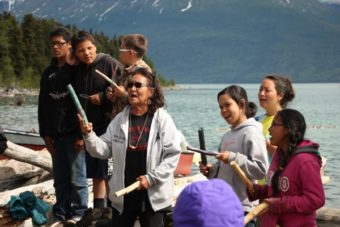
9(MDEwMjQ0ODM1MDEzNDk4MTEzNjU3NTRhYg004))