History

Alaska’s most-visited national park puts little-known Buffalo Soldiers story in the spotlight

When you think of Buffalo Soldiers, does Alaska come to mind?

Probably not.

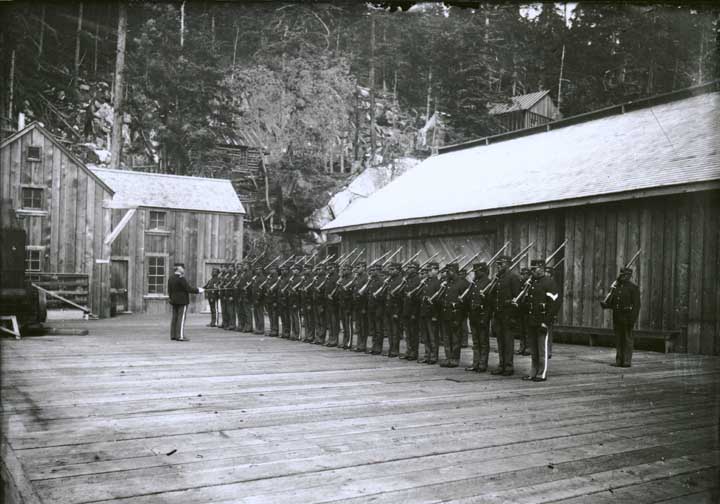
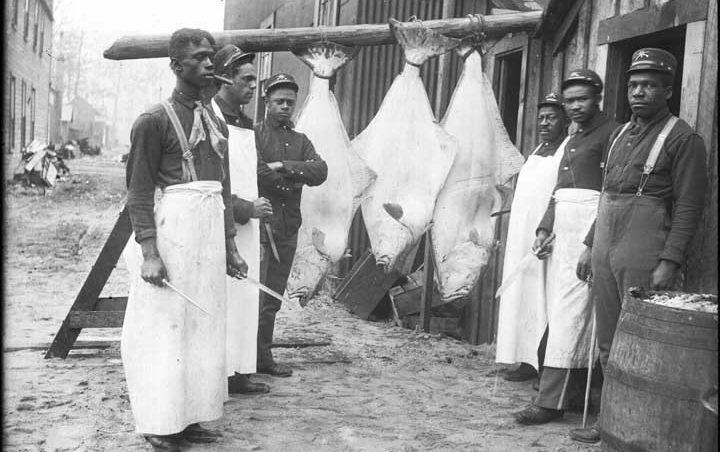
But the units of black soldiers formed in the 19th century before the U.S. military was de-segregated are a part of Alaska’s history – specifically, Skagway’s history – during the days of the Klondike Gold Rush.

It’s a seldom-told story that’s now in the spotlight.

Alaska’s most-visited national park is part of nationwide effort to make the parks relevant to an increasingly diverse America.
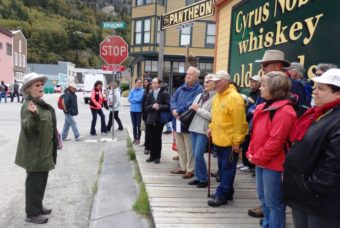
Park ranger Charlotte Henson leads a group of visitors on a walking tour of Skagway focused on the story of Company L. (Photo by Emily Files/KHNS)

“Skagway in 1898 was a pretty rough place,” said park ranger Charlotte Henson on a recent walking tour.

Henson displayed black-and-white photos of Gold-Rush-era Skagway for a couple dozen tourists.

She told the story of Alaska territorial Gov. John Brady writing a plea to the capital.

“He said to Washington, ‘the Lynn Canal is full of gamblers, thugs and loose women. Send help.’”

And help was sent.

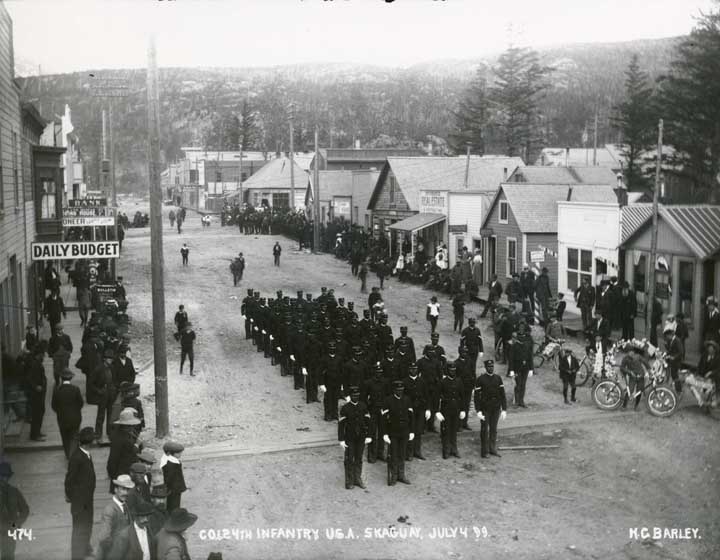
“Company L of the 24th United States Infantry was stationed here for three years, from 1899 to 1901,” said Ben Hayes, chief of interpretation for Klondike Gold Rush National Historical Park.

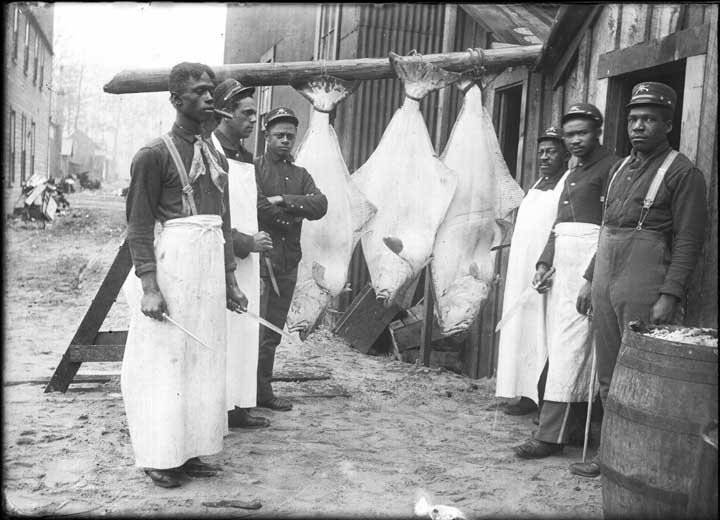
Company L was an all-black regiment sent from San Francisco to the booming mining settlement of Dyea.

A few weeks later they moved to the nearby town of Skagway.

“They lived their lives here and in many cases we found that they were not only serving their country and completing that mission as soldiers of the United States, but they were also fighting on a second front,” Hayes said. “And that was a war of discrimination and bigotry.”

Back on the walking tour, Henson leads the group to a busy street across from the historical YMCA building to tell one of those stories of discrimination.

She reads from a newspaper clipping from 1900 “It said ‘Line Drawn: Objections Arise to Colored Men in YMCA. Withdrawals Made.’”

Racial discrimination is a constant thread throughout American history.

Until this summer, that piece of Skagway’s history was mostly unexamined and untold.

Why is the story being brought to forefront now?

The National Park Service is concerned about the disparity between the people who visit parks and the American population as a whole.

Park visitors are overwhelmingly older and white.

“If we have a large segment of the country that’s growing that does not feel that national parks are important or special or for them, then that really can endanger our mission and make it difficult for us to achieve stewardship and preservation of these places for future generations,” Hayes said.

The park service has decided that to remain relevant, they have to find a way to appeal to a more diverse audience. That’s what prompted the Klondike Park to apply for a federal grant aimed at preservation of the Civil Rights Movement.

The park was the only one in Alaska to receive such a grant this year.

The $22,000 appropriation motivated Hayes to do something unusual.

Normally, the rangers who give tours get to choose what they focus on.

But this year, he required them to research and give talks about Company L – Skagway’s Buffalo Soldiers.

“I hated the idea. I didn’t feel like I had enough information,” Henson said. “And so I was kicking and screaming, I might’ve been one of the last ones to get my walk done.”

But now, Henson said she’s realized how important it is to tell this story — one that’s been relegated to background for so long.

“They helped to make our society the way it is today,” she said. “And we need to be aware that it’s just not white people that have done everything in this country.”

Unlike the Soapy Smiths of Skagway, there’s not a lot of information available about the men of Company L. Henson describes it as a puzzle the rangers are slowly piecing together.

“We don’t know what they thought about Skagway, we really don’t know what Skagway thought about them.”

Michigan resident Sharon Williams is one of about 30 people who followed along on Henson’s tour.

“I knew about the Buffalo Soldiers, I didn’t know they came as far north as Alaska,” she said at the end of the walk.

Williams is on a high school reunion cruise. She said her Virginia school was segregated until her senior year.

Williams did not expect to hear tales of Civil Rights on her cruise to the 49th state.

“I thought it was very well done and I just appreciate, she said they have to try to put the pieces of this puzzle together,” Williams said. “It’s a start.”

It’s a start: a sentiment Ben Hayes echoes.

“I think we’ve just scratched the surface,” he said.

The rangers have been working this summer to track down a living descendant of Company L in hopes that family stories will shed light on these men.

Additionally, the Klondike Park hopes to keep Skagway’s Buffalo Soldiers in the spotlight beyond this summer.

Hayes plans to apply for the same grant funding next year to continue telling visitors about this little-known piece of history.

Much more than a 5-year mission: ‘Star Trek’ turns 50

George Takei predicted Star Trek would be too sophisticated to last — but he says he's happy to have been proved wrong. (Photo courtesy of The Kobal Collection/Paramount Television)
George Takei predicted Star Trek would be too sophisticated to last — but he says he’s happy to have been proved wrong.
(Photo courtesy of The Kobal Collection/Paramount Television)

For Star Trek‘s George Takei, it was one of the worst predictions he ever made, and one of the best strokes of luck in his life: Takei, known to fans worldwide as helmsman Hikaru Sulu, originally thought the show would last only one season.

“When we were shooting the pilot, Jimmy Doohan [who played engineer Montgomery “Scotty” Scott] said to me, ‘Well, George, what do you think about this? What kind of run do you think we’ll have?'” says Takei. “And I said, ‘I smell quality. And that means we’re in trouble.’ ”

Already a bit cynical about the way TV worked, Takei figured any series he liked wouldn’t last long — including the one he was appearing in. He feared Star Trek creator Gene Roddenberry had developed a show too sophisticated for mass audiences; a show that disguised social commentary with space action.

Fifty years later, relaxing in his comfortable Los Angeles home with a long career as an actor, author and activist, Takei is happy to admit his instincts were off the mark.

“The Starship Enterprise was a metaphor for Starship Earth,” he adds, referencing an acronym Roddenberry cited often to describe his approach: IDIC, or Infinite Diversity in Infinite Combinations. “It was the diversity of this planet — people of different backgrounds, different cultures, different races … all coming together in concert and working as a team … I think that’s why, even a half century later, it’s as popular as it is.”

On Sept. 8, one of the most enduring franchises in TV and movie history celebrates its 50th birthday. Star Trek debuted on NBC in 1966, developed by Roddenberry, a former Los Angeles cop who wanted to make a TV series that could sneak past the rampant escapism of most programs back then.

At a time when scripted TV rarely dealt directly with the turbulence of the times, Star Trek set its social messages against a space opera backdrop. Swashbuckling Captain Kirk ran the Enterprise, backed by cerebral first officer Mr. Spock and emotional Southern medical officer Dr. Leonard McCoy.

On the surface, the show’s plots dealt with exotic alien worlds in a future where space travel was commonplace. But Roddenberry and his writers slipped in subtle messages.

One classic story pointed out the absurdity of racism by depicting a war among members of an alien race, where one faction was colored black on the left side of their face and body and white on the right. The other faction had the colors reversed.

And as the end of state-sanctioned segregation rattled the U.S., Roddenberry featured American TV’s first interracial kiss: Aliens forced Captain Kirk to smooch his African-American communications officer Lt. Uhura, portrayed by Nichelle Nichols.

After that episode aired, Takei — who is gay but was not public about it back then — asked Roddenberry if he would consider addressing gay issues on Star Trek.

“He said to me that the episode in which we had a black/white kiss, that show was literally blacked out in the American South,” Takei says. “And that meant the ratings plummeted to the very rock bottom. [Roddenberry said] ‘If that happens again, I’ll be off the air. I’m afraid that issue [gay rights] will do that.'”

In a way, Takei wasn’t far off in his original prediction. Plagued by high production costs and middling ratings, Star Trek was canceled by NBC after two seasons.

A cadre of devoted fans organized a letter-writing campaign that pushed the network to bring the show back. Still, NBC canceled Trek for good after its third season. But by then, the show had made enough episodes to play in syndicated reruns, and its fan base grew.

“Gene’s litmus test for what made a great Star Trek story was, ‘Can you tell it today? Can you tell it 100 years ago? Can you tell it in the future?'” says Richard Arnold, a fan who became Roddenberry’s assistant in the 1970s.

“Does it require science fiction hardware to make it work?” Arnold continued. “Because if it does, it’s not a good Star Trek story. It has to be about people. It has to be about the human condition … It’s one of the few places you can go to get those positive visions of the future.”

Arnold met Roddenberry at one of the first Star Trek conventions in the ’70s. He wound up serving as his assistant and Trek archivist until Roddenberry died in 1991.

Arnold says that in the ’70s, Paramount Studios, which then owned Star Trek, couldn’t decide how to take advantage of the show’s enduring popularity. Ideas like a new TV series, a new TV movie or a low budget movie came and went.

Then, in May 1977, Star Wars hit theaters. Its success convinced Paramount executives they could create their own blockbuster science fiction franchise by releasing a big budget Star Trek film.

“Gene used to say this: If it hadn’t been for Star Wars, they never would have gone big budget on the first movie,” Arnold says. “It was hard to get it across to the network executives and the studio executives that Star Trek had any value other than [as] a kids’ show.”

After the first Star Trek film with the original cast debuted as a commercial hit, the franchise blossomed on screen.

There were movies with the original cast from the classic series. Then a new series launched on syndicated TV, Star Trek: The Next Generation. There were spin-offs from the Next Generation universe. And there were even more movies, including three recent “reboot” films with younger actors playing the characters from the classic series.

Over the years, Star Trek became a pop culture institution because fans demanded it. Their support often allowed Roddenberry’s vision to triumph over the objections of clueless TV or film executives.

George Takei faced a conflict of his own over the fate of Sulu, the character he once played. Actor John Cho, who plays Sulu in the newest films, told Takei they would show Sulu with a male romantic partner in the latest movie, Star Trek: Beyond.

The decision was intended as a tribute to Takei’s current fame as an advocate on gay issues. But Takei suggested they create a new gay character, instead.

“Gene Roddenberry created Sulu as a heterosexual,” Takei says, noting that the Star Trek creator spent lots of time thinking about the character’s personal details, including basing his name on the Sulu Sea instead of using a name connected to a specific nationality in Asia. “That, too, reflected the times we were in, in the ’60s … It’s not about me and it’s not about Sulu. This is the 50th anniversary of Gene’s vision.”

When Takei finally saw the film, he noted that Sulu and his partner were shown in the briefest of moments. “That’s it?” he remembered thinking. “They didn’t even kiss? And John told me that they did shoot that kissing scene.” Cho said in an interview with Vulture.com that the scene was cut from the final film. Paramount didn’t respond to requests for comment on Takei’s statements.

Those discussions, however they are resolved, are the true legacy of Star Trek — which set a groundbreaking example five decades ago that modern TV and film producers are still trying to match.

Copyright 2016 NPR. To see more, visit http://www.npr.org/.

Tuskegee Airman, Martin Luther King Jr. bodyguard dies at 93

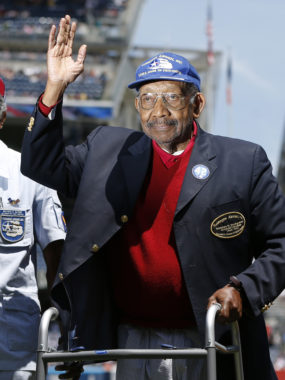
In June 2013, Tuskegee Airman Dabney Montgomery waves to the crowd as he is introduced before the start of a baseball game in New York. (Photo by Kathy Willens/Associated Press)

Dabney Montgomery fought for America on two battlegrounds: in southern Italy, during World War II, and in the American South, during the civil rights movement.

Montgomery, who died on Saturday at the age of 93, was a ground crewman with the Tuskegee Airmen. He went on to be a bodyguard for Martin Luther King Jr., guarding the civil rights leader during the march from Selma, Ala. — his hometown.

Montgomery, along with the other Tuskegee Airmen, received the Congressional Gold Medal in 2007.

The heels from the shoes he wore during the march from Selma to Montgomery will be on display in the new National Museum of African American History and Culture in Washington, which is opening later this month.

Dabney Montgomery grew up in Selma; his father was a fireman (a stoker) for Southern Railroad.

“Watching my father board his train, I wanted to be an engineer when I grew up,” he told the Wall Street Journal last year. “But only white men were engineers then, and only a few blacks became firemen.”

As a young man Montgomery was drafted, trained as a ground support crew and sent with the Tuskegee Airmen to southern Italy, where he supported the pilots.

“When I saw guys who looked like me flying airplanes, I was filled with hope that segregation would soon end,” he told the Journal.

But when he returned home at the end of the war, discrimination was rampant.

After he was discharged from duty in Atlanta, Montgomery went to the train station to head home to Alabama. He described what happened next in an oral history project by the Alliance of Ethics and Art.

“Before I could get in, a white officer threw up his hand. ‘You can’t come in this door, boy, you got to go around the back,’ ” Montgomery remembers. “That was 10 minutes after I received my honorable discharge.”

Things were even worse once he got to Selma, he says. He told the Wall Street Journal that when he tried to register to vote, the woman at the courthouse told him he needed the signatures of three white men.

Montgomery got the signatures. When he brought them in, there was a new requirement: that he own $1,000 worth of property. He didn’t have it, and she wouldn’t let him register.

He went to college on the GI Bill and moved to New York, but the civil rights movement brought him back to the south.

In an interview, Montgomery described the moment he decided to go home:

“I was sitting at home in New York City and I saw that attack on people in Selma on the Edmund Pettus Bridge. They gassed them and beat them with sticks — the sheriff, the officials in their uniforms, because they was marching to the governor’s office to vote.

“And I saw them knocked down, and I saw the gas in the air, and I was sitting here — this is happening in my hometown, Selma! I said, ‘I’m going and get[ting] a taste of that gas.’

“I went to my director and said, ‘I’ve got to go home. … I’m going home to take part in that movement.’ “

So he did. He joined the protests in Selma and became one of Martin Luther King Jr.’s bodyguards, The Associated Press reports, guarding the leader on the famous 1965 march from Selma.

The AP notes that Montgomery, who later moved back to New York and settled in Harlem, continued to serve his community for his entire life:

“He worked for the New York City Housing Authority and as a volunteer outreach worker for a nonprofit that assists the elderly.

“Montgomery remained active until his final weeks, frequently visiting schools to talk to children about his experiences growing up in Alabama, serving in the war and marching for civil rights.

” ‘He just loved motivating young people to be somebody,’ [his wife] Amelia Montgomery said. ‘That was his joy.’ “

Copyright 2016 NPR. To see more, visit http://www.npr.org/.

Homer art gallery hosts “Decolonizing Alaska” exhibit

An innovative new exhibit at Bunnell Street Arts Center has turned a spotlight on Alaska’s long history of colonization. Asia Freeman, the curator of “Decolonizing Alaska”, says colonization has had a powerful influence on the state.

“As a resource state, Alaska has been colonized by forces for centuries now, that have defined and shaped our identity as a state,” said Freeman.

The exhibition tells a multitude of stories from many perspectives.

"Counting on Liberty" by Rebecca Lyon. (Courtesy of Bunnell Street Arts Center)
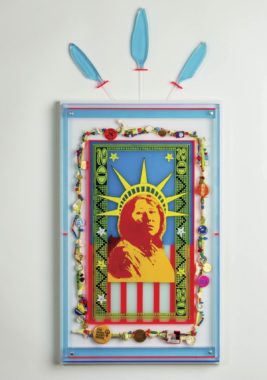
“Counting on Liberty” by Rebecca Lyon. “I have printed her image on a combination of a US twenty dollar bill and the American flag and given her a cartoon crown of the Statue of Liberty.” – Lyon (Courtesy of Bunnell Street Arts Center)

Rebecca Lyon’s mixed media piece “Counting on Liberty” represents the long struggle for women’s rights.

“It’s a piece of artwork that I silkscreened an image of my great grandmother, Anastasia Nutnaltna,” said Lyon.

Lyon’s great grandmother was sold into slavery as a young girl. According to family history, she was later purchased by Lyon’s great-grandfather, an immigrant from Sweden.

“She had a very difficult life but if you look at the photograph and the demeanor of her look, as she looks out in the audience, you can see such pride, strength. Even in an age when she had little or no rights,” said Lyon.

Her grandmother wears a cartoon crown similar to the Statue of Liberty. Lyon says that she hopes to draw more attention to the issue of who should be on U.S. currency. Surrounding the image of her great-grandmother, Lyon has positioned a contemporary Athabascan counting cord. The knotted deer hide is covered with buttons and memorabilia, documenting the history of the women’s rights movement.

“It’s all in this bright Plexiglas color and bright colors to get your attention, to scream at you across the room and say ‘let’s talk about women’s rights,’” said Lyon.

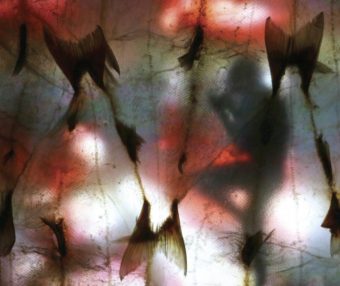
Across the room, Joel Isaak’s “Visions of Summer” is playing on a loop. He describes his artwork in pretty simple terms.

“It’s a fish screen TV screen,” said Isaak.

A hazy video of his family at fish camp is visible through translucent salmon skins that he whipstitched together.

Silhouetted on the screen is a video of him dancing. To create the video, Isaak danced for hour-long stretches at night, when the studio was empty.

“I’d go to the dance studio at my school and I’d dance all night long,” said Isaak.

For Isaak, his art not only celebrates his Dena’ina heritage, it captures some of what makes the natural world so extraordinary.

“The sense of wonderment, kind of intrigue, otherworldliness. When I’m dip-netting at the beach, I feel fish run into me and you can’t see it. So it’s kind of a little portal into another world,” said Isaak.

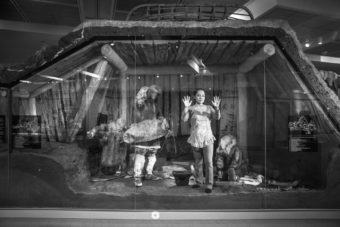
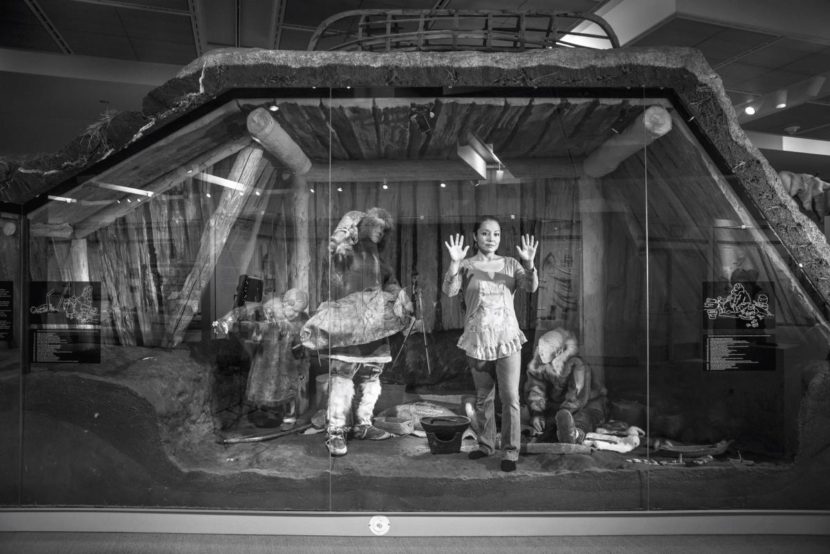
Artist Mike Conti stands beside his black and white photograph of a young Yup’ik woman named Jacquie.

“I call it Yup’ik Ena, which means “Yu’pik house” and then in quotes “White gaze,” said Conti.

"White Gaze" by Michael Conti.
“White Gaze” by Michael Conti. (Courtesy of Bunnell Street Arts Center)

The photograph shows the woman wearing jeans and a kuspuk. She’s standing inside of an Alaska Native diorama full of stiffly posed mannequins in traditional dress.

“It’s like a cross-section, so you’re looking through glass and Jackie has her hands up, like she’s pressed against the glass. Then in the glass, you can see a reflection of me, the photographer. So that’s the white gaze part,” said Conti.

As a self-described “white guy”, Conti is acutely aware of how often the Alaska Native narrative has been in the hands of outsiders.

“The control of the perception is in the viewer. In this case, the white photographer,” said Conti.

For curator Asia Freeman, this collaboration of native and non-native artists is part of what makes the show so groundbreaking.

“I think the thing that is most exciting is to actually say out loud that this type of show hasn’t happened before. I can’t think of an example where native and non-native artists come together to explore and challenge the longstanding effects of colonization through their work,” said Freeman.

The “Decolonizing Alaska” exhibit at Bunnell Street Arts Center runs through the end of August. Over the next year, it will travel to Valdez, Washington DC, Juneau and Anchorage.

Preserving the history of Alaska’s canned seafood

Canned Alaska salmon. (Creative Commons photo courtesy of cookbookoman17)

There used to be hundreds of seafood canneries all along Alaska’s coastline. Two people are involved in documenting and preserving some of that rich history in order to share it with others.

When Anjuli Grantham was growing up she would help her family beach seine on the west side of Kodiak Island. It was the same place that an old cannery site had once operated.

“My early childhood memories are playing in cannery rubble,” Grantham said.

Now Grantham is an Alaska historian based in Kodiak working as the Director of the Historic Canneries Initiative. It’s part of the Alaska Historical Society. The Initiative is a statewide grassroots effort to help educate people about the history of the seafood industry in Alaska.

“We’re looking at all fisheries but mostly on canneries because they’re such magnificent, dilapidated structures all along Alaska’s coastline and very little attention’s been paid to the documentation and preservation of these places,” she said.

These places, the old cannery sites, have been around since 1878 when the first ones opened in Sitka and Klawock. Over the next hundred years, their popularity grew and hundreds of processing sites popped up along Alaska’s coastline.

“It was really important to have processing sites on the fishing grounds because there was no refrigeration and so you had to be putting up fish nearby where people were fishing otherwise you know how quickly fish will go bad,” Grantham said.

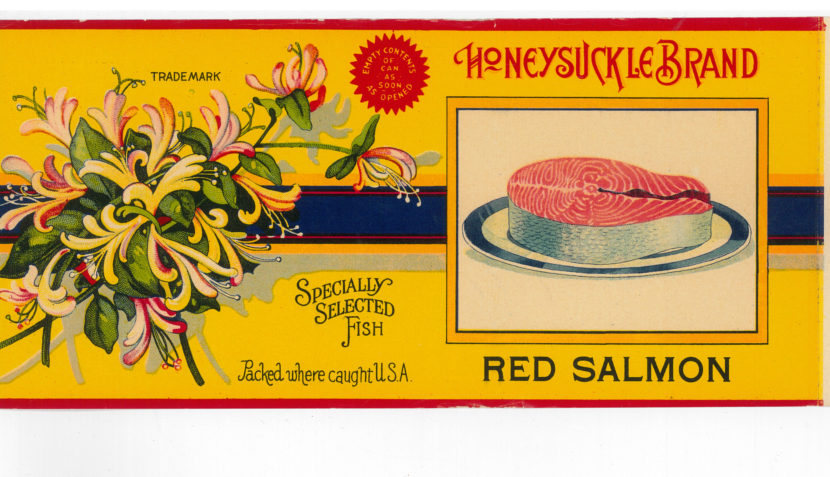
Canned salmon label courtesy of Karen Hofstad

Canning was the favorite form of seafood processing for many years. But in recent decades the number of cannery sites dropped dramatically with the onset of refrigeration technology.

“Suddenly tenders could go longer distances as well and so people can fish wherever and deliver to a centralized location because of refrigerated seawater and freezer capacity,” Grantham said.

Now freezing salmon and other seafood is the most common method of moving the fish to market.

While it lasted, the business was booming and canned salmon was in high demand. And every can needed a label. Petersburg resident Karen Hofstad is kind of a canned salmon label expert.

“There’s not a lot that say canned in Alaska,” Hofstad said. “In the olden days they were shipped out and stored down south in Washington or somewhere and then the brokers would sell the product and then those people like it may be some Jones grocery store, they want their own labels on it.”

Canned salmon label courtesy of Karen Hofstad
Canned salmon label. (Courtesy of Karen Hofstad)

Hofstad’s collected canned salmon labels for over 50 years. It started slowly with just a few at a time but once the word spread that she was collecting many people came forward giving her what they had, even anonymously sending them through the mail. She’s proud that she’s never collected them over the internet.

“Now I have thousands,” she said. “I’m sure I have the largest label collection, for sure in Alaska, maybe the West Coast.”

About 300 of the labels are still on the original tin cans.

Along with collecting canned salmon labels, Hofstad found herself researching the history of them.

“I have a lot of fish packers’ records that go back from the early 1900s that lists all of the labels that were members of that association and I have all of the Pacific Fishermen starting in 1900,” Hofstad said. “A lot of research information there.”

Hofstad has been carefully archiving all of her labels and plans to eventually donate her collection to a museum.

Both and Karen Hofstad and Anjuli Grantham are presenting their historical projects tonight in Petersburg at the public library at 6:30 p.m. A reception will follow at the Clausen Museum.

Limited funding for the Historic Canneries Initiative has been pieced together from multiple sources: the Alaska Historical Society, Alaska Seafood Marketing Institute, Alaska Sea Grant, Alaska Historical Commission, and individual donors.

Kodiak National Wildlife Refuge to celebrate 75th anniversary

Kodiak National Wildlife Refuge will celebrate its 75th anniversary this weekend and take the opportunity to acknowledge some of its accomplishments and contributions since its establishment in 1941.

Kodiak Wildlife Refuge is one of more than 560 national wildlife refuges in the country, Refuge Manager Anne Marie LaRosa said.

“So, Alaska has 16 national wildlife refuges and we comprise over 50 percent of the acreage in the national wildlife refuge system, and within that Kodiak is one of those 16 refuges, and those refuges provide a lot of different benefits to wildlife.”

Several guest speakers who will begin presenting refuge’s history at 4 p.m. Saturday in the Kodiak Wildlife Refuge Visitor Center.

The refuge monitors and protects wildlife and provides access for the public – for instance through fishing, hunting, wildlife observation, and photography, she said.

“We get almost 70,000 visitors a year. That’s including visitors to the visitor center, but almost two thirds of those actually visit the refuge itself, which on some days I find pretty amazing considering how difficult it is to get to the refuge from Kodiak town.”

The refuge also caters to residents and contributes to local education. For the last 20 years, kids in grades K-8 have learned about Kodiak’s natural resources and science through Salmon Camp.

Camp director Kari Eschenbacher said this year’s theme was “natural cycles,” which instructors helped teach through stories, lessons and hands-on activities.

“Whether that’s we’re actually being the Earth’s water and having to move our bodies when the moon is going past to kind of understand how tides work with the moon and the gravity of the moon, or we might play a game where we are salmon going through the salmon life cycle and trying to make it through. Salmon have it rough.”

Salmon Camp will celebrate its 20th anniversary alongside the refuge on Saturday.


Site notifications
Update notification options
Subscribe to notifications