History

The state plans to clean oil contamination from Alaska Native land

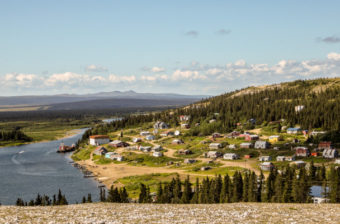
White Mountain’s oil drum storage area is one contaminated site out of 338 sites on ANCSA land that is still in the clean-up process.
White Mountain’s oil drum storage area is one contaminated site out of 338 sites on ANCSA land that is still in the clean-up process. (Photo by Laura Kraegel/KNOM)

The Alaska Department of Environmental Conservation (ADEC) is coordinating the clean-up process of contaminated lands throughout the region and all over the State.

White Mountain’s oil drum storage area is one of nearly 1 thousand sites transferred from federal entities to Alaska Native Corporations under ANCSA. The Bureau of Land Management deems 338 of these sites to be contaminated lands still in need of cleanup, including White Mountain’s oil drum storage area.

Based on a preliminary assessment report done in 1999 by the Ecology and Environment company for the United States Environmental Protection Agency (USEPA), White Mountain’s oil drum site has relatively minor petroleum contamination, up to 540 ppm (parts per million) across a 4-acre site.

As of right now, the contaminated lands have already been designated and surveyed by the Bureau of Land Management, then organized into an online interactive database. Since this database was finished, the BLM’s role in the cleanup process has been very limited.

BLM Project Manager Paul Krabacher says, legally, the BLM can’t do anything, including cleaning up the lands, since the lands have already been conveyed and are no longer managed by the BLM. But, as the clean-up process continues, ADEC focuses on high priority sites, helps negotiate agreements between parties, and examines orphan sites.

John Halverson, the Environmental Program Manager for ADEC’s Contaminated Sites program, defines orphan sites as, “those sites where there’s either known or suspected contamination and there’s not a agency or another party that’s already either working on the site to characterize it and clean it up or planning to do so in the foreseeable future,” explained Halverson.

One example of an orphaned site is White Mountain’s oil drum storage area near the old BIA school. Halverson says the level of contamination and the amount of diesel range organics (DRO) present determines the priority of the site. DROs are a mixture of petroleum hydrocarbons found in diesel fuel.

“We have different clean-up levels based upon the site’s circumstances; even our most conservative clean-up levels are typically based on the contaminants’ potential to migrate to ground water,” stated Halverson. “So, for DRO, our default clean-up level is 250ppm; that’s kind of the starting point, and then people can propose alternative clean-up levels that are higher based on the site’s specific circumstances and information that they collect.”

According to APRN, Daniel Cheyette, Legal Counsel from the Bristol Bay Native Corporation, voiced his concerns about Alaska’s contaminated lands back in August.

“As the landowners, as participants in ANCSA who believed that the land grants were in satisfaction of their land claims, it’s really frustrating that, so many decades later, we still have contaminated sites. And the federal government (is) really moving very slowly in terms of correcting the problems that it created. It’s a step, it’s a start, but it’s taking way too long, and it’s very frustrating for the landowner,” said Cheyette.

According to a DEC report from March 2011 on the White Mountain oil drum storage area, the community’s previous Indian General Assistance Program (IGAP) coordinator indicated that whatever was left of the original 1,000 oil drums would either be transported to Nome’s drum crusher or be reused by the community. Current White Mountain IGAP environmental coordinator Jay Adams says there are still about 60 fifty-five-gallon drums left at the site, less than a mile away from the BIA school building.

Even though the community of White Mountain has removed some of those oil drums on their own, it is not their responsibility to clean up the site. The DEC deemed The Bureau of Indian Affairs as the entity responsible for the cleanup of this site. After repeated attempts to contact the Bureau of Indian Affairs, they could not be reached for comment.

There is no set timeline for the rest of the cleanup at this White Mountain site, or for the other orphaned sites in the region, including the Marshall Fish processing plant and Emmonak’s tank farms.

*Note: more information on the Bureau of Land Management’s report on ANCSA contaminated lands can be found in this article from Alaska Business Monthly.

Jack Greenberg, Civil Rights Icon Who Argued Brown v. Board Of Education, Dies

Jack Greenberg, one of the lawyers who argued the landmark Supreme Court case that ended federal tolerance of racial segregation in schools, died Wednesday. He was 91.

Greenberg was a giant of the civil rights era. He argued 40 cases before the nation’s highest court, fighting against segregation, employment discrimination and the death penalty.

As Thurgood Marshall began a career on the federal bench that would eventually take him to the Supreme Court, he hand-picked Greenberg to take his place as the second director of the NAACP Legal Defense and Educational Fund.

“Few understand how powerfully Jack Greenberg shaped the practice of civil rights law and the breadth of his contributions to our modern conception of equal opportunity and justice,” Sherrilyn Ifill, LDF’s current president and director-counsel, said in a statement.

In 2001, President Bill Clinton awarded Greenberg the Presidential Citizens Medal, citing him as “a crusader for freedom and equality for more than half a century.”

The Washington Post reports that at times, Greenberg’s race — he was white — was questioned, especially because he came to represent a prominent black civil rights organization. But, the Post reports:

“Marshall stamped out any such objections. ‘As those who are fighting discrimination,’ he said, ‘we cannot afford to practice it.’ Mr. Greenberg, Time magazine quoted Marshall as saying, was ‘about as Negro as a white man can get.’ “

In a statement, President Obama said that because of Greenberg’s work, millions of Americans have known freedom.

“The son of immigrants who had fled anti-Semitism, he believed that civil rights was a cause for all Americans, regardless of race or circumstances of birth,” Obama said.

The president went on: “He learned quickly that change would not come overnight — that it would take many generations, more court cases, and nationwide movements to even begin realizing the dream of civil rights for all Americans. But Jack’s calm temperament and intellectual approach to moral arguments perfectly suited him for the fight; he knew, after all, that history was on his side.”

Greenberg was interviewed by Terry Gross on Fresh Air back in 1994 after he published a memoir about his 35 years at the LDF.

He was asked to look back at what Brown v. Board of Education accomplished. The country, he said, is still very much trying to live up to the promises of racial equality. African-Americans, he said, still suffer disproportionately. But Brown was “like an icebreaker that went through a frozen sea” that broke up the status quo, allowing for things like the Civil Rights Act of 1964.

“One way of putting it is that the glass is half-empty or half-full,” he said. “But in 1954, the glass was completely empty.”

Copyright 2016 NPR. To see more, visit http://www.npr.org/.

‘Hanoi Hannah,’ Whose Broadcasts Taunted And Entertained American GIs, Dies

One of North Vietnam’s most recognizable wartime voices fell silent last Friday, when former radio broadcaster Trinh Thi Ngo, dubbed “Hanoi Hannah” by American service members, died.

Her former employer, the government-run Voice of Vietnam, reported the news on its website Sunday. The radio service says Trinh was 87 when she died, though there are conflicting reports about the year of her birth.

Trinh broadcast under the pseudonym Thu Huong, or Autumn Fragrance. At the height of the war the Voice of Vietnam aired three 30-minute segments of hers a day.

The North Vietnamese Defense Ministry’s propaganda department wrote her scripts, she told the Voice of Vietnam. Their aim was to degrade U.S. troops’ will to fight, and convince them that their cause was unjust.

“Defect, GI. It is a very good idea to leave a sinking ship,” she advised her U.S. listeners in one broadcast. “You know you cannot win this war.”

Don North, a former ABC News reporter, remembers that “members of the special forces A-team would sit around at night and tune in around 10 o’clock to her broadcasts” in the Central Highlands of Vietnam in 1965.

“They would listen very carefully,” he adds, “you know, break out the beers and listen to Hanoi Hannah.”

North says that Trinh’s broadcasts had a “minimal” effect on her listeners. Part of this, he says, was because the signal strength of her broadcasts was too weak to be widely heard across the country. Because she broadcast in English, she was better known to Americans than Vietnamese.

Nor did most GIs find her message credible, North says.

“As she said herself, when she used interviews or tape sent to her from anti-Vietnam war people in the States, she thought they were more effective than her own broadcasts,” he says. Among the anti-war activists broadcast by Trinh was actress Jane Fonda.

Trinh received coaching in her trade from Australian journalist Wilfred Burchett, known for his sympathy for the North’s cause.

As part of North Vietnam’s efforts to demoralize U.S. troops, Trinh read the names and hometowns of GIs killed in action, taken from Stars and Stripes.

To reinforce her message, Trinh played anti-war folk tunes such as Pete Seeger’s “Where Have All The Flowers Gone?” and rock songs such as “We Gotta Get Out Of This Place,” by The Animals.

She also highlighted economic and racial inequalities in the U.S., and the Detroit riots of 1967.

“Isn’t it clear that the war makers are gambling with your lives, while pocketing huge profits?” she asked U.S. troops that summer. Trinh did not talk about U.S. victories or the horrible losses suffered by North Vietnam.

Trinh was born into a prosperous family in Hanoi, which was then under French colonial rule.

She studied English and loved Hollywood movies, especially Gone With The Wind. She volunteered to join the Voice of Vietnam in 1955.

“Our program served for a cause, so we believed in that cause,” Trinh told C-SPAN in a 1992 interview. “So we continued to broadcast.”

“She struck me mainly as an intellectual,” says North, who interviewed Trinh in 1976. “Certainly didn’t remind me of a strident propagandist at all.”

After the war Trinh moved to Ho Chi Minh City with her husband, where she worked in television until her retirement roughly a decade later. Her son left Vietnam and moved to the U.S., she told C-SPAN.

Trinh says she never joined the Vietnamese Communist Party, and quickly forgot any anger she had felt against Americans.

Copyright 2016 NPR. To see more, visit http://www.npr.org/.

Museum curator returns to the stage for ‘The Snow Child’ production

Juneau’s Bob Banghart, left, and Pat Henry, right, performing as We’re Still Here in April’s Alaska Folk Festival. The two are the only musicians to have played at all the events.
Juneau’s Bob Banghart, left, and Pat Henry perform as “We’re Still Here” in April’s Alaska Folk Festival. The two are the only musicians to have played at all the events. (Photo by Ed Schoenfeld/CoastAlaska)

Bob Banghart jokes that he was hired for his first, real full-time, year-round job when he was only 57 years old. Now, nine years later, he’s retiring.

Friday, Sept. 30, was his last day as Deputy Director of the state’s Division of Libraries, Archives and Museums.

Banghart says he’ll do a little moose and deer hunting this fall.

He’ll also be preoccupied coming up with music for an old friend from Perseverance Theater, Molly Smith, currently artistic director at Arena Stage in Washington, D.C.

Smith is developing a stage version of the book “The Snow Child” by Palmer author Eowyn Ivey. Banghart, who plays mandolin, fiddle and guitar, is working on the musical score.

Listen to Bob Banghart talk about his latest project at Arena Stage:

“It’s an Alaskan story based on the ‘20s,” Banghart said. “Americana, string band stuff: Shades of bluegrass, shades of Americana, a little bit of theater music. Musical theater has a certain element to it. Usually there’s an emotional moment with a big swing in it. There’s dance.”

Banghart just wrapped up his work on SLAM, formally known as the Father Andrew P. Kashevaroff State Library Archives and Museum.

Banghart spent most of his nine years of state employment helping guide that project to completion.

The facility in downtown Juneau just opened this spring.

SHI program trains educators to see Thru the Cultural Lens

Jackie Kookesh is in charge of Thru the Cultural Lens.
Jackie Kookesh is in charge of Thru the Cultural Lens. (Photo by Quinton Chandler/KTOO)

Juneau teachers and administrators were the students on Saturday at a Sealaska Heritage Institute seminar intended to help them see the world from their pupils’ perspectives.

It’s part of an ongoing series called Thru the Cultural Lens in which educators learn about Southeast Alaska Native culture and history. Saturday, they gave presentations on 10,000 years of education in Southeast Alaska.

Jackie Kookesh is the education director for Sealaska Heritage. She is Tlingit and is part of the L’uknax.ádi clan. She was born and raised in Juneau’s Indian village. Kookesh is in charge of Thru the Cultural Lens.

“We provide a semester-long symposium or seminar that is about 50 hours commitment on the part of the teachers once they apply and register for the course.”

Kookesh said this is Sealaska’s fourth year offering the program and in that time they’ve worked with 67 educators in Juneau School District.

Nineteen people are participating this year, including Juneau School Board member Josh Keaton. The last session will be held in November.

Kookesh said the program leads its participants through the politics and history of Southeast, and it gives them an overview of Southeast Alaska Native culture.

“We explore topics like the arts, subsistence life ways; we explore it all in that 50 hours,” she said.

She hopes those who complete the program become “culturally responsive educators.”

“It will help them in terms of how they relate to Alaska Native students in their classroom, how they communicate, how they engage,” Kookesh said. “The outcome is that our students realize their own potential (for) success in schools and in the classroom. Not only Alaska Native students but all students.”

Kookesh said she saw firsthand how damaging a school that doesn’t reflect Native students’ culture can be to be to them. She was in the Juneau School District in the late 1950s and in the 1960s.

She said the atmosphere back then was much worse than today. She left the district to attend a Bureau of Indian Affairs school.

“If I hadn’t attended the boarding school, I probably wouldn’t have graduated from high school,” she said. “At the time that I was attending school here in the Juneau School District, (it) was very racist, and Alaska Native students were very disenfranchised within the district.”

Kookesh’s experience is part of the reason she wants to continue offering Thru the Cultural Lens.

She believes the program is successfully helping teachers fulfill their own desire to build stronger relationships with their students.

Ed Becker is a social studies teacher at Yaakoosgé Daakihídi Alternative High School.
Ed Becker is a social studies teacher at Yaakoosgé Daakihídi Alternative High School. (Photo by Quinton Chandler/KTOO)

Ed Becker is a social studies teacher at Yaakoosgé Daakihídi Alternative High School. He has high praise for the program.

“I teach Alaska history and world history, and U.S. government. It’s definitely going to cause pause and create some more work for me, but more opportunities for my students to be engaged and learn,” Becker said.

Last year, 17 percent of the district’s students were Alaska Native.

Juneau School District included this table and chart in its Budget Documents for FY2017. (Courtesy of Juneau School District)
Angie Lunda is an assistant professor of education at the University of Alaska Southeast.
Angie Lunda is an assistant professor of education at the University of Alaska Southeast. (Photo by Quinton Chandler/KTOO)

Angie Lunda is an assistant professor of education for the University of Alaska Southeast. She is Tlingit from the Kaagwaantaan clan and she is teaching today’s session.

“What I hope is that it will cause teachers to dig deep in themselves to really try to reach students where they’re at, to really build on the background knowledge that students bring, to really base the education in this place,” Lunda said.

She said connecting to students through their culture and what they already know about Southeast can help with real problems like the achievement gap between Alaska Native students and non-Native students.

The state Department of Education has reported that in 2015 more than a third of Alaska Native students failed to graduate after four years of high school. That’s compared with one in four students overall.

Dianne Zemanek teaches math and science at Dzantik'i Heeni Middle School.
Dianne Zemanek teaches math and science at Dzantik’i Heeni Middle School. (Photo by Quinton Chandler/KTOO)

Dianne Zemanek is a math and science teacher at Dzantik’i Heeni Middle School. She sees Sealaska Heritage’s seminar as an opportunity to continue building on efforts at her school to bring Native culture into their classes.

“We took the core cultural values of the Native Tlingit, Haida, Tsimshian people and took those values to our kids and then asked them to connect to those cultural values and explain what it looks like in our school,” Zemanek said.

In her own classroom, she’s trying to use Alaska Native methods for building halibut hooks in her math lessons.

Pipeline Promises: Alaska’s quest for a natural gas line

For more than 40 years, the state has tried, and failed, to bring natural gas from Alaska’s North Slope to market.

In all, there have been at least 10 different versions of the pipeline mega-project. And not one has come close to breaking ground.

This week, Alaska’s Energy Desk is examining some of the reasons why the state has struck out.

Check out the five-part series below:


PART I

Video: Forty years of Alaska’s failed gas line plans

PART II

Gas Line: A love story

PART III

Man on a mission: Gov. Walker and the gas line

PART IV

The man with the plan: Can Keith Meyer sell the gas line?

PART V

Meet the skeptics: Questions surround Walker’s gas line plan

Site notifications
Update notification options
Subscribe to notifications