The World Series opens Tuesday night between the Cleveland Indians and the Chicago Cubs — essentially a matchup of long-suffering vs. longer-suffering.
You can watch coverage of Game 1 in Cleveland starting at 8 p.m. ET on Fox.
The Indians last won a World Series in 1948, and the Cubs haven’t won since 1908. Fans and sportswriters are positively buzzing with excitement.
“Most of us have never lived on a planet where one of those teams is the champion of the baseball world,” ESPN writes. “So pardon us while we take a moment to get a vertigo prescription filled.”
As Cleveland second baseman Jason Kipnis wryly said Monday night: “I think that’s a very special part of this series … that one of these teams has to win,” ESPN reported.
The Indians have developed a reputation as “a bunch of grinders,” NPR’s Tom Goldman says. “They’ve overcome injuries to key players; they’ve won seven of their eight games in the postseason by an average margin of just two runs, so they’re not blowing people out — they’re winning with pitching, timely hitting, defense, base-stealing. They’re grinding.”
The Cubs are favored to win going into this series — including with Las Vegas oddsmakers, as Tom reports. “The Cubs won 103 games during the regular season; that was a major league best. They have a star-studded lineup. Five of their players were elected as starters in this season’s All-Star Game. The Indians had zero,” he says.
But at the same time, Tom notes that you “can never count out a bunch of grinders.”
Sports Illustrated put it a different way: This is a face-off between “the best team in baseball vs. the best base-running team in baseball.” It goes on to say that “Chicago has the better roster and will win if all things are equal. Cleveland has the more opportunistic team and will win if the game is decided on the margins.”
Fans have flooded into Cleveland for Game 1, and as reporter David Barnett of WCPN ideastream tells All Things Considered, “the city’s Convention and Visitors Bureau reports that all downtown hotels are sold out, reminding some here of the GOP convention this past summer.” And while Cleveland fans are longing for a baseball victory, the city does have a big sports win under its belt: The Cavaliers won this year’s NBA title.
The start of the World Series also has Cubs fans wondering whether this championship could spell the end of the “Curse of the Billy Goat.” As legend has it, when a man was barred from bringing his pet goat into Wrigley Field in 1945, he reportedly said something along the lines of “Cubs ain’t going to win no more,” Tom reports.
Some Cleveland fans are determined to keep that jinx alive. As Cleveland.com reports, a few Indians die-hards brought two goats to the gates of the baseball field to “perform their own goat curse.”
Copyright 2016 NPR. To see more, visit http://www.npr.org/.
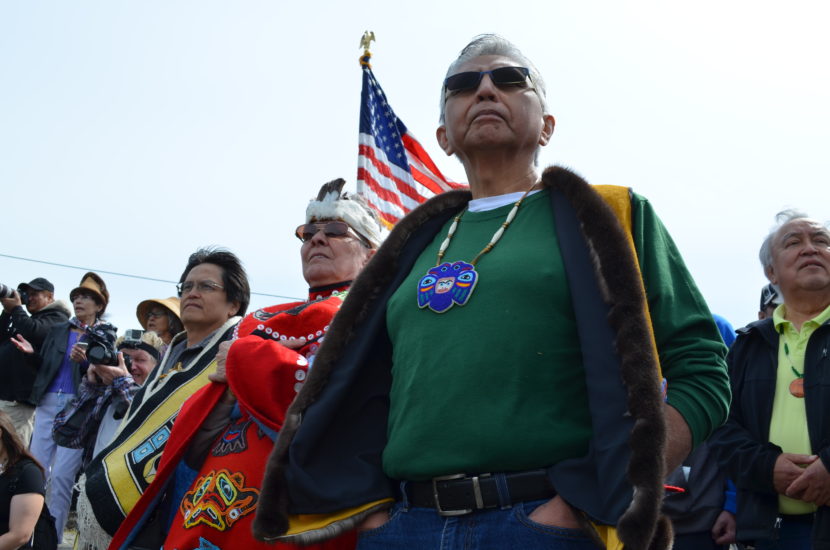
Paul Marks of the Douglas Indian Association waits for Celebration canoes to come ashore at Sandy Beach on June 8, 2016. (Photo by Emily Kwong/KCAW)
A “Moment in AFN History” celebrates the 50th anniversary of the Alaska Federation of Natives.
Listen to Paul Marks’ Tlingit translation of part one of three in this series.
Alaska Natives have owned and occupied our homelands since time immemorial. AFN was formed to deal with Native lands being taken.
The United States gave little attention to Native rights when it bought Alaska from Russia in 1867. No one cared about Native rights as fishing, mining, and logging started, and as military bases were being built.
Congress made Alaska a state in 1958. It said the state could select 100 million acres of land. Some of the land the state wanted was right under Native homes and villages.
“Our leaders had a very strong belief and conviction that this is ours,” said Edward Itta, former mayor of the North Slope Borough.
Natives organized. The president of Tlingit and Haida Central Council, John Borbridge, attended the first AFN meeting, as well as William Paul, Sr., President Emeritus of the Alaska Native Brotherhood. 400 people with 17 Native organizations met in 1966 in Anchorage to talk about protecting their land rights. That was the start of the Alaska Federation of Natives, and of a land claims settlement.
Dorothy’s ruby slippers could use a little more magic these days — or at least some conservationist TLC.
The famous shoes from The Wizard of Oz are among the most popular items on display at the Smithsonian’s National Museum of American History. But they’re showing their age, and the museum is asking the public to pitch in to help keep the shoes intact for decades to come.
The Smithsonian launched a Kickstarter campaign seeking $300,000 in donations to fund preservation work, research and a new display case. Three days in, the museum had received nearly $200,000 in pledges.
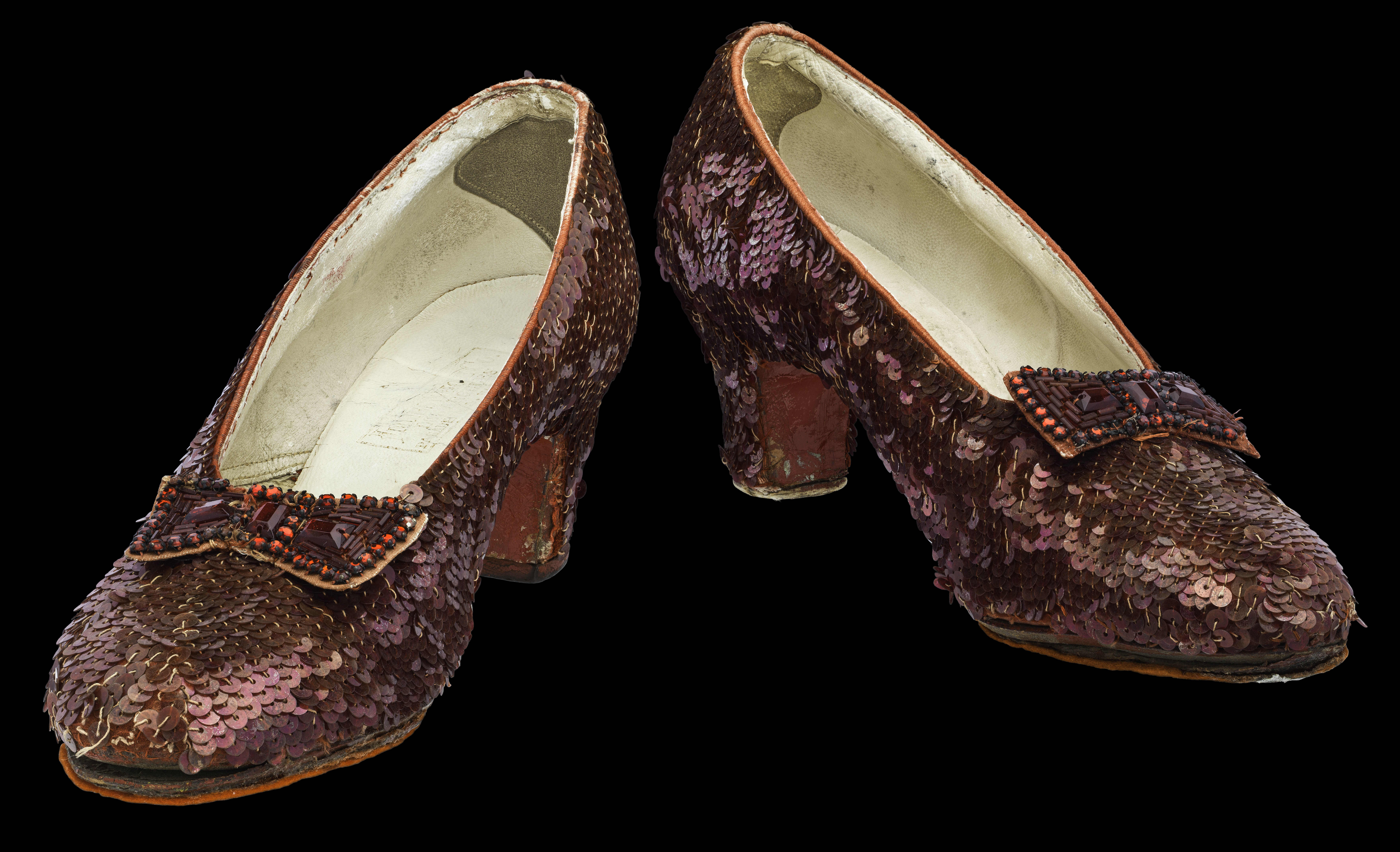
The size-5 shoes in question are one of the few known surviving pairs that Judy Garland wore in the classic 1939 film. They were made a vivid red (unlike the silver shoes in the book version) to take advantage of Technicolor, and they are covered in sequins.
The Smithsonian is raising funds to preserve one of its most popular and iconic exhibits: a pair of Dorothy’s ruby slippers. (Photo by Jaclyn Nash/National Museum of American History)
This particular pair of shoes has been on display at the Smithsonian for decades, since being donated anonymously in 1979. But these days the ruby slippers are less spectacularly red than they used to be — and showing their age in other ways.
The Kickstarter campaign lays out the situation:
“Movie costumes and props are made quickly and cheaply, to last only for the brief duration of the shoot, not forever. Now in their eighth decade, the shoes are fragile and actively deteriorating. Even to the naked eye the damage is quite obvious: the color has faded and the slippers appear dull and washed-out. The coating on the sequins that give the shoes their hallmark ruby color is flaking off its gelatin base. Some threads that hold sequins in place have broken.”
The goal is not to restore the slippers to an earlier, more pristine state. Instead, the museum wants to fund research and work to determine how to “stabilize” the shoes and stop any more damage.
That means figuring out the right temperature, light and humidity conditions for the shoes and building a new case to maintain that environment. The museum’s head of conservation told The Associated Press the case would probably need to contain a gas other than oxygen and have controls for barometric pressure.
Conservationists will also treat the shoes to stop further loss of paint or sequins.
“While the slippers undergo treatment their appearance will not change drastically, and we don’t want them to,” the Kickstarter summary says.
The idea is they’d remain as they are now for “another 80 years and longer.”
And why does the public need to chip in, since the museum is federally supported? A press release from the Smithsonian says federal funds support the museum’s core functions, like building operations and staffing, but that the Smithsonian “also relies on private donations to support many of its priorities, including the conservation and exhibition of precious objects such as the Ruby Slippers.”
Donors to the Kickstarter campaign can get posters, tote bags and T-shirts — or, for donations of $7,000 or more, their own replica ruby slippers.
This is the second major Kickstarter campaign from the Smithsonian museum. Last year, it crowd-sourced well more than half a million dollars partly to preserve and display Neil Armstrong’s Apollo 11 spacesuit.
The ruby slippers at the Smithsonian are among five known surviving pairs of red shoes from the film production (including the “Arabian Test Pair,” in a more ornate style, which was made for the movie but never actually used in the film).
One pair was stolen from a museum in Minnesota in 2005 and has never been found. Another was purchased in 2012 for a planned movie museum from the Academy of Motion Picture Arts and Science that is slated to open in 2018.
Another pair of on-screen slippers is owned by a group of private collectors who reportedly keep it in a bank vault, and the Arabian Test Pair is also believed to be in the hands of a private collector,
Copyright 2016 NPR. To see more, visit http://www.npr.org/.
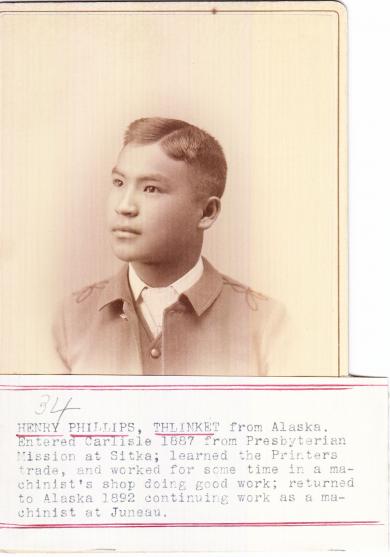
Henry Phillips, originally “Ka-Ka-Ish,” was 12 years old in 1887 when he arrived at the Carlisle Industrial Indian School in Pennsylvania. His student file says he arrived from the Presbyterian Mission in Sitka, though both of his parents were still living. He returned to Skagway to work as a printer at the Daily Alaskan newspaper. (Public Domain image from National Archives and Records Administration)
The remains of 15 Alaska Natives may soon journey home from the Carlisle Industrial Indian School in Pennsylvania. A small group of people working with the U.S. Army and the First Alaskans Institute have authored a resolution they hope to see passed at this year’s Alaska Federation of Natives convention in Fairbanks.
While the resolution is focused on students of the past, there is still concern for potential future boarding school students.
Bob Sam says the Army wants to see the repatriation process completed in less than a year, and they’re going to foot the bill. Sam is confident it can be done, but points out that the Carlisle school is just one of many schools Alaska Natives were sent away to.
“This is just the tip of the iceberg, … Carlisle school is just the beginning,” Sam says. “It’s one of the first boarding home military-type schools in America and all boarding home schools used Carlisle as a model. Chemawa, Haskell, they all have their cemeteries.”
Sam has been helping repatriate human remains for 30 years. From a former tuberculosis sanitarium in Sitka to helping a friend recover his Ainu ancestor’s remains from a university in Japan — Sam has a talent for what he calls “bringing bodies home.” And he’s well-known in Southeast for his dedication to restoring old cemeteries. There was the Russian Orthodox cemetery in Juneau and another one in Sitka.
Sam is working with Nancy Furlow and Jim LaBelle Sr. LaBelle spent 10 years at the Wrangell Institute in Southeast Alaska. He says his time there was traumatic and he’s spent a lifetime working to heal from it.
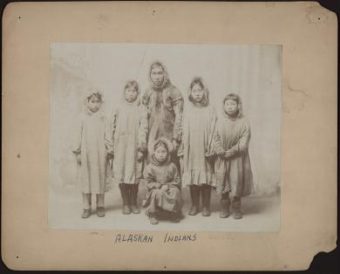
Handwritten on the back of this image: Pupils from Alaska AS THEY ARRIVED AT CARLISLE IN THE FALL OF 1897 SEE REDMAN, JUNE 1899. (Public Domain image from National Archives and Records Administration)
There is little study on the history and impacts of residential schools on Alaska Native children. In a 2005 study by the Institute for Social and Economic Research at the University of Alaska Anchorage, 61 adults who attended boarding schools from the 1940s through the 1980s were interviewed. Some said they were abused. Others experienced no abuse and enjoyed school. And some said that while they weren’t traumatized by their school, they remember seeing abuse.
Some lawmakers see regional boarding schools, or even virtual schools, as a cheaper solution to education in rural Alaska. Former Gov. Sean Parnell was a strong advocate for regional boarding schools and included increased funding for them in education bills he sent to the legislature.
As time goes on, LaBelle thinks there will be more pressure to consolidate schools and increase support for residential schools.
Jim LaBelle, his wife Susan LaBelle, and Bob Sam at the 2016 Elders and Youth conference in Fairbanks. (Photo by Jennifer Canfield)
“Should this happen, there needs to be a process where communities and families participate at all levels of this discussion,” LaBelle says. “If there is eventually going to be a return to boarding schools in some parts of Alaska, at least it will be done in the way that respects the culture, respects the language, doesn’t provide for an institutional setting.”
And these schools should not be forced on rural communities, he says.
“There’s got to be a full participation process. In the days when I went, we had no choice. If you protested or objected, parents were sent to jail.”
Both LaBelle and Sam say there are a lot of issues for Alaska Native people that need to be resolved. Bringing home the remains of Alaska Native students at the Carlisle school in Pennsylvania is part of the process, Sam says.
“Once we resolve these issues, American Indians and Alaska Natives will go on to be the people that they were intended to be and they will begin to have some sort of forgiveness in resolving. But there’s another side to it,” Sam says. “The non-Native people who have guilt, they will begin to resolve their guilt so that they can go on to become the human beings they were intended to be. And we get to know each other doing these kinds of things together.”
The resolution is expected to be presented to delegates Saturday.
About the Carlisle Industrial Indian School
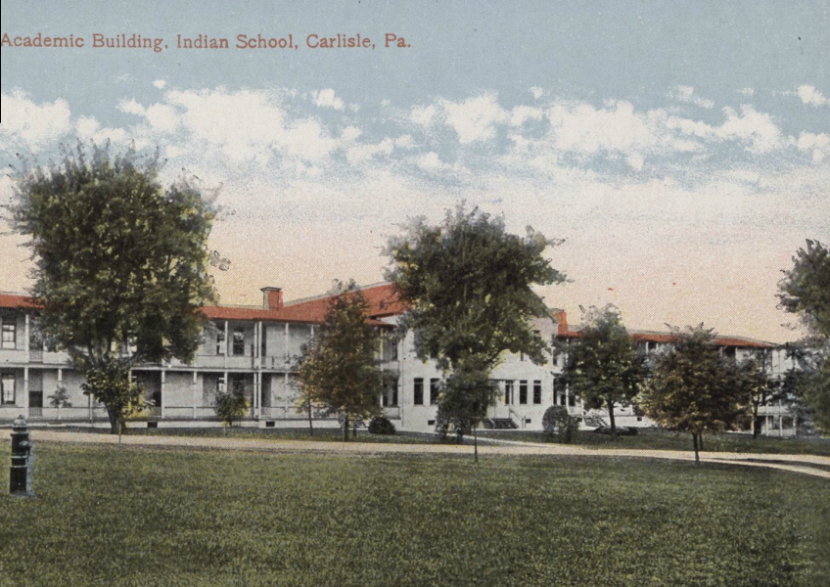
The caption on this artwork reads Academic Building, Indian School, Carlisle, PA. (Public Domain image from National Archives and Records Administration)
The Carlisle Industrial Indian School was founded in 1879 in Pennsylvania by an Army officer who believed that the federal government was holding Native American people back by segregating them.
The word “racism” is believed to have first been uttered by Richard Henry Pratt, who founded the school.
At an annual conference in 1896, Pratt said: “Segregating any class or race of people apart from the rest of the people kills the progress of the segregated people or makes their growth very slow. Association of races and classes is necessary to destroy racism and classism.”
Pratt believed Native people were intended to be inherently equal to European-Americans, they just needed to be civilized.
“It is a great mistake to think that the Indian is born an inevitable savage. He is born a blank, like all the rest of us,” Pratt said in a speech at an 1892 convention. “Left in the surroundings of savagery, he grows to possess a savage language, superstition, and life. We, left in the surroundings of civilization, grow to possess a civilized language, life, and purpose. Transfer the infant white to the savage surroundings, he will grow to possess a savage language, superstition, and habit. Transfer the savage-born infant to the surroundings of civilization, and he will grow to possess a civilized language and habit.”
Operating throughout the height of the Progressive Era until 1918, more than 10,000 attended the school. The school’s foremost goal was assimilation of its students. English was the only language allowed to be spoken. In the dorms, no two students from the same tribe were allowed to live together. Students were made to pick out new English names. Boys were required to cut their hair. The phrase, “Kill the Indian, save the man” — Pratt coined that, too.
Correction: Earlier versions of this story misstated when the resolution will be presented to the AFN delegates. It’s expected to be presented Saturday.
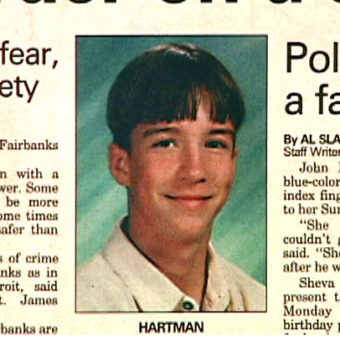
John Hartman’s obituary photo (Photo of the Fairbanks Newsminer)
Fairbanks residents gathered Thursday to remember John Hartman. The 15-year-old was beaten to death in downtown Fairbanks 19 years ago this week, a murder that resulted in the long questioned convictions of four local men, who were freed last year under a deal with the state.
Shirley Lee, an Episcopal Priest and chair of Tanana Chiefs Conference Justice Task Force, led the group in a prayer and vigil for the unsolved murder of John Hartman.
“19 years ago around here a young boy was murdered and the lives of four young men were robbed,” Lee said.
She also spoke of the four men, Marvin Roberts, Eugene Vent, George Frese, and Kevin Pease, also known as the “Fairbanks Four” who were arrested in 1997 for the murder and incarcerated until last December when they were released under conditions that they cannot sue the state or the city of Fairbanks. Lee said the state attempted to settle and quiet the case through what she believed to be an immoral agreement.
“It’s (inconceivable) to me that a confession has been made and no work has been done with it, not at the federal level, not at the state level, and not at the city level,” Lee said.
Lee said she hopes that those who gather this coming week for the Alaska Federation of Native Conference remember the case which is still unsolved.
“The boys may not be legally allowed to question or challenge it but those of us who are not involved can do so,” said Lee.
Activist and blogger behind the blog thefairbanksfour.com, April Monroe, reflected on the case saying that we are now at the 19-year mark without resolution for the murder of Hartman.
“What originally inspired so much passion and divisiveness of this case was a brutal and horrific murder of a child,” said Monroe.
Monroe hopes to see some movement in this case and feels that part of the inactivity is partly related to egos of those involved in the case initially and that going forward would take action in acknowledging the mistakes made during the wrongful conviction.
“John Hartman still needs justice and deserves it,” said Monroe.
Close
Update notification options
Subscribe to notifications
Subscribe
Get notifications about news related to the topics you care about. You can unsubscribe anytime.

9(MDEwMjQ0ODM1MDEzNDk4MTEzNjU3NTRhYg004))
9(MDEwMjQ0ODM1MDEzNDk4MTEzNjU3NTRhYg004))