
Commentator Dee Longenbaugh reviews “Purely Alaska: Authentic Voices from the Far North” edited by Susan Andrews and John Creed, and published by Epicenter Press.
History
Cars, planes and mines: the path to modern-day Juneau
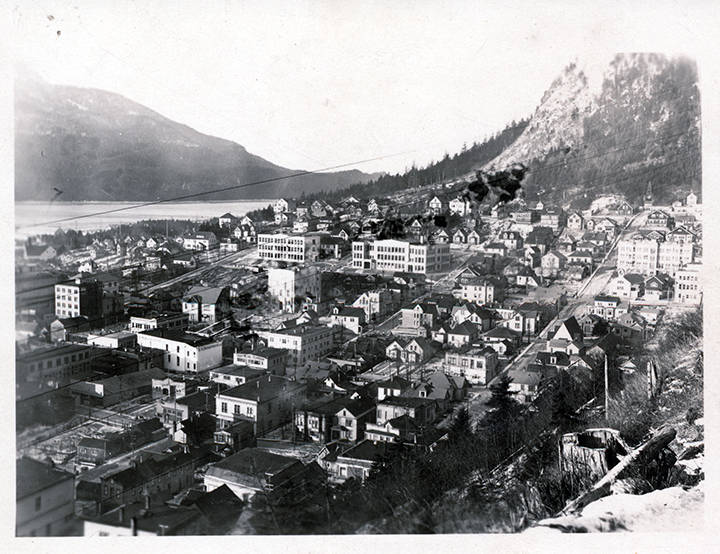
Juneau’s Lands and Resources Manager Greg Chaney said before technology made life in Juneau more feasible, transportation-wise it wasn’t a very nice place to live.
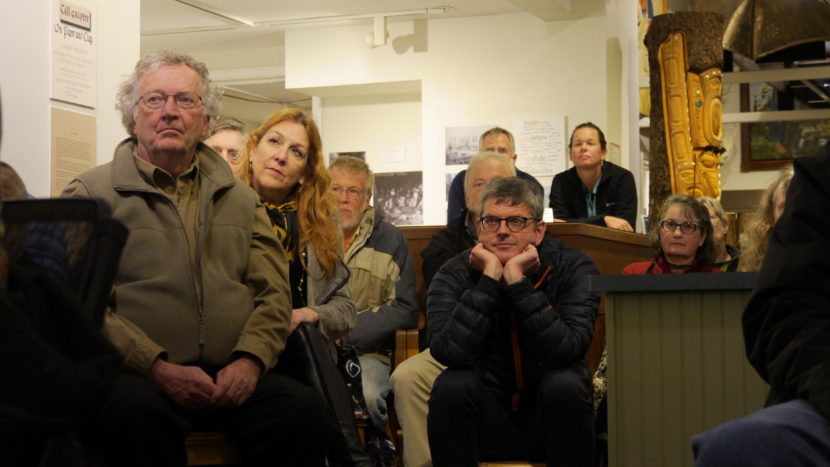
He was one of four city officials who shed some light on how Juneau became the city it is today during a presentation at the Juneau-Douglas City Museum last Thursday. The building was packed with 79 residents eager to hear how Juneau became Juneau.
Chaney said things started looking up with the use of steamships.
“That happened to correspond with when gold was discovered in Juneau in the 1880s,” Chaney said. “We became a great place to have the state capital because Sitka was on the outer coast and they used sail boats to get there. Sail boats are not very good on the Inside Passage, but steamships aren’t very good on the outside coast.”
Like many other cities, Chaney said cars were a huge factor in evolving the town’s layout.
“So our communities were laid out close together and they were all walkable, and then over time we added more and more cars to the town, and the community spread out to the Mendenhall Valley for example,” Chaney said.
If cars hadn’t taken off in Juneau, Chaney said people probably would’ve kept building homes along the hillsides which were close to their jobs in the mines. That would’ve made the town more compact and city services, such as water and sewer access, would’ve been cheaper.
“It may (have been) a bit easier, but I don’t know about finding places on mountainsides to live,” Chaney joked.
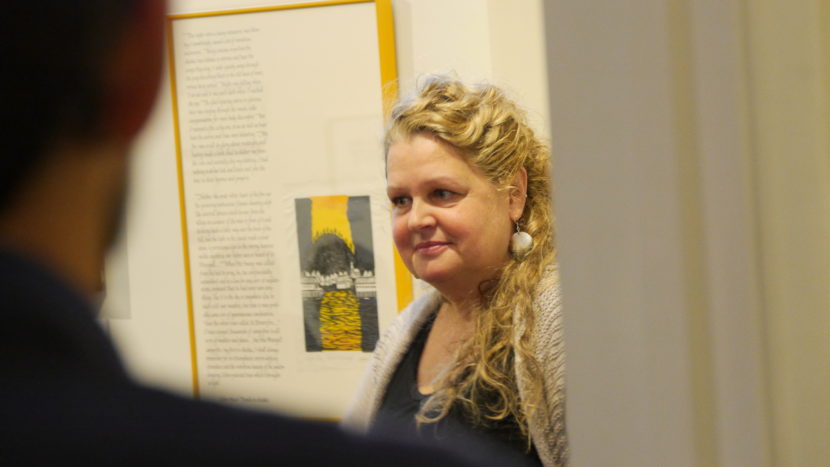
Patty Wahto, the manager of Juneau International Airport, and the deputy manager Marc Cheatham built on Chaney’s point about technology by explaining how the airport shaped Juneau’s growth.
“The mining, the mail, war … there are so many things that developed,” Wahto said.
She said the airport has been huge for Juneau because flying is one of only two options for getting in or out of town. She said aviation used to link parts of town that didn’t have a road connecting them, like Auke Bay and downtown.
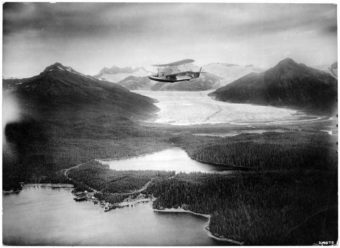
“I think … there are other things that were developed around aviation and aviation developed around it, so it’s a symbiotic relationship that the city had with the airport,” she said.
Wahto said Juneau’s first airfield was built in 1935 and in 1979 the airport became an international airport.
Juneau’s City Manager, Rorie Watt ended the evening by explaining how industry and geology influenced the decisions that created modern day Juneau.
He said, “Well if you think about Juneau, we’re a small town on the side of the mountain and we’re always questing after flat land and the AJ Mine had low-quality ore, which means there’s a lot of rock left over.”
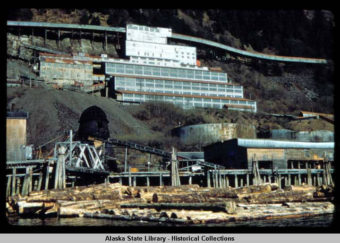
Miners dug up the low-quality ore and dumped it into tidewater near downtown Juneau to make flat land so the town could be expanded, Watt said.
“Men pulled the non-quartz rocks off and we filled large areas in 1910 to 1945 roughly,” he said. “The original shoreline was about in the middle of Franklin Street, Front Street, hugged Telephone Hill, hugged Willoughby, back along the ANB Hall. Lots of what we see downtown today was tidelands back in the day.”
Watt said he thinks a lot about the individual decisions that shaped Juneau’s economy and community. He said Juneau went from a frontier town to a mining company town, to a government town, to a tourist town.
“Now I think we’re a tourist town, and a government town, and a fishing town,” he said. “We’re a bit more diversified. I think it’s good to take the long view and think about small decisions that can deflect your path.”
Watt believes remembering Juneau’s history can help determine the next step in the city’s development.
Chaney and Wahto encourage anyone with more information about how the past influenced present-day Juneau to come forward and share what they’ve learned.
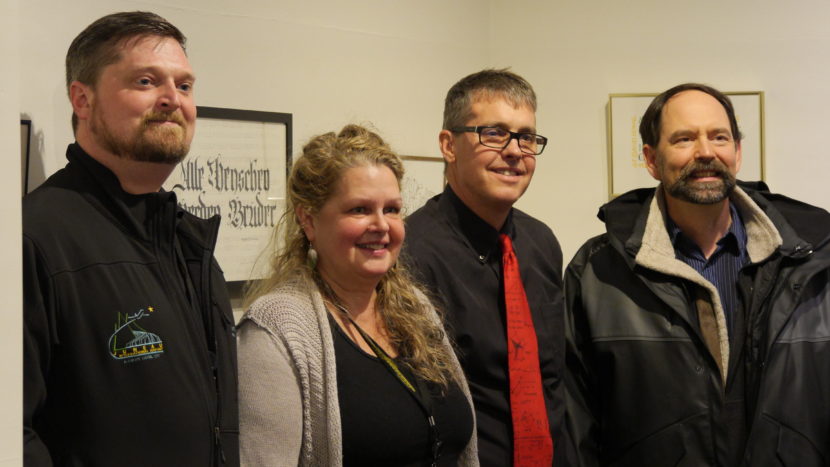
Correction: A caption on a crowd photo misidentified one of the people pictured. The man with his hands on his chin is not City Manager Rorie Watt.
Edward Itta remembered for balancing two worlds
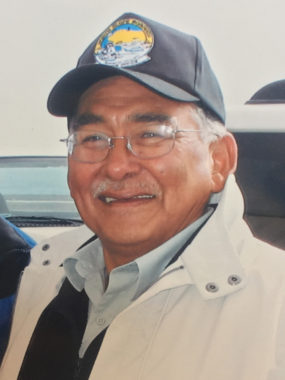
Former North Slope Borough Mayor Edward Itta died Sunday in Utqiagvik, formerly known as Barrow. Family members said the cause was cancer. He was 71.
Itta was a powerful voice for North Slope communities. He was perhaps best known for first opposing, and then negotiating with Shell when the oil company wanted to drill in the Arctic Ocean. Above all, he insisted Inupiaq communities have a say in development in the region.
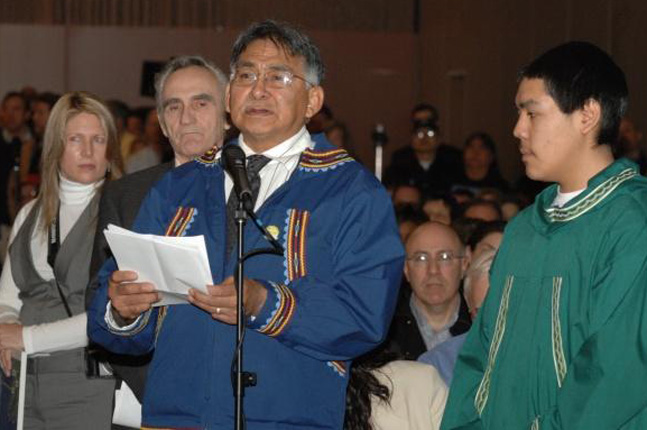
“After all the battles over the wilderness and the oil are done, we are the ones that have to live with the consequences,” he told an Arctic symposium in Seattle in January 2015. “We are the most directly impacted people. Decision makers, policy makers at all levels, need to understand that.”
As mayor, Itta became known for balancing the need for oil development and protecting subsistence.
He grew up as one of 11 children. In a phone interview Monday, his sister, Brenda Itta-Lee, recalled an older way of life, with little in the way of a cash economy, dependent on subsistence.
“Whaling, especially, was very important to Edward,” she said.
Itta-Lee said she and her siblings grew up with a foot in two worlds — traditional and modern, Inupiaq and English. Her brother became a whaling captain who negotiated with oil companies.
“He could speak just as powerfully in two languages,” Itta-Lee said. “We (had) a Western American schooling, where we were taught an American way of life. And Edward also mastered how to survive successfully in that setting. So he was very much admired for being bilingual and also bicultural.”
It was a crucial skill set when he became mayor of the North Slope Borough in 2005. Interest in the Arctic was on the rise, especially from oil companies. Shell developed big plans to drill in the Arctic Ocean.
But the company hadn’t consulted local communities, who worried about the impact on marine mammals, and especially on the whale migration.
Itta wasn’t having it. He insisted the Inupiat have a seat at the table, eventually suing the federal government to demand a more thorough environmental review.
Journalist Bob Reiss wrote about Itta’s long fight and eventual negotiation with Shell in his 2012 book “The Eskimo and The Oil Man.”
“It was too much, it was too fast, it was too soon, Edward said,” Reiss said Monday. “Here was this mayor that Shell had not even taken into account, who came up with the strategy of challenging them in court, and who brought the second largest oil company on Earth to its knees, in court. Just stopped them dead.”
Reiss said Itta agonized over his choices. North Slope communities depend on oil revenue to sustain their quality of life and public services, and on-shore oil production was in decline. Yet the ocean is central to both life and identity, and offshore drilling could threaten that.
“He said to me once, and this sort of epitomized everything, he said, ‘Well, what if it’s me?'” Reiss said. “And he meant more than, ‘What if it’s me?’ ‘What if it’s me, what if it’s my family?’ he said. ‘What if it’s me who stops the oil?’ Meaning, stops the money, stops the taxes, stops the building. ‘What if it’s me?’ But then a second later, he said, ‘Well, what if it’s me who allows the oil, and then something goes wrong, and then we lose the whales?'”
Reiss recalls sitting in on a meeting between Itta and Shell that encapsulated that struggle. Itta had come back from whaling camp to meet with oil industry executives.
“The whales only come twice a year,” Reiss said. “Edward was a whaling captain. He was responsible for the lives of his men. These are relatives, these are his best friends. Certainly the last thing that a whaling captain wants to do is leave the camp and go back to town. Which he did that day because — and this is the way the book starts, actually — Edward is on a snowmobile back to town, and a private jet is on the way up from Houston, with the top people at Shell. ”
The Shell executives wanted Itta to reassure people on the North Slope that drilling would be safe, Reiss said. Itta refused, saying Shell hadn’t done its homework, and hadn’t talked to the community.
“Well, I will say, Edward took their head off (that day),” Reiss said, laughing. “He really did! And it was great to watch as a journalist.”
The borough’s lawsuit helped force a more thorough environmental review, and over years of negotiations, Itta convinced Shell to build in measures to protect marine mammals, including a planned pause in work during the whale migration.
Department of Natural Resources Commissioner Andy Mack worked for Itta during those years, as the government affairs director for the North Slope Borough.
Asked how he liked working for Itta, Mack said, “Loved it. Loved every minute of it.”
“He’s a tremendously powerful example of a person who was really true to his principles, but practical,” Mack said. “He was also very committed to the people that he worked for.”
Above all, Reiss said, Itta had heart.
“Whether he was talking with an Inupiaq person, whether he was talking to a Yup’ik, whether he was talking with a Norwegian, or a senator, or an admiral, or an oil person, Edward could really feel your heart, and respond to it, as one human does to another. And I think that’s why he is as beloved as he is,” Reiss said. “Yeah, he was a leader. Yeah, he had brains. Yeah, he knew how to get through Washington. But when you were in a room with Edward, you were two people talking, and you were talking from the heart.”
Alaskan Book Review – “Boom Town Boy: Coming of Age on Alaska’s Lost Frontier”
Commentator Dee Longenbaugh reviews “Boom Town Boy: Coming of Age on Alaska’s Lost Frontier” by Jack de Yonge and published by Epicenter Press.
Alaskan Book Review – “Compliments to the Bear: Adventures of an Alaska Prohibition Agent”
Commentator Dee Longenbaugh reviews “Compliments to the Bear: Adventures of an Alaska Prohibition Agent” by Judith Ripley and published by Creatspace Independent Publishing platform.
6.6-Magnitude Earthquake Flattens Much Of Historic Basilica In Central Italy
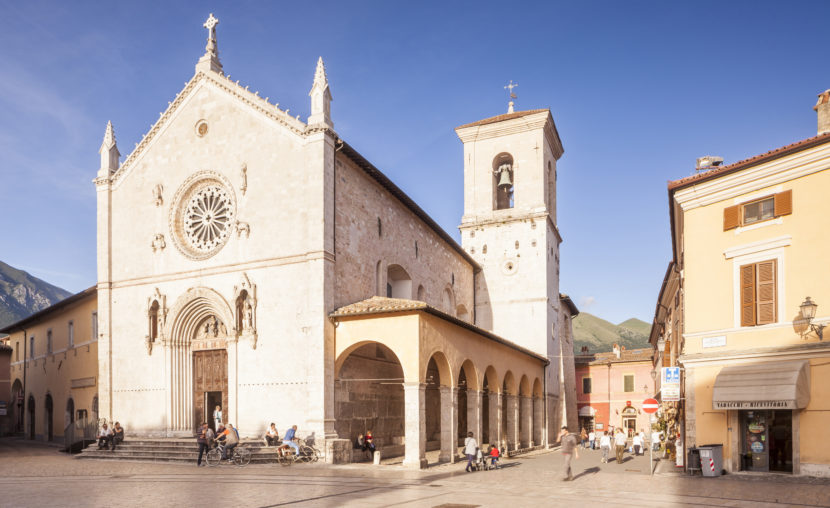
Julian Elliott Photography/Getty Images
A strong earthquake in Italy’s Umbria region destroyed a centuries-old basilica that was built at the birthplace of Saint Benedict and his twin sister Saint Scholastica early Sunday. No deaths were reported from the quake, which followed a series of smaller temblors.
Images from the scene show firefighters coming to the aid of nuns as they fled one of the buildings in Norcia, which is also commonly called Nursia. One reason for the lack of casualties: many buildings had been declared unsafe after a large quake in August.
“The monks are all safe, but our hearts go immediately to those affected, and the priests of the monastery are searching for any who may need the Last Rites,” reads an announcement from the Benedictine monks of Norcia, who had been working to raise money to repair their historic basilica.
Today, the monks said, “The basilica is destroyed.”
NPR’s Sylvia Poggioli reports for our Newscast unit:
“The quake brought down buildings already damaged by a big tremor in August and two months of aftershocks. Sunday’s earthquake was more powerful than the one that struck Aug. 24 that killed almost 300 people.
“There was extensive damage to buildings but no reports of injuries. Many towns had been evacuated in August, and few people remained. The epicenter was near Norcia in the Umbria region, but tremors were felt as far north as Bolzano in the north near the Austrian border and in the southern Puglia region.
“In the walled town of Norcia, the 14th-century basilica of St. Benedict was devastated, with only the façade still standing. In Rome, the earth shook strongly and at length. Transport authorities shut down the metro to check for damage.
“Italy lies on two fault lines, making it one of Europe’s most seismically active countries.”
Framed by the Sibylline Mountains, the town of Norcia sits in a scenic valley plain that’s named for Scholastica, Benedict’s sister. The quake has ruined months of work to make the basilica safe to use again after August’s earthquake.
In recent months, the monks had been using a fund-raising campaign and revenue from their brewery — which produces Birra Nursia — to help pay for the rebuilding effort. That effort was expected to cost $7.5 million — a figure that will surely be dwarfed by the damages incurred today.
Sunday’s quake is the most powerful of a cluster of temblors to hit central Italy. In the past week, eight quakes, all with magnitudes of more than 4, struck the region, including two that hit Wednesday: one with a magnitude of 5.5, and one with a magnitude of 6.1.
Copyright 2016 NPR. To see more, visit http://www.npr.org/.9(MDEwMjQ0ODM1MDEzNDk4MTEzNjU3NTRhYg004))