History

Juneau’s Indian Point deemed worthy of protection

JUNEAU — The traditional and cultural significance of Juneau’s Indian Point has landed it a spot on the National Register of Historic Places.

The Juneau Empire reports that the roughly 78 acre parcel of land in Auke Bay is one of the original village sites of the Aakw Kwaan. The recent federal listing has given the site protection under the National Historic Preservation Act, an effort that’s been pushed by the Sealaska Heritage Institute since 2004.

The institute’s director of history and culture, Chuck Smyth, says members of the Alaska Native community have successfully challenged development efforts in the area for decades. He says Indian Point has historical, cultural and religious significance to Native people.

The institute will work with city and federal officials on a management plan for the site.

Deacon’s music a bell-towering achievement in Sitka

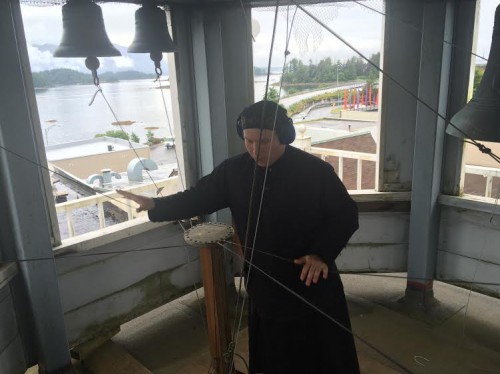
Deacon Herman Madsen plays the bells atop St. Michael’s Cathedral. (Katherine Rose, KCAW)

The bells at St. Michael’s Cathedral in Sitka are ringing again after a temporary hiatus, thanks to a new deacon with musical abilities and no fear of heights.

The bells of the Russian Orthodox church haven’t been played for a while.

That is, until Deacon Herman Madsen showed up.

“I always use the example of the medical field,” Madsen said. “The priest is like a doctor and the deacon is like the nurse to the doctor.”

He and his wife, Mary, moved here at the beginning of the summer to help with tours at the church and assist Father Michael.

It wasn’t always Herman’s plan to work for the Russian Orthodox Church.

“I was a wild child, I grew up with my grandmother,” Madsen said. “My mom and my dad sort of abandoned me. So my grandmother, at 70 took care of me. I nearly ended up in jail, but then my grandfather stuck out his neck for me.”

After spending 11 years at the academy, he debated joining the seminary for quite a while, but didn’t fully commit to the idea until he had an experience at the tomb of St. Herman in Kodiak.

“All of a sudden right next to this tree where St. Herman’s hut used to be,” Madsen explained. “Incense just started pouring out of the ground, and the smell of St. Herman’s relics, surrounded me.”

Deacon Herman said it smelled of roses.

It was unmistakably a religious calling.

“I just hit the deck and said i really need to go to the seminary, I don’t have any choice at this point,” Madsen said.

He’s been in the seminary for three years. Though he has a background in music and performance, playing the bells was a new adventure.

“When I got here there was no one really playing the bells at the time. So I just started taking it up and doing it every day at noon,” Madsen said. “I didn’t take any official classes on bell ringing. Because of my background in singing and playing instruments I had an ear for that kind of thing. I also played the spoons.”

So playing the bells wasn’t too much of a stretch. There are eight bells, a full octave, which makes it easier.

“It’s really nice on sunny days, come up here and read a book,” Madsen said. ‘Whew!”

The bells themselves have an interesting history.

They were made in Holland, and ordered by the Russian American company in St. Innocent. They lasted up to 1966, when an accidental fire broke out and destroyed the cathedral.

“In the fire these bells melted into clumps of metal,” Madsen said. “The men in the community gathered up all the metal, had them resent back to the original foundry, and these bells were recreated from the originals metal.”

The church was rebuilt based on 1961 drawings of the old cathedral, and featured its signature green domes and golden crosses.

Each bell is connected to a thin string, a bit thicker than a strand of yarn. Those strings connect to a podium with holes in it. The two largest bells are attached to two huge wooden pedals.

Madsen plays the bells a little like bongos.

“Instead of pulling the strings, I tap all of the strings, and that’s why I can play it so fast, and in so many different ways. That’s why they sound so awesome,” Madsen said, laughing. “You get some pretty awesome exciting bell ringing that happens that gets you kind of pumped up. It’s really kind of fun.”

Herman and his wife will leave Sitka at the end of the summer with plans to come back next year, and hopefully make Sitka their home.

Homer council shows concern over proposed naval training

Homer City Council passed a resolution on Aug. 8, formally requesting changes to U.S. Navy training exercises in the Gulf of Alaska. The proposed training area is 24 nautical miles from the Kenai Peninsula shoreline, just south of Prince William Sound and east of Kodiak Island.

It covers more than 59,000 square miles, an area slightly larger than the state of Georgia.

Emily Stolarcyk, program manager for Cordova-based non-profit group Eyak Preservation Council, spoke in support of a resolution requesting changes to the proposed training August 8 at Homer City Council.

“These trainings are aimed at maintaining military readiness,” Stolarcyk said. “Everything used in the exercises is actually the same weapons that are used in war. So these are real bombs, real missiles, torpedoes, heavy deck guns and then of course, the active sonar.”

Although military preparedness is important, she said the needs of local communities and ecosystems should also be taken into account.

“We certainly can’t understate the need for national security, but we could go about it in a more sensitive way,” Stolarcyk said. “Sensitive to the people that live here, the communities, our industries, and then wildlife as well,”

Homer City Councilmember David Lewis sponsored the resolution. He’s concerned about the impact of Navy training on wildlife.

“It matters because all that comes into Kachemak Bay basically comes from the Gulf,” Lewis said.

The proposed training would begin in May 2017, but the resolution requests the Navy wait until mid-September to avoid impacts on migrating marine species.

Cook Inletkeeper executive director Bob Shavelson said the environmental impacts of naval training could be lessened by scheduling it later in the fall.

“These are migration corridors for our salmon and our halibut and our whales,” Shavelson said. “And we could reduce those impacts considerably if we change it to later in the year and push it further from the coast.”

Navy representative Alex Stone said the longer days and calmer waters in the summertime allow them to do more training exercises.

“We get more value for our investment if we can plan the exercise when it has a greater probability of better weather, better conditions for flying and for training,” Stone said.

The resolution also requests the Navy avoid using live ordnance and sonar in Marine Protected Areas. One concern is that these activities produce loud underwater sounds, which can physically harm marine mammals and alter their behavior.

Beaked whales appear to be particularly sensitive to sonar. said Scripps Institution of Oceanography professor John Hildebrand.

“There was an exercise in the Bahamas around 2000 where the Navy was conducting an exercise in a relatively confined space along a channel,” Hildebrand said. “And then you could see the beaked whales strand themselves along the channel pretty much in lock step with position of the sonars.”

Although the effect of sonar on larger whales isn’t well known, many of these species are endangered.

Any activities that could harm them receive an extra level of scrutiny, Hildebrand said .

“We’re worried about these animals already so we have kind of an extra layer of concern because there are already endangered,” Hildebrand said. “And now here’s another thing that could potentially impact them, even though we don’t know the details of how it might.”

Currently, the Navy visually monitors the area around vessels to look for marine mammals.

“Sonar could cause impacts to marine mammals if they’re close to the sonar source,” Navy representative Alex Stone said. “We have a safety zone around that area. So we observe that area and if there are marine mammals in that area we’ll power down the sonar or turn it off.”

In this case, Close is 1,000 yards, according to the Navy’s Environmental Impact Statement.

The resolution requesting changes to Navy training was unanimously approved by members of Homer City Council.

It now goes before Alaska Sen. Lisa Murkowski and Reps. Dan Sullivan and Don Young.

The final Environmental Impact Statement for the proposed training is available at goaeis.com. The 30 day public comment period ends August 29.

Two people help preserve the history of Alaska’s canned seafood

There used to be hundreds of seafood canneries all along Alaska’s coastline. Two people are involved in documenting and preserving some of that rich history in order to share it with others.

Anjuli Grantham helped her family beach seine on the west side of Kodiak Island when she was growing up. It was the same place that an old cannery site had once operated.

“My early childhood memories are playing in cannery rubble,” Grantham said.

Now Gratham’s a Kodiak-based Alaska historian working as the director of the Historic Canneries Initiative, a part of the Alaska Historical Society. The initiative is a state-wide grassroots effort to help educate people about the history of the seafood industry in Alaska.

“We’re looking at all fisheries but mostly on canneries because they’re such magnificent, dilapidated structures all along Alaska’s coastline and very little attention’s been paid to the documentation and preservation of these places,” she said.

These places, the old cannery sites, have been around since 1878 when the first ones opened in Sitka and Klawock. Their popularity grew over the next 100 years and hundreds of processing sites popped up along Alaska’s coast line.

“It was really important to have processing sites on the fishing grounds because there was no refrigeration and so you had to be putting up fish nearby where people were fishing otherwise you know how quickly fish will go bad,” Grantham said.

Canning was the favorite form of seafood processing for many years. In recent decades the number of cannery sites dropped dramatically with the onset of refrigeration technology.

“Suddenly tenders could go longer distances as well and so people can fish wherever and deliver to a centralized location because of refrigerated seawater and freezer capacity,” Grantham said.

Now freezing salmon and other seafood is the most common method of moving the fish to market.

While it lasted though, the business was booming and canned salmon was in high demand. And every can needed a label.

Petersburg resident Karen Hofstad is kind of a canned salmon label expert.

“There’s not a lot that say canned in Alaska,” Hofstad said. “In the olden days they were shipped out and stored down south in Washington or somewhere and then the brokers would sell the product and then those people like it may be some Jones grocery store, they want their own labels on it.”

Hofstad’s collected canned salmon labels for more than 50 years. It started slow with just a few at a time but once the word spread that she was collecting many people came forward giving her what they had even anonymously sending them through the mail.

She’s proud that she’s never collected them over the internet.

“Now I have thousands,” she said. “I’m sure I have the largest label collection, for sure in Alaska, maybe the West Coast.”

About 300 of the labels are still on the original tin cans.

Along with collecting canned salmon labels Hofstad found herself researching the history of them.

“I have a lot of fish packers records that go back from the early 1900s that lists all of the labels that were members of that association and I have all of the Pacific Fishermen starting in 1900,” Hofstad said. “A lot of research information there.”

Hofstad has been carefully archiving all of her labels and plans to eventually donate her collection to a museum.

Limited funding for the Historic Canneries Initiative has been pieced together from multiple sources: the Alaska Historical Society, Alaska Seafood Marketing Institute, Alaska Sea Grant, Alaska Historical Commission, and individual donors.

X-rays reveal hidden portrait under painting by Edgar Degas

False color reconstruction of Degas' hidden portrait (detail). The image was created from the X-ray fluorescence elemental maps.
False color reconstruction of Degas’ hidden portrait (detail). The image was created from the X-ray fluorescence elemental maps.(Scientific Reports)

Using specialized X-ray imaging, a team of researchers in Australia has revealed a striking painting of a woman’s face hidden under French Impressionist Edgar Degas’ Portrait of a Woman.

The researchers believe the auburn-haired woman in the hidden work — which they also attribute to Degas — is Emma Dobigny, who was reportedly one of Degas’ favorite subjects and modeled for him in 1869 and 1870.

It’s long been known that another painting lay beneath the image of an unknown woman in a black dress and bonnet, housed in the collection at the National Gallery of Victoria, Australia. Since at least 1922, the research team explains in Scientific Reports, another form has slowly become visible, discoloring the bonneted woman’s face.

“Degas painted directly on the underlying portrait with no intermediate ground paint layer using exceptionally thin paint layers, thus little pigment is present to provide hiding power,” the researchers wrote. “The hiding power of paint layers often decreases as oil paintings age.”

Even as the traces of a ghostly form emerged over the course of decades, conventional imaging technology could only provide hints of what the hidden portrait looked like.

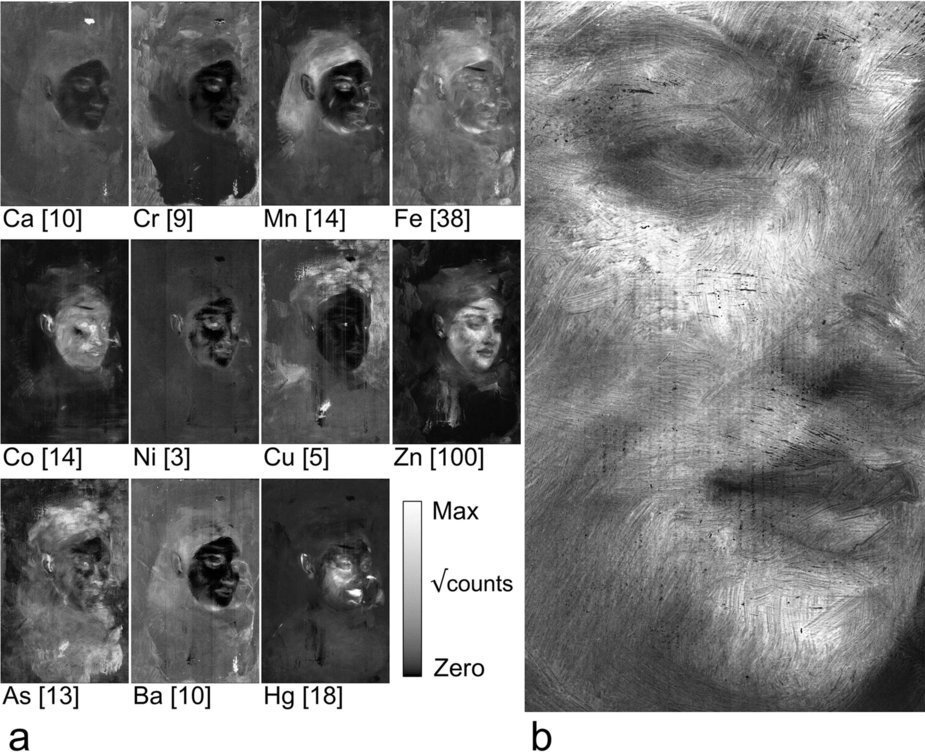
Now, an enhanced process known as X-ray fluorescence elemental mapping gives a far better picture. The technique allowed the researchers to scan for the individual elements — such as iron, zinc and copper — found in different colors of paint. This chart shows maps of elements the researchers tested:

The team said the maps “can be used to deduce pigment use based on the elements observed within the context of the painting.” For example, “Fe and Mn are co-located in the hidden sitter’s hair … strongly suggesting the use of the brown pigment umber.” The researchers detected cobalt in the face, and deduced that it is “probably present as a blue pigment, which is useful in defining flesh tones.”

By layering the elemental maps together, the researchers were able to create this representation of the hidden work:

It didn’t take long for them to identify Dobigny as the painting’s likely subject, study co-author Daryl Howard told the BBC: “Once the image had come through, basically what I did was to look up Degas’s catalogue of works. And I would say in under five minutes, it seemed that we had a good match. … I think the likeness is quote amazing.”

The researchers think at least seven years passed between the two portraits. The earlier work uses lighter and cooler tones, while the later painting is warmer and darker. This was helpful to the imaging process — as the researchers explained, “his change in palette provides exceptional elemental contrast.”

(Left) Eleven elemental maps providing an overview of the construction of the painting. (Right) Detail of zinc map.
(Left) Eleven elemental maps providing an overview of the construction of the painting. (Right) Detail of zinc map. (Scientific Reports)

The X-ray fluorescence technique was previously used on Vincent Van Gogh’s Patch of Grass to reveal a portrait of a peasant woman, as NPR reported in 2008.

The team in Australia said the technology has advanced since then — it’s faster and can measure “spatial resolutions on the order of the size of a paint bristle.”

This technique, researchers concluded, “will significantly impact the ways cultural heritage is studied for authentication.”

Copyright 2016 NPR. To see more, visit http://www.npr.org/.

Knife discovered at Kodiak Community Archaeology site

An archaeology program has discovered a primitive knife in their fourth year of digging the Kashevaroff site at Salonie Creek in Kodiak, one of the many pieces of evidence that point to the site having been a hunting camp.

“We’re down in the very bottom levels of the site, and all the artifacts we’re finding now are like 6 to 7,000 years old,” said Patrick Saltonstall, Alutiiq Museum Curator of Archaeology.

The Alutiiq Museum’s Community Archaeology program led to the discovery of a knife this week.


“We’ve been finding really complete tools, and what’s neat is we haven’t been finding a lot of the debris,” he said. “When you make a tool, you have a lot of flakes and bits of slate and stuff, and we haven’t been finding any of that. We’re just finding tools or the broken tools, ’cause they’ve been bringing them to the site.”

The group is in its  fourth year of digging at the site. Saltonstall said they’re about to finish up on the current section and they’ve been uncovering many objects.

“It’s kind of unique ’cause it’s so big,” he said. “We find a lot of hunting lances that are shaped the same way from the same time period, but they’re about half that size. We’ve never found anything quite that big.

According to the museum website, field and lab work will continue until August 12.

Site notifications
Update notification options
Subscribe to notifications