History

In Quest To Fell Rhodes Statue, Students Aim To Make Oxford Confront History

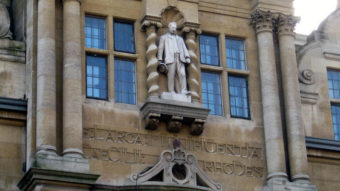
A statue of Cecil Rhodes stands on Oriel College at Oxford University.
Creative Commons photo by
Johnathan

In front of one of the colleges at Oxford University, a statue of Cecil Rhodes stands overlooking the campus. Rhodes, a South African businessman, started the De Beers diamond company and went on to become the namesake of the prestigious Rhodes Scholarship.

He was also a colonialist who believed in the superiority of Anglo-Saxons, and he enforced a policy of racial segregation in South Africa.

Now, because of that history, a growing number of students at Oxford say it’s time to take down the statue of Rhodes.

“We understood that he came and plundered the land, as many colonizers did, and that a lot of people died from what he did. And there’s a lot of structural injustice that resulted from the acts that Rhodes committed,” says Tadiwa Madenga, a student at Oxford and an organizer with the Rhodes Must Fall campaign.

She tells NPR’s Rachel Martin that the campaign is working to make the school confront a history it might not otherwise.

“When I look at the statue, I know of that legacy, but I also see the way Oxford wants to imagine itself today,” Madenga says. “It is only now that we have made them engage with this history, that they have decided that perhaps they don’t condone his actions.”


Interview Highlights

On the defense of the statue voiced by Oxford Chancellor Chris Patten: “People have to face up to facts in history which they don’t like and talk about them and debate them”

We think that debating means really seriously engaging with issues of colonial legacies and taking action to make sure that the university is not institutionally racist, as opposed to just discussing over tea what our opinions are. And so [the chancellor’s] comments, to me, just show this entitlement that certain people in administration have, where if you disagree with them specifically, they feel like you should leave.

On creating debate

First, I want to say that, once again, the university was not confronting this history prior to the movement. We want to say, “What is a public space, and what are statues for?” Statues are there to commemorate and to honor particular people. We do not put up statues of people we demonize for the sake of thinking of history or just debating.

And so we are saying that you can remove the statue, you can put it in a museum where you can continue to discuss and debate. But where it is, at the entrance of Oriel College, at the very highest position above kings and provosts, is just ridiculous. It is not appropriate.

On her experience as a student of color

I think that it’s been shocking in terms of how much people in England really truly believe that colonization was a good thing. …

I think part of the problem in England is that a lot of people, maybe, who haven’t traveled outside of England have not seen the consequences and the legacies of colonialism. So, for some of us students who come from southern Africa, who still know about the racial inequality from particular economic structures, find this shocking when we come to England and people are not aware of the other side of colonization.

On why the movement is happening now

All movements started with different types of protests happening. So, you had the Black Lives Matter movement coming up, you had the Rhodes Must Fall movement in South Africa. And we see these connections, and we say this is also connected to how people look at history.

So, the fact that the university cares more about Rhodes being a benefactor as opposed to the lives that were lost because of his actions, shows the way that people don’t care about black lives. And I think globally there has been a movement to kind of reveal this uncritical way of looking at history and the way that this uncritical reflection of history has led to some of the situations we have now, where black people are still dying over institutional oppression.

Copyright 2016 NPR. To see more, visit http://www.npr.org/.
Read original article – January 24, 2016 7:22 AM ET


In Final Report, Experts Identify Remains At Notorious Reform School

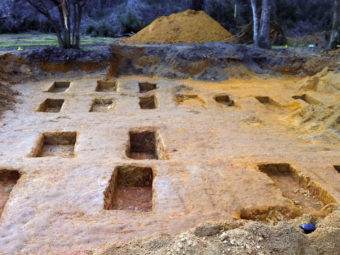
Researchers from the University of South Florida found some of the remains of 55 people in a graveyard at the Dozier School for Boys in Marianna, Fla. USF Anthropology Team/AP
Researchers from the University of South Florida found some of the remains of 55 people in a graveyard at the Dozier School for Boys in Marianna, Fla.
USF Anthropology Team/AP

Florida’s Arthur G. Dozier School for Boys was a horror tale come to life.

“There’s just too many stories,” Roger Kiser, who was at the school in the 1950s, told NPR in 2012. “I know of one [boy] that I personally saw die in the bathtub that had been beaten half to death. I thought he’d been mauled by the dogs because I thought he had ran. I never did find out the true story on that. There was the boy I saw who was dead who came out of the dryer. They put him in one of those large dryers.”

Closed since 2011, the reform school was located in the small panhandle town of Marianna, Fla., and served as a bleak destination for troublemakers, rule breakers and delinquents. In the 1900s, hundreds of boys were sent to the school — some never left.

Historical records show that nearly 100 boys ages 6 to 18 died at the school between 1900 and 1973. Many are not identified and were buried in unmarked locations. Researchers from University of South Florida, led by forensic anthropologist Erin Kimmerle, have spent the past three years exhuming human remains from the school’s land, ultimately discovering 51 sets of remains. The final report released Thursday says “in total, 55 burials were located … at the former reform school.”

It says that 13 of the graves were located in the school’s cemetery and “the rest of the graves were outside this area in the woods, including under a roadway, brush, and a large mulberry tree.” The researchers also announced that “seven positive DNA matches and 14 presumptive identifications have been made,” noting that two of the DNA matches had not been released previously.

The new report is the latest development in a years-long process to identify the remains and reunite them with surviving family members. Many of the remains, however, are still unidentified.

“Kimmerle says her team is committed to working with the families to identify the rest of the remains if possible and the work will continue,” NPR’s Greg Allen tells All Things Considered. Greg, who has reported extensively on the murky history of the reform school, said some of the details surrounding the boys’ deaths are “sketchy.”

In 2012, Greg spoke to men who were sent to the school as children in the 1950s and 1960s.

“A lot of orphans were there that did not have places at times and they were sent to Marianna. They weren’t there for any crime whatsoever,” said Jerry Cooper, who was sent to the school in 1961 when he was 16. “But we had many, many boys who [were] there for smoking in school, that were incorrigible. We weren’t bad kids. We might have needed help in some respect. But that wasn’t the place to find it, I’ll tell you that right now.”

Nicknamed the “White House Boys” after a small but infamous building on school property, called the White House, where violent punishments were meted out, the men described vicious beatings and mistreatment at the hands of school administrators.

In 2008, Florida’s former Gov. Charlie Crist ordered state investigators to look into the allegations of abuse, torture and deaths at the school. The Florida Department of Law Enforcement interviewed the White House Boys and former school staff but said it couldn’t find enough evidence to support the accusations.

The release of the new report isn’t likely to change that. The report does not weigh in on whether anything criminal occurred, saying its stated mission was to identify remains. But some of the details have raised new concerns.

The report says a small lead ball “consistent with [a] Buck size shot pellet” was found in one grave, indicating a possible bullet wound. It also highlights disparities in treatment between black boys and white boys. The school’s demographic was predominantly African-American, and more African-American boys died. But as the report lays out, African-American boys were three times as likely to be unnamed in historical records and buried in unmarked locations.

As for the yet-unidentified remains, their reinterment is something of a sticking point.

“The White House Boys are adamant that the remains should be reinterred far from the old Dozier school and not in the the nearby town of Marianna or even in that county there,” Greg said. “Many feel the town was complicit in the mistreatment of boys who were held at the school.”

He added, “Some officials and business leaders from Marianna … were on hand today here today in Tallahassee to express interest in the future of the 1,400-acre property. One that I talked to said the town was willing to acknowledge its past, to apologize and to move on. Some of the White House Boys told me that they’re now ready to do the same.”

Copyright 2016 NPR. To see more, visit http://www.npr.org/.
Read original article – January 21, 2016 6:45 PM ET

Alaska, Inc: The roots of the Permanent Fund dividend

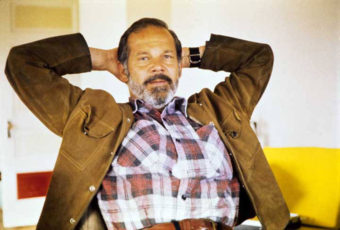
Gov. Jay Hammond was an advocate for Alaska's Permanent Fund. (Photo courtesy of the Alaska State Library)
Gov. Jay Hammond was an advocate for Alaska’s Permanent Fund. (Photo courtesy of the Alaska State Library.)

Faced with a $3.5 billion budget deficit, many lawmakers are considering proposals that would tap the earnings of Alaska’s massive Permanent Fund — and reduce the Permanent Fund dividend.

As the state consider changes to these two very Alaskan institutions, it’s worth taking a look back at how – and why – they were created.
This story starts in 1968. That’s when Humble Oil and Arco announced they had struck oil on state land in Prudhoe Bay, and Alaska officially became a major oil state.

But it really gets interesting in 1969, with the state’s lease sale at Prudhoe Bay. The auction brought in $900 million.

“Which was a pretty big deal, because the [annual state] budget was just about $100 million,” said Cliff Groh, an attorney who worked on PFD legislation in the 1980s. “You have $900 million in one day! You can imagine the excitement.”

Nobody had expected the sale to bring in that much. And yet, by the mid-70s, the money was gone.

“And a substantial number of people in Alaska felt it had been frittered away, wasted, or, to use a blunter term, pissed away,” Groh said.

Groh himself doesn’t think the money was wasted, noting that it was spent on services, especially education, in what was at that point a new and poor state. But the perception that Alaska’s first oil bonanza had been squandered lent strength to a group of lawmakers who wanted the state save some of its oil wealth.

Among them was Jay Hammond, elected governor in 1974.

“You’ve got to remove the money, put it behind a rope, where you cannot utilize it for flamboyant expenditures,” Hammond told KUAC in an interview in 1980.

Even before the Trans-Alaska Pipeline System was built, Hammond and others argued that some of the coming windfall must be put away. But they couldn’t agree on what it should be saved for.

A lot of ideas were thrown out, “ranging from dams to daycare centers,” Groh said. “And some people did say, ‘Save it for a rainy day.’ But that was not the official statement that was offered … there just wasn’t a consensus.”

Groh stressed that one thing really wasn’t a part of the conversation: the Permanent Fund dividend.

“There was a reference to cash payments thrown out as one part of it,” he said. “But it was also in there with dams, daycare centers, and rainy day funds.”

Ultimately, lawmakers simply agreed to take some portion of oil money off the table. Elmer Rasmuson, the first chair of the fund’s board of trustees, said the Fund had a “negative purpose:” just don’t spend the money now.

For Hammond, at least, one purpose was clear. He later wrote, “I wanted to transform oil wells pumping oil for a finite period, into money wells pumping money for infinity.”

And he had another idea in mind: the dividend check. If the Permanent Fund had many parents, the PFD was Hammond’s baby.

Why did Hammond want it so much?

“Because it gave to everybody, from the poorest to the richest, a fair share of the money that they actually own,” says Clem Tillion.

Tillion was one of Hammond’s allies in the legislature during the fight for the Permanent Fund.

“He said, ‘Can you get a bill?’ And I said, well yes,” Tillion recalled. “And he said, ‘Don’t use any machine guns’…He referred to me later as his strong right arm and his swift left foot.”

Once the fund was created, Tillion said Hammond saw the dividend as a way to build a constituency to protect it.

“The dividend was designed to make the people aware that it’s their money,” Tillion said. “This is a share of what their money earns. Not a fixed amount, that’s a welfare check.”

Hammond’s original concept would have granted residents more shares based on how long they’d lived in the state. That idea was declared unconstitutional.

As a 27-year-old aide in the legislature, Clif Groh helped design the backup plan: An equal payment to every Alaskan, the dividend we have today.

In addition to protecting the fund, Groh said the dividend’s creators had several things in mind.

“Jay Hammond was also concerned about what we would now today call crony capitalism,” he said.

Hammond worried that oil money would flow through government programs to the well-connected. And he wanted to make sure some of the money made it out to rural Alaska, instead of remaining concentrated in the Rail Belt. But most of all, he believed Alaskans should have a direct share of their collective oil wealth — a concept he called “Alaska, Inc.”

Exxon Valdez litigation ends, but spill’s legacy may be indefinite

Exxon Valdez Cleanup
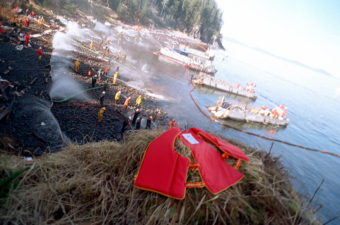
U.S. Navy Mechanized Landing Craft anchored along the shoreline as Navy and civilian personnel position hoses during the Exxon Valdez oil spill clean-up on Smith Island in Prince William Sound, March 24, 1989. (Public domain photo by PH2 POCHE)

Nearly three decades after the disastrous Exxon Valdez oil spill in 1989, the litigation for the remaining cash the state and federal governments could pursue from Exxon is at an end. A clause in the 1991 settlement said up to $100 million could be requested from Exxon for future unknown damage. It was called the reopener.

In 2006, then-Governor Frank Murkowski and the George W. Bush administrations went to court and demanded $92 million of the reopener from Exxon. The company refused to pay. And in October, the Walker and Obama administrations decided to drop the claim.

Former Marine biology professor Rick Steiner has been involved in the fight for compensation from Exxon since the spill. He says there’s no other recourse now.

STEINER: In the end it’s kind of a bitter pill at the end of this long string of bitter pills that we the people and the injured environment have suffered through for the last quarter of a century here.

TOWNSEND: Was the reopener language written in a way that made it sort of impossible to look at it in broad enough terms to say, ‘Well, there might not be lingering effects to this particular species… but certainly to this particular species.

STEINER: The government attorneys — that’s the state attorney general’s office and the U.S. Dept. of Justice — assert that the reopener language in the original settlement was so narrow that it was difficult to activate the claim later on down the road. However, if that’s the case, then that was a fraud initially in the settlement in 1991.

TOWNSEND: Have we, as a nation, at least, learned some lessons that are being applied going forward when there are these kinds of disasters?

STEINER: I would hope that some of the lessons of the Exxon-Valdez and how to manage a disaster like this were applied in the Deepwater Horizon (spill). I was down there working on Deepwater Horizon for several years and some of those lessons were applicable — certainly the reopener that the debacle of the Exxon reopener in Alaska foretold how to do it better in the BP Deepwater Horizon case. And so they did not allow BP any control over these future expenditures. Some of these lessons were applied. What were not, however — for years we pushed for a comprehensive scientific overview, or an audit, of the restoration process.

Over the entire Exxon-Valdez, how restoration funds were spent — scientifically, for research, for habitat… what the difference between Exxon results were from the government research results — which were dramatically different… and the agencies opposed that. Many of the injured habitats and populations have not fully recovered. Some are listed as ‘not recovering at all,’ here 26 years later. Those include herring, pigeon guillemots, marbled murrelets and the AT1 killer whale pod, which is actually expected to go extinct due to losses from the oil spill.

TOWNSEND: Does it feel strange to be at the end of this decades-long fight?

STEINER: Yeah, it does. You know, there were thousands of us who were involved in this in 1989 — actually before 1989! We saw there to be a risk for this sort of thing. Even a couple of years before the Exxon Valdez we tried to set up an RCAC (regional citizens advisory council) in Prince William Sound, which I still to this day believe that if we’d been successful, we would’ve seen the holes in the system and might not have ever had the Exxon-Valdez. But, there’s still more work to be done — both on lingering oil and on these larger habitat deals Bering River, Kenai Fjords, the subsurface deals in Prince William Sound and more ongoing monitoring and research that needs to be done. That will go on indefinitely. And we hope the habitat deals will get done this year.

So while it’s over in one sense, it will never be over in another sense — simply from the fact that there will never be a full recovery from the Exxon-Valdez oil spill. The other thing we’ve learned from this is how delicate these pristine coastal ecosystems can be to (recover) from one day, one wrong decision by a tanker captain. Here we are, 26 years later, still dealing with the fallout from that, and still possibly with residual oil on the beaches that could be there for centuries. I guess that take-home message is if we’re going to do these large-scale, risky developments in precious coastal areas, we have to do it with exceptional care. We aren’t there yet. We didn’t do it with the Arctic drilling (in the Chukchi) last summer, you know. Hopefully, those lessons will be applied somewhere in the future. So we’re at the end of part of it… but in an interesting way, it will never be fully over.

Rick Steiner is a marine scientist and longtime critic of the Exxon Valdez settlement terms.

Southcentral village of Nanwalek celebrates Slaviq

Subdeacon Ephim Moonin leading the Orthodox Christmas Eve celebration at Saint Sergius and Herman church in Nanwalek. (Photo by Daysha Eaton/KBBI)

Orthodox Christians in communities across Alaska celebrated Christmas Jan. 7. In the village of Nanwalek on the southern Kenai Peninsula, people spent Christmas Eve singing at the Saint Sergius and Herman church.

In the community of about 300 people, many of who are of Alutiiq (also known as Sugpiaq) descent, they sing in Slavonic, a liturgical language used by the Orthodox Church in Russia and Eastern Europe. It’s a remnant of the fur trade era and Russian colonialism.

11-year-old Tikhon Kvasnikoff starring at Chief John Kvasnikoff's house in Nanwalek on Orthodox Christmas Eve, Jan. 6th. (Photo by Daysha Eaton/KBBI)
11-year-old Tikhon Kvasnikoff starring at Chief John Kvasnikoff’s house in Nanwalek on Orthodox Christmas Eve, Jan. 6th. (Photo by Daysha Eaton/KBBI)

Starring followed Christmas Eve services Wednesday. Nanwalek resident Sperry Ash says the practice represents the journey of the three wise men.

“Each region in Alaska that practices this style of caroling, what we call Slaviq, they all have variations. But generally they follow a star, a wooden frame that’s decorated with the icon of nativity in the center and that star guides the carolers house to house,” said Ash.

Food and treats are offered to the visitors at each house.

“Starring is really an enjoyable event – to be able to go house-to-house and see each family and greet them. That fellowship is really special at this time of year,” said Ash.

Nanwalek used to be known as English Bay. The village was originally the site of a Russian trading post called Alexandrovski during the fur trade of the 1700s. Locals changed the community name back to the original Native name of Nanwalek, meaning “place by a lagoon.” Nanwalek is situated along Cook Inlet at the southern tip of the Kenai Peninsula.

Starring starts at the chief’s house. Subdeacon Ephim Moonin says a prayer. Then the singing starts in front of an icon on a shelf beside the family Christmas tree.

Chief John Kvasnikoff says the tradition and the story of the nativity are important to preserve in the face of outside influences.

“We got a lot of influences you know, internet and all this new technology. Kids are seeing, you know they see outside. But people can see in here too. And I’m glad they’re still holding onto it. It makes you a better person. It makes you want to help people who need help,” said Kvasnikoff.

Next they’ll star at the houses of newborn babies and elders, like Sally Ash, Sperry’s mother. She’s is the Sugt’stun language teacher in Nanwalek and she says she’s teaching all her grandchildren the language. Ash say she enjoys the Slavonic hymns, but says, in the future, she’d like to see some songs sung in Sugt’stun too.

“The kids, if they don’t know who they are, us being Sugpiaq, and if they don’t know their culture and their religion, they just get lost – just be a lost soul and then they follow what’s on TV. And so I think it’s really important that they know not only Christmas but also Pascha and other major feasts we celebrate throughout the year. It’s very important, yeah,” said Ash.

Pascha is Easter. Some holiday tables will have traditional octopus and chiton, or as the locals call them bidarkis or, in Sugt’stun, Urritaq gathered from the local reef, along with dry fish and seal oil, says Ash.

Food is a big part of the holidays in Nanwalek and the table is a mix of Russian, Sugpiaq and Western influences. She has a pot of turkey soup on the stove she says because the store had to give away defrosting turkeys due to a power outage last week. And having the power out has set everyone behind on their holiday preparations. With the power back on people are out to get what they need, like Adelle Kvasnikoff, the Chief’s niece.

“We have pilot crackers. So we’re going to prepare a traditional pilot cracker with salmon eggs and cream cheese. And my husband loves to use the Nally’s chili and we mix it with fresh cheddar cheese and we melt it together and we get tortilla chips and use it as a dip. And I grabbed a couple of small candies for stocking stuffers for my kids tomorrow,” said Kvasnikoff.

Orthodox Christians celebrate Christmas on January 7th, according to the Julian calendar. Starring will continue for the next several days. The holiday season runs through the Orthodox New Year on January 14th.

The holiday is also celebrated in Anchorage, the Y-K Delta, Southeast, Kodiak and along the Aleutian chain.

Stomach Of Ancient Iceman Held Microbes Like Ours

The stomach of Oetzi, who was mummified in ice, was home to bacteria that scientists were able to identify. The same species lives in the gut of many modern humans. EURAC/Marion Lafogler
The stomach of Oetzi, who was mummified in ice, was home to bacteria that scientists were able to identify. The same species lives in the gut of many modern humans.
EURAC/Marion Lafogler

Researchers have looked in the stomach of an ancient ice mummy and found the remains of the bacteria that lived in his gut. The results, published in the journal Science, suggest that the community of microbes living on and in humans has existed for millennia.

Roughly 5,300 years ago, this particular man was hiking across the Oetztal Alps between what’s now Italy and Austria when somebody shot him in the back with an arrow. The remains of the fellow, who came to be called Oetzi the Iceman, made headlines when discovered in 1991.

“He’s very well-preserved. You can see that all his tissues and also his skin is still preserved,” says Albert Zink, the head of the Institute for Mummies and the Iceman in Bolzano, Italy.

Years of study revealed details about the iceman’s diet, health and genetic heritage.

But there was one place researchers had yet to probe: his stomach. For a long time, they couldn’t even find it because it had shriveled up over the centuries. Then, about five years ago, a researcher finally spotted it, and saw it was full of material.

The scientists wanted a sample, so they went in. During the procedure there were so many doctors in the room it actually felt like a surgery on a living person, Zink says.

Inside they found the iceman’s last supper: meat from a deer and an alpine mountain goat.

“He obviously had a big meal before he died,” Zink says.

Perhaps more interesting, the researchers found DNA from a type of bacteria that lived in his gut called Helicobacter pylori.

Today, H. pylori can be found in about half of the world’s population, according to Martin Blaser a physician and microbiologist at New York University, who wasn’t associated with the study.

“In people who have it, it’s the dominate organism in their stomach,” he says.

After it was identified in 1982, scientists pegged it as a harmful pathogen. Researchers have found it causes ulcers and stomach cancer. But more recent work by Blaser and others has shown it also seems to provide benefits. It can protect against some common illnesses, including acid reflux and asthma.

“The story is complicated,” Blaser says. “And that actually fits in very nicely with this paper because it’s consistent with an organism that’s been around for a very long time in humans.”

In fact, H. pylori is part of a much larger community of microbes that live on, and in, virtually every part of the body. Increasingly, researchers suspect this microbe influences our health in many different ways. Finding H. pylori in such an ancient specimen seems to confirm that it has been doing so for a very long time. “It’s like finding a fossil,” he says.

Based on genetic evidence, Blaser believes the H. pylori bacterium has been helping and hindering humans since way before the iceman. He thinks it has been passing from generation to generation for hundreds of thousands of years.

Copyright 2016 NPR. To see more, visit http://www.npr.org/.
Read Original Article – January 7, 2016 5:11 PM ET
Stomach Of Ancient Iceman Held Microbes Like Ours

Site notifications
Update notification options
Subscribe to notifications