History

Language matters: The alleged disappearance of Áak’w Kwáan, T’aaku Kwáan


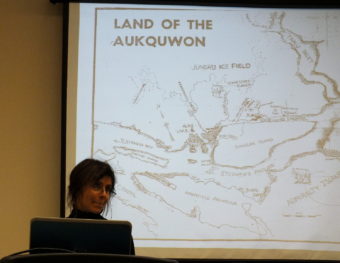
Anastasia Tarmann with the Alaska State Library and Historical Collections gives a presentation at Sharing Our Knowledge: A Conference of Tlingit Tribes and Clans on Oct. 29. (Photo by Matt Miller/KTOO)


What happened to the Áak’w Kwáan and T’aaku Kwáan? Did they all die of disease? Become assimilated? Move away?

A state researcher challenges the modern day, persistent narrative implying that local Tlingits seemed to have just vanished as soon as non-Native settlers arrived in the area.

Anastasia Tarmann with the Alaska State Library and Historical Collections explained her ongoing research during a session at “Sharing our Knowledge” clan conference held recently in Juneau.

“The stories that we tell ourselves, these interpretations, they reinforce or they cultivate relationships,” Tarmann said. “They can make relationships. Or they can just reinforce old messages. … They are our identities. And they also are possibilities.”

Tarmann pointed to recent interpretive signs for the new Brotherhood Bridge and the Auke Village Recreation Area as examples. The wording and the past-tense language implies that the Áak’w Kwáan either moved on from the area or abandoned their winter village early last century.

Tarmann highlighted the Brotherhood Bridge sign: “It says, ‘Although changes in Áak’w Kwáan lifestyle occurred, they continued to live in their traditional homeland.’ That bothers me. I’m sure it bothers you.”

Then, for the Auke Village sign, Tarmann noted: “By 1900, most of the Natives had moved to Juneau to work in the mines, and by 1926 all structural remains of the village were gone.”

“It’s like Áak’w history is a preface to Western history,” Tarmann said.

In Berners Bay, the forest was clear cut by gold miners in the area.

In 1962, Douglas Village Natives were forced from their homes without compensation and the village was burned down while many villagers were at their fish camp on the Taku River. The City of Douglas seized the land for a harbor project.

There’s an old saying that history is written by the victors, or the occupiers. Based on Western ideology and values, Tarmann said it seems that local history really didn’t start until after the United States took possession of the territory and the Gold Rush started. Does morality and virtue really only begin with Western civilization?

“When the signs, these interpretations speak in the past tense, and when they talk about people having left their lands, it really seems inaccurate,” Tarmann said. “I know, I see, I’ve been told that T’aaku and Áak’w people are alive and well, and continuing.”

Several attendees of the Tarmann’s presentation stood up and spoke afterward. They pointed out that the Áak’w Kwáan and T’aaku Kwáan have always been here, and will continue to be here.

Preview of new Alaska Native exhibits at SLAM

State curator of collections Steve Henrikson explains their plans for exhibits in the Father Andrew P. Kashevaroff State Library, Archives and Museum. (Photo by Matt Miller/KTOO)

State museum officials say they have an opportunity to do something they’ve never done before.

“It’s a pretty tall order to wrap your head around the task that we’ve been put to, which is to build a whole new exhibit from scratch basically,” said Steve Henrikson, curator of collections at the old Alaska State Museum.

He said some of their old exhibit displays used to be cobbled together on a shoestring and with salvaged materials.

That’s not the case for the Father Andrew P. Kashevaroff State Library, Archives and Museum that’s under construction in downtown Juneau. Henrikson continues as curator of collections at the new facility.

Grand opening is in May for the Father Andrew P. Kashevaroff State Library, Archives and Museum in Juneau. (Photo by Matt Miller/KTOO)

“In this project, we actually had millions of dollars to totally redo the exhibits,” Henrikson said.

Henrikson said they’ve been helped by community curation, or consulting community members from various Alaska Native tribes about selecting items for their permanent exhibits and how they should be shown.

Henrikson provided an update on exhibit planning during a presentation at the “Sharing Our Knowledge” clan conference held recently in Juneau.

He said they’ll show Native artifacts from all regions of Alaska, but their displays will likely have a Tlingit emphasis since the museum is located in the heart of Tlingit territory.

“The theories of how migration happened or if it happened, and in what direction are changing so much that we’ll try to reflect some of that uncertainty in the exhibits,” Henrikson said. “We’re trying to get away from having definitive answers about history that’s contested.”

Henrikson said original house posts and a house screen that were on loan and displayed in the old museum’s Tlingit clan house have been returned to Klukwan and Seattle. A new Tlingit clan house is now being built inside the new museum.

“When houses like this have been put into museum exhibits before, there’s been a tendency to try to skirt the thorny issue of whose house to put up by creating something that never really existed before,” Henrikson said. He used the example of an Eagle-Raven house, or a house that had everybody’s crests on the house posts.

As a result, Henrikson said visitors are usually confused.

Instead, he said they’re working with Áak’w Kwáan members to accurately depict the house as belonging to a representative clan of one moiety as the host. Hats from the other moiety will be on display inside the clan house.

“And so, the balance is achieved,” Henrikson said. “It’s a realistic scenario then of the hats inside representing guests coming to a ku.éex’. And then the host clan is the one that has its crests on the screen and the house posts.”

The clan house will include objects ranging from several hundred year old artifacts to contemporary Native art, like a painted panel by Jim Schoppert.

State curator of collections Steve Henrikson highlights a 6,000 year old recovered basket fragment (right) and a replica (left) made by noted basket weaver Delores Churchill. (Photo by Matt Miller/KTOO)
State curator of collections Steve Henrikson highlights a 6,000-year-old recovered basket fragment (right) and a replica (left) made by noted basket weaver Delores Churchill. (Photo by Matt Miller/KTOO)

“It’s going to be continually reinforced that Alaska Natives, Tlingits and other tribes are still here and still doing many of their traditional activities,” Henrikson said.

“So, there won’t be this implicit understanding that all of those people were just in the past and have been assimilated.”

Elsewhere in the museum, Henrikson said cross cultural exhibits will show similarities and compare differences between all Alaska Native groups and tribes on trade, art, basketry, bentwood objects and water craft.

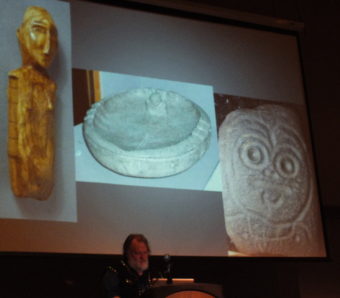
A 6,000-year-old fragile basket fragment may be exhibited if museum officials can protect it from vibration, even visitors’ footsteps can be destructive. Other key early objects on display will include an ivory figurine from St. Lawrence Island, a stone oil lamp from Kodiak Island, and a petroglyph from Southeast Alaska.

Henrikson said they’ll likely use plain body forms for clothing displays, and avoid the controversial practice of using lifelike mannequins to represent Native people.

Artifacts from the Haida, Tsimshian, Athabascan, Yup’ik, Iñupiaq, Alutiiq and Aleut peoples will also be exhibited, as well as items from European contact, the Russian era and the American period. All of the displays will flow together in a partial loop around the first floor exhibit area.

“We really feel strongly that in this area, particularly, where we talk about the Alaska Native response to colonialism, that we have to talk about the negative things,” Henrikson said.

“Once we have an understanding about that, we can talk about how the resilience of the people allowed them to survive through it.”

State curator of collections Steve Henrikson talks about key artifacts from the origins of Native peoples in Alaska. They include an ivory figurine from St. Lawrence Island, a stone oil lamp from Kodiak Island, and a petroglyph from Southeast Alaska. (Photo by Matt Miller/KTOO)

Museum officials plan to display Tlingit armor, the white man crest from the top of a Tongass village totem, a replica of a possession plate buried by Russians to mark their territory, a portable American cannon, an unexploded shell and a beaver bowl recovered from the 1882 bombardment of Angoon and part of a whale harpoon used to kill a shaman.

“There’s been a lot of talk lately about the concept of ‘Why can’t Alaska Natives just get over it?’ This is the evidence, the physical evidence showing why they can’t just get over it,” Henrikson said. “It’s the same as if we were presenting a legal case.”

Henrikson said they’re consulting with clans about the display of such sensitive items.

He said exterior work and landscaping is largely complete at the $139 million museum facility, and interior work is now underway.

As many as 90 new exhibit cabinets and cases will be arriving in January. Artifacts will be installed and labeled over the winter.

The grand opening of the Father Andrew P. Kashevaroff State Library, Archives and Museum is planned for May.

35th Anniversary of the Prinsendam, Part 1: The Rescue

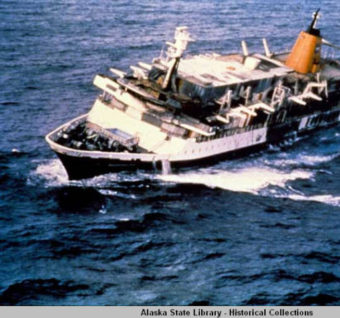
October 4th marked the 35th anniversary of the sinking of the Prinsendam. The cruise ship was abandoned 200 miles off the coast of Alaska due to fire. Over 500 passengers and crew were rescued. (Photo courtesy of the Alaska State Library

It’s been called the greatest high seas rescue in the history of the Coast Guard. 35 years ago on October 4th, the luxury cruise liner Prinsendam caught fire in Gulf of Alaska, between Yakutat and Sitka. Despite an incoming typhoon, 30-foot seas, and 100-meter visibility, every one of the more than 500 passengers and crew escaped before the ship burned and sank.
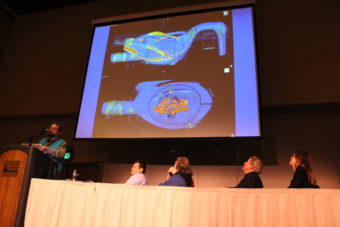
Earlier this month members of the US Coast Guard and Air Force, and their Canadian counterparts, gathered in Seattle for a reunion. In Part 1 of a three-part series on the Prinsendam anniversary, KCAW’s Rich McClear headed south to join them – and reflect on his own role in the emergency. 35 years ago, McClear, was about to leave KTOO in Juneau to start the public radio station in Sitka.

Oct. 4, 1980, was Juneau’s 100th birthday and the city was in the mood to party. The Coast Guard Cutter Boutwell was in town, up from Seattle, to help with the celebration. The bars were full of Coasties.

Sitkan Doris Bailey was in Juneau and remembers how her husband, Roy, first learned that the party was over. “Some boat started tooting blasts on the horn and Roy jumped out of bed and said “Oh My Gosh, every coastguard person is being called back to the ship, all leave is canceled,” Bailey said.

That was around 1 a.m. in the morning. The Boutwell’s captain, Lee Krumm, was scheduled to be the Centennial Parade Grand Marshal. He was enjoying himself in a Mendenhall Valley tavern when he was called to the phone.

Lee Krumm:  I went up and got the microphone from the band and said, ‘Anyone from the Boutwell in here get yourselves downstairs. We’re heading back on the ship. We have a cruise ship on fire.’ We had people actually sitting in the trunks of cars with their legs hanging out the back getting them back to the ship.

The Juneau police and volunteer fire department went to every bar rousting out crewmembers.  Seaman Dan Long was on the ship helping load the crew back on board. Long remembered the process. “One guy take the arms, one guy take the legs, haul them on board and dump them on the flight deck – those guys who couldn’t walk under their own power,” he said.

But in two hours the Boutwell was ready to sail with only nine crew members missing. In Sitka, the Woodrush was also underway and two helicopters from Air Station Sitka were heading to the ship.

Aboard the Prinsendam, the fire spread. She was dead in the water. The captain gave the order to abandon ship. John Graham was the ship’s lecturer and recalled, “In the beginning the seas were relatively calm. We were put into the lifeboats in the middle of the night. It was kind of an adventure. People did sing along to old campfire songs.”

At daybreak, the helicopters started hoisting passengers. They ferried the survivors to the Exxon Williamsburgh, which heard the SOS. Fortunately, the tanker had a helipad and was fully loaded with crude oil, making it stable in the rising seas.

Every few trips the helicopters had to refuel, so they carried their passengers to Yakutat.

Pete Torres was on the crew of one of the Kodiak choppers and said, “The people had been sitting cramped in a lifeboat for up to 10 to 12 hours. By the time they got into the helicopter, they couldn’t get themselves out of the basket. We would actually have to pick them up and move them back to the back of the helicopter.” He added, “There weren’t enough troop seats in the helicopter, so after a while a lot of the passengers would actually have to sit on the deck in a pile.  I think on our last run we had up to 16 survivors on our helicopter.”

The Prinsendam on a postcard, pictured at Skagway before the fire. (Photo courtesy of the Alaska State Library)

The Prinsendam passengers who flew to safety may have been the lucky ones. As the day wore on, the weather deteriorated.

Passenger John Graham said this is when survivors in the lifeboats began to feel desperate. “Finally the typhoon hit us full force. Winds gusting up to 60 knots. 30 foot seas. And we were all hypothermic. We were all seasick. At about 5 o’clock, the storm was so bad that the helicopters couldn’t fly anymore.  So our only hope was that there something out there on the sea that could rescue us,” he said.

Graham’s boat was eventually found by the Boutwell. She had arrived from Juneau and began taking survivors aboard. It wasn’t easy.

First they sent a launch to transfer survivors from the lifeboats to the ship. That didn’t work so well, Dan Long recalls. “We went out and got to the first lifeboat. Well, the crew from the Prinsendam, they were just panicked. We wanted to take the elderly on board first. They were climbing over the elderly and climbing onto our boat because they were so afraid. It was this total mayhem. Our boat quickly filled up and we couldn’t get the elderly off the lifeboat.”

Instead, the launch towed the lifeboat to the Boutwell, but most were not able to climb the 40-foot Jacob’s ladder to the ship. Their hands were cold, and they could not grip the rungs. Long said, “We just sent a man down with a horse collar and manually hauled them up one by one,” using a hand winch.

And that’s the way the Boutwell brought all the survivors from the remaining lifeboats aboard – or so they thought.

Lt. Colonel Dave Briski, the pilot of an Air Force C-130, was unwilling to call it a day.

Lt. Dave Briski:  I called the Coast Guard and I said, “What’s the status of the mission?’ They said, ‘Well, everybody’s been picked up. We’re closing down the mission down.’ And I said, ‘Are you sure you’ve got everybody picked up?’ And they said, ‘Yes everybody’s picked up.” And I said, ‘OK, the last I heard, the Air Force helicopter, the boat they were picking up people from, had two of our PJs, or pararescue men, and about 18 to 20 people from the ship.  Can you confirm those people were picked up?” They said ‘Yeah, they’re all picked up.’ I said, ‘Well give me the names of the two PJs and then I know you’ve got ‘em. They insisted they were going to close the mission.  I called the Rescue Coordination Center back at Elmendorf and I said ‘Hey, I don’t think they’ve got everybody picked up.’

Briski was right. The Boutwell and Woodrush sailed search patterns in the area where the lifeboat was last reported. Just before 2 a.m., the Boutwell found the missing lifeboat and hauled its passengers aboard. The mission was closed, but for the residents of Yakutat, Sitka and Valdez, the rescue of the Prinsendam was just beginning.

The end of the mission at sea was the beginning of the rescue on land, as the more than 500 passengers and crew of the Prinsendam were brought ashore with only the clothes on their backs. In Part 1 of this series tomorrow, KCAW’s Rich McClear talks with Sitkans who lent a hand – and much more – to the survivors of the Prinsendam.

This story is Part 2 in a series to commemorate the 35th Anniversary of the Prinsendam Rescue. Here is Part 1 and Part 3Click here for more historic photographs of the Prinsendam sinking, courtesy of the Alaska State Library.

How 3D printing helps preserve and return sacred Tlingit objects

This Tlingit rattle was scanned and 3D printed with the beads inside. (Photo by Elizabeth Jenkins/KTOO)
This Tlingit rattle was scanned and 3D printed with the same size beads inside. (Photo by Elizabeth Jenkins/KTOO)

The Smithsonian is using 3D printing and scanning technology to preserve and repatriate Hoonah Indian Association items.

But because they’re culturally sensitive objects, being able to make infinite copies isn’t necessarily a good thing. At last week’s Sharing Our Knowledge” clan conference in Juneau, participants learned how tribal members are adapting the new technology.

A group of people crowd around a small table in the back of the conference room at Centennial Hall. The 3D printed objects are carefully laid out. They’re gray and beige. Most are not painted yet.

Eric Hollinger and Robert Starbard put the replicas away. KTOO obtained permission to photograph the objects. (Photo by Elizabeth Jenkins/KTOO)
Eric Hollinger and Robert Starbard put away the replicas. Photography can be a sensitive subject when it comes to shamanic objects. These were photographed with permission. (Photo by Elizabeth Jenkins/KTOO)

Although these items are replicas, we are advised we can look but can’t touch. Robert Starbard, the tribal administrator for the Hoonah Indian Association, handles the copies with gloves.

The original items are yéik: objects that have a spirit embedded in them.

Eric Hollinger, a repatriation case officer at the Smithsonian, said traditionally they would have been left at the above-ground grave houses of Tlingit shamans.

“Some shamanic objects have actually been passed on from multiple shaman. They may be hundreds of years old before they were removed and sold into museums illegally,” Hollinger said. “And that’s what happened with these objects.”

After a repatriation request, the ownership was transferred back to the Hoonah Indian Association in 2013. But the items remain in the Smithsonian.

“They’re on a five-year loan to us while we explore this project together and CT scan it, but they own and control everything about ‘em,” Hollinger said.

That’s right. A CT scan, like the medical machine that shows the inside of your body. Except, this scan creates 3D digital renderings that can be printed or studied.

In 2005, the National Museum of Modern History repatriated a killer whale hat belonging to the Tlingit  Dakl’aweidí. With the clan’s permission, the hat was recreated. It’s now used for educational purposes and in the museum’s exhibition.

Robert Starbard said, during the panel, that most of Hoonah’s cultural items were lost in a fire in 1944.

“In one of the few places that we had access to some of these cultural objects, that were otherwise stolen from us, were in the museums,” Starbard said.

https://www.youtube.com/watch?v=P7MndvEcUcQ

He said the partnership with the Smithsonian provides two things: copies of the items in case something happens, and educational opportunities.

“Where we could take these objects and with our elders and our youth actually start sharing some of the stories and some of the histories and some of the techniques that went with them,” Starbard said.

Throughout the process, Starbard has been consulting with the elders and will continue to do so about the items’ sensitive nature.

He said it’s never easy to take a new technology and start using it for something that’s culturally and historically significant to the clans.

“And so there is a level of suspicion, there’s a level of distrust, and there is an apprehension to move forward, which is why we’re doing it in an incremental, very slow process.”

The Hoonah Indian Association is involved in another repatriation claim with the University of Pennsylvania. So far, Starbard said the college hasn’t been receptive. But he hopes the partnership with the Smithsonian can serve as an example.

“Even if they are replicas for display or in the case of UPenn they’re sitting in the backrooms, perhaps we’d be able to move that relationship off of the standoff that we have now,” Starbard said.

Tlingit artists in Hoonah will be painting the items and milling their own paddles and masks from the scans.

How researchers use traditional place names and knowledge

Dr. Fred Sharpe gives a presentation on the importance of traditional knowledge and place names in ecological research. (Photo by Jennifer Canfield/KTOO)
Behavioral ecologist Fred Sharpe, Ph.D., gives a presentation on the importance of traditional knowledge and place names in ecological research. (Photo by Jennifer Canfield/KTOO)

Using traditional knowledge to support ecological research was the focus of two presentations Saturday at the “Sharing Our Knowledge” Tlingit clan conference.

Behavioral ecologist Fred Sharpe, Ph.D., of the Alaska Whale Foundation, explained to attendees how researchers were using Tlingit place names to help better understand the historical ecology of Southeast.

Sharpe is most concerned about the eastern North Pacific right whale, a highly endangered species with an estimated population of about 30. He said the names of traditional sites or clan houses can indicate that a particular species once populated the area; that’s information that could help researchers understand why a species is in decline.

“Place names can be very instructive,” Sharpe said. “We learned that there’s a place on Chichagof island called Sea Otter Point. And that’s super cool because sea otters aren’t there (now) but it does suggest that they were there in the not-too-distant past.”

Sharpe said Tlingit traditional knowledge has influenced how he thinks about whales.

“I think that gaining some insight into the Tlingits’ perspective has really helped me see how a people can live for centuries, millennia, perhaps even longer with these animals and appreciate them in a nonconsumptive context,” he said. “We see that they loved them and were very proud of them. We take incredible inspiration from that to see how you can intelligently manage species.”

Using Tlingit perspective and knowledge as a guide, Sharpe said he hopes to find ways to return to a more equitable relationship with Southeast’s whales.

Another presenter, Allyson Olds, focused her master’s thesis on hooligan run times in the Chilkat and Chilkoot rivers. The main goal of her research was to establish a baseline for the annual arrival of the fish. Aside from other forms of research, Olds interviewed 20 people in the area to understand how the population has changed.

Allyson Olds points to the area where she focused her research on hooligan run times. (Photo by Jennifer Canfield/KTOO)

Little research has been done on the fish, which are not currently harvested commercially.

Hooligan is a subsistence food source in Southeast and parts of Southcentral. The small, oily fish usually arrive in Alaska streams and rivers in early summer to spawn, making them one of the first fish available for harvest by subsistence users and wildlife.

Understanding how climate change may impact run times could be key to sustainable management of the fishery, Olds said.

“There’s big implications on the influence of climate change, which not only affects run timing of course,” Olds said. “It affects everything else since so many wildlife predators rely on these. … They’re not just there, they migrate and they show up for these runs. If that run timing is changing, it can also affect their migrations as well.”

Olds said there is some concern that hooligan population decline is making its way north. On the Pacific coast, the once-prolific forage fish was listed as threatened under the Endangered Species Act in 2010. The following year, British Columbia listed the fish as endangered. Earlier this year, the Alaska Department of Fish & Game closed the Ketchikan area fishery.

Ideally, Olds said, her research would be replicated in other spawning areas to help paint a more accurate picture of the health of the hooligan populations.

Pioneering Alaska Native civil engineer: Bridge design became my thing

Roy Peratovich Jr. stands next to one of the bronze medallions he designed for the first Brotherhood Bridge created in 1965. The medallions were recovered, restored and installed on the new Brotherhood Bridge that was dedicated Oct. 24, 2015. (Photo by Matt Miller/KTOO)
Roy Peratrovich Jr. stands next to one of the bronze medallions he designed for the first Brotherhood Bridge created in 1965. The medallions were recovered, restored and installed on the new Brotherhood Bridge that was dedicated on Saturday. (Photo by Matt Miller/KTOO)

Roy Peratrovich Jr. says he never had any intentions of becoming a bridge designer. He just sort of fell into the profession.

“By doing other things that civil engineers don’t do: digging ditches, working in construction, and just doing some miserable jobs,” Peratrovich says. “And I said ‘I don’t want to be doing this all the time.’”

Peratrovich, a designer of the original Brotherhood Bridge that was completed in 1965, was in Juneau for last weekend’s dedication of the new Brotherhood Bridge. It’s the fifth bridge for the Glacier Highway crossing at Mendenhall River and the second bridge honoring the Alaska Native Brotherhood, the organization created in 1912 that advocated for Alaska Native civil rights.

Brotherhood Bridge
Construction plate for the old Brotherhood Bridge. (Photo by Matt Miller/KTOO)

After graduating from the University of Washington in 1957, Peratrovich says he was newly married and needed a job. He was hired by the City of Seattle largely because he got an ‘A’ in a bridge design class.

“At that time, there were no overpasses, no freeway systems, and we got involved in designing one of the first interchanges, separated interchanges,” Peratrovich says. “There’s a lot of firsts that we worked on down there. I found I had a natural leaning toward that. I just loved it. Bridge design became my thing.”

Peratrovich, who says he is the first Alaska Native to be registered as a professional civil engineer, later returned to Alaska shortly after statehood.

Peratrovich gets a lot of recognition for designing the original Brotherhood Bridge, but he credits his boss, chief bridge engineer Charlie Smith, with coming up with the idea.

Brotherhood Bridge
View of now-dismantled Brotherhood Bridge, pile template, and work trestle for the new bridge at Mendenhall River. Bronze medallions have already been removed from the pedestrian hand railing. (Photo by Matt Miller/KTOO)

“He learned of my Tlingit background and I kind of told him – and this is talking to him in 1962 – 50 years ago ANB was formed,” Peratrovich says. “Later on, he came back to me and he said, ‘We need to do something to celebrate that, for the ANB. Maybe we should do something with the bridge.’ At that time, it was called the Mendenhall River Bridge, bridge number 737.”

The Brotherhood Bridge symbolized the bridging of the gap between Native and non-Native Alaskans, and the project allowed Peratrovich to incorporate his first love, art, into his profession.

Peratrovich says he and Smith figured out a way to make the bridge unique and distinctive, and also honor ANB by installing art in the bridge railings.

Peratrovich remembers being inspired by a small medallion that he borrowed.

“Kind of a dollar, a bronze dollar that was made with that medallion picture on it, only a lot cruder,” Peratrovich says.

He enlarged the design so that it was 2 feet in diameter and redid it with the ovoids and other formlines seen in Northwest Coast art. Eagle and Raven, representing Tlingit moieties, face each other and both are standing on a rock that represents ANB.

Peratrovich says bridge superintendent and silversmith artist Tom Paddock carved the design into a plank of yellow cedar. At Seidelhuber Iron & Bronze Works of Seattle, the wood was pressed into oiled sand. Aluminum was poured into the sand to create a master mold for the bronze casting.

Listen to Roy Peratrovich Jr. describe creation of the bronze medallions for the Brotherhood Bridge built in 1965:


Peratrovich remembers the original medallion installation: “I think I used a stainless steel bolt in that thing and left a big enough gap in here so there wouldn’t be any contact between this and the metal. Bronze and steel will react to one another. You’ll end up eating away the bronze. Electrolysis.”

Peratrovich says three additional medallions were made. He gifted the first one to the Sitka ANB camp, where it started. A second medallion was loaned to his dad, and it eventually made its way to the ANB camps in Anchorage and then Ketchikan.

Peratrovich says he eventually got one to keep himself.

Roy Peratrovich Jr. is the son of Alaska Native civil rights leader Elizabeth Peratrovich. Among those attending the dedication of the original Brotherhood Bridge was his dad, Roy Peratrovich Sr. who represented the Alaska office of the Bureau of Indian Affairs and his uncle, Frank Peratrovich, a state senator from Klawock.

Medallion's surface texture still reflect the marks by Tom Paddock when he carved the cedar for the Brotherhood Bridge medallions fifty years ago. (Photo by Matt Miller/KTOO)
The textured surface of the medallion comes from Tom Paddock’s carving 50 years ago. (Photo by Matt Miller/KTOO)

The 10 medallions from the old bridge were recovered, restored and installed on the upstream pedestrian railing of the new Brotherhood Bridge. Pedestrians can see large concrete replicas of the medallions that have been mounted on the side of the bridge abutments.

The John O’Connell Memorial Bridge in Sitka — considered as the first cable-stayed vehicular bridge in the country — and the West Seattle Bridge were among the other projects that Peratrovich says he worked on.

After leaving state service, Peratrovich and a friend created the consulting and design firm Peratrovich & Nottingham, later called Peratrovich, Nottingham and Drage, and then PND Engineers, Inc.

“It’s been an interesting career,” Peratrovich says. “Then after I retired, I took up art. So, I did a lot of bronze.”

Now 81 years old, Peratrovich creates art in his studio in Gig Harbor, Washington. His 10-foot bronze sculpture, Flight of the Raven, located at Fourth and E streets in Anchorage, was created to honor his parents and tells the story of how Raven brought light to the world. He currently creates bronze sculpture, mostly smaller pieces, with the lost wax casting method.

Site notifications
Update notification options
Subscribe to notifications