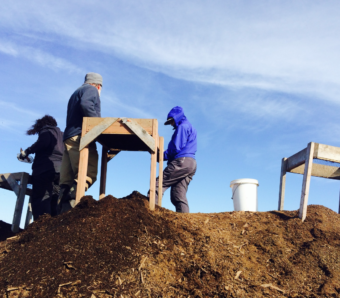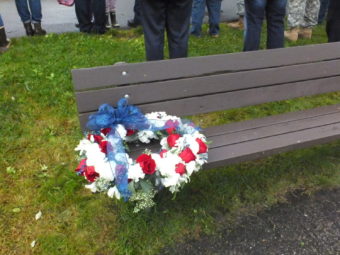
History

Obama: Katrina A ‘Man-Made’ Disaster Caused By Government Failure

President Obama greets residents in New Orleans on Thursday while in town to mark 10 years since Hurricane Katrina. Andrew Harnik/AP
President Obama greets residents in New Orleans on Thursday while in town to mark 10 years since Hurricane Katrina.
Andrew Harnik/AP

A decade after Hurricane Katrina — the costliest natural disaster in U.S. history — President Obama told a crowd in New Orleans that the storm was a “man-made” calamity that had as much to do with economic inequality and the failure of government as it did the forces of nature.

“What started out as a natural disaster became a man-made disaster — a failure of government to look out for its own citizens,” the president said in a speech at a newly opened community center in the Lower Ninth Ward, a predominantly black neighborhood that was devastated by Katrina.

Obama was a freshman U.S. senator from Illinois when Katrina struck New Orleans on Aug. 29, 2005.

The storm smashed the Gulf Coast from Texas to central Florida, causing power outages and a massive storm surge that topped the levees in the city, causing massive flooding. Nearly 2,000 people died, most in New Orleans, and another 1 million were displaced. Local and federal agencies were at a loss to respond effectively.

“New Orleans had long been plagued by structural inequality that left too many people, especially poor people, especially people of color, without good jobs or affordable health care or decent housing,” Obama said.

“Too many kids grew up surrounded by violent crime, cycling through substandard schools where few had a shot to break out of poverty,” he said.

“Not long ago, our gathering here in the Lower Ninth might have seemed unlikely,” Obama said. “Today, this new community center stands as a symbol of the extraordinary resilience of this city and its people, of the entire Gulf Coast and of the United States of America. You are an example of what’s possible when, in the face of tragedy and hardship, good people come together to lend a hand.”

The White House has sought to play up its role in helping in Katrina recovery not only in Louisiana, but also Mississippi, Alabama and Florida, touting the billions spent since Obama took office in 2009.

As The New York Times writes: “New Orleans’s economy is thriving, a new $1.1 billion hospital has opened with another being constructed, the school system has been overhauled, and the city is now protected against a 100-year storm with a $14.5 billion levee system that is far better than its predecessor.”

But the storm and its aftermath have also remade the city, changing its demographic makeup, says NPR’s Greg Allen, who reported from New Orleans earlier this week:

“Proportionately, the number of whites has risen while the number of black residents has gone down. There are 100,000 fewer black residents in New Orleans than before Katrina. African-Americans now account for less than 60 percent of the population. That’s down from two-thirds.

“And that has changed the culture of the city. ‘You can’t even hear the same dialect that you used to hear,’ says Stan Norwood, a barber and leader of a community group in the Freret neighborhood. After spending so much time in Houston after evacuating during Katrina, Norwood says he’s even lost some of the city’s distinctive drawl. ‘The drag? The New Orleans drag? It’s hard to find,’ he says.”

Copyright 2015 NPR. To see more, visit http://www.npr.org/.
Read Original Article – Published AUGUST 27, 2015 5:14 PM ET

Mayor Landrieu To Displaced New Orleanians: ‘Y’all Can Come Home’

New Orleans Mayor Mitch Landrieu speaks about New Orleans' emergence as a model of urban renewal and economic recovery 10 years after Hurricane Katrina during a visit Tuesday to the National Press Club in Washington, D.C. Mandel Ngan/AFP/Getty Images
New Orleans Mayor Mitch Landrieu speaks about New Orleans’ emergence as a model of urban renewal and economic recovery 10 years after Hurricane Katrina during a visit Tuesday to the National Press Club in Washington, D.C.
Mandel Ngan/AFP/Getty Images

After the levees broke 10 years ago in New Orleans, tens of thousands of residents fled the city and never returned. They resettled in 32 states around the nation, many of them landing in Houston.

New Home Family Worship Center also relocated to that city and became the spiritual family for a dislocated and homesick congregation. Most of the people who came to a special worship service Thursday night were born in New Orleans. With “Katrina 10” projected on the screen behind the altar, Pastor Robert C. Blakes introduced his special guest.

“So tonight our mayor, the mayor of our beloved New Orleans, Louisiana,” he said to applause. “Yeah. I don’t care where you put your head down at night, you’re 504 at heart, aren’t you?”

This week, Mitch Landrieu made stops in Washington, D.C., Atlanta and Houston to proclaim that New Orleans is not only surviving, but thriving, as well as to thank America — and the two southern cities in particular — for helping his city after it was nearly obliterated. But, also to call his people home, to tell them their hometown is a better place today than it was when they left.

“I know y’all are over here, and y’all are in Houston, I appreciate it. I do,” he said. Y’all know y’all can come home whenever y’all want.”

Around the country, Landrieu has evangelized for post-Katrina New Orleans, recounting the long, hard road from 2005 to 2015.

“And we have started to rebuild your city in a way that you should be proud of and that you would love,” he said.

New Orleans has rebuilt many of its neighborhoods. It’s encircled by a new nearly $15 billion flood protection system. There’s a new network of primary health clinics. Academic performance in public schools has improved. And Forbes Magazine listed New Orleans as America’s No. 1 “brain magnet.”

Problems remain, to be sure. Parts of the city are still blighted — such as New Orleans East and the Lower Ninth Ward. And real estate prices have soared, meaning some families cannot afford to come back. But, as the mayor says again and again, there’s no place like New Orleans.

“We don’t talk the way anybody else talks, we don’t dance the way anybody else [dances],” he said. “They don’t eat the way we eat, they don’t hug the way we hug, they don’t love the way. It’s just different. And it’s wonderful. Because you know what? I love Houston. Houston’s one of the great cities in the world. I love Atlanta.

“But you know what? New Orleans does not want to be Houston or Atlanta. What we want to be is the best version of our real selves, because we are unique.”

And that’s what the people who came to church Thursday night said they missed most about their native city, which is six hours away.

Chantel Hodges Jones is originally from New Orleans East and has a good job at MD Anderson hospital in the Texas Medical Center. When she’s in her kitchen, she said she tries to enlighten Houstonians.

“Well I’m a cook and I’ve introduced a lot of things to Houston, like I’ve introduced good gumbo to Houston. I’ve introduced good red beans and rice to Houston,” she said. “When I go home I’m lookin’ for a po’boy. I’m lookin’ for shrimps that come out of the Gulf or out of Lake Pontchartrain.”

Their reasons for staying in Houston have to do with practicality, not lifestyle.
Houston has more jobs, higher salaries, better housing, less crime and Houston had better public schools when they arrived.

But when Latrice and Terry Lowery go home to New Orleans — which is frequently — they bring back a big bag full of things they can’t find in Houston, such as pralines, pecan popcorn, Elmer’s Chee Wees snack food, and thin-crust French bread.

“There’s no place like home, especially New Orleans,” Latrice said. “I tell people at my job all the time, they say, ‘You’ve been here for 10 years, this is your home.’ I tell ’em, ‘No, New Orleans will always be my home, no matter what.”

The Lowerys miss home terribly, but they cannot answer Mayor Landrieu’s plea to come back — at least not now. Their kids are enrolled in Houston schools. They both have solid jobs. They bought a home here.

But when they retire, their fervent dream — the thing they think about all the time — is to move back to the city of their birth.

Copyright 2015 NPR. To see more, visit http://www.npr.org/.
Read Original Article – Published AUGUST 21, 2015 4:15 PM ET


Archaeologists uncover new artifacts near Quinhagak

At a site near the Southwest Alaska village of Quinhagak archaeologists are racing against time to uncover Yup’ik artifacts before the effects of climate change cause them to erode into the sea. The old village continues to reveal artifacts that give a glimpse into the daily lives of Yup’ik people hundreds of years ago.
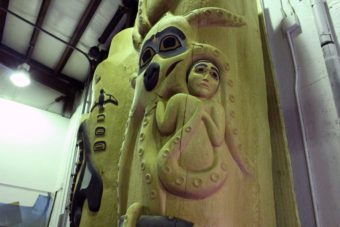
The crowning artifact found this season, says Rick Knecht, the lead archaeologist and a professor from the University of Aberdeen in Scotland, is a mask half human, half walrus, in nearly perfect condition. It’s wrapped in several layers of plastic as Knecht keeps the mask damp and cool in a refrigerator at base camp.

“It’s got amazingly lifelike contours with the cheek bones, and the nose, and the forehead and so-on. Beautifully carved out of wood, and as you can see it’s got two little conical tusks that represent that transformation into a walrus. And these are in fact made out of walrus ivory. It’s got a little beard here, and half of it are human hairs and then on the other half are sea mammal hairs, maybe walrus whiskers,” said Knecht.

Knecht says the mask could have been a used by a Shaman. He unearthed it, about five miles outside Quinhagak, on the edge of the Bering Sea, where archaeologists have spent the six field seasons scraping dirt from the remains of a 500-year-old Alaska Native sod house. Today’s discovery of a wooden bowl gives another clue about how Yup’ik people lived.

“On the bottom of the bentwood bowl is an ownership mark left by the person who carved that and these ownership marks were inherited between families. We have about six or seven ownership marks we see consistently throughout this site, which we believe was a very large sod house divided up into compartments which were domestic spaces for women and children,” said Knecht.

His team has found tens of thousands of household items, jewelry and weapons, among other things. The dig is composed of what’s left of an entire village at the site of the ancient community of Arolik.

The objects look much younger than the centuries they’ve endured. That’s because they’ve been encased in permafrost. Wood and leather items can survive for hundreds of years. The oldest objects date as far back as seven hundred years.

Unseasonably warm temperatures at the dig site– nearly 80 degrees- create another set of variables for the crew to deal with. Conditions that Knecht say are driving the crew to work as fast as possible before more washes away.

The Nunalleq excavation near Quinhagak is revealing artifacts that have survived hundreds of years in permafrost. The site is threatened now by coastal erosion. (Photo by Daysha Eaton / KYUK)

In the early 1600s, right around the time that Shakespeare was publishing plays and poems in England, Knecht says, these people were crafting art too: carving intricate ivory jewelry and weaving baskets. Then, in the middle of the 17th Century, says Knecht, their communal, sod house was attacked and burned.

Carlotta Hillerdal is a co-investigator with Knecht on the project. Back at the dig, she points to a burnt orange streak running along the dark soil of the dig’s dirt wall.

“This site was abandoned around 1640. So that’s where we have the kind of orange and black soil that you see in the wall over there that we dug. That’s the roof of the last phase of the structure that stood here that was burnt down and abandoned,” said Hillerdal.

The evidence at the site corresponds with local Yup’ik lore about the ‘bow and arrow wars,’ a time of fighting between tribes during an earlier climate change that strained resources.

Those are stories that Yup’ik elder Annie Cleveland knows. She says, when she was a girl, she remembers walking on the beach just outside of her village and finding old spears and human remains along the shore.

“When my grandmother and I used to walk down the beach to get some driftwood or pick berries we used to find spear-anek (spears) and maybe a human bone and skull and we used to put the bones back up there and dig a little bit and cover them,” said Cleveland.

That spot where she and her grandmother kept reburying things has turned into the dig called Nunalleq, meaning ‘old village.’ Cleveland says the project is bringing to life history for Yup’ik people in her village and giving them a sense of pride. The Native corporation in Quinhagak eventually wants to develop ecotourism around the site, but rapid erosion has made getting artifacts out the priority.

As they dig, researchers are finding that the village is larger than expected. With the new discoveries they’ve tacked on another season of fieldwork to unearth more history before it’s too late.

The archaeologists will ship the artifacts to Scotland for study and preservation before they return them to the region. Tribal leaders say they will eventually display them either in Bethel or Quinhagak.

A national park’s missing stories find new home in Glacier Bay Tlingit tribal house

An artist's rendering of the Huna Tribal House. (Image courtesy National Park Service)
An artist’s rendering of the Huna Tribal House. (Image courtesy National Park Service)

A $3 million Tlingit tribal house is being constructed on the shore of Bartlett Cove in Glacier Bay–likely the first time the National Park Service has funded a tribal house.

Three carvers are chipping away on an Eagle moiety pole that will go outside the red cedar tribal house with a Raven. The crest of a Wolf, Porpoise, Brown Bear and Thunderbird are starting to form, representing the clans in the area.

Gordon Greenwald, the lead carver, says it’s taken over a month to get this far on the totem and it’ll likely be six more before it’s finished.

“Now we could complete it faster than that if we used some machines. Chainsaws and so forth to do some of the major cutting but we’ve chosen not to do it that way. We’re trying to do it all by hand.”

His team has been carving the pieces to go in the 2,500-square-foot Huna Tribal House for about five years. There’s a constant flood of cruise ship tourists in and out of the shed, asking questions and marveling at the handiwork. But Greenwald says he doesn’t mind.

“For people that are new to this area, it gives them a chance to learn about our people. Going away knowing  Tlingit people, knowing what our life was like. And for local people, they can stop and see something is being made in our homeland,” he says.

An interior and exterior screen is already complete. So are the house posts of the four clans that identify Glacier Bay as home: Wooshkeetaan, Chookaneidí, Kaagwaantaan and T’akdeintaan.

The house posts which will go in the Huna Tribal House. (Photo by Elizabeth Jenkins/KTOO)

Tom VandenBerg, the chief of interpretation at Glacier Bay National Park says the clans are an inextricable part of the story of Glacier Bay.

“But there’s no physical sign of their history here unfortunately,” he says.

Bartlett Cove is the site of the new tribal house. It’s where the clans originally resided until an encroaching glacier forced them to relocate hundreds of years ago to what’s now called Hoonah. In 1925, Glacier Bay became a national monument and federal laws limited what the Huna Tlingit could do in their homeland.

“It’s difficult, you know. The parks service represents the stories of our nation. And it seems like some of the Native stories have been missing from some parks.”

VandenBerg says there are places like Sitka National Historic Park with Southeast Native totems, but “there’s not much in the way of Alaska Native stories being told in parks.”

The National Park Service received a request from the Hoonah Indian Association back in 1992 to build the tribal house. VandenBerg is unaware of anything else like it: a ceremonial house paid for by concessioners fees from businesses that operate within Glacier Bay.

Tlingit elder and park management assistant Ken Grant says it’s going to be an emotional day when the tribal house is finished.

The house posts which will go in the Huna Tribal House. (Photo by Elizabeth Jenkins/KTOO)

“Our people really have a strong tie to the homeland. The feeling of being left out has been with our elders for a long time. Like they say in our language: they were buried with a sorrow in their hearts,” Grant says.

He hopes that it’ll provide a space for young Huna Tlingits to learn about their roots and enhance language and cultural preservation.

Gordon Greenwald says it’s been a long time for the project to come fruition.

“But now I’m looking back on it, I’m wondering why this hadn’t happened in all the other parks long ago,” he says.

Back at the shed, carvers Owen James and Herb Sheakley are singing a song about one of the Huna clans.

When Sheakley started this project five years ago, he says he didn’t know all of the stories and he didn’t know how to carve. He’s been practicing at home, making ceremonial hats out of spruce and working on the Eagle pole.

“It’s stuff like this that keeps me going. I can actually create this now,” he says. “Before I could look at this and say, ‘Hmm, I couldn’t do that.’ Making the knives, listening to my boss teaching me the formlines, this is the kind of thing I’m making now.”

Greenwald says he owes teaching to his mentors; passing on the knowledge so it doesn’t stop with him.

“On all of this work, none of us will sign it because none of this work is about us as individuals; it’s about our people,” Greenwald says.

The Huna Tribal House is expected to be dedicated next August.

A lifetime of fighting: A history of Alaska LGBT rights

Alaskans voted in 1998 to define marriage in the state constitution as only between a man and a woman. Now that the U.S. Supreme Court has invalidated that definition, Alaska and the entire country has marriage equality.

To some it may seem like things are changing fast, but Alaska’s fight for gay rights began half a lifetime ago.

In the course of Alaska’s legislative history, there have been six bills to outlaw sexual orientation and gender identity discrimination. In Anchorage, there have been at least three ordinances.

They’ve all failed.

The fight may have begun in 1975, when the Alaska State Human Rights Commission took a formal stance that sexual preference should be included in the state’s non-discrimination policy.

Copy of bill 125, from 15th legislative session.

House Bill 125 was introduced in 1987, during the AIDS epidemic. The commission director, the attorney general and the governor all supported the bill.

“[It was] just something that seemed to me, it was time to make some noise about it,” says former Democratic Gov. Steve Cowper.

He introduced the bill less than two months after taking office. He had served in the Vietnam War and made a friend who was gay.

“They served just as well or better than other people,” Cowper said.

Cowper can’t remember why exactly he introduced the bill, but cites that personal experience as a possible reason. Old files also suggest commission Director Janet Bradley asked for his support.

“But as a general principle, people shouldn’t be discriminated against any more than you should be able to discriminate for racial reasons,” Cowper said.

Cowper’s friend died from AIDS years later. HB 125 never made it out of committee.

Janet Bradley left the Human Rights Commission in 1988. During the last decade of her career, she had taken an aggressive approach to more inclusive legislation.

After she left, Paula Haley became the commission’s director. She’s still the director now and she hasn’t touched the issue.

In 1989 through an LGBT advocacy group, researchers Melissa Green and Jay Brause published a statewide survey documenting the experiences of Alaska’s lesbian and gay community, including issues of discrimination and health.

Janet Bradley ended the report’s forward with a call to action: “This report then becomes our challenge; for if we believe that our vision of Alaska is marred when discrimination exists, we must commit ourselves to eliminating sexual orientation discrimination.”

Melissa Green, LGBT activist and researcher. (Photo courtesy of Melissa Green)

In 2012, Green published her final report on a survey on LGBT discrimination in Anchorage through Identity, Inc. It was a few weeks before Anchorage voted on Proposition 5, a sexual identity anti-discrimination measure that failed. She says the report received a lot of criticism.

“It has important things to say. I hope that people might still read it, but I’m done. I’m done. I’m off on my own life,” Green said.

She’s burnt out and says she’s kind of bitter.

“It ate up a lot of my life and a lot of my time, and it had, I wouldn’t say exactly zero impact, but pretty close to that,” Green said. “Nobody really cared— outside of the [lesbian, gay, bisexual and transgender] community, nobody really cared.”

In 1986, the Anchorage Daily News interviewed a gay man working at Identity, Inc., an advocacy organization. He was collecting violent and homophobic voice mail the office received for a research report on gay and lesbian discrimination.

That man’s name was Jay Brause.

“Through the AIDS crisis we started finding out how important our relationships were,” Brause said.

“We started finding out we had no rights. We were denied in so many ways.” Brause said.

He said he knew of couples who’d been together for decades and if one of them would become ill or die, often their relationship meant nothing when it came to hospital visitation, burials, military honors and home ownership.

“How do you explain that to people? It’s a potent, virulent form of discrimination,” Brause said.

During the same year the ADN published the story, he interned with the National Gay and Lesbian Task Force in D.C.

(left to right) Jay Brause, Gene Dugan, Fred Hillman and Les Baird. In 1982, the board members were moving out of the Alaska Gay & Lesbian Resource Center, which closed down. It was later revamped and named Identity, Inc. (Photo courtesy of Melissa Green)

Brause and his now-husband Gene Dugan applied for their marriage license in 1994. The controversial act eventually led to the 1998 constitutional amendment defining marriage.

He paid for being a prominent gay figure in the 80s and 90s in more ways.

“I felt the prejudice and the discrimination very personally and directly. In a way, you don’t know if you’re hiding or you haven’t disclosed (your sexuality),” Brause said.

Like his friend Melissa Green, he’s disillusioned about his fight and American liberties. His reaction when Alaska got marriage equality?

“I did not have the person-in-the-street’s reaction. No, not even a smile,” Brause said.

In 2006, he and his husband moved to England, where he has dual-citizenship. In September, he’ll travel back to Anchorage to clean up to the last few bits of his life in America before leaving for good.

“Thank you to every single one of us who took on that work as activists, who took chances to make a difference, and believe me, there’s more to be done.”

State Legislative Reference Librarian Jennifer Fletcher researched legislative files. This article could not be produced without her assistance.

Editor’s note: This story and audio have been updated. The number of Anchorage anti-discrimination ordinances that have failed has been qualified; there have been at least three. Also, Identity, Inc. published all three reports. Jay Brause and Identity, Inc. volunteers authored One in Ten, Brause and Melissa Green authored Identity Reports, and Green authored the LGBT Anchorage Discrimination survey report. Volunteers and community members assisted with all three of the studies. 

__

Bibliography 

1975-76, Senate Bill 60, (Files 1, 2, 3, senate floor tape)

1983-84, House Bill 364 (File 1)

1983-84, Senate Bill 406 (Files 12)

1983-84, Senate Bill 77 (Files 1, 2)

1985-86 House Bill 194 (Files 1, 2, 3, 4, 5)

1987-88, House Bill 125 (Files 1, 2, 3, 4, 5)

The Alaska Gay and Lesbian Community Center

“One in Ten,” report published by Identity, Inc.

“Sexual Orientation Bias in Alaska,” published by Identity, Inc. 

Jay Brause & Gene Dugan v. Alaska Dept. of Health and Social Services

1998 Alaska Ballot Measure 2

Jerry Prevo,  June 6, 2009 sermon against Anchorage Ordinance 64

Jerry Prevo, March 25, 2012 sermon against transgender rights and Prop. 5

Identity, Inc.’s flag burns, article by Alaska Dispatch News

U.S. EEOC, July 2015 ruling on sexual orientation discrimination

U.S. EEOC rulings on sexual orientation and gender identity discrimination

Anchorage Municipal Mayor Ethan Berkotwitz’s 2015 transition report

Aug. 12, 2005 interview with Gov. Bill Walker

2015 Anchorage Ordinance on city’s non-discrimination policy

70 years after WWII, two nations’ militaries jump side by side

A Japanese Air Self-Defense Force airman directs a taxiing C-130H Hercules on Joint Base Elmendorf-Richardson, Alaska, Aug. 11, 2015.  (Photo by Alejandro Pena/U.S. Air Force)
A Japanese Air Self-Defense Force airman directs a taxiing C-130H Hercules on Joint Base Elmendorf-Richardson, Alaska, Aug. 11, 2015. (Photo by Alejandro Pena/U.S. Air Force)

Seventy years ago this month, the U.S. dropped two atomic bombs on Japan, prompting its surrender and the end of World War II. Now, the two nations’ armed forces are collaborating in Alaska.

As part of the Alaskan Command’s Red Flag exercises this summer, two dozen Japanese paratroopers are training with Army soldiers based at Joint Base Elmendorf-Richardson. After 10 days of exercises, the group flew north in cargo planes before jumping into the Donnelly Training Area near Fort Greely.

It’s not the first time the Japanese Ground Self Defense Force have partnered with Alaskan troops. Lieutenant Colonel Alan Brown says in the past, soldiers have gone through cold weather training at the Army’s Black Rapids site.

“The airborne capability is something that Japan has been developing in recent years. Our first experience with it recently is jumping with them over in Japan as part of an exercise this February.”

Brown says the goal is building a firmer partnership with one of the U.S.’s most important Pacific allies.

“The deeper the foundation, the more readily we’ll be able to integrate with them in an emergency situation–a contingency like a human disaster, where we need to assist in concert with that country for Recovery operations or Search and Rescue, those types of things.”

The U.S. is increasingly shifting its military focus to the Pacific.

According to the Army, Tuesday’s jump was a success, with no reports of injuries.

Site notifications
Update notification options
Subscribe to notifications