U.S. Army Corps of Engineers staff and Army officials assemble outside Fort Greely’s SM-1A nuclear reactor during a 2021 site visit. (From USACE)
The decommissioning of an old nuclear power plant at Fort Greely can move forward now that the federal agency overseeing the project has resolved a contract dispute that delayed work for more than a year.
Work on the final phase of decommissioning and dismantling the long-mothballed SM-1A heat and power plant has been on hold since late last year, when a company that was competing for the contract began filing protests over how the Army Corps of Engineers handled the bid proposals.
The Corps awarded a $103 million contract to South Carolina-based Westinghouse Government Services last August. But soon thereafter officials for a competing firm, Louisiana-based Aptim-Amentum Alaska Decommissioning appealed the decision to the federal General Accounting Office. The GAO partially upheld the protest and directed the Corps of Engineers to reopen discussions with the competing companies and re-evaluate their bid proposals.
“We ultimately made the decision to reverse the award, based on our re-evaluation of proposals,” says Brenda Barber, the Corps’ project manager. “So the award is going to Aptim-Amentum Alaska Decommissioning, and the Westinghouse Government Services contract has been terminated.”
The SM-1A is located in the center of Fort Greely, bounded by Allen Army Airfield to the north and the missile-defense base to the south. The post is about five miles south of Delta Junction, and about 105 miles south of Fairbanks on the Richardson Highway. (From U.S. Army Corps of Engineers)
Barber said Wednesday that when the Corps allowed the companies competing for the contract to submit final proposals, Aptim-Amentum Alaska Decommissioning — also known as A3D — lowered its bid for the contract to $95.3 million.
“And it was deemed to be fair (and) reasonable, and resulted in an award to them,” she said.
That’s about all Barber could say about the dispute. She referred most questions to the GAO.
“We don’t typically comment too much on the protests,” she said, “just because of the sensitivity.”
According to online information about the dispute on a GAO webpage, A3D accused the Corps of misevaluating the competing Westinghouse proposal. A3D also accused the Corps of failing to take into account the lack of a so-called key personnel-retention plan in the Westinghouse proposal.
Barber said the year-long, back-and-forth process of reviewing and re-evaluating the proposals means the completion date of the project also will be pushed back by a year.
“So we’re looking at 2029, at this point,” she said, adding that it’ll take a while for A3D to begin work on the facility. “We’re finalizing some startup-related issues with respect to the contract now,” she said, “and we’re hopeful that work on the site — physical work on the site — is probably still six to eight months out.”
Many of the nuclear-power components of the old SM-1A are encased in concrete in the building that still stands at Fort Greely. (U.S. Army photo)
During that time, Barber says the Corps’s team assigned to the project will be spending time at Fort Greely and the 61-year-old facility on the post to develop detailed engineering and project-timeframe plans.
The SM-1A’s highly enriched uranium dioxide fuel and most highly radioactive components of the facility were removed after it was shut down in 1972. Remaining materials have been entombed in concrete or safely stored onsite. Much of that will be removed as part of the contract with A3D.
The facility generated up to 2 megawatts of electricity and up to 20.2 megawatts of thermal energy for a central steam-heat system.
Barber says when the the remaining work is completed, the SM-1A, like two other prototype military nuclear power plants developed during the Cold War, will finally all be decommissioned and dismantled.
John Sherman, a 60th Engineer Squadron firefighter, is hit by fire-retardant foam after it was “unintentionally released” in an aircraft hangar at Travis Air Force Base in California on Sept. 24, 2013. Firefighters with the 60th Air Mobility Wing helped control the foam’s dispersion using powerful fans and covering drains. (KEN WRIGHT / U.S. AIR FORCE)
Gary Flook served in the Air Force for 37 years, as a firefighter at the now-closed Chanute Air Force Base in Illinois and the former Grissom Air Force Base in Indiana, where he regularly trained with aqueous film forming foam, or AFFF — a frothy white fire retardant that is highly effective but now known to be toxic.
Flook volunteered at his local fire department, where he also used the foam, unaware of the health risks it posed. In 2000, at age 45, he received devastating news: He had testicular cancer, which would require an orchiectomy followed by chemotherapy.
Hundreds of lawsuits, including one by Flook, have been filed against companies that make firefighting products and the chemicals used in them.
And multiple studies show that firefighters, both military and civilian, have been diagnosed with testicular cancer at higher rates than people in most other occupations, often pointing to the presence of perfluoroalkyl and polyfluoroalkyl substances, or PFAS, in the foam.
But the link between PFAS and testicular cancer among service members was never directly proven — until now.
A new federal study for the first time shows a direct association between PFOS, a PFAS chemical, found in the blood of thousands of military personnel and testicular cancer.
Using banked blood drawn from Air Force servicemen, researchers at the National Cancer Institute and Uniformed Services University of the Health Sciences found strong evidence that airmen who were firefighters had elevated levels of PFAS in their bloodstreams and weaker evidence for those who lived on installations with high levels of PFAS in the drinking water. And the airmen with testicular cancer had higher serum levels of PFOS than those who had not been diagnosed with cancer, said study co-author Mark Purdue, a senior investigator at NCI.
“To my knowledge,” Purdue said, “this is the first study to measure PFAS levels in the U.S. military population and to investigate associations with a cancer endpoint in this population, so that brings new evidence to the table.”
In a commentary in the journal Environmental Health Perspectives, Kyle Steenland, a professor at Emory University’s Rollins School of Public Health, said the research “provides a valuable contribution to the literature,” which he described as “rather sparse” in demonstrating a link between PFAS and testicular cancer.
More studies are needed, he said, “as is always the case for environmental chemicals.”
Not ‘Just Soap and Water’
Old stocks of AFFF that contained PFOS were replaced in the past few decades by foam that contains newer-generation PFAS, which now also are known to be toxic. By congressional order, the Department of Defense must stop using all PFAS-containing foams by October 2024, though it can keep buying them until this October. That’s decades after the military first documented the chemicals’ potential health concerns.
But given its effectiveness in fighting extremely hot fires, like aircraft crashes and shipboard blazes, the Defense Department still uses it in operations. Rarely, if ever, had the military warned of its dangers, according to Kevin Ferrara, a retired Air Force firefighter, as well as several military firefighters who contacted KFF Health News.
“We were told that it was just soap and water, completely harmless,” Ferrara said. “We were completely slathered in the foam — hands, mouth, eyes. It looked just like if you were going to fill up your sink with dish soap.”
Fire-retardant foam was “unintentionally released” in an aircraft hangar at Travis Air Force Base in California on Sept. 24, 2013. “The non-hazardous foam is similar to dish soap,” says the Defense Visual Information Distribution Service. “No people or aircraft were harmed in the incident.” (KEN WRIGHT / U.S. AIR FORCE)
Photos released by the Defense Visual Information Distribution Service in 2013 show personnel working in the foam without protective gear. The description calls the “small sea of fire retardant foam” at Travis Air Force Base in California “non-hazardous” and “similar to soap.”
“No people or aircraft were harmed in the incident,” it reads.
There are thousands of PFAS chemicals, invented in the 1940s to ward off stains and prevent sticking in industrial and household goods. Along with foam used for decades by firefighters and the military, the chemicals are in makeup, nonstick cookware, water-repellent clothing, rugs, food wrappers, and a myriad of other consumer goods.
Known as “forever chemicals,” they do not break down in the environment and do accumulate in the human body. Researchers estimate that nearly all Americans have PFAS in their blood, exposed primarily by groundwater, drinking water, soil, and foods. A recent U.S. Geological Survey study estimated that at least 45% of U.S. tap water has at least one type of forever chemical from both private wells and public water supplies.
Health and environmental concerns associated with the chemicals have spurred a cascade of lawsuits, plus state and federal legislation that targets the manufacturers and sellers of PFAS-laden products. Gary Flook is suing 3M and associated companies that manufactured PFAS and the firefighting foam, including DuPont and Kidde-Fenwal.
Congress has prodded the Department of Defense to clean up military sites and take related health concerns more seriously, funding site inspections for PFAS and mandating blood testing for military firefighters. Advocates argue those actions are not enough.
“How long has [DoD] spent on this issue without any real results except for putting some filters on drinking water?” said Jared Hayes, a senior policy analyst at the Environmental Working Group. “When it comes to cleaning up the problem, we are in the same place we were years ago.”
On a Mission to Get Screening
The Department of Veterans Affairs does not recommend blood testing for PFAS, stating on its website that “blood tests cannot be linked to current or future health conditions or guide medical treatment decisions.”
But that could change soon. Rep. Dan Kildee (D-Mich.), co-chair of the congressional PFAS Task Force, in June introduced the Veterans Exposed to Toxic PFAS Act, which would require the VA to treat conditions linked to exposure and provide disability benefits for those affected, including for testicular cancer.
“The last thing [veterans] and their families need to go through is to fight with VA to get access to benefits we promised them when they put that uniform on,” Kildee said.
Evidence is strong that exposure to PFAS is associated with health effects such as decreased response to vaccines, kidney cancer, and low birth weight, according to an expansive, federally funded report published last year by the National Academies of Sciences, Engineering, and Medicine. The nonprofit institution recommended blood testing for communities with high exposure to PFAS, followed by health screenings for those above certain levels.
It also said that, based on limited evidence, there is “moderate confidence” of an association between exposure and thyroid dysfunction, preeclampsia in pregnant women, and breast and testicular cancers.
Testicular cancer is the most commonly diagnosed cancer among young adult men. It is also the type of cancer diagnosed at the highest rate among active military personnel, most of whom are male, ages 18 to 40, and in peak physical condition.
That age distribution and knowing AFFF was a source of PFAS contamination drove Purdue and USUHS researcher Jennifer Rusiecki to investigate a possible connection.
Using samples from the Department of Defense Serum Repository, a biobank of more than 62 million blood serum specimens from service members, the researchers examined samples from 530 troops who later developed testicular cancer and those of 530 members of a control group. The blood had been collected between 1988 and 2017.
A second sampling collected four years after the first samples were taken showed the higher PFOS concentrations positively associated with testicular cancer.
Ferrara does not have testicular cancer, though he does have other health concerns he attributes to PFAS, and he worries for himself and his fellow firefighters. He recalled working at Air Combat Command headquarters at Joint Base Langley-Eustis in Virginia in the early 2010s and seeing emails mentioning two types of PFAS chemicals: PFOS and perfluorooctanoic acid, or PFOA.
But employees on the base remained largely unfamiliar with the jumble of acronyms, Ferrara said.
Even as the evidence grew that the chemicals in AFFF were toxic, “we were still led to believe that it’s perfectly safe,” Ferrara said. “They kept putting out vague and cryptic messages, citing environmental concerns.”
When Ferrara was working a desk job at Air Combat Command and no longer fighting fires, his exposure likely continued: Joint Base Langley-Eustis is among the top five most PFAS-contaminated military sites, according to the EWG, with groundwater at the former Langley Air Force Base registering 2.2 million parts per trillion for PFOS and PFOA.
According to the EPA, just 40 parts per trillion would “warrant further attention,” such as testing and amelioration.
The Defense Department did not provide comment on the new study.
Air Force officials told KFF Health News that the service has swapped products and no longer allows uncontrolled discharges of firefighting foam for maintenance, testing, or training.
“The Department of the Air Force has replaced Aqueous Film Forming Foam, which contained PFAS, with a foam that meets Environmental Protection Agency recommendations at all installations,” the Air Force said in a statement provided to KFF Health News.
Both older-generation forever chemicals are no longer made in the U.S. 3M, the main manufacturer of PFOS, agreed to start phasing it out in 2000. In June, the industrial giant announced it would pay at least $10.3 billion to settle a class-action suit.
Alarmed over what it perceived as the Defense Department’s unwillingness to address PFAS contamination or stop using AFFF, Congress in 2019 ordered DoD to offer annual testing for all active-duty military firefighters and banned the use of PFAS foam by 2024.
According to data provided by DoD, among more than 9,000 firefighters who requested the tests in fiscal year 2021, 96% had at least one of two types of PFAS in their blood serum, with PFOS being the most commonly detected at an average level of 3.1 nanograms per milliliter.
Readings between 2 and 20 ng/mL carry concern for adverse effects, according to the national academies. In that range, it recommends people limit additional exposure and screen for high cholesterol, breast cancer, and, if pregnant, high blood pressure.
According to DoD, 707 active and former defense sites are contaminated with PFAS or have had suspected PFAS discharges. The department is in the early stages of a decades-long testing and cleaning process.
More than 3,300 lawsuits have been filed over AFFF and PFAS contamination; beyond 3M’s massive settlement, DuPont and other manufacturers reached a $1.185 billion agreement with water utility companies in June.
Attorneys general from 22 states have urged the court to reject the 3M settlement, saying in a filing July 26 it would not adequately cover the damage caused.
For now, many firefighters, like Ferrara, live with anxiety that their blood PFAS levels may lead to cancer. Flook declined to speak to KFF Health News because he is part of the 3M class-action lawsuit. The cancer wreaked havoc on his marriage, robbing him and his wife, Linda, of “affection, assistance, and conjugal fellowship,” according to the lawsuit.
Congress is again trying to push the Pentagon. This year, Sen. Jeanne Shaheen (D-N.H.) reintroduced the PFAS Exposure Assessment and Documentation Act, which would require DoD to test all service members — not just firefighters — stationed at installations with known or suspected contamination as part of their annual health checkups as well as family members and veterans.
The tests, which aren’t covered by the military health program or most insurers, typically cost from $400 to $600.
In June, Kildee said veterans have been stymied in getting assistance with exposure-related illnesses that include PFAS.
“For too long, the federal government has been too slow to act to deal with the threat posed by PFAS exposure,” Kildee said. “This situation is completely unacceptable.”
Fire-retardant foam temporarily covered a small portion of the flight line at Travis Air Force Base in California after it was released inside a hangar on Sept. 24, 2013.(KEN WRIGHT / U.S. AIR FORCE)
KFF Health News is a national newsroom that produces in-depth journalism about health issues and is one of the core operating programs at KFF—an independent source of health policy research, polling, and journalism. Learn more about KFF.
Subscribe to KFF Health News' free Morning Briefing.
This undated family photo shows Solomon Atkinson, the Metlakatla man who is the namesake of a new U.S. Navy ship. Atkinson was one of the first U.S. Navy SEALs, completed 22 years of active naval service and retired in 1973. (Photo courtesy Maria Hayward/Distributed by the U.S. Navy)
The U.S. Navy will name a new oceangoing tugboat after Solomon “Sol” Atkinson, a Metlakatla man who was a member of the Navy’s first SEAL team and trained astronauts for their return to Earth.
The decision was announced last week by Secretary of the Navy Carlos Del Toro on Metlakatla’s Founders’ Day holiday, Aug. 7.
U.S. Sen Dan Sullivan, R-Alaska, praised the decision, calling Atkinson “a legendary Alaskan and an American hero” who led “an extraordinary life of honor and distinction.”
Born in 1930, Atkinson enlisted in the U.S. Navy in 1952, becoming the first Alaska Native to join the Underwater Demolition Teams, the predecessor to the SEALs, which were created in 1962. Atkinson was a member of the inaugural SEAL Team 1.
He served in the Vietnam War, earning a Bronze Star and a Purple Heart, and trained astronauts, including the first men to walk on the Moon, in underwater simulations.
After retiring from the Navy in 1973, he returned to Metlakatla — Alaska’s sole Native reservation — and became a community organizer, mayor, and founder of the island community’s first veterans organization.
Atkinson’s name will be attached to the USNS Solomon Atkinson, a Navajo-class oceangoing tug and rescue ship whose vessels are named for American Indian and Alaska Native tribes and individuals.
The first ship of the class, the USNS Navajo, was launched in March and has yet to be commissioned. The Solomon Atkinson will be the seventh ship of the class. It is under construction in Alabama, and no completion date has been announced.
When completed, the Solomon Atkinson will join the under-construction destroyer USS Ted Stevens as the only Navy ships named after individual Alaskans.
The naming of the Solomon Atkinson was sponsored by his daughters, Michele Gunyah and Maria Hayward.
“There exists a long-held Tsimshian tradition, ‘akadi lip a’algyaga sm’ooygit,’ loosely translated ‘a chief never speaks for himself’,” Hayward said in a written statement released by the Navy. “Through all of his time as a U.S. Navy UDT and SEAL, as well as a leader of veterans and Native Alaskans, Sol lived this ethos. And, here today, in the shadow of Sol’s death, he holds to it still. Thank you to the U.S. Navy for speaking to Solomon’s honor and helping his family and fellow Frogmen shout his legacy to the seven seas!”
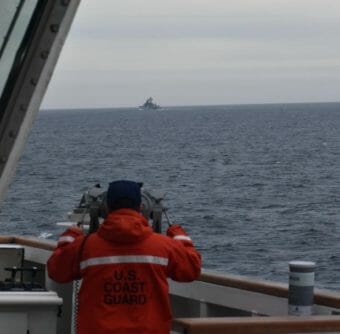
Several U.S. Navy warships docked in Unalaska last week, after 11 Chinese and Russian military ships were found operating in the region. (Andy Lusk/KUCB)
Navy warships were dispatched to the Aleutians last week after 11 Chinese and Russian military ships were found operating in the region.
The exact location of the foreign ships was not disclosed, but a military spokesperson from the U.S. Northern Command said the foreign patrol ships remained in international waters and were not considered a threat.
Still, U.S. Sens. Lisa Murkowski and Dan Sullivan issued a statement Saturday saying the incident shows why the military should expand its presence in Alaska to protect U.S. interests.
“This is a stark reminder of Alaska’s proximity to both China and Russia, as well as the essential role our state plays in our national defense and territorial sovereignty,” Murkowski said.
Her office offered additional assurances to Aleutian communities.
“Because this is a military operation, we are limited with what we can say,” said Joe Plesha, a spokesperson with Murkowski’s office. He assured Unalaskans the senator was “taking this incursion very seriously.”
China has sent naval ships to the Bering Sea off Alaska’s shores before, in what U.S. analysts often say is a provocative gesture. The first-known incident was in 2015, coinciding with then-President Barack Obama’s visit to Alaska.
Sen. Sullivan said in the statement he was glad to see a tougher response to these warships, which “sends a strong message to Xi Jinping and Putin that the United States will not hesitate to protect and defend our vital national interests in Alaska.”
F-22 fighter jets taking off from JBER in June 2015 morning as part of the Northern Edge exercise. (Zachariah Hughes/Alaska Public Media)
The U.S. Senate has passed a national defense bill that includes a 5.2% pay raise for service members and eight military construction projects for Alaska worth $168 million.
The largest share of the project funding would be for a runway extension at Joint Base Elmendorf-Richardson, in Anchorage. The second would be housing for Fort Wainwright soldiers, in Fairbanks.
U.S. Sen. Dan Sullivan issued a statement highlighting the Alaska projects. He also said he’s disappointed Democratic senators didn’t agree to boost total military spending above the $886 billion President Joe Biden requested, which Sullivan called “anemic.”
Sullivan’s office did not respond to questions about the bill or an interview request Monday.
His statement also credits him for getting exemptions that allow Alaska Native Corporations to more easily win defense contracts. One exempts them from a proposed rule that would require defense contractors to disclose their greenhouse gas emissions. The pending rule is part of the Pentagon’s plan to mitigate its climate impact.
The House has also passed a defense bill with a 5.2% pay raise. Unlike the Senate version, it includes limits on service members’ access to abortion and transgender care. The two bills go next to a conference committee.
Monique Andrews, a licensed professional counselor, sits in her office on June 5. Andrews is a private practice therapist and is in the Alaska Army National Guard. She sees many active duty military service members and said they face unique struggles with mental health. (Matt Faubion/Alaska Public Media)
Infantryman Robert Waddle’s mental health was declining early this year while he was stationed in Fairbanks.
“The situations I had been encountering inside of my unit had greatly impacted my mental health,” said Waddle. “I would definitely say I was in a crisis state.”
Waddle was not the only service member struggling. People serving in the military here face all the typical stressors of Alaska life – like short winter days and geographic isolation. And they often don’t have a strong support system nearby because they’ve been stationed here from elsewhere in the United States.
The rate of suicide in the military in the state peaked in 2021; that year 17 Army soldiers took their own lives. It was a wake-up call. And the Army’s 11th Airborne Division at Fort Wainwright decided to create a program called “Mission 100” in response.
“We realized that connectedness is critical to the health and well being of our soldiers,” said Col. Masaki Nakazono, the command chaplain for the division.
It’s now a year and a half into the Mission 100 program. And Nakazono and others say it seems to be paying off – although there’s still work to be done.
Nakazono said all soldiers must now see a professional for a wellness visit once in their first six months and then once a year after that. And team leaders also call a soldier’s family members to introduce themselves.
“A lot of times it is a family member who understands when their soldier is in trouble and is struggling,” said Nakazono, “and they really don’t understand the military system or even how to contact a unit or a leader.”
The program has brought more chaplains and counselors to Alaska. Nakazono said this has led to shorter wait times for counseling, and a 95% reduction in soldiers experiencing an immediate crisis. Suicide rates are also down – but the numbers are so small it’s hard to draw conclusions just yet. Halfway through the year, there has been one suspected suicide. The total was six last year, down from the high of 17, yet similar to years before the spike.
Nakazono said that one key piece is that chaplains are available after hours and on the weekend around army barracks – when talks won’t interfere with work. He thinks these casual conversations help catch problems earlier.
“I believe that these meaningful conversations really allow soldiers to process through issues before they kind of bubble up and get to a point where they’re there alone, disconnected and have no one to really talk to,” said Nakazono.
Nakazono said the division is also working on other mental wellness efforts like helping soldiers buy plane tickets to visit family and providing blackout curtains to promote better sleep quality.
Monique Andrews is a therapist in Anchorage and she’s in the Alaska Army National Guard.
She sees many soldiers in her practice but she’s not associated with Mission 100. She described the program as a brilliant approach to reduce the stigma sometimes tied to seeking mental health care.
“If every single person has to connect and talk, then there isn’t this us versus them,” said Andrews. “You know, a general is going to talk to a mental health provider. A private is going to talk to a mental health provider.”
Andrews is not speaking as a representative of the military – which she said is wrestling with its long history of stigmatizing mental health care.
“Back in the day, if you went to mental health, your career was over,” said Andrews. “That’s no longer the case. But there is some truth and validity with every stigma.”
Andrews said military culture leans on several positive roles like “heroism, being a provider, being strong, never quitting, taking care of the family, good relationships.”
Those roles can be positive, but if a soldier struggles to meet those expectations for any reason, it can cause shame and guilt.
Andrews said she also sees a lot of patients in the military struggling with isolation and loneliness. Last month the surgeon general labeled loneliness in America an epidemic. Its toll on health and mental health is twice as harmful as obesity.
Waddle, the infantryman stationed in Fairbanks, said he struggled with feeling alone. He saw Chaplain Drew Paul who came up to the division as a part of “Mission 100.” And he said their discussions helped him learn to reframe his relationships.
“I had constantly been feeling really ostracized or alone,” said Waddle. “And after having someone that I could connect with. It’s hard to describe. It had been nice to feel connection with a person for the first time in a long time.”
He began seeing the chaplain regularly, sometimes as often as once a day. He said it was easier to open up because the chaplain is also in the military and has been deployed. And this June, Chaplain Paul was the officiant in Waddle’s wedding.
Chaplain Drew Paul officiated the wedding of Emily Rose Waddle and Robert Waddle. Robert Waddle sought out mental health care from the chaplain during a crisis and has since found more stability. (Photo courtesy of Robert Waddle)
But Waddle said getting help wasn’t perfectly smooth. He got pushback from peers and was reprimanded by a supervisor for being late when a session ran over – even though he had a written excuse.
“When that happened, it honestly made it really hard for me to want to continue going because I felt like I was going to get reprimanded or in trouble for trying to seek help,” said Waddle.
But he did continue to see the chaplain. And it continued to help. He considers his mental health a work in progress, but no longer a crisis.
And now he tells his peers about the value of his visits with the chaplain. He thinks that’s helping nudge military culture around mental health in the right direction.
Close
Update notification options
Subscribe to notifications
Subscribe
Get notifications about news related to the topics you care about. You can unsubscribe anytime.