Nation & World

Parnell signs bill opposing Beringia International Park

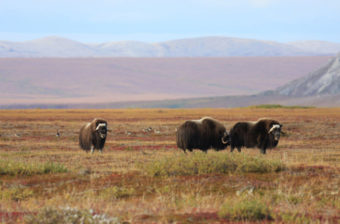
Musk ox grazing on the tundra by the Cape Krusenstern National Monument. (Photo by Doug Demarest/ National Park Service)

Governor Sean Parnell has signed into law a piece of legislation to stop development of the Beringia International park. Senate Joint Resolution 15 urges the federal government to end efforts “pursuing the creation of an International Park” stretching from Northwest Alaska into Russia.
“This is a park that has been going forward quietly over the years. It sounds like such a laudable goal,” said state Senator Cathy Giessel, who sponsored the resolution, and wants an end to the memorandum of understanding between the U.S. and Russia out of concern over Alaska’s resources. “My concern however is it’s a United Nations designation that could affect the use of our natural resources.”

But in actual terms the resolution’s passage into law does very little to the National Park Service’s work on the Beringia Shared Heritage Program.

“It was stopped because of the situation in the Ukraine with Russia,” explained John Quinley, a spokesman for the National Park Service. “The United States government suspended almost all its bilateral engagements and negotiations with the Russian Federation, including negotiations about the Beringia MOU.”

In February NPS sent a letter to pointing out a range of factual errors and mistaken assumptions in the language of Geisel’s resolution, as well as the reporting of it.

One such claim is that the state of Alaska and U.S. Congress haven’t been able to give input as the federal government pushes the memorandum of understanding through. The Parks Service’s letter, however, points out the state provided a range of comments—some as recent as 2012.

Geisel introduced the legislation in December, before government sanctions against Russia. And her chief worry is a repeat of what’s playing out with the proposed airport road in Cold Bay, with international bodies dictating how Alaskans use their land.

“Would we then be limited in resource development and use of fishing and game resources?” Giessel asked.

The Park Service letter tried to correct conclusions like that one, laying out misunderstandings in the bill’s grasp of the Beringia Shared Heritage Program’s scope, goals, and basic legality. Section eight of the MOU, for example, spells out, “This legally nonbinding Memorandum is not an international agreement and does not create any rights or obligations under international law.”

In spite of the legislative rhetoric, much of the environmental and cultural research underpinning the goal of an eventual shared park is set to continue.

“Research about the archeology, subsistence uses, and how sea ice and other climate issues are changing and evolving in that area. We think that work is important and should continue, we’re continuing to fund some of it,” Quinley explained of upcoming research work under the Beringia Shared Heritage Program. “We think the idea of learning about the area is important.”

The memorandum of understanding with Russia has no timetable for resumption until Congress lifts sanctions placed on the Russian government.

Russia’s import ban hits Alaskan seafood industry

(Photo courtesy KUCB)

Alaska’s seafood industry is getting caught in the middle of a power struggle between Russia and western nations.
Ever since Russia seized part of Ukraine this winter, sanctions against it have been stacking up. Now, Russia’s fighting back by banning food imports from the United States and a handful of other countries.

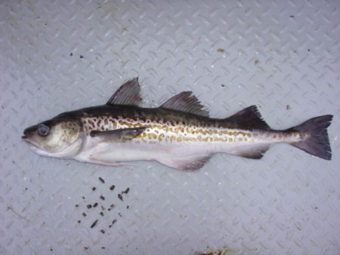
Alaska shipped almost $9 million worth of pollock to Russia last year. Some of it went to fast food chains, including McDonald’s. A significant chunk of it is used for making surimi — better known as fake crab.

At least one shipment of surimi was on its way to Russia when the ban came out on Thursday. Undercurrent News reports that the fish could get diverted to South Korea or another eastern market.

That’s got some American fishing advocates fired up. A former U.S. Congressman has started the “Just Say Nyet” campaign, seeking a corresponding ban on Russian fish coming into the States.

But it’s slow going: As of Friday afternoon, his petition to the federal government had only gathered 18 signatures.

Former Haines exchange student now living in war zone

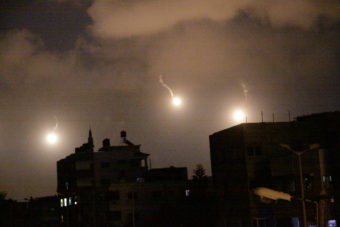
From his bedroom window, Haytham Mohanna took this photo of Israeli flares about a week ago. (Photo by Haytham Mohanna)

Just days after exchange student Haytham Mohanna made the long journey from Southeast Alaska to his home in the Gaza Strip, the conflict between Israel and Hamas escalated into war.

Haytham lived and studied in Haines through a U.S. Department of State program that brings students from Muslim countries to America.

Haytham at the Mendenhall Glacier ice caves. (Photo courtesy of Rich Moniak)

Two months ago, 17-year-old Haytham Mohanna was kayaking in Sunshine Cove and hiking to the Mendenhall Glacier ice caves in Juneau.

Now, Haytham is home in Gaza City spending his summer break in a war zone.

“Every minute we are expecting a bomb. When we hear a near bomb, we are saying that our house is going to be the next one,” Haytham says.

His family has an emergency bag packed with their identification and other important documents. If they get a call that their house will be bombed, they’re ready to evacuate.

“My family is lucky ‘til now that nobody died and they didn’t see anyone dying,” Haytham says.

At the moment, he is living with 14 people – his parents, grandmother, three siblings and his aunt’s family.

“Her house kind of is near the tanks and the bombs, so she’s scared and ran away from there and she came to our house,” Haytham says.

His parents and siblings sleep on the floor, while his aunt’s family shares the six beds in the house. It’s crowded, but up to 50 people have stayed in the house during other wars. This is Haytham’s third.

Haytham says they haven’t had electricity for more than a week. His family has their own gas-run generator, which they turn on to charge flashlights, laptops and phones. They also use it to pump water to the house.

Without a refrigerator, Haytham’s father takes the risk of going to the market a few times a week.

Haytham Mohanna attended Haines High School during the last school year. (Photo by Lisa Phu/KTOO)
Haytham Mohanna attended Haines High School during last school year. (Photo by Lisa Phu/KTOO)

“In the U.S. we had fulltime electricity, we have water all the time, we have freedom to go anywhere. But here, I can be scared to go out to get the trash out of the house and I’ll be scared if I’m going to go to our neighbors’ to drink some tea or something. It’s really hard to get out, even from the house,” Haytham says.

The last time Haytham went outside was more than 10 days ago during a ceasefire. It lasted six hours.

“I went to hang out with my friends. We tried to go and get a haircut but the places were very crowded so we didn’t have a haircut,” he says.

Everyone was in the streets.

“People were happy, you know, just going out from their houses. Not really happy, just relief, you know,” he says.

Haytham says days pass inside the house doing nothing and he loses track of the date. He only sleeps between 5 and 10 a.m. when bombs are less frequent. He says there are more bombs at night.

Inside, Haytham says his family still occasionally laughs.

“But it’s not the laugh that comes from the heart. We just laugh to let my 6-year-old brother to laugh and feel that he’s safe and we’re not in danger,” he says.

Haytham has mixed feelings toward the U.S. due to its relationship with Israel. The U.S. provides Israel with $3 billion in foreign military financing annually, according to the Department of State.

Haytham misses living in Haines, but he says, “I can’t really wish to be there right now. My country now needs me. If everyone wishes to be outside, nobody is going to be in Gaza. There should be people staying in Gaza so they can protect it and after the war, they can build it.”

Haytham is supposed to start his senior year of high school at the end of the month. But, he says, schools have delayed opening. Even if the war ends soon, it’ll still take time to repair.

Related content:
Differences between U.S. & Gaza Strip? Weather and freedom
Origami peace peacock finds a home in the state capitol
Forum@360: Middle East to Southeast
Haytham Mohanna on Photography

Donors pay to test seawater for traces of Fukushima radiation

Fukushima seawater radiation plume dispersal model by Rossi et. al. (Chart by Vincent Rossi et. al., Deep-Sea Research journal)

It’s been more than three years since the Fukushima nuclear plant accident resulted in a spill of millions of gallons of radioactive cooling water into the Pacific. Oceanographers projected that it could take until this year for highly diluted traces of that spill in Japan to reach the West Coast of North America.

Radiation experts don’t believe there is cause for alarm on our shores, but some coastal residents are stepping forward to pay for seawater testing just to be sure.
‘I Don’t Really Want To Die’

The presence or absence of Fukushima radiation in the water can hardly be more personal than it is for open water swimmer Wayne Kinslow of Seattle.

Kinslow swims about 20 minutes per day in Puget Sound. So he dug into his own pocket to the tune of $550 to finance an independent water test. It came back “non detect” for nuke plant radiation.

“This was something that was really important to me because I’m out there ever day and I don’t really want to die,” Kinslow said. “So it is best to test the water and this is my chance. As soon as we got an opportunity, I just threw all my money at it for the first sample.”

Kinslow is not the only one willing to pay big bucks for reassurance. Portland high school art teacher Terry Waldron is fundraising to test the waters near her and her husband’s second home in Newport, Oregon.

“For a while, I thought about not eating fish,” she said. “I can’t do that. But I was so concerned because I couldn’t find information. I do eat fish, I do. But I still want that test done.”

Waldron and Kinslow signed on to a crowdfunded radiation monitoring project called Our Radioactive Ocean. It is managed by Woods Hole Oceanographic Institute. Donors have ponied up for testing at about 30 sites from California to Alaska.

Waldron and Kinslow say it’s a lot of work and slow going to get others to contribute to this cause. That might have something to do with the fact that scientists and government agencies have been consistent in saying not to worry.

Swimmer Wayne Kinslow prepares to dive into Puget Sound at Alki Beach, a place he personally paid to have tested for traces of Fukushima radiation. (Photo by Tom Banse/NNN)

‘We Are Not At All Concerned About It’

“With the samples that we’ve taken along the West Coast, we don’t see anything of concern. We don’t expect to see anything,” Kathy Higley said. She is a professor of radiation health physics at Oregon State University.

“It has diluted. It has decayed. It has dispersed,” Higley said. “My husband and I take our kids to the coast all the time. We are not at all concerned about it. We eat seafood. We’re not concerned about it.”

Higley said graduate students in her department are looking for Fukushima radiation, but not out of fear, rather out of academic and scientific interest. Isotopes released in the accident can be used as tracers to study ocean circulation and fish migration.

This summer, Delvan Neville, one of Higley’s PhD students, collected seawater samples and various fish on a research cruise off the Washington and Oregon coasts. He is now analyzing these in Corvallis.

The samples go into a really sensitive detector covered in lead bricks. They have to sit inside the chamber for days to generate a result.

“It takes a long time to count it because there is so little activity present,” Neville explained. “Even in the worst case model, there may be just a few Becquerels at most of cesium 137 on the detector.”

Neville said for perspective it helps to remember we’re surrounded by low levels of natural radiation.

“Several seconds in a stuffy basement was a larger dose than consuming a year’s worth of albacore,” he said. “People are not aware of all the things around them that are radioactive. They don’t consider themselves radioactive.”

Turning To Crowdfunding

Oregon State University researcher Delvan Neville places a seawater sample in a lead-shielded radiation detector on the Corvallis campus. (Photo by Tom Banse/NNN)

State public health agencies are also testing seawater for Fukushima contamination. Oregon results show nothing abnormal. Washington’s latest results are pending. But it seems these efforts have not fully penetrated the public consciousness.

Enough people called marine chemist Ken Buesseler on the East Coast seeking assurances that he started Our Radioactive Ocean.

“Given this concern and the numerous requests for information, I just decided if we could do this with crowdfunding, we could do this quickly and get people the information they want and basically let them select their beach — their favorite site — for analysis,” Buesseler said.

He said in his more than 30 years in ocean science, he’s never crowdfunded a research project before. But on this one, he said he was unwilling to wait for government grants to come through given that models show a highly diluted Fukushima plume could be arriving now.

“I am concerned with radioactivity. It can be quite dangerous, but not at the levels we are expecting off the West Coast of North America,” the Woods Hole researcher said in explaining where he is coming from.

‘An Opportunity To Get A Little More Information’

“In our minds, this is ground truthing the model, which should happen with every model (of dispersal),” Tillamook Estuaries Partnership executive director Lisa Phipps added. “Our hope is that what we find is in line with the model.”

Phipps’ conservation nonprofit is sponsoring radiation testing at Pacific City, Oregon, through Buesseler’s project. Phipps said her group had some extra dollars leftover from an U.S. Environmental Protection Agency grant for water quality monitoring.

“It was an opportunity for us to get a little more information. It was certainly timely,” Phipps explained.

The Our Radioactive Ocean project and the other ocean monitoring looks for what scientists call the nuclear “fingerprint” of the Fukushima reactor — a combination of two isotopes of cesium.

One other project involving patched together funding and in-kind contributions is underway along the West Coast. It uses kelp as a coastal detector. Kelp Watch has expanded from its genesis at several California universities to include sampling for cesium on the Olympic National Park coast and Vancouver Island.

Why kelp? The project website explains, “brown seaweeds are known to concentrate Cesium , Strontium and Iodine into their tissues.” All of the kelp fronds processed to date showed no signs of Fukushima radiation.

Alaska sampling sites include Skagway, Seward, Bering Strait, Kachemak Bay, Kodiak Island and Prince William Sound. Nearby sites include Canadian waters near the Southeast Alaska border.

Inaugural Beringia Arctic Games brings indigenous people together in Russia

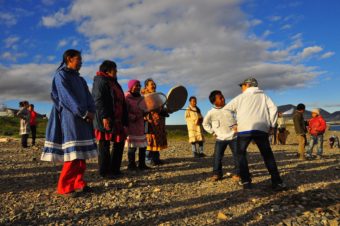
The residents of Novoye Chaplino greeted vistors when they arrived on the beach with traditional song and dance. (Photo by Emily Schwing/KUAC)

This time of year, indigenous people across the Far North gather to play games and celebrate traditions. Earlier this month, in Fairbanks the took part in the World Eskimo Indian Olympics. There was also a gathering of people from across the Circumpolar north in Inuvik, Canada. This year, native people from Arctic nations joined Russia’s Chukchi and Inuit peoples for the first ever Beringia Arctic Games. It was the largest gathering of it’s kind in a once forgotten corner of the world called Chukotka.

Seven women row a long, wide boat out to the middle of a protected bay off Russia’s Bering Sea coast. A flare soars into the air and they pull with all their strength at long wooden oars. They’re in a race against seven other boats and teams.

These are skin boats, made from hand-carved driftwood and the hides of two female walrus. Valentina Attun stands at the back of one. She mans a giant wooden rudder and counts strokes in Russian to help her team keep a cadence. By the end of the race, her voice is hoarse.

“Of course we are very happy to win the race,” says Attun, “but we had a lot of training,” She says her team is very thankful for the men in her village and her uncle who helped build their boat.

This year, more than 20 athletes from seven Arctic nations including Canada, Norway, the United States, Iceland, Greenland and the Faroe Islands joined the competition. They also took part in other games of agility, endurance and strength that test traditional hunting and survival skills.

In a school gymnasium, competition is fierce during the one arm reach. An athlete balances their entire body on one hand and reaches above their head for a tennis ball, but their legs cannot touch the floor. It’s the same movement you might make if you were gathering bird eggs from a rocky cliff.

Johnny Issaluk is from Iqaluit, on Canada’s Baffin Island. He was surprised to discover Russia’s Chukchi people play the same games as Canada’s Inuit.

“When we start competing, it’s just the same as competing at home. There’s nothing different. I am playing with my homeboys.”

Issaluk says the Russian competition is stiff because they are here to represent their villages. Andrej Kainenen agrees. He is one of 200 residents who lives here in Novoye Chaplino.

Kainenan captains a skin boat for his village. He says the event is good because it brings people together. He says the people in Novoye Chaplino took the time to make their village presentable for guests.

The games were met with traditional drumming and dancing. Olga Leitikai is from a small coastal village to the south. She came to sing. She also works as a liaison between the Russian government and local marine mammal hunters. As more attention is paid to natural resources in the region, she says there is dialogue on all sides.

“Of course the society of Chukotka is changing, like all over the world, it’s changing. I think the most important things is to take a balance between tradition and modern life.”

The challenge to find that balance is familiar for Sam Nystad, a native Sami from Norway’s Finnmark region. “The western world has definitely taken a big chunk in the Sami culture,” he says. “The thing is i was actually impressed by how they preserved their culture and how they wanted to chow it to the world through the games.”

After two days, the official games come to a close, but the residents of Novoye Chaplino aren’t ready to quit.

A group of teenage girls from Greenland sings around a bonfire as Andrej Kainenan shows the crowd a new game. Men carry a giant rock around in a circle until their arms are exhausted.

As a midnight sun sinks below the horizon other local games last well into the night, the same way they have for generations.

Malaysian jet that crashed in Ukraine may have been shot down

This post was last updated at 2:30 p.m. ET.

A Malaysia Airlines Boeing 777 with 295 passengers and crew aboard has crashed in eastern Ukraine in an area of the country that has been wracked by a separatist insurgency.

Ukrainian President Petro Poroshenko said he would “not exclude that this plane was shot down, and we stress that the armed forces of Ukraine did not take action against any airborne targets,” he said. “We are sure that those who are guilty in this tragedy will be held responsible.” Later, he called the crash an act of terrorism, according to The Associated Press.

A separatist leader based in Donetsk, Ukraine, where the plane reportedly went down, said his fighters also took no action, telling Interfax that they don’t have weapons that could reach that altitude. Ukraine reported earlier Thursday that two of its aircraft had been shot down in recent days.

A U.S. official tells NPR that the airliner was likely shot down by a surface-to-air missile. A congressional staffer says that U.S. surveillance assets covering the area should be able to determine a likely cause of the crash and that lawmakers expect to get a report within 24 hours.

Malaysia Airlines acknowledged Thursday that it lost contact with the passenger jet over Ukraine, issuing the following statement:

“Malaysia Airlines confirms it received notification from Ukrainian ATC that it had lost contact with flight MH17 at 1415 (GMT) at 30km from Tamak waypoint, approximately 50km from the Russia-Ukraine border.

“Flight MH17 operated on a Boeing 777 departed Amsterdam at 12.15pm (Amsterdam local time) and was estimated to arrive at Kuala Lumpur International Airport at 6.10 am (Malaysia local time) the next day.

“The flight was carrying 280 passengers and 15 crew onboard.

Data on the FlightAware website suggest MH17, a daily flight, normally travels at an altitude of around 33,000 feet, or some 6 miles in the air. A video posted to YouTube showed a smoldering area on the ground that is said to be the crash site.

“I am shocked by reports that an MH plane crashed. We are launching an immediate investigation,” said Malaysian Prime Minister Mohd Najib Tun Razak, in a tweet.

Russian President Vladmir Putin discussed the plane crash with President Obama during a telephone conversation between the two leaders, the White House confirmed.

Later, Obama said the “world is watching” reports of the downed jetliner.

“It looks like might be a terrible tragedy,” he said, adding that his team is trying to determine whether there were any Americans aboard the plane. “That is our first priority.”

“The United States will offer any assistance we can to help determine what happened, and why,” he said.

The U.S. Federal Aviation Administration also warned airlines last month about flying over parts of Ukraine owing to the ongoing conflict, but the warning did not specifically cover Donetsk, where the plane went down, nor did the International Civil Aviation Organization, or ICAO, warn of that region.

Boeing issued a statement saying, “Our thoughts and prayers are with those on board the Malaysia Airlines airplane lost over Ukrainian airspace, as well as their families and loved ones. Boeing stands ready to provide whatever assistance is requested by authorities.”
Details are only starting to emerge about the incident. We’ll update this post as news allows.

Copyright 2014 NPR. To see more, visit http://www.npr.org/.image
Read original article – Published July 17, 201411:55 AM ET
Malaysia Airliner Reportedly Crashes In Ukraine
Site notifications
Update notification options
Subscribe to notifications