Nation & World

Can an aggressive Russia remain our nice Arctic neighbor?

Vladimir Putin, Prime Minister of the Russian Federation at the World Economic Forum Annual Meeting in 2009. (Photo courtesy World Economic Forum)

Pro-Russian activists seized public buildings in eastern Ukraine this week, and U.S. officials say they suspect the actions were not spontaneous but engineered by Russia. That, combined with Prime Minister Vladimir Putin’s recent annexation of Crimea has Arctic experts wondering what this means for international relations in the Arctic and whether the era of cooperation with Russia is over.
So far, despite occasional fears from the West of a Russian land grab in the Arctic, Russia has behaved as a good neighbor in its dealings with other countries in the Arctic Council. It led the way to treaties on pollution control and search-and-rescue, for instance, in effect pledging its mighty fleet of icebreakers to help its neighbors. But sometimes Russia shows a harsher face. Like in December, when Putin told his top military officers they should pay special attention to building their forces in the Arctic. He told them Russia will be stepping up development in the region and must “have all the levers for the protection of its security and national interests.” This week Putin also instructed his security forces to beef up the Arctic frontier.

Russia watchers in Washington say there are signs that, whatever its intentions in Ukraine, Russia might remain a good neighbor in the Arctic. The best sign is the meeting of the Arctic Council late last month in Canada. The Russian delegation came as scheduled, even as Canadian Prime Minister Steven Harper was criticizing Russian aggression in Crimea and demanding Russia’s expulsion from the G8.

Charles Ebinger, a senior fellow at the Brookings Institution, says his contacts within the U.S. Coast Guard told him last week they were still talking to their counterparts across the Bering Strait.

“I think everybody realizes it’s in our own mutual interests to cooperate and not run the risk of some disastrous sea accident just because of the broader international difficulties.”

In the big picture, Ebinger says Putin must realize he can’t develop his petroleum assets in the Arctic without the help of American or Western European oil companies. On the other hand, Ebinger says he expects an emboldened Putin will press for territory beyond Ukraine. That, he says, will trigger tougher sanctions against Russia and the spirit of cooperation in the Arctic is likely to be crushed by a grimmer mood in Moscow.

Heather Conley, director of the Europe Program at the Center for Strategic and International Studies, says it’s unclear if cooperation will continue in the Arctic.

“I think right now everyone is walking very carefully,” she said.

Conley says Russia and the other Arctic nations still have a strong interest in maintaining their good working relationships.

“But, I think we do recognize that should the Ukraine crisis escalate I think it’s clear there will be some spillover effect which will impact the Arctic,” she said.

Already, the U.S. and Norway have called off a naval exercise with Russia in the Arctic. That’s outside the realm of the Arctic Council, but such exercises do help the countries develop the integration needed for multinational rescues and pollution control operations as envisioned by the council.

Robert Huebert, associate director of the Center for Military and Strategic Studies  in Calgary, says he expects the Russians to continue to play nice in the Arctic for the time being, either because they still believe in the cooperative alliance, or because they want to make their actions in Crimea look like an isolated incident. Huebert says figuring out Russia’s true motivation is a puzzle for Western nations.

“On the one hand it’s also in their interest to have the Arctic remain outside all of this, but if the Russians have become more assertive, more aggressive, there’s a requirement to stand up to it,” he said.

As Huebert sees it, Russia has touched off a national security chain reaction that is likely to spread north, because Putin’s takeover of Crimea has both Sweden and Finland feeling they might be next. That has revived their interest in joining NATO. If either country becomes a full member, Huebert says Russia would take it as a direct military threat, an attempt by NATO to encircle the Arctic.

“The Russians, since about 2004, 2005, have always listed one of their core security threats … is an expansion of NATO onto its doorsteps,” he said.

Huebert acknowledges his perspective on Russia tends to be darker than most, but he never really believed in Russia the nice Arctic neighbor. Huebert says the Arctic Council experience only proves the countries can cooperate to set up a framework for cooperation.

“I don’t know if you have kids, but it’s always easy to get the kids to agree to all the rules about sharing toys until the actual toy shows up,’ he said.

The real test, Huebert says, comes when the Arctic Council stands between Russia and something it wants.

Seismologists, lawmakers call for earthquake early warning system

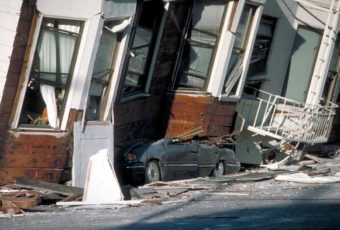
An automobile lies crushed under the third story of this apartment building in San Francisco after the 1989 earthquake. (Photo by J.K. Nakata/U.S. Geological Survey)

In Congress yesterday, a House subcommittee marked the 5oth anniversary of the Great Alaska Earthquake with a hearing focused on what scientists have learned from that event that can prepare the nation for the next big temblor or tsunami. Seismologists and several lawmakers said Congress needs to pony up for an earthquake early warning system.
50th Anniversary of the Great Alaska Earthquake
[icon name=”icon-angle-right”]Tsunami warning test too real?
[icon name=”icon-angle-right”]When the earthquake struck, Bob Allen took care of what he could
[icon name=”icon-angle-right”]The Great Alaska Earthquake: 50 Years Later
[icon name=”icon-angle-right”]Sitkans remember Alaska’s 1964 earthquake

For people who study earthquakes, each major event serves as a lab experiment. Plate tectonics was a tentative theory before the 1964 quake, which also provided valuable insights about soil liquefaction and tsunamis. William Leith, an earthquake advisor for the USGS, says North America’s largest ever earthquake changed policy, too.

“Through the iconic scenes of houses broken apart by landsliding in the Turnagain neighborhood of Anchorage, the ‘64 disaster demonstrated the importance of considering earthquake hazards in urban planning and development,” he said.

Leith was one of four scientists who testified. They say one lesson the U.S. should have learned by now is the need to develop an early warning system for earthquakes, as other countries already have. USGS has spent $10 million over more than a decade to come up with a prototype for California, but it would take $16 million a year to build and operate a system for the whole West Coast. Professor John Vidale of the University of Washington says the Cascadia fault, for example, is set to deliver an Alaska-sized earthquake to the Pacific Northwest. Vidale says it’s likely to be detectable 1 to five minutes in advance.

“An early warning will forestall train, car and airplane accidents, halt surgeries, allow for bridges to clear, shut down elevators, open critical doors, warn schools and the population in general,” he said.

Vidale  says a magnitude 9 quake would cause an estimated $50 to $100 billion damage. To some Congress members, the lack of will to pay for a warning system makes no sense. Here’s Peter DeFazio, an Oregon Democrat.

“We’ve spent $10 million – WOW! — since 1999,” DeFazio said, mocking the sum as low, in Congressional terms. ”We’re looking at a $100 billion problem in the Pacific Northwest. We’ve spent $10 million. You talk about countries like, I think you said Romania? Mexico? They’ve deployed early warning systems and the United States of America hasn’t? We have a prototype?”

One of the scientists said most countries develop a warning system only after a catastrophe strikes. New Jersey Democrat Rush Holt says Congress has been too stingy:

“And here the richest country in the world by far, undeniably, doesn’t act as if we have a future. One invest, one builds infrastructure, one sponsors research when we believe we have a future. Instead we just cut, cut, cut.”

Alaska Congressman Don Young says he and the late Sen. Ted Stevens were able to provide funds for tsunami warning, but he says he’s disappointed Congress has cut it back. As for earthquake warning, Young had a bit of low-tech advice for the panel.

“I do believe we can identify when an earthquake can occur. You have to buy a pheasant. It always worked back in California,” he claimed. “A pheasant will tell you when an earthquake is going to happen about five second before it happens.”

Young supports funding an earthquake warning system, too, but he says the Alaska disaster showed tsunami to be the more lethal danger.

Tribes push to restore salmon to upper Columbia River

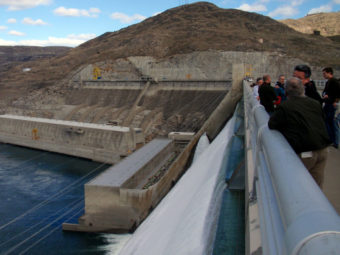
A pre-conference tour of Grand Coulee Dam on Monday kicked off a conversation about restoring salmon to the Upper Columbia Basin. (Photo by Tom Banse/NNN)

Once upon a time, salmon and steelhead swam over a thousand miles upriver to the headwaters of the mighty Columbia River, at the foot of the Rockies in British Columbia.

Those epic migrations ended in 1938 with the construction of Grand Coulee Dam.

This week, tribes from both sides of the U.S.-Canada border along with scientists and policymakers are meeting in Spokane to figure out how Columbia River fish could be restored to their entire historical range. The idea draws passionate supporters, but has unknown costs that you might be asked to help pay.

Uncharted waters 

Salmon and steelhead have been absent from the upper Columbia River for 75 years. But tribes on both sides of border still miss the fish. Colville tribal member D.R. Michel senses an opportunity “to correct a lot of wrongs.”

“The tribes never surrendered to the loss of salmon,” he says. “You see old photos of the chiefs standing on the reservation side looking down on the project with all of those promises of, ‘We’ll take care of you. You’ll have your fish. We’ll put in hatcheries.’ None of that stuff ever really happened.”

Tribes are taking the lead to examine options for restoring migratory fish to the upper Columbia River. Five dams built without fish ladders now stand in the way — two in Washington and three in Canada.

The Bureau of Reclamation’s Lynne Brougher led a tour Monday of Grand Coulee Dam for tribal leaders and biologists from British Columbia and the U.S. Northwest. She stopped the tour van in the center of the enormous concrete span so the group could peer over the edge at the torrents of water plummeting down the spillways.

“What you’re looking at here is a 350 foot difference between the water at the base of the dam and uplake in the reservoir,” Brougher explained over the din of rushing water.

A map of dams in the Columbia River Basin (Map courtesy of U.S. Army Corps of Engineers)
A map of dams in the Columbia River Basin
(Map courtesy of U.S. Army Corps of Engineers)

Nobody has built a fish ladder on a dam this high according to Canadian Columbia River Inter-Tribal Fisheries Commission biologist Will Warnock of Cranbrook, British Columbia.

“It would be going into uncharted waters to build that kind of passage facility. There’s other things you can do to get salmon past dams this high, though. You can trap them and manually truck them around the dam.”

That’s one idea. An elevator actually is another. A long fish ladder would be very expensive and a last resort, if tried at all.

A separate suite of technologies would be needed to help juvenile salmon migrating downstream get past the hydropower turbines and long stretches of slack water behind the upper Columbia dams.

Who would pay?

Who would pay for this? Nearly all of us, as D.R. Michel sees it. He directs the Upper Columbia United Tribes of North Idaho and Eastern Washington.

“It’s potentially a shared cost between ratepayers, the federal government, farmers and irrigators,” says Michel. “Some of the folks who benefit directly from use of this water and what comes out of this dam should help pay for this also.”

The unknown costs of reintroduction could add up, and that worries the Public Power Council’s Scott Corwin. He represents public utilities who get electricity from Columbia River dams.

“There are just a lot of questions about whether that is even possible and how it would impact other species. Yeah, we have a lot of questions.”

The U.S. and Canada are about to open negotiations to renew the 50-year-old Columbia River Treaty. That is the forum chosen by fish advocates to advance their idea. But last week, British Columbia’s government declared it doesn’t want to discuss it at the treaty talks.

A position paper forwarded to Ottawa reads, “British Columbia’s perspective is that the management of… salmon populations is the responsibility of the Government of Canada and that restoration of fish passage and habitat, if feasible, should be the responsibility of each country regarding their respective infrastructure.”

“We are very respectful of the importance of salmon to First Nations,” said provincial Energy Minister Bill Bennett, using the Canadian term for native tribes. But during an interview, Bennett also maintained that ratepayers of BC Hydro should not have to pay more for fish passage. “Our (electricity) rates are already going up in B.C.,” Bennett noted.

Tim Personius, deputy regional director of the U.S. Bureau of Reclamation, says Canada’s position could be a problem.

“The position of the United States is that we should not move forward without Canada participating. I think that’s a good idea.”

Personius says it looks like a lot of the spawning habitat for upper Columbia River fish is in Canada. He says it would not make a lot of sense “for the United States to spend millions or billions of dollars on fish passage” only to have the salmon run to British Columbia and “stub their noses” on a Canadian dam.

The U.S. government is taking an open-minded position in Personius’ telling. But given the many unknowns, “We should kind of approach this cautiously and probably in small steps.”

Juneau Peace Corps volunteer evacuated from Ukraine

Mary Miller, of Juneau, spoke Thursday to Juneau World Affairs Council about her recent experience in Ukraine.

Longtime Juneau resident and Peace Corps volunteer Mary Miller had several months to go on her two-year tour in Ukraine when the organization pulled out volunteers late last month.

Miller was teaching English to what she calls “technically elite students” at Odessa National Academy of Telecommunications.

With a population of about a million people, Odessa is the third largest city in Ukraine and a major shipping port on the Black Sea. It’s about 275 miles south of Kiev, the capital.

Miller said most of the people she met were fluent in Russian and Ukrainian, and many spoke English.

“They may have grown up speaking one language but they know the other, and for the most part I would say the vast majority of the population is bilingual,” she said.

As demonstrations in Kiev grew violent, the Peace Corps volunteers found themselves in a tenuous position.

“We’ve followed it, you know, every day for the last three months, everything that was happening, just as an observer,” she said. “I would have students that would ask me ‘what do think about what is going on up there’ and I would say it’s not important what I think, it’s what do you think. But I would say that I did believe it was a human right for people to be able to express their opinions in a peaceful manner without fear of persecution.”

On Feb. 22 , Peace Corps volunteers in Ukraine were sent home. Miller doesn’t know if or when she will return.

Miller spoke to the Juneau World Affairs Council on Thursday night and to KTOO News earlier this week .

You can watch Miller’s talk to the Juneau World Affairs Council Friday at 8 p.m. on 360 North television.

U.S. pushes international ban on arctic fishing

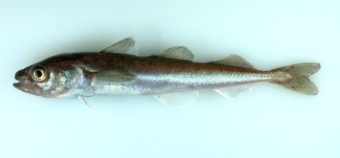
Arctic cod. (Photo courtesy of NOAA)

The United States is gathering support for an international moratorium on commercial fishing in the Arctic Ocean.

The Globe and Mail reports that Denmark and Canada are prepared to back the ban at a meeting of Arctic states in Greenland this week. The other nations — Russia and Norway — are not currently on board.

The proposal on the table is to close down fishing beyond each nation’s 200-mile exclusive economic zone. The region would remain closed until scientists were able to conduct a comprehensive stock assessment of Arctic fish species.

In 2009, the United States outlawed commercial fishing within its exclusive waters off the northern coast of Alaska.

Scientists and environmentalists have been pushing for an international measure in recent years, as warming climates melt off more ice and expose potential fishing grounds in the Arctic Ocean.

Commission wants Alaska to have more influence over arctic’s future

The Canadian Coast Guard Ship Louis S. St-Laurent trails the Coast Guard Cutter Healy as the two ships work their way farther north to research the floor of the Arctic Ocean Sept. 2, 2009. (Photo by Patrick Kelley, U.S. Coast Guard)

After a year of meetings, the Legislature’s Arctic Policy Commission is rolling out its strategy for the region.

The draft report is over 100 pages, and it offers recommendations on how to manage maritime commerce and resource development in the Arctic, how to improve emergency response, and how to include the state’s indigenous population in policy decisions.

Rep. Bob Herron, a Bethel Democrat who co-chaired the commission, says having an “Arctic thought process” puts the state on better footing with the federal government when it comes to having a say in policy for the region.

“We want to be in the center of all those decisions,” says Herron.

The Arctic Policy Commission’s work may have a more immediate influence on the state’s own policy. The report identified the lack of infrastructure as a key problem for the region, and Herron and his fellow co-chair, Sen. Lesil McGuire, each introduced legislation to address that last week. One bill would create a port authority for the Arctic, while the other would authorize the state to issue loans for projects like roads and harbors.

McGuire acknowledges that Arctic development will be expensive and difficult to afford given that the state is looking at a budget shortfall. Still, she sees it as a necessary investment.

“I think we’re going to have to start looking at it right now. We’re already behind,” says McGuire.

The Obama administration offered its own strategy for the Arctic region last week.

Site notifications
Update notification options
Subscribe to notifications