
Nation & World

Alaska’s high court first supreme court in the nation to hear climate change case

Alaska’s high court became the first state supreme court in the country yesterday to hear an appeal in one of more than a dozen climate change lawsuits.

The lawsuits pit young people against their states. The plaintiffs claim the state has an obligation to protect the atmosphere from excessive carbon emissions.

Nelson Kanuk is a freshman at the University of Alaska Fairbanks and the main plaintiff in Alaska’s case.

His family’s home in the 600-person village of Kipnuk became uninhabitable because of spring floods, melting permafrost and erosion. This summer, his parents, two brothers and three sisters moved to Bethel, about 100 miles away.

“So we’re thinking of hopefully rebuilding our home in Kipnuk, or we might move out of town to possibly Kenai,” Kanuk said. “Somewhere we can start over.”

 The state has three main arguments for why the court should dismiss his case:

  • Climate change is a political question that only lawmakers and the governor can address. Not the courts.
  • The injury to these youths from climate change is so ubiquitous that they don’t have legal standing.
  • And finally, the atmosphere, unlike, say, clean water, isn’t a public trust resource that the state has a legal obligation to protect.

The science of climate change was not disputed.

Assistant Attorney General Seth Beausang argued the case for the state.

“My argument is not that that nothing can be done to stop global warming,” Beausang said. “It’s just that it shouldn’t happen in the context of a lawsuit. Where I think it should happen is at the political level, so if people are concerned about climate change, you know, they should get involved. And, you know, we live in a democracy and you should get as involved as you possibly can.”

While it’s not up to the court to write policy, attorney for the plaintiffs Brad DeNoble argued it is the court’s role to compel the state to come up with policy.

“You can declare the constitutional rights. You can declare that the atmosphere is a public trust resource. You can order the state to develop an accounting,” DeNoble said.

Similar lawsuits are pending in 12 other states, federal court — even Ukraine and Uganda. That’s according to Julia Olson, director of Our Children’s Trust. Her Oregon-based nonprofit helped Kanuk and other young people file these suits.

So far, Olson says only a trial court in Texas has backed the plaintiffs. Texas filed an appeal.

Alaska Chief Justice Dana Fabe didn’t give a timetable for when to expect a decision. Opinions typically come months after arguments are heard.

You can watch Gavel Alaska’s webcast of the Supreme Court proceedings and read tweets from the event here.

Why “Alaska” means milk and basketball to many Filipinos

When Filipinos hear “Alaska,” often the first two things that come to mind are milk and basketball.

(Composited from photos by @Doug88888 and Ion Botezatu via Flickr Creative Commons)

That’s according to the Philippines’ recently appointed honorary consul to Alaska, Jenny Gomez Strickler.

It turns out, the Philippines-based Alaska Milk Corporation sells milk in the country and sponsors the Alaska Aces — not Anchorage’s minor league hockey team, but a professional basketball team in the Philippines. Neither the milk nor the basketball team have a meaningful connection to the 49th state.

That means if Alaska wants to make inroads in trade with the Philippines, the state has a lot of work to do. In 2012, less than 1 percent of Alaska’s exports ended up in the Philippines, according to census data.

Jenny Gomez Strickler, Philippines honorary consul to Alaska

But Strickler says connections are being forged that could help build a market for Alaska seafood, and even liquefied natural gas.

The Juneau resident and retired Alaska Department of Commerce and Economic Development worker spoke to the Juneau World Affairs Council on Wednesday. In her new honorary role for the government of the Philippines, she’s part bureaucrat, and part international trade facilitator.

She’s trying to make the case that “Alaska” should mean “seafood” in the Philippines.
“The Philippines is a fish-eating country,” she said. “Yet its fish is imported from other countries. And its imported salmon is farmed salmon.”

Strickler, Juneau Rep. Cathy Munoz and the governor’s office are trying to put together a seafood festival in Manila next year to show the country what Alaska has to offer.

Strickler shared an anecdote about a missed connection that networking at the festival might fix. A former Juneau resident brought some Alaska seafood to Manila for his friends to try. One of samplers happened to be a hotel owner.

“The business owner enjoyed it so much, he said, ‘If I get this from you, can you guarantee me X amount throughout the year, or a portion of the year?’ He looked him straight in the eye and said, ‘I can’t, cause I’m not a fisherman.’”

She said they’re working on a pitch to get support from the Alaska Seafood Marketing Institute.

Strickler also said she was on a recent conference call between Philippines Ambassador Jose Cuisia Jr. and state officials. The ambassador said he’s putting together a team to visit Alaska and investigate opportunities to import liquefied natural gas.

Finally, Strickler said Aklan State University in the Philippines is interested in sending instructors to the University of Alaska Southeast through an exchange program. They want to learn about saltwater fisheries.

Strickler said she expects that arrangement to come together after the Juneau Assembly adopts a sister city proclamation linking Juneau and Kalibo, the capital city of the Philippine province Aklan.

A Juneau Assembly committee backed the proclamation on Monday.

Jenny Gomez Strickler’s talk with the Juneau World Affairs Council is tentatively scheduled to air on 360 North on October 11th.

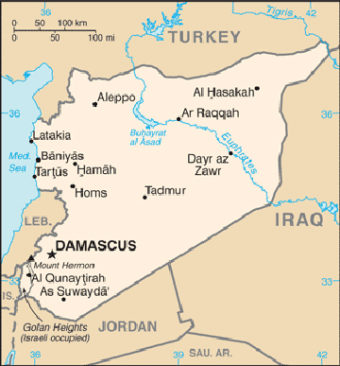
Alaskans overwhelmingly oppose military involvement in Syria

President Barack Obama has asked Congress to postpone a vote on a U.S.-led military strike against Syria to pursue a diplomatic solution.
The president Tuesday night took his case to the American people, but said he would let proposals for a peaceful solution play out.

Obama has been making the case for U.S. involvement since the Assad regime reportedly used chemical weapons in the Syrian war, killing more than 1,400 people.

But war-weary Americans have not lined up behind President Obama and  Alaskans have overwhelmingly opposed U.S. intervention in Syria.

The state’s two U.S. senators and lone House member say the issue has sparked more constituent mail than any recent development in Washington.

“We had over a thousand calls and emails opposing any intervention and I think we had less than five – the total amount – that was supportive.”

Republican Rep. Don Young has steadily opposed any U.S. military involvement in Syria.  He just returned to Washington from Alaska, where constituents told him to stay out of the Syrian civil war.

“The most amazing thing to me in my traveling across the state, I never found one person who was in support on intervention in Syria.  And we are very much a military state,” Young said before the president’s speech.  

He said Alaskans’ opposition is blind to political alliance.

“You know you have the very liberals, you have the moderate conservatives, the real conservatives, a lot of different reasons,” Young said.

Six-thousand Alaskans participated in a telephone town hall on Syria last week with Sen. Mark Begich, a Democrat.  Press secretary Heather Handyside said the number of comments coming in was the impetus behind it.

Outside that town hall teleconference, Handyside said there have been thousands of calls, letters, emails and Facebook comments.

I’d say since this issue came to the forefront we’ve had about 3,000 contacts.  Probably only about 5 percent or less are in favor of engagement,” Handyside said.

Republican Sen. Lisa Murkowski has also been inundated with Alaskans’ concerns about Syrians.  Press secretary Matthew Felling said most are strongly negative for a myriad of reasons.

“Some people are frustrated that a couple times a year we get a different crisis in the Middle East and we don’t see to have a plan. And there are other people who say just ‘stay out of it, we are not the world’s police’. And there are some people who say ‘we don’t want boots on the ground’. I mean the massive response overall has been no, but for a myriad of reasons,” Felling said.

He said Facebook traffic hit a “fever pitch” before the president’s speech.  It was coming worldwide, but the senator’s office only counts Alaskans’ comments.


Sen. Begich lays out position on Syria strike

Alaska’s junior senator says he’s likely a “no vote” on a resolution to authorize a military strike in Syria.

Democratic Sen. Mark Begich says he doesn’t support President Obama’s version because it was too broad, and had serious reservations about the version the Senate Foreign Relations Committee advanced to the full Senate on Wednesday.

He made the comments from Washington, D.C., during a telephone townhall meeting with constituents on Thursday evening.

Begich said he has four unsatisfied criteria. First, he said the response to the Syrian President Bashar al-Assad’s violation of an international chemical weapons ban must be an international effort that includes Russia and China.

Second, “No boots on the ground, whatsoever, of any kind.”

Third, the military strikes must be paid for without stripping down “important, needed services.”

Finally, he must have an understanding of the “real game plan” and the end game.

Begich said it was unlikely his criteria would be met.

“I know what some will say,” he said. “Well, I put too high a standard — that means I’ll probably be a ‘no.’ Well, these are the standards when you’re putting American lives on the line that we should have. So that’s where I’m at on this, they got a lot to still prove to me.”

Republican Rep. Don Young has said he’s opposed to any U.S. military intervention in Syria. And Republican Sen. Lisa Murkowski has said she is “wary” of intervention, but is soliciting constituent input on the topic.

The full Senate is expected to take up the resolution next week.

Syria strikes could catapult oil prices even higher

Azaz, Syria during the Syrian civil war. (2012 Photo by Voice of America News: Scott Bob/Wikimedia Commons)

Syria does not produce much oil.

It’s allies do, though, said Ed Hirs, an energy economist at the University of Houston.

“Iran and Russia being two of Syria’s primary allies are of course, two of the largest oil exporting in the countries in the world,” Hirs said from his office in Houston. “A little run unrest in that part of the world goes a long way in bumping prices a tiny bit.”

Hirs said oil prices spiked after the United States bombed Iraq in 1998. The president said Wednesday he’s still weighing his options on how to respond to chemical attacks in Syria last week. His own Defense Secretary said cruise missile strikes are an option.

The unrest and climb in prices comes as rural Alaskans are stockpiling heating oil and gasoline for the winter.

Bob Cox, vice-president at Crowley – the company that barges refined petroleum products to Western Alaska, said the second to last barge of the season went out Wednesday. That’s headed for communities near Norton Sound.

The final is scheduled to load and ship out next week for Bethel and the Y-K Delta.

“There’s been a run up in the markets here in the last week and we see prices $.15 or $.20 a gallon higher than they would have been two weeks ago,” Cox said.

The last two barges account for just 10% of the 50 million gallons Crowley ships to Western Alaska throughout the summer.Despite the high prices for the final shipments, this season as a whole will be cheaper than last.

“It’s actually been a pretty good year. I was tracking prices over the last few years. 2013 prices were actually down a little bit versus last year,” Cox said.

Last year’s prices – like this year’s – were a result of unrest in the Middle East.

Site notifications
Update notification options
Subscribe to notifications