Nation & World

Warming Arctic likely contributing to erratic worldwide weather

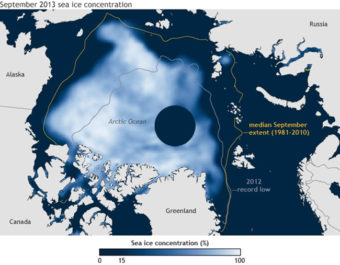
A federal agency says the Arctic continued to warm in 2013 and may have entered a “new normal” of diminished sea ice and wilder swings in weather that affect lower latitudes.

It’s not proven, but the evidence is growing, the report’s chief author said, that a warming Arctic is making the jet stream waver more and delivering more erratic weather patterns to the Lower 48 states, Europe and Russia.

Martin Jeffries of the University of Alaska Fairbanks says more and more research papers are establishing specific links between that weather and a warmer Arctic Ocean.

“It’s believed to be causing in the wintertime colder snowier winters on the eastern seaboard,” Jeffries said. “There is evidence that recent summers in the UK, which have been very wet and have affected farmers are due to the changes in the Arctic as well.”

Or, as University of Virginia Professor Howard Epstein more succinctly put it, “The Arctic is not like Vegas. What happens in the Arctic doesn’t stay in the Arctic.”

But the weather swings involved cooling as well as warming. In Fairbanks, for instance there was an unprecedented record run of 36 days when the temperature was above 80 degrees. But in the same year, Jeffries noted, there was a prolonged spring cold spell.

“In central Alaska, spring 2013 experienced the coldest April in 90 years,” Jeffries said. “And the first green shoots on trees, they appeared very late, on the 26th of May, the latest since records began in 1972.”

Courtesy climate.gov.

Yet the report card also notes that alder shrubs in Siberia have added a whopping 25 percent to their range, and more shrubs and dry conditions have made large wildfires in the Arctic tundra so widespread that they are affecting the atmosphere – putting out so much smoke that Howard Epstein speculates it could be reversing the decreased emissions from Russia since 1989.

“Since the early 1990′s black carbon in the Arctic atmosphere has decreased by roughly 50 percent due to economic collapse in the former Soviet Union,” Epstein said. “Given the increase in arctic wildfires, it seems reasonable to ask how much might that increase offset the decrease of black carbon from other sources.”

But they don’t really know, because the Russians don’t have good satellite coverage and American satellite capacity is eroding as well.

This decline in remote sensing capacity is also one of the reasons nobody knows what the consequences are of an estimated 25 percent increase since the 1970′s of the amount of heat and fresh water that ends up in the Beaufort Gyre to the northwest of Alaska.

So the report card for 2013 is mixed.

Lead author Martin Jeffries says scientists are now studying a moving target when it comes to the effects of a warming Arctic.

“And multiple observations provide strong evidence of widespread sustained changes that are driving the arctic environmental system into a new state,” Jeffries said. “Some would say that this has already happened – that the Arctic has shifted to a new normal.”

The Arctic Report Card is the work of 147 scientists from 14 countries and is now available on NOAA’s website.


First Fuel Rods Plucked From Tsunami-Damaged Fukushima Plant

Workers remove nuclear fuel rods from a pool at the Unit 4 reactor of the Fukushima Daii-chi nuclear power plant on Monday. Handout/TEPCO

Workers at Japan’s Fukushima Dai-Ichi nuclear power station successfully completed the first day of a delicate operation to remove radioactive fuel rods from a reactor damaged in the March 2011 tsunami.
The fuel rods were removed from the Unit 4 reactor, which was offline at the time the tsunami smashed into the plant, overwhelming its backup systems. Although Unit 4 was spared the fate of three other reactors that melted down, a fire in its containment building weakened the structure.

Tokyo Electric, or TEPCO, the utility that operates Fukushima, has reinforced the Unit 4 containment structure, but NPR’s Geoff Brumfiel says it’s continued to be a big worry.

“It had more than 1,500 bundles of nuclear fuel being stored in a pool above the reactor core. Those bundles are a big threat at the plant: People worry that if there’s another earthquake or something else happens, they might release more radioactivity,” he tells All Things Considered.

TEPCO plans to remove unused fuel rods first and then the spent fuel. According to The Guardian, 1,331 spent rods and 202 unused rods will be removed when the operation is complete.

“People move these fuel bundles around all the time during normal operations at a nuclear power plant,” says Brumfiel. “But this is not a normal situation — this is a plant that’s been heavily damaged. There’s also a fear that one of these casks might get dropped, say during an earthquake.”

To get the fuel rods into a more secure location, says Brumfiel, TEPCO workers are using a crane to lift them from their containment pool and then deposit them into a heavy cask.

“They … lift the cask out of the pool and then carry it to another location onsite where it can be stored more safely,” Brumfiel says.

“It’s a slow process that will take more than a year, and there are still three other reactors to go,” he says.

And then there are the three reactors that melted down, which will pose an even greater challenge.

“They have fuel not just in the pools above the reactors, but in the cores themselves. That fuel is melted down and it’s going to take a very, very long time to even figure out how to get that fuel out,” he says. “Then, on top of it all, the site is full of radioactive water and that continues to be a problem.”

Copyright 2013 NPR. To see more, visit http://www.npr.org/.
Read original article – Published November 18, 2013 3:33 PM
First Fuel Rods Plucked From Tsunami-Damaged Fukushima Plant

In Shattered Filipino City, A Fight For ‘Sheer Survival’

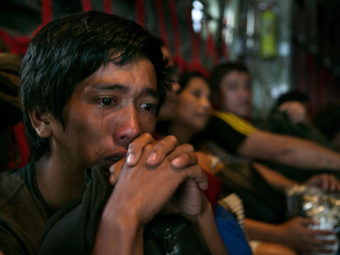
In anguish: Tears ran down the cheeks of a man as he waited with other survivors Tuesday for a flight out of Tacloban, the Philippines, which was devastated by Typhoon Haiyan. Paula Bronstein/Getty Images

(We updated at 10:40 a.m. ET to include the latest official death toll of more than 2,300.)

HOW TO HELP: The U.S. State Department is coordinating with The mGive Foundation to collect funds for aid groups that are responding to the crisis in the Philippines.

As some trucks loaded with food and other aid arrive in the Philippines city of Tacloban they’re being looted by residents struggling to survive in the aftermath of Typhoon Haiyan, NPR’s Anthony Kuhn said Wednesday on Morning Edition.

He’s spoken with many of those people and they seem to be “ordinary folks who would not do such things in ordinary times,” Anthony told host Steve Inskeep. “But they are doing such things to stay alive.”

In Tacloban, he added, a fight for “sheer survival” is under way as people in the city of more than 220,000 search for food, water and other essentials. As of Wednesday, there weren’t enough government troops in the area to control things.

Anthony’s report from the scene underscores this headline from The New York Times: “Mayor of Typhoon-Ravaged City Urges Residents to Flee.” Here’s how the Times starts its story:

“TACLOBAN, the Philippines — The mayor of this typhoon-ravaged city urged residents on Wednesday afternoon to flee to other cities and find shelter there with relatives if they could, saying that the local authorities were struggling to provide enough food and water and faced difficulties in maintaining law and order.”

Euro News has posted some video of looting at a store in Tacloban and writes that “desperation, thirst, hunger and opportunism are said to be provoking anarchy.

It was last Friday when Haiyan, known as Yolanda in the Philippines, made landfall. It was packing winds that sometimes reached or exceeded 200 mph. As of late Wednesday morning in the U.S., the official death toll from the Philippines government stood at more than 2,300 (President Benigno Aquino III has said the final toll is likely to be between 2,000 and 2,500). More than 660,000 are thought to have been forced from their homes. As many as 9.8 million people, U.N. officials say, were affected by the storm.

While the government, international aid groups and foreign militaries that have rushed to the affected area are having trouble getting to the victims because of blocked roads, the U.S. commander on the scene told NPR early Wednesday that American assistance has quickly ramped up.

Marine Brig. Gen. Paul Kennedy said that “this disaster is 5 days old for the people of the Philippines, [but] we’ve effectively only had U.S. military operations for the last 72 hours. And in 72 hours we’ve gone from essentially a cold start — I flew in here with 6 people and a suitcase staff — to running … aircraft. We moved 65 tons of humanitarian assistance supplies yesterday. That’s a lot of stuff. We’ll do the same today.”

NPR’s coverage of the typhoon is collected here. For another view of how desperate things are in some places, see our post from Tuesday:

After Typhoon Tore Through, People ‘Were Left On Their Own’

Copyright 2013 NPR. To see more, visit http://www.npr.org/.
Read original article – Published November 13, 2013 7:25 AM
In Shattered Filipino City, A Fight For ‘Sheer Survival’

Juneau’s Filipino community plans relief efforts for Typhoon Haiyan victims

Filipino Community Inc flag
Juneau’s Filipino Community Inc. celebrated its 50th anniversary in 2006. Photo by Casey Kelly/KTOO.

Juneau’s Filipino community is pulling together to help the victims of Super Typhoon Haiyan, which hit the country early Friday morning.

Thousands are feared dead and injured from the storm, one of the most powerful ever recorded. According to news reports, at least 300 people are confirmed dead on Samar Island in the central Philippines. Another 10,000 people are believed to have died in Tacloban city on Leyte Island, near Samar.

The storm knocked out power and communications to much of the central Philippines. Dante Reyes is president of Juneau’s nonprofit Filipino Community Inc. He’s from Aklan province, where close to 10,000 homes were destroyed.

“We’re still waiting for some reports coming in from our relatives and from some of our friends what happened to them, or are they okay, or fine or something like that,” Reyes says. “So, it’s really hard.”

Filipino Community Inc. held a membership meeting on Saturday, where Reyes says they decided to cancel the organization’s free Thanksgiving Day meal. Instead, the group will donate the $3,000 dollars budgeted for the event to relief efforts. In addition, there will be a fundraising dinner on Saturday November 23rd at the Filipino Community Hall downtown on Franklin Street.

“We will be having the traditional American and Filipino dishes,” he says. “So we will have turkey for sure. We will have a Filipino kind of beef steak – we call it Bistek. So we’re planning to have a community-wide fundraiser for the event. And hopefully we can raise money to help the victims of the typhoon.”

He says the meal will cost $15 per single adult, or $25 for a couple, and $5 for children. More details will be available as the event gets closer.

Reyes says anyone who wants to offer to help can contact him on his cell phone at 321-6235.

Super Typhoon Leaves More Than 100 Dead In Philippines

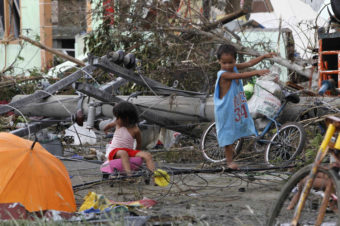
Children play near electric posts which were damaged after super Typhoon Haiyan battered Tacloban city in the central Philippines. Romeo Ranoco /Reuters /Landov

The Philippines is just now starting to assess the damage caused by the landfall of one of the most powerful tropical cyclones in recorded history.

As Mark reported, Typhoon Haiyan roared over the Philippines with top sustained winds at nearly 200 mph.

One of the hardest hit areas appears to be Tacloban City, which faced a 40-foot storm surge. The New York Times, quoting Capt. John Andrews, deputy director general of the civil aviation authority, reports that at least 100 cadavers were seen on the streets. The country’s National Disaster Risk Reduction and Management Council puts the number of dead at 138.

There are reports of many more deaths across the country. For now, we’ll stay away from numbers, but it’s a pretty safe bet to say that this will be a mass casualty event.

The Times adds:

“As rescuers make their way to isolated areas and communications are restored, officials worried that the death toll could rise significantly. Damage was believed to have been extensive, in part because many structures in poorer regions are not well built.

“As the typhoon barreled toward Vietnam, where it is expected to hit landfall Sunday morning, roughly 20,000 people were evacuated from Da Nang, a city of nearly 1 million, state media reported. The government mobilized nearly 450,000 soldiers and militia members to deal with the storm, which is expected to weaken slightly as it hits Vietnam.

“By some accounts the typhoon, named Haiyan, ranked among the world’s strongest. But because it moved across the Philippines so rapidly and hundreds of thousands were evacuated, officials were hoping that the death toll would be limited. Experts say that is because it did not linger long enough to deluge the islands with rain that has caused the widespread flooding and mudslides that have in the past lead to death tolls in the thousands.”

USA Today paints a grim picture of near-total destruction. There are reports of “widespread power outages, flash flood, landslides and scores of buildings that were torn apart.” The airport terminal in Tacloban, reports the paper, was ruined by the storm surge. USA Today adds:

“‘We expect the level of destruction caused by Typhoon Haiyan to be extensive and devastating, and sadly we fear that many lives will be lost,’ said Anna Lindenfors, Philippines director of Save the Children.

“‘With this magnitude we know that the destruction is overwhelming,’ said Emma Amores, who is waiting outside Villamor Airbase in Manila, where a C-130 is loading relief supplies and personnel heading to hard-hit Tacloban. ‘From the images we saw on TV, it’s highly likely our houses are gone. We just want to know that the family are all safe.'”

Reuters has put together a video of early images from the Philippines:


s more news comes out of the area, we’re update this post.

Update at 3:55 p.m. ET. Severe Destruction:

It is now almost 5 a.m. in Tacloban City, which means we may start getting some more news as day breaks. Meanwhile, CNN’s Andrew Stevens has made his way to Tacloban and he reports “severe destruction.

He says the entire waterfront was destroyed by a fast-moving storm surge. He said he saw bodies floating in the water. And has only now started seeing military helicopters over the city.

“The city is still pretty much cut off,” Stevens reported. “Food and water are running out.

The head of the U.N. Disaster Coordination Team put it in starker terms.

“The last time I saw something of this scale was in the aftermath of the Indian Ocean Tsunami,” Sebastian Rhodes Stampa said.

One bright spot CNN’s Stevens said is that many in Tacloban, which has a population of more than 200,000, were told to evacuate.

Update at 9:09 a.m. ET. 138 Dead:

According to the Philippines’ National Disaster Risk Reduction and Management Council, as of a few hours ago, 138 people were reported dead and 4.2 million people were affected.

Update at 8:17 a.m. ET. Relief Efforts Will Be Massive:

Weekend Edition Saturday spoke to Nichola Jones, a spokesperson for the International Red Cross currently in Cebu Island. She said that the Red Cross expects tens of thousands of homes to be damaged and the “scale of the relief efforts will be massive.”

To put it into perspective: Jones said the hurricane pummeled an area with a total population of 3.2 million. What’s more, Bacolod, which was struck by the typhoon, was also hit by a 7.2-magnitude earthquake back in October.

“It’s been a very difficult time for people here,” Sebastian Rhodes Stampa said after arriving.

Copyright 2013 NPR. To see more, visit http://www.npr.org/.
Read original article – Published November 09, 2013 8:01 AM
Super Typhoon Leaves More Than 100 Dead In Philippines

Strongest Cyclone Ever? Typhoon Haiyan Slams Philippines

From space, Typhoon Haiyan was almost beautiful. On the ground, it wasn't so pretty. EUMETSAT
From space, Typhoon Haiyan was almost beautiful. On the ground, it wasn’t so pretty. EUMETSAT

Meteorologists weren’t holding back Friday after watching in amazement as Typhoon Haiyan roared over the Philippines with pounding rain and top sustained winds approaching 200 mph as it neared the coast.

It is “the strongest tropical cyclone on record” that’s made landfall, writes Jeff Masters at Wunderground.

Since we last posted about the storm Thursday evening, there’s been word that as Haiyan slammed the islands it caused landslides, knocked out power and has led to the deaths of at least four people, The Associated Press reports.

That death toll is expected to rise. According to the AP, “close to 720,000 people had been evacuated from towns and villages in the typhoon’s path across the central Philippines, the National Disaster Risk Reduction and Management Council said.” Getting word about what’s happening is going to take some time:

“Telephone lines appeared down as it was difficult to get through to the landfall site 405 miles southeast of Manila where Typhoon Haiyan … slammed into the southern tip of Samar island before barreling on to Leyte Island.”

Correspondent Simone Orendain, who is in Manila, tells our Newscast Desk that authorities are “working with private radio groups to get word” about the extent of the damage so far and any more deaths.

The good news is that Haiyan is now back over water, allowing authorities to lower their public warnings — a sign that the worst is over.

The BBC is live blogging about Haiyan here.

Copyright 2013 NPR. To see more, visit http://www.npr.org/.
Read original article – Published November 08, 2013 7:45 AM
Strongest Cyclone Ever? Typhoon Haiyan Slams Philippines
Site notifications
Update notification options
Subscribe to notifications