Nation & World

Begich skeptical of Syrian strikes without congressional assent

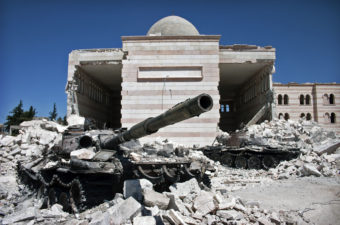
Two destroyed tanks in front of a mosque in Azaz, Syria.
Two destroyed tanks in front of a mosque in Azaz, Syria. From March 6 to July 23, a battle between the Free Syrian Army (FSA) and the Syrian government was fought for control over the city of Azaz, north of Aleppo, during the Syrian civil war.
(Photo by Christiaan Triebert/Flickr Creative Commons)

The United States Sixth Fleet is sailing in the Mediterranean Sea, and the Fifth Fleet is in nearby Bahrain. The Pentagon is mobilizing forces for long-range bombings or cruise missile strikes.

Secretary of State John Kerry said Monday the U.S. government is holding the government of Bashar al-Assad responsible for the chemical attack last week.
“The indiscriminate slaughter of civilians, the killing of women and children, and innocent bystanders by chemical weddings, is a moral obscenity,” he said in the State Department briefing room. “By any standard it is inexcusable, and despite the excuses and equivocations that some have manufactured, it is undeniable.”

President Barack Obama has long said a chemical attack would be a red line. This is reportedly the second such attack, but much larger than the previous.

U.S. Senator Mark Begich said he’s skeptical of engaging.

“They cannot go down this path without consultation and engagement with the Congress,” he said Tuesday on the public radio program “Talk of Alaska.”

But that may happen. Strikes could begin any day – and Congress is not due back in Washington until September 9th. Begich said he can’t support the actions if the United States acts alone.

British and French leaders have indicated they’re willing to support the military strikes.

“It can’t be the U.S. carrying the weight of the world all the time. Saudi Arabia, Jordan, and others in that region need to step up to the plate,” Begich said. “It means other countries around the globe, and this includes people like Russia and China, they need to step up, and quit playing the politics of the Middle East for leverage for their own political and economic purposes.”

Russia and China will not side with the United States in the conflict. Russia has proven to be Syria’s largest backer. Both Moscow and Beijing are protecting Damascus on the United Nations Security Council.

Neither of the Republicans in the delegation would talk about the issue. A spokesman for Representative Don Young said he’s opposed to military intervention – that the country isn’t ready for another war after fighting two for a dozen years. He also wants the president to seek approval from Congress. Young voted for the 2002 Iraq War Resolution.

Senator Lisa Murkowski declined several requests for comment.

Oil prices surge as Alaskans stockpile for winter

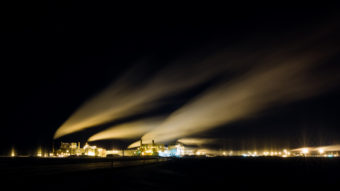
Prudhoe Bay at night.
Prudhoe Bay at night. (Photo by J Weston/Flickr Creative Commons)

The state of Alaska wants oil prices high.

“Every dollar change in price is close to 100 -150 million dollars in state revenue,” said acting Revenue Commissioner Angela Rodell. “Short term volatility like you’ve been seeing in the past few weeks, given things going on around the world, create a lot of distractions.”
The recent coup in Egypt gets all the headlines is not the reason for the jump, said Frank Verrastro. Verrastro, a senior vice president at the Center for Strategic and International Studies, said fears over control of the Suez Canal are legitimate.

Other conflicts, he said, are having more tangible effects.

“The Iraq Ceyhan Pipeline has been down, and that’s reduced exports out of Iraq. There’s been problems down in Basra,” he said by phone Monday from Washington.  ”Syria, Yemen, Nigeria, and the fact that Libyan production is down 600,000 – 700,000 barrels a day.”

All this means that Alaska has little control over a global commodity. High oil prices translate to higher fuel costs, especially in hard to reach rural Alaska.

Throughout western Alaska, villagers are ordering and stockpiling hundreds of gallons of heating oil for the winter.

Bob Cox, vice president with Crowley Maritime Corporation – the company that barges refined oil products to western Alaska, said there are about three weeks left for the final barge of the season to make the journey.

The company stores the fuel in tanks throughout the state. Both Crowley and other companies sell the fuel to villagers.

Cox said the company monitors global oil prices to get the best price, and this year, it tried something new: Buying  300 thousand barrels of heating oil from China.

“That arrived off the west coast of Alaska in July. We offloaded that and brought that into our tank farms because that was a better value at that time, then U.S. prices,” he said.

The company still needs to finalize its price for the final barge.

Crowley uses the price per barrel the day the barge is loaded in its calculation for final prices.  Cox says about one-third of Crowley’s cost is overhead, distribution, profit and transportation – the rest is the product.

“So we’re somewhat hostage to whatever is going on in the oil markets at the time we’re loading the barges,” Cox said.

Oil prices have been higher before: They hit $120 a barrel when the Arab Spring erupted.

‘Devastated’ Quebec Town Waits For Word About Missing

With 40 people still missing after massive explosions Saturday in the center of their town, the people of Lac-Mégantic, Quebec, begin the week “with fears that the death toll from a weekend rail disaster could surge,” CBC News writes.
The people there, the news network adds, are devastated by the accident that left the center of the town looking like a war zone. According to The Montreal Gazette, “the city’s downtown core was almost completely destroyed by the blast. It housed a mix of commercial and residential units in historic buildings.”

When Monday dawned, it was known that at least five people had been killed when freight tankers loaded with crude oil derailed and exploded in the small town near the Maine border. “The search for victims in the charred debris has been hampered by the fact two of the train’s cars continued to burn Sunday morning, creating concerns of other potentially fatal explosions,” the CBC says.

It’s hoped that some of those now counted as missing were away from their homes when the tanks exploded and haven’t yet gotten in contact with relatives or authorities.

As for how more than 70 tank cars detached from a locomotive after they were parked several miles from Lac-Mégantic — and then rolled into the town on their own — the investigation continues. There’s word of a fire aboard the locomotive before the tank cars separated and began rolling. The Gazette writes in an editorial that:

“Early reports that the conductor had left the freight train parked unattended — with brakes supposed locked in place — in the nearby town of Nantes, with another conductor expected to take over several hours later, are troubling. Preferable would be more simultaneous transfer of responsibility. As it turns out, five minutes after the conductor left, a fire broke out in one of the locomotives. But while firefighters in Nantes put out the flames and reports last night suggested someone representing the company arrived to inspect the train and found no damage, it still remains to be seen whether proper regulatory procedures were followed — and if they were, whether the inspection failed to detect brake damage possibly caused by the fire.”

The CBC is also live blogging here.

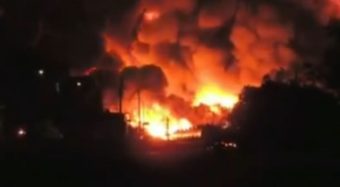
Here’s video from the fire:

Copyright 2013 NPR. To see more, visit http://www.npr.org/.
Read original article
‘Devastated’ Quebec Town Waits For Word About Missing

‘Friends Of Syria’ Countries Meet To Map Out Arming Rebels

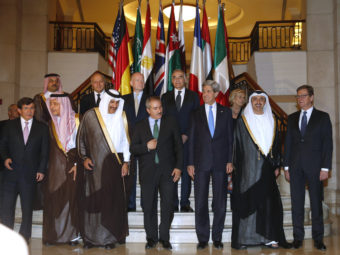
Secretary of State John Kerry (front row, third from right) poses with foreign ministers of the "Friends of Syria" in Doha, Qatar. AFP/AFP/Getty Images
Secretary of State John Kerry (front row, third from right) poses with foreign ministers of the “Friends of Syria” in Doha, Qatar. AFP/AFP/Getty Images

Update At 11:30 a.m. ET:

Secretary of State John Kerry called the current situation in Syria “unacceptable by anyone’s standard” and lashed out at the government of President Bashar al-Assad for using Hezbollah in the fight against rebels.
“Assad chose to raise the stakes militarily,” Kerry said. “He chose to attack the Syrian people, but this time using Iranian supporters and using Hezbollah, which is a terrorist organization.

“Neither side is going to back off helping those they’ve chosen to help, we understand that,” he said of Russia’s military assistance to the Assad regime. “The key is for us to use the leverage with people that we’re helping to bring them to the table and achieve an appropriate negotiated solution.”

Kerry said the group of ministers had pledged an additional $300 million in humanitarian aid to the rebels.

Update At 10:20 a.m. ET:

Reuters reports that the “Friends of Syria” group of ministers has issued a joint statement in Doha saying they agree to “provide urgently all necessary materiel and equipment to opposition on the ground.”

Here’s our original post:

U.S. Secretary of State John Kerry and representatives of 10 other countries are meeting in Qatar to coordinate military support to Syrian rebels vying to overthrow President Bashar al-Assad.

The group, dubbed “Friends of Syria,” is meeting in the Qatari capital, Doha, and includes European powers and regional Sunni Muslim-dominated countries. It could provide Syrian insurgents with the anti-aircraft and anti-tank weapons they say they need to defeat Assad’s military.

Quoting two Gulf sources, Reuters reports that Saudi Arabia has stepped up its lead role in arming the rebels.

“In the past week there have been more arrivals of … advanced weapons. They are getting them more frequently,” the source was quoted by Reuters as saying. Another source told Reuters that the latest supplies had the potential to top the balance in the rebels’ favor even as Syrian government forces have been making significant gains on the battlefield.

The White House announced last week that it would provide direct military support to Syria’s rebels after it said Assad’s forces had used chemical weapons against the insurgents.

On Friday, the U.S. said it would base another 700 combat-ready military personnel in Syria’s neighbor, Jordan, after already saying it would leave F-16 fighters and Patriot missiles there following the conclusion of a joint U.S.-Jordan military exercise.

NPR’s Deborah Amos, reporting from Amman, says Jordan, on the front line of the conflict, has more than a half-million Syrian refugees.

She says that “rebels have confirmed to NPR that Jordan hosts a covert military-training program overseen by Western intelligence agencies.”

Meanwhile, Russian President Vladimir Putin cautioned the West against arming the rebels, saying their ranks included “terrorist” elements. The U.S. has said that one of the groups fighting Assad, al-Nusra, is a terrorist organization.

Putin, speaking on a panel in St. Petersburg, Russia, with German Chancellor Angela Merkel said if the U.S. already recognized al-Nusra as a terrorist group, “how can one deliver arms to those opposition members? … Where will they end up? What role will they play?”

Copyright 2013 NPR. To see more, visit http://www.npr.org/.
Read original article
‘Friends Of Syria’ Countries Meet To Map Out Arming Rebels

‘Suffering On A Huge Scale’: World Refugee Numbers Swell

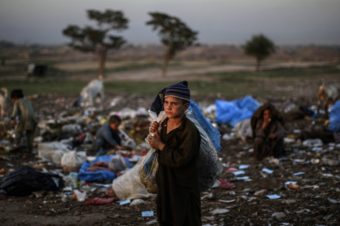
Afghan refugee children collect items of use from a pile of garbage on the outskirts of Islamabad, Pakistan. Muhammed Muheisen/AP

The United Nations Refugee Commission says more than 45.2 million people were in “situations of displacement” around the world as of last year — the most since 1994.

A report from the Office of the United Nations High Commissioner for Refugees says there were 15.4 million refugees in other countries, 937,000 people seeking political asylum and 28.8 million people forced out of their homes but still inside their own countries.

“Those are the highest numbers since 1994, when people fled genocide in Rwanda and bloodshed in former Yugoslavia,” according to The Associated Press.

The U.N.’s yearly Global Trends report says most people are running away from war. “A full 55 percent of all refugees listed in UNHCR’s report come from just five war-affected countries: Afghanistan, Somalia, Iraq, Syria and Sudan,” it states. Millions are also on the move in Mali and the Democratic Republic of the Congo.

“These truly are alarming numbers. They reflect individual suffering on a huge scale and they reflect the difficulties of the international community in preventing conflicts and promoting timely solutions for them,” said António Guterres, head of UNHCR.

Nearly half of all refugees were children. The U.N. says 21,300 children who sought asylum were alone or separated from their parents — a record high.

The country producing the greatest number of refugees is Afghanistan: The agency says that “on average, one out of every four refugees worldwide is Afghan, with 95 percent located in Pakistan or Iran.”

Next is Somalia, followed by Iraq and then Syria, an area of growing concern. Because the report covers only 2012, it counts 471,400 Syrian refugees — and none from this year. Syrians are now fleeing in greater numbers, prompting the U.N. to label that country’s civil war “a major new factor in global displacement.”

Another concern is who is hosting all these refugees. The U.N. says it is poorer countries: “In all, developing countries host 81 percent of the world’s refugees compared to 70 percent a decade ago.”

The U.N. also says the 28.8 million displaced people represent the highest number in more than 20 years. Again, Syria is listed as a significant new contributor to this problem, along with the Democratic Republic of Congo.

Copyright 2013 NPR. To see more, visit http://www.npr.org/.
Read original article
‘Suffering On A Huge Scale’: World Refugee Numbers Swell

Afghan Govt. Suspends Talks; Taliban Attack Kills 4 Soldiers

Afghan President Hamid Karzai speaks during a ceremony Tuesday at a military academy on the outskirts of Kabul. Rahmat Gul/AP

In the hours following an announcement by the Taliban and the United States saying they were ready to begin peace talks, we received reminders of just how tenuous that situation is: On Tuesday night the Taliban said they fired two rockets near Bagram airbase in Kabul. The International Security Assistance Force said four service members were killed by “an indirect fire attack.”

Not only that, but this morning Afghan President Hamid Karzai walked away from bilateral talks with the U.S. to “protest the way his government was being left out of initial peace negotiations with the Taliban meant to find ways to end the nearly 12-year war,” The Associated Press reports.

The AP adds:

“In a terse statement from his office, Karzai said negotiations with the U.S. on what American and coalition security forces will remain in the country after 2014 have been put on hold.

“The statement followed an announcement Tuesday by the U.S. and the Taliban that they would pursue bilateral talks in Qatar before the Afghan government was brought in.

“‘In view of the contradiction between acts and the statements made by the United States of America in regard to the peace process, the Afghan government suspended the negotiations, currently underway in Kabul between Afghan and U.S. delegations on the bilateral security agreement,’ Karzai’s statement said.”

As The New York Times explains it, the attack was “at best a rocky prelude to peace talks with Taliban.” The newspaper frames the story as a struggle for legitimacy between Karzai’s government and the Taliban.

Karzai is angry that the Taliban are flying a flag at its newly opened office in Doha, Qatar, and calling the office the “Islamic Emirate of Afghanistan.” The Afghan government wanted that office to be just an address where talks are held, but as the Times explains, the Taliban are making it sound like an embassy.

The Times reports that the Taliban:

“… made clear that they sought to be dealt with as a legitimate political force with a long-term role to play beyond the insurgency. In that sense, in addition to aiding in talks, the actual opening of their office in Qatar — nearly a year and a half after initial plans to open it were announced and then soon after suspended — could be seen as a signal that the Taliban’s ultimate aim is recognition as an alternative to the Western-backed government of President Karzai.”

Update at 8:49 p.m. ET. Walks Away From Peace Talks:

Beyond talks about a U.S. withdrawal, Afghanistan has now announced it will stay out of the peace talks between the U.S. and the Taliban.

Reuters reports:

” ‘As long as the peace process is not Afghan-led, the High Peace Council will not participate in the talks in Qatar,’ Karzai said in a statement, referring to a body he set up in 2010 to seek a negotiated peace with the Taliban.

“Karzai also said the opening of a Taliban office in Qatar showed the United States had failed to honour promises made to the Afghan state about the role of that office.”

Update at 7:43 a.m. ET. Anticipated ‘Areas Of Friction’:

Speaking at a joint news conference with German Chancellor Angela Merkel, President Obama said the U.S. had anticipated “some areas of friction.”

He said today’s developments were “not surprising” because “there’s enormous mistrust” between the parties.

Still, Obama said, he hoped that “despite those challenges” the talks would continue.

Copyright 2013 NPR. To see more, visit http://www.npr.org/.
Read original article
Afghan Govt. Suspends Talks; Taliban Attack Kills 4 Soldiers
Site notifications
Update notification options
Subscribe to notifications