Nation & World

North Korea Reportedly Moves Missiles Off Launch Status

A 2009 image released by Korean Central News Agency of a medium-range Musudan missile. Associated Press

North Korea has reportedly moved two medium-range missiles away from a launch site in the country’s east in an apparent ratcheting down of tensions in the region.

Reuters and the BBC quoted unnamed U.S. officials as saying that two Musudan missiles that were in launch-ready status have been moved after being on standby for weeks.

Reuters quotes one U.S. officials as saying Washington does “not believe the missiles were moved to an alternate launch site and were [now] instead in a non-operational location.”

Pentagon spokesman George Little declined comment on the reported missile stand down, but told reporters “what we have seen recently is a provocation pause.”

The BBC reports:

“North Korea unveiled medium-range Musudan missiles during a military parade in 2010 but had not yet tested them.

Last month, South Korea raised its alert level to ‘vital threat’ amid indications the North was preparing for a missile test.

At least one ballistic missile with an estimated 3,000km (2,000-mile) range had been fueled and ready for launch, according to US and South Korean sources.”


Read original article

North Korea Reportedly Moves Missiles Off Launch Status

North Korea Sentences U.S. Citizen To 15 Years Hard Labor

Passersby watch a local television broadcast in Seoul on Thursday showing a report on the sentencing of Kenneth Bae. Kim Jae-hwan/AFP/Getty Images

North Korea has sentenced a U.S. citizen to 15 years in one of the country’s notorious labor camps for allegedly attempting to overthrow the Pyongyang government.

Pyongyang’s official KCNA news agency announced the sentence imposed on Pae Jun-ho, known in the United States as Kenneth Bae. He has been held since November, when he was arrested at the northeastern port city of Rason, a special economic zone near North Korea’s border with China.

KCNA says Pae, 44, admitted to the charges against him at his April 30 trial.

He is not the first American over the years to be detained by North Korea.

Pyongyang arrested U.S. journalists Euna Lee and Laura Ling, English teacher Aijalon Gomes, businessman Eddie Jun Young-su and Christian activist Robert Park. Former President Bill Clinton secured freedom for Lee and Ling, and former President Jimmy Carter negotiated the release of Gomes. Jun and Park were freed by North Korea on “humanitarian grounds.”

Pae is believed to be a tour operator of Korean descent. The Associated Press reports that friends describe him as a devout Christian.

As we’ve written in the past, these kinds of incidents highlight the difficult task diplomats face when a U.S. citizen is caught up in legal or political trouble in a so-called rogue state.

The New York Times, quoting analysts, says his detention presents the White House with a choice between “two equally distasteful options”:

“Washington … could send a former president to win the release of Kenneth Bae. … Then, North Korea, as it did before, could advertise such a high-profile visit as an American capitulation before its new young leader, Kim Jong-un, who is craving a chance to burnish his profile as a tough anti-American strategist.

“Or Washington, as its leaders have repeatedly vowed, could try to break Pyongyang’s habit of blackmailing its adversaries by ignoring its latest pressure tactic — and see one of its citizens languish in one of North Korea’s infamous prison camps, where the State Department says starvation and forced labor remain rampant.”


Read original article

North Korea Sentences U.S. Citizen To 15 Years Hard Labor

U.S. Said To Be Leaning Toward Arming Syrian Rebels

Opposition fighters from the Free Syrian Army last month in Aleppo, Syria. Maysun/EPA /LANDOV

As the U.S. considers a “spectrum of military options” it could take to assist the groups battling against the regime of Syrian President Bashar Assad, the Obama administration is leaning toward giving lethal arms to some of those rebels, a senior administration official has told NPR’s Kelly McEvers.
Wednesday on Morning Edition, Kelly told host Renee Montagne that it’s most likely, according to the official, that the arms would be shoulder-fired missiles capable of taking down military aircraft.

Some other news outlets are reporting similar stories.The Washington Post writes that “President Obama is preparing to send lethal weaponry to the Syrian opposition and has taken steps to assert more aggressive U.S. leadership among allies and partners seeking the ouster of President Bashar al-Assad, according to senior administration officials.”

According to The New York Times, “the White House is once again considering supplying weapons to Syria’s armed opposition, senior officials said Tuesday.”

The Los Angeles Times adds a cautionary note about the timing of such a decision: “The White House is considering providing weapons to the Syrian rebels, officials said Tuesday, but no decision is imminent and President Obama seemed to soften his public threats to the Syrian government over its alleged use of chemical weapons.”

The reports follow Tuesday’s news conference at the White House. The president discussed whether Assad had crossed a “red line” drawn by the U.S. — by using chemical weapons against his own people as he tries to suppress an opposition that has been battling against his forces for more than two years.

“What we have now is evidence that chemical weapons have been used” in Syria, Obama said Tuesday. But he noted that it isn’t yet known “how they were used, when they were used [or] who used them.”

So, while he has said the use of such weapons would be a “game changer,” the president added that “I’ve got to make sure I’ve got the facts” before taking action. If it is proved that the Assad regime used chemical weapons, Obama said, “we would have to rethink the range of options that are available to us.”

Sending arms to the Syrian opposition does, of course, raise the concern that those weapons might some day fall into the hands of anti-U.S. Islamist extremists. Kelly reports that the U.S. appears to have chosen the fighters it likes and believes there is a “knowable pipeline” through which the arms could get into the right hands if the decision is made to send them.

Up to now, U.S. assistance has focused on humanitarian aid and some training of rebel fighters.


Read original article

U.S. Said To Be Leaning Toward Arming Syrian Rebels

In Japan: Running Out Of Places To Put Radioactive Water

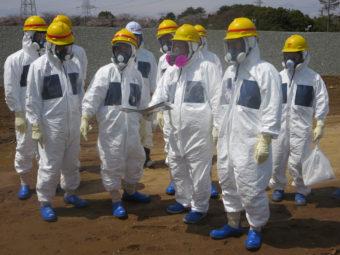
As they inspected an underground storage pool near the crippled Fukushima Daiichi nuclear power plant earlier this month, Tokyo Electric Power Co. President Naomi Hirose (4th from left) and other officials wore protective suits and masks. Radioactive water stored in some of the pits has leaked. Tokyo Electric Power Co./Reuters /Landov

Adding to reporting from NPR, The Associated Press and other news outlets, The New York Times writes Tuesday that:

“Two years after a triple meltdown that grew into the world’s second worst nuclear disaster, the Fukushima Daiichi nuclear power plant is faced with a new crisis: a flood of highly radioactive wastewater that workers are struggling to contain.”
According to the Times, at the power plant crippled by an earthquake and tsunami in March 2011 “groundwater is pouring into the plant’s ravaged reactor buildings at a rate of almost 75 gallons a minute.”

In response, “a small army of workers has struggled to contain the continuous flow of radioactive wastewater, relying on hulking gray and silver storage tanks sprawling over 42 acres of parking lots and lawns. The tanks hold the equivalent of 112 Olympic-size pools.”

But more storage space is needed. So, the Times adds, Toykyo Electric Power Co. “plans to chop down a small forest on its southern edge to make room for hundreds more tanks, a task that became more urgent when underground pits built to handle the overflow sprang leaks in recent weeks.”

On Morning Edition earlier this month, NPR’s Geoff Brumfiel said some of the contaminated water is leaking from storage pits that have also been used at the site. “They are just earthen pits that have been lined with sheets of plastic, and the plastic may have torn or it may just leak,” he said.


Read original article

In Japan: Running Out Of Places To Put Radioactive Water

Bombing In Syrian Capital Kills More Than A Dozen People

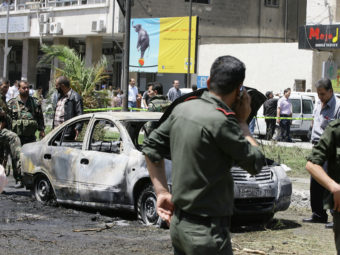
Syrian government security officers after a blast in the Marjeh district of Damascus on Tuesday. Louai Beshara/AFP/Getty Images

Syrian state TV is reporting that a bomb blast in Damascus has killed at least 13 people, a day after the country’s prime minister narrowly escaped a car bomb.

The Associated Press reports:

“The bombings appear to be part of an accelerated campaign by opposition forces seeking to topple President Bashar Assad to strike at his heavily protected seat of power. …

“Syrian TV said Tuesday’s explosion was caused by a ‘terrorist bombing’ in the district of Marjeh, a commercial area in central Damascus. Assad’s regime refers to opposition fighters as ‘terrorists.’ ”

The latest attack in the Syrian capital comes a day after Prime Minister Wael al-Halqi’s convoy was targeted by a remotely triggered bomb and amid increasing international concern that Syria may have used chemical weapons against the opposition. A new CBS News/New York Times poll shows 62 percent of Americans oppose U.S. intervention in Syria, while 24 percent think the United States has an obligation to act.

In an interview on NPR’s Morning Edition, Robert Malley of the International Crisis Group says that while the White House has claimed it has some evidence for Syria’s use of the deadly chemical agent sarin, “we’re still not quite at the point where they could make a conclusive case.”

“I think it’s understandable certainly in the case of the United States to have a pretty high threshold,” Malley says. “First, it’s always hard to establish such claims, particularly when you’re at a distance.”

He says the question is not necessarily how Washington might intervene in Syria to stop the fighting that has killed an estimated 70,000 people, but whether such an intervention would help the Syrian opposition and serve U.S. interests.

Arming the opposition, a no-fly zone or airstrikes against airfields and delivery systems all can be done, Malley notes.

“The U.S. certainly has the means to do them,” he says. “That’s not the question — the question is whether they would have a positive impact in Syria and whether they would serve U.S. national interests.”

He says France, Turkey and Saudi Arabia all have a slightly different point of view on Syria.

“A number of them are saying, ‘We will do what you want’ — you, the United States — ‘if you take the lead,’ which ends up being a game where each side says, ‘You go first,’ ” Malley adds. ” Some countries are more eager to see some action; others are more worried.”


Read original article

Bombing In Syrian Capital Kills More Than A Dozen People

Rescuers Still Hope For Survivors In Bangladesh Collapse

Bangladeshi volunteers and rescue workers at the site of the factory on Friday. AFP/AFP/Getty Images

Rescue workers are still hoping to find survivors from the collapse of an eight-story garment factory in Bangladesh that has killed more than 300 people and left hundreds missing.

Meanwhile, angry relatives of the missing have clashed with police, blaming authorities for the catastrophe at Rana Plaza in Savar, an industrial suburb of the capital, Dhaka.

“Some people are still alive under the rubble and we are hoping to rescue them,” deputy fire services director Mizanur Rahman told Reuters.

The news agency quoted a spokesman for Prime Minister Sheikh Hasina as saying that she had ordered the arrest of the owners of the building and of the five factories that occupied it.

According to Army spokesman Shahinur Islam, the death toll had reached 304 and H. T. Imam, an adviser to the prime minister, said it could exceed 350, Reuters said.

Speaking to NPR, Anbarasan Ethirajan, a Bangladesh-based reporter for the BBC, says rescuers have been using “cranes, diggers and even bare hands.”

The factory complex, which reportedly supplies major retailers in the United States and Europe, showed signs that something was wrong the day before the structure suddenly crashed to the ground. Ethirajan says workers had reported cracks in the walls and floor.

Survivors and officials told Ethirajan that when the owner of the building was informed, “he said ‘no need to worry about the safety,’ [that] they can go back to work on the next day.”

One of the garment workers who survived the collapse told Ethirajan that they were told Tuesday “if they didn’t go back to work, they might lose their wages.”

But employees at a bank on the first floor did not report for work Wednesday because they feared for their safety, he said.

Thousands of workers from the hundreds of garment factories across the Savar industrial zone and other nearby industrial areas are protesting over the collapse and poor safety standards, according to the AP.

Garment makers in the building include at least two that claim to supply Western retail outlets.

The Associated Press reports:

“Britain’s Primark acknowledged it was using a factory in Rana Plaza, but many other retailers distanced themselves from the disaster, saying they were not involved with the factories at the time of the collapse or had not recently ordered garments from them. Wal-Mart said none of its clothing had been authorized to be made in the facility, but it is investigating whether there was any unauthorized production.”


Read original article

Rescuers Still Hope For Survivors In Bangladesh Collapse

Site notifications
Update notification options
Subscribe to notifications