Nation & World

South Korean Workers To Leave Industrial Zone In North

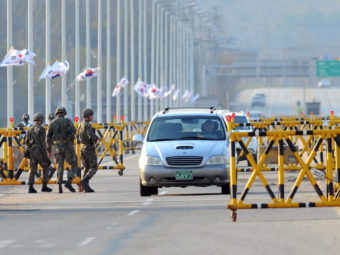
South Korean soldiers stand beside barricades as cars drive on the road leading to North Korea's Kaesong industrial complex on Friday. Jung Yeon-je/AFP/Getty Images
South Korean soldiers stand beside barricades as cars drive on the road leading to North Korea’s Kaesong industrial complex on Friday. Jung Yeon-je/AFP/Getty Images

South Korea has ordered the withdrawal of its workers from a jointly run industrial zone in North Korea, in a further sign of how relations have gone from bad to worse between the two countries in recent weeks.

Earlier this month, Pyongyang blocked access to the Kaesong zone, which is located just inside North Korea and was established in 2002 as a symbol of rapprochement between the rival neighbors. In the past, even as tensions flared, Kaesong — an important source of hard currency for the North and cheap labor for the South — had kept operating.

On Friday, however, Seoul’s Unification Minister Ryoo Kihl-jae said the approximately 175 South Korean workers still in the zone after the North’s blockade would be returning home after Pyongyang this week declined to resume bilateral talks.

“Because our nationals remaining in the Kaesong industrial zone are experiencing greater difficulties due to the North’s unjust actions, the government has come to the unavoidable decision to bring back all remaining personnel in order to protect their safety,” Ryoo said.

“North Korea must guarantee the safe return of our personnel and fully protect the assets of the companies with investment in Kaesong,” he added without giving a time frame for the withdrawal.

About 120 South Korean companies set up shop in the complex, which employed 53,000 North Koreans, according to The Christian Science Monitor. The endeavor was meant to be a “mutually beneficial arrangement,” providing South Korean companies with cheap northern labor and North Koreans with much needed income. North Korea earned about $80 million from the complex last year, which produced $470 million worth of goods.

The Monitor reported earlier this month that five days after Kaesong was closed to new workers from the South, it was already the longest interruption of “in-and-out traffic” at the complex since it opened. The state-run Korean Central News Agency said at the time that South Korea was “trying to ‘turn the zone [Kaesong] into a hotbed of war.’ ”


Read original article

South Korean Workers To Leave Industrial Zone In North

White House: Evidence Syria Used Chemical Weapons

Secretary of Defense Chuck Hagel speaks with reporters on Thursday in the United Arab Emirates after reading a statement on chemical weapon use. Pool/Getty Images

Update at 5:45 p.m. ET. ‘All Options’ On The Table

A White House official reiterated much of what was in the letter sent to Capitol Hill, but added that “all options were on the table in terms of our response.”

The official said that reports of the use of chemical weapons in Aleppo in March was one of the incidents being examined.
Speaking on All Things Considered, Sen. Bob Corker, R-Tenn., the ranking minority member on the Senate Foreign Relations Committee, said “we have to step up our ability to respond” if it emerges that the Assad regime used chemical weapons.

He said the U.S. needs to support moderate rebels so their ability to respond to Assad matches those of rebel fighters linked to al-Qaida and other extremist groups.

Also on All Things Considered, NPR’s Larry Abramson shed more light on the possible use of chemical weapons. He said:

“NPR has sources in the region, doctors who say they have responded to patients who say they were experiencing symptoms consistent with the use of chemical weapons, and that these doctors are sending tissue samples to the U.S. We don’t know if that’s the same type of evidence the intelligence community is looking at.”

Larry added that U.S. intelligence officials say the possibility of the use of chemical weapons in Syria is a “strong maybe” rather than a “slam dunk,” a term that was used to describe Iraq’s weapons of mass destruction, which were never found.

‘Red Line’ Letter


Update at 3:15 p.m. ET:

In response to the White House statements on Syria, Sen. John McCain (R-Ariz.) says: “I hope the administration will consider what we have been recommending now for over two years of this blood-letting and massacre — to provide safe haven for the opposition to operate.”

Here’s our original post:

The White House has acknowledged that U.S. intelligence assessments indicate “with varying degrees of confidence” that the Syrian regime has used chemical weapons during the country’s ongoing civil war, but has cautioned that it still needs more evidence.

Secretary of Defense Chuck Hagel, speaking in the United Arab Emirates, said that such an action “violates every convention of warfare.”

The Associated Press says Hagel did not offer details on what kind of weapons were used, how much chemical was involved or whether casualties resulted. But Secretary of State John Kerry was quoted by the AP as saying two attacks were thought to have taken place.

Reuters quotes Britain’s Foreign Office on Thursday as saying that it also has evidence of chemical weapons use by Syria and calling on President Bashar Assad to cooperate with international investigators to prove that he had not sanctioned their use.

“We have limited but persuasive information from various sources showing chemical weapons use in Syria, including sarin. This is extremely concerning. Use of chemical weapons is a war crime,” a Foreign Office spokesman said in a statement.

President Obama has described the use of chemical weapons as a “red line” and a “game changer,” suggesting that it could prompt the U.S. and perhaps other Western countries to intervene more directly in Syria’s civil war.

In letters sent to Sens. John McCain (R-Ariz.) and Carl Levin (D-Mich.) on Thursday, Miguel Rodriguez, White House director of the office of legislative affairs, echoed Hagel’s remarks, saying:

“Our intelligence community does assess with varying degrees of confidence that the Syrian regime has used chemical weapons on a small scale in Syria, specifically the chemical agent sarin. This assessment is based in part on physiological samples. Our standard of evidence must build on these intelligence assessments as we seek to establish credible and corroborated facts. …

“Given the stakes involved, and what we have learned from our own recent experiences, intelligence assessments alone are not sufficient — only credible and corroborated facts that provide us with some degree of certainty will guide our decision-making …”

The Washington Post quotes a spokesman for the Damascus military council, which is part of the Free Syrian Army, as being critical of the U.S. response to what it calls Syria’s “certain” use of such weapons:

“‘Small scale? Varying degrees of confidence? The leaders of the Free Syrian Army are certain that chemical weapons are being used in Syria, so we find this whole statement odd,’ said Musab Abu Qatada.

“‘We’ve noticed that the American administration only works according to its own needs,’ said Abu Qatada, who uses an alias. ‘We’ve started to believe that there is a conspiracy in the West to support the regime in its quest to oppress the Syrian people,’ he said via Skype. But if Washington ‘truly’ wants to help Syria, it will use this finding to start arming the Syrian rebels, he added.”


Read original article

White House: Evidence Syria Used Chemical Weapons

Middle East exchange students reflect on their time in Juneau

Ayah Tafesh is from Gaza City. Hadi Kamj is from Lebanon. Mohammed Qabani is from Israel.

Three exchange students from the Middle East are wrapping up their time in Juneau. They came here as part of the Kennedy-Lugar Youth Exchange and Study program under the wing of Juneau People for Peace and Justice. JPPJ leadership knew the three students would twice become young ambassadors – first in their new communities, and again when they return home.
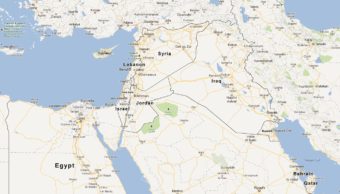
Ayah Tafesh of Gaza City says it was a miracle she made it to Juneau at all. Her homeland borders Israel and Egypt, and travel from the region is difficult.

Tafesh’s uncle works for the government. He helped her secure a route from Gaza Strip through Egypt to Juneau because it would have been too tough to travel across the Israeli border.

She got up early on a hot summer day in August, ate a light breakfast and left home on a bus to head to the Hamas checkpoint.

 “The police officer working with Hamas asked me where I was going, I told him America,” Tafesh says. “Somehow he heard Egypt and he asked me ‘What are you going to do in Egypt?’ so I told him just, ‘study.’ So they let me in. If they saw my visa to America they wouldn’t have let me in.”

Tafesh says the Palestinian government doesn’t approve of exchange programs that send children to America.

“The Palestinian side called the Egyptian side and told them to send me back but I already submitted my passport to the officers in Egypt and they accepted me to go in,” Tafesh says.

The 16-year-old arrived at Thunder Mountain High School two weeks late. Tafesh says in addition to being a high school student, she tries to be the best ambassador she can.

She expected her classmates to be mean and ignore her, but found them to be loving. She says only once, a student who did not know she was Muslim made derogatory remarks about Muslims but she stood up to him and a teacher backed her up.

“I want to take back the good view and the good picture about America that all, most of the people in my country have it wrong about America,” Tafesh says.

Seventeen-year-old junior Hadi Kamj from Lebanon is studying at Juneau-Douglas High School. He says every American city offers a different experience, and he’s glad he ended up in Juneau.

“It’s not like what you see in TV or in the movies, where it’s all about shopping and fast food, it’s more than that.” Kamj says. “Here in Juneau, Alaska, there’s not much shopping but everyone just enjoys nature and is fit.”

Kamj says he’s glad he comes from Lebanon, too, but he often has to explain where his home country is.

“And the people who think, if you tell them about the Middle East, they would also think that it’s all sand, deserts, and camels. And that’s not true at all. We don’t have deserts in Lebanon,” Kamj says.

Lebanon is north of Israel and has plenty of cedar trees, coastland and mountains.

Kamj misses the food back home. Kamj and Tafesh went to Washington, D.C. for the Civic Education Workshop to learn about the U.S. government and civic organizations. Kamj says travel to big cities like Washington and Portland, Oregon gave him the opportunity to eat Middle Eastern food again.

Still, there’s a lot the students miss while in Juneau. Kamj learns about news from Lebanon by talking with his parents on Skype.

“There is always something going on. Every few years there’s something big that happens,” Kamj says. “Seven years ago we had a war with Israel, now three years ago, four years ago, there’s the Gaza war. Now there’s this Syrian thing.”

Sixteen-year-old Mohammed Qabani is a junior at Thunder Mountain. He says he’s enjoyed playing soccer, which has taken him around the state. His father fills him in on news from his home country of Israel, which borders the Jordan River and Mediterranean Sea.

“It was the elections and what’s happening in Syria and the Middle East and why is it happening, and he tries to explain to me why is it happening,” Qabani says.

When Tafesh calls her family, they tell her about life on the Gaza Strip. Tafesh’s host mom Alex Pastorino says the Skype calls to Gaza are humbling.

“They basically just entrusted their daughter to our care and were so trusting and so humble and so gracious,” Pastorino says.

Tafesh says living in Gaza is difficult and there is a lot of death. During missile strikes in November her family told her they slept away from windows in their apartment for extra protection. She says her family can afford necessities such as water only because both her parents work. Her sister also was a YES student and is now attending college in Chambersburg, Penn.

One evening in her Juneau home, Tafesh put it into perspective. Pastorino’s granddaughter Zan leaned back on a new chair and it broke.

“My granddaughter felt really, really bad about it and my jaw was about to hit the table. I didn’t know what to say, and Ayah immediately saw how upset Zan was, and just looked at her and said ‘It’s okay, Zan, no one’s dead,’” Pastorino says. “And so for me, that was perspective. Her world, versus our world, you know, a broken chair is really nothing.”

The students go back to their home schools when the school year ends.

Anger Rises Along With Death Toll At Bangladesh Factory

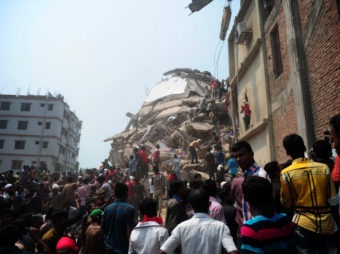
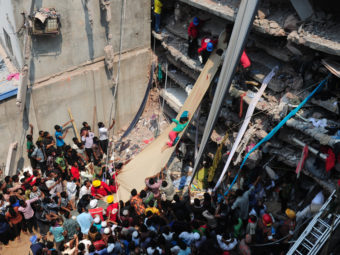
Volunteers on Thursday use a length of textile as a slide to move victims from the rubble of a collapsed building in Savar, Bangladesh. AFP/Getty Images

Rescue workers in Bangladesh sifted through broken concrete and twisted rebar Thursday hoping to find survivors from the collapse of an eight-story garment factory complex that has killed more than 200 people and trapped hundreds of others.
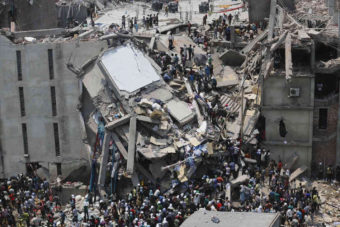
NPR’s Julie McCarthy, reporting from New Delhi, India, says this could be the South Asian country’s worst industrial disaster, and that it has “revived anger about unregulated factories that supply some of the world’s best-known brands.”

The Associated Press reports that:

“Hundreds of rescuers, some crawling through the maze of rubble in search of survivors and corpses, worked through the night and into Thursday amid the cries of the trapped and the wails of workers’ relatives gathered outside the building, called Rana Plaza. It housed numerous garment factories and a handful of other companies.”

The collapse in Savar, an industrial suburb of the capital, Dhaka, occurred Wednesday after some workers reported the appearance of deep cracks in the walls of the complex. Officials said factory managers ignored a police order to evacuate the building after the cracks were discovered.

Cheap labor and production costs have made Bangladesh an attractive place for Western companies to produce textiles and garments in recent years, allowing the country to become the second-largest producer of textiles, after China.

“But workers’ rights groups say the pressure to produce things cheaply in Bangladesh only discourages renovations [to factories] that can be costly,” McCarthy says.

The AP says at least two factories in the complex produced clothing for major foreign brands: Ether Tex claims to supply Wal-Mart and New Wave Style, which says it makes clothing for U.S. retailers The Children’s Place and Dress Barn, Britain’s Primark, Spain’s Mango and Italy’s Benetton.

On its website, Primark said it was “shocked and deeply saddened” by the incident.

On Wednesday, The Children’s Place confirmed that it was supplied by one of the factories in the complex, but Dress Barn said it had “not purchased any clothing from that facility since 2010.”

The collapse comes just five months after 112 workers were killed in a fire in another apparel factory in Bangladesh that had supplied Wal-Mart and Sam’s Club.


Read original article

Anger Rises Along With Death Toll At Bangladesh Factory

Dozens Killed In Collapse Of Bangladesh Garment Complex

More than 70 people are dead and some 600 injured in the collapse of an eight-story housing garment factories and a shopping center. Andrew Biraj /Reuters /Landov

More than 70 people are dead and some 600 injured in Bangladesh following the collapse of an eight-story building on the outskirts of the capital, Dhaka.

The building, called Rana Plaza, housed several garment factories in the town of Savar. A fireman at the scene told Reuters that about 2,000 people were inside when the upper floors jolted down on top of each other Wednesday.

“I was at work on the third floor, and then suddenly I heard a deafening sound, but couldn’t understand what was happening. I ran and was hit by something on my head,” Sohra Begum, a worker at one of the garment factories, told the Press Trust of India.

M.M. Niazuddin, the government’s health secretary, told Reuters that at least 76 people were confirmed dead. Another official said hundreds were being treated for injuries.

“We assume scores of people are still trapped inside and many of them would have died,” Bangladeshi Health Minister A.F.M. Ruhal Huq was quoted by PTI as saying.

Mohammad Asaduzzaman, in charge of the area’s police station, told Reuters that the factory owners appeared to have ignored a warning not to allow their workers into the building after a crack was detected in the block on Tuesday.

Photographs show rescue workers and the Army frantically searching through the rubble, looking for survivors as onlookers dig with their bare hands.

NPR’s Julie McCarthy, reporting from New Delhi, India, says that the building collapse is just “the latest tragic accident to hit the country’s booming garment industry, one of the main drivers of the Bangladeshi economy, accounting for approximately 80 percent of exports.”

“Critics have condemned the government and global brands that earn billions from Bangladeshi cheap labor for not doing more to improve conditions,” she says. “In November, a fire at a Dhaka garment factory killed 112 people, and triggered an outcry over safety standards.”


Read original article

Dozens Killed In Collapse Of Bangladesh Garment Complex

Senate to vote on first steps in gun control debate

The US Capitol Building. (Image courtesy JamesDeMers/Pixabay)

The U.S. Senate will vote today whether to begin debate on a package of new gun regulations.

The bill aims to strengthen school safety and stiffen penalties for gun trafficking.

There could be amendments to establish an assault weapons ban and limit the size of magazines.

There will be one amendment that would require background checks for guns bought and sold online and at gun shows, an amendment that neither of Alaska’s senators has committed to.

Pennsylvania Republican Pat Toomey is no moderate. Before the Senate, he was president of the Club for Growth, a group that supports Tea Party candidates in primary campaigns against insufficiently conservative incumbents.

So gun control advocates are excited he’s a cosponsor of an amendment that would close the so-called gun show loophole.

Introducing his amendment, he put it bluntly.

“I don’t consider criminal background checks to be gun control,” Toomey said. “I think it’s just common sense.”

While he was speaking, the NRA issued a press release saying expanded background checks will not prevent the next school shooting or stop violent crime.

One of Senator Toomey’s cosponsors is West Virginia Democrat Joe Manchin. Both he and Senator Toomey have A ratings from the NRA.

When Senator Manchin first ran for the Senate, he was criticized for a campaign commercial where he fired a shot through a climate change bill.

But Senator Manchin says the Newton shooting changed the debate that the country needs to strengthen the background check system.

“If you go to a gun show, you have to do a background check,” Manchin said. “All background checks have to be recorded with an FFL, a Federal Firearms Licensed Dealer, the same as you do if you go to the gun store, that would be a licensed dealer.”

“If you go online, the same.”

Senator Lisa Murkowski discussed the amendment with Senator Toomey.

She says she has concerns on how the new background checks would be implemented in rural Alaska.

“If an individual wants to buy a gun over the internet, from what I understand, the only way they’d be able to do that, is if they went to a town where this a licensed gun dealer so that dealer could do the check,” Murkowski said.

The amendment does not require background checks for private sales. If a person in a remote village wants to sell a gun to a neighbor or family member, they could still do so.

And it explicitly outlaws any national registry of firearm sales.

The vote on Thursday is not on the passage of the amendment or the bill. It’s just to begin debate. And at least 13 Republicans say they will filibuster the motion.

Senator Murkowski is noncommittal on whether she’ll join the filibuster.

Senator Mark Begich, who faces reelection next year, says he has problems with the overall package, especially a provision from New York Democratic Senator Charles Schumer that would monitor every gun sold in America.

Senator Begich would not say whether he plans to join the filibuster. He says he won’t decide until he knows whether the Senate will vote on his amendment that he says would strengthen mental health reporting.

“I’m still patiently waiting to hear what they’re going to tell me on my bill,” Begich said.

Both Senators Begich and Murkowski don’t have much time to make up their minds. A vote is scheduled for 11:00 Thursday morning.

Senator Harry Reid thinks he has the requisite 60 votes needed to overcome the blockade.

He’ll need yes votes from Republicans, especially if he can’t get all the moderate Democrats.

“I don’t get all the Democrats all the time, and that’s for sure,” Reid said.

One thing is certain: Any vulnerable Senator who votes yes to debate the gun package won’t necessarily vote yes on its passage.


See Original Post

Senate To Vote on First Steps in Gun Control Debate

Site notifications
Update notification options
Subscribe to notifications