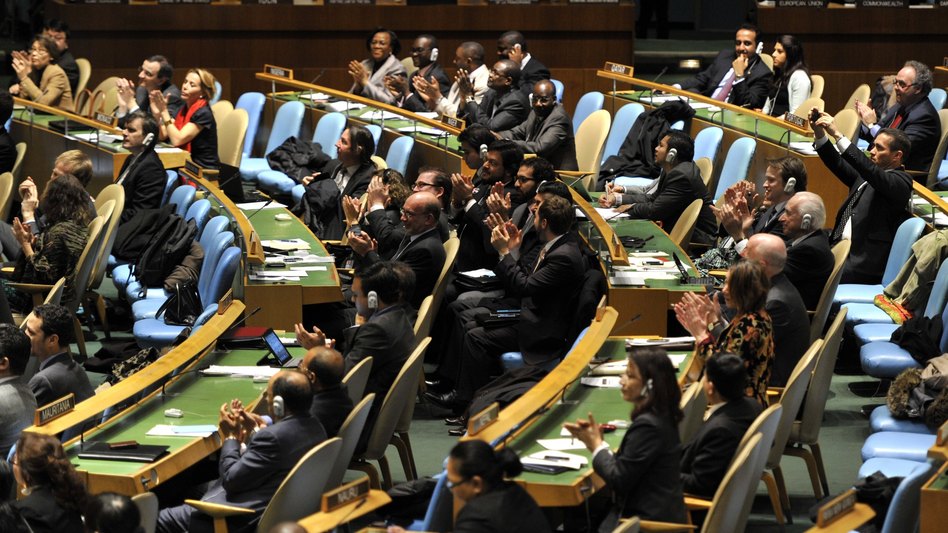
Delegates to the United Nations General Assembly applaud the passage of the first U.N. treaty regulating the international arms trade on Tuesday. Timothy A. Clary /AFP/Getty Images
The United Nations General Assembly overwhelmingly approved the first U.N. treaty to regulate the estimated $60 billion global arms trade on Tuesday.
The goal of the Arms Trade Treaty, which the U.N. has sought for over a decade, according to The Associated Press, is to keep illicit weapons out of the hands of terrorists, insurgent fighters and organized crime.
The vote on the treaty was 154-3, with 23 abstentions.
Iran, Syria and North Korea voted against the treaty, the same three nations that blocked the treaty’s adoption at a negotiating conference last Thursday.
The 23 countries that abstained included a handful of Latin American nations, as well as Russia, one of the largest arms exporters. Russian envoy to the United Nations Vitaly I. Churkin said his country had misgivings about what he called ambiguities in the treaty, reports the Times, including how terms like genocide would be defined.
“The treaty would require states exporting conventional weapons to develop criteria that would link exports to avoiding human-rights abuses, terrorism and organized crime. It would also ban shipments if they were deemed harmful to women and children. Countries that join the treaty would have to report publicly on sales every year, exposing the process to levels of transparency that rights groups hope will strictly limit illicit weapons deals.”
In the U.S., there has been criticism of the treaty from the National Rifle Association. The gun lobby fears that the treaty would be used to regulate civilian weapons, and the NRA has vowed to fight ratification in the Senate.
The treaty will not, in fact, control the domestic use of arms in any country, but nations that ratify it will be required to create and enforce national regulations to control the transfer of conventional arms, parts and components and regulate arms brokers.
Battle tanks, armored combat vehicles, large-caliber artillery systems, combat aircraft, attack helicopters, warships, missiles and missile launchers, and small arms and light weapons are covered under the treaty.
That list originally contained the phrase “at a minimum,” but the wording was dropped, reports the AP, at the insistence of the U.S.
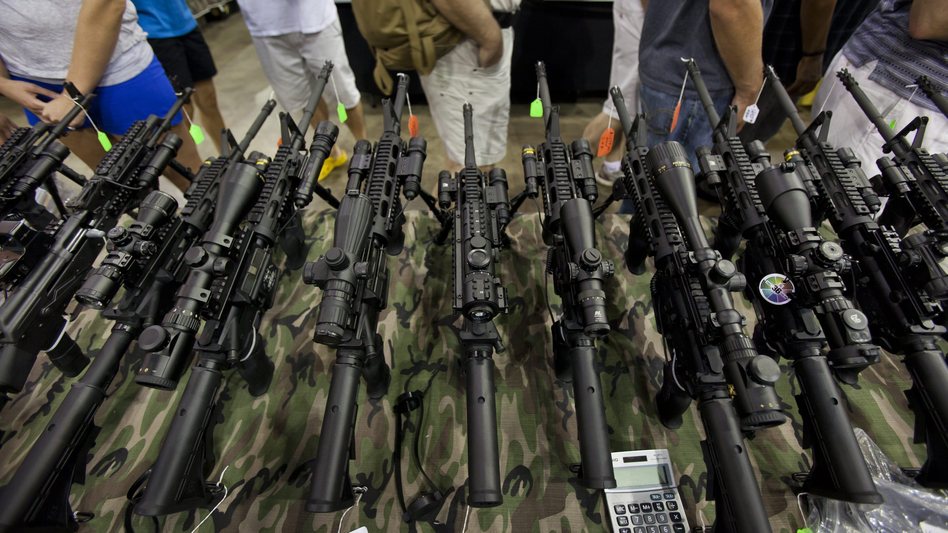
Guns on display at a show in Chantilly, Va., in July 2012. Jim Lo Scalzo /EPA /Landov
The day after last December’s mass shooting at Sandy Hook Elementary School we wrote that:
“The tragedy in Newtown, Conn., will surely spur pollsters to ask Americans again about guns, gun ownership, gun laws and the Second Amendment.
“If recent experience is a good guide, public opinion may not shift too much.”
A week later, the Pew Research Center reported that “the public’s attitudes toward gun control have shown only modest change in the wake of last week’s deadly shooting.”
Now, with the Senate soon to vote on initiatives including expanded background checks of gun purchasers and increased penalties for gun trafficking, a scan through data from polls about gun laws underscores how attitudes for the most part seem to be close to pre-Newtown levels.
— That CNN/ORC polling done in January 2011 showed 71 percent agreeing there should be “some restrictions” on gun ownership. Last month, 70 percent said the same thing.
— That ABC News/Washington Post polling done in January 2011 showed 52 percent saying they favored stricter gun control laws, vs. 45 percent who said they did not. Right after the Newtown shootings, there were 54 percent in favor of stricter laws and 43 percent against. In March, the responses were back to where they were two years earlier: 52 percent in favor of stricter gun laws and 45 percent against.
— That Pew Research Center/USA Today polling done in July 2012 showed 46 percent of those surveyed believed it was more important to “protect the right to own guns” than it was to “control ownership.” Forty seven percent said it was more important to control ownership than to protect the right to own guns. In February of this year, 46 percent said it was more important to protect gun owners’ rights — no change from before the Newtown shootings. Fifty percent came down on the side of “control ownership” — almost no change from the previous polling when the margin of error is factored in.
At least one response to one poll runs counter to the trend. An NBC News/Wall Street Journal survey has asked: “In general, do you feel that the laws covering the sale of firearms should be made more strict, less strict, or kept as they are now?”
In January 2011, 52 percent said laws should be “more strict,” 10 percent said “less strict” and 37 percent said they should be “kept as they are.” The “more strict” response grew to 56 percent in January of this year and 61 percent in February. Meanwhile, the “less strict” response declined to 7 percent in January this year and 4 percent in February. Fewer people said laws should be “kept as they are”: 35 percent agreed with that in January this year; 34 percent said that in February.
President Obama, who will continue his push for stricter gun laws this week when he travels to Denver, last Thursday said Congress shouldn’t “get squishy” on tightened gun laws. Speaking of the Newtown shootings, the president said “shame on us if we’ve forgotten.”
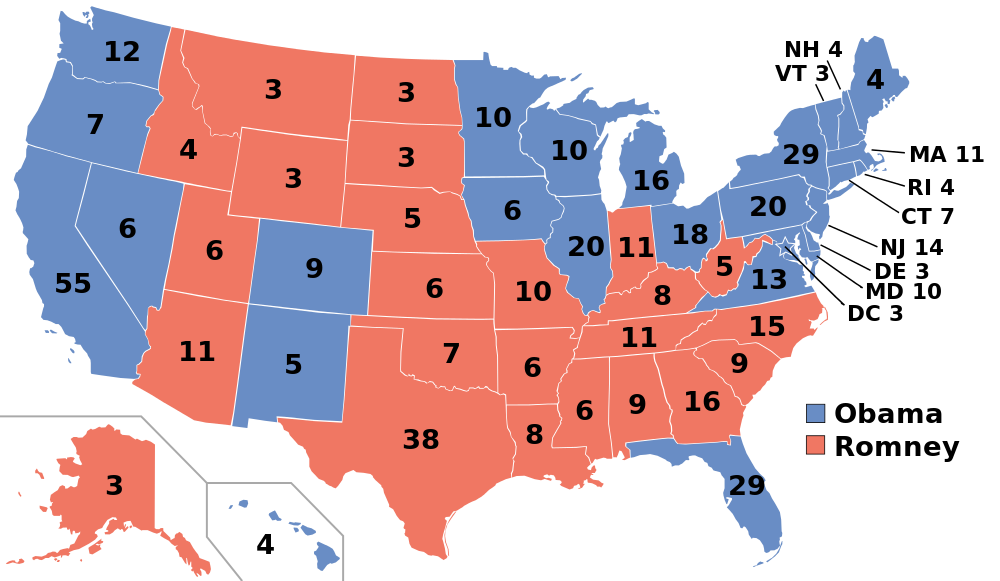
The 2012 Electoral College map. (Courtesy Wikimedia Commons)
There’s a reason President Obama chose Colorado to hold a rally this Wednesday in favor of gun control.
Among the states this year, Democratic-controlled Colorado has passed the toughest new restrictions on gun rights, requiring universal background checks and banning magazines that hold more than 15 rounds of ammunition.
But if certain liberal wishes have come true in Colorado — recall that it was one of two states last fall that voted to legalize marijuana — things look very different next door in Kansas.
So Long Swing States
The winning margin in presidential voting last fall was greater than 10 percent in all but 16 states. Back in 1976, twice as many states were that close.
A raft of conservative legislation has been moving in Kansas this year, including a measure that allows people to carry concealed weapons into public buildings. The Republican-dominated government also has put new restrictions on abortion and made it harder for teachers to donate to union political activities.
“I live probably about 12 miles from Kansas,” says Greg Brophy, a Republican state senator from eastern Colorado. “I like Colorado better, but I have to admit their [Kansas’] politics has more appeal to me right now, that’s for sure.”
A ‘New Phenomenon’
This sort of dynamic is playing out across the country. On a wide variety of issues — gay marriage, tax policy, implementing Obamacare, the death penalty — states are moving in polar opposite directions from one another.
“This is very much a new phenomenon, drawing really clear lines between the states,” says Ray Scheppach, former executive director of the National Governors Association.
Those divisions mean people are living in political cultures that are starting to look entirely different from one another. That’s likely to polarize the nation’s politics even further.
“Most of the policy [innovation] has come from the states, but we’ve never had a country that’s so ideologically segmented as it is right now,” says Susan MacManus, a University of South Florida political scientist.
How It Happened
By now, the notion that most states are either Democratic “blue” or Republican “red” is a fairly shopworn idea. But it’s increasingly true. Even as presidential voting has remained reasonably close on a national level, the states are split far apart.
Last year, Obama won nationally by 4 percentage points, but the winning margin of victory for either candidate was under 5 percent in only four states (Florida, North Carolina, Ohio and Virginia). Victory was totally lopsided in half the states, with margins of more than 15 percent.
States are just as divided internally. In last year’s elections, blue states got bluer, while red states grew redder. The parties now share legislative control in only three states — Iowa, Kentucky and New Hampshire — which is the lowest number since 1944.
One party controls both the legislature and the governorship in all but a dozen states — with veto-proof supermajority control in half the chambers nationwide. The result has been that legislation in most states now strongly comports with the wishes of one party or the other.
In previous years, new policies might have originated in either Democratic or Republican states, but they tended to spread eventually pretty much everywhere, regardless of partisan leanings, says Scheppach, who now teaches at the University of Virginia.
Now, though, states are following almost entirely separate and distinct tracks.
“It’s a new phenomenon, and I don’t think it’s a particularly good one,” he says. “It makes all politicians much more ideological, which means not negotiating our differences.”
A Patchwork On Abortion
With the Supreme Court considering gay marriage, there’s been a lot of speculation about whether justices would make policies uniform or let state laws differ.
There have been comparisons to the 1973 abortion decision in Roe v. Wade, which appeared to set a national standard but has in fact triggered a wide variance among states, as conservatives find new ways to limit abortion rights.
That’s been especially true recently, with Republicans in states such as North Dakota and Arkansas passing strict limitations on abortions last month.
“For a woman who lives in New York, her constitutional rights around reproductive choices are just stronger than a woman who lives in Mississippi,” says Julie Rikelman, director of litigation at the Center for Reproductive Rights.
A number of states have passed abortion restrictions over the past couple of years, while a few are looking into ways of expanding access to abortion. Washington state is considering a measure to require health insurers to pay for abortions, for instance, while California may increase the number of health professionals allowed to perform surgical abortions.
It’s better for the states to undergo this sort of “tumultuous” sorting out of abortion policy than having the courts impose a single standard by fiat, says Dan McConchie, vice president for government affairs at Americans United for Life.
“The [Supreme] Court, by taking this out of the public sphere with Roe, actually created this trench warfare,” he says. “Your only alternative is to let the democratic process work, even if that results in a patchwork.”
It’s Not Just Social Issues
Several red states are looking into abolishing income taxes altogether, while income taxes have been raised or might yet go up in places such as Maryland, Massachusetts and Minnesota.
Environmental policy also looks a lot different depending on where you live. States have roughly split themselves in half over the past decade when it comes to the question of addressing climate change, or not.
Now, neighboring states such as Pennsylvania and New York are taking totally different approaches when it comes to allowing fracking for natural gas.
“It is a tale of two nations,” says Barry Rabe, an expert on environmental policy at the University of Michigan. “We see states going in dramatically different directions.”
It’s happening on almost every issue.
“Ten years ago, you couldn’t tell the difference between Republican and Democratic governors [on some issues],” says Scheppach, the former governors association official. “They’re becoming more extensions of their respective parties, so I’m afraid that gulf is going to get larger.”
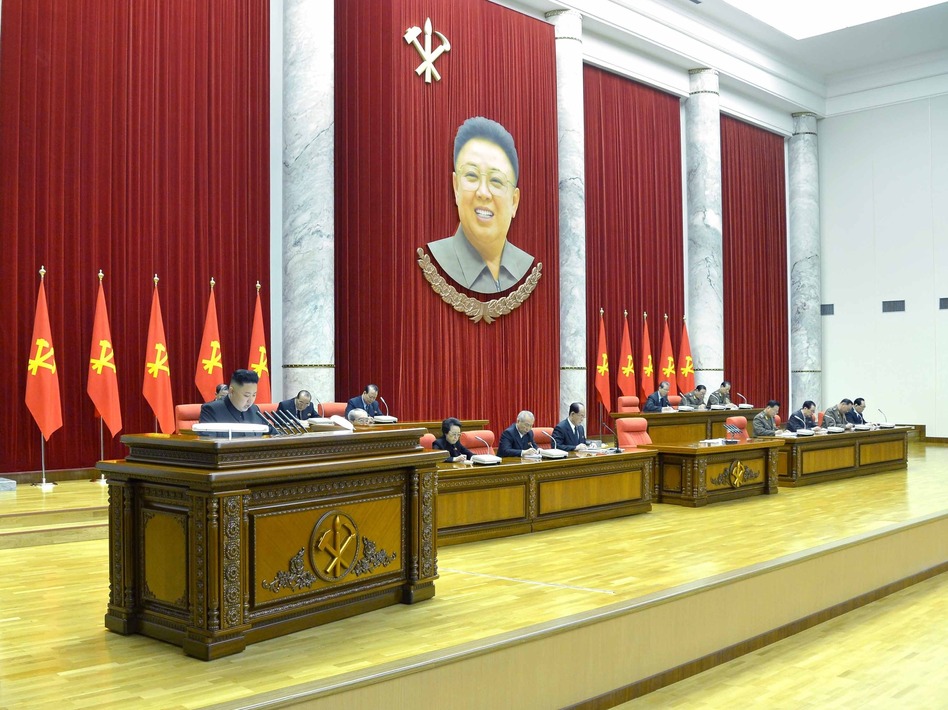
North Korea’s KCNA news agency released this photo Monday, saying it shows leader Kim Jong Un (at left) speaking during a plenary meeting of the Central Committee of the DPRK in Pyongyang. Hanging above is the image of his father, former leader Kim Jong Il, who died in 2011. Xinhua /Landov
A vow Tuesday from North Korea that it will restart a nuclear reactor that eventually could make about one bomb’s worth of plutonium a year further escalates tensions that were already high due to that nation’s almost daily threats, NPR’s Louisa Lim tells our Newscast Desk.
According to Louisa, who filed her report from Beijing:
“In a statement, North Korea said work to restart all facilities at the Yongbyon nuclear plant will begin without delay. It said it needs to resolve an acute electricity shortage, as well as bolster what it called its nuclear armed force.
“Analysts say that Pyongyang now sees its nuclear arms program as essential for national security — and non-negotiable. It’s not clear how long it will take to restart the nuclear plant. In 2008, its cooling tower was blown up as part of disarmament efforts.”
The Associated Press adds that the plutonium reactor “was shut down in 2007 as part of international nuclear disarmament talks that have since stalled. The declaration of a resumption of plutonium production — the most common fuel in nuclear weapons — and other facilities at the main Yongbyon nuclear complex will boost fears in Washington and among its allies about North Korea’s timetable for building a nuclear-tipped missile that can reach the United States, technology it is not currently believed to have.”
Monday, as we reported, the Pentagon told reporters that two F-22 Raptor fighter jets have been sent to South Korea to take part in U.S.-South Korean military drills. That followed last week’s news that nuclear-capable B-2 stealth bombers had conducted a training flight to the Korean Peninsula.
The North, and its young leader Kim Jong Un, have been blaming the U.S.-South Korean military drills (which those nations have conducted many times in recent decades) as they have moved to cut hotlines to the South and annul the 1953 armistice that ended open warfare on the peninsula.
According to the Los Angeles Times, the announcement about restarting the Yongbyon reactor came “after a rare plenary meeting of the central committee of the ruling Worker’s Party, which set a new strategic direction for the nation. At the meeting, Kim described the nuclear weapons program as the ‘nation’s life’and ‘treasure,’ which ‘can never be abandoned.’ ”
South Korea’s new president, Park Geun-hye, said Tuesday that the security situation is “grave,” Yonhap News reports. The news agency adds, though, that she believes “discouraging North Korea from provocations through strong diplomatic and military deterrence is just as important as punishing the communist nation after provocations.
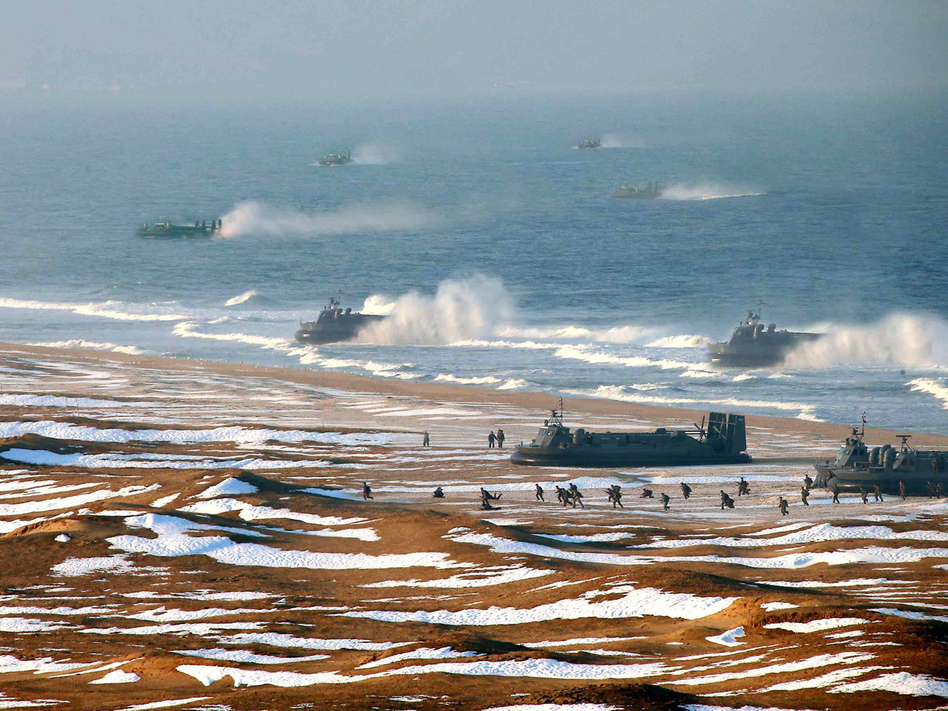
North Korean “landing and anti-landing drills” are shown in a photo released Tuesday. KCNA/AFP/Getty Images
North Korea says it has moved its artillery and ballistic missiles into “combat posture” for possible use against targets in South Korea, Guam, Hawaii and the U.S. mainland.
“From this moment, the Supreme Command of the Korean People’s Army will be putting in combat duty posture No. 1 all field artillery units including long-range artillery units [and] strategic rocket units that will target all enemy object in U.S. invasionary bases,” the official KCNA news agency said.
KCNA said Pyongyang’s forces had been “assigned to strike bases of the U.S. imperialist aggressor troops in the U.S. mainland and on Hawaii and Guam and other operational zones in the Pacific as well as all the enemy targets in South Korea and its vicinity.”
The Associated Press quotes Seoul’s Defense Ministry as saying it hasn’t seen any suspicious North Korean military activity and that officials were analyzing the North’s warning.
Analysts say a direct North Korean attack is extremely unlikely, especially during joint U.S.-South Korean military drills that end April 30, though there’s some worry about a provocation after the training wraps up.
The submarines would supplement China’s existing fleet of about 65 subsurface vessels, including indigenously built nuclear and ballistic missile submarines.
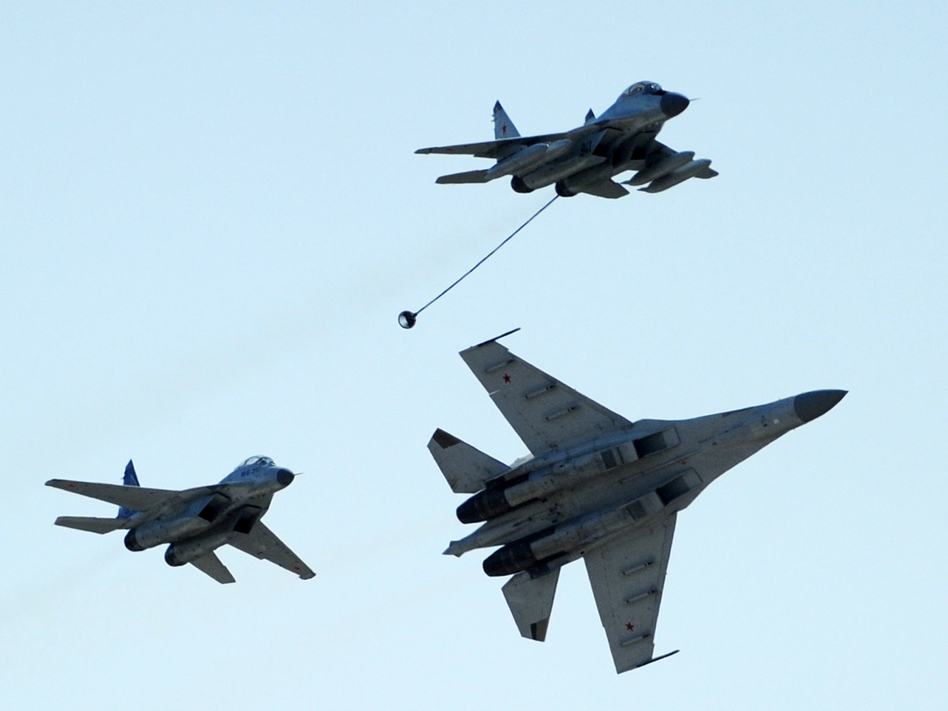
China has also produced several of its own variants of Russia’s Sukhoi Su-27, Su-30 and Su-33 warplanes and is in the process of developing its own stealth fighters. The BBC quotes China’s People’s Daily as saying the advanced Su-35s from Russia would “effectively reduce pressure on China’s air defense” as China moved ahead with its stealth planes.
Last year, IHS Jane’s, quoting the Moscow daily Kommersant, reported that Moscow was leery of a deal with China because it was afraid Beijing would illegally copy the weapons.
Kommersant said:
“[Moscow] is requiring that Beijing provide a legally binding guarantee that it will refrain from making reverse-engineered copies of the Russian fighter — largely so that this does not create a potential competitor in the market to sell the aircraft to other countries. China is [in] no hurry to provide this guarantee.”
The reports come as Beijing and Moscow have moved closer in an apparent desire to counterbalance U.S. interests in Asia and Europe and The China Daily described Xi’s visit to Russia as a “well-deserved riposte to Washington for America’s military ‘pivot’ to Asia. Xi is executing China’s own ‘pivot’ — the visit to Moscow to cement ties with” Russian President Vladimir Putin, according to the BBC.