Nation & World

Rebels Rain Down Mortars On Damascus

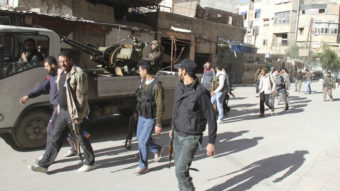
Rebels from the Free Syrian Army walk on a street in Damascus in this picture provided by Shaam News Network and taken March 23.
Rebels from the Free Syrian Army walk on a street in Damascus in this picture provided by Shaam News Network and taken March 23. The Syrian capital came under mortar fire on Sunday and Monday. Ward Al-Keswani/Shaam News Network/Reuters /Landov

The author is a Syrian citizen living in Damascus who is not being further identified out of safety concerns.

Syrian rebels carried out mortar and rocket attacks on Sunday and Monday in what appeared to mark a new escalation in the fighting over the Syrian capital.
At least two people were killed and dozens injured, according to the state-run media in Syria. The United Nations announced it was relocating about half of the 100 members of its international staff in the city for security reasons.

The rebels have periodically attacked Damascus with mortar shells before, but the magnitude of Monday’s attack, felt in every city neighborhood, was much more intense than before and left many Damascenes feeling caught in the crossfire.

The two sides exchanged fire all night, which included sporadic shelling from the government batteries placed in the hills around the capital. Damascenes are now used to those sounds and accustomed to interrupted sleep punctured by blasts and thuds. On a bad night, it sounds like continuous loud thunder.

An Early Morning Blast

But Monday morning, a loud boom jolted me from bed. It was louder and closer than usual.

We heard similar blasts on Sunday evening too, when rebels fired a rocket and mortar shells at state television headquarters.

The early morning blast Monday was just the beginning. More explosions roared, one after the next. Two dozen, maybe more. I lost count.
Then, countershelling from government missile batteries began. Everyone in Damascus can recognize that sound. But Monday, even those sounded different more sustained and angry than usual.

Activists later said the government had fired from a huge missile battery in the city, and not just ones in the hills that surround Damascus. This would seem to explain why Damascenes throughout the city heard and felt each retaliatory missile fired from Damascus onto the rebel-held areas on the outskirts.The attacks and counterattacks went on for several hours.

I had been through similar shooting exchanges two or three times before, the most recent being just last Tuesday, when rebels fired onto the neighborhood of Malki, an affluent residential areas where President Bashar Assad lives. But there was a widespread belief that this was the heaviest such shooting yet in the capital.

Rebel Warnings

Every now and then, Damascus is abuzz with the latest statements from rebels claiming that the “final battle” for Damascus has arrived.

“The shaking of fortresses has begun,” a rebel brigade, Liwa al Islam, said in a statement referring to regime targets in the capital.

“Government installations shall be targeted, including presidential, military and intelligence. They will be pounded with surface-to-surface missiles,” it added. “We advise our fellow citizen who live near such government targets to hurriedly leave to a more secure location. As God is our witness, you have been forewarned.”


Read original article

Rebels Rain Down Mortars On Damascus

Secretary Of State Kerry In Baghdad, With Concern Over Syria

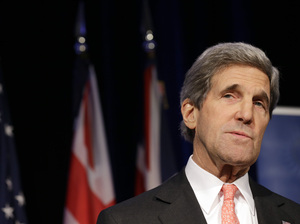
Secretary of State John Kerry is in Baghdad Sunday on an unannounced visit following President Obama's Mideast tour. Alex Brandon/AP
Secretary of State John Kerry is in Baghdad Sunday on an unannounced visit following President Obama’s Mideast tour. Alex Brandon/AP

Secretary of State John Kerry is on an unannounced trip to Baghdad Sunday, and according to an official, the buzzword of the trip is “engagement.”

NPR’s Michele Kelemen, who’s traveling with Kerry, tells our Newscast Desk that Syria is on his agenda:

“He’s … pressing [Iraqi Prime Minister Nouri al-Maliki] to crack down on, as one official put it, ‘the nearly daily Iranian flights over Iraqi territory to Syria.’ The U.S. accuses Iran of shipping weapons to Bashar al-Assad’s regime and is warning Iraq that these shipments are fueling the conflict and are dangerous to the region.”

The Associated Press reports the overflights “have long been a source of contention between the U.S. and Iraq.” Iraq promised to inspect the flights last year, the AP says, but an official says only two have been checked since then.

The New York Times has more on the Iran-Syria relationship:

“The air corridor over Iraq has emerged as a main supply route for weapons, including rockets, antitank missiles, rocket-propelled grenades and mortars, as well as Iranian personnel, according to American intelligence officials. There are supply lines on the ground as well.

“Iran has as an enormous stake in Syria, which is its staunchest Arab ally and has provided a channel for Iran’s support to the Lebanese Islamist movement Hezbollah.”

The conflict in Syria rages on: Refugees are pouring into neighboring countries, and the United Nations is investigating the possible use of chemical weapons in the conflict.

Kerry’s trip comes 10 years after the war in Iraq began. With Iraqi provincial elections in April, having the Shiite government work with Sunnis and Kurds is also a concern for the U.S., Kelemen says.

Kerry’s trip follows President Obama’s Mideast tour, including his first trip to Israel as president.


Read original article

Secretary Of State Kerry In Baghdad, With Concern Over Syria

Ex-President Musharraf Returns To A Different Pakistan

Former Pakistani President Pervez Musharraf greets supporters upon his arrival at Karachi airport in Pakistan on Sunday. S.I. Ali/AP

After four years of self-imposed exile, Pakistan’s former military ruler Pervez Musharraf has come home. His plan is to run for office and reclaim political influence, but death threats and legal battles complicate his return.
Security at Karachi airport was unusually tight as he arrived Sunday, NPR’s Julie McCarthy reports; the Pakistani Taliban has issued threats to kill the former president. Just before he was whisked away for his own safety, CNN reports, Musharraf made a statement to a few hundred supporters.

“I have put my life in danger and have come to Pakistan — to you, to be the savior of this country,” he said. “I have come to save Pakistan.”

Pakistan’s columnists are calling the 69-year-old’s return politically naïve, McCarthy reports, even ego-maniacal.

“They wonder aloud whether this isn’t a man’s personal battle against irrelevance, against the idea that his day has come and gone,” she tells Weekend Edition Sunday.

Musharraf wants to run in Pakistan’s elections, which are scheduled for May 11. He formed his own party while in exile, the All Pakistan Muslim League, but McCarthy says most independent analysts view it as politically marginal. Musharraf has returned to a country that has changed in his absence, she says.

“For the first time in its 65-year history, a democratically elected government has just completed its five-year term,” she says. “It’s seen as a watershed for this country.”

Musharraf came to power in a military coup in 1999. Although he’s a civilian now, his legacy is that of a military dictator.

“Pakistanis like determining their own leaders,” McCarthy says. “While they may feel patriotic about their army, they don’t want to be governed by it.”

Musharraf stepped down from office in 2008 to avoid impeachment over suspending the nation’s constitution and imposing emergency rule.

Aside from the very real threat of death — former Prime Minister Benazir Bhutto was assassinated in 2007 when she returned to campaign in Pakistan — Musharraf also faces imminent legal battles.

Among the charges against him is that he did not provide enough security to prevent Bhutto’s death. To smooth his arrival, McCarthy reports, Musharraf was granted pre-emptive bail, which essentially prevented his immediate arrest upon returning to Pakistan.


Read original article

Ex-President Musharraf Returns To A Different Pakistan

Obama Closes Trip To Israel, West Bank With Memorial Visits

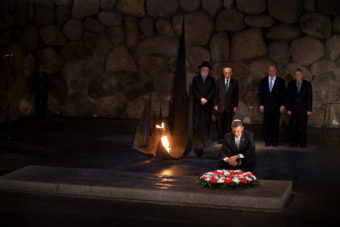
President Barack Obama pays his respects in the Hall of Remembrance in front of Israel's President Shimon Peres, Israel's Prime Minster Benjamin Netanyahu, Chairman of the Yad Vashem Directorate Avner Shalev and Rabbi Yisrael Meir Lau after marines layed a wreath on his behalf during his visit to the memorial on Friday. Uriel Sinai/Getty Images
President Barack Obama pays his respects in the Hall of Remembrance in front of Israel’s President Shimon Peres, Israel’s Prime Minster Benjamin Netanyahu, Chairman of the Yad Vashem Directorate Avner Shalev and Rabbi Yisrael Meir Lau after marines layed a wreath on his behalf during his visit to the memorial on Friday. Uriel Sinai/Getty Images

President Obama wrapped up his trip to Israel and the West Bank on Friday with visits to three symbolic pilgrimage sites: First he laid a stone on the grave of Theodor Herzl, the father of modern Zionism, then he laid a wreath and a stone on the grave of Yitzhak Rabin, the Israeli leader assassinated in 1995. Finally, Obama made a somber visit to the Holocaust memorial Yad Vashem.
The Jerusalem Post reports Obama wore a kippa and “rekindled an eternal flame next to a stone slab above ashes recovered from extermination camps after World War Two.”

The New York Times reports that a solemn President Obama spoke about the “obligation not just to bear witness” but to act against racism and anti-semitism.

“Our sons and daughters are not born to hate, they are taught to hate,” Obama said according to the Times. “The state of Israel does not exist because of the Holocaust but in the survival of a strong Jewish state of Israel the Holocaust will never happen again.”

Throughout his visit, Obama made it a point to highlight similarities between Israelis and Palestinians and the United States. He made that point symbolically today. The AP reports the stone Obama placed on Rabin’s grave was from the grounds of the Martin Luther King memorial in Washington.

Later today, Obama heads to Jordan where he will meet with King Abdullah II. The AP reports:

“Among the topics is Jordan’s struggle with the influx of a half-million refugees from the Syrian civil war. Abdullah has voiced fears that extremists and terrorists could create a regional base in Jordan.”

The Guardian has a piece previewing that visit. The important part is that it comes after Abdullah gave an incredibly candid interview to The Atlantic.


Read original article

Obama Closes Trip To Israel, West Bank With Memorial Visits

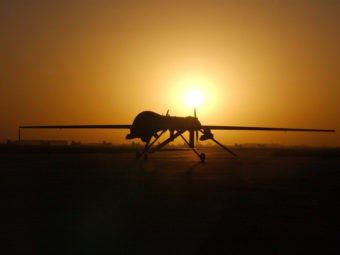
CIA Drone Operations Could Be Handed To Pentagon

A Predator drone taxis in after a sortie over Iraq in 2004. U.S. Air Force/Getty Images

The responsibility for counterterrorism operations involving unmanned drones could soon begin shifting from the CIA to the Pentagon as part of Obama administration efforts to mollify critics who say the program lacks transparency, says NPR’s Tom Gjelten.

A senior U.S. official tells NPR that while no decision has been made, the change is a “distinct possibility.” The Daily Beast broke the story on Wednesday.

The move would come in response to a bruising confirmation fight for John O. Brennan to become the new head of the Central Intelligence Agency. Republicans and Democrats alike used Brennan’s confirmation hearings to criticize the administration for not being more open about the drone program, especially when it has, on rare occasions, targeted U.S. citizens.

“The Obama administration basically had to promise to come clean on the drone program in order to get Brennan approved,” Gjelten says.

Also, last week the U.S. Court of Appeals for the District of Columbia Circuit ruled that the CIA could no longer deny the existence of the program, because so much had come out about it already.

For years, the CIA has been using unmanned aircraft to target suspected terrorists — first under President George W. Bush and then under President Obama. A CIA drone was used in Yemen to kill an American citizen, Anwar al-Awlaki, after he became a key operative in the al-Qaida network.

Under the aegis of the CIA, the program has enjoyed a considerable degree of secrecy and flexibility because under U.S. law is not subject to the same restrictions as a traditional military operation carried out by the Pentagon, Gjelten says. The president can authorize the CIA to carry out the operation outside the normal military chain of command, where it can remain covert and deniable.

From the administration’s standpoint, such a shift would occur at a time when the drone program is not quite as high of a priority as it once was, Gjelten says.

“To be brutal, they’ve killed most of the really bad guys they’ve been after,” he says. “They lately have been going after second- or third-tier al-Qaida operatives.”

Gjelten says that in his new post, Brennan also wants to demilitarize the CIA.

If a decision is made, shifting responsibility for the program would occur gradually as “a phased approach” of operations in individual countries.

“It would be easiest to do it in Yemen, because the drone strikes there are already being carried out jointly by the Pentagon and the CIA,” he says. “Pakistan would be the big change. The drone strikes there have been almost entirely directed by the CIA.”

In an interview with NBC last month, outgoing Secretary of Defense Leon Panetta hinted at the change and suggested that even if most of the drone operations were moved to the military, some of them might remain covert.

“I think a lot more of this can be put under Title 10 [military operations] and that on Title 50 [intelligence operations] we always ought to have that capability to use a covert effort if we have to,” he said. “But I would limit that.”


Read original article

CIA Drone Operations Could Be Handed To Pentagon

Gaza Militants Fire Rockets, As Obama Heads To West Bank

President Barack Obama arives for a joint press conference with Palestinian president Mahmoud Abbas at the Muqataa, the Palestinian Authority headquarters, in the West Bank city of Ramallah. Mandel Ngan /AFP/Getty Images

Militants in Gaza fired rockets into Israel on Thursday, just as President Obama travelled from Israel to the West Bank, where he met with Palestinian President Mahmoud Abbas.

NPR’s Larry Abramson filed this report for our Newscast unit:

“Two of the rockets reached the southern town of Sderot, but one fell in an open area. The other caused some damage to a building, according to Israeli police.”

“This is only the second incident of rocket launchings from Gaza since a ceasefire was reached between Hamas and Israel in November. President Obama, who spent last night in Jerusalem, is to meet with Palestinian President Mahmoud Abbas in Ramallah today.”

“Parts of the city have been blocked off and schools have been closed. In recent days, Palestinians have staged a series of small but vocal demonstrations against U.S. support for Israel.”

The New York Times reached a spokesman for Hamas, who did not take responsibility for the rocket launch. Salah al-Bardawil told the paper that in November, Obama had given Israel a “green light to destroy Gaza.” Obama, he told the paper, “speaks in the language of Israel.”

The Wall Street Journal adds a bit more background on the Palestinian Authority, which is facing tough times. The Journal reports:

“The Palestinian Authority is short on cash and has struggled to pay its 150,000 public servants on time in recent months fueling popular discontent with the leadership. In addition to seeking financial aide, Mr. Abbas is expected to ask Mr. Obama to pressure Israel to make some confidence building measures to strengthen his domestic political standing, which many believe is at an all-time low, and allow him to resume peace talks without appearing to have caved.

“For Mr. Obama, the visit with Palestinian leaders is a tricky diplomatic balancing act in which he must show support for the Palestinians without undercutting his message to Israelis.”

Update at 8:03 a.m. ET. ‘Peace Is Necessary’:

During a joint press conference, President Obama and Palestinian President Mahmoud Abbas said both countries were committed to peace.

“We believe peace is necessary and inevitable,” Abbas said.

But that talk quickly dissipated into reality. Obama first condemned the rocket attacks from Gaza and then went on to criticize Hamas, whom he said is more interested in “destroying Israel,” than in bringing prosperity to Palestinians. Remember, the Palestinian Authority and Hamas are rivals. Abbas controls the West Bank and Hamas has controlled Gaza since 2007, a year after it swept into power through elections.

Obama was asked if after talking to leaders from both sides, he still believed a two-state solution was possible.

“I absolutely believe that it’s still possible, but it is difficult,” Obama said.

One of the big issues that has kept leaders from direct negotiations is that Israel has continued expanding its settlements. Obama said he has been clear with Netanyahu that continued settlement activity is neither “constructive” nor “appropriate.”

But Obama said both sides need to ditch any preconditions and begin direct negotiations that adress the core two issues in this conflict: Palestinian sovereignty and Israeli security.

“We cannot give up on our search for peace,” Obama said. At one point, he got personal. Palestinians deserve dignity and a sovereign state, he said. Look at the United States. At one point in American history, his daughters would not have had the opportunities they have now.

Change is hard, he said, but it is possible.


Read original article

Gaza Militants Fire Rockets, As Obama Heads To West Bank

Site notifications
Update notification options
Subscribe to notifications