Nation & World

Congress passes superstorm Sandy relief bill

On Friday, Congress passed the first of two relief bills for Superstorm Sandy.

Money for Alaska was not in it.

The Senate passed a $60 billion aid package a couple of weeks ago. Included was more than $60 million to study and prevent marine debris. Also included was $150 million for fishery disasters across the country.

But it went nowhere in the House. And now that the new Congress is sworn in, the process begins anew.

The version passed today is just shy of $10 billion, and pays for the flood insurance program. The House is slated to debate the remaining $50 billion when it returns Jan. 15.

San Diego area Republican Darrell Issa says the bill needs to focus on just the Northeast, and do so in a timely fashion – meaning leaders need to have a bill settled and ready to go.

“We do need to pre-negotiate with the Senate. We need to get the pork out. Now none of the pork we’re talking about is in New York, New Jersey or Connecticut. In fact, it’s as far away as Alaska,” Issa said.

But Senator Charles Schumer, a New York Democrat, says it’s important to maintain funding for all disasters in this bill – not just related to his part of the county.

“If the House wants to deal with that, we’ll have to deal with that in the Senate. It’ll obviously make some people unhappy and make it harder to pass,” Schumer said.

Make it harder to pass, because it would leave Senators voting to pay for reconstruction in the Northeast and not their part of the country.

Senator Lisa Murkowski, who voted for the aid package, has expressed deep concern over the cost of the bill and whether members are loading it up with projects that can wait for the appropriations process.

It’s not just the Alaska money causing concern.

New York Democrat Carolyn Maloney says her city’s subway system moves 8 million people a day. Some tunnels are still closed, and the federal government needs to pay to reopen them.

“You need structural changes to repair them, and mitigation to upgrade them in a way that helps you prevent it in the future,” Maloney said.

Mitigation – that’s a term many Republicans bristle at – saying it shows the project is more an upgrade than an emergency.

But the fight is still weeks away. The new 113th Congress has recessed one day after it gaveled in.

Following the election, some Alaskans join secession bandwagon

Following last week’s re-election of President Obama, petitions for secession began appearing on the We the People website hosted by the White House.

The site allows people to post a petition to be addressed by the Obama Administration. If the petition gains 25,000 signatures in 30 days the White House will offer an official response.

Two people from Alaska have submitted petitions.

“Matthew G” from Palmer, created a petition on Nov. 10. The petition requests that “the Federal Government allow Alaska to peacefully secede from a dysfunctional Union that is run by corrupt politicians who buy the votes of individuals who can no longer be seen as American citizens but rather, slaves to a tyrant.”

So far it has gained 507 signatures, most of which come from outside Alaska. Only 57 signers self-identified as being from Alaska.

Though the site requests people to avoid making duplicate or similar topic petitions, another secession petition for Alaska was added on Nov. 11.

“Paul M” from Anchorage created a petition for Alaska to have an election to decide whether or not to secede from the United States.

[quote]“Our main “goal” is a legal vote and ballot; one that was not given in 1958 and was in violation of International Law and Treaty. Alaskans were robbed of the choices we were to have as a non-self-governing territory, and steam-rolled into the current classification of a State. The Native population of Alaska, in a large percentage, did not even receive a ballot because of the Federal Voting Rights Act in place. Alaskans now seek to a statewide free election to decide whether Alaska should be a free and Independent Nation.”[/quote]

The petition is still 18,602 signatures shy of the 25,000 required for review. So far several hundred self-identified Alaskans have signed on.

Thus far, citizens in approximately 40 states have posted petitions for secession. However, only a handful have gained enough signatures to meet the threshold for response. Petitions for the secession of Texas, Louisiana, Florida, Georgia, Tennessee, Alabama and North Carolina each have more than 25,000 signatures. The petition from Texas boasts the most with more than 98,000 signers.

There are some petitions approaching the issue from the other side. There is a petition to make all states wishing to secede pay their share of the national debt first. Another asks to exile American citizens who signed petitions for secession, which has gained nearly 10,000 signatures.

There is currently no timeline on when the White House might respond to the petitions, however the White House did tell ABC News that it will review and respond to the petitions that obtained enough signatures.

The Supreme Court upholds the Affordable Health Care Act

The Supreme Court has upheld the heart of President Barack Obama’s health care overhaul — ruling in favor of the requirement that most Americans can be required to have health insurance, or else pay a penalty.

The decision means the historic overhaul will continue to take effect over the next several years, affecting the way countless Americans receive and pay for their personal medical care.

The ruling also hands President Barack Obama a campaign-season victory.

The court found problems with the law’s expansion of Medicaid. But even there, it said the expansion could proceed as long as the federal government does not threaten to withhold the entire Medicaid allotment to states if they don’t take part in the extension.

The court’s four liberal justices, Stephen Breyer, Ruth Bader Ginsburg, Elena Kagan and Sonia Sotomayor, joined Chief Justice John Roberts in the outcome.

The Supreme Court began hearing the case on March 26, nearly two years to the day that President Obama signed the act.

The Court had four key issues to consider:

  • Does the Supreme Court have the right to hear the case?
  • Does Congress have the authority to compel people to buy health insurance?
  • If the court strikes down one part of the law (specifically the individual mandate) does the whole law become invalid? If not, would other linked parts of the law have to be struck down as well?
  • Arguments by the states against being required to expand Medicaid programs.

On the SCOTUS blog the court wrote “Our precedent demonstrates that Congress had the power to impose the exaction in Section 5000A under the taxing power, and that Section 5000A need not be read to do more than impose a tax. This is sufficient to sustain it.”

From the SCOTUS Blog:

“In Plain English: The Affordable Care Act, including its individual mandate that virtually all Americans buy health insurance, is constitutional. There were not five votes to uphold it on the ground that Congress could use its power to regulate commerce between the states to require everyone to buy health insurance. However, five Justices agreed that the penalty that someone must pay if he refuses to buy insurance is a kind of tax that Congress can impose using its taxing power. That is all that matters.

“Because the mandate survives, the Court did not need to decide what other parts of the statute were constitutional, except for a provision that required states to comply with new eligibility requirements for Medicaid or risk losing their funding. On that question, the Court held that the provision is constitutional as long as states would only lose new funds if they didn’t comply with the new requirements, rather than all of their funding.”

Alaska, which is among the states that sued over the constitutionality of the federal health care law, has yet to implement a health care exchange. The health department has hired a consultant to help design one, and that report is expected soon.

In Alaska there are approximately 125,000 residents that do not have insurance, which is about 18 percent of the state’s population.

Republican Gov. Sean Parnell is expected to take the report and the U.S. Supreme Court decision into consideration in deciding how to proceed on the health care exchange issue. Spokeswoman Sharon Leighow declined to comment about contingency plans before the court’s ruling.

Read the full Supreme Court ruling here.

Japanese ship watched for oil, debris after being sunk

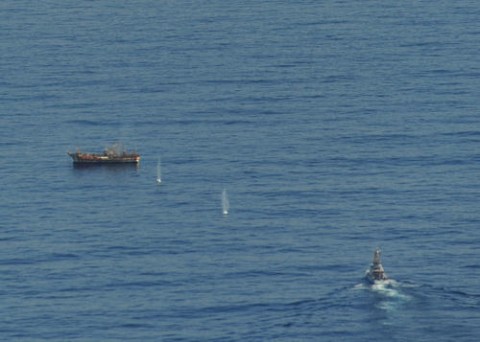
The Coast Guard Cutter Anacapa crew douses the adrift Japanese vessel after shelling started a fire. Photo by Petty Officer 2nd Class Charly Hengen.

Click here for ifriendly audio.

The Coast Guard is watching for fuel and debris from a derelict Japanese fishing vessel it sank off the coast of Southeast Alaska on Thursday.

Kip Wadlow of the agency’s public affairs office says nothing of significance has been found so far. A small sheen was spotted Thursday, but was expected to dissipate quickly.

Wadlow says the Petersburg-based cutter Anacapa began firing at approximately 1 p.m. Thursday.

The Ryou-Un Maru went down at 6:15 p.m. in about 6,000 feet of water.

“When the ship started to sink, the starboard quarter, or the right-back side, went in the water first. And then the ship just slowly rolled over and sank,” Wadlow says.

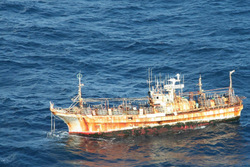
The approximately 200-foot vessel was washed out to sea by last year’s Japanese tsunami. It crossed the Pacific Ocean without crew or power, then drifted up the coast of British Columbia into Alaska waters.

Wadlow says the Coast Guard fired 440 rounds of explosive ordinance at the ship’s waterline.

“The reason why we decided to sink this vessel is that it posed a safety threat to mariners and maritime shipping that travel the sea lanes off of Southeast Alaska,” he says.

Firing was delayed when a fishing boat captain expressed interest in salvaging the ship. He decided against the idea after getting a closer look.

The Ryou-Un Maru caught on fire after the first round of shelling. Wadlow says the Anacapa’s crew put it out by shooting a stream of water from their vessel.

“There was a significant smoke plume and we didn’t want to worry any mariners in the area thinking that there might be a vessel on fire and people in danger,” he says.

The Japanese ship was about 180 miles west of Sitka when it sank.

It’s not clear what hazardous materials were on board. The Coast Guard does not believe the ship contained any radiation.

An agency C-130 aircraft is flying a grid over the area to check for oil or debris.

The Coast Guard Cutter Anacapa fires explosive ammunition at the adrift Japanese fishing vessel, Ryou-Un Maru, before it sank Thursday evening. Photo by Petty Officer 2nd Class Charly Hengen.

Ghost ship to be sunk

Ryou-Un Maru
Vessel Ryou-Un Maru as it enters U.S. waters on March 31. U.S. Coast Guard photo by Air Station Kodiak.

The U.S. Coast Guard on Thursday will attempt to sink a Japanese fishing vessel that washed out to sea after last year’s tsunami.

The cutter Anacapa Wednesday night arrived on the scene of the drifting Ryou-Un Maru, now about 170-miles southwest of Sitka.

“They have some mounted weapons on board so they will fire the weapons into the vessel and try to hole it sufficiently to sink it,” says Lt. Sarah Morin, command duty officer for the Coast Guard’s 17th District headquartered in Juneau.

After being spotted in Canadian waters last month, the Ryou-Un Maru has been drifting in a northerly direction. It entered U.S. waters on Saturday.

“They are scuttling it now instead of waiting because there is concern for pollution and increased hazard to navigation if it comes closer to shore,” Morin says.

The ocean is about 3,600 feet deep in that location. Morin says any diesel fuel remaining on-board the drifting vessel would likely dissipate quickly.

“Having a diesel spill out at sea, where there’s significant wave and wind action to dissipate it quickly, is significantly less damaging to the environment than having a diesel spill drift into inside waters here in Southeast Alaska, or into any of the harbors,” she says. “A confined spill there could have a more significant impact on the environment and the wildlife.”

It’s unclear exactly how much fuel there is on board.

Morin says the owner has surrendered the vessel and the Japanese government has consented to the sinking.

“The U.S. Coast Guard communicated extensively with the Canadian Coast Guard when this was in the border waters and once it was firmly established in our EEZ (Exclusive Economic Zone), the U.S. Coast Guard coordinated with the Japanese government before making the decision to sink the vessel,” she says.

According to the website GlobalSecurity.org as well as information from the Coast Guard and contractor Bollinger Shipyards, most variants of the 110-foot Island class cutter are usually equipped with a 25-millimeter machine gun mounted in the bow and at least two .50 caliber machine guns.

The cutter Anacapa is based out of Petersburg.

Site notifications
Update notification options
Subscribe to notifications