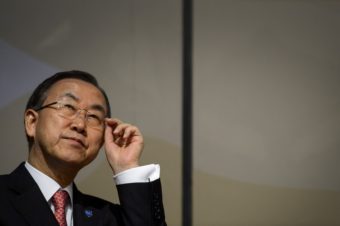
U.N. Secretary-General Ban Ki-moon. Fabrice Coffrini /AFP/Getty Images
The United Nations is launching an investigation into the possible use of chemical weapons in Syria.
U.N. Secretary-General Ban Ki-moon made the announcement during a media briefing on Thursday.
“I have decided to conduct a United Nations investigation into the possible use of chemical weapons in Syria,” Ban said according to Reuters. He said the investigation will focus on “the specific incident brought to my attention by the Syrian government.”
The use of chemical weapons is a big deal because the United States has declared that its “red line” in the conflict.
Obama also expressed doubt about claims made by the government of Bashar Assad. On Tuesday, Syria said rebels may have launched a chemical attack on the city of Aleppo. The rebels said the opposition was “not behind this attack.”
Obama said intelligence tells him it is the Syrian government that has the capability of launching such an attack.
Ban said the use of chemical weapons by any side would be “an outrageous crime.”
“There is much work to do and this will not happen overnight,” Ban said. “It is obviously a difficult mission. I intend for this investigation to start as soon as practically possible. Again my announcement should serve as an unequivocal reminder that the use of chemical weapons is a crime against humanity.”
Ban said the “overall mandate, mission composition, and operational conditions” of the investigation are still being worked out.
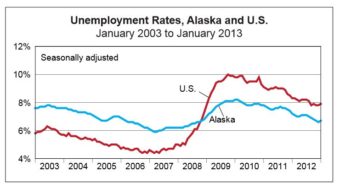
A chart comparing Alaska’s unemployment rate to the national rate. (Chart from Alaska Department of Labor and Workforce Development, Research and Analysis Section; and U.S. Bureau of Labor Statistics)
Alaska’s unemployment rate has been lower than the national rate for 51 straight months.
That’s a record and it’s the longest stretch since unemployment has been officially counted in Alaska. Alaska’s unemployment rate in January was 7.8 percent but when it’s seasonally adjusted it drops down to 6.7 percent.
Once again that’s well below the U.S. unemployment rate of 7.9 percent.
Caroline Schultz is an economist with the Alaska Department of Labor and Workforce Development. She and other observers are waiting for things to revert back to the way they used to be before the recession with Alaska’s unemployment rate being higher than the national rate.
Compared to January of 2010 the national unemployment rate has dropped by 1.9 percent while Alaska’s rate has dropped 1.5 percent. The region of Alaska with the highest unemployment rate is Southwest Alaska where the January rate was 14.6 percent. However, there were some areas in the Southwest region that saw big declines in unemployment in January. For instance the unemployment rate in the Aleutians West Census Area was 20 percent in December but in January it dropped down to 8.9 percent. In the Aleutians East Borough the unemployment rate dropped down from 29.2 percent in December to 12.9 percent in January. Schultz says that’s normal for this time of year.
The January unemployment rate in the Wade Hampton Census Area was 22.9 percent and it was 16 percent in the Bethel Census Area. The unemployment rate in the Dillingham Census Area was 11.9 percent, which was up from the 11 percent rate recorded in December. The Lake and Peninsula Borough posted an unemployment rate of 11.8 percent and it was 10.3 percent in the Bristol Bay Borough. Schultz says the unemployment numbers indicate healthy job markets in the population centers of Alaska.
A look around the state shows that the Kenai Peninsula Borough had a January unemployment rate of 9.8 percent and it was 7.1 percent in the Kodiak Island Borough. The highest rate in the state was the 25.4 percent in the Hoonah-Angoon Census Area and the lowest rate in the State was the 4.8 percent in the North Slope Borough.
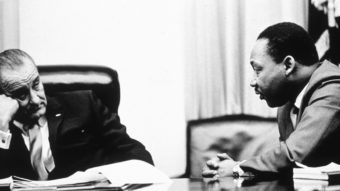
President Lyndon Johnson and civil rights leader Martin Luther King Jr. discuss the Voting Rights Act in 1965. On Wednesday, the Supreme Court hears arguments on whether a key part of the law is still needed nearly a half century after its passage. Hulton Archive/Getty Images
The U.S. Supreme Court hears arguments next week in a case that tests the constitutionality of the 1965 Voting Rights Act, the law considered the most effective civil rights statute in American history. At issue is whether a key provision of the statute has outlived its usefulness.
A staggering 49 friend of the court briefs have been filed, among them briefs from 11 states urging the court to either strike down or uphold the law. What is intriguing is that some of the states now arguing against the law were not troubled by its provisions just four years ago, the last time it was before the court.
In 2009, a small Texas utility district challenged the so-called preclearance section of the law, which requires nine states, most of them in the South, and parts of other states like California and New York, to get advance approval from the Justice Department or a federal court in Washington before changing any voting laws or regulations.
When the case got to the U.S. Supreme Court, only one state — Georgia — came out clearly against the law, claiming that the provision was unconstitutional. Alabama filed a brief echoing part but not all of Georgia’s arguments. Both emphasized that their respective states have changed dramatically since 1965, and asked the court to seriously consider the legality of the preclearance section, given its burden on covered states.
The Supreme Court in 2009 dodged the preclearance question, but the issue is back this year in a challenge brought by Shelby County, Ala. And this time seven states — Alabama, Alaska, Arizona, Georgia, South Carolina, South Dakota and Texas — are asking the court to strike down the law.
Of the seven, Arizona has made the most noticeable switch between 2009 and 2013. In 2009, Arizona joined a brief supporting the law, along with North Carolina, California, Louisiana, Mississippi and New York.
Back then, Arizona and the other states said that the preclearance section of the law was “not onerous,” and that indeed, preclearance had offered “some benefits,” for example, protecting them from expensive litigation. The states supporting the law said that although some of them had expressed initial resistance to the preclearance process when the Voting Rights Act was originally adopted, “by 2006 the process for seeking preclearance had become painless and routine.”
Today, however, Arizona is on the other side of the debate, saying something very different. The preclearance requirement, it now argues, is “arbitrary and burdensome,” and unconstitutional.
Arizona’s governor this time, as last, is Republican Jan Brewer. Though she was quite new to the job in 2009, she had previously held the job of Arizona secretary of state, the position that deals with elections.
Four other states — Alaska, Louisiana, South Carolina and Texas — also seem to have changed their tune since 2009. Back then, Louisiana supported the law, while Alaska, South Carolina and Texas were silent on the issue, taking no position. This time, Louisiana is silent, while Alaska, South Carolina and Texas are urging the Supreme Court to strike down the preclearance provision.
Among the states that are fully covered by the preclearance requirement, Mississippi seems to be the only one that has consistently supported the law. The state signed on to briefs in 2009 and again this year urging the Supreme Court to uphold the law.
New York, California and North Carolina — states that are only partially covered by the preclearance mandate — also have remained true to the positions they took four years ago. Like Mississippi, they are supporting the constitutionality of the law, declaring that it is not unduly burdensome.
U.S. Secretary of State John Kerry speaks to the press prior to talks with Japanese Foreign Minister Fumio Kishida at the State Department in Washington on Friday. Nicholas Kamm /AFP/Getty Images
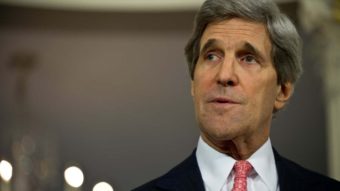
John Kerry sets off Sunday on his first foreign trip as secretary of state, visiting Europe and the Middle East.
One dominant theme of the trip will be how to resolve the crisis in Syria, where an estimated 70,000 people have been killed over the past two years. Kerry is portraying his trip as a listening tour, and he expects to hear a lot about Syria.
He told reporters recently that he wants to talk with U.S. allies about how to persuade Bashar Assad to agree on peace talks that would end the Syrian leader’s bloody rule in Syria.
“My goal is to see us change his calculation,” Kerry said. “My goal is to see us have a negotiated outcome and minimize the violence; it may not be possible.”
Kerry, however, needs to find out, says former State Department official Frederic Hof, now a senior fellow at the Rafik Hariri Middle East Center at the Atlantic Council.
“The primary purpose here, I think, is due diligence,” Hof says. “It’s to check an important box as to whether or not a peaceful, managed political transition in Syria, a negotiated process, is actually possible.”
This past week, Russian Foreign Minister Sergei Lavrov, along with the head of the Arab League, offered to broker talks between the Syrian government and the opposition.
Neither side can rely on a military solution to the conflict, Lavrov argues, because “that’s a road to nowhere, a road to mutual destruction of the people.”
Lavrov will meet Kerry in Berlin this week, and Kerry will likely use the opportunity to encourage Russia to once again use its influence with Assad. Kerry will also be visiting Rome, where he will have a chance to meet Syrian opposition figures. Hof says Moaz al-Khatib, the Syrian opposition council leader, has made clear he’s ready for negotiations.
“He asked for a major prisoner release, but he did not demand that Assad resign first,” Hof says. “This is potentially very significant. He took a big risk with his own followers who understandably want Assad gone up front.”
Hof has his doubts that this diplomatic effort will get very far, though, and if it doesn’t, he says, the Obama administration will have to think again about how to support the opposition, whether with arms or intelligence sharing.
“If [Kerry] comes to the conclusion that there’s [nothing] there, I suspect he will come back,” he says. “He’ll report to the president and he may well propose a significant readjustment of U.S. policy toward Syria and that might be the thing that could have the effect of changing Assad’s calculation.”
After visiting London, Berlin, Paris, Rome and Ankara, Kerry is to visit several Gulf states as well.
Aaron David Miller, the vice president of the Woodrow Wilson Center, says this is a relatively risk-free trip.
“It’s safe centrist and very secretarial,” Miller says.
Kerry does have one risky stop, Egypt, and experts will be watching how the new secretary deals with the struggling Islamist government there.
After more than five years of recession and painfully slow recovery, President Obama has sent a powerful signal that he thinks the U.S. economy is now in much better shape — good enough, at least, to provide workers with raises.
In his State of the Union address Tuesday night, Obama called upon Congress to boost the federal minimum wage to $9 an hour by 2015, up from the current $7.25. The wage would rise in steps, and after hitting the maximum in two years, would thereafter be indexed to inflation.
In the president’s first term, the unemployment rate was very high, peaking at 10 percent in October 2009. And during those four years, Obama never seriously pushed Congress for legislation to force employers to pay more.
Tuesday night, he changed direction, saying in his State of the Union speech that he wants Congress to drive up wages for millions of workers by forcing up the benchmark minimum wage. Even though only a relatively small percentage of workers make $7.25 an hour, that pay level serves as a wage floor for all workers. When it moves higher, other wages ratchet up too.
In other words, if Congress were to boost the minimum hourly wage, then a person currently making $9 likely could move up to $10 or even $11 an hour as employers adjusted pay scales to higher levels to compete for the better low-wage workers.
‘Honest Wages’
The White House says 15 million workers would benefit directly from a higher minimum wage, but many economists say that millions more would gain too after taking into account the ripple effect as the whole wage scale moves up.
“We know our economy is stronger when we reward an honest day’s work with honest wages,” Obama said. “But today, a full-time worker making the minimum wage earns $14,500 a year.”
He said that’s not enough money to keep a family above the poverty line. “Let’s declare that in the wealthiest nation on Earth, no one who works full time should have to live in poverty, and raise the federal minimum wage to $9 an hour. This single step would raise the incomes of millions of working families.”
The president’s focus on the minimum wage came as something of a surprise, even to longtime supporters of a pay increase. Sen. Amy Klobuchar, D-Minn., said in an interview Wednesday morning that while she agrees with the president, “I didn’t know he would bring it up.”
Given that the wage push was unexpected, she said she did not know how Democratic lawmakers might put together their strategy for getting the legislation passed. For many years, it had been Massachusetts Democratic Sen. Edward Kennedy who led congressional battles for higher wages. But with his death in August 2009 — one month after the last minimum wage hike took effect — supporters will need a new champion in Congress to marshal the troops.
Opponents already are gearing up for the fight. At a press conference this morning, House Speaker John Boehner, a Republican, made it clear he would work against minimum-wage legislation.
“When you raise the price of employment, guess what happens? You get less of it,” Boehner said. “At a time when the American people are still asking the question, ‘Where are the jobs?’ why would we want to make it harder for small employers to hire people?”
Congress last passed a bill establishing a series of minimum wage increases in 2007 — before the Great Recession began. The last of those increases took the pay up to $7.25, where it has remained frozen.
Higher Existing Minimums
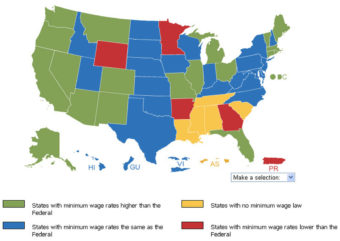
Nineteen states plus the District of Columbia have minimum wages above $7.25. For example, in Washington state, the pay is now up to $9.19 an hour — the highest minimum in the country. If the federal level were to rise, many of those 19 states would most likely pass new legislation to exceed it.
If the past is any indicator, business groups — particularly the National Restaurant Association — will put up a fierce fight to block any federal minimum wage increase.
Another group backed by the restaurant and hotel industries says an increase in the minimum wage can hurt the economy. “The President’s minimum wage hike ignores both simple economic logic as well as the overwhelming scholarly consensus on minimum wage hikes,” Michael Saltsman, research director of the Employment Policies Institute, said in a statement. The institute says research “points to a loss of job opportunities following a minimum wage hike.”
But many economists point to studies that show a higher minimum wage does little to hurt job creation. Instead, these economists argue that a higher wage reduces income inequality and puts more money into the hands of the consumers who can spend it. So, the argument goes, while a pizza-shop owner might have to spend more on his payroll under new wage legislation, he also would see a boost in revenues as customers find themselves enjoying bigger paydays.
A Hot-Button Issue
The minimum wage has been a hot-button issue with business groups since its introduction in 1938. They argue that a federal minimum wage is inflationary and represents an unnecessary government intervention in the labor market. They say labor supply and demand alone should set wages, not lawmakers.
Supporters disagree. They say inflation is very low, while income inequality is growing. Working people lack of spending power, and that’s what is inhibiting economic growth, the argument goes.
“We applaud the president for expressing support for raising the minimum wage and tying it to the cost of living,” Richard Trumka, president of the AFL-CIO, said in a statement on behalf of the labor organization. He said the economy is not suffering from high wages but rather from “wage stagnation and growing inequality.”
Between 2000 and 2010, U.S. median income fell 7 percent after adjusting for inflation, according to census data. Over the past year, the unemployment rate has hovered at or just below 8 percent.
A Military Police Officer with Alpha Company, 49th Missile Defense Battalion, conducts a hasty traffic control point on the Missile Defense Complex as part of the recent force protection exercise on Fort Greely, Alaska. The Soldiers participating in the exercise are able to train on this operational missile defense site and concurrently sustain real world mission operations. (Photo by Sgt. Jack W. Carlson III, 49th Missile Defense Battalion)
The U.S. Missile Defense Agency successfully tested an anti-missile warhead over the weekend. The test marked the first time in over two years that missiles like the ones at Fort Greely have been launched. It sets the stage for missile-defense contractor Boeing to conduct a full-scale test later this year.
Boeing spokeswoman Jessica Carlton says Saturday’s test of the ground-based interceptor rocket and its so-called “kill vehicle” that destroys incoming enemy missiles, was a smashing success – even though the test didn’t involve smashing a target in space, as it’s designed to do
“Getting back to flight testing has been the number-one priority for us,” she said, “and we’ve been working closely with our customers as well as our industry teammates to get to yesterday’s test.”
Missile Defense Agency officials declared the test successful because it proved the operability of a new-generation kill vehicle that is launched from the ground-based interceptor missile when it reaches outer space. The kill vehicle is designed to collide with and destroy an incoming enemy missile in space.
The missile defense base at Fort Greely is the hub of the nation’s Ground-based Midcourse missile-defense system. About 25 interceptor missiles are based at Greely.
The last time the system was tested, in December 2010, the kill vehicle malfunctioned and failed to intercept the dummy target missile. According to Bloomberg News, the $35 billion ground-based midcourse defense system hasn’t successfully intercepted a target missile since 2008. Bloomberg says the system has logged a 53 percent rate of success during several years of testing.
Carlton says even though testing had been suspended over the past couple of years, the system has remained up and running.
“Throughout our work, and throughout returning to flight, throughout the design solutions, GMD has always remained on alert,” she said. “This system is 24/7/365.”
Missile Defense officials say they’ll test the new and improved kill vehicle in upcoming testing involving a target missile later this year.
Bloomberg News says 10 of those missiles at Greely have been fitted with the new-generation kill vehicle that was successfully tested Saturday.
Close
Update notification options
Subscribe to notifications
Subscribe
Get notifications about news related to the topics you care about. You can unsubscribe anytime.