Nation & World

Pacific Commander: U.S. Can Intercept North Korean Missiles

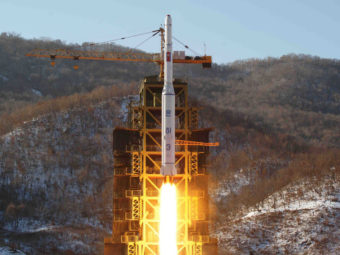
The launch of North Korea's Unha-3 rocket in December in a photo released by the official Korean Central News Agency (KCNA). AFP/Getty Images
The launch of North Korea’s Unha-3 rocket in December in a photo released by the official Korean Central News Agency (KCNA). AFP/Getty Images

The commander of the U.S. Pacific Command said Tuesday that American forces currently have the ability to intercept a North Korean ballistic missile.
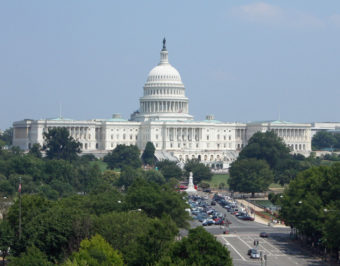
Adm. Samuel Locklear, speaking before the Senate Armed Services Committee, was asked by Sen. John McCain, R-Ariz., if the U.S. had the ability to intercept a North Korean missile launched “within the next several days.”

Locklear replied: “We do.”

McCain: “Would you recommend such action?”

“If [it] was in defense of the homeland, I would certainly recommend that action, and if it was in defense of our allies, I would recommend that action,” Locklear said.

In case of a North Korean launch, “we should have a sense of where it’s going to be aimed,” he added. “If we don’t, it doesn’t take long for us to determine where it’s going and where it’s going to land.”

He said that Pyongyang’s pursuit of nuclear weapons and long-range missiles was a clear threat to the United States and its allies in the Pacific, and that North Korean leader Kim Jong Un remained untested and unpredictable.

Copyright 2013 NPR. To see more, visit http://www.npr.org/.image

Read original article

Pacific Commander: U.S. Can Intercept North Korean Missiles

North Korea To Shut Jointly Run Factories, May Test Missile

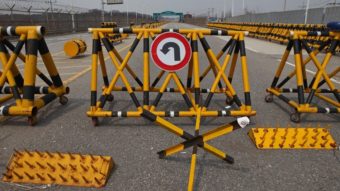
Do not enter: Barriers, including spikes, at the Military Demarcation Line (MDL) near the Demilitarized Zone (DMZ) in the Gyeonggi province, South Korea. Jeon Heon-kyun /EPA /LANDOV
Do not enter: Barriers, including spikes, at the Military Demarcation Line (MDL) near the Demilitarized Zone (DMZ) in the Gyeonggi province, South Korea.
Jeon Heon-kyun /EPA /LANDOV

Monday’s developments on the Korean Peninsula, where tensions have been running even higher than usual in recent weeks:
— North Korea says it is recalling workers from the Kaesong Industrial Complex, inside its territory, where tens of thousands of North Koreans produce products for South Korean companies. It plans to at least temporarily shut the operations there.

NPR’s Louisa Lim, who is monitoring developments from Beijing, says more than 50,000 North Koreans will be pulled out of the zone if Pyongyang follows through on that decision. Louisa tells our Newscast Desk that “a senior North Korean official says the zone had been reduced to a theater of confrontation, quite contrary to its original nature.”

She adds that it’s not clear what will happen to more than 400 South Koreans still in the zone.

— A South Korean official is warning the North may be setting the stage for another missile test. But, Louisa reports, Seoul is backing away from earlier statements that another nuclear test by the North may be imminent.

As The Associated Press writes, these reports come “amid weeks of North Korean war threats and other efforts to punish South Korea and the U.S. for ongoing joint military drills. North Korea is also angry over the U.S.-led push for U.N. sanctions over its Feb. 12 nuclear test.”

But, as Louisa also reported Monday on Morning Edition, some who have visited North Korea in recent weeks say there are few if any signs in Pyongyang that the North is on a war footing. Watch for more from her on that part of the story later today.


Read original article

North Korea To Shut Jointly Run Factories, May Test Missile

Former British Prime Minister Thatcher Dies

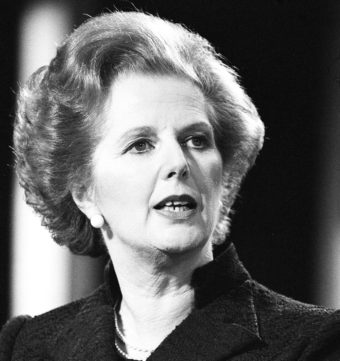
Prime Minister Margaret Thatcher in 1981. She died Monday, at the age of 87. PA Photos /Landov
Prime Minister Margaret Thatcher in 1981. She died Monday, at the age of 87.
PA Photos /Landov

Margaret Thatcher, who as British prime minister in the 1980s became known as the “Iron Lady” for her tough economic policies, her partnership with President Reagan in standing up to communism and the short war with Argentina over the Falklands, has died.

Her spokesman, Lord Bell, tells the British Press Association that Baroness Thatcher died Monday following a stroke. She was 87.

As NPR’s Jackie Northam reports:

“Thatcher’s long journey to becoming one of Britain’s most influential leaders began in humble surroundings. She was born on Oct. 13, 1925, in the small English town of Grantham. Her mother was a dressmaker, her father a grocer and a local politician.

“Thatcher often credited her father with introducing her to politics. She said he instilled in her the importance of being an independent thinker and of being able to stand on her own two feet — values that she expected from all Britons once she gained power.”

We’ll have more on Thatcher and her legacy as the day continues. Hit your refresh button to see our latest additions.

Update at 10 a.m. ET. How Her Popularity Changed:

On The Guardian‘s website there’s an interactive chart showing how Thatcher’s approval rating in Britain changed over the 11 years she was prime minister. She began her time in office with a rating just above 40 percent. It briefly topped 50 percent several times — most notably when British forces recaptured the Falklands in 1982. When she left 10 Downing St. in November 1990, her approval rating was in the mid-30s.

Update at 9:55 a.m. ET. Opinions Remain Deeply Divided In Northern Ireland:

As The Guardian notes, the leader of Northern Ireland’s Democratic Unionist party is calling Thatcher “one of the greatest political figures of post-war Britain.” And Peter Robinson adds that “whilst we disagreed over the Anglo-Irish Agreement, Mrs Thatcher was committed to the union and later described the Anglo-Irish Agreement as one of her greatest regrets.”

But Gerry Adams, president of Sinn Fein, said Monday that “working class communities were devastated in Britain because of her policies,” the Guardian adds.

Update at 9:25 a.m. ET. Second President Bush Calls Her “An Inspirational Leader”:

“She was an inspirational leader who stood on principle and guided her nation with confidence and clarity,” former President George W. Bush says in a statement released by his office. “Prime Minister Thatcher is a great example of strength and character, and a great ally who strengthened the special relationship between the United Kingdom and the United States.”

Update at 9:15 a.m. ET. Respect From The Opposition:

Ed Miliband, leader of Britain’s Labor Party (which stands in opposition to Thatcher’s Conservatives), says in a statement on his party’s website that Labor politicians “disagreed with much of what she did and she will always remain a controversial figure. But we can disagree and also greatly respect her political achievements and her personal strength. … She coped with her final, difficult years with dignity and courage. Critics and supporters will remember her in her prime.”

Thatcher, Miliband adds, “moved the center ground of British politics and was a huge figure on the world stage.”

Update at 9 a.m. ET. Remembering Her:

“Passionately opposed to communism, Thatcher’s close friendship and political alliance with President Ronald Reagan played an important part in setting the stage for the end of the Cold War,” NPR’s Philip Reeves tells our Newscast Desk from his base in London. “In Britain, she changed the face of the nation’s politics, though public opinion of her legacy is divided. A grocer’s daughter, she rose to become the nation’s first female prime minister. During that time she led her country into a controversial war with the Falklands, fought a ruthless battle against Britain’s powerful unions, and privatized state run businesses and social housing.”

Update at 8:50 a.m. ET. She “Transformed Her Time As Few Leaders Ever Have”:

In 1991, President George H.W. Bush presented Thatcher with America’s highest civilian award, the Medal of Freedom. Bush said of Thatcher, in part:

“It has been said that great leaders reflect their time. Margaret Thatcher did. She also transformed her time as few leaders ever have. Consider the 1980’s and early ’90s — a golden age of liberty. Remember what she meant and how she mattered. Hers was not merely among Britain’s finest hours. She helped mold perhaps democracy’s finest era. …

“Margaret Thatcher helped bring the cold war to an end, helped the human will outlast bayonets and barbed wire. She sailed freedom’s ship wherever it was imperiled. Prophet and crusader, idealist and realist, this heroic woman made history move her way.

“Prime Minister, there will always be an England, but there can never be another Margaret Thatcher. Thank you for all you’ve done.”

Update at 8:25 a.m. ET. Funeral Status “Same As Queen Mother And Princess Diana”:

An indication of how Thatcher will be honored — with a “ceremonial” funeral sure to attract leaders from around the world.

Update at 8:20 a.m. ET. Queen Is Saddened, Cameron Hails A “Great Leader”:

According to the BBC, Queen Elizabeth II “is sad to hear the news of the death of Baroness Thatcher and will send a private message of sympathy to the family, Buckingham Palace says.”

The current prime minister, David Cameron, says, “We’ve lost a great leader, a great Prime Minister and a great Briton.”

Update at 8:15 a.m. ET. “Dominant Figure”:

Thatcher was “the dominant figure of post-war British politics,” writes Nick Robinson, the BBC’s political editor. He adds, “Love her or loathe her, Margaret Thatcher shaped this country as few others did.”

On our Newscast this hour, NPR’s Philip Reeves said from London that Thatcher’s “legacy is immense. She will of course internationally be remembered for partnership with Ronald Reagan, her close ally, in bringing about the circumstances that led to the end of the Cold War. Domestically, in Britain, she was a controversial figure. She is an iconic figure for British conservatives — someone in the same stature as Winston Churchill. But for others in Britain she is still remembered for breaking the trade union movement. … She will be remembered here for her enormous impact on the country.”


Read original article

Former British Prime Minister Thatcher Dies

U.N. passes global arms treaty that faces opposition in Senate

The U.N. Global Arms Trade treaty took seven years to negotiate. It aims to block the sale of weapons to countries charged with crimes against humanity, prevent future genocide, and assure terrorists won’t get their hands on tanks, artillery and helicopters.

Scott Stedjan, senior policy adviser with Oxfam America, a group that supports the treaty, said the new rules would force arms dealers to weigh human rights equally with profit.

“It puts an end to what some call the body bag approach to international arms control,” he said Thursday. “That’s where countries wait until a situation becomes really bad, a situation like Syria right now, or previously in the Democratic Republic of Congo or Sudan, where the body bags have to pile really high before the international community does anything to stop arms flowing into those countries.”

Fifty countries will need to ratify the treaty. In the United States, only the Senate does so, and because of the magnitude of these treaties, they require 67 votes.
“Anything with UN on it is almost dead on arrival in the Senate,” said Mark Helmke, a longtime aide to former Senator Richard Lugar.

Lugar, a moderate Republican and two-time chair of the Foreign Relations Committee, lost a primary campaign last year.

Helmke said the administration knows there’s no chance of ratification in the Senate.

But it needs to make a show of support because it wants to distance itself from the three countries that voted against the treat: Iran, North Korea and Syria.

And in the Senate, opposing the treaty gives conservatives a chance to rile a base opposed to the United Nations.

“Every time a U.N. treaty comes up, the opposition raises a lot of money with a lot of phone calls, a lot of emails to people who somehow believe blue-helmeted people are going to come in and confiscate our guns,” Helmke said.

Helmke, who now teaches at Trine University in Indiana, said the Senate could use a Republican internationalist like his former boss to get colleagues on board.

Senator Lisa Murkowski, who declined an interview for this story, supports the separate U.N. Law of the Sea treaty. She’s tried unsuccessfully to recruit her fellow Republicans to support that cause.

But on this international agreement, she stands with her party in opposition. Senator Murkowski signed a letter to President Obama saying she worries the treaty will enforce international arms regulations on Americans.

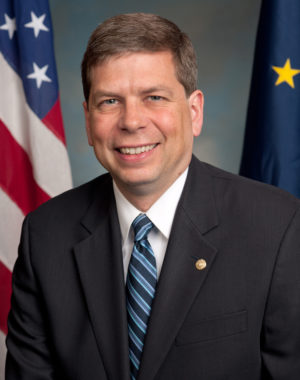
Senator Mark Begich is one of the few Democrats who signed that letter.

“It’s going to be a problem if can’t differentiate between domestic trade and international trade. That treaty melds it all together. Therefore it does infringe and jeopardize the Second Amendment rights of this country,” Begich said.

The National Rifle Association has maintained that argument as well.

Oxfam America’s Scott Stedjan said the treaty clearly lays out its boundaries, noting that the preamble states domestic regulations will be handled within the country.

“The treaty does not undermine the Second Amendment in anyway whatsoever,” he said. “The treaty is only about the cross border trade of armaments.”

Stedjan warned the treaty won’t become law for several years. Countries can begin signing onto the treaty in June, and then the ratification battle will begin.

There’s no indication whether Senate Majority Leader Harry Reid would bring the treaty to the floor before the next election in 2014.

Related

U.N. Approves Treaty To Regulate Multibillion-Dollar Global Arms Trade

See Original Story

U.N. Passes Global Arms Treaty That Faces Opposition in Senate

Outside group targets Begich on immigration

Mark Begich
Mark Begich. Official photo.

The group Numbers USA aims to “educate voters” in states with senators who could play a pivotal role in the coming immigration debate.

The group started airing an ad throughout Alaska this week that asks actors who “thinks Senator Mark Begich’s plan to bring in foreign workers to take American jobs is a good idea?”

Roy Beck, executive director of Numbers USA, said Senator Begich has been tight-lipped on immigration since arriving in the Senate four years ago, except on J-1 visas.

J-1 visas allow foreign students to work in Alaska for the summer with student status. Fish processors contend the industry needs foreign workers who are willing to work the hours and for the pay.

Beck said he doubts the need for J-1 visas.

“It is a sell out if he trades his vote and votes for the entire amnesty and this huge increase in foreign workers. Anytime you increase the number of foreign workers, you drive down the value of wages for the American workers,” he said Thursday afternoon.

A group of eight senators is crafting a comprehensive immigration reform package. It would create a path to citizenship for the 11 million or so immigrants living in the U.S. illegally, so long as they paid fines and back taxes.

Beck dismissed that as amnesty, but Senator Begich called it a step in the right direction.

He said the new ad is full of lies.

“I don’t support amnesty, and I don’t support giving Social Security to illegal immigrants,” he said in a Thursday phone interview. “So I don’t know what they’re talking about.”

But he did agree with Beck that his vote for an overall package depends on whether J-1 visa reform is included.

“We may want to get this done right, and it may hinge on that,” he said.

The Senate reconvenes from a two week recess on Monday. The group could introduce the legislation as early as next week. Most expect debate to begin in earnest in May.


See Original Post

Outside group targets Begich on immigration


North Korea Moves Missile, Threatens To Close Factories Used By South

On Thursday, a South Korean security guard kept watch as South Korean trucks waited to enter the Kaesong industrial complex in North Korea. For the second day, the North blocked the trucks and workers from the South from entering its territory. Kim Hong-ji /Reuters /Landov

Bear in mind that, as NPR’s Louisa Lim has said, North Korea’s regime is skilled at making threats. And fortunately, the most ominous of those threats have not been followed by action in recent decades.

With those caveats in mind, here are Thursday’s developments in the latest round of provocative moves by the communist state. From Beijing, Louisa tells our Newscast Desk that:

— South Korean Defense Minister Kim Kwan-jin says North Korea has moved a missile with considerable range to its east coast. Kim told the South Korean parliament Thursday that the North Korean missile is not capable of hitting the United States. He said the missile could have been moved for testing or for drills. So far, according to Kim, there’s no sign of military mobilizations that could suggest preparations for a full-scale conflict.

— North Korea has said it may shut down a joint industrial zone within its borders where companies from the South get some goods produced. And for a second day, South Koreans have been blocked from entering the Kaesong industrial zone.

Wednesday’s headlines included:

North Korea’s Brinksmanship: Same As Before, More Dangerous Or Both?

‘Best Jobs In North Korea’ Pay $62 A Month; Now They’re Diplomatic Pawns

Responding To North Korea, U.S. Sends Missile Defenses To Guam

Amid Threats, N. Korea’s Neighbors Rethink Defense Policies

image

Read original article

North Korea Moves Missile, Threatens To Close Factories Used By South

Site notifications
Update notification options
Subscribe to notifications