Nation & World

After Two Violent Days, Protesters In Turkey Return

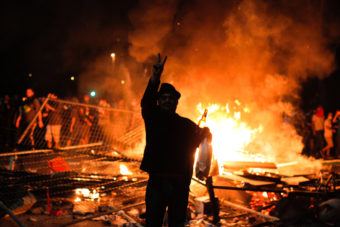
Protesters clash with riot police between Taksim and Besiktas in Istanbul, on Sunday. Gurcan Ozturk/AFP/Getty Images

This morning central Istanbul was quiet. It was still reeling from two days of anti-government rallies that led to violent confrontations with police. NPR’s Peter Kenyon reports from Turkey that some 900 people were arrested across the country and several hundred were wounded.

Peter said officials “are beginning to ask questions about who ordered the fierce police crackdown on peaceful demonstrators that triggered the massive anti-government reaction.”

Al Jazeera and Haaretz are live blogging the action today. Al Jazeera has posted stunning pictures of the aftermath. Haaretz reports that by around 1:30 p.m. local time, protesters began entering Taksim Square.

Haaretz reports:

“The protesters at Taksim Square represent all sectors of Turkish society. Though flags hanging from poles and walls of buildings around the plaza are mostly of left-wing radical groups, some protesters did not identify themselves as supporters of the left. Their only demand, they said, is democracy Despite the secular dominant majority, some of the demonstrators identified as Muslims. A few men with beards and women wearing veils said they identified as members of the “radical Muslims,” a religious organization that opposes [Prime Minister] Recep Tayyip Erdogan.”

As we’ve reported, these mass protests — what some are calling the biggest challenge to Prime Minister Recep Tayyip Erdogan — began as peaceful demonstrations opposing the redevelopment of a city park.

During the day, yesterday, the government took an unrelenting stance.

“The Taksim project will go ahead,” Erdogan said. “If you bring 100,000, I’ll bring out a million.”

Eventually, police retreated and protesters celebrated. The Telegraph reports that Erdogan sought a resolution. The paper reports:

“Speaking at a rally on Saturday, Erdogan acknowledged: ‘It is true that there have been some mistakes, extremism in police response.’

“But he added: ‘I call on the protesters to stop their demonstrations immediately.’

“The interior ministry promised legal action against police officers who had acted ‘disproportionately.'”

Protesters rejected those talks. “We are still ruled by a prime minister who thinks people are lambs and declares himself the sultan,” 19-year-old law student Batuhan Kantas told the Telegraph.

We’ll leave you with a video that’s made the rounds on the Internet. It sums up the last few days in 70 seconds:

The person who made it, Memento Mori, has some other great videos on his Vimeo page.

Copyright 2013 NPR. To see more, visit http://www.npr.org/.
Read original article
After Two Violent Days, Protesters In Turkey Return

UPDATE: Russian Missiles ‘Months Away’ From Delivery To Syria

Update at 7 a.m. ET, May 31:

Since we first posted about the reports of what Syrian President Bashar Assad said regarding the delivery to his military of Russian anti-aircraft missiles, new reports have surfaced:

— “Russian S-300 missiles unlikely to reach Syria for months.” (Reuters)

— “Assad interview fuels missile confusion.” (ABC News)

Our original post, from 10:40 a.m. ET May 30:

The latest news about the conflict in Syria includes word that:

— Missiles. Syrian President Bashar Assad has told Al-Manar TV, a channel owned by Lebanon’s Hezbollah, that the first shipment of Russian S-300 anti-aircraft missiles has arrived in Syria, The Guardian reports.

As we wrote Tuesday, “the European Union’s decision to end its embargo on arming the opposition in Syria has been followed by sharp criticism from Russia’s foreign ministry and word that Russia will follow through on plans to deliver anti-aircraft missiles to President Bashar Assad’s military.”

— Talks. “Syria’s opposition will not participate in proposed international peace talks in Geneva next month, its leader has said.” That report from al-Jazeera adds that “George Sabra, the head of the Syrian National Coalition (SNC), on Thursday said the opposition was suspending their participation until the international community intervened to end the siege in Qusayr, a town in Homs province near the Lebanese border.”

Meanwhile, according to Reuters, “Russian, U.S. and U.N. officials will meet next week to discuss ways to bring the warring sides in Syria together for a peace conference, Russian news agencies quoted a Foreign Ministry official as saying on Thursday. ‘Preparations for the international conference on Syria will be discussed’ at the three-way meeting in Geneva on June 5, Interfax quoted the unidentified Russian ministry source as saying.”

Copyright 2013 NPR. To see more, visit http://www.npr.org/.
Read original article
Assad Says Russian Missiles Have Arrived in Syria

Report: An Angry Russia Will Deliver Missiles To Syria

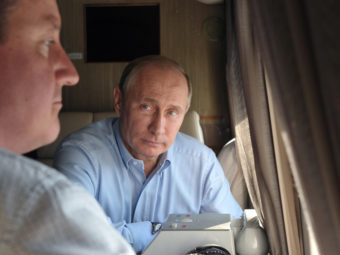
Russian President Vladimir Putin (right) and British Prime Minister David Cameron met earlier this month. Cameron said then that he was encouraged by Russia's willingness to take part in a peace conference on Syria. Now, Russia is said to be angry about the EU's decision to lift an embargo on arming the Syrian opposition. Alexey Nikoksky /AFP/Getty Images
Russian President Vladimir Putin (right) and British Prime Minister David Cameron met earlier this month. Cameron said then that he was encouraged by Russia’s willingness to take part in a peace conference on Syria. Now, Russia is said to be angry about the EU’s decision to lift an embargo on arming the Syrian opposition. Alexey Nikoksky /AFP/Getty Images

The European Union’s decision to end its embargo on arming the opposition in Syria has been followed by sharp criticism from Russia’s foreign ministry and word that Russia will follow through on plans to deliver anti-aircraft missiles to President Bashar Assad’s military.
According to the BBC, “Deputy Foreign Minister Sergei Ryabkov said the [Russian] missiles were a ‘stabilizing factor’ that could dissuade ‘some hotheads’ from entering the conflict.”

Russia has been one of Assad’s few foreign friends since the start of protests against the Syrian president’s regime in March 2011 and during the sectarian civil war that has followed. As NPR’s Corey Flintoff reports from Moscow, Russia says the weapons it has delivered and the missiles it will be sending are part of arms deals that were signed before the conflict began.

From London, NPR’s Philip Reeves says that Russian diplomats believe the EU’s decision undermines the chances of a possible peace conference aimed at ending Syria’s civil war. From Moscow, Corey adds that “Russia’s foreign ministry acted as if the Europeans were sabotaging Russian and U.S. efforts to bring the warring parties to the bargaining table.”

Just two weeks ago, British Prime Minister David Cameron was hailing Russia’s agreement to take part in such peace talks. That was “a real breakthrough,” Cameron said.

Though EU ministers have agreed to end their nations’ embargo on arming the Syrian opposition, British Foreign Secretary William Hague said Monday that his nation has “no immediate plans to send arms to Syria.” The Associated Press adds that “no other EU member appeared to have immediate plans to send arms to the rebels.”

Related:

In Damascus, A View Of Syria’s War Turned Inside Out.

McCain Meets With Rebels In Syria.

Copyright 2013 NPR. To see more, visit http://www.npr.org/.image

Arctic council adds six observer seats

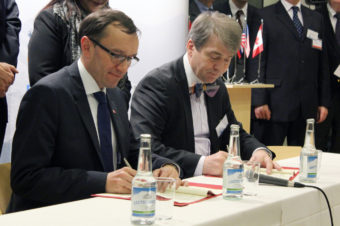
Host Country Agreement Signing Ceremony January 2013
Host Country Agreement Signing Ceremony January 2013 (Photo courtesy The Arctic Council)

The Arctic Council – the association of the world’s polar countries – has agreed to grant observer status to six non-Arctic nations.
Some people fear the countries are trying to secure long-term commercial interests.

The Arctic Council will now allow China, Japan, South Korea, Singapore, India and Italy observer status.

U.S. Senator Lisa Murkowski attended the biennial Arctic Council Ministerial this week in Kiruna, Sweden. She says the new observer countries will not vote on policies and agreements, but they will have a voice in negotiations.

“It allows you to be in the discussions, to help formulate the papers that will be reviews,” Murkowski said. “It is more than allowing you to sit in a room with a credential pass around your neck.”

Voting on new partnerships, like the one on oil spill prevention agreed to this week, remains in the hands of the eight polar countries.

And alongside those are six permanent participants – groups representing Arctic natives.

Charlie Ebinger directs the Energy Security Initiative at the left-leaning Brookings Institution. He says people are justifiably concerned that these new countries are using observer status as a stepping stone.

“Obviously those countries want observer status because they believe they have long term commercial interests,” Ebinger said. “The Chinese have interest in mineral deposits in Greenland, both rare earths and uranium.”

And it’s not just mining the countries are interested in. James Collins is a former ambassador to Russia. He says the Arctic is still an emerging market, and more resources will become available as climate change opens the ocean.

“There’s shipping, there’s energy, there’s resource extraction,” Collins said. “And exactly which companies are going to actively pursue those is only beginning to be defined.”

Canada takes over the chair of the Arctic Council this week. And the United States follows suit, so for the next four years, the chair will be in North American control.

Luke Coffey is a fellow at the conservative Heritage Foundation, and he says it’s a good sign of U.S. involvement that both Secretary of State John Kerry, and his predecessor, Hillary Clinton, attended the Arctic Council meetings. They are the first two Secretaries of State to do so.

But it should not stop there. He says the United States should start to consider a diplomatic post to handle Arctic negotiations.

“For the U.S. to show they are serious about the Arctic it needs to be at a very senior level, which very well may mean a more senior level than ambassador,” Coffey said.

Coffey suggests a deputy secretary of state for the Arctic. Both Senator Murkowski and Senator Mark Begich have called for an Arctic ambassador. Senator Murkowski says the administration does not support the position.

As for the expanding council, Senator Murkowski says the observer issue is resolved after it dominated much of this week’s gathering.

She says no countries will be added to the list of observer states, nor will the European Union, which is seeking the designation.

Still, there are major global players located far from the north that will now have a hand in Arctic policy.

“There’s a lot of discussion about ‘well what do you think their motives are?’ I look at it and say they see that the Arctic is filled with opportunity and promise. Things are happening up there. They want to know what’s going on. They want to be on the inside,” Murkowski said.

She says a country’s observer status is up for review every four years, though she acknowledges no country has lost it since the Arctic Council formed in 1996.

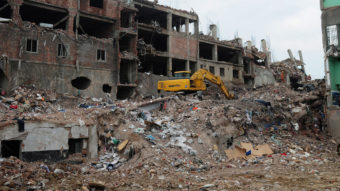
Death Toll Tops 800 In Bangladesh Factory Collapse

Bangladeshi rescue and army personnel on Wednesday continue recovery operations at the site of the building collapse near Dhaka. Munir Uz Zaman/AFP/Getty Images

Authorities in Bangladesh say the death toll in last month’s collapse of an eight-story garment factory complex has surpassed 800 as dozens more bodies were pulled from the rubble on Wednesday.

The latest corpses to be recovered were so badly decomposed that they were being sent to a lab for DNA identification, police said, according to The Associated Press.

Several people, including the building’s owner, have been arrested in connection with the disaster, which many survivors say was due to negligence.

The April 24 collapse of Rana Plaza, where apparel was made for several Western retailers, has sparked an international outcry over substandard working conditions in Bangladesh, where workers have some of the lowest wages in the world and the garment industry is largely unregulated.

On Wednesday, a European Union delegation was dispatched to the country to urge the government to “act immediately” to improve working conditions, the AP says.

The BBC says:

“Officials say about 2,500 people were injured in the collapse and that 2,437 people have been rescued.

“Bangladesh has shut down 18 garment plants for safety reasons since the Rana Plaza disaster, the Bangladeshi textile minister has confirmed.”

Copyright 2013 NPR. To see more, visit http://www.npr.org/.image

Read original article

Death Toll Tops 800 In Bangladesh Factory Collapse

Obama Says U.S. And South Korea Stand Firm Against Pyongyang

President Obama and South Korean President Park Geun-hye after a news conference at the White House on Tuesday. Saul Loeb/AFP/Getty Images

President Obama says the United States and South Korea are determined to stand firm against North Korean threats and that the days of Pyongyang manufacturing a crisis to get international concessions “are over.”

In a joint news conference with South Korean President Park Geun-hye on Tuesday, Obama said the two leaders “very much share the view that we are going to maintain a strong deterrent” against North Korea.

“We’re not going to reward provocative behavior, but we remain open to the prospect of North Korea taking a peaceful path,” he said.

“So far, at least, we haven’t seen actions on the part of the North Koreans that would indicate they’re prepared to move in a different direction,” he added.

He said he’s never spoken directly to North Korean leader Kim Jong Un, whose actions seem to be leading his country to a dead end.

Obama’s talks with newly installed President Park show that the North has “failed again” to drive a wedge between Washington and Seoul, he said.

The president spoke of the “deep friendship” and the “great alliance” between the two countries.

Park’s visit, her first abroad since becoming president in February, marks the 60th anniversary of the U.S.-South Korean alliance and comes amid ramped up rhetoric from North Korea, including threats to attack South Korea and the United States with nuclear missiles.

As we reported Monday, however, North Korea appears to have moved two medium-range missiles off launch standby in the country’s east — a move that could signal a toning down of tensions.

Copyright 2013 NPR. To see more, visit http://www.npr.org/.image

Read original article

Obama Says U.S. And South Korea Stand Firm Against Pyongyang

Site notifications
Update notification options
Subscribe to notifications