Nation & World

Marriage equality and mourning: Mildred Boesser fought till the end

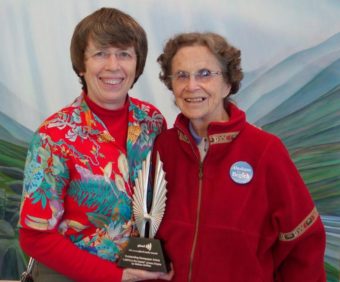
Sara Boesser and Mildred Boesser in September, 2014. (Photo by Melissa Griffiths)

When the Supreme Court legalized same sex marriage nationwide last week, President Obama called the ruling “a consequence of the countless small acts of courage of millions of people across decades who stood up.”

Mildred Boesser stood 5 feet tall, and she was one of those people. On the day of the ruling, Boesser was on her deathbed at home in Juneau, surrounded by family.

“Friday she was still up and in the chair and talking and holding court and doing well,” says Sara Boesser, Mildred’s daughter. “But she was ready to go and she said, ‘Why am I still here? Why am I still here? I am ready.’ And then the Supreme Court ruling came through and she said, ‘That’s why I’m still here,’ and she was so happy.”

The wife of an Episcopalian minister, Mildred spent decades fighting for gay rights and marriage equality. Just last year, she testified to the legislature in support of a bill that would prohibit discrimination based on sexual orientation or gender identity.
“For the record, I’m 88 years old. I’ve lived in Alaska since 1959. I’ve been married for 65 years to the same man and together we’ve raised four children. I’m also a Christian and my faith informs what I do,” Mildred said. “I can’t begin to tell you how saddened I am by the fact that in this great state I love so dearly, a person can be fired legally from a job, evicted from housing, denied credit or financing simply because of whom they happen to love.”

Mildred’s advocacy work stemmed from her daughter Sara.

Sara recounts her mother visiting her while she was a senior at the University of Washington in Seattle. It was the early 1970s.

“I was working at a bookstore called Madwomen Bookstore downtown and it had a lot of feminist and progressive and some lesbian books,” Sara says.

As they were leaving the store, Sara decided at that moment to tell her mother:

“At the crosswalk, light hit green and we started across the crosswalk. I said, ‘Mom, did you know that I’m a lesbian?’ She kind of kept going and she looked at me and said, ‘No, but I’m glad you told me, but that doesn’t change anything about what I feel for you.’ And we got across the crosswalk.”

Throughout the years, Mildred spoke up in the State Capitol Building, in city halls across Alaska and knocked on doors in support of gay rights. Sara says her mother never missed an opportunity to testify in the Capitol, even when Sara herself was discouraged.

“At some point it became too difficult for me to go back to those same legislators and tell them again that we are no threat. I couldn’t do it anymore,” Sara says. “And my mother still would. She wouldn’t even sometimes tell me she’d done it and then I read about it in the paper and think, ‘Wow, way to go Mildred.’”

Liz Dodd is a close family friend. She worked alongside Mildred in 1998 against the state constitutional amendment that defined marriage as between a man and a woman. Dodd says the hearings were antagonistic and she recalls times when lawmakers were rude.

“You would have this bank of legislators sitting around their little dais there and little Mildred at the table in front of them, soft spoken, just preaching love basically,” Dodd says.

Sara Boesser was honored to be Mildred’s daughter.

“People would stop me on the street always and say, ‘I love your mother. She’s my surrogate mother. She’s my grandmother. She’s a mother to us all.’ I was always very proud of her,” Sara says.

The respect was mutual, says Dodd. Dodd recounts her last conversation with Mildred.

“She started to talk about Sara and how Sara was her hero and how Sara inspired her and made her stronger,” Dodd says. “And she said, ‘I had brought this person into the world and then all through the years, I’ve watched her in absolute amazement at who she is.'”

Sara Boesser and her partner Juanita Reese recently got engaged. (Photo by Lisa Phu/KTOO)

After the Supreme Court ruling, Sara announced to her mother and father that she and her partner of four years are getting married.

“The last day that she was alive, she said, ‘I’m sorry I’m going to miss your wedding.’ I said, ‘Oh, don’t worry mom. You’re my first invitee and you’re going to be there with us, don’t you worry,'” Sara says.

Mildred Boesser passed away at age 90 on June 29, 2015. She is survived by her husband Mark, her four daughters and countless others who considered Mildred their mother.

Federal spending bill fully funds tribal healthcare’s contract support costs

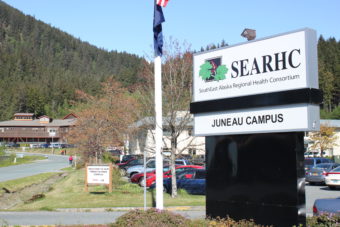
SEARHC serves from about 17,000 Alaska Natives and American Indians in Southeast Alaska. (Photo by Lisa Phu/KTOO)

A spending bill advancing in the U.S. Senate includes full funding for Alaska Native health care providers’ contract support costs, an area of Native health care that’s been underfunded even though the Supreme Court has repeatedly ruled in favor of tribes. Those costs include items like legal and accounting fees, insurance and workers’ compensation. Contract support costs were fully funded for the first time in 2014.

Sen. Lisa Murkowski chairs the appropriations subcommittee that wrote the bill. She says the spending plan fences off funding for contract support to prevent the government from taking from other programs, which has happened in the past.

“They basically dipped into existing Indian programs, shortchanging them. That’s not how to do it. You don’t rob Peter to pay Paul. What we’ve done is put in a separate appropriations account that will prevent this cycle that’s occurred at the IHS,” said Murkowski.

Contract support costs have been the subject of lawsuits and recently brought multimillion dollar settlements to tribal health care groups for overdue reimbursement. Murkowski says the new bill provides clarity.

“That’s significant. It’s significant in that the assurance going forward, full support for contract support costs, is going to be there and there’s not going to be a shortage in other accounts to pay for that full coverage,” said Murkowski.

The bill would also provide the first federal funds for tribal courts in so-called PL 280 states, which includes Alaska Native villages and states in which the state government has extensive criminal and civil jurisdiction in Indian Country. The bill has $10 million for tribal law enforcement and justice pilot projects.

“That will help insofar as how we deal with these perpetrators who seemingly time and time again inflict this level of violence and basically get away with it. Because we have not been able to collect evidence, prosecute and bring to some level of justice those offenders,” said Murkowski.

The Senate Appropriations Committee approved the bill earlier this month. It still must advance though the full Senate, which is in the midst of a larger budget gridlock.

Tlingit and Haida boycotts FedEx over Redskins support

Washington Redskins training camp. (Creative Commons photo by Keith Allison)

Central Council Tlingit Haida Indian Tribes of Alaska is boycotting FedEx.

The Juneau-based tribal organization announced Thursday that it has sent notice to all employees to stop using FedEx services, citing the national delivery company’s sponsorship of the Washington Redskins football team.
In a news release, Central Council says FedEx is a top sponsor of the football team, and economic pressure might encourage the delivery service to reconsider financial support of the Washington, D.C.-based team.

The issue is the team’s name. The word “redskins” dates back to colonial times, and refers to Native Americans. It is considered offensive by many with Native heritage.

Tlingit Haida Central Council President Richard Peterson says he understands that the team name has a long history.

“There’s debate even among Native Americans on whether it’s derogatory,” he said. “But I think most people feel like the name Redskins is derivative of racial slurs against Native Americans.”

According to the Central Council, other tribes and tribal groups also are boycotting FedEx, including the Native American Rights Fund and National Congress of American Indians.

Central Council Tlingit Haida is a federally recognized tribe with a membership of about 30,000, and Peterson says he hopes the membership will join tribal employees in the boycott.

“Who better to take a stand and to exercise our concerns and voice that through our spending?” he said. “Just saying, we’re not going to spend our dollars with folks that are going to be supportive of what we consider racism.”

Peterson stressed that this move isn’t an attack on FedEx or the Washington Redskins.

“We would just ask that they really take a look at what they’re doing,” he said. “If I’m doing anything that has a negative impact on people, I would certainly take a look at that and do some self-examination. I’d hope that the ownership of the Redskins would do that, and the corporate sponsors that endorse them would realize it’s time to take down our Confederate flag, so to speak.”

A message sent to FedEx public relations resulted in a written email statement. It says “FedEx has closely followed the dialogue and difference of opinion regarding the Washington Redskins team name, but we continue to direct questions about the name to the franchise owner.”

Alaskans rejoice same-sex marriage ruling as Leman laments

 (Photo by Mel Green)
The Supreme Court declared same-sex marriage legal in all 50 states. (Photo by Mel Green)

In a 5-4 vote, the Supreme Court on Friday declared same-sex marriage legal in all 50 states. That means the status quo will remain in Alaska, where same-sex marriage was legalized in October.

But for Juneau raised performing artist Seneca Harper, the decision changes how he will feel while traveling in the Lower 48. He married his partner last year in Washington.

“It’s going to be nice to be able to visit more conservative areas of the country and say , ‘Oh I’m sorry, oh actually, I’m not sorry at all,’ and to unapologetically exist as who I am with my husband and hold his hand that has a ring on it and be proud of that,” Harper says.

Joshua Decker is the executive director of the American Civil Liberties Union of Alaska. The ACLU led the first marriage equality case back in 1970 and they were plaintiffs in the Supreme Court case. He says the decision affirms that same-sex relationships need to be respected everywhere in the nation.

“We think when you look back on today in the future, today’s U.S. Supreme Court decision is going to be right up there with Brown v. the Board of Ed when the U.S. Supreme Court struck down segregation in the schools,” Decker says.

Former Lt. Gov. and state lawmaker Loren Leman says including Friday’s decision as a win for the civil rights movement is demeaning to minority groups, like black people and Alaska Natives, who he says, really needed civil rights protections.

As a senator, Leman led the 1998 effort to amend the Alaska Constitution to define marriage as between a man and a woman.

“I believe it was so important for Alaska to protect its definition of marriage, which was in statute, but to protect it in constitution,” Leman says. “Marriage has always throughout history been a union of a man and a woman and to change the definition to something else is a diminishment of the institution of marriage.”

In 1998, almost 70 percent of Alaska voters agreed with Leman. Pollsters found public opinion swinging for the first time in favor of same-sex marriage in 2014.

Juneau Republican Rep. Cathy Muñoz sponsored a bill last session that would prohibit discrimination based on sexual orientation or gender identity. She sees marriage equality as a step forward.

“It recognizes a basic right and I think that’s important. It’s progress,” Muñoz says. “I know that a number of people in our community will benefit and as a matter of fact, I look forward to attending a wedding in August and now that this decision has happened, I think they can have much more to celebrate.”

But there’s more work to do. Muñoz’s anti-discrimination bill wasn’t heard this year, but she hopes it’ll get a fair chance in the 2016 legislative session.

Alaska pastor’s missionary trip to Nepal becomes relief effort

Kathmandu, Nepal after a 7.8 magnitude eartquake in April. (Creative Commons photo by UK Department for International Development)

Last month, a magnitude 7.8 earthquake caused massive destruction and killed more than 8,000 people in Nepal. For one Upper Susitna Valley pastor, the timing meant that his planned mission trip turned into a relief effort.

Mike Sloan is the pastor at the Church on the Rock in Sunshine, Alaska.  On April 25th, Sloan and his group were on a plane from Bangkok to Kathmandu when the earthquake struck.

“We were just on our descent from Bangkok into the landing approach to Kathmandu Airport when they pulled up again and circled for an hour, and the pilot came on and said there had been an earthquake and the airport was closed,” Sloan said.

Sloan and the other men were traveling to Nepal for an eight day trek to a remote village.  After their flight returned to Bangkok, they waited overnight before being able to complete the journey to Kathmandu.  Once there, the eight day trek was cut in half, and they turned their efforts to helping villagers who lost their homes to the devastating earthquake.

“We pooled as much money as we could among the team, and the biggest concern became shelters, tents, and food. And so, that’s what we put our money into to get out to villages,” he said.

Sloan says that a large international effort began quickly to help the people of Nepal, but that much of the focus was on Kathmandu, the country’s largest city.  Sloan and his companions were able to pool together about $9,000, which they used to buy hundreds of tents and large bags of rice. He says that many of those who lost their homes in the villages also lost their stored food.

“Out in the villages, it’s between crops, and what happens is they store all the food they harvested in their houses, which all collapsed.  So, that means they lost all their food,” Sloan said.

On top of that, Mike Sloan says monsoon season is coming, which will mean constant rainfall for most of the time from June to September.  While houses in Nepalese villages tend to be simple structures built from mud and brick, Sloan says the subsistence lifestyle of many villagers means they don’t have time right now to try to rebuild.

“Right now is their monsoon time, coming, which means they’re planting, mostly corn right now. And that corn has to be planted and going before the rains hit, so they just don’t have a lot of spare time,” Sloan said.

Once the supplies were purchased, they had to be delivered.  Sloan says he and his companions partnered with local church leaders in two villages to get the supplies out.

“With those tents and rice, we were able to go to two different villages,” Sloan said. “One you could drive to, near the Tibetan border, and another we had to hire 50 to 60 porters to pack out the rice.”

The porters spent three days on the trail to reach the remote village. Sloan says the efforts of local church leaders helped greatly with making sure the food and tents got to those who needed them.

“When you work with the faith community, like the Nepali churches, a hundred percent goes in and a hundred percent goes out, just like us.”

Sloan, who lived in Nepal as an aid worker in the past, says that working through the government’s layers of bureaucracy can be frustrating.

“When you get all this money coming in, it ends up getting eaten up by this bureaucratic mess, and very [little] goes out.  That’s just the way it is, and Haiti was that way, and that’s the way this one—and these governments are very, basically, corrupt.”

For that reason, Mike Sloan says he will continue to work through the faith community.  He says efforts are continuing to raise funds locally to send to villages in Nepal.  Currently, the fundraising efforts have yielded between $8,000 and $9,000.  Sloan says he will continue his annual trips to the country, and plans an additional visit later this year.

Tlingit-Haida pushes for larger tribal role in U.N.

Tlingit-Haida Central Council's Will Micklin attends the United Nation's World Conference on Indigenous Peoples Sept. 22, 2014..
Tlingit-Haida Central Council’s Will Micklin attends the United Nation’s World Conference on Indigenous Peoples Sept. 22, 2014.. (Photo courtesy Indianz.com)

Alaska’s largest tribal government has joined an international effort to boost Native influence in the United Nations.

The Juneau-based Central Council of Tlingit and Haida Indian Tribes of Alaska wants a larger forum to address its concerns.

The U.N. has focused attention on indigenous issues in recent years, such as returning artifacts to tribes and preventing violence against women.

Jacqueline Johnson-Pata is executive director of the National Congress of American Indians, as well as part of the central council’s leadership.

She told a recent tribal assembly that a more formal arrangement is needed.

“Tribes and governments, elected representatives of indigenous nations, should have a voice in the United Nations. We shouldn’t just go as an organization. But we should go as a representative government,” she says.

Central Council First Vice President Will Micklin agrees.

“We are a nation with longstanding international relations with other countries and have issues that cross boundaries,” he says.

Micklin is also CEO for an Indian band near San Diego and executive director of the California Association of Tribal Governments. He’s a strong advocate of United Nations involvement.

“The only way to address these issues like climate change, like water resources, like fisheries, like the environmental impacts of extractive industries is to engage in the international arena,” he says.

The 30,000-member central council is part of a nationwide movement pursuing increased involvement in the United Nations. It’s been active for several years.

Micklin says the effort stems from the U.N.’s 2007 Declaration on the Rights of Indigenous Peoples, which also targets discrimination and human-rights violations.

un-declaration-poster“We envision and have proposed to the secretary general all rights and privileges for indigenous governments the same as a member state,” he says.

That would put tribal members on committees and allow them to submit reports.

“The only distinction is we would not be able to vote as a member state in the general assembly,” he says.

He says tribal governments have met with U.N. and federal officials, and they’ve found support.

Terry Sloan is director of the New Mexico-based group Southwest Native Cultures. The Navajo-Hopi, who already serves on United Nations committees, says more outreach is needed.

“What’s happening is that a lot of the tribes aren’t fully aware of this declaration, what it means and what it contains. So there is going to be some sort of an educational process throughout the country,” he says.

He also says many indigenous groups outside the U.S. aren’t aware of the effort. Many have faced violence when attempting any form of organization.

Sloan just returned from a meeting following up on the U.N.’s World Conference on Indigenous Peoples.

He says there was no consensus and years could go by before formal recognition happens. But he remains optimistic.

“When and if and how long it takes to get the implementation process through, we will see great gains for the Native Americans of the United States,” he says.

Sloan says despite differences, the Obama administration is very supportive of the U.N. effort.

He says the U.S. could become a model for other countries’ tribal government roles in the international organization.

Site notifications
Update notification options
Subscribe to notifications