Nation & World

Barefoot pastor raising money to buy shoes for people in developing countries

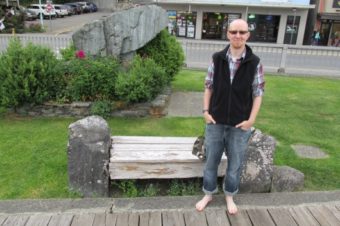
Peter Epler, a pastor at Ketchikan Church of the Nazarene, is going barefoot for a month to raise awareness of the need for shoes in third-world countries. (Photo by Leila Kheiry/KRBD)

A Ketchikan minister is going barefoot for a month, in hopes of raising awareness of the need for shoes among the world’s poor.

While only part way through his monthlong project, Peter Epler has gotten a feel – so to speak – for what many people deal with all the time.

Epler’s bare feet are a little weird in downtown Ketchikan. Most people here and in developed countries around the world don’t think twice about wearing shoes, beyond which pair matches which outfit.

Some places, though, there’s a shortage of affordable shoes, which can be a health and safety hazard.

“(People) walk through dirt roads, sewer systems, manure, sharp rocks,” he said. “Children get cuts on their feet and infections because of what they walk through, so they can lose their feet or die from the infection. So, shoes tend to save lives in third-world countries.”

Epler is a pastor at Ketchikan’s Church of the Nazarene. That church and other Nazarene churches in Alaska are working together to raise money for an international charity that provides special shoes for children in developing countries.

The group is called Because International, and the shoes they provide are made to last five years.

“They grow five sizes in five years, so roughly kindergarten through fifth grade,” he said. “And they’re working on a second pair that will take them up to ninth grade.”

And will they actually last five years?

“Yeah, they’ll last five years,” he said. “The rubber on the bottom is made from the rubber you make street tires from. And then they used high-quality leather and industrial snaps. So, these things are very sturdy … This is the final product they put out. They’ve been working on it for years.”

Many churches involved in the campaign are raising money through their congregations. Epler is taking it a little further in hopes of involving more community members. So, to raise awareness, he’s pledged to go without shoes for a month.
About a week into it, Epler has had some new-to-him tactile experiences.

“I’ve got a blog that I’m kind of keeping track of my own experiences: Things I’ve stepped in that you take for granted with shoes,” he said. “I’ve stepped in unidentifiable wet substances on a hot, sunny day, I’ve stepped in dog poop. I’ve stepped in gum. That was not my favorite. There was a sticky, warm quality to it that was distasteful.”

The point of going barefoot is to attract attention, and hopefully engage people in conversation. Then Epler can talk about the campaign and hand out cards with information about how to donate.

Sometimes it works. Sometimes, not so much.

“Most people give me the once-over stare, like ‘Who’s the crazy guy without the shoes?’” he said.

That was the case as Epler and I walked through downtown Ketchikan. He received a lot of furtive glances.

“Yeah, the glances go from head to toe and they kind of linger, and they look away,” he said. “I tend to wait until someone leans a little in for the conversation before I’m like, ‘Here’s the card and information,’ because I don’t want to creep people out. It’s enough that I’m the barefoot guy.”

Epler said the campaign is, indeed, raising money, although it’s difficult to say how much in total. People in his church have given about $600, but the cards he’s handing out direct people to not only the church’s webpage, but also to Because International’s main site. He said that’s a way to reach more people.

“Some folks might not be religious and might not feel comfortable donating through a church and that’s fine,” he said. “They can still go to theshoesthatgrow.org and donate. “

Epler isn’t the only one going barefoot for the cause. He said a few other people in his church, adults and children are spreading the word, too.

“I think children are the key to this,” he said. “They can relate very much to other children and they have this unashamed ability to buy into an idea and advertise it quite well, because they’re bolder. They can do a lot of good. Children can make a lot of difference. And because this project is for children, I think getting children involved is the best way to go.”

With several weeks left in the campaign, Epler predicts his feet will become sturdier. And, so far, it’s not been a bad experience.

“I’m feeling more connected to the world around me, which I didn’t expect: sticky things, smooth things, soft things, temperature changes, from going inside to outside. These are things I was completely unaware of before,” he said.

So, Epler’s barefoot campaign is raising a different kind of awareness for himself, along with helping the public learn more about a global need.

Cleaning Alaska’s remote beaches, one piece of debris at a time

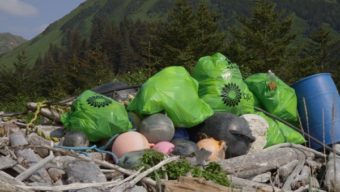
“Super-sacks” await pickup on Montague Island. (Photo by Hanna Craig/Alaska Public Media)

Big, white plastic bags called “super-sacks” line a beach on Montague Island in Prince William Sound. The sacks are filled with marine debris like fishing nets, water bottles and Styrofoam. This summer, the team from Gulf of Alaska Keeper has spent 50 days on Montague so far collecting the debris, as part of a multi-year effort.

The trash that accumulates on the shoreline of Montague Island, from one day to another, is only the tip of the iceberg. There’s more where it came from, and it will keep coming back. It has been like this for decades.

“What you see on the beach is a fraction of what’s out there. Either being it floating on the surface or sunk on the bottom of the water,” Ryan Pallister says. Pallister has spent 10 years working for a nonprofit: Gulf of Alaska Keeper.

A helicopter lands on Montague Island in Prince William Sound. (Photo by Hanna Craig/Alaska Public Media)

The “goAK” crew goes all the way down the shorelines of Southcentral Alaska, from Kodiak to Kayak Island. Pallister says the weather can be extreme. The team also has to keep a close watch for brown bears. And then there’s the challenge of the work itself.

“Basically, it comes down to human muscle; I mean, we use chainsaws and knives… And the heli, of course; now that we have the heli we can use the heli to pull, and lift, and…but yeah, it comes down to men hour.”

The 10-person-crew receives help from volunteers like Hanako Yokota, who works with the Japan Environmental Action Network. Yokota has a very special duty: recognizing the marine debris from Japan that may be from the 2011 tsunami that swept millions of tons of debris into the ocean. She points at the mass of trash next to her:

“With this, I can never say that it is from Japan. I mean, it is from Japan, but I can never say if it is from the tsunami, because it doesn’t really state it is from the tsunami.”

However, Yokota can read Japanese and she’s able to recognize the logos and names some fishermen write on their buoys to distinguish them. Although she now lives in Vancouver, when Yokota visits Japan fishermen ask her to bring their buoys back, if she finds them.

“It will be very interesting if I actually get to take something back and return it.”

The marine debris that ends up in the beaches of Montague comes from remote places such as Japan, but also from Russia, China, Korea, Vietnam and Malaysia, Yokota says.

“It doesn’t really matter where it comes from; we’ll just have to clean it up.”

“The more we collect and the more we remove, the more gets off this island and gets recycled.”

Crewmember Scott Groves is standing next to a few super-sacks of trash and he seems satisfied: they have reached their goal of around 20 to 25 super-sacks a day. He writes the numbers down in his notebook.

“As far as numbers are concern, you kind of forget how much you actually do out here. It’s like every day you still get your mind blown by how much garbage is actually on these beaches.”

Ryan Pallister says that after a decade cleaning this coast, he’s still surprised by the amount of marine debris.

“Out there, is dirty forever. And almost it’s hard to finish it in my lifetime but…more people would help, more resources.”

So why keep coming back to clean something that will be dirty tomorrow? Pallister has a simple answer:

“If your neighbors are throwing trash in your yard, just clean it up or say something to them … it’s kind of the same situation.”

Pallister believes a change in people’s behavior is needed to stop the contamination problem, but he’s not very optimistic about it. In the meantime, the helicopter will come down soon to collect the bags of trash and sling them onto a barge.

First Lady wows crowd at White House Tribal Youth gathering

First Lady Michelle Obama hugs a lunch guest as she and President Barack Obama have lunch with youth from the Standing Rock Sioux Tribe in Washington, D.C., Nov. 20, 2014. (Official White House Photo by Pete Souza)

About 30 Alaskans in their teens and 20s were in Washington, D.C. Thursday to participate in the first-ever White House Tribal Youth Gathering. The highlight for many was a passionate speech by First Lady Michelle Obama.

In a cavernous hotel ballroom near the White House, Obama told the crowd they, as individuals, matter.

“Each of you was put on this Earth for a reason,” she said. “Each of you has something that you’re destined to do. Whether that’s raising a beautiful family, or succeeding in a profession or leading your community into a better future. You all have a role to play. And we need you.”
Obama urged them to notice the investment placed in them. She also said despite how they may feel at low points, they are never alone.

“Everyone in this room has your back. Everyone speaking at this summit – all those cabinet secretaries and powerful people who’ve come here for you – they have your back,” she said. “And you definitely have a president and a first lady who have your back.”

Sierra Shanigan-Daugherty, 19, of Anchorage, and Miss Arctic Circle: Elizabeth Ferguson, 21, of Kotzebue in Washington, D.C. (Photo by A Liz Ruskin.)

The gathering is part of President Obama’s Gen-I – or Generation Indigenous –project, aimed at cultivating leadership in young people and helping them succeed. The participants, more than 1,000, had to apply for selection, so this is a high-achieving bunch. Many of them have already launched projects to improve their communities. In her speech, the first lady warned attendees that some of the big changes they’re seeking may not occur until their children or grandchildren are grown.

“Maybe decades from now, maybe those kids — your kids, your offspring — will look back at all of you and say you were the generation who started it all. Gen-I,” she said. “You were the generation that dug deep. You were the generation that drew strength from your history and wrote a new story of Indian Country, and of America.”

Among those seeking big changes is Meghan Topkok of Nome, who has roots in Ambler and Mary’s Igloo.

“My to-do list? It’s very long,” she said. “I’m really concerned about subsistence hunting, and shipping that’s increasing through the Bering Strait, as well as the erosion of the land.”

She’s a law student at the University of Oregon and, at 24, one of the older attendees at the gathering. She spoke after a session on environment and climate change.

“I think what’s really inspiring is our youth (is) engaging in these issues, because I think so often, especially out in the village, like where I’m from, there’s kind of a lack of awareness, or a passivity about it,” Topkok said. “These kids are really inspiring because they’re doing things in their communities and bringing ideas here with them and sharing them. So we’re all learning from each other and we take those ideas back and it’s like a ripple effect.”

Some of the Alaskans wore fur vests and calico kuspuks that made them easy to identify. Elizabeth Ferguson, 21, really stood out. She wore a tall crown made of jade and ivory. It’s her tiara for winning Miss Arctic Circle, a regional culture pageant. She wore a sash across her torso, with “Miss Arctic Circle” spelled out in sealskin. She’s also the youngest member of the Native Village of Kotzebue’s tribal council.

Ferguson says she drew inspiration from other leaders at the conference, but she says the First Lady’s speech really hit the mark.

“Not only did she just speak to us and encourage us and empower us, she didn’t speak down on us, you know, like she’s superior,” Ferguson said. “She spoke at us. She met us at our level, and she lifted us up.”

In conjunction with the conference, the White House also announced a raft of grants and programs to improve Indian education, justice and economic opportunity.

A Pilgrimage To Minidoka: ‘We Can See The Memories Slipping Away’

Living witnesses to the forced relocation of West Coast Japanese-Americans during World War Two are growing fewer every year. Many who were incarcerated are in their 80s and 90s now. Their descendants — and historians — want to preserve the memory and lessons from the unjust internment. Some take an annual pilgrimage to the Minidoka internment camp in southern Idaho to find out more.

We need to take a quick detour to the past before dwelling in the present. You know about the surprise attack on Pearl Harbor in 1941. Less well known is that in its wake, President Roosevelt signed an executive order to summarily round up Japanese immigrants and Japanese Americans living along the West Coast.

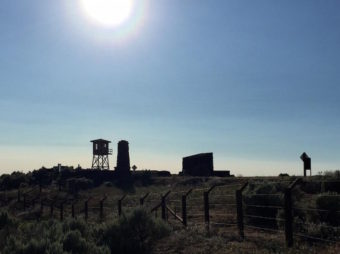
Minidoka was one of ten main camps built to confine civilians of Japanese ancestry during the war. It held people from coastal Oregon, Washington and Alaska, most of whom were U.S. citizens.
The former internment camp is now managed by the National Park Service. It’s also the destination for an annual pilgrimage.

“The potbellied stove was in the corner,” Sam Kito Jr. says. “Then we had a triple bunk on this side.”

Kito was five years old when his family was crammed into one room in a barrack block guarded by soldiers amidst the dusty sagebrush of southern Idaho.

“And then a double-bunk on this side,” Kito says.

At its peak, Minidoka internment camp held nearly 10,000 people. Kito, 77, hails from southeast Alaska. He says it was his daughter’s idea to join the organized pilgrimage to the site. Hope Kito, 32, is a nurse in Bellingham.

“It was something I always heard about growing up, but it is not something anyone ever talked about for a while,” Hope Kito says. “I don’t think the magnitude of it was ever expressed. So it was worth coming with him.”

“When you get new people or younger people involved, what happens is your mind starts thinking about what should have been better for your parents and your generations,” Sam Kito says. “Well, that’s great. But you can’t rewrite history. You live history the way the cards that were dealt to you and then make sure it doesn’t happen again.”

Mary Tanaka Abo, 75, was held at the camp when she was a child. In the midst of war hysteria, her family was “evacuated” – to use the parlance of the day – from Juneau, Alaska.

“Being here made me ashamed of being Japanese when I was young,” Abo says.

Abo came on the pilgrimage with her daughter and two grandchildren. This was the second trip back for the retired teacher, now living in Bremerton, Washington.

“Just being around people is always good,” Abo says.

Nearly two hundred pilgrims journeyed to the site on the final weekend in June. Co-organizer Bif Brigman says this was the eleventh edition of the Minidoka Pilgrimage. He says the idea from its genesis carries on today.

“We’re losing the Issei, the first generation, and Nisei, the second generation of Japanese-Americans. We’re afraid of losing those stories,” Brigman says. “That is one of the things that pushes us to do it annually, to keep doing it.”

Brigman says the number of first hand witnesses decrease with every passing year.

“We can see that those memories, those stories are slipping away,” Brigman says.

Minidoka National Historic Site Superintendent Judy Geniac also feels the urgency to capture more voices of witnesses before they go silent.

“It would be incredible for us to figure out a way to have young people interviewing, whether it is their great-grandfather or it is their next door neighbor,” Geniac says. “We know that people from the camp went all over the United States after they left the camp.”

Earlier this June, the National Park Service award more than $368,000 to the Seattle-based nonprofit Densho, which collects Japanese-American oral histories. The latest grant was directed at enhancing an online encyclopedia about this dark chapter in American history and to help Densho do outreach to connect the Japanese-American incarceration story to more contemporary examples of injustice.

Densho curates an online video repository featuring more than 800 interviews about the community’s life before, during and after World War II.

Meanwhile, the physical remains of the Minidoka camp – which nearly disappeared – are being resurrected. A guard tower, barracks, mess hall and fire station have been rebuilt or restored in recent years. Geniac says a visitor center is in the works as are plans to recreate the central baseball field.

Juneau’s state flags display receives attention as nation debates Confederate flag

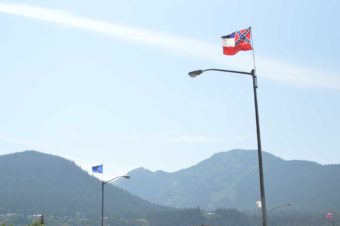
Some residents are asking for the removal of the Mississippi flag on Egan Drive because of the Confederate imagery in its upper left corner. (Photo by Lakeidra Chavis/KTOO)
The Mississippi flag on Egan Drive features Confederate imagery in its upper left corner. (Photo by Lakeidra Chavis/KTOO)

Some locals are calling for the removal of the Mississippi state flag flying on the main street into downtown Juneau because it prominently features the Confederate stars and bars.

On Monday evening business owner Marc Wheeler and community member Matt McGuan spoke to the Assembly about removing the flag.

For Wheeler, who’s originally from Louisiana, his connection to the Confederate flag goes back generations.

“On a personal level, my ancestors were slave owners, and I feel like that flag symbolizes our country’s original sin,” he said, “and we have to atone for that.”

Mississippi is a part of an all-states flag display organized every year by a group of volunteers who call themselves Friends of the Flags.

In light of recent events, McGuan decided to do something about it.

“That’s not a welcoming symbol. That’s a symbol of intimidation and hatred. It’s a relic of a terrible time in our country’s history,” McGuan said.

Jim Carroll, has been a Friends of the Flags volunteer since the display’s inception.

“Well, it’s a state representation of the flags, that’s what we have up, no matter what’s on the flag,” Carroll said.

Although he understands the controversy surrounding the flag, he said immediately removing it is impractical. The flags are replaced yearly using a donated piece of heavy equipment.

Mississippi adopted its current flag in 1894. In a controversial statewide referendum in 2001, voters doubled down on keeping the flag.

But the flag doesn’t belong in Alaska, according to McGuan.

“If the people of Mississippi want it on their flag that’s their deal, but we don’t have to give it a place of honor in our community,” McGuan said.

Chair of the Juneau Human Rights Commission Alavini Lata, says the board hasn’t received any complaints from the community. Lata says Friends of the Flags has the final say and the most the commission could do is to talk to them. The issue might be addressed at an upcoming meeting, but he doesn’t think taking down one flag would be effective.

“Generally we don’t take action unless something is brought up by the community and we internally haven’t talked about it as a group,” Lata said.

Georgia removed the Confederate stars and bars from its flag in 2003. South Carolina had flown an actual Confederate flag on its statehouse grounds until late June. South Carolina Gov. Nikki Haley called for its removal and five days later, an activist climbed the flagpole and took it down herself.

Mississippi is now the only state with Confederate imagery in its flag.

Criticism of the Confederate flag has grown after the racially charged mass murder of church parishioners at a historic black church in Charleston, South Carolina, last month.

Since the Charleston attack, stores and major companies like Wal-Mart and Amazon have stopped selling the flag. A supermajority of South Carolina legislators now officially supports removing the Confederate flag from the statehouse.

McGuan says about 10 other community members have met to discuss removing the flag in Juneau. One possible alternative, according to McGuan, is to use the Mississippi Magnolia Flag, which was the state’s first official flag.

Slow or no Internet access hinders remote Arctic communities

Arctic Fibre plans to route its 10,000-mile-long cable linking Great Britain to Japan along the coast of northern Canada and Alaska. (Image courtesy of Arctic Fibre)

This story is the first of a two-part series from KUAC.

Dial-up Internet access is a distant memory for most of us. But slow connections to the web are still a fact of life in much of the far north, says Madaleine d’Argencourt, who heads up a municipal-government organization in the Canadian territory of Nunavut.

“It’s a serious issue, all across the board here in Nunavut,” d’Argencourt said.

Most of northern Canada lacks access to broadband Internet connections. D’Argencourt says that limits residents’ ability to conduct business online. She cites studies that show broadband in the three northern territories would create jobs and dramatically boost the economy.

“This has huge economic impact,” she said.

The lack of broadband also contributes to a fragmentation of the communities, because residents must go elsewhere for training and education.

“Most people in Nunavut have to leave their own community to get the training they need because online training is impossible to do in the north, without the right broadband. And they’re paying $8,000 to $10,000, to go south.”

An ambitious project proposed by a Toronto-based company could change all that. Arctic Fibre proposes to lay a 10,000-mile-long cable on the ocean floor from the United Kingdom to Japan.

“It’s an immense undertaking — 17,000 kilometers from Asia through to Europe,” d’Argencourt said.

Company spokeswoman Madeleine Redfern says it also would enable much faster and reliable connections than the satellite-based systems now in use.

“We’re the only region in Canada that does not have fiber-optic connections to the outside world,” Redfern said. “And so we’re completely dependent on satellite. It’s very slow, and it’s extremely expensive.”

Arctic Fibre proposed the $700 million backbone as a faster link for financial institutions, and a backup for other cables. Redfern says Arctic Fibre has offered to link up with local Internet service providers in several communities along its route, which would provide broadband to about half of Nunavut’s 30,000 residents.

Next week: Alaska fiber-optic cable project would bring broadband to villages.

Site notifications
Update notification options
Subscribe to notifications