Nation & World

Yup’ik educator appointed to National Advisory Council on Indian Education

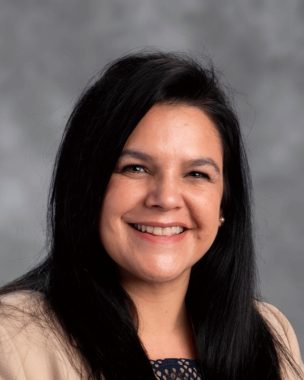
Doreen Brown. (Photo courtesy Anchorage School District)

An Alaska educator has been appointed to the National Advisory Council on Indian Education, the White House announced Wednesday.

Doreen Brown of Anchorage will serve on the council, which was established under the Indian Education Act of 1972. The council is tasked with advising the Secretary of Education and Congress on the administration and funding of Alaska Native and American Indian education programs.

Brown is the executive director of the Title VII Indian Education program at the Anchorage School District. She began her teaching career in Aniak in 1989. She went on to teach in Anchorage classrooms and eventually transitioned into the Indian Education program.

Alaska has the third lowest graduation rate in the country for Alaska Native and American Indian students — about 51 percent in the 2010-11 school year.

Storytelling gives refugee teens a voice in their new community

Olive Mtoni records Furaha Sefania outside of UAA. (Photo courtesy of ATMI.)
Olive Mtoni records Furaha Sefania outside of UAA. (Photo courtesy of Alaska Teen Media Institute)

Everyone has a story to tell, but it may not be the story you’d expect. An Anchorage non-profit called StoryWorks is helping teenagers find their stories, and this summer they focused on students who arrived in the state as refugees.

A group of students and their story-telling mentor lounge on couches at the University of Alaska Anchorage telling each other about their lives.

“Did you learn something from that day?” Rosey Robards asks 17-year-old Furaha Sefania. Robards is a story coach and also the director of the Alaska Teen Media Institute.

Sixteen-year-old Olive Mtoni interjects in Swahili, translating for her new friend. Both girls are originally from the Congo, but Mtoni’s family fled the war-torn nation to Rwanda before she was born. Sefania’s went to Mozambique. They met for the first time at East High in Anchorage late last year. But that’s not the story Sefania has chosen to share…

“Wakati nilikuwa nacheza mpira na rafiki zangu, na mdogo …” Sefania says, telling her story.

She’s talking about a time when she was 12 years old and playing soccer with her friends back in Mozambique. Her little sister calls her to come eat and she refuses to go. When she finally heads home two hours later, the food is gone. Her sister laughs because she received extra, and her mother admonishes her – if you like soccer so much, than you can eat it! Sefania says she learned to listen to her mother. So why tell this story?

“Niliona tu, tuongee.” She just thought of it when chatting.
And that’s the whole point – stories are just moments to help people understand each other. That’s why 11-year-old Khalil Edais participated in the program. He was born in Anchorage but he loves storytelling and wanted to learn about the other kids.

“A lot of the kids have stories to tell, so this is like a big camp for them because they have big stories from their countries that they told here, so it’s pretty big for me to come here.”

Edais learned about a girl who climbed a tree, was distracted by a monkey, and ended up at the hospital getting shards of wood pulled from her arm. A boy told about the disappointment of leaving home for a cold place but eventually making new friends.

Jessica Kovarik, the program director of Refugee Assistance and Immigration Services, says these stories can help the community understand people from other nations.

“We really wanted to give the youth an opportunity to have some voice and to learn to tell their stories and recognize how powerful their stories are and how much they have to share with the community.”

Alaska Teen Media Institute director Rosey Robards chats with Iqlas Dubed. (Photo courtesy of Alaska Teen Media Institute)

Twelve-year-old Iqlas Dubed shares the story of her first bee sting – just a month ago, near the Campbell Creek Science Center.

“Then I ran around, ran around, ran around. Then came, I was out of breath, so I was just like ‘It hurts! It hurts!’ And the bee was still on my hijab so I took it off.”

The sting taught her what goes around, comes around. She laughed at other kids who were stung on previous days, and then she was stung. But telling the story taught her

“Don’t be scared to tell others. Other people that you don’t know.”

She said she feels kind of brave now.

Access to benefits focus of VA Secretary’s visit to Point Hope, Kotzebue

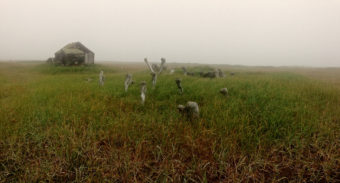
Point Hope’s old townsite. (Photo by Emily Russell/KNOM)

Walking amongst the old sod and whalebone houses on the edge of the Bering Sea, it’s easy to let the world around you fade away. We’ve come to Point Hope, Alaska, one of the oldest continuously inhabited communities in North America, 200 miles north of the Arctic Circle.

The barrier between the old abandoned town site and the new community is the airport, which sees multiple small-plane departures and arrivals each day, though today is a bit different. Today a pearly white plane is parked on the runway. On the side it reads “United States of America,” which feels like a million miles away from where we are.

McDonald at a listening session in Point Hope. (Photo by Mitch Borden/KNOM)

The official aircraft came all the way from Washington DC to made good on a request from local. Leonard Barger, Transportation Director of the Native Village of Point Hope, wrote to the Secretary of Veterans Affairs, Robert McDonald, last year requesting a visit to honor the community’s veterans.

Barger explained the importance of McDonald’s visit to the 49thstate. With the highest number of veterans per capita in the country, even the most remote communities throughout Alaska have vets. Along with Point Hope, Barger acknowledged the veterans in communities like Barrow, Point Lay, and Unalakleet. “All these people in Alaska, they’re going to Afghanistan,” Barger said, “they’re leaving their family, but they’re serving their country, they’re sacrificing their lives for us.”

Along with visiting Point Hope, McDonald also held a listening session that day in Kotzebue. It took Walter Sampson, a Vietnam vet living in Kotzebue, 11 years to get serviced by the VA in Anchorage, a 500-mile journey and a $600 plane ticket away from home. Sampson made sure to remind McDonald of the unique challenges that many of Alaska’s vets face in accessing the benefits they’ve earned.

Whalebones welcome visitors to Point Hope. (Photo by Mitch Borden/KNOM)

“Remember that we’re in bush Alaska,” Sampson said, “We’re in roadless communities.” While Fairbanks and Anchorage have the clinics, the VA officers, and the hospitals, he stressed that, “for bush Alaska we’ve got nothing at all.”

Without the VA facilities and representatives, information has a hard time reaching vets in bush Alaska. Sampson expressed a feeling that many vets seemed to share. “As a veteran, do I really know who [the] VA is?” Sampson asked himself. “What benefits does it have for me?

Sampson is frustrated by the convoluted nature of the VA support system, which often requires multiple phone calls, website logins, and, in the end a system too complex for its own good. McDonald was quick to acknowledge those inefficiencies.

“Walter’s right,” McDonald admitted, “we’ve got too many 1-800 numbers, it’s too confusing.” With over 900 1-800 numbers and 14 websites that require different usernames and passwords, many vets get lost in the system before they ever get help. “We’re going to go to one 1-800 number, we’re going to go to one website,” McDonald promised, “it’s just too complex, we’ve got to simplify it, that’s what we’re working to do.”

But a simplified system is only one step towards getting vets throughout Alaska the benefits they deserve. With McDonald gone and many questions left unanswered, the support system that seems the most promising comes from within the state.

Chester Ballot, another Vietnam vet in Kotzebue, was trained in Anchorage as a tribal veteran representative and now works to sign up fellow vets to the VA. The Alaska VA also sent two representatives to both Point Hope and Kotzebue to sign up and inform vets of their benefits. So far the Alaska VA has sent representatives to 39 of the state’s nearly 300 villages.

Although McDonald is back in DC, Leonard Barger hopes this will not be his last visit to Point Hope. Barger and other community members encouraged him to return in the spring to take part in a whale hunt, one of the many benefits of living on the edge of the Bering Sea.

Climate change, not Arctic drilling, drives Obama trip to Alaska

Whitehouse.gov video screenshot

The White House released a video Thursday morning to explain why he will be the first sitting president to visit Alaska’s Arctic.

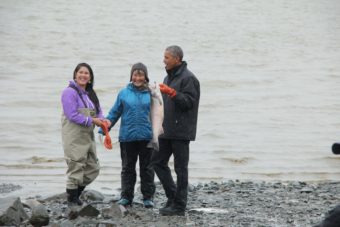
The folksy video (it starts with the President of the United States saying, “Hi, everyone”) features dripping glaciers, raging wildfires and Alaska Natives hanging salmon to dry.

“As Alaskan permafrost melts, some homes are even sinking into the ground,” Obama says in the video. “The state’s God-given natural treasures are all at risk.”

In the video, the president says he’s coming to Alaska because it’s on the front lines of climate change, with lives and communities already being disrupted.

“What’s happening in Alaska isn’t just a preview of what will happen to the rest of us if we don’t take action. It’s our wake-up call,” Obama says. “The alarm bells are ringing. And as long as I’m president, America will lead the world to meet this threat — before it’s too late.”

In Anchorage, Alaska Senator Lisa Murkowski said she hopes President Obama will keep his eyes open during his visit rather than come to Alaska with a predetermined agenda.

“I think we’re all looking forward to welcoming the President of the United States to Alaska, his first official trip to see our state,” Murkowski said. “It is somewhat disappointing, though, that he apparently intends to use this as nothing more than a backdrop for climate change.”

Murkowski’s fellow Republican, Rep. Don Young, used less diplomatic language in his press release.

“It is my hope that the president will use his visit as an opportunity to learn about the many challenges we face and not as a platform to pander to extreme interest groups using Alaska as a poster child for their reckless agenda,” Young’s statement said.

Young’s statement described that agenda as locking up critical resources like oil, gas and minerals.

The White House video does not mention the administration’s Alaska- and climate-related policy that has been making national headlines this summer: its approval of exploratory drilling in the Arctic Ocean.

With the Obama administration’s blessing, Shell Oil began drilling last month in the Chukchi Sea. The company is hoping the Interior Department will approve deeper drilling into oil-bearing rocks any day now.

Environmental groups say the administration’s green lighting of Arctic drilling just doesn’t square with Obama’s stated aim of leading the world in fighting climate change.

“It’s a pretty evident contradiction,” Margaret Williams with the World Wildlife Fund in Anchorage said. “It is absolutely clear that greenhouse gases are driving change in the Arctic, and to solve the climate problem, we have to be stemming the source of greenhouse gases.”

Greenhouse gas emissions come primarily from burning fuels like coal, oil and natural gas.

International climate negotiators will meet in Paris in December. They’ll try to agree on how fast to reduce those emissions. Their aim: keeping the earth’s climate from warming more than 2 degrees Celsius.

A study this year by British energy researchers in the journal Nature found that climate change can only be kept under 2 degrees Celsius by leaving Arctic oil in the ground.

Sarah Erkmann with the Alaska Oil and Gas Association said the group has no reaction to Obama’s trip yet, with the details of his agenda still being worked out.

“We’ll have a reaction if he has any announcements that would impact the industry in Alaska specifically,” she said.

Erkmann said AOGA has no position on climate change, though individual oil companies that make up its membership do.

Last week, Shell announced it was ending its membership in the American Legislative Exchange Council. A Shell spokesman said the energy giant would be leaving the anti-regulatory group because ALEC’s opposition to action on climate change was inconsistent with Shell’s approach to the issue.


LGBT discrimination claims still not valid in Alaska

The Rainbow Flag is a symbol of LGBT pride. (Creative Commons photo by torbakhopper)

The U.S. Equal Employment and Opportunity Commission ruled in late July that sexual orientation discrimination in the workplace is illegal because it is a form of sex discrimination, which is already prohibited.

Some of the most common types of discrimination LGBT people face are in the workplace and in housing. Despite this, Alaska’s statewide and Anchorage anti-discrimination commissions don’t offer protections for gay, lesbian, bisexual or transgender people. The commissions are not legally required to do so, and some activists see that as an injustice.

“Just imagine if you couldn’t call the fire department because you were LGBT. If you are LGBT you should be able to call any state agency and get the same service,” says attorney Caitlin Shortell. She represented the same-sex couples that sued the state for the right to marry. “This is an injustice that needs to be corrected.”

In December, Attorney General Eric Holder announced that the Department of Justice would treat gender identity as protected under Title VII of the Civil Rights Act of 1964.

In early February, the U.S. EEOC Director of Field Programs sent a memo saying that complaints of discrimination based on gender identity should also be accepted under the Civil Rights Act. Federal and state employees already have these workplace protections.

And late last month, the federal commission ruled in a 4-2 vote that sexual orientation discrimination in the workplace was illegal, too.

But the Alaska State Commission for Human Rights and the Anchorage Equal Rights Commission refer LGBT discrimination complainants to a toll free number for the federal EEOC.

When I called the toll-free number, I was directed through nearly three minutes of call options. To speak with a federal EEOC employee, on one particular day the wait was approximately 60 minutes.

Both the state and Anchorage commissions have work-sharing agreements with the EEOC and receive a portion of their budget from the federal agency. However, the funding does not require commissions to enforce civil rights laws as the EEOC interprets them.

“There’s a basis and a duty to already be taking these complaints and the commission should be doing that, without even amending our state and municipal human rights law,” Shortell said.

In initial interview requests for this story, the commission’s directors — Paula Haley for the state and Pamela Basler for Anchorage — both refused to be recorded and would not answer questions directly. Neither director responded to subsequent interview requests.

Gov. Bill Walker on April 18. 2015. (Photo by Jeremy Hsieh/KTOO)
Gov. Bill Walker on April 18, 2015. (Photo by Jeremy Hsieh/KTOO)

Gov. Bill Walker says he “[doesn’t] like any form of discrimination, at all.”

But disliking discrimination doesn’t mean he’s willing to change up the state commission members and director, who serve at his pleasure.

“At this point we don’t intend to address this issue. That shouldn’t be a surprise,” Walker said.

Walker says his administration will not introduce legislation on this issue or any other social issue. He says he’s not reviewed the priorities of the state’s human rights commissioners or the commission’s executive director.

“I don’t want to be judgmental about what the Human Rights Commission is or isn’t doing, but I will say that we are working on that issue ourselves,” Walker said. “It’s come up in the past, the issue of them having some venue to report, record circumstances where they feel they have been discriminated against.”

In an earlier written statement the governor said he’d leave it to the commission to decide whether to accept LGBT discrimination complaints, or complaints from any other class.

In other words, the state commission is actively choosing to not provide coverage.

Only two of the seven board members on the state Human Rights Commission could be contacted. Although neither would agree to be recorded, one stated that discussion surrounding LGBT discrimination protections has only come up a few times in the past few years.

The federal EEOC canceled an interview and declined to reschedule. In a written statement, an agency spokeswoman says neither the state or Anchorage commissions are required to accept claims that they don’t have jurisdiction over. And jurisdiction is based on their own assessment of the law, independent of the EEOC’s positions.

In an interview with KYUK’s Elllie Coggins in May, state commission director Paula Haley didn’t include LGBT people in her organization’s duties.

“So we have a very broad area of coverage and we protect people from discrimination based on race, sex, disability, age, marital status, so there’s a lot of coverage. Pretty much everyone in Alaska is protected by our laws,” Haley said.

Later in the interview, Haley said most of the complaints the agency receives deal with employment discrimination—a type of discrimination transgender people are most at risk for, according to a 2012 Anchorage survey on LGBT issues.

In a previous story for KTOO, Paula Haley said she’s only seen a handful of cases over the years.

“Very few people contact us because they’re concerned about discrimination based on lesbian, gay, transgender, queer issues, because they know we don’t cover those. So they don’t reach out to us because we don’t have the ability to help them.”

Anchorage mayor Ethan Berkowitz. (Photo from ethanforanchorage.com)

In the Human Rights Campaign’s 100-point 2014 Municipal Equality Index, Anchorage scored the highest at 35, Juneau at 33 and Fairbanks the lowest at 24.

Anchorage Mayor Ethan Berkowitz says he, “everyone who lives in Anchorage has equal protection under the law.”

But later in the interview, Berkowitz said he was unsure of how the Anchorage commission currently handles these complaints and didn’t mention any specific plans to address the issue.

Juneau first stop on gay cruise’s trip around Alaska

RSVP patrons enjoy the drag performances during Monday night's event.  (Photo by Lakeidra Chavis/KTOO)
RSVP patrons enjoy the drag performances during Monday night’s event. (Photo by Lakeidra Chavis/KTOO)

On Monday afternoon, nearly 2,000 people arrived in Juneau for their first stop on the 30th anniversary RSVP Vacations cruise. The cruise line caters exclusively to gay and lesbian people.

The Southeast Alaska LGBTQ+ Alliance, also known as SEAGLA, hosted an event for cruise patrons at the Imperial Saloon downtown. Nearly 200 patrons mingled, drank and played billiards during the 2-hour event.

SEAGLA decorated the outside of the Imperial with various gradient flags from the LGBT community, including the pride, bisexual, transgender, leather, bear flags. (Photo by Lakeidra Chavis/KTOO)

“It’s just important to remember that we are in the community, that we’re neighbors, but also to welcome people who are traveling, who might be looking for community,” says Lauren Tibbitts-Travis, SEAGLA outreach coordinator.

She helped organize the event.

“It’s one thing to go somewhere that you’ve never been and see the sights, but if you’re going there [and you] immediately identify with [the place], that makes it a much better experience. That’s what we’re trying to do at these events,” Tibbitts-Travis says.

This week’s cruise will take tourists to Glacier Bay, Sitka, Ketchikan and Victoria, British Columbia. Although the passengers are predominantly male, the cruise caters both to gay and lesbian people.

Ticket prices ranged from $900 to almost $3,000. Joe Fallon and his husband David Rodes says the cruise was worth it.

“We’d never been to Alaska and we’d always wanted to do an Alaska cruise, but a straight cruise never seemed like that much because we figured we’d be with a lot of old people,” Fallon says.

Fallon and Rodes, who are both in their late 50s, decided to take the cruise to celebrate paying off their mortgage.

“We met working in the same shopping center when we were like 17 and 18 years old.” Fallon says.

They’ve been together for 39 years, says Rodes.

Both men says they’re most excited to see Glacier Bay.

Sam Wilson, 47, sits in the Imperial with his best friend, who he came on the RSVP cruise with. (Photo by Lakeidra Chavis/KTOO)
Sam Wilson, 47, sits in the Imperial with his best friend and travel partner. (Photo by Lakeidra Chavis/KTOO)

For 47-year old Sam Wilson, he decided to go on the cruise because it’s something his best friend has always wanted to do.

“He actually wanted to go for a very long time, and we finally found time to go. We travel a lot, this is like my fourth cruise. I did a couple in the Caribbean and a Mediterranean one, so this was like on the bucket list — definitely one to come and see,” Wilson says.

Wilson and his friend have traveled everywhere from Egypt to Greece. He says the cruise is like a party every night and there’s always a chance to meet new people.

Halfway through the event, four local drag performers took the dance floor to entertain the crowd. Performer Vanessa LaVoce-Kellie — who preferred to be identified by her stage name — was one of them.

For her the event symbolized a larger effort to create a more inclusive community.

“I performed tonight because there’s not very many opportunities to do drag here in Juneau; it’s been getting a lot better. We’ve been having more exposure, but any chance that I get to step out in face and give somebody a show, I’ll take it,” La-Voce-Kellie says.

For LaVoce-Kellie, the bigger the drag queen presence in Juneau, the better.

“These events give people that safe place, and help us to build the conversation for more acceptance and tolerance. The more you can do for love the better,” LaVoce-Kellie says.

The cruise left late Monday night to travel to its next destination, Sitka, before making a stop in Glacier Bay.

Site notifications
Update notification options
Subscribe to notifications