Crime & Courts

No charges against 3 Anchorage officers in fatal shooting of man who drew gun on them

A parking lot at the Anchorage Senior Activity Center on Tuesday, June 4, 2024. Anchorage police say they shot and killed an armed man Monday evening near the center. (Chris Klint/Alaska Public Media)

The three Anchorage police officers who shot and killed a man they say drew a gun on them last month will not face criminal charges after body camera footage corroborated their accounts, according to the state.

The state Office of Special Prosecutions released a letter Thursday clearing Sgt. Jesse Frey and Officers Isaac Kimball and Nicholas Flechsing in the June 3 shooting of 21-year-old Tyler May.

The letter comes just days after the state cleared two Anchorage police officers who shot and wounded murder suspect Kaleb Bourdokofsky on June 1. State prosecutors say they are working to speed up reviews of officer-involved shootings, with Anchorage police shooting five people – three of them fatally – since mid-May.

The letter on the June 3 fatal shooting, sent to APD Chief Sean Case by Assistant Attorney General Dan Shorey, also included new details about what happened.

According to the letter, 911 calls to police at about 9:30 p.m reported two men who had fired shots and were walking toward the Anchorage Senior Activity Center in Fairview. One caller said that one of the men had previously “pulled a gun on children in the neighborhood and tried to take the children’s scooter.”

Frey, Kimball and Flechsing all responded to the area within five minutes of the first call, armed with .223-caliber rifles, and were soon joined by K-9 Officer Timothy Dorsey and his dog, Ray. When they encountered a man matching callers’ descriptions of one suspect, they ordered him to sit on the ground and he complied – just as another man, later identified as May, ran into the senior center’s north parking lot.

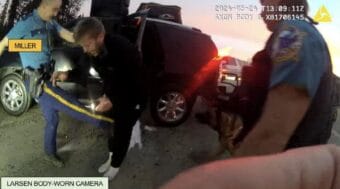
“Officers observed a pistol in May’s right hand,” Shorey said in the letter. “Officers immediately commanded May to drop the gun and get on the ground. May put the pistol in his front waistband, raised his hands above his shoulders, and turned away from the officers.”

May then ran from the officers, but the K-9 unit was released and bit him in the upper back, knocking him to the ground. As Frey, Kimball and Flechsing approached, they saw May roll onto his back as he struggled with the K-9 and reach into his waistband, Shorey said in the letter.

“May pulled the pistol out and pointed it in the direction of officers,” Shorey said. “At that time Sergeant Frey, Officer Kimball and Officer Flechsing each fired their rifle, striking and killing May.”

According to Shorey, May was shot during two seconds of gunfire from the officers at 9:38 p.m. Flechsing’s rifle obscured his camera’s view during the shooting, but both Frey and Kimball’s cameras recorded the shooting, in Kimball’s case capturing the shots he fired.

“May is heard screaming in distress as K-9 Ray bites him,” Shorey said. “May’s right hand raises up and he has a pistol in his hand. An officer commands May to ‘drop the gun!’ Nearly simultaneously, at 9:38:41 p.m., Officer Kimball shoots May and the pistol drops from May’s right hand.”

Sixteen .223 shell casings were recovered from the site of the shooting. The rifles were each loaded with 30-round magazines, with 21 rounds remaining in Frey’s rifle and 25 each in Kimball’s and Flechsing’s.

Police recovered an unfired pistol from the detained man. They also found May’s Glock .40-caliber pistol in parts near him, including an extended magazine and slide that appeared to have been struck by gunfire. The weapon’s grip, trigger and lower frame were found under May’s right thigh.

“(T)here was a Federal brand .40 (Smith & Wesson) cartridge in the barrel, and 12 additional cartridges in the 22-round .40-caliber Glock magazine,” Shorey said.

Shorey said an autopsy on May discovered alcohol in his blood at a level of .194, just over twice Alaska’s legal limit for driving. Traces of marijuana were also found in his system.

Police spoke with May’s girlfriend, who said she and May had been arguing earlier that day.

“(She) told detectives May was usually calm but he would lose control when he drank and that he had been drinking that day,” Shorey said.

May’s mother, who lived in the area, told police she last saw him about three and a half hours before he was shot. When she heard gunfire and word of a police shooting, she went to the senior center and recognized May’s body at the scene.

A woman who knew both May and the man initially detained told police he had visited her apartment that evening. During the visit, she said he abruptly strangled her for about a minute.

“(She) told detectives that May was talking to her that night about being ready to die and said he loaded and unloaded his gun,” Shorey said.

The detained man told police he visited the woman’s apartment and told May to take a walk with him. But May was still angry, the man said, and fired his gun during the walk.

The detained man said he didn’t see police shoot May because he was facing away at the time, but he said he flinched when he heard the gunfire and saw May’s body when officers led him to a police car.

Frey told detectives that after he arrived at the senior center, he and the other officers were determining whether anyone had entered the building when they saw May and the other man.

Frey said that during the struggle with May, he fired immediately after seeing May draw his pistol.

“I remember seeing the barrel, and like Dorsey and Flechsing are right there so if he gets that clear he’s gonna shoot and kill them,” Frey told detectives. “Like I can’t…I can’t let him do that.”

Both Kimball and Flechsing told detectives that the officers had initially hoped to handcuff May while he was face-down, but were surprised when he rolled onto his back despite having a K-9 on him.

Kimball, a firearms instructor and member of APD’s SWAT team, said that had May fired at the group of officers, “we would’ve taken that round for sure.”

Flechsing said as May drew his pistol, he decided that if May aimed the weapon at him he would open fire.

“And that’s when I drew the line in the sand, when I saw him still raising the gun after being – refusing commands to drop the gun,” Flechsing said. “And that’s when I fired my rifle.”

Shorey said that given the overall circumstances leading up to the shooting, it was “objectively reasonable” for police to be concerned about “an armed subject in a crowded neighborhood who has been firing shots and scaring other residents.” He ultimately decided against charging the officers, noting that state law allows officers to use deadly force against people they believe pose a threat of death or serious injury to themselves or others.

“Collectively, the officers subjectively believed that deadly force was necessary to protect their own lives and the lives of their fellow officers,” Shorey said.

Supreme Court’s trawl bycatch case casts a wide net

Fishing boats in the Naknek River. (Jaylon Kosbruk/KDLG)

A recent U.S. Supreme Court decision could have important implications for fisheries in Alaska.

Last month, the Supreme Court overturned a legal principle called Chevron deference. For 40 years, that principle gave federal agencies wide authority to interpret the gray area in laws passed by Congress. Now, more of that authority will go to judges.

The decision came after a legal battle over who should pay for bycatch monitors on trawl boats. The potential effects extend to all federally regulated industries — including fisheries.

Many trawl boats are required to have bycatch observers onboard. And in Alaska, the North Pacific Fisheries Management Council can have trawl boats pay for those observers. That’s the law. It’s spelled out in the Magnuson-Stevens Act, which governs commercial fishing.

But that act is not clear on who should pay for bycatch observers elsewhere. In the Atlantic, a federal agency created a similar funding program and a trawling business sued.

“And so (the National Marine Fisheries Service) used its agency authority to interpret the statute and fill in the gap and say, ‘Well, you know, we’re going to do what we do in the North Pacific region here in the Atlantic region.’ And the court said, ‘Nope, you can’t do that,’” said Anna Crary, an environmental lawyer at the firm Landye Bennett Blumstein LLP in Anchorage. She’s been watching that court case.

That Supreme Court decision, in a case known as Loper Bright, was a reversal. Forty years ago, in an environmental lawsuit called Chevron vs. Natural Resources Defense Council, the Supreme Court established a legal doctrine known as Chevron deference.

That doctrine said that when federal laws are vague, federal agencies should fill in the gaps, and courts should defer to the expertise of those agencies. Crary says that understanding of agency power has become a baseline assumption.

“Administrative law, unbeknownst to many people, really forms the backbone of what we perceive as our everyday life, as modern society. But the extent to which this decision destabilizes that, I think is quite profound,” Crary said.

Now, legal analysts say it will be easier to challenge federal agency decisions — and to win. Crary says that challenges could play out in the agencies that set safety standards for everything from drugs to airplanes. It could also make regulations by the North Pacific Fisheries Management Council or the National Marine Fisheries Service easier to challenge.

Crary is also watching for challenges to decisions by the Federal Subsistence Board, which carries out subsistence fishing rules under ANILCA. And, she thinks the ruling could give a boost to lawsuits that challenge the very existence of that board, since it was created by agency regulation and not by law.

“It’s not just the time, place and manner regulations, but it’s the actual regulations creating the Federal Subsistence Board itself. I think we will probably see a challenge to those regulations that follows the blueprint of what the Supreme Court laid out here in Loper Bright,” Crary said.

Crary says the impact of the loss of Chevron deference will depend on the context, “Chevron was, you could use it as a sword, you could use it as a shield.”

In Alaska, questions about how much power federal agencies have are important for all sorts of projects that could impact salmon habitat. Siobhan McIntire is a lawyer at Trustees for Alaska, whose work includes lawsuits opposing Pebble Mine, which many Bristol Bay fishermen see as a threat to salmon.

“If we’re, for example, in a plaintiff’s posture and holding agencies accountable, the overturning of deference to agencies could be positive for our clients. On the other hand, if we’re in defensive posture, seeking to uphold an agency action, then the opposite could be true,” McIntire said.

McIntire said it’s too soon to say what impact last month’s Supreme Court ruling will have on Pebble Mine or in other lawsuits.

“This decision really cuts both ways, and we can’t project into the future as to what that will look like from here,” McIntire said.

Under the Dunleavy administration, the State of Alaska has been fighting a number of federal agency decisions, including a decision by the Environmental Protection Agency to block Pebble Mine.

Commissioner John Boyle, a Dunleavy appointee, leads the Alaska Department of Natural Resources. He says they are starting to look at what the ruling could mean for a variety of legal challenges.

“We can really look at that in the context of looking at environmental laws that have been passed, the Endangered Species Protection Act, the Clean Water Act, the Clean Air Act, etc. The onus is really now on Congress to be more specific in what they want the agencies to do,” Boyle said.

Boyle said Loper Bright might reinvigorate the state’s effort to limit which streams and lakes are subject to federal wetland protection under the Clean Water Act. That’s the law that the EPA used to block Pebble Mine.

“What may or may not constitute a water of the United States becomes a very big deal again, because it can be the difference between being able to see a successful development project move forward or not. So the state has been very interested to better define and narrowly tailor what constitutes a water of the United States to remove as much federal entanglement as we possibly can,” Boyle said.

The Loper Bright decision will also require judges to decide more highly specific and technical questions. Boyle said maybe that’s a good thing.

“So it will cause uncertainty, there’s no question about it. And I’m sure there’s going to be all kinds of new litigation and all kinds of new case law that’s going to feed into to what extent does a court defer to a federal agency but I don’t think reining in the powers of federal agencies in particular is necessarily a bad thing at this juncture,” Boyle said.

Loper Bright is not the only recent Supreme Court case to limit federal agency power. In 2022, West Virginia v. The Environmental Protection Agency also limited how agencies could interpret laws in a way that echoes the reversal of Chevron deference. Another ruling this summer, Corner Post v. Federal Reserve, makes it possible to challenge federal agency decisions for longer. Both of those rulings may also impact fisheries.

Alaska State Troopers released the name of one officer involved in the shooting of a Juneau man

Caution tape blocks off an area of downtown Juneau after witnesses say police shot a man on July 15, 2024. (Clarise Larson/KTOO)

The name of one of the law enforcement officers involved in the shooting death of a man in downtown Juneau earlier this week has been released. 

Alaska State Troopers released the name of Alaska Wildlife Trooper Sergeant Branden Forst on Thursday. Forst was among several officers who fired their weapons during a confrontation with Steven Kissack on Monday. 

Videos of the incident appear to show five officers with guns drawn and pointed at Kissack when he was shot. 

Forst is a 12-year veteran of the Wildlife Troopers stationed in Juneau.

Meanwhile, the Juneau Police Department says it won’t release the names of its officers involved until early next week, in accordance with department policy.

Forst and the Juneau police officers who fired their weapons have all been placed on administrative leave, following the policies of both agencies.

The shooting is being investigated by the Alaska Bureau of Investigations to determine if lethal force was necessary. The Alaska Office of Special Prosecutions will then independently review the findings.

Brian Smith sentenced to 226 years for killing 2 Alaska Native women

Brian Smith walks out of the courtroom after receiving what amounts to two separate life sentences. Anchorage Superior Court Judge Kevin Saxby said Smith, who was convicted of killing two Alaska Native women, was beyond rehabilitation. (Matt Faubion/Alaska Public Media)

The Anchorage judge sentencing convicted killer Brian Smith on Friday gave prosecutors exactly what they asked for: a 226-year sentence for the murders of two Alaska Native women.

Smith sat still, with no reaction, but the packed courtroom was charged with emotion.

Even before sentencing got underway, there was a demonstration outside the Nesbett Courthouse.

Margaret Yellow Wolf Tarrent, an advocate for missing and murdered Indigenous people, holds a sign outside the Nesbett Courthouse. (Rhonda McBride/KNBA)

A group of mostly Native women, dressed in red, gathered outside, carrying signs that said, “Honk for justice,” and “We do not feel safe.”

“These are our sisters,” Sarah Wiseman said. “We have to look out for each other.”

Sarah Wiseman holds a poster with pictures of Veronica Abouchuk and Kathleen Henry, women that were killed by Brian Smith. Wiseman is related to one of Abouchuk’s sisters and said she came to Smith’s sentencing to support her family. (Rhonda McBride/KNBA)

Wiseman is related to Veronica Abouchuk, one of the women Smith was convicted of killing. The jury also found Smith guilty in the death of another woman, Kathleen Jo Henry. Both were from small western Alaska villages but struggled to survive in Anchorage. Smith told detectives he preyed upon them, because they were vulnerable.

Anchorage Superior Court Judge Kevin Saxby told the court he hopes the harsh sentence for Smith will be a deterrent.

“Some people come to Alaska because it’s an easy place to take advantage of people, people who live on the street,” he said.

Saxby recapped a series of videos that were played during the trial. They came from a cellphone, stolen from Smith by a sex worker. She copied the images, which Smith shot and narrated, and turned them over to police. They captured Kathleen Henry’s last moments at a Midtown hotel, as Smith tormented her.

“He says, quote, you’re alive and you die. And you’re alive and you die,” said the judge, as he read from the video transcript. “So, I guess I need to stop this because the blood is getting to the floor.”

Only the jury saw the video, but the whole courtroom heard the sound of Smith’s voice, as he said, “You live. You die,” while pressing his fingers on and off Henry’s throat.

The judge’s description of the footage brought sobs from Veronica Abouchuk’s family, who were invited to sit together in a large group inside the jury box.

Kristy Grimaldi, the daughter of Veronica Abouchuk, was the only person to testify at Brian Smith’s sentencing. Grimaldi told the court it was a relief to know that Smith would rot in prison for killing her mother. “I hope he is swarmed with guilt someday knowing he stalled so many people’s joy,” she said. (Matt Faubion/Alaska Public Media)

Abouchuk’s daughter, Kristy Grimaldi, told the court that, since the trial, it’s as if a heavy fog descended on her life, but there are times when she remembers her mother’s full-hearted laughter — and moments, like the other day, when a store clerk gave her two quarters for change. One had her birthdate, and the other, her mother’s.

“It was an insignificant moment that became significant to me,” Grimaldi said. “I feel her all around me, watching over me. No one can take that away. This experience has taught me so much and has shown me that true love never dies.”

She told the court Brian Smith was a sick human being, unable to comprehend the meaning of life.

“Forget the defendant’s name,” Grimaldi said, “and remember Veronica Rosaline Abouchuk and Kathleen Jo Henry.”

Abouchuk’s sister, Rena Sapp, said the sentencing brings relief for now, but worries about what may come next for other families. She believes Smith had more victims.

“It’s not done. This is not the end for Brian Smith. There are more,” she said.

Smith did not speak at his sentencing. Although his wife, Stephanie Bissland, sat in a gallery bench directly behind him, he did not turn around to look at her. His attorney Timothy Ayer pushed for a 132-year sentence, about a hundred years less than what he received. He said either way, Smith would spend the rest of his life in prison.

Outside the courthouse, before the sentencing, there was a large poster-sized sketch of a woman who appears to be an Alaska Native, believed to be Brian Smith’s third victim. Police found her photos on another one of his cell phones. She looks battered in the pictures, and it isn’t clear if she’s alive. The woman has yet to be identified, a reminder that there are likely more chapters to come.

“It was absolutely horrific. That man is a monster,” said D. Matt Duncan, who was one of the jurors.

Duncan said he currently sees a therapist to help him cope with what he saw and heard during the trial, but said it was an honor to serve on the jury. He said Alaska has a serious problem, and he hopes the case will open people’s eyes.

Duncan said it’s alarming that Smith felt safe enough to brag about his killings to a girlfriend and appeared to have tried to show off Kathleen Henry’s body to another friend.

“I am very confident that there was a community of people that are involved in that behavior that Brian Smith is convicted for,” Duncan said. “And they are preying on defenseless women in our community. That needs to change.”

Another juror, Michael Stewart, also attended the sentencing. He said he’s glad the judge, rather than just throwing the book at Smith, “threw a pallet full of encyclopedias.”

Antonia Commack, an MMIP activist, stands next to a forensic artist’s rendering of an unidentified woman believed to be Brian’s Smith’s third victim. Commack posts regular updates about the case on her Facebook page, where she broke the story about the prosecution’s release of images of the woman, a week before Smith’s sentencing. They were found on one of Smith’s cell phones in 2019. (Rhonda McBride/KNBA)

Both Stewart and Duncan sat together in the courtroom to watch the sentencing. Stewart said what he experienced during the trial was unspeakable.

“It’s burned into my head. It’s hard to watch crime dramas now,” he said.

Both jurors say they wish police would have acted sooner on leads in the case.

“Brian Smith’s girlfriend, Alicia Youngblood, reported him to police years before the police did anything,” Duncan said. “If it wasn’t for dumb luck, he would still be out there murdering women.”

Duncan also believes that Smith’s friend, Ian Calhoun, should be brought to justice. The prosecution said Smith tried to meet Calhoun at a park near his home, presumably to show off Kathleen Henry’s body. In the state’s sentencing recommendations, attorneys said, they believe it’s likely Calhoun saw Henry’s remains, but so far, he hasn’t been charged. Calhoun was not compelled to testify during the trial.

Brittany Dunlop, the lead prosecutor in the case, said it may not seem like police are working to pursue a case, because a lot of work goes on behind the scenes and police are limited in what they can say about an ongoing investigation. During the trial, the jury saw massive amounts of cellphone and satellite data to connect Smith to the killings of Abouchuk and Henry. At the sentencing she called Smith truly evil, someone who should never be permitted “to walk among us.”

The Anchorage police’s big break in the case came from Valerie Casler, the sex worker who stole Smith’s phone. The images on it gave police the evidence they needed to make an arrest.

“What she did, and the danger that she put herself in — and is still in danger today — is absolutely heroic,” Duncan said.

Stewart and Duncan say the jurors discussed amongst themselves how Smith has likely killed more women. But thanks, in large part to Casler, Smith has been stopped.

Stewart said he hopes lessons from the trial will “open up the floodgates for more justice.”

Margaret Lestkenkoff, Veronica Abouchuk’s sister, gets a hug after Brian Smith’s sentencing is over. She said she is happy that Smith will spend “forever” in jail for the murders of her sister and Kathleen Jo Henry. (Matt Faubion/Alaska Public Media)

Two members of a Washington family sentenced for selling fake Alaska Native art in Ketchikan

Alaska Stone Arts, one of the Rodrigo family’s stores, on Front Street in Ketchikan. (KRBD File Photo)

46-year-old Glenda Rodrigo and 24-year-old Christian Rodrigo pled guilty last month to violating the federal Indian Arts and Crafts Act. They were part of a scheme to pass off fake stone carvings and wood totem poles as traditional art made by local Tlingít and Haida artisans.

Cristobal Rodrigo, Glenda’s husband and Christian’s father, was sentenced in 2023 to two years in prison for his role in the scheme. Its still the longest sentence a defendant has received for any similar violation in the United States, according to the U.S. Department of Justice.

The Rodrigo family ran two storefronts in downtown Ketchikan – Alaska Stone Arts and Rail Creek. They were living in Washington state at the time. Rail Creek sold mostly wooden totem poles and Alaska Stone Art sold stone carvings. Both though were advertised as being made by Alaska Native master carvers and artisans.

But they were actually sourced from a business in the Philippines called Rodrigo Creative Crafts. The company in the Philippines was owned by Glenda Rodrigo. Its sole purpose was to use Philippine labor to make knock-off Alaska Native designs.

They were then shipped to the U.S. and the Rodrigo’s Ketchikan storefronts. The family even hired Alaska Native people to sell the art as their own. Federal prosecutors found that the workers told customers they were all one big family and made everything from locally sourced materials.

The stores operated from 2016 to 2021. In 2019 alone, after they’d unknowingly drawn the attention of federal agents, they sold nearly $1 million of the fake art.

Cristobal Rodrigo worked in the tourist trade for over 20 years before the family started Rail Creek and Alaska Stone Works. According to the Department of Justice, he went to the Philippines in the late 90s to teach the Filipino employees of his wife’s company how to imitate Alaska Native styles. He also handled most of the day-to-day operations in Ketchikan.

Glenda oversaw the Philippines operation from afar, and the affairs at both stores – though she only co-owned one of them with her husband. Cristobal was the sole owner of Rail Creek.

As for Christian, he worked as a salesperson and helped operate the stores.

Meridith Stanton is the Director of the Indian Arts and Crafts Board. In a written statement, she said that she hopes the sentences will send a strong message to those who may prey on real Alaska Native artists and vulnerable consumers.

She said: “Fakes and counterfeits, such as those marketed for huge sums of money by the Rodrigos, tear at the very fabric of Alaska Native culture, Native livelihoods, and Native communities.”

Glenda Rodrigo was sentenced to up to six months of home confinement and 240 hours of community service, and Christian Rodrigo was sentenced to up to three months of home confinement and 200 hours of community service. Plus, both defendants are required to serve five years of probation and write a letter of apology to be published in the local newspaper. The whole family is required to pay a little over $54,000 in restitution.

Alaska businesswoman faces prison time for tax evasion with storied Nome hotel

What remains of the Polaris Hotel in Nome is being demolished and removed by Q Trucking. (Photo by Davis Hovey/KNOM)
What remained of the Polaris Hotel in Nome being demolished and removed by Q Trucking in 2017. (Davis Hovey/KNOM)

An Anchorage woman pleaded guilty last Wednesday to evading taxes on income from her Nome business, which was destroyed in a fatal fire in 2017.

Court documents show that Tina Yi kept two sets of financial records for the Polaris hotel, bar and liquor store from 2014 until it burned down. One set of records accurately captured the business’ earnings, while the other understated its yearly income. Yi gave the false records to the accountants she hired to prepare her business’s taxes, which resulted in false federal tax returns from 2014 to 2018.

A news release from the U.S. Department of Justice said the move allowed her to dodge more than $550,000 in federal taxes.

Yi is scheduled to be sentenced by a federal district court judge on Oct. 11, and the maximum penalty is five years in prison. There is also a potential for supervised release, monetary penalties and restitution, according to a release from the U.S. Department of Justice.

She was the sole owner and operator of SJ Investment LLC, which did business as Polaris HBL.

Yi was indicted in 2022, according to reporting from the Nome Nugget, which also reported that she owed more than $23,000 in Nome city property tax at the time.

The criminal investigation group for the IRS conducted the investigation.

This story originally appeared in the Alaska Beacon and is republished here with permission.

Site notifications
Update notification options
Subscribe to notifications