Public Safety

29 homes have been lost in Denali Borough fires, officials say

Smoke-covered hills near Chena Ridge in Fairbanks on July 8, 2025.
Smoke-covered hills near Chena Ridge in Fairbanks on July 8, 2025. (Shelby Herbert/KUAC)

Twenty-nine homes, along with 34 other structures, have been lost in the fires near Healy since they began last month, borough officials said Tuesday. Officials say that no structures have burned in the Fairbanks North Star Borough.

So far this week, scattered rain and cooler weather have been helping firefighters protect homes and infrastructure from the Interior wildfires. Over 200 fires are burning across the state, but firefighters are concentrating their efforts on the roughly two dozen that are threatening residential areas.

Meanwhile, smoke from the fires is a growing health concern. Air quality levels in Fairbanks dropped into the “unhealthy” range early this week. The city is shrouded in a pale haze that smells like a campfire, and borough officials are urging people to stay inside as much as possible.

Alaska Division of Forestry spokesperson Liv Stecker says she’s been asked a lot about whether recent rain will also help clear up the air. She says that unfortunately, that’s not the case.

“It kind of creates this blanket, this weight, the increased humidity that traps smoke in lower levels a little bit,” she said. “So you have kind of this smoky, humid condition around Fairbanks and beyond where the fires are impacting, which can definitely help slow fire behavior, but it decreases that air quality.”

Kaitlin Wilson is a spokesperson for the Fairbanks North Star Borough mayor’s office. She says the borough has opened its breathing room at the local public library, where residents can get a break from the smoke during regular business hours.

“As long as we’re having these unhealthy smoke levels, unhealthy air quality, we’re just urging residents to stay inside, limit prolonged exertion in the smoke,” she said.

Rain showers are expected to continue throughout the week, with a chance of thunderstorms. Fire activity is still slowing traffic on parts of the Parks and Elliott Highways, and drivers should expect delays.

Paralytic shellfish poisoning moves beyond Alaska’s shoreline

The beach in Sand Point July 2023.
The Knik Tribe tested for marine toxins along the coast in Sand Point. Typically found during the summer months, paralytic shellfish poisoning is becoming more prevalent throughout the year, due to Alaska’s warming climate. (Theo Greenly/KSDP)

Just back from the beach in Sand Point, Jackie McConnell carried a bucket of clams and cockles into her motel room at the Anchor Inn.

McConnell is the project coordinator for the Knik Tribe’s program for monitoring paralytic shellfish poisoning, or PSP — a dangerous and often fatal neurotoxin that can show up in local shellfish.

PSP is typically found during the warm summer months, but McConnell says the toxin has been showing up in butter clams and cockles for much longer.

“They are basically hot all year round,” she said.

McConnell was sorting through the bucket of shellfish with Bruce Wright, the tribe’s chief scientist. He’s studied PSP levels in Alaska for about 20 years. On this trip, he said he is particularly interested in Arctic surf clams — also called pink-neck clams — a favored food of walruses.

“There’s people that, when they catch a walrus, they like to take the stomach and eat the undigested clams,” Wright said.

That’s one example of how saxitoxin moves through the food web — starting in shellfish, then traveling into larger animals. But the researchers say they’re also finding high levels of saxitoxin in animal droppings far from the coast.

“We’re finding that wolves, bears, their scat in areas where they’re not even feeding from the ocean, that they can have moderate levels of PSP in their scat,” Wright said.

They’ve concluded the inland contamination comes from cyanobacteria, a type of blue-green algae found in ponds and lakes. That suggests a second, freshwater source of saxitoxin is entering the food web.

Saxitoxin — one of about 50 neurotoxins found in shellfish — commonly accumulates in freshwater systems in the Lower 48, where warm weather creates favorable conditions for the bacteria. Its presence in Alaska’s cooler climates is relatively new.

Despite the elevated readings, the researchers said local shellfish can still be safe to eat if it’s been tested first.

“We’ll pay for the shipping, we’ll pay for the analysis, and we’ll and we’ll take care of that consultation after the data comes back,” Wright said.

He said residents can leave their harvest in a bucket and send a sample to the tribe. Results are typically returned within one or two days.

Juneau chiropractor accused of assault scheduled to start trial Tuesday

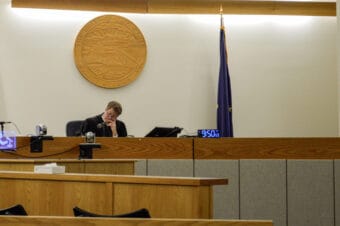
Courtroom A at the Dimond Courthouse in Juneau on Dec. 11, 2024. (Photo by Yvonne Krumrey/KTOO).

Editor’s note: This story originally reported the trial would begin Monday, July 14 due to a clerical error on the court system calendar. It actually begins Tuesday, July 15. 

A new trial date has been set for the Juneau chiropractor arrested four years ago on multiple sexual assault charges. Jeffrey Fultz is accused of assaulting more than a dozen women under the guise of medical care. His trial is scheduled to start next Tuesday.

This is Fultz’ third trial date. It comes after nearly 50 hearings and numerous postponements. But at a pre-trial hearing Tuesday, the state prosecutor, judge and Fultz’s defense attorney all said they plan to avoid further delays. 

A final pretrial hearing is scheduled for Friday. 

Police arrested Fultz in 2021 based on seven initial accusations that he had assaulted patients while he was a chiropractor for Southeast Alaska Regional Health Consortium. Fultz now faces 15 felony sexual assault charges and one misdemeanor harassment charge. 

Fultz has been living in Colorado since posting bail four years ago. He has made one in-person appearance in Juneau court since.

One of Fultz’s accusers, a woman the courts are identifying as C.E.L., said that she is relieved and grateful this case may finally go to trial. 

“So many of us have lived in this limbo, and we’ve been unable to fully heal, because the system that promises accountability has kept stalling,” she said.

Several factors contributed to the delay. The investigating Juneau police officer died. The first judge assigned to the case retired. Fultz’s first attorney was deemed “mentally unable” to continue with the case. 

Fultz hired his current attorney, James Christie, in January of last year.

Fultz’s case was first scheduled to begin trial in February of this year but was delayed as the court continued to process and release outstanding records. Then, it was scheduled for a trial date in April but was delayed yet again when a member of the defense team experienced serious health issues.

Some of the charges Fultz faces date back to 2014. 

“Once we get into trial, what we’ll see is that some of the victims, the harm happened to them 11 years ago,” C.E.L. said. “Like, that’s when Obama was in office.”

The Anchorage Daily News and ProPublica reported early this year that felony cases in Alaska often face years of delays requested by defense attorneys and approved by judges.

Due to new limitations established by the Alaska Supreme Court, cases filed before 2023 now have a limit of 270 days before they must go to trial starting in May. 

The order says the defense and prosecution are each allotted 90 days of delay requests, and a further 90 days is included for “other periods of delay for good cause.”

C.E.L. said long delays can take a toll on alleged victims of assault.

“This idea that ‘justice delayed is justice denied’ is absolutely true, and that every delay reinforces the idea that harm against victims isn’t urgent, isn’t serious,” C.E.L. said. 

The trial is scheduled for a five-week time period, starting next Tuesday and lasting into August. Judge Larry Woolford will be presiding. 

The public may attend proceedings in person in Courtroom A at Juneau’s Dimond Courthouse, or by phone.  

In early 2021, the Indian Health Services established a hotline for callers to report suspected sexual abuse by calling 1-855-SAFE-IHS (855-723-3447) or submitting a complaint online on the IHS.gov website. The hotline may be used to report any type of suspected child abuse within the IHS, or any type of sexual abuse regardless of the age of the victim. The person reporting by phone or online may remain anonymous.

People who suspect they may be the victims of sexual abuse in Juneau can also call AWARE at (907) 586-1090.

Judge throws out case against Eklutna Tribe’s casino

Dan Amadon is one of the first patrons to visit the casino during a private opening in January.
Dan Amadon was one of the first patrons to visit the casino during a private opening in January. (Photo courtesy of Chin’an Gaming Hall)

The Eklutna Tribe has operated its new casino outside Anchorage under the shadow of two separate lawsuits. A federal judge has dismissed one of those, filed by a group of property owners near the tribe’s casino in Birchwood.

With approval from the U.S. Interior Department, the tribe opened its Chin’an Gaming Hall on a Native allotment in February.

The property owners argued that the casino harmed the rural character of their neighborhood and claimed it would increase traffic, noise and raise the risk for water pollution. Their attorney, Don Mitchell, also challenged the Native Village of Eklutna’s status as a federally recognized tribe.

“Congress has never allowed a middle-ranking employee of the Interior Department to just wave a magic wand and create 200 Indian tribes, either in Alaska or any other place,” Mitchell said.

Mitchell is referring to Ada Deer, who served as Assistant Secretary of Interior during the Clinton administration. In 1993, she included Eklutna in a list of Alaska tribes to eliminate any doubt that they have the same status as tribes in the Lower 48. Numerous court cases have tried and failed to invalidate this decision. In a ruling on Friday, June 27, U.S. District Judge James Robart said the Eklutna lawsuit should be dismissed in “equity and good conscience.”

In a statement, Aaron Leggett, the president of the Native Village of Eklutna called the ruling a significant step forward, because it affirmed an important principle to the tribe — that its rights are firmly rooted in the land.

Tribal legal experts like Michelle Demmert says even one challenge to an Alaska tribe’s legitimacy threatens them all. They also consume time, energy and precious dollars, she says.

“Time and time again, the law is clear in these areas that continue to be challenged,” said Demmert, an attorney in the Tribal Governance Program at the University of Alaska Fairbanks. “If the argument was that the Eklutna tribe is not a tribe, there’s legal precedent. There’s federal law that says, ‘They are.'”

Mitchell disagrees that the federal law and courts have been clear on tribal jurisdiction in Alaska.

Depending on what the neighboring property owners decide, Mitchell says an appeal could be the next step, because the judge delivered a second blow to his case on Monday. Mitchell had asked the judge to reconsider his ruling, a motion he quickly rejected.

The tribe also faces another federal lawsuit, this one brought on by the Alaska Attorney general. It also aims to shut down the casino and contests the tribe’s authority over the land the gaming hall was built on land that was conveyed to the Ondola family under the Alaska Native Allotment Act of 1906.

The Chin’an Gaming Hall sits on about eight acres near the Birchwood Airport, which the tribe has leased from the heirs of the Ondola family. During the Biden administration, the Interior Department reversed course on an earlier decision that said Native allotments in Alaska could not be considered “Indian Country.” This step cleared the way for the casino’s approval.

Since the gaming establishment opened, it’s seen brisk business, sometimes with long lines waiting to enter. Chin’an means thank you in the Dena’ina language. For now, it’s a small gambling operation in a temporary building limited to electronic gaming. The Native Village of Eklutna hopes to build a permanent facility, so it can add restaurants and expand its operations. The tribe hopes to use the money to create jobs for its members and fund social and economic development programs.

Defense attorney says man accused of local woman’s murder has no plans to return to Juneau

A smiling woman sits at a table holding a spoon in a bowl of something you can't see
Photo courtesy of the family of Faith Rogers

Earlier this week, a man arrested for the 2022 murder of a Juneau woman was released from prison in Wasilla.

In early June, a judge dismissed charges against Anthony Michael Migliaccio based on a lack of evidence. On Monday, Juneau’s District Attorney Whitney Bostick decided not to refile charges.

“At this time, the State no longer believes it can prove the case beyond a reasonable doubt,” Bostick said as part of her statement. “While this decision may be painful, it reflects our legal and ethical responsibility under the law.”

The Department of Law said the decision was based on new information, but declined to say what that new information was or elaborate beyond the initial statement.

Migliaccio was arrested two months after Faith Rogers was found dead on a popular Juneau hiking trail in September 2022. Migliaccio was indicted on charges of murder and manslaughter.

Since his release Monday, some Juneau residents have questioned this outcome. They have been posting their frustrations and fears online. A Reddit post contains a video allegedly posted by Migliaccio talking about planning to get away with murder. And on Facebook, commenters say they aren’t sure if it’s safe to walk trails alone in Juneau.

Betsy Holley from the Department of Corrections says Migliaccio declined transport back to Juneau, and was released to a pre-trial facility in Palmer with no supervision.

Migliaccio maintains his innocence and his attorney, Nico Ambrose, says his client has no plans to return to Juneau.

Ambrose issued a statement Thursday saying police arrested the wrong person. Ambrose argues that public pressure to make an arrest led to this outcome.

“I think the record bears out that the pressure to close the case led the police to cut corners and rush their investigation with the result that they charged the wrong person,” his statement reads.

Ambrose said he doesn’t know why the state stopped pursuing the case, but he offered a few speculations in the emailed statement. He points to a lack of physical evidence.

Police found no blood or DNA from Rogers on Migliaccio when they contacted him hours after her death. He was allegedly wearing the same clothes described by witnesses who saw him near the scene of the crime.

Ambrose said police also lost possible evidence obtained via a search warrant for Rogers’ phone backups, though police say the department re-obtained the evidence. Ambrose also said the police didn’t investigate a conflict she was having with family members.

In an email Thursday, Juneau Deputy Police Chief Krag Campbell defended the department. He said JPD’s investigation showed that Migliaccio was the sole suspect in the case after speaking with multiple people associated with Rogers and the investigation into her death.

“The investigation showed enough evidence to form probable cause that Migliaccio was the suspect in the murder of Faith Rogers,” he said. “And it was determined that he posed an active threat to the community.”

Campbell said JPD stands by the investigation it conducted in 2022.

He said Migliaccio remains the primary suspect in Rogers’ murder and the case currently has no active leads, though JPD will investigate any new information.

Family of missing Juneau man asks for community’s help in their search

A candles burns near a missing person’s poster of Benjamin Stepetin at his brother’s apartment on Thursday, July 3, 2025. (Photo by Clarise Larson/KTOO)

It’s been nearly two weeks since 42-year-old Juneau resident Benjamin “Benny” Stepetin was last seen by his family in downtown Juneau.

His brother, former Juneau School Board member Martin Stepetin Sr., said he last spoke to him over the phone on June 17.

“I really hope that wasn’t the last phone call I had with him,” he said. 

On Thursday morning, Martin and his other brother, Carl Stepetin Sr., sipped coffee in his apartment as they prepared to take a skiff out on Gastineau Channel to look for their missing brother. A candle burns next to Benjamin’s missing person poster nearby. 

“It’s been about 11 days now, which is hard to say. It still feels like it’s the first day,” Martin said. “That’s way unusual — that’s not normal at all.”

Benjamin is Alaska Native, about 5 feet, 6 inches tall and has brown eyes. He’s well-known in the downtown area and has been homeless for roughly two years. Martin said Benjamin became homeless again after two years of sobriety.

On Monday, the Juneau Police Department shared a Facebook post that asked the public to help locate Benjamin. Department spokesperson Erann Kalwara said a detective has been assigned to investigate the case and police are working to track down any leads. 

Benjamin is listed on the Alaska Bureau of Investigation’s missing persons clearinghouse page and a Missing and Murdered Indigenous Persons investigator with the state’s Department of Public Safety is assisting in the search. 

Martin said his family and more than a dozen volunteers have spent multiple days looking for Benjamin all across town and had 500 missing person posters printed to put up around town. So far, they’ve only heard rumors.

“We’re going off a bunch of hearsay, but it doesn’t matter what we hear, how crazy or ridiculous it sounds,” he said. “We’ve been following up every single tip.”

Benjamin’s disappearance coincides with another missing person case in Juneau this week. Search and rescue responders are also actively searching for a cruise ship passenger who has not been seen since leaving for a hike Tuesday morning. As of Thursday afternoon, she’s still missing.

Martin said he’s grateful that JPD has assigned a detective to the case, but he still thinks there aren’t enough resources in Juneau to ensure the search for his brother is getting enough help. His family worries they may now be looking for his remains. 

“I don’t want this to happen to anybody ever, but if it does, I hope that they have a better way of getting through it than we did,” he said. “We’re kind of on our own.”

He said he also thinks the stigma and association with homelessness mean this search is not being taken as seriously as others. 

“He’s got two kids, and he’s got three siblings. He’s a good man. He’s a good guy, a happy person,” Martin said. “Benny’s a fisherman, a really good basketball player — and he’s missing.”

Police and family encourage anyone with information about Benjamin’s whereabouts to contact the department. 

Site notifications
Update notification options
Subscribe to notifications