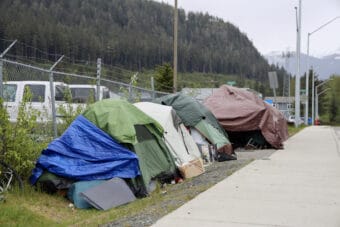
One of several ash piles near the entrance to White Sands Beach near Kodiak. The beach is a popular spot for bonfires, fishing, bear watching, walks, or letting dogs run around off-leash. (Brian Venua/KMXT)
A Kodiak grand jury has indicted a 16-year-old in connection with an explosion last month at a popular beach that injured 11 teenagers.
The state Department of Law said in a press release that Kavik Skonberg, a high school junior, was indicted Thursday on felony charges. He’s being charged as an adult for multiple counts of first- and third-degree assault for allegedly causing the explosion at a party at White Sands Beach in Kodiak.
The indictment comes after about a month-long investigation from Alaska State Troopers. The incident occurred at a popular recreation area after a 55-gallon fuel drum was thrown into a fire in the early morning hours on Nov. 10, causing five teens to be medevaced to Anchorage for severe burns. Some have already returned to the island, however others are still being treated in Anchorage.
Several fundraisers have been held locally to support the victims. It is unknown if Skonberg will also be held responsible for any of the treatment or counseling costs on top of the criminal charges.
Water rushes past homes and reinforced riverbanks along the Mendenhall River during Juneau’s annual glacial outburst flood on Monday, August 5, 2024. (Photo by Eric Stone/Alaska Public Media)
Since the record-breaking glacial outburst flood damaged hundreds of homes in August, the City and Borough of Juneau has been focused on its short-term plan to install flood barriers along the Mendenhall River in hopes of holding back the next glacial outburst.
It’d be a temporary measure, but city leaders have maintained that it’s imperative. Some residents from flood-prone neighborhoods don’t see it that way. Starting next week, residents in Juneau’s Mendenhall Valley will be asked to weigh in on the proposal, and some, like Noah Teshner of Lakeview Court, said they’ll vote against it.
Teshner is part of a small group of well-organized homeowners that are calling themselves the Juneau Flood Solution Advocates. They’ve held community meetings attended by more than a hundred residents from flooded neighborhoods. Teshner said many would rather see a long-term solution to flooding, and they feel rushed by the city’s plan.
“It doesn’t give people the opportunity to make an educated decision,” he said. “It’s like a drowning man. You’re going to reach out and cling to the first thing that you can that you think is going to save you.”
City Manager Katie Koester said she wants a more permenant flood prevention plan too, and earlier this month she visited Washington, D.C., along with other representatives from the city and from the Central Council of Tlingit and Haida Indian Tribes of Alaska to seek funding for it. But she said its success will depend on more immediate action, and the barriers are a critical way to buy time before next summer’s glacial outburst flood.
“We’re really concerned that if we don’t have a temporary, short-term solution, we won’t have much to protect,” she said.
The barrier installation would cost homeowners nearly $8,000 each over the next 10 years. A long-term solution would almost certainly be more–but homeowners might be less likely to have to foot the bill.
Juneau Flood Solution Advocates released a video earlier this month to draw attention the August flood and a Fairbanks project that they believe is a good example for Juneau. After a devastating city-wide flood in 1967, the U.S. Army Corps of Engineers took on the massive Chena River Lakes Flood Control Project. Teshner wants something like that to control the flow of water at Mendenhall Lake.
And Koester said the Corps might be interested in pursuing that, but any long-term flood prevention project will require a lot of study, permitting and funding. For instance, it took six years for Chena River Lakes Flood Control Project to break ground and more than a decade to complete construction.
Koester says the Army Corps suggested the barrier plan as a first step.
“We really need to follow their advice, because they are our partner in finding a long term solution to this problem,”
For Debbie Penrose Fisher, president of the Juneau Flood Solution Advocates, the city’s focus on the barrier plan has been scary. She worries that if she and her neighbors don’t go along with it, they won’t receive any help at all. And she said she’s willing to wait for a long-term solution, even if that means flooding again.
“I choose not to be told scare tactics, and ‘It’s this or nothing,'” she said. “I think if I’ve seen from the community that we’re strong and we can come together and until they solve this in a long term way.”
She wants the city to develop a plan that makes the flood season easier on her and her neighbors–something with details for a better warning system, evacuation plan and sandbag deployment ahead of next year’s flood.
Penrose Fischer and nearly 500 other homeowners will weigh in on the barrier proposal over the next few weeks. They’ll have the opportunity for public comment at the regular Assembly meeting on Monday, Dec. 16th.
Courtroom A at the Dimond Courthouse in Juneau on Dec. 11, 2024. (Photo by Yvonne Krumrey/KTOO).
The criminal case against Jeffrey Fultz, the chiropractor accused of assaulting more than a dozen women under the guise of medical care, is on track to go to trial in February after three years and 32 readiness hearings.
At a hearing Wednesday, Assistant District Attorney Jessalyn Gillum said the repeated delays in this case have taken a toll on the alleged victims who call in to testify at most hearings.
“The idea of just sort of delaying for delay’s sake does sometimes have an adverse effect on witnesses’ willingness to participate,” she said. “They get tired, they get fed up.”
Police arrested Fultz in 2021 on three charges of sexual assault. Those charges are based on accusations that he assaulted patients who sought chiropractic care while he worked for Southeast Alaska Regional Health Consortium. More women have come forward since. A total of 14 women have now accused Fultz of assault. Some of the crimes date back more than a decade.
A number of factors have delayed the trial, including the case’s complexity, the number of witnesses, and a backlog of criminal cases in Juneau during the COVID-19 pandemic. Over the last three years, the first judge assigned to the case retired, the investigating Juneau police officer died, and Fultz’s attorney was deemed “mentally unable” to continue with the case.
Fultz has been living in Colorado since he posted bail three years ago. He has made one in-person appearance in court since.
Fultz’s attorney James Christie took on the case last January. He has requested that the witnesses who call in to court to testify be publicly identified and has filed a motion to request broader access to witnesses’ medical records. The judge denied both requests.
Christie has also argued at each hearing that his team hasn’t had enough time to review the case.
“I understand that everyone on the line has rights here and my client’s constitutional right to a fair trial trumps all of them,” he said on Wednesday.
Presiding Judge Larry Woolford scheduled hearings around a Feb. 18 trial date.
Gillum acknowledged that this isn’t a simple case, but said the case has been delayed for three years and it has to go to trial.
“It is the court’s responsibility at the end of the day, I think, to ensure that all the rights of individuals involved are being protected and also balanced,” she said. “Defendants have the right to a fair trial. They have the right to a speedy trial. Victims also have rights under the Victim’s Rights Act.”
One alleged victim called in to Wednesday’s hearing. She said she has been waiting for this trial to happen for a long time, and it’s been hard on her.
“Each time we have these hearings and it keeps getting continued, it is just a constant retraumatization of the victims,” she said. “It feels like it’s never going to be resolved and the longer it goes the more it feels like we don’t matter. It also feels like he gets to live his life and be happy.”
Judge Woolford scheduled a readiness hearing for Dec. 27 at 9 a.m. He says he has blocked out a five week trial starting on Feb. 18, 2025.
A U.S. Coast Guard HH60 Jayhawk helicopter flies over Juneau, Alaska, on Saturday, Oct. 2, 2021. (Photo by Mikko Wilson/KTOO)
Update, 10 a.m. Tuesday:
The U.S. Coast Guard has suspended its search for five missing mariners after their fishing boat capsized near Point Couverden.
The Coast Guard received a mayday call shortly after midnight on December 1 from the Wind Walker, a 52-foot seiner based in Sitka. The crew reported that their boat was overturning. Attempts by the Coast Guard to gather additional information from the crew over the radio failed. Soon after, an emergency position-indicating radio beacon registered to the Wind Walker was detected just south of Point Couverden, in Icy Strait.
For 24 hours, the Coast Guard searched over 108 nautical miles for the missing crew to no avail. Chief Warrant Officer James Koon is a search and rescue mission coordinator for the Coast Guard in Southeast Alaska. In a statement issued on Monday afternoon (Dec 2), he wrote, “We stand in sorrow and solidarity with the friends and family of the people we were not able to find over the past 24 hours.” The Coast Guard did not release the names of the passengers on the vessel, but confirmed to KCAW that next of kin have been notified.
While the Coast Guard has suspended the search for now, it could pick up again pending new information. Anyone with new information about this situation is requested to contact Coast Guard headquarters in Juneau at 907-463-2980.
Initial report:
The U.S. Coast Guard has released no new information regarding the search for a seiner which reportedly capsized in heavy weather near Hoonah early Sunday morning.
The Coast Guard received a mayday call shortly after midnight on Dec. 1 from the Wind Walker, a 52-foot seiner based in Sitka, when the crew reported that their boat was overturning.
Attempts by the Coast Guard to gather additional information from the crew over the radio failed. Soon after, an emergency position-indicating radio beacon registered to the Wind Walker was detected just south of Point Couverden, in Icy Strait.
This type of device – called an EPIRB – is attached to the cabin of a boat, and releases automatically when submerged.
The state ferry Hubbard was in the vicinity and overheard the mayday, and diverted to Wind Walker’s last reported location to begin the search. A helicopter from Air Station Sitka and a 45-foot medium-response boat from Coast Guard Station Juneau arrived and joined the Hubbard, as did the Coast Guard cutter Healy.
The Coast Guard believes five crew were on board the Wind Walker when it capsized. Reports on social media claiming that some of the victims had been found were incorrect: So far, only seven survival suits and two strobe lights have been located in the water in the search area.
Local weather conditions in Icy Strait early Sunday morning included heavy snow, 45 to 60 mile-per-hour winds, and 6-foot seas.
Cassandra’s face and arms were both badly burned. (Courtesy Gustavo Canaveral)
One of eight Kodiak teenagers severely injured in an explosion on a local beach is talking about the aftermath, as well as her hopes and worries about her recovery.
“I thought I died, because, just, that’s all I saw,” Cassandra Canaveral said in an interview from her hospital bed. She was among the five victims medevaced after the Nov. 10 blast, caused by a fuel drum thrown into a bonfire. “All I saw was light for a couple seconds, and then the fire got extinguished.”
Cassandra was about a week from her 17th birthday, at a bonfire in the middle of a stormy weekend, when the explosion on White Sands Beach sent her to a hospital in Anchorage. She was still there being treated last week when she discussed the incident.
Cassandra said she noticed her head and facial injuries first.
“I started feeling my hair and I could pull out some chunks, and I was like, ‘I got burned bad,’” she said. “So I looked for my friends and I was kind of just – I remember what I was saying the whole time. I was just talking like, ‘I got burned.’”
Her friends tried to reassure her as they poured cold water on her face as a sort of first aid, but she knew she needed to see a doctor. Her brother called their parents. Gustavo Canaveral, their father, agreed.
“I met her at the hospital and then I just learned from what she and my son told me – that the kid threw the barrel into the fire and exploded,” he said.
It was a harrowing reunion.
“She said, ‘Papi, I got burned,’ and I’m thinking like, ‘Yeah, you sure did,’” Gustavo recalled. “It was like the blisters on the skin was sort of like, melting off her face, and her hands were just bloody and black. It was pretty shocking and frightening.”
Cassandra was glad to see him though.
Cassandra Canaveral before a Nov. 10, 2024 explosion on Kodiak’s White Sands Beach sent her to the hospital. (Courtesy Gustavo Canaveral)
“I had a small wave of relief then because it was like, OK. It was kind of grounding to (be) seeing my dad there and being like ‘OK, I’m going to get through this,’” she said.
And she did. Or at least, she’s still getting through it.
By the time she comes home, Cassandra will have spent about two weeks in the hospital. Some of her peers might be there longer. Their injuries have spurred an outpouring of support from the community. But recovering from the explosion – physically and emotionally – will take time.
Scott Ellis is the chief of the Bayside Fire Department. He was the first emergency responder on the scene. The initial call was for an uncontrolled fire. Then he heard that several children were injured. But when he got there, all the teenagers had left.
Ellis and his team found the metal barrel about 10 feet away from the still-burning fire, and the area smelled of fuel. He said he’s glad the barrel didn’t rupture, or injuries could have been much worse.
“That would have been catastrophic,” he said. “You would have had the metal of an everyday 55-gallon metal barrel fracturing catastrophically and moving at very high speeds in multiple directions, shrapnel everywhere.”
He said he hopes people will pay more attention to fire safety now.
Alaska State Troopers have said an unnamed suspect who allegedly threw the fuel drum was taken into custody and held by the state Division of Juvenile Justice.
The explosion shook the Kodiak community, but people didn’t just reel – they organized. At least six GoFundMe pages were set up, and nearly all of them hit their goals right away. Some even doubled their original asks, including the one for Cassandra’s family. Other victims who solicited donations included Alexia Cobban, Mia Vasquez, Brian Dierich, and Kavik Wolfe. The only page that hasn’t hit its goal is for a victim who wanted to be anonymous.
One community member, Chislyn Hoen, even set up an account at a local Credit Union 1 branch for donations, to avoid GoFundMe’s fees. That money is expected to be split evenly among the affected families.
Artists and businesses are supporting the victims, too. Robert Wagner auctioned off a painting, while Highmark Marine and Outdoor Kodiak are hosting a drive-in movie and paintballing as fundraisers.
The support has helped give Cassandra hope.
“I feel so blessed and lucky to have such a tight-knit community,” she said. “For a wide majority of people I see everyday come together and be so willing to give so much money to people they don’t even know.”
Her father said he’s grateful, too – he’s not sure if their insurance will cover the emergency flight.
Teachers and school administrators have already begun preparing for Cassandra and her peers to return. The school district’s superintendent, Cyndy Mika, said there’s already a policy for it called a medical 504 – a sort of specialized education plan to help kids with specific needs.
“If the burns are to the hands, they probably won’t be able to use their hands for a while. So schoolwork is going to look different for them, right?” Mika said. “So that’s what we will be working individually with each family: to come up with plans to meet the needs of their students.”
The district is also prepared for the mental health impacts – it increased its counseling services after the explosion, and the superintendent acknowledged it might be a while to heal what she called “hidden injuries.”
Cassandra said she knows things will be different when she comes back. She still wants to play basketball, but she won’t be as competitive as she had hoped. And her teachers and friends all know why she’s been away.
She just hopes things don’t change too much.
“I am looking forward to seeing everybody again,” she said. “I hope that my recovery is kind of at a good point, to where people aren’t going to be shocked when they see me. Because I don’t want my appearance to change the way people treat me.”
She also knows that she’s probably changed, too.
“My biggest takeaway that’s always going through my mind is valuing life,” she said. “It was just so crazy how quickly my life just could have been gone, and I didn’t realize how much I cherished my life until I was just sitting in the car, realizing that I almost, fully, could have died.”
Cassandra was hoping to be discharged from the hospital and back in Kodiak soon.
A fresh layer of ice on Mendenhall Lake on Sunday, Nov. 24, 2024 (Photo by Clarise Larson/KTOO)
Dozens of bikers, figure skaters and hockey players took to the ice at Juneau’s Mendenhall Lake this weekend. But venturing out onto a frozen lake can be extremely dangerous, and several reports of people falling through the ice circulated on social media.
Cold temperatures allowed several inches of ice to form at the surface of Mendenhall Lake and Twin Lakes over the last week, but meteorologist Nicole Ferrin with the National Weather Service office in Juneau said lake ice that may appear solid is still prone to give way, especially near running water like streams or waterfalls and, in the case of Mendenhall Lake, near the face of the glacier.
“Even if it looks like it’s frozen solid, there’s a lot of inflows and outflows of the lake where the ice thickness might not be as thick,” Ferrin said.
The National Weather Service office in Juneau does not monitor ice conditions, nor does the U.S. Forest Service, which manages Mendenhall Lake.
According to Capital City Fire Rescue, crews did not respond to any incidents at the lake over the weekend. One person reached via Facebook said they were present when a child’s leg broke through the ice on Sunday, but the child was able to pull himself out and crawl to safety.
Ferrin said the crowds of people on the lake this weekend don’t necessarily prove that the ice is safe.
“Just because you see someone else out on the lake doesn’t mean that they are necessarily measured,” she said.
NOAA ice safety guidance. (Image courtesy of the National Weather Service Juneau)
Generally, 4 inches of ice can support ice fishing and walking, 5 inches can support small groups of skaters, and 6 inches can support snow machines, according to guidelines from the National Oceanic and Atmospheric Administration. The National Weather Service also advises that people keep a distance of at least 300 yards from the face of the glacier.
Close
Update notification options
Subscribe to notifications
Subscribe
Get notifications about news related to the topics you care about. You can unsubscribe anytime.