Search & Rescue

Father and 2 young children rescued after taking wrong Ketchikan trail

A hilly, wooded coastline
Settlers Cove State Park (KRBD file photo)

Three hikers were rescued from a popular trail on the north side of Ketchikan on Tuesday.

Jerry Kiffer of the Ketchikan Volunteer Rescue Squad says it happened on a trail above Settlers Cove State Recreation Site. He says state troopers got a call about three overdue hikers around 11 p.m.

The caller said the 35-year-old man was new to the area and had gone for a hike with his two small children, ages 4 and 6.

“This would be his first hike out with the kids, and they were fairly lightly dressed — not really prepared for a day hike, no real supplies, no lights other than what’s on their cell phone,” Kiffer said by phone Tuesday afternoon.

He says a rescue squad team found the man and his kids about two miles up the Lunch Creek Trail just after midnight. He says they were cold and wet but otherwise OK. Rescuers carried the children back to the trailhead, arriving before sunrise Tuesday.

Kiffer says the hikers didn’t mean to attempt the difficult five-mile out-and-back trail — he says they meant to hike the nearby Lunch Falls Trail, which is a half-mile loop.

And they’re not the first people to end up on the wrong path. Kiffer says others who have required search and rescue in the area have made the same mistake.

“They’re under the impression by either the signage, or the way the trail system is laid out that the trail that you can access at the end of the road — at the end of North Tongass Highway — is the actual loop trail that they’re thinking will bring them back down into Settlers Cove Park,” he said. “When in reality … you would enter the loop trail if you went left and went down towards the water. Most people, though, they’re going right, they’re going up on the Lunch Creek Trail.”

In March 2020, a five-year-old boy was found dead on the Lunch Creek Trail after he and his mother reportedly lost their way in the snow. Kiffer says warmer temperatures during Tuesday’s rescue helped prevent dire consequences.

Kiffer says it’s a good idea to bring a flashlight, warm and dry clothes, some way to start a fire, and a GPS beacon when venturing out into the wilderness. It’s also a good practice to let someone know where you plan to hike and when you’ll return.

The Ketchikan Volunteer Rescue Squad loans out locator beacons for free at the Ketchikan Public Library, the Ketchikan Visitors Bureau and the local Alaska State Troopers post.

It’s the second backcountry rescue in the Ketchikan area in less than a week. On July 27, searchers located two hikers who had lost their way on a popular traverse. The pair was unharmed.

Two hikers rescued from Ketchikan trail after losing their way in the snow

A topo map showing the trail where the hikers got lost
A map of the Deer Mountain to Silvis Lakes Traverse (U.S. Forest Service)

Two people were rescued on July 27 after losing the trail during a backcountry hike near Ketchikan. The pair was unharmed.

The head of the Ketchikan Volunteer Rescue Squad, Jerry Kiffer, says the hikers were attempting a popular traverse through the mountains when they got lost in the snow.

“They were doing a Silvis to Deer Mountain traverse with a scheduled overnight over on Mahoney Mountain,” Kiffer said.

Kiffer says the hikers ended up on a spur trail to John Mountain by mistake and got lost in the snow as they returned to the main trail. Kiffer says the hikers called for help when they found themselves stuck in steep terrain.

“We had kind of sketchy cell phone connectivity with them. They had to get just in the right position to be able to get a signal, but they were able to get a signal out,” he said.

The rescue squad was then able to locate the hikers and lead them to safety.

Kiffer says the episode serves as a good reminder that the 14-mile trek is a challenging hike even for those with plenty of experience outdoors.

“That traverse is, I think, probably the most underestimated hike that we have locally. … That whole part of the trail from Blue Lake out until you drop down into Silvis, just use caution there. It’s not very well marked,” he said. “It’s very easy to get off the trail.”

Kiffer says it’s a good idea to let someone know where you plan to hike and when you plan to return, and to carry a GPS beacon like a SPOT. The Ketchikan Volunteer Rescue Squad loans out SPOT beacons for free at the Ketchikan Public Library, the Alaska State Troopers post, and the Ketchikan Visitors Bureau.

Anchorage floatplane crash sends 6 to hospital, including 2 seriously injured

A badly damaged plane partially submerged, nose down, in a floatplane lagoon
A de Havilland Canada DHC-2 Beaver floatplane partially submerged in Anchorage’s Lake Hood after crashing while taking off the morning of July 26, 2022. (Photo courtesy of Ted Stevens Anchorage International Airport Police and Fire Department)

A floatplane heading to Katmai National Park and Preserve crashed Tuesday morning while departing Anchorage, injuring six of the seven people onboard, according to the National Transportation Safety Board.

Two were seriously injured, four suffered minor injuries and all six were taken to area hospitals, said Clint Johnson, head of the NTSB’s Alaska office. The seventh person was not injured, according to Ted Stevens Anchorage International Airport Police and Fire Department.

Johnson said the passengers were visitors from the Lower 48 flying with Regal Air, which offers flights to Katmai, famous for its bear viewing.

The de Havilland Canada DHC-2 Beaver had just lifted off from Anchorage’s Lake Hood Seaplane Base when it crashed back into the water a little before 9:20 a.m. Tuesday, Johnson said.

“So it was during the initial climb phase, it crashed shortly after takeoff,” he said.

Beyond that, Johnson said he could not comment on any early indications as to what went wrong.

Airport Police and Fire Chief Aaron Danielson said the pilot reported a gust of wind struck the plane as it was taking off, and the pilot tried to correct its course. The pilot and passengers were able to exit the crashed plane on their own, and nearby good Samaritans jumped into the water to help them out, Danielson said.

The plane was partially submerged following the crash, and Regal Air was working with its insurer to remove it from the water, Johnson said. After that, investigators would examine the wreckage, he said.

Reached by phone Tuesday afternoon, Regal Air declined to comment.

Some Alaska fishermen likely have defective survival suits on board

A close-up of part of a survival suit showing a seam separating
Close-up of the defect on a new Survitec immersion suit. Glue attaching the zipper to the neoprene shell does not adhere well. (Photo by Dylan Simard/KMXT)

Kodiak Marine Supply is a large department store on Kodiak’s dockside, selling just about anything one might find on a fishing boat. Normally, that would include survival suits — but not right now.

Jordan Clay is a sales representative at Kodiak Marine Supply. She says that her store got a call from the Coast Guard in early July.

“They did tell us to inspect and pull our suits off the shelf,” Clay said.

Kodiak Marine Supply stocks Jumbo Immersion suits, which are made by Survitec. The Coast Guard issued a warning on July 1 cautioning sailors and vendors to look carefully at immersion suits made by Survitec.

After inspection, Kodiak Marine Supply pulled out their whole remaining inventory of about six suits.

“Most of the boats prefer that suit over other suits,” Clay said.

The defect involves a patch of glue that is meant to adhere the suit’s waterproof zipper to the suit’s neoprene shell. The defect could allow freezing seawater to enter the suit, making it unsafe. Most of the suits have been manufactured very recently.

Kodiak Marine Supply has already sold 20-30 of these suits — the Coast Guard requires fishermen to have survival suits on board.

Clay says they’re offering refunds. But it’s too late for some fishermen, who are already chasing the red salmon run in Southeast Alaska.

“A lot of guys are keeping their stuff on their boats just to … for something. I mean, they can’t have nothing,” Clay said.

It’s unclear how Survitec is going to respond — Clay says she expects a refund to retailers.

Survitec has not responded to requests for comment.

Coast Guard finds serious defect in popular survival suit

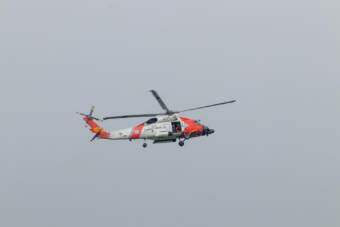
MH-60 Jayhawk helicopter crews perform a search and rescue demonstration off the back of the Coast Guard Cutter Munro April 15, 2013, in Womens Bay, Kodiak, Alaska. (U.S. Coast Guard photo by Petty Officer 3rd Class Jonathan Klingenberg.)

The Coast Guard has found a serious defect with a common brand of survival suit that may reduce their usefulness in emergencies.

Survival suits, also called immersion suits, are full-body protective suits that the Coast Guard requires on commercial fishing vessels for sailors to wear in an emergency. The suits have flotation devices and are meant to protect sailors from freezing water as they await rescue.

A close-up of part of a survival suit showing a seam separating
Close-up of the defect on Survitec immersion suits. The glue attaching the zipper to the neoprene shell does not adhere well.

Scott Wilwert is the commercial fishing vessel safety program manager for the Coast Guard in Alaska. He says the problem was discovered during a routine inspection in June.

“Inspectors that were out in Bristol Bay a few weeks ago reported finding issues with relatively newly manufactured immersion suits,” Wilwert said. “And what they were finding was an area of what appeared to be a delamination, or a lack of adhesion of the glue that’s used to fix the zipper assembly to the neoprene part of the suit.”

The suits are Imperial Immersion Suits manufactured by Survitec Group, a safety equipment manufacturer based in the United Kingdom that makes everything from lifeboats for submarines to “G” suits for fighter pilots. They are one of only a handful of companies approved by the Coast Guard to make survival suits for use in the United States.

Wilwert says the Coast Guard isn’t sure how widespread the issue is. The problem became apparent in late June. After the Coast Guard notified Survitec, the company told the Coast Guard they had seen suits in Canada with a similar defect.

Wilwert says the Coast Guard then began finding more suits in Alaska with the same problem.

“I started to get a little feedback from some local Alaskan Coast Guard units who had taken it upon themselves to walk into some of the retail stores and vendors in their towns,” Wilwert said.

The Coast Guard did find suits on shelves that bore the defect. All were Imperial suits manufactured in the last few years.

Wilwert says that Survitec is investigating the defect and may soon issue a “general service bulletin” that will outline the extent of the problem and possible remediation for it, potentially including a recall.

Survitec could not be reached for comment in time for this story.

Plane missing since Monday found crashed at Thompson Pass

A power line in the mountains in heavy fog
The slopes above Thompson Pass on July 12, 2014. A National Guard helicopter crew located the crashed plane Thursday afternoon at the top of Thompson Pass, about 1,000 feet off the Richardson Highway.(Photo by Ian Dickson/KTOO)

Wreckage of a plane that went missing July 11 has been found in the mountains near Valdez.

Alaska State Troopers say the sole occupant, 38-year-old pilot Andy Andersen of Sutton, died in the crash.

According to Troopers, Anderson departed Valdez in the Aeronca Champion plane Monday evening headed for Sutton, and a search was launched after he failed to show up.

Troopers say an Alaska Army National Guard Black Hawk helicopter crew found the downed plane Thursday afternoon at the top of Thompson Pass, about 1,000 feet off the Richardson Highway.

They say Andersen’s body was recovered and will be taken to the State Medical Examiner’s office, and that the National Transportation Safety Board plans to investigate the cause of the crash.

Site notifications
Update notification options
Subscribe to notifications