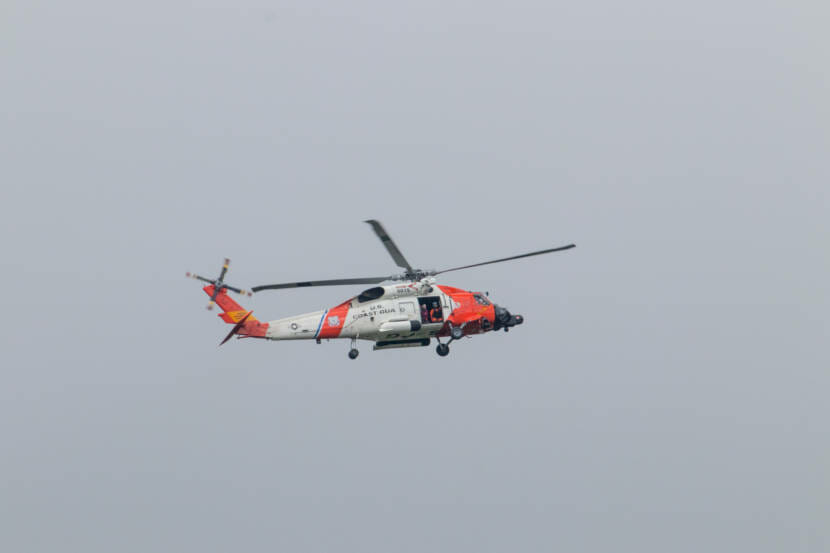
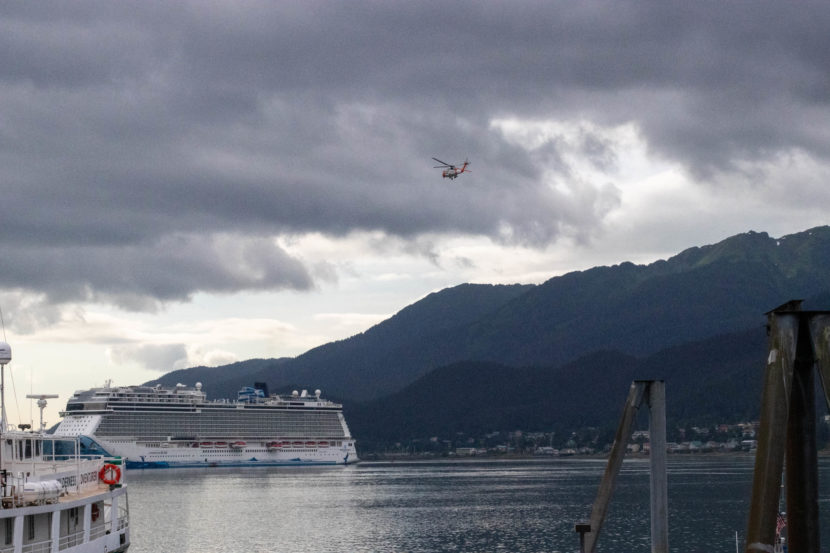
A U.S. Coast Guard HH60 Jayhawk helicopter flies over Juneau, Alaska, on Saturday, Oct. 2, 2021. (Photo by Mikko Wilson/KTOO)
Rescue crews were attempting Monday to reach a plane that crashed Sunday afternoon in mountains near Cordova. The crash left the pilot dead, according to the U.S. Coast Guard.
Coast Guard spokesman Petty Officer 1st Class Nate Littlejohn said an emergency locator transmitter signal was received from the plane just before 2:30 p.m. Sunday.
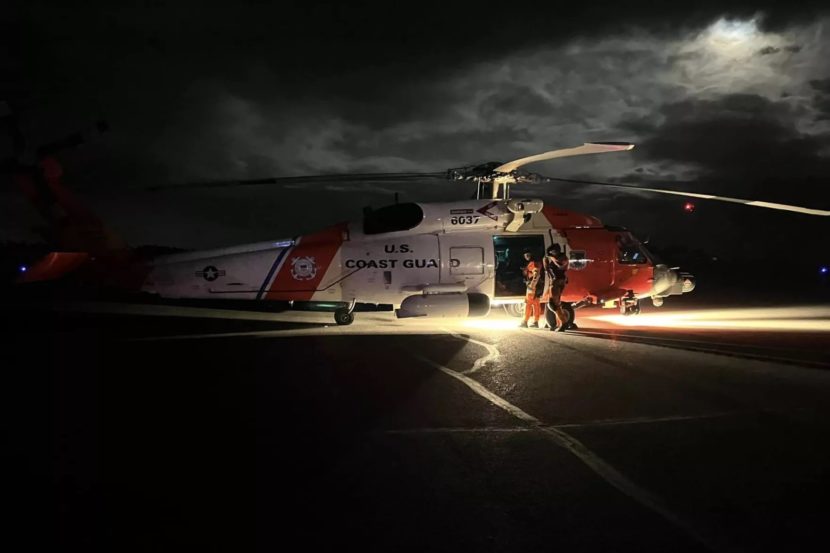
An MH-60 Jayhawk rescue helicopter and a C-130 search plane were sent from Air Station Kodiak to the crash site in the Heney Range west of Cordova and arrived about three hours later.
“They discovered wreckage on steep, cliff-like terrain at an elevation of about 1,700 feet,” Littlejohn said. “Crews were not able to lower anyone to the site due to difficult terrain and poor flying conditions with low ceilings, low visibility, rain and mist. The Coast Guard helicopter hovered and searched in the area, but did not find any sign of life.”
Clint Johnson, the National Transportation Safety Board’s Alaska chief, said the plane’s pilot was its sole occupant. Contact with the pilot was lost just before the crash, with no further transmissions received as of Monday afternoon.
Federal Aviation Administration data listed the aircraft as a Piper PA-32 Cherokee operated by Nunak Air Taxi, which does business as Friendship Air. A call to the company wasn’t immediately returned Monday.
Johnson said an NTSB investigator was accompanying Alaska State Troopers and U.S. Coast Guard personnel on Monday’s attempt to reach the crash site.
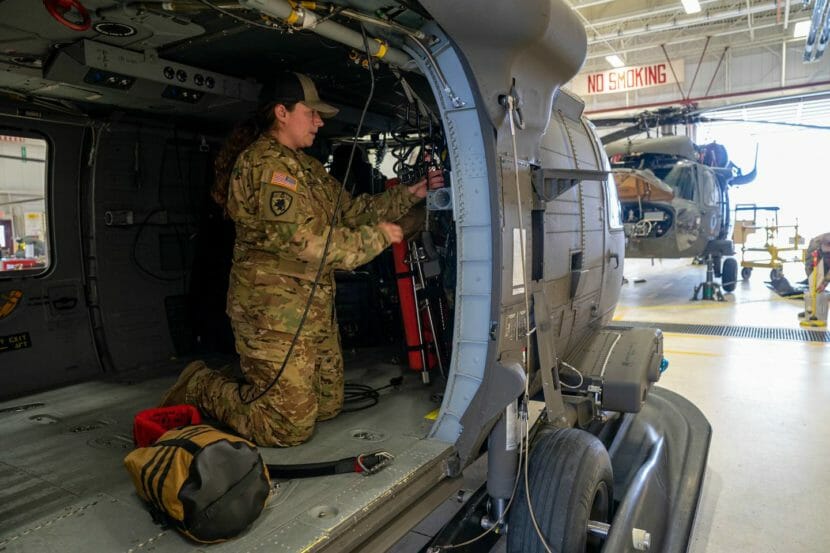
Sgt. First Class Mikana Halloran demonstrates the capabilities of the HH-60M Black Hawk medevac helicopter on Joint Base Elmendorf-Richardson on Sept. 7, 2022. (Loren Holmes/ADN)
By the time Sgt. 1st Class Mikana Halloran descended from a helicopter by way of a winch-fed cable toward the top of Crow Pass, her target, a single hypothermic hiker, was stripped down near naked.
“He left all his stuff on the ground. He was just wearing his underwear,” Halloran said of the August rescue.
Stuck in the wet and cold of the Chugach Mountains, the man gradually shed all his soaked outerwear trying to keep it from further freezing him, until, by the time help arrived, he was left in just base layers.
Halloran strapped him into a harness, and the pair ascended into the belly of a Black Hawk outfitted for medical care. There, she jammed heat packs under the otherwise-uninjured man’s armpits before swaddling him in blankets for the flight to an Anchorage hospital.
Halloran, who grew up in Healy, is a medic with the Alaska Army National Guard, one piece of the state’s elaborate web of agencies, organizations and individuals involved in searches, rescues, and recoveries — the technical euphemism for returning the body of a person who has died afield.
The number of search and rescue missions in Alaska is rising, gradually ticking upwards in recent years from a combination of proliferating safety devices, social trends and esoteric but effective reconfigurations in military-governmental bureaucracy. Officials say that taken all together, the changes generally mean less searching, more rescuing.
Still, few Alaskans, even those who know in the back of their minds they will be saved if they twist an ankle on a backcountry hike or flip a four-wheeler out moose hunting, know much about the intricate system that launches into place once they hit SOS on an InReach or text a spouse to send help.
The short version is: it depends where you get hurt.
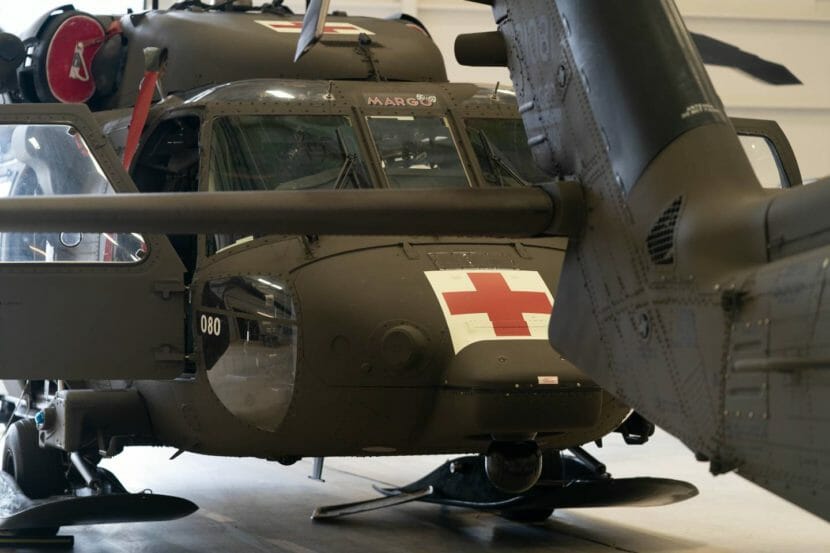
Two HH-60M Black Hawk medevac helicopters sit in a hangar on Joint Base Elmendorf-Richardson on Sept. 7, 2022. (Loren Holmes/ADN)
‘There’s been a lot of airplane crashes for us this summer’
To a civilian, the jigsaw puzzle of jurisdiction and chains of command between federal, state, and civilian authorities involved in a search and rescue mission is nearly indecipherable, governed by intricate org-charts, jargon-laden acronyms and numerology bordering on the occult.
Where you get hurt or lost determines much of who will end up rescuing you.
Let’s say you are out on the north side of the Alaska Range when you trip over a tussock, falling down a steep stretch of tundra, breaking your leg badly enough there’s no chance you can stand, let alone walk yourself to help. Luckily, you recently spent a few hundred dollars on a safety beacon, and when you hit the SOS button it relays the signal to an array of satellites that then give your coordinates to an out-of-state private company, letting them know you are in trouble. They in turn contact officials in Alaska. And then the real work begins.
Some of the variables to consider as this rescue mission takes shape: are you inside a national park or on state land? Is the pitch of the hill steep enough to merit a helicopter hoist rescue? Is there a local search and rescue crew in the relative vicinity that the Alaska State Troopers can activate? Is it a holiday or weekend? How much daylight is left? Which rescue entities have enough personnel on hand for this particular call out?
The considerations are no more straightforward if your trouble occurs on water, where rivers and oceans are overseen by entirely separate chains of command.
In general, the Alaska State Troopers take the lead when a distress signal comes in and handle most of the search and rescues that happen on land. They work hand-in-glove with local SAR crews, volunteers, and regularly get help from helicopters, planes, and personnel under the military.
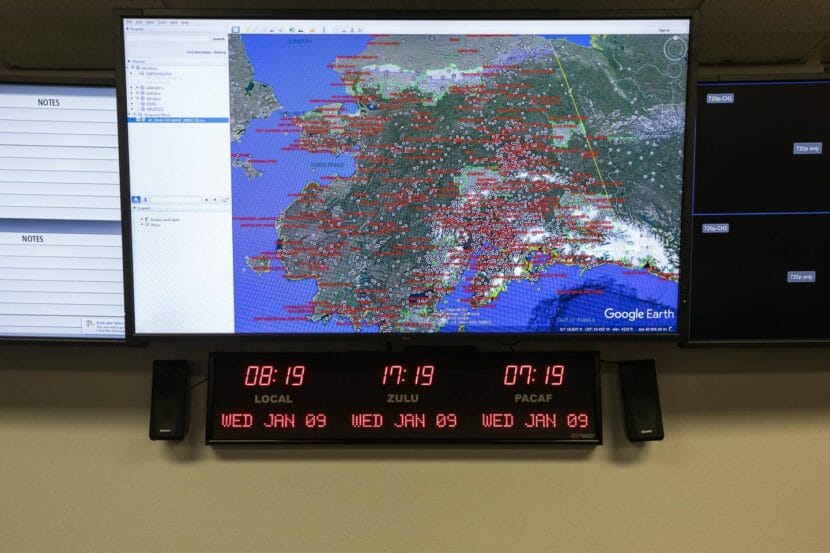
The Alaska Rescue Coordination Center, photographed Wednesday, Jan. 9, 2019 at Joint Base Elmendorf-Richardson. (Loren Holmes/ADN)
Plane crashes, though, fall under a wholly different chain of command. And even in a normal year Alaska sees a lot of aviation accidents.
“It’s been been pretty busy. There’s been a lot of airplane crashes for us this summer,” said Lt. Col. Christy Brewer who directs the Alaska Rescue Coordination Center.
The center is staffed around the clock by at least 12 members of the Alaska National Guard, and handles aeronautical search incidents, which in a state with so much aviation makes it a key player. The center functions like a football coach diagnosing a given situation and picking plays accordingly, but never actually taking the field. At the entryway is vintage map peppered with pins demarking airplane crashes. The display isa relic. Years ago,the Guard replaced it with a Google map.
A map at the Alaska Rescue Coordination Center shows the location of airplane crashes in Alaska, on Jan. 9, 2019. (Loren Holmes/ADN)
Much of the RCC’s work is parsing whether there’s a real need for help, or if there’s just been some kind of miscommunication. Signals arrive all the time that could suggest trouble, but are resolved with a phone call or runway check confirming the person in question is fine but, for example, accidentally bumped the emergency transponder in their cockpit.
This fall, the Guard launched a search for a moose hunter 60 miles northwest of Galena after a distress signal pinged from his airplane’s safety equipment. The RCC scrambled an air crew, which eventually located the man. He’d left his plane and rafted six miles down river, ultimately relaying by radio to the guardsmen that he didn’t need any help.
“He crashed and probably didn’t realize that the authorities are already notified. And we’re going to act and go rescue you, and treat it as distressed until we can be proven otherwise,” Brewer said.
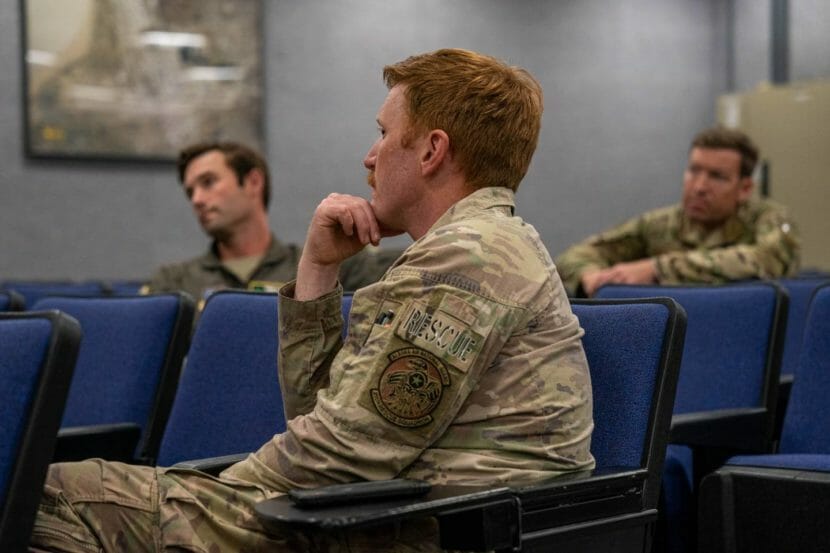
For complex rescues, the center taps what is referred to as the “rescue triad,” three squadrons under the Air Guard’s 176th Wing comprised of helicopter teams, HC-130 Combat King II plane crews, and pararescuemen called almost exclusively “PJ’s.” Those are the elite Swiss Army knives of the search-and-rescue world, expected to parachute out of planes, hike up mountains, dive below water and either extract a patient or else keep them alive in inhospitable wilderness for days.
“We’re the only ones that would do what we do,” said Senior Master Sgt. Chris Robertson, a Colony High School grad with decades of experience on the kinds of rugged backcountry and combat rescues the PJ’s are known for.
“There’s a lot of stuff that we do that you just can’t find in doctrine, can’t find in regulations,” Robertson said.
From left, 1st Lt. Chris Bailey, Capt. Ben Van Alstine, and Senior MSgt. Chris Robertson discuss the Alaska Air National Guard’s rescue operations on Joint Base Elmendorf-Richardson on Sept. 7, 2022. (Loren Holmes/ADN)
Outside trends
Even though COVID-19 pushed more people to recreate outdoors, the pandemic actually led to a calmer-than-normal SAR season in Alaska during 2020.
“People weren’t at work, or were teleworking. But they were camping, they weren’t actually going further out. So our numbers (were) actually down a little bit. Not much, but they were down a little bit during COVID,” said Lt. Paul Fussey, the search coordinator for the Alaska State Troopers.
Along the road system there were fewer out-of-state tourists requiring assistance. In rural Alaska, many communities barred inter-village travel in order to curb viral spread. All that led to fewer rescues.
“A lot of the communities out in western Alaska were locked down. So that dropped the number of individuals visiting family members back and forth, or going to the larger hubs to get groceries. Same with southeast,” Fussey said.
But since then, the numbers have reversed course and kept with a longer-term trend of slowly ticking upwards. Between July 1 and Sept. 11 this year, Alaska saw 176 individuals rescued or recovered. During the same period last year it was 146, and 145 the year before that.
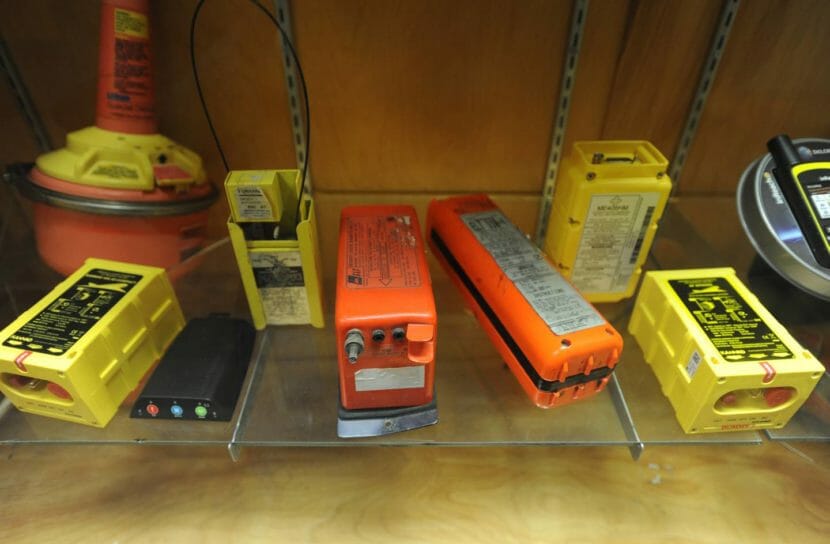
One of the factors Fussey and others point to is the steadily growing popularity of personal locator beacons and similar devices that can relay positioning and distress signals to officials. According to Brewer with the RCC, the number of such devices sold has increased by 10% each year since 2016. The effect for rescue coordinators is receiving more pings, whether or not the event generating them is serious. In earlier eras, a hunter or hiker in trouble might not have been reported missing until days after she was due back home. Or they might have been spotted by a good Samaritan, extricated from harm without a formal report ever reaching the RCC. Now, though, more people in the backcountry carry a piece of hardware with a satellite-linked SOS button.
The main frustration in the rescue community with locator beacons is that too often people don’t register them, omitting crucial information like the owner’s identity, where they live, an emergency contact, all of which can save searchers hours of hunting for clues about who might have pressed that help button.
“I can’t stress that enough,” Fussey said. “If you have an ELT or personal locator beacon, once you purchase it, register it.”
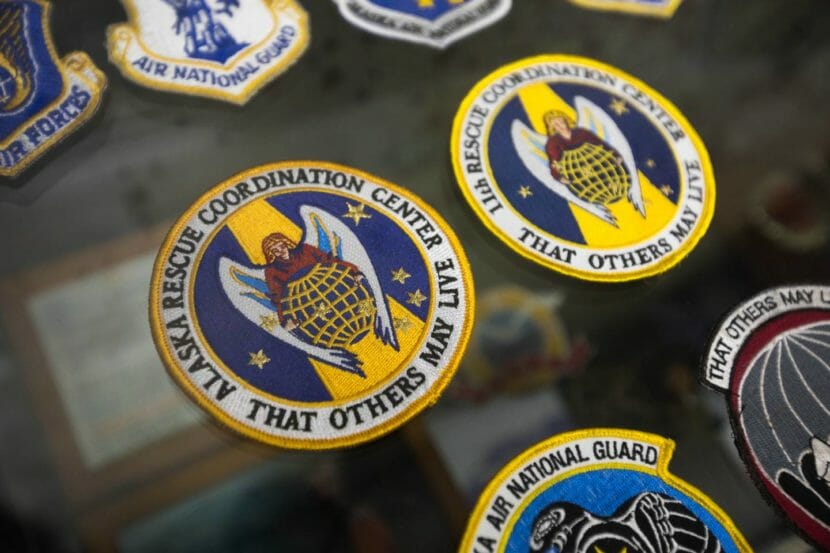
Various ELT’s on display at the Alaska Rescue Coordination Center in 2017. (Bill Roth/ADN)
‘Everybody knows somebody who’s been rescued’
Another substantial change in the state’s SAR system is an infusion of helicopters over the last half decade. Beginning in 2017, the Alaska Army National Guard changed how it used helicopters, from an offensive mission to general support aviation. That seemingly remote bureaucratic adjustment led the Army Guard to mix different helicopters into its fleet and build up its capacity for in-flight medical care. Members of the unit, many of whom were reared in Alaska, searched for ways to add extra capabilities to the state’s SAR system that were missing.
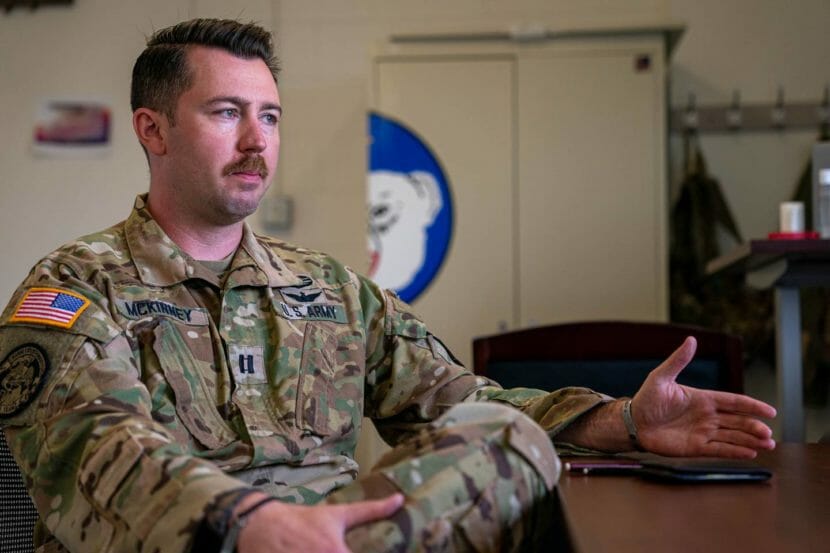
Capt. Cody McKinney is the deputy state army aviation officer for the Army National Guard, photographed on Joint Base Elmendorf-Richardson on Sept. 7, 2022. (Loren Holmes/ADN)
“What we try to do is to complement each other and not compete,” said Capt. Cody McKinney, an East High grad who up until a few months ago was the medevac commander for the Army Guard.
“Where we tend to excel is as high altitude, high angle, dynamic hoist profiles,” McKinney said of the Army Guard’s specialty, meaning rescuing people up high on steep mountains by scooping them into a helicopter hovering overhead, or sometimes in actively in motion to avoid the rotors blowing the injured patient off a cliff.
Overall, the shift in organizational priorities has added new hardware and personnel to rescue missions across the state. Not just in Southcentral where the majority of the Army Guard’s fleet is based, but also in Western Alaska where the unit tries to keep small numbers of personnel year-round in a few hub towns. That capacity was in high demand in the weeks after the Merbok storm slammed into communities along the Bering Sea coastline. During assessment and recovery operations, Army Guard Black Hawk helicopters stationed in Nome and Bethel flew thousands of miles ferrying public officials between communities and bringing in supplies.
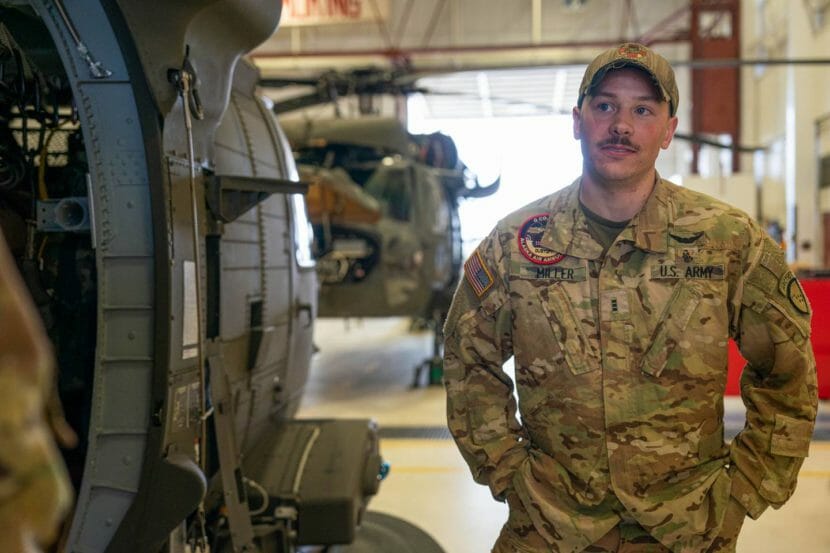
“I would say up until maybe two years ago, we kind of got all the leftover missions,” said Chief Warrant Officer 3 Michael Miller, who grew up in Western Alaska and recently finished a two-year posting in Bethel.
As a relative newcomer to the state’s rescue community, the Army Guard picked up work other entities passed on for one reason or another. Often that meant back-filling capacity on weekends and holidays. Or missions like body recoveries that rarely bring positive attention or commendations, but helped hone the unit’s technical acumen.
“We’re all Alaskans, we all grew up here,” Miller said. “Everybody knows somebody who’s been rescued.”
Chief Warrant Officer 3 Michael Miller stands next to a HH-60M Black Hawk medevac helicopter on Joint Base Elmendorf-Richardson on Sept. 7, 2022. (Loren Holmes/ADN)
The U.S. Coast Guard helicopter that responded to the request for help from John Casteel’s hunting party after Casteel was injured by a bear near Dillingham on Sept. 10, 2022. (From Rodger Goddard/Dillingham Police Department)
A Dillingham hunter was mauled by a bear on Friday. Alaska State Troopers spokesperson Tim DeSpain said in an email that 40-year-old John Casteel was hunting up the Nushagak River, about 20 miles by air from Dillingham, when he was mauled.
Casteel’s aunt, Marjorie Nelson, said he came upon the bear while moose hunting. The bear attacked, and Casteel called out to his hunting partner, who shot and killed the bear. His partner sent a satellite message requesting help, saying that Casteel had injuries on his arm and leg. He was conscious but couldn’t move.
“They had a nurse with them and other hunting parties that helped stabilize him and control his wounds,” she said. “He stayed out in the wilderness for four hours, laying on the tundra. But you know, those people, the hunting party that he was with, they started a fire and they tried to keep him warm and keep him conscious and awake until the helicopter came and got him. It was a rough Friday night for us.”
It was dark by the time the helicopter arrived. Nelson said the group shot flares into the air to show their location. The helicopter took Casteel to Dillingham.
“The whole time, John was conscious. He was awake during this whole ordeal,” she said. “And after they got him stabilized, cleaned up, they got a medevac out of Dillingham and sent him to Anchorage.”
Casteel has deep wounds on his leg and arm and was in the Alaska Native Medical Center’s critical care unit in Anchorage over the weekend. Nelson says he went into surgery Saturday morning. It lasted for about eight hours.
“He’s still in a lot of pain, but they’re trying to manage that pain right now,” she said. “He’s pretty overwhelmed with what happened to him. And, you know, totally understandable. I can’t imagine. I can’t — it’s overwhelming to me.”
Nelson doesn’t expect recovery to be easy and said Casteel may have to undergo additional surgeries. She added that the family is grateful to his hunting partner and thanks everyone for their prayers.
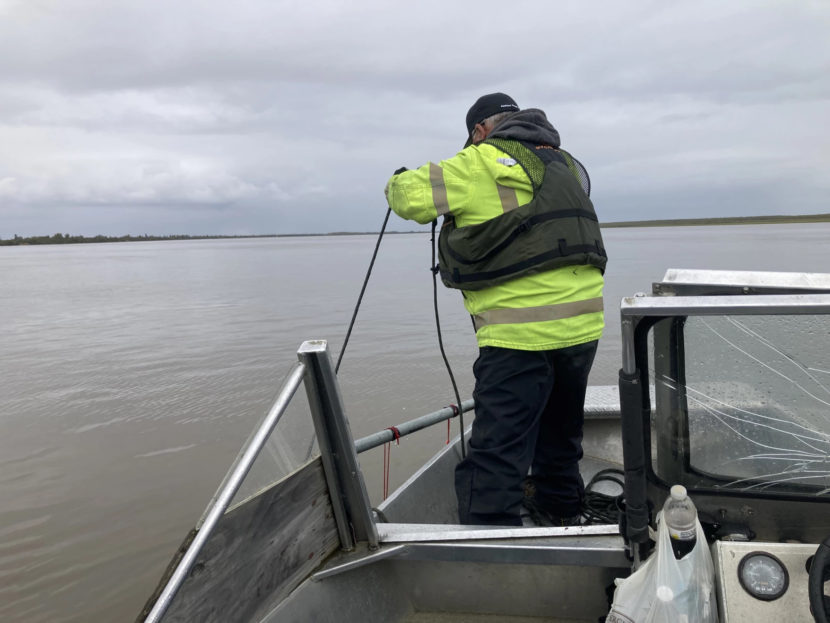
Bethel Search and Rescue President Mike Riley searches the Kuskokwim River with a drag bar. (Photo by Will McCarthy/KYUK)
Bethel Search and Rescue is still searching for a group of moose hunters missing for a week and a half near Bethel — and for another hunter missing for over a week near Kalskag.
On day eight of the search, about a dozen volunteersheaded toward their boats after a morning briefing. It was raining, as it has been for much of the time since Justin Crow, Shane McIntyre, and Carl Flynn went missing. Mike Riley, the longtime president of BSAR, drove toward the harbor.
“It being so close to home with three people involved, it’s hard,” Riley said. “We know that is someone’s loved one out there. People depend on you to look for them and bring them home for closure.”
At the harbor, Riley checked his gear. BSAR has been working under the assumption that the boat sank in rough waters after the men dropped off equipment at their hunting camp upriver.
After leaving the harbor, Riley headed toward Straight Slough. Six boats were there, searching for the missing hunters. Riley pulled up beside one.
“I’m sorry it took so long to come out here, but I was told something that I think will enlighten us,” Riley said.
Riley said he got a tip that two people were coming home to Bethel the day after the hunters were reported missing. Apparently they saw an aluminum pole bobbing upright in the water about 20 feet from shore, a few hundred yards upriver of Straight Slough. They had to swerve to avoid it. Riley thought it could be a clue.
“So that’s that side of the river, coming up,” Riley said. “That side of the river has never really been dragged.”
After hours of scanning sonar and dragging lines, hoping to catch something, even just this little piece of information seemed like a burst of energy.
Searching the river is a test of endurance. A few of the boats scan the search area with sonar, slowly making a grid of each section of the river. The rest use drag bars, which are long ropes attached to a metal bar. Each of the lines have a weighted hook at the end. The idea is that if there’s something underwater, the hooks will catch on it. Hope, Riley said, is the name of the game.
He dragged the bottom of a 100-yard portion of the river. The tide was slack, so he kept one hand on the rope and the other on the steering wheel. Nothing. He tried again. Nothing. It started to rain. Riley tried again.
“Themajority of the people that are out here have been out here since day one,” Riley said. “It’s a lot of stress and frustration, you know. We’re working in the dark.”
So far, the main clues BSAR have are debris from the missing boat that turned up near the head of Straight Slough, but there’s still so much river to cover. BSAR has never given up on a search, and there are no plans for them to give up on this one.
“That was the question: how long are you going to search,” Riley said. “As long as someone is willing to come out here, we’re going to continue.”
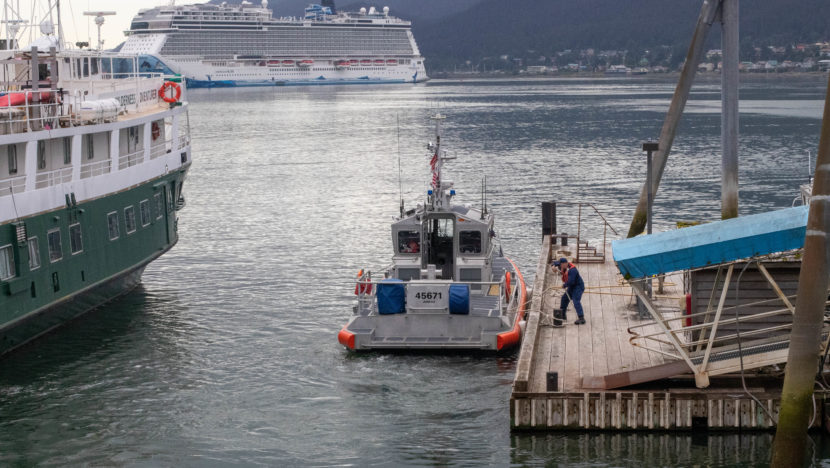
Searchers combed Gastineau Channel by boat and helicopter but did not find a man who went missing from the Holland America cruise ship Koningsdam on Aug. 8. (Photo by Paige Sparks/KTOO)
Police say it was a 31-year-old man from Tennessee named Lorenzo Anthony Holmes Jr. Police say he was an entertainer on Holland America’s Koningsdam, where he’d worked since May.
Authorities say video on board captured a person climbing over the ship’s railing. Eyewitnesses on another cruise ship saw something fall into the water, followed by calls for help. Holland America said on Tuesday that it was likely the man went overboard “intentionally.”
Juneau Police Lt. Krag Campbell says that for now, the incident is being treated like a missing person case.
“Without a body, you know, there’d be nothing to go to the medical examiner’s office,” Campbell said. “They wouldn’t make any ruling.”
Campbell says that because the eyewitnesses and ships are in motion, investigating will take some extra coordination. Campbell said the police will document their findings, which could help the court system declare a legal death without the body.
Holland America says it’s offering counseling services to affected team members and guests.
A Coast Guard helicopter searches Gastineau Channel in Juneau on Aug. 9 for a man who went missing from the Holland America cruise ship Eurodam the night before. (Photo by Paige Sparks/KTOO)
Update — Aug. 9, 3:55 p.m.
The Coast Guard suspended its search just before noon on Tuesday for a crew member missing from a cruise ship in Juneau.
“We searched for 38 nautical miles around the area for approximately 11 hours, and concluded that with no results, we would end the search,” said Coast Guard Petty Officer Ian Gray.
Gray offered condolences to the crew member’s family.
Gray said that at 10:45 p.m. Monday, Holland America reported that a 31-year-old man had gone missing and “potentially gone overboard” from a cruise ship.
Coast Guard Sector Juneau launched a response boat twenty minutes later. An MH-60 Jayhawk helicopter from Air Station Sitka joined the search at around 12:40 a.m.
In a statement Tuesday afternoon, Holland America said camera footage showed that a crew member “likely went overboard intentionally.”
The cruise line also clarified that the man went missing from the Koningsdam. In an earlier statement, the Coast Guard said the report came from the Eurodam, which was also in Juneau and assisted in the search.
The Coast Guard asks that anyone with information that could help in the search call the Juneau command center watchstanders at 907-463-2980.
The National Suicide & Crisis Lifeline is available 24/7. Call or text 988.
Correction: The Coast Guard said that a 31-year-old man had gone missing but did not say that he was a passenger.
This post has been updated with information from Holland America and to reflect that the Coast Guard has suspended the search.
Jeremy Hsieh contributed to this story.
Close
Update notification options
Subscribe to notifications
Subscribe
Get notifications about news related to the topics you care about. You can unsubscribe anytime.