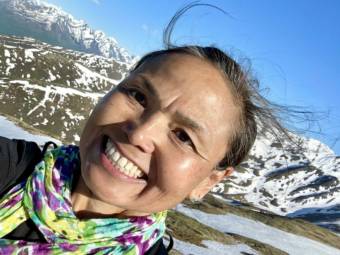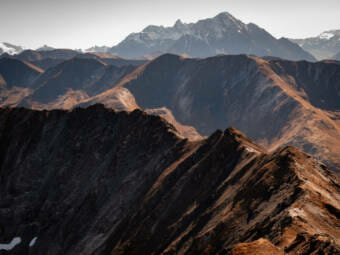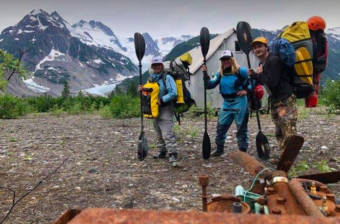
The Pioneer Ridge Trail (Abbey Collins/Alaska Public Media)
A search is ongoing for a hiker near Palmer who was reportedly charged by bears on a local trail.
According to Alaska State Troopers, the department was notified at around 1:30 a.m. Tuesday that a hiker needed help on the Pioneer Ridge Trail.
AST said the woman contacted her husband, telling him she had been charged by multiple bears and had used bear spray. Shortly after that, she stopped responding to phone calls and messages.
Troopers searched the first section of the trail but did not find her.
The Alaska Rescue Coordination Center responded later in the day with an aerial search. The Alaska Mountain Rescue Group and a local search and rescue team are conducting a ground search.
Aerial view of the 14,200-foot camp on Denali during on a routine helicopter resupply on Saturday, June 5, 2021. (NPS Photo/Joe Reichert)
Denali climbing season is back after being called off due to the pandemic last year, but it has come with a higher rate of accidents and medical issues on the mountain. In the first month of climbing season, there have been more search and rescue calls than in some entire years.
Park Service rangers identified a number of concerns in a blog post on the Denali National Park website titled “Troubling Trends.” In the post, they cite several problems including inadequate experience, attempting to summit too quickly, and not fully appreciating the difficulty of climbing Denali.
South District Ranger Tucker Chenoweth’s job involves overseeing ranger patrols, and he has years of experience in search and rescue. He said Denali, even along the popular West Buttress route, brings several unique challenges.
“The West Buttress is not easy,” Chenoweth said. “Technically it’s not hard, but then you factor in the remoteness, and you also factor in the altitude, then … the West Buttress becomes a serious endeavor.”
As of Wednesday, no fatalities had been reported on Denali, but there have been severe accidents, including a 1,000 foot fall high on the mountain that left Canadian climber Adam Rawski in critical condition. There have also been many reported cases of high-altitude pulmonary edema reported — fluid in the lungs — which can happen when climbers ascend too quickly.
Climbers ascend fixed lines on the headwall of the West Buttress route on Sunday, May 30, 2021. (NPS Photo/Erickson)
Chenoweth said the popularity of the West Buttress Route can make it easy to forget the remoteness of Denali. For a significant portion of this climbing season, there have been more than 400 people on the mountain at once. Even then, Chenoweth said the hundreds of people and mutual support that they can provide can suddenly vanish.
“All of a sudden that wilderness component where you’re the only team — or maybe it’s summit day and you’re really late in the evening and everyone else is already down below you. You’re so far out there at that point that the remoteness — it may be the first time you feel it,” he said.
Chenoweth said one thing that tends to lead to problems is when climbers form ad hoc climbing teams.
That can happen before a trip begins or if a climber’s partners have to turn back before making it to the summit. A common point to give up an attempt on Denali is at 14,000 feet. Chenoweth said forming a new team at that point poses additional challenges.
“Then people start looking for partners, but they don’t know them. They don’t know their technical skill. There’s no camaraderie, no teamwork. At that point, it feels like a summit-driven decision,” he said.
Chenoweth said some of the teams formed mid-expedition have met with unfortunate results, including serious injuries and fatalities in recent years.
Another trend that rangers said is a cause for concern is when climbers attempt the summit in one long push from 14,000 feet instead of resting at High Camp at 17,000 feet before a summit bid. Chenoweth said the impacts of that jump in elevation shouldn’t be underestimated.
A typical summit attempt involves leaving a lot of gear behind and moving light and fast to try to make it to the top and back in one day. If a group making a longer summit attempt encounters a problem, they may find themselves needing to rely on other teams for food or tent space.
There’s no guarantee that National Park Service rangers will be nearby or able to help when a group runs into trouble. In many cases, professional guides leading groups of paying clients step in to provide what help they can.
Caitlin Palmer, co-owner of Alaska Mountaineering School, a guide service based in Talkeetna, said her guides’ instinct is often to help whenever they can, but that can impact the group they are leading as well.
“A lot of our guides are sort of superhuman and can do some extraordinary things up there at high altitude,” she said. “But it does impact not only the patient’s life in a big way, but also the rescuers and the people the rescuers are responsible for their safety.”
Palmer said she was happy to see the National Park Service talk openly about the problems they’re seeing on Denali, and she hopes that climbers will follow the advice.
“A lot of it isn’t brand new, but it’s important for the Park Service to bring these incidences to light,” she said. “Hopefully these climbers who are not experienced enough yet will take some time to learn more skills and slow their pace down.”
As of Wednesday a bit more than a third of the expected attempts on Denali have been completed.
Nation Sega (center) and friends pose with USCG crew after being rescued in Monashka Bay. (USCG)
Being rescued by the Coast Guard while out on the water or a hike is not entirely unusual in Kodiak. But it is if you’re being dragged out to sea on a giant inflatable flamingo.
It was a picturesque summer Saturday last weekend in Kodiak. Nation Sega, his sister, her roommate and dogs were enjoying the sunny skies and warm temperatures out in Monashka Bay, about five miles from the city of Kodiak.
It’s a common spot for recreators to fish, swim surf, and kayak. But Sega and his friends brought something different: A pink inflatable flamingo.
“We usually do it in a lake, where we’re usually more cautious,” Sega said. “But Saturday we were just having too much fun and not paying attention.”
They weren’t worried at first, but by afternoon, the winds had picked up and pulled the flamingo riders out across the bay.
“Then we were in the middle of nowhere at one point, but we just called 911, and were ‘Okay, we don’t have any paddles or lifejackets. Can you send someone out here?’ We were hanging out waiting for someone to show up,” Sega said.
As they waited for rescue, the flamingo drifted toward some offshore rocks until they finally ran aground.
About an hour later, an MH-60 Jayhawk helicopter from Coast Guard Air Station Kodiak came to their rescue, hoisting them up.
“Alaska State Troopers and the USCG worked together to determine that due to the treacherous circumstances, a helicopter hoist was the best option to bring these folks and their animals back to shore, safe and sound!” the Coast Guard said on Facebook.
Alaska State Troopers recovered the flamingo but have not yet returned it to its owners. Sega said he intends to get it back. He and his fellow flamingo riders plan to ride it out again — but next time, they say they’ll be more prepared.
KMXT’s Dylan Simard also contributed to this story.
Chinook helicopter (courtesy Tech. Sgt. Amy Picard/Alaska National Guard)
A group of 12 mountaineers were rescued Tuesday from a glacier in Wrangell-St. Elias National Park by the Alaska National Guard.
Alaska Rescue Coordination Center Director Lt. Colonel Keenan Zerkel said the St. Elias Guides climbing party initially called for help Saturday, reporting two of the mountaineers were suffering altitude sickness.
Zerkel said the party had hunkered down at about 10,000 feet, after abandoning an attempt to summit 16,000-foot Mt. Bona due to bad weather.
“Continuous snowfall, high winds, you know, all the conditions conducive to hypothermia and everything else,” he said.
Zerkel says the extreme conditions thwarted repeated efforts to reach the climbers until late Tuesday, when a high-altitude Chinook helicopter team was able to make it in.
“The winds died down enough that they thought an attempt was possible, so they took off and were able to get in and pick up all 12 individuals in one lift,” he said.
Zerkel said three of the climbers had minor injuries including one with frostbite.
“It became an issue of, get them out of there now before there are serious injuries that will develop, so I guess a bit of preventative medicine if you want to think of it like that,” he said.
Zerkel says the three injured were transported on to Anchorage for care, and the other climbers were dropped off in McCarthy.
He described a drawn-out rescue operation that included 80 hours of flight time involving Air and Army National Guard planes and helicopters and crews, supported by the National Park Service, local businesses and individuals.
Mount Hawkins is a 10,000-foot peak in Wrangell-St. Elias National Park in Alaska.
Anne Northup’s husband survived a plane crash in one of Alaska’s most forbidding and remote mountain ranges, inside Wrangell-St. Elias National Park. He and the pilot of their small plane used a Garmin satellite device to call for help Saturday afternoon.
But recovery efforts were stretching into a second day. Rain, snow and wind kept rescuers from reaching Fred Northup and James Feola.
The pair of New York pilots, both 62, had crashed their Cessna 182 into a mountainside at 6,000 feet — hard enough that one of its wings was gone, and their gear was scattered across the mountainside.
“His last communication through the Garmin was, ‘Send rescue now, we will not make it through the night,’” Anne Northup said in a phone interview Monday. “I was preparing my family for the worst.”
When Northup woke up early Monday morning, she still had no news about her husband. But half an hour later, she said, she got a phone call: The two men had been plucked from the mountainside by Anchorage-based National Guard members, who were part of three crews that worked round-the-clock on rescue efforts.
Northup and Feola were cold but had only minor injuries, the National Park Service said.
In a spring that’s proven unusually treacherous for Alaska adventurers, another group of climbers remains stranded on the side of Mount Bona, about 70 miles from where Northup and Feola were picked up. A National Guard official said the same bad weather has blocked that rescue because the climbers are stuck at a higher altitude — on a glacier 10,000 feet above sea level.
In the meantime, Anne Northup is hailing her husband’s improbable survival.
“It was a miracle that they were saved,” she said. “I want to extend, just, gratitude to search and rescue for not giving up. They searched and searched.”
Anne Northup said her husband described a “loss of altitude” and a rapid descent as they were flying a roughly 400-mile leg from Talkeetna to Yakutat.
The town sits just outside Wrangell-St. Elias park, which contains North America’s largest non-polar icefield and America’s second-tallest peak, Mt. St. Elias. The area also gets hammered with storms from the Gulf of Alaska: Yakutat gets 150 inches of rain each year.
“These mountains will humble you,” said Paul Claus, a veteran bush pilot and climber who operates the Ultima Thule lodge inside Wrangell-St. Elias park. He said he was working with four climbers who finished a trip on Mt. St. Elias who have been waiting five days for a pickup in a remote bay due to bad weather.
Feola and Northup, who both have private pilots licenses, flew Feola’s Cessna 182 across the country to Alaska, with the high point of their trip a planned visit to a yearly air show in Valdez, Anne Northup said. They spent time in Ketchikan and Fairbanks, as well as Talkeetna, a town that’s known as the launch pad for climbing expeditions to Denali.
“They flew around Denali, and it was a little rougher flying than I think both of them were used to,” she said. “But overall, they could see the mountain and they liked doing what they were doing, and then they were going to be headed home.”
The two men took off from Talkeetna for Yakutat around 10:30 a.m. Saturday, the National Park Service later said in a prepared statement.
Roughly three hours later, an international rescue coordination center informed park service officials that they’d received “rescue needed” messages from near a glacier on the north side of Mount Hawkins — a rarely-climbed, 10,000-foot peak a little further than halfway along their route.
Authorities initially asked Claus, the lodge operator, to see if he could find the crash site. But in his own small plane, Claus said he could get no closer than 17 miles away from the pilots’ reported location after running into weather and wind he described as “not flyable.”
The National Guard, meanwhile, already had its own aircraft — a C-130 plane and a Pave Hawk helicopter — in the area, which were trying to retrieve the three stranded climbers from Mt. Bona, to the northwest. The weather was similarly problematic for them, though, said Maj. Greg Ulrich, one of the officers who coordinated the rescue.
“The ceilings were just below where the plane crash was,” he said. “There were times the helicopter got within .8 miles — multiple times, got within two miles of the crash site — but just could not get high enough onto the glacier to where they were.”
Video shot Saturday by a helicopter crew member just below the crash site shows a pair of rocky peaks rising out of a vast, foggy expanse of glacier with deep crevasses.
Guard crews spent all night trying to get to the stranded pilots, and early on Sunday morning, they finally had a window to fly over the crash site. But bad light and visibility stopped them from landing or from dropping the parajumpers that were onboard, Ulrich said.
“I can’t tell you how many times they were like, ‘Hey, we’re going to go see if we can get up there, the weather looks like it’s getting better,’” Ulrich said. “And then 20 minutes later they’d call us on the satellite radio and tell us they had to turn around because of weather. And the whole time we’re standing by the radio hoping for good news.”
After working for nearly 12 hours, that crew had to return to Anchorage’s Joint Base Elmendorf-Richardson.
Another crew replaced them Sunday, but the weather continued to block a rescue, and they spent much of the day with the helicopter waiting on a snowfield below the pilots.
Finally, around 2 a.m. Monday morning, a third crew — the one that had done Saturday’s original search for the pilots — got enough of a break in the weather to hoist Feola and Northup into their helicopter.
In total, Ulrich said roughly 30 guard members flew in support of the rescue, which relied on mid-air helicopter refueling and technology like night vision goggles.
“It’s amazing, the rescue community,” he said. “The amount of people that we brought back in on a holiday weekend and there were no questions asked — it was like, ‘This is what we do.’”
National Transportation Safety Board investigators were still waiting Tuesday morning to speak with Feola, the pilot. Claus, the longtime bush pilot and lodge operator, also said he was eager to hear what happened.
“Those good, happy endings in the aviation realm don’t happen all the time — they’re more likely to be the other way around,” he said. “If these guys are alive and everything, I’m sure they’ll have a good story to tell.”
Denali Pass is the V-shaped notch in the upper left quadrant, at 18,200 feet. The flat plateau below it to the right is where the high camp sits. Adam Rawski was traversing from the pass to the camp when he fell, according to park officials. (NPS Photo/Jeff Pflueger)
A 31-year-old climber from British Columbia is in critical condition after falling almost 1,000 feet from a high mountain pass Monday on Denali, said a statement from park officials.
Climbers at the 17,200-foot high camp on Denali’s West Buttress route witnessed the “un-roped mountaineer take an almost 1,000-foot tumbling fall” around 6 p.m. from Denali Pass, said the statement.
The climber, identified as Adam Rawski of Barnaby, British Columbia, was on his way down the mountain, according to Sharon Stiteler, a park spokeswoman.
Denali Pass is at 18,200 feet, and a snow and ice slope called the “Autobahn” leads climbers between the pass and high camp.
Park officials said several guides from high camp responded to Rawski. He was alive but unresponsive due to multiple traumatic injuries.
Rawski was taken off the mountain in the park’s high-altitude helicopter, which was at the Kahiltna base camp for glacier monitoring surveys.
He was flown to Talkeetna, where paramedics from the Matanuska-Susitna Borough provided immediate life-saving measures, said the park’s statement. He was then medevaced to an Anchorage hospital in critical condition.
Stiteler said Rawski was an independent climber and registered to climb with one other partner.
“However, our understanding is he was travelling with three other climbers yesterday evening, not his original partner,” she said in an email on Tuesday.
Denali park reported two climbing-related deaths earlier this month in other parts of the Alaska Range.
Park officials said three other climbers have been evacuated off Denali so far this season, one with frostbite and two with high-altitude pulmonary edema.
As of Tuesday, there were 382 climbers on Denali, with a total of 912 registered for the season. Six climbers had reached the summit out of the 30 who attempted it.
Stiteler said she didn’t know if Rawski had reached the summit.