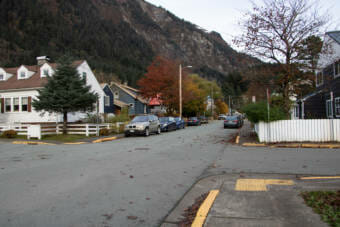
Kake’s high school photographed in 2010 (Division of Community and Regional Affairs’ community photo library.)
Kake is now experiencing one of its biggest outbreaks of COVID-19 since the beginning of the pandemic, with 32 active cases reported as of March 11.
Kake city schools have moved to remote learning through at least the end of this week.
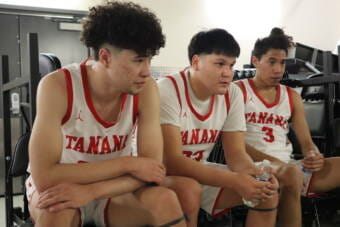
The outbreak started after Kake High School basketball teams traveled with family and fans to Juneau for the small schools regional basketball tournament on March 2-5 at Thunder Mountain High School, where community members are suspected of catching the virus.
Thunder Mountain’s activities director, Luke Adams, told KCAW that masks were mandatory for spectators and non-playing team members but optional for players on the court.
In a call with KCAW, Kake superintendent, Rich Catahay said the teams — as well as accompanying fans and family members — followed masking protocol and were diligent about testing before and after the tournament. Catahay says the city made sure to report the positive cases to the Alaska School Activities Association.
The city is offering antigen tests to those who believe they’ve been exposed or are experiencing symptoms, as well as preventive measures for the elderly and immunocompromised.
The next booster and children’s vaccine clinic will take place April 1.
Alaska School Activities Association basketball director Isaiah Vreeman said in an email that the association was unaware of the outbreak, but that since the state 1A tournament was more than 10 days away, “this might not be an issue.”
The state 1A/2A tournament will be held March 16-19 in Anchorage at the Alaska Airlines Center and the UAA Seawolf Sports complex.
Anja Radano is originally from Germany and started mushing in 2004. She now lives in Talkeetna, and this year is her third Iditarod Trail Sled Dog Race. (Photo by Jeff Chen/Alaska Public Media)
On a rest day before the Iditarod, Anja Radano stepped into the yard next to her house in Talkeetna. All 23 dogs in her kennel exploded with excitement.
“They’re all really friendly. A little wild sometimes,” she laughed as a big brown and black dog named Rice leapt toward her, hoping for pets.
“He’s just a big boy, so if you’re not prepared, he can kind of knock you over. But he doesn’t mean it. And then that’s his mom back there, her name is Butcher,” she said, pointing a few dog houses down from Rice.
“She’s my favorite. Like you, don’t have favorites, but she’s my favorite,” Radano said.
This week, Radano is on the trail racing toward her third Iditarod finish. She said she loves the single-mindedness of being on the trail, focusing only on her dogs and the next checkpoint. But getting to this point takes months of preparation and training — and a lot of money. And that’s a struggle every year, said Radano.
While some mushers have major tour businesses and sponsors that help fund their kennels and pay for staff, others like Radano are working non-dog jobs to balance the big bills that come with being a dog musher.
“If you’re just working normal jobs and you’re not making, you know, $100,000 a year, then it’s almost impossible to pay for all this on your own,” she said.
But Radano wouldn’t trade her mushing lifestyle.
From training horses to training dogs
Radano has lived in Talkeetna since 2003. She was born in Germany in a small village called Hechendorf, outside of Munich, where she grew up training horses with her family.
“Working animals, I was always intrigued with because it’s not just like this lazy dog that hangs out on the couch and just wants to be pet and fed,” she said. “You can build more of a connection with an animal that has a job and does what it’s meant to do and what it’s bred for.”
Radano found her way to Talkeetna on a road trip in the summer of 2003 and returned that winter to be a dog handler for Iditarod musher Melanie Gould. Pretty much immediately, she said, she wanted that life, too, even if she knew it wouldn’t be easy.
“Honestly, there was not too much of a thought process. It was more like a fluid transition. I mean, I knew kind of what it takes working for a musher — what it costs, what it takes, what is necessary,” she said.
Butcher is 6 years old and has finished two Iditarod races. She’s named after Susan Butcher, the second woman to ever win the Iditarod. (Photo by Jeff Chen/Alaska Public Media)
Radano has made racing work over the years by stringing jobs together, often saving money all summer to be able to train in the winter. But in the last decade, things like dog food and mushing gear have gotten more expensive, especially during the pandemic. And she said it’s getting harder for mushers with smaller operations like hers to keep racing the Iditarod.
She skipped the 1,000-mile race for a few years to run shorter ones that don’t require as much money or training time.
“If you’re just a normal musher like me, you know, it’s getting harder and harder to do stuff like that, because it’s so costly, and now with prices rising and all that,” she said
Early in her mushing journey, Radano trained to become a vet technician, working a few days a week in Wasilla. But eventually she found she could actually make more money waiting tables at Denali BrewPub in Talkeetna. In the summer, she works as a guide at five-time Iditarod winner Dallas Seavey’s kennel nearby.
“That’s pretty recent, because I’m not working at a vet clinic anymore. So I needed another job to support my expensive hobby,” she said.
$15,000 a year on kibble
Radano estimates she spends up to $15,000 a year just on kibble, not to mention the meat, fat and supplements she feeds her dogs. A friend sponsors her team with fresh chum salmon. Then there are vaccines, plus deworming medicines, which can run several hundred dollars a year.
Plus, you have to have enough land to care for the dogs and be able to transport them, said Radano. She spent $3,500 on a used trailer and paid another $2,000 to have a friend outfit it with bunks for the dogs. Flying the dogs back from Nome at the end of the Iditarod is at least $500.
Is it ever a struggle to cover those costs?
“Yes,” Radano said. “Every day, very much so. It’s definitely a struggle, and it’s getting worse. So that’s why I’m always trying to keep my dog numbers as low as possible. Because every extra mouth to feed is more money. And I just want to give my dogs the best care possible.”
Radano joked that with 23 dog mouths to feed, she probably couldn’t afford to have kids.
“Children are very expensive,” she laughed. “The dogs are my children.”
Anja Radano says she’s reconsidering the way she feeds her dogs. “We were just discussing about changing dog food and what we can use that’s cheaper, because we love the dog food we’re feeding, but they just went up almost 10 bucks per bag, you know, which is a lot if you feed 2,000 pounds or 4,000 pounds of it a year — that’s a lot of money.” (Photo by Jeff Chen/Alaska Public Media)
Radano has small sponsorships from friends and a few local businesses to help offset costs. But unlike better-funded mushers, she doesn’t have a handler to help her train. And she said while money isn’t everything, it’s a huge factor in how competitive a musher can be in a race like the Iditarod.
“Dallas Seavey, he actually goes out there and trains his dogs himself, very much so, but he does have an army of handlers who do all the other things. I don’t think he cut a single piece of meat for his food drops,” she said. “I have to do that all by myself.”
For top mushers, some of the expense of mushing can be recouped through race winnings.
Take Seavey. He’s placed in the top 10 in all but two of his 12 races, winning five of them. In total, he’s won $496,661 in prize money, plus new trucks and, last year, a new snowmachine.
In contrast, for Radano’s 35th and 51st place finish during her two Iditarods, she earned $2,098 total — just a fraction of the race entry costs.
Still, Radano said, there is more than just money that makes a champion musher. You have to have a deep understanding of the trail and a strong bond with your team. And those are things that come with time and dedication.
Radano said she doesn’t expect to win this year’s Iditarod, but that’s also not why she’s running.
“It’s really more about the journey with your dogs and doing the best you can for your dogs,” she said. “It’s amazing, you know, you can go for a week or two with your best buds and just travel through Alaska.”
Radano said the dogs are her life, not the racing. She’d be a happy musher without running another race. But having paid her $4,000 Iditarod entry fee, she and her team are wearing bib number 26 on this year’s run to Nome.
Emily Mesch stands outside of the Alaska State Capitol. Mesch chairs Southeast Alaska’s gay, lesbian, bisexual, transgender and queer alliance, called SEAGLA. She is against a bill Republican Alaska Sen. Shelley Hughes that would prevent transgender female athletes from competing in school sports against other female athletes. (Photo by Olivia Ebertz/KYUK)
A state senator has proposed legislation that would prevent transgender female athletes from competing against other female athletes in school sports. Supporters of the bill say they’re trying to protect girls’ sports. But others say it unfairly penalizes transgender female athletes and could have drastic consequences for their mental health.
Republican Sen. Shelley Hughes is the leader of the Senate majority. Her new bill had its first hearing in front of a Senate Education Committee in early March.
Hughes told that committee that trans female athletes are bigger and stronger than cisgender females.
A cisgender person identifies with the gender they were assigned at birth. A trans person does not. Hughes says trans female athletes have an unfair advantage.
“Girls and women should not be robbed of the chance to be selected for a team to win a championship or to be awarded a college scholarship,” Hughes said.
The person who oversees high school sports competitions in Alaska says the idea that someone will be robbed of a scholarship by a trans athlete isn’t accurate.
“This is a solution looking for a problem,” Billy Strickland said.
Strickland spent most of his career at the Lower Kuskokwim School district. He lives in Anchorage now, where he’s the executive director of the Alaska School Activities Association. He says he only knows of one trans female athlete in all of Alaska’s history and she’s already graduated.
He says she came in second in one big track and field race and third in another. But her success didn’t prevent any other athletes from getting scholarships or making it onto a college team.
“Your numbers are your numbers. You’re not recruited because you’re a state champion in Alaska, you’re recruited because you run a 10 second 100-meter dash,” Strickland said.
But Sen. Hughes says that just because a trans female athlete hasn’t beaten out a cis female for a scholarship yet doesn’t mean it won’t happen. She says her bill protects against that possibility.
Trans woman Emily Mesch says that school sports should be about education and inclusion.
“When you’re not allowed to socialize with the group of people that you think you belong to, that hinders your development, that hinders your ability to be a part of society,” Mesch said.
Mesch chairs Southeast Alaska’s gay, lesbian, bisexual, transgender and queer alliance, called SEAGLA.
She’s also a member of the Juneau Human Rights Commission. She’s against Hughes’ bill. One reason is that it’s not clear how it would be enforced or how an athlete’s birth-assigned gender would be determined.The thought leaves Mesch uncomfortable.
“I don’t even want to list the possibilities of how you would check that, like, it’s not a comfortable thing,” Mesch said.
Sen. Tom Begich had a similar view.
“You’d have to examine them, you might be able to test for chromosomes, you might be able to do that. But listen to what I’m saying. These are all extraordinarily invasive things,” Begich said.
Begich is a Democrat, he sits on the education committee with Hughes. He said he doesn’t support the bill and questions whether it’s constitutional.
Hughes agreed that, as written, the bill leaves its enforcement open to interpretation by the state’s Department of Education. But she said the committee could choose to amend it to be more specific about enforcement. This bill looks similar to an Idaho law that was passed but didn’t go into effect. A federal judge considering the bill has said it’s likely unconstitutional.
Begich points out that transgender kids have a higher rate of suicide than cisgender kids. And this type of legislation would hurt them more.
Hughes says that hurting trans kids is not her intention. She says she wants to provide them with essentially a separate but equal playing field.
“I am not transphobic. I love people, no matter what their choice, as far as their identity, I have value for them,” Hughes said.
But Emily Mesch says that Hughes’ actions speak differently than her words.
“Sen. Hughes might believe that she’s not transphobic but her actions are transphobic in the extreme, so that makes her transphobic,” Mesch said.
For his part, ASAA Executive Director Billy Strickland said he prefers ASAA’s policy to this bill. That policy allows individual schools to determine an athlete’s gender. Under this policy, girls must play against girls’ teams and boys’ and co-ed teams must play against boys’ teams.
Strickland says this bill was written without input from the Alaska School Activities Association.
The Senate committee considering the bill will hear public testimony on Senate Bill 140 on Saturday, March 12.
Matt Paveglio is an ER nurse at Alaska Regional Hospital in Anchorage. He starts work at 7 a.m. and tries to group his shifts three days at a time so that he can spend the other four days training his dogs in Caswell for the Iditarod Trail Sled Dog Race. (Photo courtesy Matt Paveglio)
Nurse Matt Paveglio has had some tough days over the last two years in the emergency room at Alaska Regional Hospital. This fall, during the height of the delta variant of the coronavirus, he said it was particularly bad.
“We had a stretch of days in mid-August where I had seven deaths before 10 a.m., seven straight days,” he said.
It was a traumatic time for health care workers across the state as they watched their hospitals move into crisis mode and COVID-19 deaths pile up. Some formed support groups, some channeled their frustration into policy activism and some just brought in cookies for their colleagues to try to keep morale up.
Paveglio had another outlet: 20 sled dogs at a kennel near Caswell, in the Matanuska-Susitna Borough, that he was training for the 2022 Iditarod Trail Sled Dog Race.
Through the worst of the pandemic and personal tragedy, he said, he’s relied on the dogs for distraction, support and to get him out of his head and into the mountains around the kennel. He doesn’t know where he’d be without them.
“Maybe I would have had to work out,” he said “Or you just get drunk or you run from it.”
Since September, Paveglio has lived a sort of split life.
He’d spend three straight days working 14-hour shifts in the ER treating COVID-19 patients. By the time he’d get home to Eagle River to his wife and 14-year-old daughter — a Junior Iditarod finisher — it would be late at night. He’d have no energy.
“I get into comfy clothes, I eat and I basically pass out watching ‘Project Runway’ or whatever crap is on the television because I don’t care,” he said.
On his days off, he’d drive two hours north to Cantwell to a friend’s kennel whose dogs he was running. He’d arrive exhausted and let the puppies out. They’d run down the hill to the pond for a swim.
“Immediately you would get away from all of the stress and all the grief,” he said. “The affection of the dogs takes all of that away.”
He’d camp at the kennel for three or four days to train the team.
Emergency Room Nurse Matt Paveglio with his dog Fergus at a kennel in Caswell. Paveglio said dogs have helped him through personal tragedy this year. (Photo by Lex Treinen/Alaska Public Media)
On a recent weekday afternoon, just days before the Iditarod, he walked around the kennel, with a non-alcoholic beer in hand and a goofy demeanor, far from the solemn nurse you might expect.
He wondered aloud what costume he should pack for his run into Nome: a leprechaun in honor of St. Patrick’s Day or Mario, to whom the mustachioed 44-year-old bears a striking resemblance. He stopped to show off a few of the dogs.
“This is Nala. She’s a peppy, cheerleader, sorority girl type of girl,” he said. “She’s not always the most heady but she just drives.”
Paveglio is relatively new to mushing, but it’s helped him fill a void since he moved to Alaska 13 years ago. To him, the Iditarod took the place of the Big 10 basketball tournaments he’d loved in Michigan.
Soon after moving, he met veteran musher Jim Lanier and started training with Lanier’s dogs. Before Paveglio knew it, he was competing in mid-distance sled dog races. He didn’t think of it at the time, but they served as Iditarod qualifiers.
“I decided finally after my second or third race that oh — maybe I should try and qualify, still not thinking the Iditarod was reasonable,” he said. “And then my mom got sick during my last qualifier”
His mom DeLynn — who was also a nurse and a naturopathic doctor — was diagnosed with ovarian cancer. It was the beginning of the COVID-19 pandemic, and her compromised immune system made it risky to visit. She seemed to recover for a while, but in the fall of 2021, Paveglio realized his mom’s health was failing. He took leave from work to visit her. As she neared death, he told her he’d signed up for the Iditarod.
“It was pretty neat to be able to sign up, and then to just show her, ‘Hey, I’m going to do this,’” he said. “She was proud right up into the end.”
Paveglio’s mom died in August.
He returned to Alaska and started training, and is calling his squad Team DEEtermined after his mother, DeLynn.
He said he’s always been an emotional guy, but lately, tears have come especially easy. Usually, it’s not from grief.
“Tears of joy, mostly, and it just feels good. Because everything we’ve been through, co-workers, the loss of my mom,” he said. “This hobby has been amazing.”
He finished his non-alcoholic beer and headed indoors to check a few more items off his Iditarod list. He still had bags to pack and food to prepare.
And, he had some important decisions to make, like which costume to pack for Nome.
Hundreds of sled dogs parade through Anchorage for the 2020 Iditarod Trail Sled Dog Race ceremonial start. (Photo by Joey Mendolia/Alaska Public Media)
The 2022 Iditarod Trail Sled Dog Race kicks off Saturday with a ceremonial start in Anchorage followed by the official race start in Willow on Sunday.
The race, in some ways, is back to normal: Mushers are again dashing 1,000 miles to Nome.
But in other ways, it’s still marked by the COVID-19 pandemic: Vaccination is mandatory, as is testing before the race starts and along the trail.
Here’s what to know about the 2022 Iditarod.
When will the Iditarod start?
The race begins with an 11-mile ceremonial start in Anchorage on Saturday, March 5.
Mushers and their sled dogs will get ready on the streets of downtown Anchorage early that morning for the parade-like event.
Iditarod musher Meredith Mapes at the 2020 Iditarod Trail Sled Dog Race ceremonial start. (Photo by Joey Mendolia/Alaska Public Media)
Starting at 10 a.m., they’ll take off one-by-one every couple minutes from Fourth Avenue, near D Street. They’ll head down onto city trails and end at the Campbell Airstrip. Here are some spots to watch from.
Then, mushers and their sled dogs will truck north to Willow for the official race start on Willow Lake, which begins at 2 p.m on Sunday. Teams will again leave at two-minute intervals, starting their long-distance run to Nome.
Race officials are encouraging fans to attend both events, but ask that they wear masks. They’re also not allowing the public in the area where mushers get ready for both the ceremonial and official race starts.
That means their checkpoints include stops in communities such Ruby, Galena and Nulato on their way to Nome.
(Iditarod.com)
There are a few changes to the checkpoints, however, due to COVID-19.
Takotna — a village about 330 miles into the race — opted to not be a checkpoint this year to avoid COVID-19 spread. Instead, mushers will pass by and go straight to Ophir.
And at White Mountain, just 77 miles from the finish line, teams will take their 8-hour breaks in a heated tent on the river instead of closer to town.
How are conditions?
Trail breakers passed through the Iditarod route on snowmachines about two weeks ago and found excellent conditions, according to race marshal Mark Nordman.
It’s not totally clear how more recent weather has affected the course.
Frosty dogs on Richie Diehl’s team in Nikolai during the 2020 Iditarod. The village serves as a race checkpoint about 260 miles into the trail. (Photo by Zachariah Hughes/Alaska Public Media)
On Wednesday, Nordman said he had heard some reports of snow melting in places like the treacherous and zig-zagging Dalzell Gorge and near the community of Nikolai.
Meanwhile, closer to the start in Willow, heavy snow in the past few weeks has pushed moose onto mushing trails, putting mushers on high alert.
Will mushers get tested for COVID-19 during the race?
Yes.
Mushers got tested on Thursday with molecular COVID-19 tests. They will also be required to get rapid tests at the ceremonial start in Anchorage on Saturday and again at the official start in Willow on Sunday.
Musher Jeremy Traska gets a rapid COVID test outside the Lakefront Hotel in Anchorage ahead of the 2021 Iditarod. (Photo by Hannah Lies/Alaska Public Media)
Plus, they’ll be tested in McGrath — about a third of the way into the race.
What happens if mushers test positive?
If mushers test positive on any of their required rapid tests, they’ll be retested with a molecular test to confirm the result and have to immediately isolate. Last year, a musher was forced to withdraw from the race after he tested positive at the McGrath checkpoint.
What other COVID-19 protocols are in place?
There are strict vaccination and daily testing requirements for volunteers, race officials and official media, like the Iditarod Insider, who will be at checkpoints along the course.
Those groups will be part of the Iditarod bubble. According to the race’s COVID-19 prevention plan, people inside the bubble will wear armbands to show they’ve met the requirements. They’re also required to wear masks when in contact with people who are outside of the bubble and are “highly encouraged” to wear masks any time they are indoors. And they’re required to submit a daily questionnaire to ensure that they don’t have any symptoms. Mushers “should” wear masks when in contact with people outside of the bubble, according to the plan.
Who’s competing in this year’s race?
There are 49 mushers signed up, Six past champions are among the racers, including reigning Iditarod champion Dallas Seavey, who notched his fifth win last year.
Dallas Seavey poses with his dogs North, left, and Gamble. Seavey arrived in Willow to win the 2021 Iditarod Trail Sled Dog Race on March 15, 2021. (Photo by Marc Lester/ADN)
The other former champions are Dallas Seavey’s dad, three-time champion Mitch Seavey, Pete Kaiser, Joar Leifseth Ulsom, Martin Buser and Jeff King. (King got tapped to race the Iditarod just days before the competition. He’s taking Nic Petit’s dog team after Petit tested positive for COVID-19.)
Other top contenders looking to unseat Dallas Seavey include three-time Yukon Quest winner Brent Sass and last year’s second-place Iditarod finisher Aaron Burmeister.
How can I follow the 2022 Iditarod?
Bookmark alaskapublic.org/Iditarod. Alaska Public Media reporter Lex Treinen and photojournalist Jeff Chen are headed out on the trail this year. They’ll have stories and photos on the Alaska Public Media website.
Musher Jeremy Keller’s sled dog leaps into the air at the 2020 Iditarod Trail Sled Dog Race ceremonial start. (Photo by Zachariah Hughes/Alaska Public Media)
Plus, keep an eye out for the latest episodes of the Iditapod podcast, now in its sixth season. You can subscribe on iTunes or Spotify. And Alaska Public Media is launching a new Iditarod newsletter.
Other local news outlets will also be following the race, and there’s coverage provided by the Iditarod itself on iditarod.com.
Reagan Dibble took first prize in the wrist carry at a local competition for students in the Matanuska-Susitna Borough. He says it was good practice for the statewide Junior Native Youth Olympic Games. (Photo courtesy of Emily Dibble)
The Native Youth Olympic Games test athletic abilities required to survive in Alaska. The games were traditionally used to build the strength, endurance and teamwork needed for subsistence activities like hunting and foraging.
This year’s Junior Native Youth Olympic Games are virtual, with nearly 300 participants sending in videos of themselves competing in the events.
One of those competitors is nine-year-old Reagan Dibble. He and his classmates at Machetanz Elementary in Wasilla have been practicing for weeks.
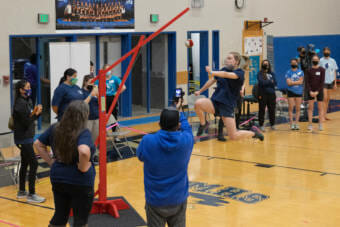
Dibble competes in the wrist carry event. During the game, he hooks one wrist over a pole, grabs his arm with his other hand and holds himself off the ground. Two other boys hold onto each side of the pole and walk forward. The athlete who stays suspended for the longest time wins.
Last weekend, Dibble competed at a local event for students in the Matanuska-Susitna Borough. His previous record had been 19 seconds. That day, he held on for 43 seconds.
On Thursday morning, he filmed his video for the state competition at his school gym.
Dibble explained that the wrist carry was a traditional way to honor a hunted animal. His mom, Emily Dibble, said those types of lessons are what make the games special.
“It’s one more thing we love about living in Alaska,” she said. “They really do cherish their Native culture and immerse everybody in it, and I find that unique and special for these kids growing up here.”
Reagan Dibble said these games foster more teamwork than his other favorite sport, hockey.
“I like how you can encourage others and coach everybody, because you’re all on the same team,” he said. “Playing hockey, it’s kind of like you’re one-on-one, and this is all together.”
That’s what made Nicole Johnson fall in love with the games, too. She grew up in Nome, and first tried the two-foot high kick in fifth grade. She went on to hold the record for that event for 25 years. Now, she’s the head official for the Native Youth Olympic Games. She says it’s a different kind of competition.
“You’ll see the athletes encouraging each other to go harder and higher, even if they are going harder and higher and further than you are,” she said. “You coach your opponents, you coach other teams, you help other coaches. It creates a community of friends and family for life.”
Winners of the Alaskan high kick and kneel jump were announced on Feb. 14, and the awards ceremony for the seal hop and two-foot high kick will be livestreamed on the Cook Inlet Tribal Council’s Facebook page on Monday.
Registration for the remaining junior events – the wrist carry, one-foot high kick and scissor broad jump – ends on March 1, with submissions closing on March 6. That award ceremony will be held on March 14.
This year’s senior games — to be held in-person for the first time since the pandemic began — are slated for April 21-23 at the Alaska Airlines Center in Anchorage.
Close
Update notification options
Subscribe to notifications
Subscribe
Get notifications about news related to the topics you care about. You can unsubscribe anytime.