Sports

Why one Hoonah family rooted for the Czech women’s hockey team this Olympics

A large family photo
Alena and Thomas Mills with family in Kutna Hora, Czech Republic, December 2021. (Jiri Coubal)

Women’s hockey fever took hold in Southeast Alaska this month as the best teams in the world play for Olympic gold in Beijing. That’s because one Czech hockey star has a huge, close-knit Hoonah family rooting for her.

The Czech women’s hockey team made its debut at the Olympics this year. They lost to the United States in the quarter finals last week, but their strong preliminary games and an early lead against the US in the quarterfinals made some noise in the women’s hockey world.

Alena Mills is the Czech team captain. She is married to Thomas Mills, who grew up in Hoonah and Juneau. They now live together in Russia, where he teaches while she travels to play hockey.

“I’m not surprised that she is in the Olympics,” said Alena’s mother in law, Jane Lindsey, who lives in Juneau.

“I’m actually a little surprised it’s taken as long as it has for her Czech team to qualify.”

Lindsey says one thing that strikes her in Alena’s story is how she committed her whole life to playing hockey — she even moved to the United States in high school so she could be on a team.

“There was pretty much no opportunity for her to excel at the level she needed in the Czech Republic for as a woman, as a young lady. So I think I just really admire her for being at the place that she’s at,” Lindsey said.

The family couldn’t join her in Beijing this year because of COVID-19 precautions, but that doesn’t stop them from streaming the games — which are really late at night because of the time difference.

“The Hoonah family and all of us are just kind of — we’re all over Facebook every time she plays. I’ll get on to the phone and be like, ‘I can’t believe she just made that shot!’ Or, you know, ‘Oh my gosh, I’m so nervous!'” said Lindsey.

Valerie Veler is Alena and Thomas’ cousin in Hoonah. She says Alena’s Olympic journey has brought her huge family together.

“Even though we aren’t face-to-face the whole time, we have our phones up. And we’re FaceTiming and we’re wearing our number 9 Alena Mills jerseys,” Veler said.

Veler got to meet Alena when the couple stayed while she was introduced to the family in Hoonah. Veler says she blended right in. She remembered they went casting for trout, and she was especially happy that Alena embraced Lingít foods she prepared, like herring egg salad and canned cockles.

“She ate whatever foods we had, which is cool because when you come in from the Outside, a lot of people who are not familiar with our way of life don’t have a desire to try different things. And she’s very open,” said Veler.

So she says seeing Alena achieve her dreams on national television is really moving.

“I totally leaked tears because it’s like, how awesome is that to have somebody representing this, you know, she’s married into our family, but instantly she’s like, one of us,” she said.

A lot of the family is concentrated in Hoonah, but many members are spread out across Alaska and the Lower-48. Everyone tunes in for the games: Facebook messages to a cousin in Kansas, chats between Juneau and Russia. Alena’s father-in-law lives really remotely, on Excursion Inlet. Veler says he doesn’t get the games out there, but he’s always got his team hat on and stands by for text updates from the family when Alena plays.

“The bottom line, the whole thing is like: our hearts are full of love, excitement and pride for her,” Veler said.

“We are all spread out all over the U.S. and we are all feeling the same thing. You can’t quite explain it, but it’s pretty powerful. Pretty awesome. She’s one person connecting all of us with all these feelings and emotions,” she said.

Alena Mills’ team won’t medal this year. They were eliminated after a loss to the U.S. team. But the Mills family — from Hoonah to Juneau to Kansas to Russia — was with her the whole way.

A previous version of this article misspelled Alena Mills’ name.

Ketchikan’s school district is investigating allegations of racism at a basketball game against Alaska’s only Native reservation

Ketchikan High School (Photo by Leila Kheiry/KRBD)

Ketchikan’s school district says it’s investigating allegations of racism in the stands after some of its high school students dressed up as cowboys during a basketball game against its rivals from Alaska’s only Native reservation.

Tensions flared after photos circulated of student fans dressed in western wear in the stands at a varsity high school basketball game at Ketchikan High School on Saturday. Students in the school’s pep club wore cowboy hats, cowboy boots, flannel shirts, and the like.

India Hudson says she was at the game. She has ties to both communities — she lives in Ketchikan, and her sons play for Kayhi’s junior varsity basketball team, but she’s Tsimshian from Metlakatla and a member of Metlakatla’s federally recognized tribe.

“I’m related to a lot of the (Metlakatla) basketball players, and I think that they are also really awesome kids, too,” she said by phone Tuesday. “So it was extremely hard for me to see what was going on.”

Hudson says she was taken aback by the pep club’s attire.

“When the Juneau-Douglas Bears play, they (the Kayhi pep club members) dress up as hunters, and it’s kind of funny, you know?” she said. “And I thought, Are they trying to be cowboys and Indians?”

The school district announced shortly after the game that it had launched an investigation into the incident. Ketchikan High School apologized on its Facebook page the next morning.

“Ketchikan High School would like to extend a sincere apology to our community and to our friends, family, and neighbors in Metlakatla for the cultural insensitivity shown at last night’s basketball game. It is our desire to make Ketchikan High School a safe and welcoming environment for all. We will continue to work to hold ourselves to those highest standards of sportsmanship, respect, and hospitality,” the statement said.

The posts were later taken down. Ketchikan’s interim superintendent, Melissa Johnson, said in a text message Wednesday night that the school district stood by its statements and had removed the posts after social media users left comments targeting individual students.

Johnson says that as she understands it, the pep club had dressed up for a “country” theme night.

“But then it looked like cowboy night, and so it looked like it was a cowboy-versus-Indians theme. And so the people from Metlakatla, rightfully so, felt like we were being culturally insensitive,” Johnson said by phone Tuesday.

Johnson is Alaska Native and serves on Ketchikan Indian Community’s Tribal Council. She’s in the running to be the district’s first permanent superintendent of Alaska Native descent.

The student president of the pep club did not respond to requests for comment on Monday and Tuesday. Johnson did not respond to an emailed request to speak with pep club leaders.

Metlakatla’s superintendent, Taw Lindsey of the Annette Island School District, says he’s been in touch with his counterpart in Ketchikan and is awaiting the outcome of the investigation.

“It, to me, is definitely insensitive. It brings out some historical trauma on how Native people have been treated in the past, and it’s concerning,” Lindsey said in a phone interview Tuesday. “Our students don’t deserve that.”

Ketchikan’s school board president, Stephen Bradford, was at the game. He chalks up the insensitivity of the theme to carelessness rather than racism.

“The adults probably should have thought that through a little more carefully, when the themes were announced, that it might be inappropriate for the Metlakatla game,” Bradford said in a phone interview on Tuesday.

Ketchikan’s full school board has yet to publicly address the issue.

Hudson, the Metlakatla tribal member in Ketchikan, says it may not have been malicious. But even so:

“No matter what the intent was, that was the message that came across. And I think that maybe they didn’t think about the past — all of the past that cowboys and Indians entails to Native people,” she said. “That’s not a good history that comes up when you say that to somebody Native, you know?”

Ketchikan’s superintendent says the investigation is still underway. But she says the school district has accepted some responsibility for a lack of staff oversight of the pep club’s country and western theme.

“That is a fault on the adults’ part — it’s a fault on our policies and procedures, which won’t happen again, and we will make sure that whatever theme that we choose is culturally sensitive and appropriate. So moving on, we will definitely have a plan moving forward on what the kids will dress up like,” Johnson said.

Anger is simmering among some parents from Metlakatla who attended Saturday’s game, including Latonya Galles, the mother of a Metlakatla Chiefs point guard.

“Shame on them,” she said. “Racism at its finest.”

She insists the offensive conduct went beyond what the Ketchikan students were wearing.

“Those kids were like literally barking and making weird noises when our kids were at the free throw line — like, what is that?” she said by phone Monday.

Hudson says she, too, heard barking from the Kayhi fans. She said it brought back painful memories of discrimination and institutional racism.

“It’s a personal reason — It’s actually the first time I realized that racism was a thing. I was a little girl walking with my grandfather over here,” she said. “We were walking downtown and the food smelled really good. And I said, ‘Let’s go in there to this restaurant.’”

She says she recalls her grandfather saying no — that he never went to that restaurant.

“And I said, ‘Why not?’ And he said, ‘Because there used to be a sign up that said no Indians or dogs allowed,’” she said. “That was what I was thinking about when they were barking.”

But Ketchikan school board president Stephen Bradford suggests another explanation for the rowdy Kayhi fans.

“Kayhi’s pep club, I think, has been barking at the opponents shooting free throws for years — whether it’s Petersburg, or Juneau or anybody. So I didn’t associate it with anything improper,” Bradford said by phone Tuesday.

It’s still unclear whether any racial slurs were voiced. That, Johnson says, is something the school district is trying to establish.

“But I will find that out,” she said. “And if we have situations where people were not using appropriate behaviors, then we will take action on  that.”

Darcy Booth, a member of Metlakatla’s school board, said in a lengthy statement that the incident represented not cultural insensitivity, as it was described in Ketchikan High School’s apology, but outright racism.

“It was aimed at our players, our students, our children, and I publicly denounce and rebuke it unequivocally. Like every other parent in Metlakatla, I want to see accountability after the district’s investigation.”

India Hudson, the Tsmishian parent in Ketchikan, says she hopes this will be a teachable moment.

“As a Native, it is difficult to live in Ketchikan a lot of times,” she said. “I mean, every single member of my family has experienced racism here — you know, racial slurs, name calling, that kind of thing. It’s not something that we’re making up in our heads.”

Johnson says the investigation is expected to wrap up by the end of the week.

This story has been updated with information about attempts to reach pep club members for comment and with an explanation by the superintendent for why social media posts were deleted.


Fairbanks curler Vicky Persinger’s Olympics end after losses to Switzerland and Great Britain

A woman preparing to slide a curling stone.
Vicky Persinger at the Fairbanks Curling Club in 2016. (Indie Alaska screenshot)

Fairbanks curler Vicky Persinger and U.S. mixed doubles teammate Chris Plys of Minnesota did not advance to the medal round at the Olympics in Beijing.

Persinger and Plys lost their final four matches in round-robin play, finishing with a 3-and-6 record and placing 8th out of 10 teams. Only the top four teams qualify for the semifinals.

The Star Tribune reported that Persinger and Plys lost 6-5 to Switzerland on Sunday night, eliminating them from metal contention. On Monday morning, they finished the round-robin play with an 8-4 loss to Great Britain.

While this year’s Olympic competition is over for Persinger, Plys is also a member of the U.S. men’s curling team, which begins play on Wednesday.

Gold medalist Lydia Jacoby shares stories and laps with young Sitka swimmers

Lydia Jacoby standing in a pool with kids swimming laps in the background
Jacoby is a senior at Seward High School who will attend the University of Texas next fall. She told the Barracudas that she wasn’t disheartened by the postponement of the Tokyo Olympics by a year (from 2020 to 2021), as the extra time was put to good use in more training. And, as she told the Sitka kids, “I’m only 17” — meaning, she’s got a few more Olympic Games ahead of her. (Photo by Katherine Rose/KCAW)

Olympic gold medalist Lydia Jacoby shared stories of her rise to the top with some of Sitka’s youngest swimmers in a one-hour pool session on Friday, Jan. 28.

And when that was done, they dived in to practice with — and race against — one of the fastest women in the water.

On the pool deck, Jacoby towered over the 30-odd Baranof Barracudas swimmers schooling around her. On the starting block, she was every inch the larger-than-life Olympian who captured gold in the women’s 100-meter breaststroke last summer.

Jacoby is a 17-year old high school senior from Seward and the first Alaskan swimmer ever to qualify for the Olympics. She gave a short talk to introduce herself to the kids and parents — and to let them pass around her gold and silver medals from the Tokyo Olympics. Then she warmed up in the water with the young swimmers, chatting as she moved from lane to lane.

A woman and two small children posing with an Olympic gold medal
Emily Routon and kids look at Lydia Jacoby’s gold medal from the 2020 Tokyo Olympics — the first-ever won by an Alaskan swimmer. (Photo by Katherine Rose/KCAW)

But everyone felt they knew her already.

In the bleachers, Edith Johnson watched while her daughter Addison swam laps with Jacoby. She said the family watched Jacoby’s gold medal swim over and over. And even though the two girls are just a few years apart, Johnson said the visit felt like a hero moment for Addie.

“She’s been counting her sleeps,” she said. “She’s been so excited to see Lydia. She made her a card. Every day she has been talking about it. So yeah, this totally made made her school year.”

At the starting blocks, Knox and Jacoby organized the swimmers into heats, youngest to oldest, to take on the fastest female breaststroker in the world.

Nine swimmers shot from the blocks, but Jacoby remained standing on hers. When the kids were nearly halfway down the pool, Jacoby dove in and broke the surface just in front of the pack, swam two or three strokes to touch the wall, then turned and waited for everyone to catch up.

Jacoby gives the same starting advantage to all the age groups, and the competition tightened up a bit with the teens.

James Nellis, 13, just managed to edge her out.

“It’s it’s crazy,” he said. “I don’t even know what to say.”

Nellis said Jacoby’s talk encouraged him to stick with swimming.

“When she said a lot of her friends were dropping out, and she wanted to quit — I’ve felt that before,” he said. “And I thought, ‘I’m gonna keep going now.'”

Lydia Jacoby standing poolside, talking to young swimmers
Olympian Lydia Jacoby is just a few years older than the kids in Sitka’s swim program, and she remembers the feeling when her friends left the pool to play more social team sports. “I think that’s definitely something that happens in a lot of the sports like running, swimming, skiing, you know, people don’t think of them as ‘cool,’ she says. “So it’s neat to kind of gotten to this level and realize how cool it really is and know what amazing people keep doing it.” (Photo by Katherine Rose/KCAW)

In her talk with the kids, Jacoby said that just as she was breaking into the record books in Alaska as a 12-year old, her friends began turning to other, more social sports.

Kevin Knox said it is something every swimmer struggles with because swimming is the most solitary of team sports.

“You know, when you’re trying to stay in and get better and better and better, you have to keep at it,” Knox said. “It’s not the same as, you know, a season of basketball or a season of baseball or something else like that. You have to stick with it because it’s tough.”

Jacoby said she’s needed someone to motivate her, too.

“I was really inspired by Jessica Hardy,” she said. “She was the world record holder in the 100 breaststroke before Lily King. She came to do a clinic with our team a few years ago, when I was 13, and we’ve stayed in touch ever since. And she’s been super encouraging through the whole Olympic process for me, so she’s been awesome.”

https://www.youtube.com/watch?v=94AF3tYSrlI

Jacoby shared some Olympic stories with the kids — the early-morning hours, the intense training and how to take into competition whatever attitude helped you in practice. She said she was just glad to have made it to the Olympics.

There were also a few swimmers at the Mt. Edgecumbe Aquatic Center who were going to stick with it with or without inspiration from an Olympian.

Dean Orbison is an Alaska Masters silver medalist in the 100 fly in the 60-year-old age group. He had Jacoby sign the back of his t-shirt. Tom Jacobsen, a local dentist, holds the Alaska Masters gold for the 200 backstroke for 65-and-up.

“I am inspired,” he said. “Inspired at how much faster she is than I am.”

Olympic skier Rosie Brennan heads to Beijing with high hopes for herself — and for the next generation of athletes

""
Anchorage resident, Olympic ski team member and Alaska Pacific University Nordic Ski Center athlete Rosie Brennan. (Alaska Pacific University photo)

Alaskans account for more than half of this year’s U.S. Olympic cross-country ski team, and that includes Anchorage’s Rosie Brennan, who is returning to the Olympics after racing in 2018.

Brennan’s performances early in this season’s World Cup races earned her a spot on the team which was announced last week.

Brennan says she’s helped by her experience, not just in Olympic or World Cup racing, but in having already navigated the first year of a global pandemic as an athlete.

Listen here:

The following transcript has been lightly edited for clarity.

Rosie Brennan: I think all of us this summer had hoped that this winter was not going to be the same, that we would be able to spend more time together and not have races canceled, and so on and so forth. And here we are: I don’t know —maybe things are arguably worse right now? I’m not sure. That’s a little frustrating for sure.

Just the consequence of getting COVID before Beijing is pretty extreme. I think in the last probably month or so, that’s been weighing very heavy on everyone’s mind. We made it through the whole season with everyone staying healthy. So I think, hopefully, that means that the things that we were doing were working for the most part. Maybe we just got lucky. It’s hard to say. But I think we at least have some feeling that we did have enough control over our behaviors to put ourselves at least in a place to have good luck.

Casey Grove: Well, I should say congratulations on making the team.

Rosie Brennan: Oh, thank you.

Casey Grove: My admittedly limited understanding of how this works is that there are different avenues to making the Olympic team. How did that work out for you?

Rosie Brennan: There are different tiers of standards that you can meet to get selected for the team. I actually met the first standard on the first weekend of World Cup racing finishing 6th in a classic race in Ruka, Finland, so it was pretty slick for me. I’d say, it went according to plan, very, very well since knew that I had met the standard to make the team back in November.

Since then, I’ve really been able to focus on the path I need to take to be in the best shape I can for the Olympic games. So that’s been an exciting approach for me, and just a great place to be.

Casey Grove: That’s awesome. One thing that a lot of folks here in Alaska have been talking about are all the the athletes on the team with connections to Alaska. Of course, Alaskans have to do that but I wonder, what do you think that says about Anchorage, or Alaska in general, that so many people on the on the U.S. Ski Team are from here, or have connections to here?

Rosie Brennan: I mean, I think that’s what it says! I think it speaks volumes to the nordic community that’s in Alaska, and also just the incredible momentum we’ve had over the last 10 years or so, probably starting with Kikkan Randall. When that’s what you see everyday growing up, someone out there crushing World Cup races, it certainly gives you the confidence and the belief that it’s possible.

It’s a tight-knit community, and I think we really pride ourselves in being supportive and really rooting for one another, putting in a lot of hard training hours in probably some subpar weather compared to some of the other club teams around the nation. But also being super fortunate to have access to so much snow in Alaska.

For me, anyway, that’s made a huge difference in my training, just being able to ski so much more than all the other teams. I think the best example is when we head to World Cup in November, for the first weekend of racing. At that point, I have anywhere from like three to four weeks of training on snow under my belt, and all of my other teammates on the national team have had zero hours on snow at that point. And I think it pays off to just be able to ski a lot.

Casey Grove: You mentioned different generations of skiers inspiring the ones that that came after them, including yourself. I wonder how you feel about maybe inhabiting that role now as the person inspiring the next generation and just what what would you say to that person?

Rosie Brennan: Honestly, it’s been one of my biggest motivators to continue my career this far. The women’s team in particular had made so much progress, and I felt like the youngsters were really close but still needed a little bit of guidance to make that step. And so I definitely have been motivated to not step away until I felt like they were really ready to carry things forward. And we do have a lot of younger athletes on the team. We have a very, very young team.

I think it will be a great opportunity for them to gain experience and hopefully the veterans on the team can share what knowledge we have.

For me, my career really took a long time to take off, I guess you could say. And so my message has always just been to give yourself that patience, to have the patience and to continue the belief and to know that not every two skiers’ paths look the same. There’s so many different ways to become a good athlete, and it’s really about being true to yourself, who you are and having the patience, but also the willingness to put in that work year after year after year. If you believe it’s worth it.

Kuskokwim mushers cope with extreme cold, rain and glare ice: ‘It’s been weird’

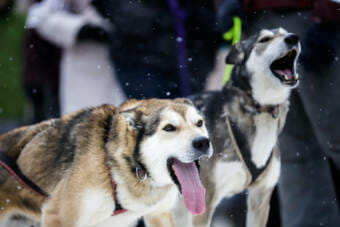
a pair of frost-covered sled dogs in harness
Kuskokwim mushers have been training in extreme weather conditions ahead of the 2022 K300 Sled Dog Race. (Photo by Katie Basile/KYUK)

Kuskokwim mushers have trained in all kinds of weather this past winter, starting with the coldest November on record in Bethel, rain in December 2021, and then glare ice in January 2022. Some Kuskokwim mushers competing in this weekend’s K300 race say that they’ve been contending with some of the most challenging training conditions of their careers.

Jason Pavila of Kwethluk is gearing up for his first K300, and he says he’s nervous. He’s been mushing for about 10 years, including winning the Bogus Creek 150 at the age of 15. But in all that time, he’s never trained in weather like this.

“It’s been weird,” Pavila said. “This is the first year I’ve actually trained dogs with a raincoat.”

In December 2021, an extended period of rain and warm weather melted the snow. During that time, Pavila trained his dogs using a four-wheeler, doing little 5-mile loops to Kwethluk’s airport.

“It was pretty boring going back and forth. Same things over and over,” Pavila said.

Pavila, an 18-year-old high school senior, is balancing schoolwork and playing basketball with training in difficult conditions.

Other Kuskokwim mushers, like five-time K300 Champion and former Iditarod Champion Pete Kaiser of Bethel, were completely sidelined in December due to weather.

“During that whole two weeks of just sitting around waiting, you’re just unsure how long it’s going to be before you get back on the runners,” Kaiser said.

“That two weeks was one of the harder two weeks in the middle of training that I’ve had to deal with,” said last year’s K300 Champion, Richie Diehl.

But Kaiser said that the break wasn’t too big of a setback for his team. In fact, he said that it could actually help.

“Definitely time off is not a bad thing, especially if it’s timed right. It can help, you know, refresh the team mentally, physically, all that stuff,” Kaiser said.

In 2019, bad weather in Bethel forced Kaiser’s team to take a 10-day training hiatus about a month before the Iditarod, which he ended up winning.

For some Y-K Delta mushers, the difficult training conditions caused them to withdraw from the K300. Four mushers dropped out of the race this month. Fr. Alexander Larson of Napakiak, who finished fourth in his first K300 last year, said that he was considering doing the same.

“I was planning to withdraw too, but I did one long run which made my dogs’ difference,” Larson said. “I think some of my dogs will do good. I think they learned a lot from last year.”

Last year, Larson and other Kuskokwim mushers were able to practice for the K300 by running the Bogus Creek two weeks before. The two races also shared the same route.

“Running the Bogus, it helped a lot. That’s what I was looking forward to this year, but didn’t happen,” Larson said.

The Bogus Creek 150, originally scheduled for earlier this month, was postponed until February due to weather conditions.

Other top K300 contenders from out of the region have been a bit luckier with the weather. Former Iditarod Champion Joar Leifseth Ulsom runs a kennel out of Willow. He said that the training conditions have been pretty good there this year. And even when it’s been bad, he’s been able to move his team around on the road system.

“That’s where we’re kind of lucky compared to the guys on the Kuskokwim. We can load them in the truck and drive 2[00] to 300 miles and find snow,” said Leifseth Ulsom.

This year, the K300 is back on the traditional race route, going from Bethel to Aniak and back. That’s a relief for 2019 K300 Champion Matt Failor, who got lost on last year’s course.

“I’m going to try to make sure I do not repeat that. I don’t want to get lost,” Failor said.

Diehl, last year’s K300 champion, is also happy for the race to return to its traditional course, which travels through his hometown.

“That’s one thing I missed last year was, definitely there was a part of me that was like, ‘Darn, I wish I would’ve got to take this winning team through Aniak.’ But I guess we’ll try this year,” Diehl said.

Diehl is looking to repeat his win, but he’ll have to beat a field of 15 other mushers who have each overcome their own set of challenges to compete in the 2022 Kuskokwim 300 Sled Dog Race. The race begins Friday, Jan. 28 at 6:30 p.m.

Site notifications
Update notification options
Subscribe to notifications