Sports

Fairbanks curler to compete in Winter Olympics

A woman preparing to slide a curling stone.
Vicky Persinger at the Fairbanks Curling Club in 2016. (Indie Alaska screenshot)

Fairbanks curler Vicky Persinger has earned a place on the U.S. team that will compete in the Winter Olympics in China in February. 

According to USA Curling, the 29-year-old Fairbanks resident and 34-year-old Chris Plys of Duluth, Minnesota will represent the United States in mixed doubles in Beijing.

Persinger is a fourth-generation curler who learned the sport at the Fairbanks Curling Club.

The U.S. Olympic Trials champions secured the spot by defeating Russia in the finals of a mixed doubles qualification event in the Netherlands this week.

The Bejing games will be Persinger’s first.  Plys competed in the 2010 Olympics.

Olympian Lydia Jacoby partners with swimwear company following NCAA rule change

Lydia Jacoby of Seward, who won gold at the Tokyo Olympics, is swimming at the University of Texas at Austin next year. Her deal with swimwear company Arena wouldn’t have been possible a few months ago because of a previous NCAA rule that prohibited college athletes from making money off of their image. (Valerie Kern/Alaska Public Media)

Seward swimmer Lydia Jacoby just signed with swimwear company Arena — the high school senior’s first deal with a brand since winning gold at the Tokyo Olympics this summer.

But it wouldn’t have been possible even a few months ago. The partnership takes advantage of a new set of rules from the National Collegiate Athletic Association, the body that governs student athletics.

Before June, student-athletes had to choose: play college sports or go pro and sign with companies. It’s a choice Olympic champions like Missy Franklin and Katie Ledecky had to make when they were entering college, due to a “name, image and likeness rule” that prohibited college athletes from profiting off their popularity.

That was until this summer when the NCAA lifted that rule.

“The rules are still very cloudy,” said Steve Ozmai, director of marketing for Aena. “And what complicates things a little bit is the fact that the rules for the individual athlete are different state to state and university to university.”

Jacoby is swimming at the University of Texas at Austin next year. Before signing with her, Arena worked with the university to talk through the terms of the contract.

This fall, representatives from Arena came to Seward to meet the Jacobys. Jacoby’s mom Leslie said the brand felt like a good fit.

“Lydia’s always been surrounded by people that support her and she has a really great team of supporters between her coach and her family and her friends and community,” Leslie Jacoby said. “And I get a really good feeling from the Arena group.”

The feeling is mutual. Jacoby is the first student-athlete Arena signed.


View this post on Instagram

A post shared by Lydia Jacoby (@lydiaalicee_)

“We were just so inspired by what we saw from her in the pool in Tokyo,” Ozmai said. “It still gives you goosebumps if you watch the watch party in Seward and all of her fans. And when we were up there and came to visit, we saw the banners on the side of the buildings saying, ‘Go Lydia’ and the stickers on the backs of the cars.”

Jacoby is not the only Olympian who’s heading to college under the new rules. And athletes with large social media followings, like football players from Big Ten schools, might have the most to gain.

Travis Thornberry with the University of Alaska Anchorage athletic department said there’s at least one athlete taking advantage of the new rules at UAA — cross-country skier JC Schoonmaker.

Generally, Thornberry said most deals will probably be reserved for Division 1 athletes. He said UAA will handle deals with companies on an individual basis.

Ozmai said the new rules are a game-changer for both companies and athletes. Under the old guard, even if Jacoby was wearing a swimsuit from Arena, the brand couldn’t promote it. Now, it can.

“Any promotional advertisement materials, whether it’s social media, TV commercials, full-page advertisements, things like that were off-limits in the past,” Ozmai said. “And now, this has opened up the opportunity to do that.”

Leslie Jacoby said life has been a whirlwind since the Olympics when Jacoby swam her way into the hearts of spectators all over the world. When the Jacobys returned to Seward in August, they hired an agent. In September, Jacoby joined the U.S. National Team. Just a few months later, she joined her peers in the pool for the state meet in Anchorage.

“We have been learning step by step since Lydia’s success at the Olympics,” Leslie Jacoby said. “We just haven’t anticipated each step. We just didn’t see any of this coming. It’s been a really positive but really busy and wild ride since.”

The Seward Tsunami Swim Club, Jacoby’s home team, is also feeling the hype.

Leslie Jacoby said the club has 82 swimmers signed up this year. She said it’s the most they’ve ever had.

A musher from the world’s southernmost city is headed to Alaska to compete

Miguel Isla Casares with a rental van and his dogs at the John F. Kennedy International Airport in New York City (Santiago Cullen)

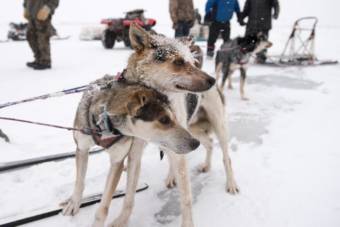
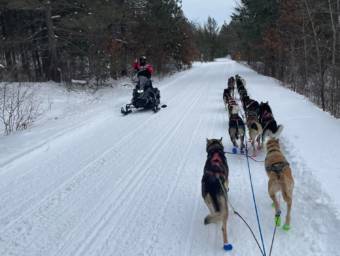
It’s spring in the southern hemisphere, but the lure of another season of cold and snow to run dogs is drawing a musher named Miguel Isla Casares from the southernmost city in the world to Alaska.

“I’m from Argentina,” he said. “Ushuaia, Patagonia.”

Casares said he and his 10 sled dogs flew to New York and then drove a rental van to Michigan, where they are temporarily staying with Iditarod veteran Lloyd Gilbertson.

“They give us food and everything,” he said. “I feel like home here, and I am really far from home.”

Casares said Gilberston even gave him a dog truck for the next leg of the journey north.

“To drive all the way to Fairbanks,” he said.

It isn’t Casares first trip to Alaska or Fairbanks. He said he met Yukon Quest and Iditarod Sled Dog Race champion Lance Mackey in 2019 and spent last winter at his Fairbanks area kennel after Mackey’s partner was killed in an ATV accident.

“I went there to be with them and help with the dogs, and we become good friends,” said Casares. “They are a great family.”

Casares credits Mackey, Gilbertson and other mushers for helping him, as well as people all over the world who’ve donated money after seeing a video he posted on Instagram about his goal of racing his dogs in Alaska.

“The idea or the plan in my brain today is to bring the first team from the Southern Hemisphere to compete in the Northern Hemisphere,” he said. “I made all the money to come all the way here just through Instagram with showing the video and telling the people this is my dream and if someone want to help me. And thousands of people start to show up and here I am.”

Casares wants to run the 1,000-mile Iditarod but says his first challenge will be completing shorter, qualifying races like the Copper Basin 300 or the Yukon Quest 550.

Sealaska Heritage, Tlingit and Haida host training for Native Youth Olympics coaches

Kyle Worl demonstrates the One Foot High Kick, and event in the Native Youth Olympics. (Photo by Adelyn Baxter/KTOO)
Kyle Worl demonstrates the One-Foot High Kick, an event in the Native Youth Olympics, in 2017. (Photo by Adelyn Baxter/KTOO)

Sealaska Heritage and Central Council of the Tlingit and Haida Indian Tribes of Alaska will offer free classes for anyone who is interested in becoming a Native Youth Olympics coach. The organizations are based in Juneau, but anyone with internet access can sign up because, for the second year in a row, the training is virtual.

Juneau resident Kyle Worl has been coaching NYO for four years. He said the games are based on hunting and survival skills that allowed the Inupiaq people to live in Arctic conditions, like the One-Foot High Kick.

“[That] is a high jump where you kick a suspended seal skin ball target,” Worl said. “It was used long ago, not only as a game but also as a form of communication across the Tundra. So a high kick could signal a successful or unsuccessful hunt.”

An athlete participates in the One-Foot High Kick during the 2021 Traditional Games in Juneau.
An athlete participates in the One-Foot High Kick during the 2021 Traditional Games in Juneau. (Photo courtesy of Kyle Worl)

There’s also a Seal Hop which is based on a technique used to sneak up on seals laying out on the ice. Alaska isn’t the only place where the games are played either. Worl said they reach as far as Canada, Greenland and Russia.

“But in other places they’ll refer to it as Inuit Games or Arctic Sports,” he said. “So they’re games that draw origins really from across the Arctic.”

More than 100 different Alaskan communities participate in the games. Worl said by offering virtual coach training, he hopes to bring it to more places. So far, people have registered for it from six different time zones across North America.

The training is available in two parts on Monday and Tuesday or as a single session on Saturday, Oct. 16. Worl said he’s found coaching to be very rewarding.

“You’re providing support for youth and a healthy outlet for them,” Worl said. “It also keeps me involved with my community, keeps me healthy. We encourage anyone who may be interested to join us.”

Registration will remain open until the day before for each training session. The link to sign up is available on the Sealaska Heritage Facebook page

The next event scheduled for Juneau is the 2022 Traditional Games. Those will take place April 2-3, 2022 at Thunder Mountain High School.

Jacoby makes splash in World Cup

Seward swimmer Lydia Jacoby after returning home from the 2021 Olympic trials on June 23, 2021. (Valerie Kern/Alaska Public Media)

Seward Olympic champion Lydia Jacoby added to her medal collection in a FINA World Cup short-course meet in Germany this weekend. The 17-year-old won a bronze in the 100-meter breaststroke Saturday followed by silver in the 50-meter breaststroke Sunday. She was fifth in the 200-meter breaststroke Friday.

Jacoby’s silver time of 30.04 seconds in the 50-meter was a personal best and an unofficial record for Americans 18 or younger. Her bronze time of 1 minute, 5.20 seconds in the 100-meter set another unofficial record for junior Americans.

Jacoby won gold in the 100-meter breaststroke in the Summer Olympics this year, though that was in a 50-meter pool. World Cup races are in 25-meter pools.

Jacoby is scheduled to compete in the second leg of the FINA World Cup in Budapest, Hungary, later this week.

Ironman triathlon is coming to Alaska for the first time with race in Juneau

Auke Lake (Gillfoto / CC BY-SA 4.0, via Wikimedia Commons)

The Ironman triathlon is coming to Juneau next year. It will be the first time the event is ever held in Alaska.

The race will be on August 7, 2022. It includes a 2.4-mile swim in Auke Lake, a 112-mile bike ride out the road and a 26.2-mile marathon in the Mendenhall Valley, in that order.

There isn’t even a 112-mile road in Juneau. But Ironman has been planning this race for over nine months now, and they were able to plan a course around the Auke Bay area.

They considered how to get all those bikes here, trail conditions and wildlife. And neither bears nor a lack of a road system to get to Juneau phased organizers.

They are partnering with Travel Juneau to plan the event.

“They’ve done this all over the world, so it really was impressive how much, things we would have considered possibly an obstacle, they’re like, ‘Oh no this is, we’re gonna work it this way,’” said Travel Juneau’s Destination Marketing Manager Kara Tetley.

Tetley said that Juneau has a unique appeal to racers as a travel destination.

“A lot of these athletes, my understanding, is that they are very excited to go to new places and that’s part of how they travel, you know? Their family vacation,” she said.

Up to 1,500 athletes, their family and their friends could be coming to Juneau for the triathlon. Tetley said it will be an economic boost for the city.

“Local businesses will be seeing a lot more visitors. The hotels will be probably full,” she said.

Priority registration begins about a week from now on Aug. 16 at 8 a.m. Alaska Daylight Time. You can find out more about the race on the Ironman website.

Site notifications
Update notification options
Subscribe to notifications