I help the newsroom establish daily news priorities and do hands-on editing to ensure a steady stream of breaking and enterprise news for a local and regional audience.
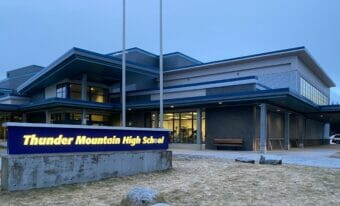
Thunder Mountain High School (Photo by Bridget Dowd/KTOO)
The Juneau School District announced Thursday that Shawn Arnold will be the next principal of Thunder Mountain High School.
Arnold is the current director of student services for the school district. In that role, he manages the district’s special education program as well as counseling and student activities.
Arnold is one of three candidates who visited the school on Tuesday. After interviews with staff, district administration and the school’s site council — Arnold was recommended for the position.
Thunder Mountain High School is the largest school in the district. Nearly 600 students were enrolled there at last count. The last principal left in the spring of 2021. During the fall semester, the school had an interim principal, but there hasn’t been a principal this semester.
Arnold will start his new position in late July, according to the school district.
A health care worker caring for a woman hospitalized in an isolation room in the critical care unit of Bartlett Hospital in Juneau, Alaska on April 7, 2020. (Photo by Rashah McChesney/KTOO)
Two more Juneau residents have died of COVID-19.
The state reported Wednesday that a man in his twenties and a man in his eighties had died, though few other details were given. City officials didn’t immediately return messages seeking more information on Wednesday afternoon.
So far, at least 21 Juneau residents have died from COVID-19.
The state also reported another 24 new cases for Juneau since Monday. Those are the total new cases from the past two days, but that number doesn’t include Wednesday’s tests or results from home tests.
There are four people now being treated for the virus at Bartlett Regional Hospital. Eight staff members are home with positive tests or symptoms.
Statewide, another 863 Alaskans and visitors to the state tested positive for the virus between Monday and Tuesday.
Twenty-five more Alaskan residents died as well. Most were from Anchorage and Wasilla, but people from North Pole, the Kusilvak Census Area, Kodiak, Ketchikan, Fairbanks, Bethel and the Houston/Big Lake area died as well.
So far, at least 1,141 Alaskans and visitors to the state have died from COVID-19.
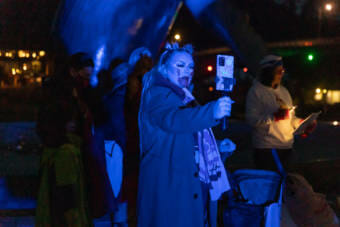
Attendees of a vigil honoring missing and murdered Indigenous persons light lanterns at Overstreet Park on Feb. 14, 2022, in Juneau (Photo by Lyndsey Brollini/KTOO)
Valentine’s Day this year marked three years since Tracy Day went missing.
Day, who is Lingít, is one of several Alaska Native Juneau residents who disappeared and haven’t been found. About 30 people gathered on Monday night to share their stories and sing to their missing loved ones.
A row of seven portraits sat propped up near the whale statue in Overstreet Park in Juneau. All were of Alaska Native people who went missing in Juneau or nearby communities. Most have not yet been found or were found dead.
One of the missing people is Tracy Day.
Tracy Day has been missing since Feb. 14, 2019. (Photo courtesy of Juneau Police Department)
Mike Kanaagoot’ Kinville stood looking at the portraits, then turned to share his story about Day. His family and Day’s family have been close for generations, so he has a lot of them. Like, when Day was 14-years-old, and she ran away from home in Juneau and beelined for his house in Ketchikan.
“She had known that I was a drinker at one time and she came looking to drink with me,” Kinville said. “And I had gotten sober since then, so I was in a position to take her in and started doing foster care for her.”
Kinville said she stayed with the family for nearly three years. He said she had a lot of charisma — that she was joyful and mischievous at the same time — and that she was “kind of a smart aleck.”
Kinville’s family ended up taking care of Day’s daughters, too. The older one, when Day went away to nursing school; the younger one, after Day went missing.
“Our families are tied together really close,” Kinville said. My mom and dad took in Tracy’s mom when she was a teenager, too. That’s pretty Lingít too, the generational ties back and forth together,” he said.
Before Day disappeared, Kinville says she had her ups and downs. She struggled with substance use and her mental health. It’s the kind of thing a lot of families experience but don’t usually talk about.
“You learn to guard your heart to a certain extent with situations as much as you can, but you still get bruised,” he said. “And, in this case, heartbroken. It’s just, the heartbreak can’t heal because we don’t know what happened to her.”
Kinville said that what makes it even harder is that before she disappeared, Day seemed like she was getting some stability in her life.
“We were hopeful,” he said.
As he looked down the row of photos of Juneau’s missing again and talked about each of the families they left behind, he got choked up.
“You know, I said heartbroken, but what it feels like is an ache in my soul,” Kinville said. “It’s just so deep, you know, deeper than my bones. This sense of this unresolved pain that goes on and on. It’s really difficult. My heart goes out to the families of these missing people. I imagine I have their sympathy as well. The other part about it that’s difficult is, you know, life goes on for everybody else, and things go back to normal, and that part of us is still missing.”
Jamiann S’eiltin Hasselquist drums at a vigil for Tracy Day and other missing and murdered Indigenous persons at Overstreet Park in Juneau. Hasselquist is part of the Strong Women singing group. (Photo by Lyndsey Brollini/KTOO)
Kinville said he’s hoping the vigil will help people understand what it’s like to love someone and not know what happened to them. It’s a wound that won’t close.
“It’s important for a community to come together and not give up on the people who are missing and not marginalize these people. What’s common here is race and income bracket, you know. That’s not the society that I want to live in, and I think we can do better than this,” he said.
The Strong Women group sings at a vigil to honor missing and murdered Indigenous persons in Juneau, Alaska. (Photo by Lyndsey Brollini/KTOO)
Several women sang throughout the night for those who have missing and murdered Indigenous relatives. They’re called Strong Women, and Rhonda Butler is one of them. Butler is the President of the Alaska Native Sisterhood Camp 2 in Juneau. She said she and the women who joined her sing to bring strength to families who are struggling from these losses.
“One of our strengths is our voices, and if we don’t use our voices, no one will hear. So we’re here to share a couple songs with everyone here in honoring Tracy Day and all the other missing and murdered Indigenous peoples,” she said.
Candles lit in honor of Tracy Day and other missing and murdered Indigenous persons at a vigil at Overstreet Park in Juneau. (Photo by Lyndsey Brollini/KTOO)
The temperature dropped as the sun went down, but people stuck it out. They lit candles and sheltered the flames from the wind. Then they started lighting flying lanterns.
Toward the end of the evening, as the snow started to fall more heavily, one woman said she wanted to sing a hymn for Tracy Day. Day’s twin sister Angela jumped up and ran over to join in.
They huddled together, rocking and shivering as they sang “How Great Thou Art,” as the flickering light from sky lanterns faded off into the distance over Gastineau Channel.
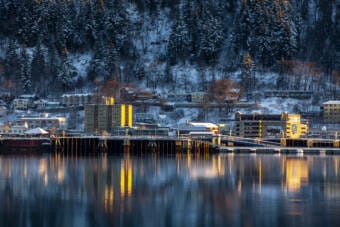
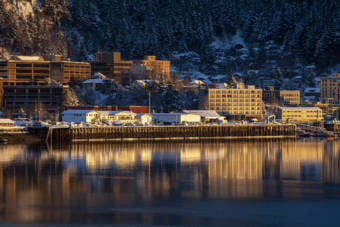
The sun rises over downtown and the cruise ship docks on Dec. 22, 2021, in Juneau, Alaska. (Photo by Rashah McChesney/KTOO)
Juneau’s emergency managers have decided to lower the city’s COVID-19 risk level. That’s in part because of a decline in new cases and in part because there are more treatments available for people who are at a higher risk of having severe cases of the virus.
The city has been at a modified high level since early January. Now it’s down to moderate.
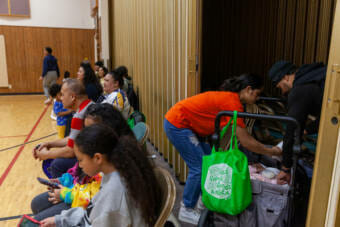
What that means in practice is that the city’s current mask mandate is still in place for people who are not fully vaccinated. But for people who are, it’s just recommended. Businesses and organizations can choose whether to require masking. It’s still required in city facilities.
Indoor gatherings are still limited to 50% of the indoor capacity of a building — or 50 people — whichever is greater. But there are no size limits if everyone is fully vaccinated. Bars and gyms are still limited to 50 percent capacity too.
The state reported another 66 new cases for Juneau on Wednesday. Those are new cases from the past two days, but that number doesn’t include results from home rapid tests.
The city’s emergency operations center reports that it still has a good supply of those take-home tests which can be picked up at all of the libraries, the police station and city hall.
Three patients are currently being treated for COVID-19 and 11 staff members are out due to exposure to the virus.
The Juneau school district reported 17 new cases in schools since Monday.
Statewide, another 2,264 Alaskans and visitors to the state have tested positive for the virus over the last two days.
The state is reporting that another 4 people have died. So far, at least 1,114 Alaskans and visitors have died after contracting COVID-19.
Melehoko Pauu Ma’ake talks to a friend during her family’s regular meetup to play pickleball on Jan. 22, 2022, in Juneau, Alaska. Most of the family is Tongan and they’ve been trying to reach family and friends in the island nation after a volcanic eruption and tsunami. (Photo by Rashah McChesney/KTOO)
Last weekend, two locations of the Church of Jesus Christ of Latter-day Saints will be open for eight hours on Saturday and Sunday to accept donations for Tonga.
Melehoko Pauu Ma’ake is helping to coordinate the aid drive. She said it all came together veryquickly after a got a call from Edric Carillo who works in Sen. Jesse Kiehl’s office earlier this week.
She said Kiehl’s staff were hoping to make contacts in the Tongan community in Juneau and “they wanted to find out if I can help, you know, find a facility that would be able to house all of the donations here in Juneau.”
Ma’ake and another family member made some calls and within a few hours, both bishops of their local LDS churches called back to volunteer church space.
“That was just so awesome,” Ma’ake said. “Knowing that, you know, that we can have a place like that at the spur of the moment, very last minute in a situation.”
Right now, suggested donations are nonperishable foods like flour, sugar and canned goods. There’s also an option to donate at a website set up through the church. Specify “Tonga Relief,” in the comment section after donating.
They’re also looking for donations of personal protective equipment to help prevent the spread of COVID-19.
“Masks, hand sanitizer, any, you know, cleaning supplies, you know would be what is most needed. The latest thing that’s going on right now is, you know, COVID has come to Tonga. For them it’s a very very big deal because they’re a third-world country, they’re very poor, so they know they cannot afford to handle a situation if COVID starts effecting and goes out of hand rapidly,” Ma’ake said.
There have been worries of an influx of foreign aid and workers bringing the pandemic to Tonga. Right now, the whole country is on lockdown because the country recorded its first cases of community transmission of the virus.
This food drive and fundraiser have been a way for them to direct their efforts.
Siua Sekona watches a pickleball game on Jan. 23, 2022 in Juneau. Sekona was born and raised in Tonga and, along with the rest of his family, has been waiting to hear from friends and family who still live there. (Photo by Rashah McChesney/KTOO)
“They’re very excited… they’re kind of like ‘OK Mele, whatever you have in mind, let us know and we’ll jump on it,’” she said.
Ma’ake and several members of her family will be taking donations at the church locations over the weekend and then several members of her family and a few other Tongan families have offered to help pack donations on Tuesday, but they’d welcome more hands to help with that process. They’ll be packing at 4 p.m.
“We’ll be packaging it up and delivering it over to Alaska Airlines, and Alaska Airlines will be sending it directly to Anchorage,” Ma’ake said.
Ma’ake says that a larger shipment of goods will be going out to Tonga next Wednesday.
This is the first official aid drive for Tonga in Juneau, but Ma’ake said she doesn’t think this will be the last one.
“This is going to be a long haul for Tonga,” she said. “Livestock … and also agriculture has been devastated by this volcano. Hopefully, the people of Juneau will come together and donate what they can.”
State attorney Libby Bakalar cites a statute governing the appeal process for election certifications and recounts during a press teleconference at the Division of Elections office in downtown Juneau on Nov. 26, 2018. A federal judge ruled that Gov. Mike Dunleavy violated her First Amendment rights when he fired her on the day he was sworn into office. (Photo by Jeremy Hsieh/KTOO)
Rashah McChesney sat down with former assistant attorney general Libby Bakalar to talk about what the ruling means.
Listen:
The following transcript has been edited for length and clarity.
Rashah McChesney: This is kind of a complex timeline, so let’s walk through it. You have this blog, One Hot Mess, for several years. At one point, you start writing about former President Trump, and another attorney and the state complains. The state investigates you and your blog and finds no wrongdoing.
Then Gov. Dunleavy gets elected, and he and his former chief of staff, Tuckerman Babcock, send out these demands for resignations to 800-something employees in the state — including you. Something that’s recently deemed unconstitutional. You resign. Gov. Dunleavy gets sworn in at noon on Dec. 3, and you find out 20 minutes later that you’ve been fired.
Libby Bakalar: You know, it was really slow and grueling, to be honest. I mean, it wasn’t like every single day, something different was happening in the case or anything. It’s just, it’s a long time to be in limbo with something like this. You know, I think I wrote about this in my blog — it just a takes a very long time to prove this kind of point. When I filed this case, I was like, I’ll be surprised if this is resolved within Dunleavy’s first term of office. So I fully expected it to take pretty much as long as it took. It’s just part of being a litigant.
Tuckerman Babcock, (left) Gov. Mike Dunleavy and Ben Stevens pose for a photo that accompanied the announcement of that Stevens succeeding Babcock as Dunleavy’s Chief of Staff. A federal judge ruled that Babcock and Dunleavy violated the rights of a Juneau attorney when she was fired in 2018. (Photo courtesy of the governor’s office)
Rashah McChesney: One of the reasons that Tuckerman Babcock said that he did it was because he didn’t like your resignation letter. I’m wondering if you could tell me a little bit about that letter and sort of describe what you were thinking when you wrote it.
Libby Bakalar: Well, so the attorney general at the time, Jahna Lindemuth, gave everybody a template to write the resignation letters on. So every attorney who submitted the resignation letter used the same template. I may have added something like, “I’m doing this under duress,” or “I’m doing it because, you know, Mr. Babcock said I was going to be terminated if I didn’t do it.” I kind of wanted to make it clear that my resignation wasn’t voluntary. But that language about the resignation being involuntary was in the template. And as Judge [John] Sedwick said, another attorney who used the exact same language … that resignation letter wasn’t accepted. So that was just something that — I think that we found completely not credible. And I think when you read the letter, you can see it’s completely professional and completely anodyne. So, you know, that was clearly pretextual and Sedwick saw right through that.
Rashah McChesney: When you submitted that resignation letter did you expect that they were going to accept it and that you were going to lose your job?
I think in the back of my mind, I was worried about losing my job, but I knew that what I was doing was legal. That’s the thing, right? I knew my work was good. I knew my relationships with my clients and colleagues were good. My work was beyond reproach, right? And I knew I had the constitutional right to speak on these matters. And so my mistake was assuming that these folks were going to comply with the law, right? And I think I must have thought that because, you know, when they called me and told me about this, that I was fired, I was like, I picked up the phone, and I said, “Are you calling and telling me… You’re firing me? And like, yeah, sorry, basically.” So it kind of, you know, wasn’t like this huge shock, I guess. But I think deep down, I was like, they couldn’t really do this, because this is against the law, right? And they did it anyway. And we’re, you know, we’re a firm of lawyers. So I thought, “There’s no way that these lawyers are going to carry out this illegal order, from Tuckerman Babcock,” and I was wrong about that. I was wrong about that. So I think I was surprised on some level.
Rashah McChesney: This is a little bit of a rabbit hole, but there was another lawsuit against the governor’s administration, for demanding those resignations. These psychiatrists from Alaska Psychiatric Institute sued over the same thing, over being asked to resign.
Libby Bakalar: Right. The ACLU filed a case on their behalf of at the same time that they filed my case. And in that case, the psychiatrist plaintiffs did not submit resignation letters at all, and because of that, the judge had a different analysis. There’s these two lines of free speech cases like this. And one of them has to do with patronage schemes, and one of them has to do with policymaking and disruption at work. And the former line of cases is what the psychiatrist case was about, because they did not submit those resignation letters. And so the judge was able to find in that case, that the entire scheme itself, the resignation letter scheme itself, the very act of submitting of … was essentially an unconstitutional patronage.
Rashah McChesney: So, they were just on some kind of parallel track this whole time?
The Alaska Psychiatric Institute in Anchorage. (Photo courtesy Alaska Department of Health and Social Services)
Libby Bakalar: The judge declined to consolidate those two cases early on, the ACLU asked to have them consolidated and for a number of reasons, he denied that motion. And I think when you see the two orders, in those two cases, you can kind of see why. There are a lot of different issues. Obviously the psychiatrists, they didn’t have this blog. There wasn’t this whole question of whether they were policymakers there wasn’t, there was just kind of some different issues going on, different fact patterns.
So yeah, they were similar in some ways. But in a way, it was the best possible outcome, in my opinion that these two cases were decided separately and on different grounds. Because what the judge did, essentially within one case, he invalidated the resignation demand scheme on its face. And in my case, he invalidated it as applied to me. It’s sort of a double whammy. I think in the end, it was good because we got those two separate rulings that essentially validated the illegality of this entire scheme, both as it was conceived and as it was applied.
Rashah McChesney: Now that it’s been ruled that they fired you unconstitutionally – how do they pay for it?
Libby Bakalar: So that’s yeah, that’s the question. It’s either gonna be through a settlement or a jury trial. And so this is kind of like the analogy would be the sentencing hearing, kind of. After someone’s convicted, right, there’s a whole other sentencing phase. It’s kind of like that. So the judge basically, you know, quote, unquote, convicted them on this wrongdoing. And now there’s the quote, unquote, penalty phase, that’s more or less the analogy in the civil setting. So it’s over in the sense that the merits of the case have been decided, I mean, they could always appeal for all I know, they might appeal. And that could change the picture somewhat. But we have this ruling that says they broke the law, right? So now it’s like, well, how do you remedy that? And that’s an open question.
Rashah McChesney: There could still be a fair amount of wrangling.
Libby Bakalar: There’s a fair amount of loose ends. It’s not just, like, completely over. It’s a win there. It’s a pretty much an unqualified win, in my opinion, just because for me, just psychologically, I just, this whole time, all I ever wanted was for a judge to say, “Yes, this was unconstitutional. Yes, this was illegal.” And that finally happened. And so for me, it’s over in my mind on that front. In terms of my feelings of vindication on the merits of what they did, how they’re going to pay for it, what’s going to happen in the future, how this will affect state employees. …What I really care about is that this never happened to another state employee ever again. I never want to see a mass resignation scheme. I never want to see a partially exempt, non-unionized state employee — some geologist, biologist, architect, you know — be forced to resign their job every four years. That’s just insane.
Rashah McChesney: Is this case as simple as a free speech test? And should every state employee go out now and write whatever they want about the president on a personal blog and feel reasonably certain that they won’t be fired?
Libby Bakalar: I don’t know. I definitely would hesitate to answer that question in the affirmative. I don’t think that’s true. I think there is a fact-based analysis of like, what positions are really policymaking positions for which political affiliation is actually a job requirement? I don’t think the court order really answers that question in any kind of uniform way. It certainly doesn’t say every non-unionized state employee can say whatever they want, whenever they want. Like, that’s not what it says. But I think what it does do is it sends a message that, you know, at least in some cases, you know, non unionized state employees do have free speech rights. It’s not a good faith constitutional use of personnel resources, to demand resignations, and to make personnel decisions, based strictly on people’s off-duty speech, right?
But there again, there’s complicated case law, and these complicated tests and balancing tests and applying all these factors and things. So it’s not as cut and dried as now, you know, every non-unionized state employee, every partially exempt state employee can say and do whatever they want. No, that’s not what this order says. But I think it does send a message that there are still, there are limits, you know, to what the government can do to you. And we do have, we still have democracy, at least nominally. And we still have free speech rights in this country. And even if you work for the state, and that’s, that’s been established now. And I think it was established before it should have been known before. But now it’s been reiterated in no uncertain terms.
So I think future administrations are going to think twice before they try anything like this ever again. So functionally, I think it’s going to be — there will be much more deliberation about that transition. About who is told to leave their job, and who was forced to resign their job. And under what conditions, right? I think I will have set some precedent, these two cases will have set some precedent in that respect.
Rashah McChesney: Right, because this is something that happens during every governor’s administration, generally, is that they asked for the resignation, but usually of political appointees, right?
Libby Bakalar: Usually commissioner-level and director-level people, deputy director levels … people who are quite comfortably within that policymaking framework, right. Not typically ever, you know, a Fish and Game biologist, or, you know, city water, a state water inspector or something. I mean, jobs that have absolutely no policymaking, you can’t even make a good faith argument that these are policymaking jobs. But, you know, that was all based on norms before, and this administration shattered those norms.
Just because it had never been done before. And the reason it had never been done before was because you would never even consider asking non policymaking employees to resign. And yet, they did do that as some sort of, quote, bold new thing or something to quote Tuckerman Babcock. But what it was, it was a flex, you know. It was a flex. It was an intimidation tactic. It worked. You know, for the past four years, three-and-a-half years people have been absolutely terrified in this administration.
I hear from state employees every day, how scared they are working for these people. And with good reason. They have shown absolutely no compunction about violating the law and penalizing people for quote-unquote disloyalty.
So there was like, a few different kind of iterations of this, right? And all of it just sent this general message of intimidation. And the idea that you’re, you know, the administration is lurking on your social media, and they’re just waiting to pounce on you for disloyalty. I mean, that’s a terrible and completely undemocratic way to exist as a government employee. And it just made me so angry. And I think that’s what fueled this entire thing for me, is that I just wanted to do something impactful for the entire state employee workforce.
Rashah McChesney: In that other case that we were talking about earlier were a couple of doctors sued over this resignation letter requirement. The judge ruled that Tuckerman Babcock and and Governor Dunleavy don’t have qualified immunity in that situation. Does that apply to your case as well?
Libby Bakalar: No, it doesn’t, and I didn’t expect it to either. Qualified immunity is a very hard thing to lose. You have to really do something bonkers to lose it. And I was actually surprised in the psychiatrists case to see Dunleavy and Babcock stripped of qualified immunity, because its functions, in practice, like absolute immunity, it really does.
I’ve never seen it happen where a government defendant in a civil case like this loses qualified immunity. It’s just unusual, it’s very unusual. Because if government workers were able to be held personally liable in their jobs, no one would ever work for the government, right? So there has to be some form of protection there.
But I think what the judge was saying is that they went so far with this, this was so out of the realm of reason to do this, that they were personally liable for it. I think, in a way, I think qualified immunity is good for government workers. In another sense, it also disincentivizes good faith conduct on the part of people in power in government, because unless it’s their personal assets on the line in these types of situations — somebody is acting in bad faith — there’s no incentive to obey the law.
Take my case, for example. I’ve been gone from the Department of Law for three-and-a-half years. They got what they wanted, they got me gone, I’m gone. I’m not there, right? They’ve gone on. And now like the damages phase is, you know, the damages go to the state of Alaska, not to them. So — they lost nothing. So when you lose qualified immunity, at least that sends the message of “you can’t just do whatever you want.” At some point, there’s going to be a point at which you are going to have to worry about your personal assets in these things. And you can’t just disobey the law, and expect to completely get away with it every time and have the State of Alaska foot the bill in the end.
Close
Update notification options
Subscribe to notifications
Subscribe
Get notifications about news related to the topics you care about. You can unsubscribe anytime.