Alaska Public Media

Alaska Public Media is one of our partner stations in Anchorage. KTOO collaborates with partners across the state to cover important news and to share stories with our audiences.

Successes and shortcomings in Anchorage’s homelessness strategy

As the year comes to a close, Anchorage officials are taking stock of the city’s problems with homelessness.

Several assertive measures to connect people with housing and social services are succeeding, but the coordinated effort is showcasing just how much work is left to do.

A Wednesday meeting of the Assembly’s committee on homelessness put on display the measurable gains being made by city programs, and also where critical gaps remain.

Assembly members were briefed on a number of programs implemented over the last year, which included a lot of good news.

Dozens of people have been moved into housing since this summer.

Coordination among city services and non-profits has created a list of 250 vulnerable adults, including their names and needs based on comprehensive assessments.

A number of experimental programs are showing positive results.

One is a work-van program run by a company called Alaska WorkSource.

This fall, staff picked up individuals living or panhandling on the street and brought them to work sites.

Reporting by the Alaska Dispatch News recently uncovered questionable practices handling a no-bid contract from the city worth $75,000.

WorkSource’s Executive Director Darryl Waters took issue with the claims during remarks at Wednesday’s meeting, and stressing that what matters more is the half-dozen people who have gotten sober and found employment in the four months since the program launched.

“That’s how we roll, we don’t do a lot of technical stuff, we get right to the matter: ‘how do we help you?’” Waters said.

Five of the people who have gone through the program joined Waters in the audience.

The committee’s chair, South Anchorage Assembly member Bill Evans, is pleased with AlaskaSource’s results, which he held up as a compassionate and cost-effective way of getting people off the streets.

“But that doesn’t give us a pass,” Evans said. “Even (though) we’re working for a good end we’re still subject to public scrutiny because we’re using tax-payer dollars, so we have to be willing to take that level of scrutiny or criticism.”

Addressing Waters’s objections to the reporting about his venture, Evans offered his own diplomatic interpretation: “If anything the criticism seems to be directed mostly towards the city, the Assembly, whoever granted the contract on a no-bid basis, and whether we rushed into that or not.”

Much of what the committee heard was that some of the city’s efforts to gather data on the extent of Anchorage’s homeless problem and deal with it comprehensively are working too well, in that they’re giving stretched employees and services more work than they can handle.

One example is homeless camps: a systematic approach to locate, log and clean up camps has nearly tripled the amount of material hauled to the city’s dump over last year.

So far, 138 tons of debris have been removed, according to the city’s Parks and Recreation Director John Rodda. The demands placed on staff from the aggressive new approach were, Rodda said, not physically possible.

The increased focus has exposed other over-burdened services as well.

Alison Kear, the executive director of Covenant House, told Assembly members that not only are overnight shelters unable to house everyone in need amid an ongoing cold snap, but it’s often non-profit employees who are picking up the slack.

“We’re asking organizations to function over-capacity, and we’re calling it a ‘municipal cold weather plan,’” Kear said. “The organizations are funding the back-bone of this, and it needs to change.”

Kear also spoke of critical missing gaps in the city’s social safety net and ability to get people stable on the way into housing.

Chief among them is a shortage of detox beds and substance abuse resources.

To make the point, Kear put a tan grocery bag on the conference table.

Inside, she explained, were the cremated ashes of a 23-year-old who died of a heroin overdose Dec. 3. The young man was Tucker Sauder, son of Lisa Sauder, the executive director of Bean’s Cafe, a local soup kitchen.

“That young man had myself and Lisa, who I feel like is a pretty relentless person. I could not get that kid treatment,” Kear said. “I think there’s something wrong when we continue to fund the pickup of people and we don’t fund what we do after we pick them up.”

The homelessness committee’s next meeting will be in January.

Enviros ready for ANWR fight, with military vets in their camp

Genevieve Chase
Genevieve Chase, an Army vet from Idaho, in the DC office of Alaska Wilderness League. (Photo by Liz Ruskin/Alaska Public Media)

With Donald Trump about a month away from the White House, Alaska’s congressional delegation sees a chance to finally open the coastal plain of the Arctic National Wildlife Refuge to oil drilling. The environmental lobby is ready for the fight. And they’ve got some new, patriotic allies on their side: military veterans.

Genevieve Chase served in the Army in Afghanistan, where she earned a bronze star and a purple heart. For years the Sierra Club has been taking veterans like her into the wilderness to heal. Chase says a special trip to the Arctic National Wildlife Refuge restored and inspired her.

“I wish I could bottle that up, and I wish I could send as many vets there as possible to experience the incredible vastness and to see the land,” she said, “the country that we defended.”

While she was in the refuge, she says she heard or felt a message: “Don’t play small in the world.”

“It changed my life,” she said. “And that’s why I’m here.”

“Here” at that moment, was a comfy couch in the Washington, D.C. office of the Alaska Wilderness League at the base of Capitol Hill. The League was founded in the 1990s to be a permanent presence in the capital, fighting to keep oil rigs out of ANWR and to preserve other parts of Alaska. They, with the rest of the green lobby, have made the Arctic refuge a potent symbol. They can marshal a torrent of constituent phone calls to wavering lawmakers when they need to. Now, they’re reaching beyond their usual membership to help spread their message.

“If it wasn’t for our public lands I would never have survived the transition home,” says one veteran in a video shot during a trip in the Arctic refuge amid clouds of mosquitoes. The video was made for a coalition that includes the Alaska Wilderness League.

“So let’s get out there as military veterans and protect the lands that are helping save us.”

The Alaska Wilderness League, year in and year out, has a budget of about $3 million. They have a staff of 21.

The League’s counterpart in Washington used to be Arctic Power, a largely state-funded effort to press Congress to open ANWR. Their side used to bring veterans to the hill to make a national security argument for more domestic oil production. Now, Arctic Power has no budget and no office, a victim of state budget cuts, and of the Obama years, when it was obvious no ANWR bill would become law. Arctic Power board member Gail Phillips says they’re beginning to take themselves out of mothball status. They haven’t decided yet whether to seek money to join the fight.

“We’re just getting re-grouped, so we’re just in the beginning of reorganization,” she said.

Even with GOP control of Congress and the White House and even with a cabinet that would be the oil industry’s dream team, it’s not clear ANWR drilling tops anyone’s priority list outside of Alaska and its three members of Congress.

“Compared to the past we haven’t seen as much advocacy promoting ANWR,” said Dan Simmons, a vice president at American Energy Alliance, an industry-supported advocacy group.  “Why that is, I’m not 100 percent sure.”

Simmons’ boss is the head of Trump’s energy transition team. His blueprint for Trump’s energy policy calls for more development in Alaska. It mentions the Chukchi and Beaufort Seas, and the National Petroleum Reserve. It says nothing about the Arctic refuge. Simmons says, after eight years of Obama, trade associations need time to sift through their priorities.

“It’s definitely important, for the state of Alaska,” he said. “But it’s tough to say how the energy industry views ANWR.”

Kyle Parker, an Anchorage attorney who represents companies in the oil sector, says it’s fine with him if there’s no big, noisy ANWR fight next year.

“In Alaska, for years, people talk about ‘ANWR ANWR ANWR,'” Parker said. “I hope that’s not the focus of the new administration.”

Parker says his clients would rather see the Trump administration ease rules and policies elsewhere on the North Slope than see Congress and the administration mired in another tangle over the Arctic National Wildlife Refuge.

Man indicted for January Point Woronzof deaths still at large

21-year-old Jamal Hall was indicted for the two murders at Point Woronzof on January 28, 20916. He is also wanted by Anchorage Police for a robbery at an Anchorage Walgreens. (Photo courtesy of Anchorage Police Department)
Jamal Hall, 21, was indicted for the two murders at Point Woronzof on January 28, 2016. He is also wanted by Anchorage Police for a robbery at an Anchorage Walgreens. (Photo courtesy of Anchorage Police Department)

A 21-year-old man indicted by an Anchorage grand jury in a January double homicide at Anchorage’s Point Woronzof is still at large, police say.

The Anchorage District Attorney’s office announced four charges of murder in the first- and second-degree against Jamal Hall through a news release Monday afternoon.

On Jan. 28, responding to a 911 call, police found the body of Selena Mullenax. Soon after, the body of Foriegnne Aubert-Morrissette was discovered further down the beach.

According to the district attorney’s office, witnesses place Hall at the scene where he allegedly shot the two victims.

Hall also is wanted by Anchorage police for a robbery at an Anchorage Walgreens last month.

Anchorage pushing for port, more flexible finances from Legislature

Members of the Berkowitz administration meeting with the Assembly in September. (Photo: Zachariah Hughes/Alaska Public Media)

In a departure from big wish lists of the past, Anchorage Mayor Ethan Berkowitz’s legislative request has only one capital budget project.

The administration is also pushing for a number of law changes designed to give local governments more financial flexibility.

Berkowitz submitted his legislative program to the city’s Assembly on Friday. It’s a menu of funding items and bills the municipality hopes to see from the Legislature in the upcoming session.

This year’s legislative program is just seven pages — six if you don’t count the title page.

The small size and focused scope are intentional steps toward a new funding relationship between Anchorage and the state, according to Ona Brause, the mayor’s deputy chief of staff.

“We had a pretty sparse request last year, and we’re continuing with that,” Brause said.

The one big request is for $298 million for improvements to the Port of Anchorage, something city officials insist is a state-wide asset in critical need of repair. It’s the same approach the administration tried last year, emphasizing the port as it’s main funding need and pushing for it to go on a state-wide bond proposal.

“In the past, the legislative programs have been 50, 60 pages deep,” Brause added. “With the way the state is dealing with the fiscal situation we don’t expect them to have very large capital budgets.”

But many of the other requested are changes to state laws that will allow local governments more latitude in collecting funds for themselves.

For example, letting municipalities set property tax exemptions rather than state statutes determining them. Or ironing out a section of Senate Bill 91, the criminal justice overhaul, that lowered fines for traffic violations. Another change seeks to get rid of a “mandatory sprinkler system exemption” in state law, since Anchorage’s building code makes that redundant, shifting more than $815,000 of the tax-burden onto property owners, according to the administration.

The overall goal, according to Brause, is adjusting or eliminating some of the state laws that hinder the municipality’s ability to raise revenues.

“Our request focuses on the largest infrastructure need for the municipality coupled with legislation that frees up municipalities to make decisions at a local level that they have been prevented to (make) by the state legislation in the past,” Brause said.

The other major change requested by the administration is the replacement of the current municipal revenue sharing program with a community dividend.

The idea came from former Gov. Wally Hickel, according to Brouse.

It relies on an endowment model similar to the PFD to redistribute the state’s wealth to local governments for more predictable budget building.

Brouse said pay-outs to Anchorage from the current program have ranged from $20 million to just $4 million, and that’s been a challenge in local budgeting.

“Having a firm, predictable funding source from the state is something that all the municipalities and local governments need,” Brouse said.

Brouse admitted the administration’s legislative program this year has some heavy lifts. But she’s optimistic that politics in Juneau may be a bit different with a new majority caucus in the house.

Four more people arrested in Palmer murder case

Hundreds of people turned out Friday night in frigid temperatures to honor and pray for David Grunwald, the Palmer teenager who was kidnapped and killed in November.

Four more individuals linked to Grunwald’s death were arrested Friday about the time mourners began showing up at the vigil at the Alaska State Fairgrounds, Palmer.

Renee Royal of Wasilla waved a sign “Justice For David.” Royal, a mother of two, said social media could have lured Grunwald into a dangerous scene he was not aware of.

“There was a lot of information on social media, and that is just indicative of the time that we live,” Royal said. “I think a lot of that has been perpetuated in this case, and I think that it definitely adds an element, an eerie element, to this story, to the overall feeling, that we are living in a community that there are some youth out there that are dangerous.”

The 16-year-old was reported missing Nov. 13.

Grunwald’s body was located Dec. 2 in the woods near Knik River Road.

Erick Almandinger, 16, also of Palmer was taken into custody Dec. 2 and charged with first-degree murder in Grunwald’s death. Almandinger will be tried as an adult.

On Dec. 8, a Palmer grand jury issued arrest warrants for Devin Peterson, 18, Austin Barrett, 19, Dominic Johnson, 16, and Bradley Terrigin-Renfro, 16. All were taken into custody Dec. 9, according to an Alaska State Trooper dispatch.

Johnson and Terrigin-Renfro, both of Wasilla, were charged with first-degree murder, kidnapping, second-degree murder and evidence tampering.

Barrett of Palmer was charged with first-degree murder, kidnapping and second-degree murder.

Peterson of Wasilla was charged with evidence tampering and first-degree hindering prosecution.

Obama draws fury and joy with Bering Sea protection

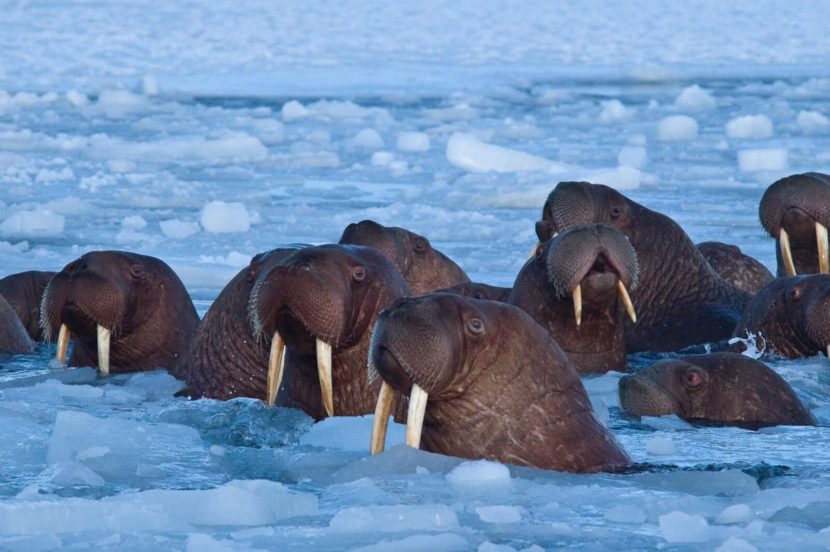
Walrus
(Photo courtesy Bering Sea Elders Group)

President Obama today issued an executive order creating the “Northern Bering Sea Climate Resilience Area.” The area covers more than 100,000 square miles off Alaska’s western coast, from the mouth of the Kuskokwim to just north of the Bering Strait. The president’s order withdraws about 40 percent of the area from offshore oil and gas leasing. It also reaffirms an existing ban in the area on bottom-trawl fishing.

Alaska’s congressional delegation pre-reacted, before the order came out, warning the president not to close off any more of Alaska’s ocean. Sen. Dan Sullivan later said Obama imposed “a unilateral action to hurt Alaskans.”

But for 64-year-old Harry Lincoln, a subsistence hunter from Tununak, this isn’t a case of the president imposing his will on distant seas. Lincoln is chairman of the Bering Strait Elders Group. He said he was stunned to learn the president has acted on the urgent request of the 39 tribes Lincoln represents.

“It’s the happiest moment I ever had in my life!” Lincoln said.

Native American Rights Fund attorney Natalie Landreth said it’s a historic action.

“The level of presidential responsiveness to a group of some of the poorest and smallest native communities in the United States is the real story here,” she said.

She said the story began not in Washington, but in Bethel, in July of 2015, just before the president’s Alaska visit. The Bering Sea Elders were meeting and Landreth was there as their attorney. The elders, she said, were worried about the decline of sea ice and what the predicted increase in ship traffic would mean for the marine mammals they hunt.

“And then somebody said — I wish I could remember who: ‘Let’s ask the president for help.’ And I said, that’s what you’d call a hail Mary. And then I had to explain what that was,” Landreth recalled.

The term is applied to desperate efforts, with almost no chance of success. But, Landreth said, the elders resolved to try.

“Over the past 15 months,” the attorney said, “people from rural Alaska went to the president’s office and said, ‘This is what we need.’”

The order, she said, mirrors a resolution the Bering Sea Elders passed in June. Landreth said it can prevent the kind of conflict seen now with the Standing Rock Sioux over the North Dakota Access Pipeline, because a main theme of Obama’s order is the early inclusion of Bering Sea tribes in federal decision making that concerns their region.

“It’s not just the text of the order,” she said. “It’s the fact that the president would spend an inordinate amount of time to try to help these people. I’ve never seen that in my life. I’m not sure that we’re going to see it again.”

The area the president is withdrawing from oil leasing is roughly Norton Sound, the southern strait and around St. Lawrence Island.

Gov. Bill Walker issued a statement saying he supports tribal leaders in their efforts to protect their resources, but that he’s concerned about lost development opportunities for the state.

Landreth said the withdrawal doesn’t harm the economy because it has been offered and explored in the past, with no results.

“This is not a commercially viable area,” she said. “It just isn’t.”

And now that’s less likely than ever. Obama used a provision of the offshore leasing act known as 12(a). Drilling opponents maintain these kind of withdrawals are permanent. Alaska Congressman Don Young said he plans to ask the next president, Donald Trump, to reverse this order. That’s legally possible, but historically, these orders tend to endure.

Rachel Waldholz contributed to this story from Anchorage.

Site notifications
Update notification options
Subscribe to notifications