Alix Soliman

Climate & Environment Reporter, KTOO

“I write stories that shine a light on environmental problems and solutions. In the words of Rachel Carson, ‘The public must decide whether it wishes to continue on the present road, and it can do so only when in full possession of the facts.’”

When Alix isn’t asking questions, you can find her hiking, climbing or buried in a good book.
Juneau Empire’s managing editor departs, with plans to launch online news nonprofit

A Juneau Empire delivery box on South Franklin Street on Wednesday, Jan. 17, 2024. (Katie Anastas/KTOO)

The editor of Juneau Empire is leaving the paper. Mark Sabbatini has edited the paper since 2023 and announced his departure in a Facebook post.

Sabbatini said he submitted his resignation letter three weeks ago over disagreements with the publisher, Carpenter Media Group, which bought the paper last year. His last day with the Empire was supposed to be Tuesday. But he said he was fired today.

“I kept it quiet until word leaked out today on social media that I was departing, and at that point, I announced my departure on the Empire’s Facebook page, and a few hours later, I was informed that, well, basically they fired me,” he said.

He said the disagreements stem from his view that Carpenter Media is focused on cutting costs and publishing sensational content that gets the most web clicks rather than focusing on important issues that affect the community. 

Just before Sabbatini became the editor, the paper decreased its publishing frequency from five issues per week to two. 

Sabbatini said he plans to launch a new, nonprofit online newspaper called the Juneau Independent at the end of this week. 

“I think there should be a locally based, locally owned, locally focused, full-fledged newspaper, which is exactly what the Juneau Independent is going to strive to be,” he said.

According to Sabbatini, the publisher does not plan to replace him. The paper will now be edited remotely from the Peninsula Clarion office in Kenai. 

Carpenter Media Group did not respond to a request for comment on Monday.

Juneau has a new electric utility, with some conditions

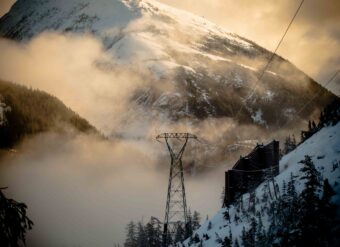
A tower and avalanche diversion wall on the Snettisham transmission line. (Photo courtesy of Mike Janes/AEL&P)

Listen to this story:

The Regulatory Commission of Alaska approved Juneau Hydropower’s application to become an electric utility on June 11. The decision requires Alaska Electric Light and Power, previously Juneau’s sole electricity provider, to help connect the new utility to the grid. But Juneau Hydropower must finance and build its proposed hydroelectric project before its federal license expires, or the commission will revoke its approval.

The decision comes after more than a decade of equipment and ownership disputes between the new utility and AEL&P over what’s called ‘interconnection’ — the point where electricity from separately owned facilities joins to supply power through the same transmission line. The two companies will now have to work together to bring a new hydroelectric project online. The proposed project at Sweetheart Lake would grow Juneau’s renewable energy capacity by 19.8 megawatts. That’s enough to increase the borough’s hydroelectric capacity by nearly 20%.

AEL&P’s total hydroelectric capacity is 102 megawatts. The Snettisham Hydroelectric Plant operated by AEL&P currently supplies two-thirds of Juneau’s electricity and has a capacity of 78.2 megawatts.

Duff Mitchell, the managing director at Juneau Hydropower, says his project will increase energy security in Juneau in the event of a natural disaster. There was a two-month outage in 2008 when an avalanche hit multiple electric towers and took out about a mile of the Snettisham transmission line. Mitchell says the project will also help the city flourish.

“There’s going to be energy security for the future needs of Juneau, whether it be air-source heat pumps, electric cars, dock electrification or just growth and prosperity for Juneau,” Mitchell said.

The commission approved a service territory where Juneau Hydropower can deliver electricity that includes the stretch from Lena Point through Berners Bay. 

To shuttle power there, the company must build several pieces of infrastructure including a hydroelectric plant at Sweetheart Lake, a switchyard near Mist Island to connect Sweetheart with Juneau’s existing transmission line, and an additional transmission line from AEL&P’s Lena substation to the Kensington Mine more than 30 miles away. The company also plans to build a substation at Echo Ranch Bible Camp near Berners Bay to serve potential future customers and a battery energy storage system.  

The proposed hydroelectric project is planned for Lower Sweetheart Lake. Photo courtesy of Google Earth.
The proposed hydroelectric project is planned for Lower Sweetheart Lake. (Photo courtesy of Google Earth)

But to complete the work, Juneau Hydropower needs money and has limited time. The commission made its approval conditional on both.

Juneau Hydropower has to file proof that it has secured enough funding for the project, which is estimated at about $265 million dollars, before it builds. Construction must begin by September 8, 2026, and finish three years later — deadlines that match the new utility’s Federal Energy Regulatory Commission license restrictions.

Mitchell says he’s moving as quickly as possible to make this happen. 

Financing Energy

The commission exempted the company from a requirement that a utility must serve 10 or more customers. So far, Juneau Hydropower’s only contracted customer is the Kensington Mine, which is projected to use 8.5 megawatts of electricity. The gold mine currently powers its operations with diesel.

Mitchell says that other potential customers have indicated a desire to receive electricity from Juneau Hydropower, including the Alaska Department of Transportation and Public Facilities, Goldbelt Corporation, Grande Portage Resources, GreenSparc, Alaska Energy Metals Development Corporation, Alaska Communications and Rainforest Telecom.

But Mayor Beth Weldon says she is skeptical that Juneau Hydropower can build a reliable customer base. 

“I’ve said all along that they have to come up with year-round customers, and right now, we don’t have, other than Kensington, there’s no year-round customers,” Weldon said. 

Alec Mesdag is the CEO at AEL&P. He says that he doesn’t think Juneau Hydropower’s proposed project is financially viable.

“They have one customer versus our 18,000 customers,” he said. “So it’s an incredible burden to try to recover all of the revenue you need from one customer.” 

Juneau Hydropower proposes to pay for most of the hydropower project through federal and state loans from the U.S. Department of Agriculture Rural Utilities Service and the Alaska Industrial Development and Export Authority (AIDEA), the public agency that owns Snettisham. The loans have not yet been approved. Mitchell says he will also rely on federal investment tax credits, which the company hasn’t earned yet. 

Those uncertainties prompted a comment from the commission. “We are concerned about JHI’s lack of loan approval,” the commission wrote in the decision. “However, it would not be just or reasonable for us to require JHI to have approved Sweetheart financing in order to be granted a certificate when JHI has been told it must have a certificate in order to get financing approval.”

Mitchell says he is confident that he will be able to secure funding by the September deadline. 

The Interconnection Point 

The point where new development at Sweetheart Lake will connect to the Snettisham transmission line, called the Mist Island switchyard, is where the largest disputes have erupted between AEL&P and Juneau Hydropower.

Last month, Mayor Weldon brought a resolution to the Juneau Assembly supporting AIDEA’s ownership of the switchyard. But the commission decided Juneau Hydropower is to own it, writing that AIDEA will instead own a motor-operated bypass switch so that power would still flow from Snettisham to AEL&P’s customers in the event of a catastrophic failure at the Mist Island switchyard. 

Still, Mesdag insists that the switchyard would be capable of interrupting power from Snettisham to Juneau in the event of a failure. 

Mesdag wrote in an email to KTOO that AEL&P is “deeply disappointed in the commission’s decision regarding interconnection, which sacrifices the security of Juneau’s most important generation resource to instead accommodate a small group of private investors that has never built, owned, operated or maintained electric generation or transmission infrastructure.” 

Juneau Hydropower is contracting with Ameresco, a company that builds energy infrastructure, and David Burlingame, an electrical engineer with companies based in Anchorage, to design, build and maintain the project. The commission wrote that relying on contractors doesn’t indicate a lack of technical expertise on Juneau Hydropower’s part. 

Juneau Hydropower must file interconnection and joint-use use agreements with the commission by June 25. AEL&P has until July 11 to appeal the decision.

Plastic fish food bags litter the water between Sitka and Juneau

Juneau resident Wayne Carnes holds one of the 54 fish food bags he found around Funter Bay. (Photo by Alix Soliman/KTOO).
Juneau resident Wayne Carnes holds one of the 54 fish food bags he found around Funter Bay. (Photo by Alix Soliman/KTOO)

A shipping container full of empty industrial-sized fish food bags fell off a barge heading from Baranof Island to the landfill in Petersburg. Dozens of the plastic bags have washed up near Juneau over the past week.

They came from the Hidden Falls Hatchery, owned by the Northern Southeast Regional Aquaculture Association. 

Adam Olson, the operations manager at the aquaculture association, says high winds likely caused a container to go overboard near the southern tip of Admiralty Island in May. In a press release, the aquaculture association said that the barge company it contracted to transport the trash, Lituya Freight Runners, did not contact them or make any efforts to recover the bags.

Instead, another vessel traveling through Chatham Strait notified hatchery staff about the incident on May 20. Olson says he did not report it to any authorities. A representative at the Alaska Department of Environmental Conservation couldn’t specify an official process for reporting such an incident in Alaska. 

Hatchery staff attempted to clean up the spill.

“We flew the area to see what was there, and we sent staff from the facility out in skiffs to collect refuse out of the water,” Olson said. 

Olson says hatchery staff retrieved more than a thousand bags over six days, but there could be thousands left in the water. 

The bags are white and the size of large dog food bags. Most of them are from an aquaculture brand called Bio-Oregon and others are from a brand called EWOS. 

A shipping container full of the fish food bags fell off of a barge destined for the Petersburg landfill. (Photo by Alix Soliman/KTOO).
A shipping container full of fish food bags fell off of a barge destined for the Petersburg landfill. (Photo by Alix Soliman/KTOO)

Juneau resident Wayne Carnes discovered the litter about 90 miles north of the spill site while he was on a boat trip from Gustavus to Juneau last week. He retrieved 54 bags that had washed up at Funter Bay and were floating in the water nearby. 

“We don’t want our fish eating these things, because that’s what happens to it eventually it ends up as microplastics, and we’ve got enough of that in the water already,” Carnes said.

The aquaculture association encourages those who have seen the litter to tell the Southeast Alaska Commercial Fishermen Marine Debris Clean Up program at seakmarinedebris@gmail.com.

Mendenhall Valley residents prepare for annual glacial outburst flood

Benjamin Coronell and S'eiltin Jamiann Hasselquist with the Juneau Tlingit and Haida Community Council fill sandbags in the parking lot behind Thunder Mountain Middle School. (Photo by Alix Soliman/KTOO
Benjamin Coronell and S’eiltin Jamiann Hasselquist with the Juneau Tlingit and Haida Community Council fill sandbags in the parking lot behind Thunder Mountain Middle School. (Photo by Alix Soliman/KTOO)

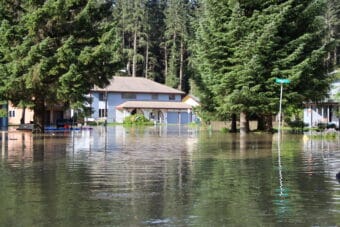
Dozens of Juneau residents in the glacial outburst flood zone filed into the Mendenhall Valley library on Saturday afternoon to learn how to prepare for flooding expected later this summer. 

Members of the Juneau Lions Club walked residents through the new flood map website made by UAS researchers and handed out weather alert radios. Local insurance providers talked about how FEMA’s National Flood Insurance Program (NFIP) works. The program is still operating, but that might change given the Trump administration’s past statements about weakening the agency. 

Reuben Willis, a State Farm insurance agent in Juneau, explained that the price for NFIP is based on FEMA’s risk zone maps, last updated in 2020. He recommended that homeowners lock in lower pricing before FEMA updates the city’s maps again. 

“If they change your zone and put you in a higher-risk zone, which would allow them to require us to charge a higher premium, if you purchased the policy you’re grandfathered in,” Willis said. 

He added that if homeowners with NFIP policies sell their place in the future, that grandfathered price transfers to the new owners. A new policy takes 30 days to go into effect, so Willis said Mendenhall Valley homeowners should consider applying now to protect their assets from potential flooding this year. Catastrophic floods hit neighborhoods during the first week of August the past two years.

Elizabeth Figus, a Valley resident whose home on View Drive flooded in 2023 and 2024, said that NFIP made a huge difference for her financially and shared tips for how to document losses after a flood. 

“If you are feeling stressed out after a flood, you might be urged to just throw stuff away,” Figus said.

But instead of tossing damaged property, she recommends taking photos of everything before moving it and cataloging each item — even small things like cleaning supplies. 

Residents who already have NFIP insurance raise their hands at the flood preparedness workshop on June 7, 2025. (Photo by Alix Soliman/KTOO)

Laird Jones has lived in the Valley since 1982. His place is on Skywood Lane, near the library. He said his home was spared during last year’s record-breaking 16-foot flood, but that could change if a future flood breaches 17 feet. Last year, he watched the water level rise too close for comfort.

“The ditch was full of water, and we had a salmon swimming by in the ditch,” he said.

He said FEMA maps put his home in one of the lower-risk zones, so when he got a quote for flood insurance, it was just under $360 per year. 

Insurance providers said that’s the base price for the program, but it can be around $2,000 for those in higher-risk zones. The standard policy covers $250,000 for residential structures and $100,000 for belongings inside.

In the parking lot behind Thunder Mountain Middle School, staff from the city and Tlingit and Haida, along with a handful of volunteers, filled free sandbags for residents to stack against their homes. The U.S. Army Corps of Engineers donated the bags, and the city and tribe evenly split the cost of the sand — about $18,000. Another sandbag event will take place on June 14. Tlingit and Haida will also host Community Emergency Response Team trainings on June 14, 21 and 28.

Anton Rieselbach, a program associate at the Juneau Economic Development Council, attended the event to talk with people about a survey to capture how the 2024 flood affected the community. 

“We want to figure out the gap between the amount of help that’s been given to flood victims and the amount of impact that they actually incurred,” Rieselbach said. “We also want to try to figure out some of the social impacts of the flooding — for example, is this flooding causing people to try to leave Juneau in higher numbers than usual? Is it causing people to have negative mental health experiences or any other health issues?”

He said getting a comprehensive picture of the issue will help inform future flood responses. So far, roughly 60 people have responded to the mail-in survey, and Rieselbach said the council is aiming to get 150 responses by the end of the month.

Feds ask court to dismiss timber industry lawsuit that aims to increase Tongass old-growth logging

The Tongass National Forest covers more than 80% of the land in Southeast Alaska. (Photo by Katie Anastas/KTOO)

Listen to this story:

The largest timber companies operating in Southeast Alaska want the Tongass National Forest to sell them more old-growth timber, and they’re suing the federal government to get it. The Department of Justice asked the court to throw the case out in May.

The Alaska Forest Association along with two of their members, Viking Lumber and Alcan Timber, filed the lawsuit in March, alleging that the U.S. Department of Agriculture failed to fulfill a promise to supply the companies with enough timber to meet market demand. But the government filed a motion to dismiss the case, writing that it didn’t make such a promise.

The case comes after President Trump issued two executive orders aimed at expanding logging in the Tongass this March, and follows decades of legal disputes over Tongass timber. 

Frank Garrison is an attorney with Pacific Legal Foundation representing the timber industry. He said the industry has faced a 30-year decline, and that Viking and Alcan are struggling. 

“They’re on the brink of collapse,” he said. 

He said the companies rely almost completely on old-growth timber offered by the Tongass National Forest.

The government argues in the motion that it is only required to “seek to” provide enough timber to meet market demand while balancing other forest uses and ensuring their sustainability — as written in the 1990 Tongass Timber Reform Act. The law eliminated an old requirement for the Tongass to supply 4.5 billion board feet of timber per decade. The DOJ argues that the agency is not legally required to provide a specific amount of timber to companies.

The DOJ also writes in the motion that the timber sale objectives in the 2016 Tongass National Forest Management Plan are aspirational goals, not binding commitments that can be challenged in court. Furthermore, the government asserts that plaintiffs don’t point to a specific agency action or rule that has been violated. 

But Garrison said that the management plan gave timber companies an expectation that they would have roughly 15 years to transition their businesses from old-growth to new growth trees, and provided estimated amounts of old-growth timber that they could expect to buy. 

“The timber industry, including our clients, relied on the management plan when they were figuring out how they were going to run their business for the next decade,” Garrison said.

When the Forest Service announced the Southeast Alaska Sustainability Strategy in 2021, which proposed to end old-growth logging, Garrison said the agency abandoned its commitment to a slow transition.

The Forest Service has not met its annual target for timber sales in Alaska since 2014, according to a U.S. Government Accountability Office report published last year. Demand for forest products from the Tongass between 2015 and 2030 is estimated to range from roughly 41 to 76 million board feet per year, according to a Forest Service study published in 2016, the most recent market analysis. Between 2020 and 2023, the Forest Service offered sales for a total of 14 million board feet.

Garrison said he hopes that two recent Supreme Court decisions will tip the lawsuit in the industry’s favor. The first is DHS v. Regents, a 2019 case that set a precedent that federal agencies must consider whether those benefiting from a policy rely significantly on its continuation before upending it.

The second case is Loper Bright Enterprises v. Raimondo, which overruled a legal doctrine called Chevron deference last year. The doctrine directed courts to defer to federal agency interpretations of ambiguous laws. Now, the courts must use their independent judgment to interpret laws that agencies administer. It’s unclear whether these new precedents on agency discretion will factor into this case.

Nonprofit environmental law firm Earthjustice is representing a group that seeks to intervene in the case. It includes the Organized Village of Kasaan, the Organized Village of Kake, a boat tour company called The Boat Company, Alaska Longline Fishermen’s Association, Natural Resources Defense Council, Southeast Alaska Conservation Council, and The Wilderness Society.

Earthjustice Attorney Kate Glover agrees with the DOJ that the case should be thrown out because the industry hasn’t challenged a specific agency action. She said that timber companies are looking for a wholesale policy change.

“The timber industry plaintiffs are asking the court essentially to order the region to take a step backwards — to go back to a long-gone era of large timber sales, large clear cuts, where we make that the priority for the use of old-growth forests,” Glover said.

Joel Jackson is president of the Organized Village of Kake, a tribe based on Kupreanof Island. He said the forest’s health is vital to support an abundance of salmon, deer and moose. Since heavy logging moved out, he said the tribe’s food security has improved. Jackson does not want to see old-growth logging scale back up. Instead, he wants the old-growth to be preserved for future generations to experience it as he has. 

“It’s like walking into one of the most beautiful cathedrals you could ever walk into anywhere in the world,” Jackson said of the forest.

The tourism industry brings significantly more money into Southeast Alaska than the timber industry. Jackson said the two are at odds because visitors come to see one of the last protected temperate rainforests in the world, not clear-cut logging in the mountains. 

Maggie Rabb is the Executive Director of the Southeast Alaska Conservation Council, one of the environmental groups trying to intervene in the case. She said that the timber industry’s demands are out of line with what most Southeast Alaskans want for the Tongass.

“They want nuanced, science-based, responsive management. And that does not look like one logging company telling the Forest Service how much they need, and letting that drive decisions about how we manage our forests,” Rabb said.

The Tongass National Forest is undergoing a revision to its management plan, which will update timber sale objectives. The new plan is expected to be completed in 2028. 

The USDA, DOJ and Forest Service declined to comment. The timber industry must file a response to the DOJ’s motion to dismiss the case by June 24. 

Clarification: This story has been updated to include the name of the boat tour company seeking to intervene in the case. 

Juneau Assembly delays second extension of Mendenhall River levee

HESCO construction on Riverside Drive on April 2, 2025. (Photo by Alix Soliman/KTOO).

The Juneau Assembly voted to wait on a second extension of Juneau’s Mendenhall River levee until after this flood season. 

Assembly Member Greg Smith said the project to protect additional homes from annual flooding faces engineering and funding obstacles that can’t be solved before the flood expected later this summer.

“We don’t seem to have a way to fund this fairly this year, “ Smith said. “We don’t have a way to armor the bank and ensure the barriers are going to be properly installed this year… We want to do as much as we can, but this one just doesn’t seem to make sense to me.”

The city’s lawyer said there isn’t enough time to permit reinforcements for another section of the riverbank this summer. Without boulders to armor the bank from erosion, city officials said they aren’t confident that a second levee extension would hold up against a flood.

City officials also said the affected property owners would also need to vote on whether to create another local improvement district to divide the cost — estimated at more than $2 million

The levee extension, called phase 1B, would go from Kax̱dig̱oowu Héen Elementary School to Brotherhood Bridge on Glacier Highway. City Manager Katie Koester said the intention would be to protect 96 homes and commercial properties from an 18-foot flood. 

The likelihood of such a catastrophic flood is unknown, but the volume of water would have to be 50% higher than last year’s record-breaking 16-foot flood. 

“There would be 96 parcels if we did not do 1B that would flood in a 18-foot event. We would attempt to mitigate the impact on 30 of those parcels,” she said. 

Koester said this year the city will use large sandbags called supersacks to protect 30 properties on Meadow Lane that could see more water due to an initial levee extension that the Assembly approved last month.

The Assembly will consider the extension again next season, once city staff draft a plan to pay for it.  

Site notifications
Update notification options
Subscribe to notifications