Anchorage Daily News

Anchorage Daily News is our partner in Anchorage. KTOO collaborates with partners across the state to cover important news and to share stories with our audiences.
As some question her commitment, Palin says she’s never left Alaska

Sarah Palin, walking with sunglasses on
Former Alaska Gov. Sarah Palin waves to a woman as she approaches the doors of the Anchorage Baptist Temple to attend a memorial for the late U.S. Rep. Don Young on Saturday, April 2. (Photo by Emily Mesner/ADN)

Juanita Cassellius wanted Sarah Palin’s help. But she couldn’t figure out how to find her.

Cassellius, an independent from Eagle River, has been working for years to rally fellow Alaskans around defending the Permanent Fund dividend.

Palin, she thought, could help the cause — perhaps with an endorsement, or an anonymous donation to help pay for some radio ads. Cassellius got Palin’s home mailing address from Palin’s father, then sent a couple of letters.

She never heard back, which was especially frustrating because Palin seemed like a “natural ally,” Cassellius said.

“Give me a, ‘Sorry, I’m too busy,’ at least,” she said in a phone interview Wednesday. “I would love to do anything to send a message to Sarah Palin that she’s been MIA. And we don’t appreciate our state being used for her PR campaign.”

Cassellius voted for Palin more than a decade ago, when she was running for governor. She doesn’t plan to again.

Cassellius’ drift away from the one-time vice presidential candidate embodies how Alaska’s politics have shifted since 2006. That’s when Palin was elected governor after a landslide win against the incumbent Republican, Frank Murkowski, in the GOP primary.

Veterans of Alaska elections, and Palin herself, say that it’s dangerous to count her out now that she’s launched a campaign for the U.S. House of Representatives this year. Palin has always been a political outsider, and she’s defied pundits’ predictions before.

“The establishment machine in the Republican Party is very, very, very small. They have a loud voice. They hold purse strings. They have the media’s ear. But they do not necessarily reflect the will of the people,” Palin said in a lengthy phone interview Thursday. “I’ve never been a part of the Republican establishment. So, sure: It’s not going to surprise me at all if they go with whomever their chosen one is.”

But those veterans also say that Palin’s profile, and Alaska’s politics, have changed since she left office.

And after her long absence from state-level affairs, they say Palin can no longer count on the same coalition of grassroots Republicans, independents and even some progressives who supported her reformist, anti-corruption campaign for governor.

Back then, “she was the white knight riding in to sweep up the mess,” said Andrew Halcro, the former Anchorage Republican state legislator who ran against Palin in 2006 and is running against her for Congress this year.

Now, Halcro said, “I think her sliver of the pie has gotten much smaller.”

The ‘Sarah Palin show’

Palin announced her run last week just before the filing deadline for the special primary election to replace Republican U.S. Rep. Don Young, who died suddenly in March after 49 years in office. Forty-seven other candidates have entered the race.

Among Alaska Republicans, the reaction to Palin’s candidacy was muted.

Many leaders from the party’s conservative wing, and from Palin’s Mat-Su home base, have already committed their support to Republican Nick Begich III, who announced his U.S. House bid months ago. And some still resent that she resigned partway through her term as governor and has since maintained a far more visible national profile than local.

“There’s no way in hell I’m going to endorse Sarah Palin. I think it’s not really something that she’s doing for the state of Alaska so much as for the Sarah Palin show,” said Jesse Sumner, a Mat-Su Borough Assembly member who’s endorsed Begich. “Let me know if you find somebody that’s gung-ho for Sarah Palin. Because I can’t find anybody.”

Sarah Palin, wearing sunglasses indoors, speaks into a microphone
Former Gov. Sarah Palin speaks to reporters after the memorial for the late Rep. Don Young at the Anchorage Baptist Temple on Saturday. (Photo by Emily Mesner/ADN)

Palin’s congressional campaign drew a quick endorsement from former President Donald Trump and support from other Outside Republican figures, like former U.N. Ambassador Nikki Haley and former House Speaker Newt Gingrich.

Inside Alaska, Palin is working with longtime friend and aide Kris Perry, who’s acting as campaign manager. Former Republican state Sen. Jerry Ward, the Alaska director for Trump’s 2016 presidential campaign, is an adviser, Perry said in an email. Three Outside campaign professionals — former Trump campaign staffers Michael Glassner, Stephanie Alexander and Mark Serrano — are assisting, too.

Palin said Thursday that her campaign has raised roughly $100,000 so far. But she has not yet announced any Alaska-based endorsements, nor does she appear to have much access to political or party infrastructure inside the state.

In the interview, she defended her level of engagement in Alaska politics, pointing as an example to her 2014 endorsement of independent gubernatorial candidate Bill Walker. She said she also helped raise money for Young, the late congressman, last year, and often hosts business people visiting Alaska from Outside.

She also said she still lives in the same house and has never lived in a different state — only traveled to promote Alaska and visit grandparents.

“If people — and again, I believe these are going to be the political people in Alaska — if they’ve taken issue that I haven’t been hobnobbing around, in the halls of the Juneau Capitol, and been to their cocktail parties and all that, nope. Most normal people don’t do that,” Palin said. “I am a normal person, using the platform that I do have in every way possible, to promote Alaska to help good Alaskans succeed.”

She added: “If one individual says, ‘I tried to get ahold of her about Permanent Fund,’ well, you didn’t try hard enough. Everybody knows where I live. I have social media. If I missed a letter or a request somewhere, I guess I should try to track it down with the volunteers who help with my mail.”

Alaska GOP figures say they’ve had few substantive interactions with Palin since she left office.

Statewide elected Republicans like Gov. Mike Dunleavy and U.S. Sen. Lisa Murkowski struggle to remember the last time they saw her. Palin is a no-show at Alaska Republican conventions. She speaks at national conservative events but almost never at public gatherings inside the state, with rare exceptions like pop-ins to Trump rallies in 2020.

“She doesn’t have that big of a tribe in Alaska. Nick Begich’s been building a tribe since October,” said Suzanne Downing, who runs the conservative Must Read Alaska site and has supported Begich’s campaign.

Begich is a nephew of Democratic former U.S. Sen. Mark Begich, and grandson of Nick Begich Sr., a Democrat who held Alaska’s seat in Congress before the small plane carrying him disappeared in 1972.

Nick Begich, wearing a grey suit, speaks from behind a lectern with several Nick Begich campaign posters on the wall behind him
Nick Begich III announces his campaign for Alaska’s U.S. House seat, on Thursday, Oct. 28, 2021 at the Windbreak Cafe in Wasilla. (Photo by Loren Holmes/ADN)

Nick Begich III’s list of endorsements includes eight GOP state House members, three state senators, four Republican Party districts and an influential sportsman’s group, the Alaska Outdoor Council. In interviews, several conservative Alaska Republicans said they haven’t heard of Begich supporters moving to Palin since her announcement.

“I haven’t wavered,” said Anchorage Assembly member Jamie Allard, who’s also endorsed Begich. “I haven’t heard of anybody who’s flipped.”

‘She’s always been an outsider’

Still, few political insiders doubt that Palin will win enough votes in Alaska’s new nonpartisan primary system to finish in the top four, which would advance her to the August general election to finish Young’s term.

One of the dynamics favoring Palin, observers said, is that Alaska leads the nation in population turnover. That means that some 40,000 people who move into the state each year might have new or different views of the former governor — and also might be more inclined to give weight to Trump’s endorsement.

“For the low-information voter who just cares that they’re conservative, she’ll probably pass,” said Jim Lottsfeldt, a centrist Anchorage political consultant. “Those who are going to vote for her in the primary are people who are going to look at that ballot and say, ‘I don’t really care a lot about politics, I like Donald Trump, he likes her.’ ”

Jane Plank, a 44-year-old Wasilla resident who’s retired from military service, said she’ll support Palin this year.

Plank, who moved to Alaska six years ago, said she likes Palin’s “down-to-earth” style and doesn’t hold it against her that she resigned and has been more visible in national-level politics.

“I know there’s a lot of people who feel betrayed and all that. But I feel like she was run through the mud during her vice presidential bid, and I don’t blame her for stepping away for a while,” Plank said in a phone interview. Palin’s critics, Plank added, “forget all the good things she did do for Alaska.”

Others stress how Palin has never been closely aligned with Republican insiders, and say she may not need their support.

Palin was elected governor after beating an incumbent Republican, Murkowski, in the party primary. Before that, she first attracted widespread public notice when she brought down a longtime GOP operative close to the oil industry, Randy Ruedrich, for doing party business in his politically appointed job at an obscure state oil and gas agency.

“She’s always been an outsider. And she has been a harsh critic of the GOP and she’s called it corrupt,” said Downing. “There are no Republicans that I have talked to that are excited about her as a candidate. They are done. It is, ‘No thanks, Sarah.’ ”

Palin’s anti-corruption, anti-establishment bent, combined with her willingness to raise taxes on the oil industry while she was governor, meant that she also once drew support from some progressives and Democrats.

But many of those allies have deserted Palin, too, after her vice presidential run and her affiliation with Trump. Ray Metcalfe, an independent Anchorage anti-corruption activist, said he grew uncomfortable watching Palin embrace the new conservative wing of the GOP.

“I voted for her back in the day. But I won’t vote for her again,” said Metcalfe, who served in the state Legislature as a Republican before running for U.S. Senate as a Democrat in 2016. “I appreciated what she did with oil taxes. But she’s changed.”

Cassellius, whose letters to Palin went unanswered, said she’d be more inclined to offer her support if she felt the former governor were more invested in Alaska’s affairs.

Palin has applied for Permanent Fund dividends in recent years, Cassellius noted, which signifies that she’s spending most of her time in Alaska. But Cassellius questioned what Palin has done in recent years at the local or state level.

“It’s kind of creepy having people who are not living in Alaska advise us on electing this ineffective politician who is not involved in our state,” Cassellius said. “Yes, Alaska is cool, and she got to capitalize out in the world with that coolness. No, you cannot come back when you have not paid your dues in our state.”

This story was originally published by the Anchorage Daily News and is republished here with permission.

When death arrives in Utqiaġvik, volunteer gravediggers answer the call

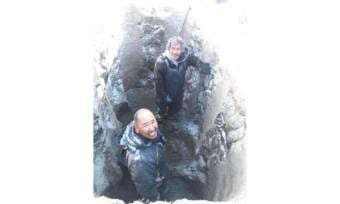
Two men stand at the bottom of a freshly dug grave
Herman Ahsoak and Marvik Kanayurak dig a grave dusted in snow in winter 2021. (Photo courtesy of Herman Ahsoak)

When Betty Ann Bodfish died from COVID-19 complications, her family wanted to follow her wishes and bury her in Utqiaġvik, next to her mom and grandparents. Relatives gathered from Wainwright, Chugiak, Unalakleet and Colorado, hoping to have the funeral as soon as they could — but the weather was bad and volunteers were already busy digging another grave.

Still, the five men who always volunteer to dig graves in Utqiaġvik were up to the task, even on a long and stormy day.

“When my mom, Dorothy Edwardsen, asked if they could double up, dig two graves in one day, they didn’t hesitate. They never hesitate,” Bodfish’s cousin Iñuuraq Moss said about the volunteers. “They always show up, grave after grave, snow or shine. They honor our loved ones that way, and we couldn’t do what we do without them.”

When people pass away in Utqiaġvik, the family reaches out to a team of volunteer gravediggers, and they take time off from their jobs, bring their tools and get to work, asking for nothing in return. About 20 people in the community sometimes help dig graves, but about five of them come every time.
“We’re here for the people that love those who passed the most, that are hurting the most,” said one of the volunteers, Marvin Kanayurak. “I can’t imagine them having to dig a grave for a person they loved so much. So we’re here for them. We dig graves so that they don’t have to worry about it.”

In a tight-knit community like Utqiaġvik, volunteers do end up digging graves for people they know — or even people who harmed their families. A few years ago, Kanayurak helped bury a person who died in jail after murdering his aunt.

“They buried him in Barrow, and we went there and helped dig that grave,” he said. “There’s always the same five, six guys that are always there. And I mean always.”

Kanayurak has been volunteering for several decades, and he noticed that in the past few years, the number of deaths in Utqiaġvik — the biggest village on the North Slope and the northernmost community in the state — has grown.

“We used to only get two or three deaths a year, and now we’re getting way too many,” he said. “I don’t count them, I just know that the gravesite that we have, when we started it, was empty.”

This winter was a bad season for Utqiaġvik, a city of fewer than 5,000 people. Residents needed eight new graves in December and another 11 since January, said another longtime volunteer, Herman Ahsoak, who digs graves “working from the heart” for his community.

“It’s almost 20 graves in a two-month time frame,” Ahsoak said.

Bodfish’s death a few weeks ago was another addition to the graves volunteers needed to make.

To thank the Utqiaġvik gravediggers “for their continuous tireless hard work,” Bodfish’s family — Dorothy Edwardsen and her daughters, Tracy Benson, Qiñuģan Roddy and Moss — made five hats for the volunteers. The women got together last week to cut out the patterns and sew hats using seal and sea otter skins, a fleece lining and yarn for tassels.

“Our mom said, ‘They’re digging another grave on Monday. I’d like to give them to the guys then.’ And that was our deadline,” Moss said. “It was definitely a labor of love.”

The hats turned out to be quite warm, which was welcome news for the Utqiaġvik gravediggers who were working at temperatures of 20 below zero last month.

Five men stand at the edge of a snowy graveyard, with a wheelbarrow filled with shovels beside them
(From left to right) Volunteer gravediggers Simon Ahluk Toovak, Herman Ahsoak, Marvin Kanayurak Sr., Will Ahlook Stevens and Tony Kaleak received hats as gifts for digging graves for the community of Utqiagvik. (Photo by Clifford Benson)

Kanayurak explained that gravediggers work even if it’s windy or cold because they try to make the graves the day before the burial, following the tradition of not letting anyone “sit above ground.” The team goes out to dig during blizzards, even if the gusts are blowing 45 to 50 miles an hour and the visibility is limited to 150 feet.

“The other day, we’re just facing the wind,” Kanayurak said, “and the guy standing next to me, I looked at his face and said, ‘Hey, your cheeks are turning white!’ And he looks at me and says, ‘Yours too!’ ”

At 59, Kanayurak has been on the volunteer crew the longest. When Kanayurak was a 10-year-old boy in the 1960s, he said, his mother asked him — “a strong young man” — to go help gravediggers. Back then, volunteers only used buckets, sledgehammers and a big ice pick, and it would take them up to three days to dig one grave.

“My job was to hold that pick while they hit that sledgehammer at it, and they would say, ‘Don’t lose!’ Oh, that was the scariest thing I’ve done in my life. But I got good at it,” he said.

Once gravediggers started using a drill, it cut down the digging time to about 10 hours. Nowadays, using different equipment and after years of working side by side, they can dig a grave in solid permafrost in about four or four and a half hours, Kanayurak said.

They drill eight holes close to each other, drill out the middle pieces of mud and use an excavator to dig a grave 6 to 7 feet deep. The ground has changed in the past years too: When Kanayurak first started, the permafrost was about 10 inches to a foot deep. Now the permafrost is only down to 3.5 inches, and the soil is muddier.

Kanayurak observes the passage of time with a smile: “I used to be the youngest gravedigger, and now I’m the oldest.”

Today, the youngest volunteer is 15-year-old Donald Adams, known to everyone as Button. Adams was 8 when he helped dig his first grave — the one for his auntie.

“At first, I didn’t know what I was doing,” Adams said. “At first, I was a little emotional.”

He said that as he has volunteered more and more, he’s gotten better and better at managing his emotions and understanding the importance of the help he is providing.

“We dig other people’s graves to show appreciation to the people that passed on,” Adams said. “We help them because we might have known them. They might have been part of our families, part of our life in some way.”

Ahsoak and Kanayurak both have helped bury their family members as well, but for Kanayurak, there was one grave he couldn’t bring himself to dig: his mother’s.

“I didn’t even dig when my mom passed away. I tried to, but it just made me cry so much,” he said. “I sat there all the way through, and it was the first time I did absolutely nothing on a grave.”

For Ahsoak, the hardest graves to dig are for really young people.

“When it comes to the elderly, I look at it as, we’re going to celebrate their life,” Ahsoak said. “But when there are young people, those are the harder ones to dig. … There’s been moments in the past where I’ve actually started crying while shoveling because it’s hard to witness young people passing away.”

Overall, digging graves becomes easier for the volunteers with time.

“At first it was kind of hard. Now, it hardly fazes me anymore. Death. I’m just so used to it now. But I’ve been doing it for a very long time,” Kanayurak said.

Kanayurak used to get complaints from his wife, asking him to volunteer less and focus on work more, but he would always respond that nothing was more important than honoring people who passed.

“I know we need money, but this is the last time we’re going to help them. So I’m just going to go and help them,” he said. “I just really love my community that much, and I’ll give anything to my people. I hate digging graves, but I love helping my people.”

While working on a grave, the team tries to keep the mood positive, among themselves and with the family, Kanayurak said. They share a meal with the relatives of a person who passed. They start their work with a prayer and finish it with a prayer after they cover the grave with plywood.

“The most memorable part of digging is when you taste the mud, and you smell the mud,” Ahsoak said. “The Heavenly Father says, ‘From dust you were made and to dust you shall return.’ … Every time I dig, I remind myself that one day, they’re going to have to dig a grave for me, you know. So it reminds me to stay humble.”

This story was originally published by the Anchorage Daily News and is republished here with permission.

Anticipating a busy election season, Alaska constitutional convention opponents launch early campaign

Former Senate President Cathy Giessel, R-Anchorage, and former Speaker of the House Bryce Edgmon, D-Dillingham, talk to reporters during the first day of the legislature’s second special session on July 8, 2019, in Juneau, Alaska. Giessel and Edgmon are part of the bipartisan group behind the “Defend Our Constitution” campaign. (Photo by Rashah McChesney/KTOO)

A new bipartisan group, citing unusual interest in Alaska’s once-per-decade constitutional convention ballot question, has launched a new campaign to convince voters to reject a convention that could significantly change the state’s laws and government.
The campaign, called “Defend Our Constitution,” was launched by a group of Republicans, Democrats and independents in a teleconference Thursday.

Voters will be asked in November whether they want to convene a convention. Campaign co-chair Cathy Giessel, a Republican and former Senate president from South Anchorage, said it makes sense to begin campaigning early.

“The person who speaks first usually carries the most impact, so we want to make sure Alaskans have the information before they plant themselves,” she said.

Among the group’s other leaders are Democratic former attorney general Bruce Botelho; Republican U.S. House candidate John Coghill; Rep. Bryce Edgmon, I-Dillingham; and Joelle Hall, president of the Alaska AFL-CIO.

Each said they organized their campaign because they fear the unpredictability of a constitutional convention and worry that it could destabilize Alaska.

Alaska’s convention requires the state to ask voters every 10 years whether they want to call a convention as a means to alter the constitution. Alaskans have repeatedly, and by wide margins, rejected the idea. In 2012, voters picked “no” by a 2:1 margin.

The Alaska Legislature’s failure to provide a reliable formula for the Permanent Fund dividend and Christian conservatives’ desire for measures prohibiting abortion are driving unusual interest in the vote this year.

“The sense is it is somewhat different this round,” Botelho said.

Jim Minnery is the director of the Alaska Family Council, which is urging Alaskans to vote “yes.” He said his group is interested in judicial reform — the Alaska Supreme Court has repeatedly ruled in favor of abortion rights — and in school choice — the constitution prohibits state funding for religious schools.

“If you want to know what the conservative Christians in the state are thinking, that’s the reason,” he said.

Frustration over the Permanent Fund dividend is also driving interest. Since 2016, the annual payout has been set by fiat, rather than by a formula in state law, and legislators have been unable to agree on a new formula or a constitutional amendment that would guarantee payouts.

Coghill said he agrees that changes to the constitution are needed, but he believes a convention isn’t the right way.

Because there are no limits on what a convention can change, he and other said it could go in unpredictable directions. Because the state and the United States as a whole has become politically polarized, he said the result would be acrimony, and it would bring little progress.

“Quite honestly, a melee could break loose,” Edgmon said.

This story was originally published by the Anchorage Daily News and is republished here with permission.

An epic forecast for Bristol Bay salmon has industry leaders worried it will be too much to handle

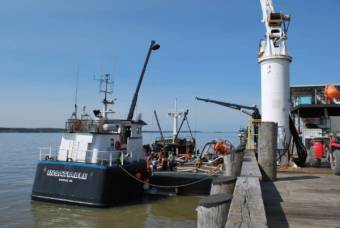
A fishing vessel called the Insatiable unloading fish at a dock
The tender Insatiable unloads salmon at Naknek. (Alaska Journal of Commerce file photo)

Alaska biologists are forecasting another massive run of sockeye salmon in Bristol Bay this summer, raising questions in commercial fishing circles about whether the industry in the Southwest Alaska region will be able to keep up.

The Bristol Bay Regional Seafood Development Association, representing the area’s commercial driftnet fleet, is urging processors to boost their capacity to maximize the fishery’s value and prevent harm to future runs if too many salmon return.

“We’re in unprecedented territory as far as what is forecast, so we never had a test like this to see how it would go,” said Andy Wink, executive director of the association.

The Alaska Department of Fish and Game predicts that a record 75 million fish will return to Bristol Bay rivers this summer, with 60 million available for harvest, according to the agency’s commercial fisheries division.

But the agency reported early this year that 15 main commercial processors said they expect to buy 52 million Bristol Bay salmon, according to a survey. That amount of purchased fish would also be a record.

The large gap in expected returns and planned processing means fishermen might have to forgo large numbers of fish and could easily lose out on $100 million, Wink said.

The group in February highlighted the problem in an article on its website and encouraged processors to bring in more floating processing capacity to supplement shore-based processing facilities.

“Processors, fishermen, and fishery managers are gearing up to make the most of 2022, and those efforts are highly commendable but with such a large forecast it begs the question of what happens if processors and tenders cannot keep up,” the group said in the update.

Processing companies are not divulging their plans. A representative with OBI Seafoods, with three processing plants in the Bristol Bay region, declined to provide comment.

Norm Van Vactor, a general manager with Silver Bay Seafoods, which operates a processing plant in Naknek on Bristol Bay, said the prospect of another epic salmon harvest is a “pleasant dilemma” for a processor.

Salmon returns to Bristol Bay have been exceptionally strong in recent years even as other areas of Alaska have experienced declining runs, he said. A record 66 million salmon returned to Bristol Bay last year, and about 40 million were harvested, the state said.

Silver Bay and other processors are keeping their plans close to their vests, Van Vactor said. But he thinks they are all looking at options to increase processing this summer.

“I have to believe without question that everyone is doing everything they can to maximize the efficiency and capability of plants in the region and looking at how to get extra fish out of region, like putting it on planes for fresh markets or using faster vessels to process it somewhere else,” Van Vactor said.

Among the concerns this summer is whether there will be enough of the tenders, or delivery vessels, to get a surge of fish quickly from fishing boats to processing plants, Wink said.

Another issue is the industry’s ongoing challenge of finding enough workers for a brief processing period in a remote area. That’s been complicated by increased competition for workers during the COVID-19 pandemic, he said.

“With the labor situation and how tight the labor market is, it will be challenge to keep processing capacity where it’s been,” Wink said.

Van Vactor said there are many uncertainties that will determine whether fishermen and processors can harvest all the available salmon. That includes the weather, and whether the salmon return in an overwhelming surge or in steadier numbers that allow different different fishing districts in the region to keep up.

“At the the end of the day, Mother Nature will dictate how this unfolds,” he said.

The H-2B visa program, often used by fishing processors and tourism businesses in Alaska to bring in foreign workers, will help processors overcome difficulties finding workers, he said.

The U.S. departments of Labor and Homeland Security announced late last month that they will make an additional 35,000 nonagricultural worker visas available in the U.S. for the summer.

“With the tourism and fishing season right around the corner, and the economic fallout we have seen from COVID, it is vital to ensure Alaskans have the needed workers to supplement our local workforce,” Alaska Sen. Lisa Murkowski said in a March 31 statement.

Chris Barrows, president of the Pacific Seafood Processors Association, said in the same statement that the federal agencies need to take steps to ensure that the foreign workers can arrive in time for the summer season.

They’ll be a “lifeline” to some seafood processing companies that might otherwise be short-staffed this summer, he said.

This story was originally published by the Anchorage Daily News and is republished here with permission.

Alaska lawmakers consider $2,600 payment per resident in 2022, but proposals differ in details

lawmakers conferring on the House floor
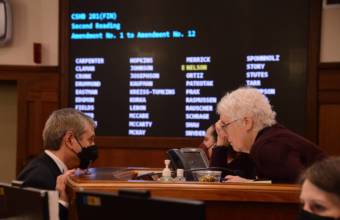
House Majority Leader Chris Tuck, D-Anchorage, talks to Speaker of the House Louise Stutes, R-Kodiak, on Tuesday, April 5, 2022 during a break in debate on the state’s operating budget. (Photo by James Brooks/ADN)

The Alaska House opened debate on the state’s annual operating budget Tuesday by repeatedly voting in favor of $2,600 payments to eligible residents this year.

The payments would be a combination of a one-time $1,300 “energy rebate” and a Permanent Fund dividend of about that size. The House turned down a series of amendments that would have increased the dividend or provided retroactive payments. A narrow majority of lawmakers voted against those amendments, citing their cost.

Debates on amendments affecting other parts of the budget are expected to continue through the week.

Once the budget passes the House, it will advance to the Senate, where lawmakers are at work on their own proposal. The two ideas must be compromised and the result signed into law before July 1, the start of the state’s fiscal year.

""
Rep. Tom McKay, R-Anchorage, talks to Rep. Cathy Tilton, R-Anchorage, on Tuesday, April 5, 2022 in the Alaska House of Representatives. (Photo by James Brooks/ADN)

Though the House’s proposed $2,600 payout is similar in size to a dividend proposed by Gov. Mike Dunleavy, the details of the two proposals are significantly different and reflect major differences between the governor and lawmakers:

• In December, Gov. Mike Dunleavy proposed a 2022 dividend of about $2,560, the result of a new distribution formula that pays dividends with half of the annual transfer from the Alaska Permanent Fund to the state treasury. This idea has become known as the “50-50 split.”

The governor also proposed an additional, supplemental dividend of about $1,250, the amount necessary to raise the 2021 dividend to what the new formula would pay.

• In March, as oil prices spiked, members of the House majority proposed a $1,300 “energy rebate.” The budget proposal being considered by the House includes that rebate plus a dividend of about $1,280, equivalent to one-quarter of the Permanent Fund transfer. This has been called the “75-25 split.”

• The state Senate has yet to vote on the dividend, but on Tuesday, members of the Senate Finance Committee considered a bill that would set a 50-50 dividend in 2022 but drop future payouts to the House’s 75-25 level unless the Legislature and governor come up with $800 million in new revenue. If that happens, the 50-50 payouts would continue.

Dunleavy proposed the 50-50 formula in May 2021, but lawmakers didn’t accept it, saying the state didn’t have enough money to pay for it. A bipartisan, bicameral working group concluded in August that lawmakers should work toward a 50-50 formula by raising revenue and cutting spending.

A spike in oil prices caused by the Russian invasion of Ukraine has changed the situation. There’s now little doubt that the state can afford a 50-50 dividend in 2022.

For members of the House majority, the question has shifted: Is a 50-50 sustainable for more than one year, and would paying it this year create a false expectation?

“The 75-25 is sustainable in perpetuity,” said Speaker of the House Louise Stutes, R-Kodiak, on March 11. “A 50-50 just isn’t sustainable in the long term when you don’t know what going to come in the future. You know that oil isn’t going to stay at 120 bucks a barrel. You know, what goes up comes down.”

That sustainability matters to lawmakers: In 2014, plunging oil prices created a tug-of-war for funding between dividends and services that resulted in the obsolescence of the state’s old formula for paying dividends. Since 2016, state lawmakers have set the dividend by fiat. An Alaska Supreme Court decision supports their legal ability to do so and ignore the old formula, which remains in state law.

A 50-50 dividend in the budget would create momentum to permanently change that old law in favor of the 50-50 option.

A lawmaker in a suit standing and speaking on the House floor
Rep. Ben Carpenter, R-Nikiski, talks to members of the Alaska House of Representatives on Tuesday, April 5, 2022. (Photo by James Brooks/ADN)

In the House Finance Committee and in debates Tuesday on the House floor, members of the House’s Republican minority have argued that the difference between a 50-50 dividend and the House’s energy rebate plan are semantic because they result in the same amount of money going to Alaskans.

“It’s the same number,” said Rep. Ben Carpenter, R-Nikiski.

Other lawmakers said the House should go above the 50-50 level because inflation is affecting the cost of goods and services across Alaska, creating a financial strain on individual Alaskans.

“This is the greatest time of need I’ve seen in my 63 years of life,” said Rep. Kevin McCabe, R-Big Lake.

But that rhetoric failed to change the results.

“Is it a PFD we can continue to pay out into the future? If the answer is no … then I think we know what our votes should be,” said Rep. Dan Ortiz, I-Ketchikan.

This story was originally published by the Anchorage Daily News and is republished here with permission.

With Alaska struggling to hire, state legislators consider revived pension plans for public employees

""
A Juneau firefighter and member of the International Association of Firefighters, participates in a rally on Thursday, March 31, 2022 in front of the Alaska State Capitol. The rally was intended to support a bill that would create a pension program for police and firefighters in Alaska. (Photo by James Brooks/ADN)

With the state of Alaska struggling to hire and retain employees amid the “Great Resignation,” state legislators are more earnestly considering new pension programs for state employees.

Lawmakers abolished pensions for new employees in 2006 amid a multibillion-dollar shortfall in the pension fund, replacing them with a 401(k)-style retirement system. Proposals to reverse that decision have been introduced with regularity since then, but none have come close to becoming law. This year, unprecedented hiring problems and a shrinking pension liability are changing the equation.

“The single biggest change is the desperate situation we have in recruiting and keeping everyone from troopers to teachers to firefighters to wastewater plant operators,” said Sen. Jesse Kiehl, D-Juneau.

On Thursday, dozens of firefighters gathered on the steps of the Capitol to rally support for House Bill 55, a measure that would create a pension for police and firefighters. It passed the House last year and is now in the Senate.

If it becomes law, HB 55 would create a new pension fund for police and firefighters, who would be required to contribute at least 8% of their pay and could retire at age 55 if they work for 20 years.

An analysis published this month found the program would cost the state between $4 million and $7 million per year. Proponents say that’s less than the cost of hiring and training replacements for public safety workers who leave the state because there’s no pension.

“I think a lot of legislators are starting to realize that when they hear from these chiefs and heads of these departments that this is a real problem,” said Paul Miranda, president of the Alaska Professional Fire Fighters Association.

a man speaking into a microphone
Paul Miranda, president of the Alaska Professional Fire Fighters Association, speaks in favor of House Bill 55, a pension bill for police and firefighters, on Thursday, March 31, 2022 at the Alaska State Capitol in Juneau. (Photo by James Brooks/ADN)

In large part, the rally’s goal was to convince Sen. Mia Costello, R-Anchorage, to advance the bill. Costello is the chair of the Senate Labor and Commerce Committee, which reviews pension legislation. Without her support, the bill won’t move.

She’s scheduled the bill for a hearing on Monday but has no immediate plans to move it forward.

“We have to make sure we’re doing the absolute right thing, and I’m not in any hurry. And I want to do a thorough review,” Costello said.

That’s a problem for proponents: Unless House Bill 55 advances, it will die with the end of the legislative session and have to start over from scratch at the start of 2023.

“There has never been a riskless system. There never will be, and right now, we’re the only state without a defined benefit, and that’s biting us hard,” Kiehl said.

Right now, Alaska has what’s known as a “defined contribution” retirement system. Employees pay a certain amount of money, the state pitches in a certain amount, and the retirement benefit depends on how well that money is invested.

Pensions are known as “defined benefit” retirement — the state assumes the responsibility for paying a certain amount of benefits, even if there’s not enough money saved to pay for them.

In the early 2000s, a stock market slump, changes in benefits and new actuarial estimates created a huge shortfall in the state’s pension system. By 2013, the gap exceeded $12 billion, and the state faced the prospect of paying up to $1 billion per year out of the state budget in order to fill it.

Improved investment returns, a $3 billion transfer from savings, and continued annual payments in the state budget shrank the shortfall by two-thirds, to $4 billion, in 2021.

That progress has encouraged the state to reduce the amount it spends on shrinking the gap, and it’s provided additional arguments for those who want to revive pensions.

But Costello and other legislators, including Sen. Bert Stedman, R-Sitka, have deep memories of the shortfall.

“In general, I want to make sure there’s no risk to the state,” she said. “You know, we have an unfunded liability right now, and I just want to make sure that, you know, for the next 50, 100 years, we’re doing right by our responsibility to keep the state not exposed to undue risk.”

That view has been supported by libertarian antigovernment groups like the Reason Foundation, Alaska Policy Forum and Americans for Prosperity. The latter group also took out a Facebook ad thanking Costello for her position.

In Thursday’s rally, legislator-turned-consultant Chuck Kopp took aim at the three groups.

“When tragedy comes and violence comes, it’s not the Alaska Policy Forum, Americans for Prosperity, or Reason Foundation that’s coming to stop the shooter, quench the flames and rescue the wounded,” he said.

Police and firefighters aren’t the only ones seeking pensions. NEA-Alaska, the state’s largest teachers’ union, has been supporting House Bill 220, from Rep. Grier Hopkins, D-Fairbanks. That bill would reopen the state’s now-closed pension programs. That bill is in front of the House Finance Committee, and Hopkins said he intends to make changes to the proposal; an initial analysis suggested it could cost as much as $70 million per year.

Even that cost could be worthwhile, proponents argue. Teacher turnover — the issue of teachers leaving and having to be replaced year over year — is linked to poor performance by students.

“What we have been seeing is what some have coined ‘education tourists,’ where educators come up for their Alaskan adventure, and work for five years and get vested in the defined contribution system. And then they’ll go back home to Michigan, or Minnesota or Washington, where they can still work a full career and receive a defined benefit retirement there,” said Tom Klaameyer, president of NEA-Alaska.

In 2017, a study by the University of Alaska Anchorage Center for Alaska Education Policy Research concluded that every teacher who left the state cost their district more than $20,000, the cost to recruit, hire and train a replacement.

In May 2020, Gov. Mike Dunleavy’s administration formed a group to study the causes of teacher turnover and recommend solutions.

survey commissioned by the workgroup found that retirement was the No. 3 overall concern, behind salary and cost-of-living adjustments for rural teachers. In 2021, the group recommended six fixes. One of those six was a restructured retirement system for teachers.

The big question for legislators: What form will that restructured system take?

“I’m very hesitant to expose the state to a multiple-billion-dollar unfunded liability. That’s just not a prudent thing to do,” said Stedman, the co-chair of the Senate Finance Committee.

“I recognize that the employees would like a defined benefit plan. But citizens around the state don’t want to create an unfunded liability,” he said.

Rep. Andy Josephson, D-Anchorage, is the author of House Bill 55 and said if it passes the Legislature this year and is successful when implemented, it could serve as a model for other state agencies and employees.

Stedman said he has similar thoughts: If a system works for police and firefighters, why not offer it to all public employees?

“I don’t see why it wouldn’t go out to the whole system,” he said.

This story was originally published by the Anchorage Daily News and is republished here with permission.

Site notifications
Update notification options
Subscribe to notifications