Anchorage Daily News

Anchorage Daily News is our partner in Anchorage. KTOO collaborates with partners across the state to cover important news and to share stories with our audiences.
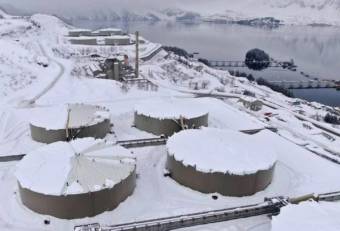
Snow pileup damages Alaska pipeline company’s massive Valdez oil tanks

A view from above of eight huge oil storage tanks with thick snow on top of them
Crews work on tank top snow removal on Tanks 12 and 14 in the East Tank Farm in Valdez on March 16, 2022. (Photo provided by Alyeska Pipeline Service Co.)

The company that operates the trans-Alaska pipeline has called in backup crews to contend with massive amounts of snow piled on top of its oil storage tanks in Valdez, which has damaged infrastructure and vented petroleum vapors to the environment in what state regulators say are violations of the Clean Air Act.

The incident has forced the Valdez Marine Terminal’s operator, Alyeska Pipeline Service Co., to take multiple tanks out of service, though it says there have been no impacts to oil shipments so far.

To try to prevent further damage, Alyeska is now sending up dozens of respirator-equipped contractors for the painstaking work of removing the snow.

Those crews are working nearly around the clock, according to Michelle Egan, an Alyeska spokeswoman. The contractors, who are roped to the top of the tanks, cannot use plows or power tools, so they’re cutting off blocks of snow with saws and sliding them off the edge.

It takes up to two weeks for a crew of 10 or 11 people to remove all the snow from each tank, though it’s not necessarily the company’s goal to completely clear all the tanks, Egan said.

“That is taking tremendous focus,” she said. “We do things very methodically, very safely — it takes as long as it takes.”

Meanwhile, a watchdog group is asking questions about Alyeska’s preparedness and whether the problems at the terminal stem from cost-cutting under new ownership. Others have concerns about worker safety.

Alyeska said its workforce is protected, adding that its snow removal workforce has been stable over the past few years.

Alyeska is co-owned by affiliates of oil companies ConocoPhillips, ExxonMobil and Hilcorp, Alaska’s major North Slope producers, and it’s responsible for moving roughly 500,000 barrels of crude a day down the pipeline.

In Valdez, there are 14 storage tanks that hold the oil until it’s loaded onto tankers for shipment.

A group of large oil storage tanks with Valdez and mountains in the background
Each of the 14 crude oil storage tanks in the Valdez Marine Terminal’s east tank farm is 62 feet tall, and 1 acre wide. Photographed on Feb. 15, 2016. (Loren Holmes/ADN archive)

Removing the snow from the tanks is a gargantuan task: Each is an acre in size and holds up to a half-million barrels of crude — about 2.5% of America’s daily oil demand.

In an email sent to employees about the situation and shared with the Daily News, Alyeska said multiple departments are “fully engaged” in the snow removal effort, which intensified later in the winter.

Employees “are asked to limit distractions to these teams as they focus on this important work,” the email said.

‘It caught people a little bit off guard’

Alyeska says that tanker loading has not been disrupted.

But the snow pileup has taken at least four of the company’s storage tanks out of service at different points in the response by shearing off valves installed along the upper edges of their roofs.

Those valves are a part of a system used to manage vapors that come off the oil, which helps prevent too much or too little pressure from building up in the tanks. The snow that accumulated on the tanks this winter created enough downward and outward force to knock off 10 valves, Alyeska said.

The company is largely blaming the situation on heavy snowfall, though Egan also said Alyeska is investigating and will be reviewing its response.

“There was just unbelievable snowfall, and it impacted us for quite a long time,” Egan said.

Valdez this winter has recorded its highest amount of snowfall, and its highest snow depth, in a decade. But over the lifetime of the trans-Alaska pipeline and the marine terminal, the area has recorded more snow both over the course of the full winter and over peak 10-day time frames, according to federal weather data.

Valdez recorded 4 feet of snow during its peak 10-day window between Feb. 15 and March 15 of this year, with a 21-inch increase in snow depth. Since 1985, the town has recorded 10-day snowfall of at least 68 inches three separate times, with a maximum depth increase of 27 inches.

The quality of Valdez’s late winter snowfall this year — wet, then freezing — worsened its impacts, including on buildings across the water from the terminal in town, said Donna Schantz, who leads the Prince William Sound Regional Citizens Advisory Council, a group that monitors Alyeska’s operations.

But while the amount of snow was unusual, particularly for the past few years, it’s also not unprecedented, Schantz said — particularly in Valdez, which has the highest average snowfall for any Alaska town near sea level.

“I think it caught people a little bit off guard. But it really shouldn’t have, knowing that we live in Valdez, which is the snow capital of Alaska,” Schantz said.

Managing benzene exposure

To address the problems at the terminal, workers are putting temporary caps in place of the damaged valves.

In the meantime, at least seven tanks have released petroleum vapors into the atmosphere, in violation of Alyeska’s Clean Air Act permit, said Moses Coss, an official with the Alaska Department of Environmental Conservation.

Potential penalties or enforcement actions that DEC could bring against Alyeska haven’t been decided, Coss said. Department officials have not yet traveled to Valdez to see the tanks but are planning to within a few days, he said.

“We have been in contact with our regulators since the beginning,” Egan said in an email. “We followed our permit and reported emissions appropriately.”

A photo from a perspective looking between two rows of large oil storage tanks
Each of the 14 crude oil storage tanks in the Valdez Marine Terminal’s east tank farm is 62 feet tall, and 1 acre wide. Photographed on Feb. 15, 2016. (Loren Holmes/ADN archive)

The tanks were originally designed when more and warmer oil was flowing down the pipeline, which used to thaw more of the snow on top of the roofs. But that’s changed as the volume of crude produced on the North Slope has diminished.

Before the late winter spike in snowfall, Alyeska had a crew of about 40 core workers for snow removal.

Now, more than 80 contractors are involved, working both day and night shifts, with “additional resources coming on board,” according to Egan.

The work comes with risks, which Alyeska said it’s managing.

The contractors shoveling snow are equipped with respirators because the broken valves are allowing the release of hydrocarbons like benzene — a carcinogenic chemical that is dangerous at high levels of exposure.

“OSHA sets the limit for benzene exposure; our limits are more conservative,” Egan said in an email. “We do not permit workers to work in areas with detectable levels of hydrocarbon without respirators.”

Workers also wear traction devices and are roped to the tanks to protect from falls. Four “first aid injuries” have happened after workers slipped while removing snow, Alyeska said in its email to employees.

Multiple workers, who did not want to be named in this story for fear of retaliation, said they were concerned about the safety of the contractors clearing snow off the tanks — because of the risks of both injury and benzene inhalation.

Joey Merrick, whose Laborers’ Local 341 union represents the snow removal workers, praised the safety measures taken by Alyeska. He said gas meters and other equipment are used to ensure that benzene exposure doesn’t reach dangerous levels.

Alyeska, Merrick said in a phone interview, goes “to every extent to make sure that people are not in harm’s way.”

A decade ago, during another especially snowy winter in Valdez, two workers fell off the roof of one of the tanks, though without serious injuries, said Schantz.

Since then, Alyeska has made safety-driven changes to its snow removal procedure. Workers start by cutting blocks of snow from the top of the tank, then slide them down chutes, rather than starting from the edge and working upward.

Lessons learned, or ‘were they forgotten?’

Schantz said her watchdog group, the citizens advisory council, will be looking into Alyeska’s preparedness once the snow removal is finished.

Given that similar problems cropped up at the terminal a decade ago, Schantz said she wants to know “what happened to all those lessons learned.”

“Were they forgotten? Or was this a different scenario?” she said.

Schantz’s group was founded after the 1989 Exxon Valdez spill, which had its the 33rd anniversary Thursday. The group is funded by Alyeska, though the council’s contract with the company guarantees “absolute independence.”

One essential question, Schantz said, is whether any cost-cutting or efficiency measures from Alyeska affected the company’s readiness.

That’s especially relevant after the Hilcorp affiliate acquired its 49% stake in Alyeska in 2020, she said, because of the company’s reputation for efficiency and reducing expenses.

“There’s a higher level of concern with Hilcorp, and really it’s because they’ve been open that that’s their business model,” Schantz said. “They have a different way of managing things to cut costs.”

In a report filed with federal responders last week, provided to the Daily News by the U.S. Environmental Protection Agency, an unnamed caller reported a release of an “unknown amount of benzene and hydrocarbon from a tank farm” at the Valdez Marine Terminal.

“The cause of the release is due to negligence to maintenance of the tanks at the tank farm,” the caller said, according to the report.

An EPA spokeswoman said that federal regulators have not confirmed the report’s details. The state is now the lead investigator on the incident, she said.

Egan, from Alyeska, said there hasn’t been a “big change” in the way the company staffs its snow removal crews. The number of available core crews and backup contractors has been stable since 2019, she said, which is before the Hilcorp transaction closed.

While this year came with an “unusual” amount of snow and unprecedented impacts to infrastructure, Egan said, the company is also reviewing its response.

“As we always do, we will identify and apply any lessons from this experience and build them into our processes,” she said. “An investigation is underway so that we can do just that.”

This story was originally published by the Anchorage Daily News and is republished here with permission.

The Alaska Permanent Fund is making its biggest investments within Alaska since the 1980s, but many of the details remain secret

""
The name of the Alaska Permanent Fund Corp. is displayed in the corporate offices on Thursday, March 17, 2022 in Juneau. (Photo by James Brooks/ADN)

Last Tuesday, a small rocket lifted off from Alaska’s state-owned spaceport, soaring into the morning sky above Kodiak with a constellation of small satellites onboard.

The rocket was designed and built by a California-based company, Astra, but its flight was powered in part by millions of dollars from the Alaska Permanent Fund.

By the end of March 2023, the corporation that manages Alaska’s $80 billion trust fund expects to have $200 million invested in projects and companies with ties to Alaska. It’s the fund’s biggest investment within its home state since the 1980s, and key details — including the size of the individual investments and even the names of the ultimate recipients — are being kept secret.

That secrecy is alarming current and former elected officials who say it isn’t a good practice because it prevents oversight and may invite corruption. When the Permanent Fund Corp. was created, legislators said they wanted it to be “insulated from political influences … but accountable to the people through their elected officials.”

The corporation’s earnings, deposited in the Permanent Fund, supplied two-thirds of the state’s general-purpose revenue in the budget passed by lawmakers last year and is expected to supply close to half of that revenue this year. That’s led to greater interest in what decisions the fund is making, and why.

Permanent Fund employees and members of the corporation’s governing board say they’ve been surprised by the pushback and that the new in-state investment program has the potential to earn billions for the state of Alaska, and it’s been designed to prevent corruption and political influence.

Craig Richards, chairman of the corporation’s board of trustees, said in December that even though the program is young, “it certainly appears as positive or better than expectations.”

The in-state investments are a small portion of the fund, but they’re part of a broader shift: This year, about 20% of the fund will be invested in private equity investments impossible for the public to inspect.

Sen. Bert Stedman, a Sitka Republican and chairman of the Senate Finance Committee, said the risks are higher when those kinds of investments are made within the state.

“The state is so small and the investment pool is so shallow that $200 million is a lot of money for the state of Alaska. So we are very concerned with the interrelationships … we’re always concerned that an arm’s length transaction might not be as distant as we assume,” he said.

In the past few months, the Alaska Legislature has begun examining the fund’s holdings in Russia, Gov. Mike Dunleavy has called for the fund to divest from some banks, and state lawmakers are investigating the firing of the fund’s former executive director.

Skepticism over the in-state investment program has received less legislative attention, but the issue could have a greater impact on the state of Alaska than any of the other topics.

By law and policy, the Permanent Fund must prioritize financial returns. What happens when a business funded by the Permanent Fund has to lay off workers or closes entirely? Would political pressure force the fund to change its finances-first approach in order to save jobs? Will state officials change policies to benefit corporations whose profits determine the success of state investments?

Other states have invested their pension funds in local businesses and projects. Those decisions have created jobs and encouraged outside investment, but the financial returns have been mixed, and political pressure has forced some odd choices.

North Dakota’s brand-new equivalent to the Permanent Fund is being tapped for a bison-themed amusement park among other questionable investments.

In California, a billion-dollar targeted investment in racial minority-owned businesses failed to perform as well as non-targeted investments, but Florida beat benchmarks with an investment in high-tech businesses within that state, and New York has also found success.

In January, former Gov. Frank Murkowski asked whether the Permanent Fund has been endangered by the combination of secrecy, a change in strategy, and the firing of the fund’s director.

“Unless these changes can be explained and justified and limits placed on them, the Legislature should require APFC to return to its successful conservative investment strategy. We must demand transparency. We must demand answers and we must demand that the best interest of the Permanent Fund comes before personal interests and political gains,” he wrote.

""
The Michael J. Burns building, which contains the offices of the Alaska Permanent Fund Corp. in Juneau, is seen on Thursday, March 17, 2022. (Photo by James Brooks/ADN)

A broader change in strategy

Alaskans tend to think about the Permanent Fund as an extension of the stock market. When the Dow Jones or S&P 500 spike or plunge, there are stories about the value of the Permanent Fund. There’s an automated Twitter account that regularly posts details of the stocks the fund owns.

Stocks are what’s considered “public equity.” An ordinary person can see their value and buy a share from open markets. But public equity investments account for less than 40% of the Permanent Fund.

A growing share of the fund, including the new in-state program, is what’s called “private equity.”

Greg Allen is the chief executive officer of Callan, a firm that provides independent advice to the Permanent Fund.

“Think of a brand-new company that is just starting up,” he said, “and they want to make some kind of widget that’s going to change the world. But they don’t have any capital, and they need a lot of capital to get this thing off the ground and make it through the first three to five years where they’re not going to be making any money.”

Private equity investors will go out and give that company money in exchange for a share of the company. Sometimes, instead of a new company, it’s an established company that’s looking to expand or change operations.

“(The investor is) betting that over time, these guys are going to execute, the company’s going to grow, and pretty soon, they’re going to be able to sell it into the public markets and make a colossal amount of money,” he said.

“You have one home run and 10 zeroes because they’re investing in very risky companies, but they’re diversifying across a lot of companies,” he said.

It takes time for those home runs to develop — years, sometimes a decade or more — and there’s rarely a quick exit. Losses tend to come in the first few years, causing what Allen and other financial experts call a “J curve.” The value of the total investment drops at first, then rises as successes outweigh the losses.

The Alaska Permanent Fund didn’t make its first private equity investment until 2004, but that kind of investment grew rapidly, making up 4% of the fund by the late 2000s, 11% by 2017, and it’s about 20% now.

That growth has come because the fund — and similar funds nationwide — have been phenomenally successful with it. Over the past five years, the fund’s private equity investments have generated an average return of 29%. During the same period, its public equity investments had a 15% return, and its real-estate investments had a 3% return.

In the recent past, the returns have been even better.

“We had this explosive return year in private equity and venture capital last year, a 65% return,” said Marcus Frampton, the fund’s chief investment officer, earlier this year.

To manage the new in-state private equity program, the Permanent Fund has hired Anchorage-based McKinley Capital Management and Barings, a global firm.

Those companies heard the pitches of companies asking for money, did their research, and over the past three years, they’ve been making investments using $100 million apiece from the corporation.

McKinley had spent about $90 million of its share as of Sept. 30, and Barings had invested $43 million as of Feb. 3.

By design, there’s no decision-making by the Permanent Fund Corp. officials.

“We have no involvement in the selection of the investments. Oftentimes, we don’t find out about them until they show up on the monthly or quarterly reporting,” said Valerie Mertz, the corporation’s interim executive director.

Space business

A rocket lifting off from a coastal launch pad
File — A rocket leaves the Pacific Spaceport Complex-Alaska in Kodiak (Alaska Aerospace Corp. handout photo)

To understand what Barings and McKinley are buying, look at the southeastern corner of Kodiak Island, where free-ranging cattle and buffalo share land with Alaska’s state-owned spaceport.

In the early 2000s and 2010s, neighbors dubbed it “Space Pork Kodiak” for its reliance on government-funded contracts and subsidies. Now, about half of the business at the spaceport comes from small startup companies, and it hasn’t received a direct state subsidy in years.

McKinley has used some Permanent Fund money to invest in three companies with links to the spaceport and the space industry.

McKinley Capital CEO Rob Gillam told Permanent Fund trustees in December that he sees an opportunity in the space business.

In 2019, a satellite company called Starlink received permission to launch up to 12,000 satellites intended to offer Internet access virtually everywhere in the world. Most of those satellites haven’t been launched yet, but the company is already seeking permission for 30,000 more.

Gillam said SpaceX, Starlink’s parent company, is going to need help from other companies to send those satellites to orbit, and those companies are poised to grow.

“In the next generation or two, I think that’s something that’s really going to dominate,” he said.

""
Rob Gillam of McKinley Capital Management, LLC, speaks during the in-state investment program discussion at the Alaska Permanent Fund Corporation quarterly meeting of the Board of Trustees at the Marriott Anchorage Downtown on Wednesday, Dec. 8, 2021. (Photo by Bill Roth/ADN)

California-based Astra sent a rocket to orbit from Kodiak in November on a test flight, then launched again on Tuesday.

McKinley’s other space-related investments include a company that hopes to use a giant centrifuge to fling satellites into orbit, and Airbus Ventures, which helped fund a company called LeoLabs. That company operates a space-looking radar site near Fairbanks.

There’s no guarantee that Astra or the other two space-related investments will pan out. Starlink could abandon its plans. SpaceX might not need the help getting to orbit. Or the companies could simply fail.

After Astra’s November launch in Kodiak, a rocket launch from Florida failed to reach orbit, and some investors are betting against the company’s success.

McKinley is also sending money toward terrestrial investments. It backed the acquisition of Peter Pan Seafoods by American buyers and is investing in a new airline that will start flying between Anchorage and Dutch Harbor this spring.

A list of investments provided by the company shows McKinley also put money into a series of venture capital firms that focus on high technology and environmentally friendly projects.

Lowercarbon Capital, one of the recipients of an investment, says the projects it funds are “buying us time to unf**k the planet.”

In all of these cases, the size of the investment wasn’t disclosed, and in cases where the Permanent Fund’s money is going into another venture capital fund, it isn’t possible to see what companies or projects are receiving money.

Barings and McKinley have different strategies as they handle the Permanent Fund’s money, and it shows up in the investments they’ve made so far. Where McKinley has leaned high-tech, Barings has favored Alaska’s traditional industries.

According to Barings, it purchased part of Alaska Communications, has invested in a gold mining project in Interior Alaska, bought a stake in a new cargo terminal at Anchorage International Airport, purchased part of Southwest Alaska’s Grant Aviation, and has invested in a company that funds mining projects worldwide.

""
Mina Pacheco Nazemi of Barings, LLC, Manager of the Alaska Future Fund, speaks during the in-state investment program discussion at the Alaska Permanent Fund Corporation quarterly meeting of the Board of Trustees at the Marriott Anchorage Downtown on Wednesday, Dec. 8, 2021. (Photo by Bill Roth/ADN)

‘Managed for return, first and foremost’

Mina Pacheco Nazemi runs the Alaska Future Fund, which is the collective name for Barings’ share of the in-state Alaska program.

This is her ninth in-state investment program, and she said Alaska’s effort is structured similar to the rest and is designed to avoid political pressure or corruption.

Private equity isn’t regulated by either the federal Securities and Exchange Commission nor Alaska’s state division of banking and securities, but advisers like Pacheco Nazemi and Gillam are licensed by the SEC. That makes them subject to regular federal inspection and the federal law banning “pay for play.”

SEC officials said that means the advisers can’t provide something of value to an official, and that official — whether it’s the governor, a Permanent Fund trustee, or someone else related to the fund — can’t give something of value to the adviser in order to steer an investment.

Gillam said that beyond the legal reasons, there are logical reasons against steering an investment. His performance is judged on financial returns, and steering an investment would endanger that performance.

“Why would I do that? I’m just going to get fired,” he said. It would also endanger the entire company, which is much larger than the Permanent Fund’s investment.

“We maintain full discretion, which means that the Permanent Fund staff, no one on the board … they cannot say, ‘I need you to invest in XYZ.’ We are the fiduciary, we serve as the investment manager, and we do all the work to underwrite all deals,” Pacheco Nazemi said.

When it comes to picking investments, she said ideas can come from people simply emailing tips or from Barings’ own staff.

These investments aren’t like a restaurant in Spenard; the Alaska Future Fund is targeting each investment to be at least $5 million, in a company worth at least $10 million. It won’t typically invest in technology startups, and the company needs to have a presence in Alaska.

Every idea, big or small, goes through a three-step process of review, research and decision-making, she said, and it can take months. Only about 5% of all the pitches they receive result in investments, she told Permanent Fund Corp. trustees in December.

At the same December meeting, she said there were 10-20 investments being actively examined and two in “deep stages” of analysis in addition to the five confirmed ones, but Pacheco Nazemi declined to say what those two are.

Job creation isn’t a factor in picking what gets funded and what isn’t.

“This program is managed for return, first and foremost,” Pacheco Nazemi said. “So we’re managing and always looking at the financial return.”

How can Alaskans judge success? Look at the financial returns five years from now, she said.

Why is the corporation doing this?

The Alaska Permanent Fund Corp. started its in-state program to make money and because state law requires it.

The Permanent Fund was created in 1976, but in its first four years, it was managed by the state’s revenue department. In 1980, the Alaska Legislature passed a law creating the Permanent Fund Corporation.

In that law, legislators included a provision saying that the corporation shall invest within the state of Alaska as long as those investments are available and “have a risk level and expected return comparable to alternate investment opportunities.”

In the corporation’s first years, state politicians pressured its board of trustees to invest in Alaska.

“It is crystal clear that the first call on the Permanent Fund should be to provide mortgage money,” said longtime Republican politician Tom Fink in 1979.

In 1981, trustees responded to that pressure by voting to invest 5% of the fund in in-state mortgages and 5% in certificates of deposit with in-state banks. By 1987, the fund had spent $224 million on in-state investments and had set aside $80 million for home mortgages in Alaska.

The 1980s oil bust and the subsequent crash of Alaska’s real estate market turned this strategy into a mistake, and because the fund was so much smaller than it is today, it wasn’t a small mistake.

“We did fund home mortgages in Alaska on a very small scale and we have seen some losses in that area,” executive director Dave Rose told the Associated Press in 1989.

Two years later, the corporation sold its remaining 165 home mortgages to KeyBank for $25 million.

The experience of the 1980s appeared to sour the corporation on most in-state investments, and state lawmakers relaxed restrictions on out-of-state investments, eliminating them altogether in 2005.

That meant investments within Alaska had to compete with investments anywhere in the world, and the corporation’s annual reports indicate Alaska didn’t compete well.

In the late 1990s, the fund’s only Alaska holdings were a mall in Ketchikan, the Pioneer Building in Anchorage, and the corporation’s office building in Juneau.

The corporation also bought $300 million in certificates of deposit from Alaska banks and renewed them regularly, but that program ended in 2013.

By 2018, the fund’s only asset in Alaska was its office building.

The corporation does hire some in-state companies to invest part of the fund on its behalf. In 2018, those amounted to less than 2% of the fund, and none of the investments were in Alaska.

That year, as the corporation’s trustees prepared to vote on a new investment policy, trustees worried that the fund’s in-state investments were so small that they might violate the requirement passed by the Legislature in 1980.

“The statute came up and we had a discussion,” Richards said, “both because it’s our investment mandate … but also, just because we thought it could be beneficial if that could be done well.”

Andy Mack, Gov. Bill Walker’s commissioner for the Department of Natural Resources, also sat on the corporation’s board at the time and said trustees were worried about the state of the Alaska economy.

Oil prices had plummeted, causing widespread layoffs and steep state budget cuts that caused more Alaskans to lose their jobs.

“It was pretty hard,” he said in a December interview, “to walk from the Capitol building, where we’re in a heated debate over $1 million or $4 million, and we’ll walk over to a quarterly meeting of the Board of Trustees and realize that we were exporting $150 million, almost, in fees to other places in the United States for management.”

Mack said the thought was, “could we deploy a small portion of the available dry powder, if you will, into Alaska-based companies? Could we do it in a way that might help fund local companies?”

Mack brought up the issue during a 2018 board meeting, but it was Richards, Walker’s former attorney general and a Walker appointee to the board, who encouraged trustees to create a new program.

""
Trustee chair Craig Richards asks a question during the quarterly meeting of the Alaska Permanent Fund Corporation Board of Trustees at the Marriott Anchorage Downtown on Wednesday, Dec. 8, 2021. (Photo by Bill Roth/ADN)

When the board met that fall to discuss its options, Richards and Rodell listed a $200 million Alaska investment program among the possibilities, and that was what the board of trustees ultimately agreed upon.

“We supported the concept of in-state investment for a small slice of the Permanent Fund to enable Alaska-based companies to help our economy and generate jobs here,” Walker said in February. “However, I believe where the money is invested should be transparent.”

Following the lead of other states

When the trustees approved the program, they were following a familiar idea.

Public pension funds have invested in private equity for decades, but in 1999, at the direction of the New York legislature, that state’s public pension fund created a special account devoted to investments in New York State.

In 2013, the pension fund noted that “overall returns have been satisfactory.”

Other states followed New York’s example.

Florida started a program in 2008, focusing on high-tech companies within the state. By summer 2020, it had invested more than $820 million within its state, creating over 19,000 jobs in the process. The state’s independent accountability office concluded that net financial returns exceeded expected benchmarks.

California’s experience was mixed. Starting in 2001, its biggest pension fund, known as CalPERS, spent $1 billion on private equity investments in a program that focused on minority-owned businesses and those in economically disadvantaged areas.

The program was successful at creating jobs, but in 2018, the pension fund’s chief investment officer said nine of the 10 fund managers in the first phase of the program lost money. In the second phase, the program earned positive returns “but still underperformed our overall benchmark.” CalPERS hasn’t repeated the program.

In 2007, CalPERS started a $465 million fund devoted to clean energy investments in the state. Six years later, it had an annualized return of negative 9.7%.

“Our experience is this has been a noble way to lose money. And we’re not here to lose money,” CalPERS chief investment officer Joseph Dear told the Wall Street Journal in 2013.

Public funds, little disclosure

When these programs started, many were subject to public-records laws that required public disclosure.

In 1999, the Houston Chronicle discovered that a third of the private equity investments made by the University of Texas’ trust fund were with firms personally or politically connected to a university leader or then-Gov. George W. Bush.

Three years later, the California-based San Jose Mercury-News won a lawsuit requiring CalPERS to disclose more information about its private-equity investments. Other lawsuits, requesting more disclosure, followed.

In response, companies receiving those investments began backing away from deals with public funds. Rather than lose access to investment opportunities, states weakened their public records laws.

Alaska didn’t need to.

When the Alaska Legislature created the Alaska Permanent Fund Corporation, it inserted a special clause into state law that allows the corporation to ignore Alaska’s public records act under specific circumstances.

For most of the corporation’s history, that clause didn’t draw much attention. The corporation’s investments were public investments, and its first officers encouraged transparency.

“Any efforts by interest groups to win concessions from the fund will be more readily seen if the fund is more visible,” board chairman Elmer Rasmussen wrote in the 1982 annual report.

When it comes to the in-state investment program, the Permanent Fund has denied public records requests for copies of its contracts with McKinley and Barings, and voluntary disclosures by those companies have resulted in the only publicly available information.

Legislators have said they’re frustrated by the lack of disclosure and have called it a reason to limit the program, if not end it entirely.

“I don’t think we should add any more (money to the program). Like, what’s done is done. Let’s not add any more, even though they have the flexibility,” Von Imhof said.

She is among a group of legislators supporting a change in the makeup of the corporation’s governing board. That legislation, from Rep. Andy Josephson, D-Anchorage, is still in early development.

The growth of private equity means the fund has changed, von Imhof said, and oversight should change too, she said.

This story was originally published by the Anchorage Daily News and is republished here with permission.

Ravn Alaska company creates a cryptocurrency for its mileage rewards program

A twin-engine Ravn Alaska plane gaining altitude after takeoff
A Ravn Alaska de Havilland Dash 8 departs from Ted Stevens Anchorage International Airport on a flight to Homer on Monday, Sept. 26, 2021. (Photo by Bill Roth/ADN)

The parent company of the state’s biggest rural airline has created a cryptocurrency to reward fliers with a digital token that, according to plans, could soon be traded on exchanges like Bitcoin is today.
Officials with Ravn Alaska say the FlyCoin token will serve the purpose of a traditional airline loyalty program, giving travelers value for miles flown.

But as they envision it, the cryptocurrency will have broader purchasing power and be redeemable for cash, like Bitcoin.

The concept is unusual in the airline industry, said Lenny Moon, chief executive of FlyCoin, a newly created company and affiliate of Ravn Alaska.

At least one airline, from Asia, created a cryptocurrency reward program, but its value was limited because it was not an asset that could be traded, said Moon.

“With this, you could trade it, get cash for it, it doesn’t expire, it’s yours, you own it,” said Moon, a former Wall Street investment banker.

Josh Jones, an entrepreneur from Los Angeles and an early pioneer in Bitcoin, is lead investor and chairman of FLOAT Alaska, the parent company of Ravn Alaska and FlyCoin.

The airline rewards industry is “past due for a digital transformation,” Jones said in a prepared statement from FlyCoin on Wednesday.

Jones is overseeing the development of FlyCoin, Moon said. FlyCoin recently raised $33 million from investors in an early step, Moon said.

Moon was previously involved in other startup companies including Payoff, a financial technology company that provides loans to help people pay off credit card debt.

The digital currency company is the latest venture pursued by FLOAT Alaska. This year, the company is also planning to launch a new international airline, Northern Pacific Airways. The airline will operate previously retired Boeing 757-200s to fly between Anchorage and Asian and U.S. destinations, according to plans.

Leadership with FLOAT purchased the assets of RavnAir Group out of bankruptcy in 2020, launching Ravn Alaska. The leadership had been developing FLOAT Shuttle, a new Southern California air taxi, created as an alternative to rush hour traffic in the Los Angeles area. FLOAT Shuttle has been on pause during the pandemic. Its phone number currently directs people to Ravn Alaska.

Ravn Alaska provides a vital service for rural Alaska communities, connecting travelers with cities on the Alaska road system such as Anchorage and Fairbanks.

FlyCoin tokens will be redeemable for travel with Ravn Alaska and on Northern Pacific Airways, Moon said in an interview on Thursday.

Company officials are also talking with other airlines, hotels, wine clubs and hospitality firms that could serve as partners that accept the cryptocurrency, he said.

FlyCoin plans to have the digital tokens available for trade on cryptocurrency exchanges later this year, broadening its value, Moon said.

Ravn customers currently receive credit in FlyCoin, though the tokens aren’t yet available for placement in digital wallets, company officials said.

FlyCoin should be fully up and running in the coming months, they said. The mileage program that currently exists with Ravn’s partner, Alaska Airlines, will also continue to exist after that point.

The company has minted the FlyCoin tokens using Ethereum technology, FlyCoin said in a statement. Plans call for a fixed supply of 100 billion tokens.

Credit that customers have built up for future Ravn Alaska flights will be converted to FlyCoin.

Chris Gale with Metaedge Ventures, a Los Angeles-based cryptocurrency advisor that has provided consulting to FlyCoin and other companies, said the idea can prevent mileage rewards from sitting around for years unused, since people can trade them on an open market.

Cryptocurrency can be complicated for people who aren’t familiar with it, he said. FlyCoin plans to build an app that will make it easy to use, he said.

One of the benefits of FlyCoin is that it can potentially rise in value, Moon said. It could, of course, also lose value, he said.

Travelers will have the option to cash it out shortly after they receive it, or hold it in hope that it rises, he said.

People will have an option through Ravn to convert it to a voucher right away, if they don’t want to deal with any fluctuation in value, Moon said. The plan is to have agreements with partner companies, such as at hotels, to ensure FlyCoins will always maintain at least a minimum value for redemption of 2 cents per token, Moon said.

Moon said cryptocurrency is growing in use, and airline customers want more flexibility with their mileage programs.

“We’re sitting at this intersection where it makes sense that rewards could convert to cryptocurrency where it’s tradeable on an exchange,” he said.

This story was originally published by the Anchorage Daily News and is republished here with permission.

Former Alaska Chief Justice Craig Stowers dies at age 67

Chief Justice Craig Stowers waits outside the House Speaker’s office before delivering his State of the Judiciary address to a joint session of the Alaska Legislature on Feb. 7, 2018. (Photo by Skip Gray/360 North)

Former Alaska Chief Justice Craig Stowers has died, the Alaska Court System said Friday. Stowers, who retired from the state Supreme Court in 2020, was 67.

In a message to court staff, current Chief Justice Daniel Winfree said Stowers died peacefully on Thursday. He did not share a cause of death.

“I served with him for about a decade on the Supreme Court and can attest to his hard work, his dedication to justice in Alaska, his love of the Alaska Court System, and his great sense of humor,” Winfree said.

Born in Florida, Stowers came to Alaska in 1977 as a National Park Service ranger working at Denali National Park. After leaving the Park Service, he obtained a law degree in 1985 and worked in public and private legal practice before being named to the Anchorage Superior Court in 2004.

In 2009, then-Gov. Sean Parnell picked him for a seat on the state Supreme Court. While on the court, he frequently dissented from rulings that upheld abortion rights in Alaska and opposed the legality of the recall campaign against current Gov. Mike Dunleavy.

In one of his last rulings, he cast a deciding vote in a split decision that dismissed a challenge to Alaska’s fossil fuel policy brought by youths concerned about climate change. (Stowers heard the case before he retired.)

Named chief justice by his fellow Supreme Court judges in 2015, he oversaw the court system during years of steep budget cuts but maintained a sense of humor, telling state legislators in 2016, “My friends, do not be afraid: Fear is the mind-killer,” using a phrase from the science fiction novel “Dune.” He served as chief justice for three years.

Stowers said in 2020 that he would retire early from the court to prevent a wave of retirements between 2023 and 2025. Dunleavy picked Dario Borghesan to replace him.

This story was originally published by the Anchorage Daily News and is republished here with permission.

Gov. Dunleavy says he stands by Zink as attacks on Alaska’s chief medical officer escalate

Dunleavy sits with his chief medical officer, Dr. Anne Zink, at a news conference in the fall of 2021. (Nat Herz/Alaska Public Media)

Alaska Republican Gov. Mike Dunleavy says the state’s chief medical officer, Dr. Anne Zink, still has his confidence even as she’s become the focus of escalating attacks by the anti-vaccine movement and other critics of the governor’s pandemic response.

Wasilla GOP Rep. Christopher Kurka, who’s running for governor as a conservative alternative to Dunleavy, this week launched a “Fire Anne Zink” petition, saying he’s committed to removing her “on Day 1 of my administration.”

At a Dunleavy constituent event Saturday in the deeply conservative Mat-Su, audience members applauded calls for Zink’s removal.

The governor, at the event, appeared to suggest that Zink’s position in his administration was uncertain, telling a participant who asked about Zink that he will “make a decision” about several members of his administration — not just one.

In a phone interview Wednesday, after some of Dunleavy’s critics attacked the governor for not defending Zink more aggressively, Dunleavy said she has “served Alaskans well” and that he “should have been clear.”

“There is no reason for me to fire Dr. Zink. Dr. Zink has my confidence,” Dunleavy said.

“Is Dr. Zink guilty of dispensing advice? Yeah, that’s her job,” he added. “I don’t think she should be held accountable for folks not liking information. I think the whole thing’s been politicized.”

For her part, Zink, in a phone interview, said “it’s been a hard week.”

“This hasn’t been new, but it’s escalated,” she said.

The attacks on her include physical threats, Zink said, which have also increased recently. But she also added that she continues to have a good working relationship with Dunleavy, even if they don’t always agree.

“I can’t ever speak to someone’s intentions as to why they do or don’t respond in a situation — particularly a live situation, in the moment. All I can speak to is my interactions and my relationship,” she said. “We continue to have regular conversations — we’ve never seen eye to eye on lots of things, and that’s what I think has made us both stronger. And I appreciate the way we continue to work through those challenges together and collaboratively.”

The attacks on Zink come amid a hostile climate nationwide for public health officials.

Hundreds of top medical officers like Zink have left the field in the past two years, as the pandemic has increasingly polarized their work and made them targets for conservative-leaning elected officials and activists. Just 17 of the 50 state medical officers in place at the start of the pandemic are still in their jobs, according to the Association of State and Territorial Health Officials.

Zink, a Mat-Su emergency room doctor, was hired just before the start of the coronavirus pandemic. Since then, she’s drawn a loyal following of Alaskans with her plain-spoken advice and lively social media presence.

Public opinion surveys suggest that more than half of Alaskans — 57% of respondents early last year — think she’s handled the pandemic well, while only about 10% think she hasn’t. Just 6% of people called Zink’s performance “pretty bad” in an August survey, which showed that even the majority of conservatives approve of her work.

Zink’s critics are “a very small group of people,” said Jennifer Meyer, assistant professor of public health at University of Alaska Anchorage.

“And the vast majority of us are very grateful for her service throughout this pandemic,” she said. “There are more of us that are with her than against her.”

Dunleavy himself nominated Zink for a national award in November, saying she’s “worked tirelessly” during the pandemic and that her work has “saved thousands of Alaskans.”

Even as a minority, though, Zink’s critics are vocal and represent a slice of Dunleavy’s base in the Mat-Su, where he lives. In an election year, they’ve been putting increasing pressure on the governor to remove her.

At the weekend constituent event, organized by conservative activist Mike Coons, the audience broke into applause at least twice when participants said Zink should be fired, with no direct response from Dunleavy.

He also did not respond directly when an audience member appeared to specifically ask him about Zink, instead suggesting that he was considering the removal of multiple members of his public health team.

“I’ll make that decision. I’m not going to have a discussion — I’m being honest with you — I’m not going to have a discussion here in front of folks. But I’ll make a decision on future, not just one staff member, but a number of staff members,” he said.

In the phone interview Wednesday, Dunleavy dismissed the idea that he was trying to placate his audience and said he was trying to avoid discussing personnel issues at a public forum.

“Personnel files, personnel everything should be protected and not just willy-nilly discussed,” he said. “But here we are. And I get it — I understand that this is the issue of the day.”

Kurka’s petition, meanwhile, says Zink endorses a “one size fits all” approach to “universal application of experimental COVID-19 shots for nearly all Alaskans,” and “refuses to listen to or act on any medical position contradicting her recommendations.”

The Centers for Disease Control and Prevention say that vaccines are the best protection against COVID-19, that they’re safe and that their benefits outweigh their risks. The coronavirus vaccines approved for use in the U.S. also are not experimental; while they’re approved on an emergency basis, they went through standard safety reviews and did not skip stages.

Kurka’s petition also says Zink “does not support or respect the rights of Alaskans to maintain medical privacy, secure informed consent before receiving experimental treatment or to try alternative prevention and therapeutic interventions.”

“This statement is self-evident in Dr. Zink’s actions, omissions, statements and attitudes towards legislators, medical professionals and anyone else who challenges the deep-state, CDC, National Institutes of Health and big-pharma agenda to which she ascribes loyalty,” Jason Floyd, a spokesman for Kurka, said in an email.

Zink, in the interview, said Alaska law gives her “almost zero power or authority over anything,” whether that’s hospital practices or doctors’ prescribing authorities.

“We are incredibly and have been incredibly supportive, from Day 1, of patients and their providers having that relationship together,” she said. “No government should get in the way of that and stand in the space of that. We are just here to provide information and resources.”

She added: “I am a public servant who took this job because I care passionately about the patients that I saw, and saw systems failing them — and felt like we could do better for my friends, for my neighbors and for fellow Alaskans.”

Zink said she’s especially frustrated when people attack her based on their assumptions about what she and Alaska health officials do, rather than what they actually do. And she invited residents to contact and question her, through the health department’s public science forums each Wednesday.

Asked about her enthusiasm for continuing in her job, Zink acknowledged that “the threats of physical violence are hard.” But she also suggested that the pressure on her has made her “more committed.”

“My name is out there,” she said. “I don’t want the amazing health care workers and public health team that is working day and night in the background to be impacted by the frustration and the hate that’s out there. In some ways, it’s my job to protect them from that.”

Meyer, the public health professor, said the attacks on Zink align with one of the key strategies of the anti-vaccine movement, which is to undermine science, scientific evidence and scientific institutions.

“And so you’ll see them attack anyone who’s using science to inform public health recommendations or public health policy,” Meyer said. Zink, she added, is “simply stating the recommendations that the CDC is putting forward, so she has recommended masking, she’s recommended vaccines, she’s consistently recommending things that scientific consensus supports.”

Meyer also noted that while some people may be frustrated that Dunleavy has not imposed statewide mandates to address the recent omicron-driven coronavirus surge, he’s also resisted significant pressure from conservatives to undercut public health strategies.

That’s even as other GOP elected officials have pushed legislation to ban policies like vaccine requirements and mask mandates.

“He’s not falling into that trap,” Meyer said.

This story was originally published by the Anchorage Daily News and is republished here with permission.

Former US House candidate Alyse Galvin to run for Alaska Legislature

Independent U.S. House candidate Alyse Galvin. (Photo courtesy Emily Russell/Alaska Public Media)
Alyse Galvin in 2018. She was the Democratic-endorsed U.S. House candidate in 2018 and 2020. (Photo by Emily Russell/Alaska Public Media)

Alyse Galvin, the Democratic-endorsed U.S. House candidate in 2018 and 2020, will run for the Alaska Legislature in 2022, she said Monday.

Galvin has filed a letter of intent with the Alaska Public Offices Commission, but in a brief interview said she doesn’t yet know whether she will run for state House or state Senate. She will make that decision after the end of Alaska’s legally challenged redistricting process.

“I’m intending to run for Alaska Legislature. That’s the big news,” she said.

Galvin said she will run as an independent interested in joining a multiparty coalition.

Galvin’s decision means she likely will not challenge incumbent U.S. Rep. Don Young, R-Alaska, for a third time. Galvin didn’t rule out another run for federal office but said it would take the equivalent of an “earthquake” to change her mind.

No registered Democrats have yet entered the race for U.S. House or U.S. Senate.

Galvin is a registered nonpartisan voter, and under Alaska’s newly redrawn legislative districts, she lives in a Midtown Anchorage state House district with no incumbents. Rep. Andy Josephson, D-Anchorage, currently represents Galvin’s neighborhood but was redistricted into the same downtown Anchorage district as Rep. Chris Tuck, D-Anchorage.

Jim Wright, a Democratic candidate, has registered to run for state House in the district he shares with Galvin, which has the fifth-strongest Democratic lean of Alaska’s 40 state House districts, according to preliminary estimates.

Galvin’s prospective state Senate district is currently represented by Sen. Elvi Gray-Jackson, D-Anchorage, but the Alaska Democratic Party is urging Gray-Jackson to run for U.S. Senate instead. If that happens, the Senate district would have no incumbent.

Galvin declined to discuss Gray-Jackson’s possible U.S. Senate run.

The situation could change entirely if state judges rule Alaska’s newly drawn legislative districts unconstitutional. Five lawsuits were filed against the proposal approved in November, and those cases have been combined into a single sprawling lawsuit that will be decided by Feb. 15.

An almost-certain appeal will place the issue in front of the Alaska Supreme Court, which must rule by April 1.

Before she decides which race to join, “I’m going to wait and let the redistricting kind of settle down for a minute,” Galvin said.

Correction: An earlier version of this story incorrectly reported Jim Wright’s political affiliation and which state House lawmaker currently represents the neighborhood he and Alyse Galvin reside in. Wright is a registered Democrat and is running as a Democratic candidate, not as a nonpartisan. The neighborhood he and Galvin live in is currently represented by Rep. Andy Josephson, D-Anchorage, not Harriet Drummond, D-Anchorage.

Site notifications
Update notification options
Subscribe to notifications