Anchorage Daily News

Anchorage Daily News is our partner in Anchorage. KTOO collaborates with partners across the state to cover important news and to share stories with our audiences.

More than 440 Alaskans have died with COVID-19. We know little about them.

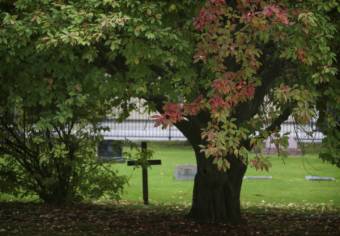
Leaves begin to change color on a tree at the Anchorage Memorial Park Cemetery on Friday, Sept. 10, 2021. (Emily Mesner/ADN)

In Alaska, 444 people have died after contracting COVID-19. We know precious few of their stories.

Of hundreds of Alaskans who’ve died with COVID-19, the fact was acknowledged in only a handful of published obituaries. A sprinkling of online memorials and fundraisers fill out the details of a few more.

Recent deaths hint at the enormity of the losses: A respected airline pilot with two children. A U.S. Marine with a toddler son. A 36-year-old dad and restaurant employee.

Those are the exceptions. By and large, the grief — and the stories — of Alaskans who died in the unfolding wave of the coronavirus pandemic have remained private.

The result is faceless human toll growing by the day.

How can hundreds of Alaskans die and we know so little about who they are?

“I have wondered the same thing,” said Anne Zink, the state’s chief medical officer.

Inviting judgment

In the earlier stages of the pandemic, people came forward with stories about their loved ones’ illnesses and death.

Pink roses and handfuls of dirt, tossed by family and friends, rest on the casket of Amanda Bouffioux during her burial at the Anchorage Memorial Park Cemetery on Sept. 15, 2020. Bouffioux tested positive for COVID-19 last August and spent three weeks on a ventilator before she died Sept. 8, 2020. (Emily Mesner/ADN)

People like Scott Wells, whose wife, Amanda Bouffioux, died of COVID-19 one year ago. At the time, Wells said, he was willing to share about the death of the 44-year-old wife and mother because he wanted Alaskans to know how lethal the virus could be.

But as almost every aspect of the pandemic — from masking to vaccination to even the threat posed by the virus itself — has become the center of an ugly political debate, that’s changed.

“I keep thinking about the similarities between the opioid epidemic,” said Zink. “The shame and the stigma that can sometimes come with COVID. And the politicization of it.”

Now, with unvaccinated people making up the overwhelming majority of recent COVID-19 deaths in Alaska, there’s a sense among some family members that going public about a loved one’s illness and death means inviting the judgments of strangers.

“I think people want to grieve and process their own loss without judgment,” Zink said.

Even before vaccines were available, families that chose to share publicly about their loved one’s loss to coronavirus faced judgment.

Michi Shinohara’s mother, Rosemary Shinohara, a retired Anchorage Daily News reporter, died in December of COVID-19.

Shinohara tweeted a raw account of her time at her dying mother’s bedside. An adaptation of the thread was published in the Daily News.

At the time, Shinohara, a physician in Seattle, worried that people might question whether her mom and dad had been sufficiently cautious. She wondered if her mother’s death might be discounted because she was older, or because she had other health issues.

People just want to believe it won’t happen to them, or if they do, that everyone will be fine, Shinohara said.

“Admitting that’s not true lets in the hideous fear of this thing that’s looming,” she wrote.

‘Very simple and private’

Funeral directors and cemetery workers are encountering families dealing with the deaths of their loved ones to COVID-19. Many are opting for direct cremation and no immediate service, said Mindy Gustin, a licensed funeral director for Legacy Heritage Chapel at Angelus Cemetery in Anchorage.

“We’ve been seeing a lot of families going ‘OK, we are going to keep our arrangements very simple and very private,’” said Gustin. Causes of death are gradually disappearing from obituaries in general, Gustin said.

“In the pandemic we are grieving in a much more isolated way,” she said.

Roses rest on the ground and line a gravesite at the Anchorage Memorial Park Cemetery in downtown Anchorage on Thursday, Sept. 9, 2021. (Emily Mesner/ADN)

The Anchorage Memorial Park Cemetery downtown has been busy with burials in August and September. Families don’t often volunteer the cause of their loved ones’ deaths, but memorial park director Rob Jones sometimes hears which are due to COVID-19.

“I’ve noticed the obits are not mentioning it nearly to the degree that it is actually causing the death,” Jones said.

Tethering a loved one’s death to the coronavirus pandemic can make it feel like it subsumes the person’s life story and accomplishments, Zink said.

“There’s a desire to not have someone’s death to be boiled down to a virus that has become so political,” she said. “They want the obit to be about the life of that person, and what that looked like.”

Disenfranchised grief

Kenneth Doka studies grief, especially what he calls “disenfranchised grief.”

Disenfranchised grief is the kind that is not openly acknowledged, validated by society or mourned publicly, says Doka, a professor emeritus at the College of New Rochelle in New York and vice president of the Hospice Foundation of America.

People who have lost loved ones to suicide or drug overdose are familiar with their loved ones’ deaths being viewed as somehow the result of perceived moral failings.

You see it sometimes in deaths from lung cancer, Doka said.

“The first question is, did they smoke?” he said. “As if their smoking makes them somehow less deserving of sympathy.”

At first, people who died with the coronavirus did not seem to be subjected to such disenfranchisement. Now, with vaccines widely available and most deaths among unvaccinated people, “there may be a sense that this was preventable,” he said. “And that there’s a stigma associated with it.”

Grief that remains unspoken, unacknowledged or unexplored festers.

“You can’t explore your own questions,” Doka said. “You can’t really process your grief as well.”

What are we missing?

What do we lose by not knowing the stories of those who have died?

A sculpture of an angel marks a grave at the Angelus Memorial Park Cemetery in Anchorage on Wednesday, Sept. 8, 2021. (Emily Mesner/ADN)

Every one of us has been through the trauma of a global pandemic in the last year and a half, Zink said. But we’ve also experienced COVID-19 so differently: from a mild spell of illness to the economic loss of a business to the death of a mother, father, husband or wife. She thinks polarization — and not knowing one another’s stories — has pushed us further apart.

“We’ve lost a lot of the humanity of this response,” Zink said. Sharing stories about all the losses Alaskans have experienced could help, she thinks.

Gustin, the funeral director, says it’s never her role to judge. It’s to help families memorialize their loved ones as they wish to — publicly or privately, with or without acknowledgement of why the person died.

She’s busy right now. The bodies of three people who died with COVID-19 arrived at her funeral home just last weekend.

This story was originally published by the Anchorage Daily News and is republished here with permission.

Alaska Airlines flight diverted to Juneau after passenger makes threats and group violates mask protocol, officials say

An Alaska Airlines plane at Juneau International Airport.
An Alaska Airlines plane at Juneau International Airport. (Heather Bryant/KTOO)

A recent Alaska Airlines flight heading from Seattle to Anchorage was diverted after a passenger began threatening staff and people near them and their group refused to follow instructions for mask use, officials said.

Multiple people traveling in the same group were earlier removed from Saturday’s flight prior to takeoff in Seattle for what Alaska Airlines described in a statement as “disruptive behavior.” Others in that party were allowed to stay on the flight, but once the plane was in the air, “at least one passenger who was part of the remaining group began to threaten our crew members and nearby guests,” Alaska Airlines said.

Alaska State Troopers said in an online report that the five passengers “were not following flight attendant instructions related to mask use and were using foul language during the flight.”
Troopers said there was no physical altercation.

The flight was diverted to Juneau, and the five passengers were removed from the plane by troopers and Juneau police officers. The flight took off about an hour later from Juneau International Airport, according to flight-tracking data.

No charges or citations were issued related to the incident, and troopers said federal law enforcement officials were notified. A spokeswoman for the Federal Bureau of Investigation said Wednesday that she could not confirm or deny whether an investigation was ongoing.

Alaska Airlines did not provide additional information or respond to questions about the incident Wednesday.

This story was originally published by the Anchorage Daily News and is republished here with permission.

Denali National Park closes road near halfway point for rest of season due to ongoing landslide

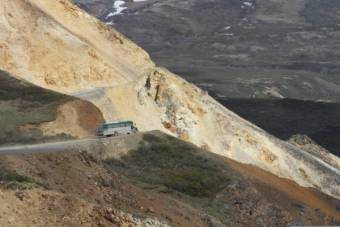
This May 27, 2016, file photo shows a bus near Polychome Pass on the only road inside Denali National Park and Preserve (AP Photo/Mark Thiessen, File)

A significant portion of the Denali Park Road closed Tuesday for the rest of the season as a landslide caused unsafe driving conditions, the National Park Service said in a statement.

The 92-mile Denali Park Road is the only way to drive into the 4.7-million-acre park. The continuing landslide at Polychrome Pass, near Mile 42, has led to the road rapidly deteriorating in recent years, causing concern about how to maintain the road while safely accommodating visitors.

“Changing climate is driving frozen ground to thaw, resulting in unpredictable and increasing landslide movement rates at Pretty Rocks that are unprecedented in the history of the park road. We cannot safely keep up with the accelerating rate of landslide movement caused by permafrost thaw currently occurring in association with the Pretty Rocks Landslide,” Don Striker, Denali’s Superintendent, said in the statement.

The Denali Park Road normally closes past the Teklanika Rest Area at Mile 30 in mid-September.

After Tuesday, westbound traffic beyond Mile 43 will only be allowed for essential purposes, like facilitating seasonal closure of western park operations, the park service said.

The closure will impact the Wonder Lake Campground near Mile 89 and the Eielson Visitor Center at Mile 66, the park service said.

About 84 people who are camping or accessing the backcountry west of the closure on Tuesday will be relocated in the coming days, said park spokesman Paul Ollig. People at Wonder Lake Campground are being relocated by park transit buses Tuesday and Wednesday, and backcountry users will be picked up by park camper buses when they return to the road during the next few days, he said.

The visitors are not stranded, Ollig said.

“Some visitors are being relocated to campgrounds east of Polychrome, where space is available, and others are simply choosing to shorten their trips,” he said by email.

The park service said camper buses won’t be able to accommodate backcountry trips past Mile 42, effective immediately. Park tour and transit buses will continue making trips, but they will stop and turn around at Mile 42.

The Denali Visitor Center, front-country trails and backcountry access remain open, along with the Kantishna airstrip, which is located near the end of the road.

Area of the Pretty Rocks landslide along the Denali Park Road

The Pretty Rocks Landslide, located around Mile 45 of the highway, has required increasing maintenance in recent years because it is changing rapidly due to climate change, the park service said.

In 2018, the landslide was causing the roadway to slump almost half an inch per day and by August of last year it had increased to 3.5 inches per day, the park service said.

“Early August rains in 2021 appear to have triggered the rate to increase significantly, with much of the landslide currently moving downhill at over ten inches per day,” the statement said.

The park service’s 2022 budget request includes funding for a construction project at Polychrome Pass to maintain access, the statement said. The project is in the planning and design stages and the park service said construction would not begin until at least 2023.

This story was originally published by the Anchorage Daily News and is republished here with permission.

Residents of Alaska border towns eager to travel into Canada but chafe at COVID testing requirements

The US-Canada border at Hyder, Alaska, on July 1, 2015. The town, with fewer than 100 year-round residents, is closely tied to nearby Stewart, British Columbia.(Loren Holmes/ADN)

Caroline Stewart of Hyder is excited to return to her church in Canada.

Steven Auch of Haines looks forward to snowmachining in the Yukon Pass this winter.

Andrew Cremata of Skagway wants to head north to go fishing.

For many Alaskans living in Southeast towns close to the Canada border, that country’s reopening Monday to vaccinated Americans signified a small return to normal life after more than a year of isolation from neighboring communities.
Some Alaskans, however, say the timelines required for COVID-19 testing in order to enter Canada are still too burdensome.

Since the border was closed in March 2020, Haines has felt like an island, said borough tourism director Steven Auch.

“It was really the border closure that kind of cemented that,” he said. “… Normally in the winter, the ferry service is pretty bad and flights are difficult to come by, so it feels kind of isolated in the winter already, but at least we could drive off into Canada, get to Whitehorse if we wanted to.

“People that have medical appointments could drive to Anchorage and all of that was made much more difficult, if not impossible, with the border closure.”

Skagway residents have experienced similar isolation, said Mayor Andrew Cremata. He plans to cross the border soon to go fishing and said he looks forward to reconnecting with friends in the Yukon.

“It’s huge on every conceivable level,” he said of the border reopening. “There are people who own property in the Yukon that haven’t been able to go check on it for almost two years. There’s people who have relationships with people in the Yukon and the only way to visit them has been via airplane, so it’s a big deal — it’s hard to overstate that.”

The border closure has impacted both Haines and Skagway financially too. Canadian tourists bolstered the local economies when they visited for fishing tours or outdoor recreation, said Haines Mayor Douglas Olerud. Both cities rely heavily on tourism and were hard hit during the pandemic by the loss of cruise ship tourists last summer.

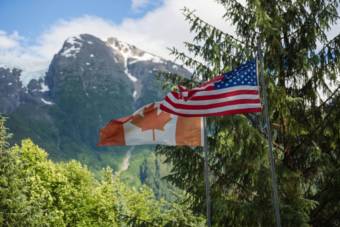
United States and Canada flags fly above a memorial in Stewart, British Columbia on July 2, 2015. The memorial remembers veterans from the area who died in WWI and WWII. (Loren Holmes/ADN)

Although it’s a step forward, restrictions remain for crossing the border, and the U.S. has not reopened its border to nonessential travel by Canadians, meaning that even fully vaccinated Canadians cannot cross into Alaska. The U.S. restrictions have been evaluated monthly and are currently set to expire Aug. 21.

But the border reopening, at least on one side, is a sign of hope, Olerud said.

Monday’s border reopening overlapped with a recent surge of COVID-19 infections in Haines, however. Olerud said the borough is working to expand coronavirus testing capacity this week and he did not believe it was interfering with anyone who had been planning to get tested in order to cross the border.

To enter Canada, Americans must provide proof of vaccination and receive a negative COVID-19 test and result within 72 hours before crossing the border. Those who stay in Canada longer than 72 hours must again test negative and upload the required documents to Canada’s ArriveCAN website or app before returning to the U.S.

For Auch, the planning made necessary by those restrictions still seems burdensome.

“There’s still a lot of hurdles to jump through,” he said. “So the people that are going to do it are those that have family that they want to see and stuff like that. There’s also a lot of us that would love to go, but to jump through all those hurdles just to go into the pass and go hiking or whatever — it’s certainly a lot to ask.”

Some restrictions were eased earlier in the pandemic for residents of Hyder because the town relies heavily on neighboring Stewart, British Columbia, for basic necessities.

Hyder is a town of fewer than 70 people, isolated from the rest of Alaska but accessible by road through British Columbia. About three miles away across the border is Stewart, where roughly 500 people reside. Many essentials — like groceries, school and medical care — are available only on the Canadian side.

Residents on both sides of the border seem to agree that the restrictions are unreasonable for the remote towns, said Caitlin Horne, who lives in Stewart.

“I think for this particular border for local residents, I don’t see why it isn’t (fully open). I think it’s ridiculous…,” she said. “I want to see my friends and it just seems silly to me personally.”

Horne, who owns a tour and charter business in Stewart, said she has lost customers during the pandemic but still has enough business from Canadian residents. But across the border, businesses in Hyder are struggling, said Caroline Stewart, who owns Boundary Gallery. With the U.S. border still closed, she said she’s holding out hope that her business and others will be able to survive until next summer, when tourists may once again return to the scenic area known for viewing of brown bears.

Caroline Stewart’s shop, the Boundary Gallery is in the town of Hyder. (Photo by Caroline Stewart)

Stewart said Monday she’s excited to spend time with her friends across the border and is especially looking forward to Sunday’s church service. The pandemic wasn’t just a marker of isolation for Stewart, but something that separated her family during major life events.

Stewart said her mother died just before the pandemic began and the family has yet to gather to spread her ashes. And her sister, Felicia Hayes, got married. Due to capacity restrictions, Stewart said, she missed out on the ceremony and she hasn’t been able to see her sister, who lives in Washington, since before the pandemic.

Quarantine restrictions related to crossing the border have kept Hayes and her husband, who owns a home in Stewart, apart since their wedding last summer at the international garden on the border near Vancouver, she said.

On Saturday, Hayes plans to cross the border to Stewart to reunite with her husband and her family. She won’t enter Hyder because COVID-19 tests for travel can be costly in Canada and she worries about how much of her 72 hours would remain after test results were returned. There is nowhere to get a COVID-19 test in Hyder.

While the Canadian border reopening is good news, Stewart said she wants to see the American side open too. In Haines, Olerud said he’s also looking forward to that reopening.

Uncertainty surrounding the pandemic has hung over Haines and made for a challenging year and a half, he said.

“Each time you just get a little bit more of a return to normal, I think that helps,” he said. “But that uncertainty of how long that normal is going to last. It’s hard to break free from it until you’ve got a sustained amount of positive things happening.”

This story was originally published by the Anchorage Daily News and is republished here with permission.

With power subsidy in court, rural Alaskans anxiously await a steep rise in electricity costs

St. Paul in 2016. St. Paul is one of the rural communities in Alaska with residents who receive subsidized power from the state’s Power Cost Equalization program. (Ian Dickson/KTOO)

On St. Paul Island, in the Bering Sea, Phyllis Swetzof is anxiously awaiting an Alaska Superior Court ruling that may decide whether or not her monthly electric bill will double.

Swetzof, a retired city clerk, is one of about 82,000 Alaskans who receive subsidized power from the state’s Power Cost Equalization program, which reduces the cost of home electricity in 192 rural Alaska towns and villages. After an extended budget debate, the Alaska Legislature failed to fund it past July 1. On Friday, an Anchorage Superior Court judge heard arguments in a lawsuit that could determine whether the program resumes this year.

A ruling is expected soon, but the first bills without the subsidy are already starting to go out across Alaska. In some cases, the price of home electricity will double. Towns and villages, also eligible for lower-cost power, may need to raise rates for water and sewer service.
“Everybody’s going to go, ‘holy smokes,’” Swetzof said. “Then it’s real, and you’ve got to figure out what to do.”

Without the program, home electricity prices in St. Paul — which has fewer than 400 year-round residents — will more than double. A normal electric bill of 500 kilowatt-hours will rise from about $95 per month to $205.

“I think the impact here will probably be hardest on residents who are a fixed income, on unemployment or elders getting Social Security checks,” said St. Paul city manager Phillip Zavadil.

Earlier this month, the city began advising residents to cut back on their electricity use by lowering their thermostats, watching less TV and washing laundry in cold water instead of hot.

“My first thought, of course, will be food. We’ll readjust the food menu so that we eat cheaper by $100 a month,” Swetzof said. “Which doesn’t sound like a lot, maybe in Anchorage, but $100 here maybe buys you a bag of groceries.”

Effects are statewide and go beyond the home

No part of rural Alaska will be immune from cost increases, and places with the highest electricity costs will see the biggest increases.

In the Yukon River community of Galena, a normal bill will rise from $180 to $300 per month, said Dave Messier, Rural Energy Coordinator at Tanana Chiefs Conference. In Huslia, another Interior village, a normal bill will go from $120 per month to $285.

“This is a major, major issue for us, because it’s a — do we buy food, or do we buy electricity — issue,” said Kevin Theonnes, director of the Council of Athabascan Tribal Governments.

In a letter to the Alaska Legislature, council chief and chair Rhonda Pitka said, “In rural Alaska, and for the 84,000 Alaskans that rely on the PCE funding, there are no neighborhood supermarkets that keep food in cold storage. Subsistence hunters and fishers cannot provide for their families properly without power.”

In Nome, a normal bill will rise from $120 per month to $180. In Kotzebue, the same bill would go from $110 to $205, according to figures published by the Alaska Energy Authority at the start of this year.

“The hardship associated to participating electric utilities and their customers with the reduction of PCE payments will be considerable,” the state’s electricity regulator wrote on July 22.

The increase is not limited to individual homes: PCE also subsidizes the cost of electricity at municipal facilities. Things like streetlights, water treatment plants and tribal halls are eligible for a subsidy under a formula based on the population of the town.

The village of Tanacross uses some of its municipal subsidy to keep fire hydrants thawed during the winter, Messier said.

“Often, the municipalities own that infrastructure, and so they operate and take care of it, but if their bills double or triple, it’s going to be unsustainable,” said Jodi Mitchell, president and CEO of Inside Passage Electric Co-Op, which serves small towns in Southeast Alaska.

“I predict they’re going to have to charge customers more for infrastructure,” she said.

That would affect businesses, which don’t receive PCE directly. In many small towns, including St. Paul, the biggest local business is a fish processing plant, which consumes large amounts of fresh water. Higher utility costs would discourage business. Swetzof worries that if residents try to buy more things from Amazon, Target or Walmart, places with free shipping to the island, the town’s store will suffer.

“We’re rolling downhill. It’s turning into a snowball, it’s getting bigger and bigger, and it affects all of us,” she said.

St. Paul’s city-owned utility system receives about $220,000 per year in PCE payments, according to figures from the Alaska Energy Authority, and state regulators warn that power companies can expect to see more people unable to pay their bills as costs rise.

Zavadil said he expects the St. Paul city government’s cost to rise about $9,800 per month. The town’s entire budget for last year was $3.6 million.

“For the city itself, it’s going to be tightening up the belts where we can, but for residents, it will have more impact upon them, especially those on fixed incomes,” he said.

A program built to provide equity

The Alaska Legislature created the program in 1984. Natural gas prices in Southcentral Alaska are subsidized by the state through tax waivers and credits. In Southeast Alaska and on the Kenai Peninsula, state-built dams supply relatively low-cost electricity.

In rural Alaska, lawmakers concluded that no single project or effort could satisfy the various needs. As part of a grand legislative bargain, legislators agreed to create PCE to subsidize power costs while other parts of the state received physical infrastructure.

“That was the deal,” said former state Rep. John Sund, a Ketchikan Democrat who worked on the legislation behind the program.

But because PCE was an annual appropriation, subject each year to the whims of legislators working the state budget, rural legislators were at a political disadvantage and had to regularly argue in support of continued funding.

In 2000, the Legislature created an endowment to pay for PCE. By investing $178 million — money from the Constitutional Budget Reserve and the sale of four dams — lawmakers believed they could fund the program in perpetuity.

The idea worked — by 2017, the fund was worth more than $1 billion, so large that its proceeds were also being used for renewable energy projects and direct payments to communities, not just the power subsidy.

The Alaska Constitution forbids the Legislature from creating “dedicated” funds, and under the terms of a 1990 constitutional amendment, any surplus money left over at the end of the state’s fiscal year is supposed to be deposited into the state’s Constitutional Budget Reserve.

To get around this provision, the Legislature has traditionally taken a “reverse sweep” vote each year. On the eve of July 1, the money from various state funds is swept into the budget reserve, and with the approval of three-quarters of the House and three-quarters of the Senate, it is swept back out of the reserve and into the original funds one minute later. Those funds are used to pay for programs as varied as anti-smoking programs and education.

But in 2003, when legislative Democrats blocked the reverse sweep for political leverage, the PCE endowment was not affected. In 2018, when legislative Republicans prepared to do the same, the endowment would have again been unaffected.

After Gov. Mike Dunleavy came into office, his administration rewrote the list of funds affected by the sweep. That rewrite added the PCE endowment.

That act — combined with the willingness of House Republicans to use the reverse sweep as leverage for a larger Permanent Fund dividend — has turned the fund into “a political football,” Mitchell said.

Republicans in the state House support PCE and proposed to fund the program without an endowment, but that idea wasn’t accepted by the House’s predominantly Democratic coalition majority.

“For many of us, voting down the reverse sweep was about honoring the constitution and our oath of office, not defunding the PCE or any other programs,” said Rep. Christopher Kurka, R-Wasilla, in a written statement.

Funding PCE without an endowment would return the program to what it was before 2000, an item that could be fought over every year.

proposal by Dunleavy to constitutionalize the Permanent Fund dividend would also provide a constitutional guarantee for the PCE program, but it isn’t yet known whether that idea has sufficient support to pass the Legislature.

For that reason, supporters of the program have filed suit, challenging the Dunleavy administration’s decision to put the PCE endowment on the list of sweepable funds. The lawsuit, led by the Alaska Federation of Natives, was heard in court Friday, and a ruling is expected sometime next week, said Jahna Lindemuth, a former Alaska attorney general representing the plaintiffs.

Regardless of the verdict, the losing side is expected to appeal to the Alaska Supreme Court.

Mitchell, from Southeast Alaska, said legal and political battles like this make her really worried about the sustainability of rural Alaska.

“We’re so frazzled already, and it’s our culture that’s at stake. If people move into a larger town, they’re away from their culture, they’re away from their home. I just think that we should be taking care of this better. Alaska is Alaska because of the many cultures that we have,” she said.

In St. Paul, Swetzoff said she was “really really hoping” the lawsuit would be resolved this past week. Life is already hard in rural Alaska, she said: The phones are bad, the internet is slow, and costs are high. She doesn’t know how to make legislators in Anchorage and urban Alaska understand.

“Enjoy where you live, because it’s easy for you. I don’t know how to make them aware of this. We lose contact with people, sometimes because our internet is slow. So many things are tough in rural Alaska. … I can’t get online. That happens a lot. You’re trying to send a PDF to somebody — it grinds, and grinds and grinds. It’s hard to do business here. But yet, we like it so much we stay. I don’t know how to explain that, either.”

“I mean, we love it. It’s home,” she said.

This story was originally published by the Anchorage Daily News and is republished here with permission.

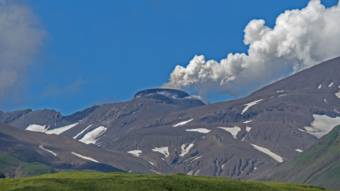
Lava streams from one Aleutian volcano, while two other volcanoes spew ash into the air

Lava dome within the Great Sitkin summit crater, August 4, 2021. View is toward the north-northwest. (Dave Ward/Jacobs Engineering)

A stream of lava flowed down the side of the Great Sitkin volcano in the Aleutian Islands Thursday morning and was visible from the nearby community of Adak, an official with the Alaska Volcano Observatory said.

Meanwhile, minor clouds of ash spewed from the Alaska Peninsula Pavlof volcano and the Aleutian Islands Semisopochnoi volcano.

No communities were immediately impacted by the volcanic activity.

The Great Sitkin volcano, which is located along the Aleutian chain about 26 miles east of Adak, has experienced unrest for about the last two weeks, said Chris Waythomas, a geologist for the USGS.

“There’s been a lava accumulation growing above the active vent, so there’s a small crater of the active area and lava is coming out of that and it’s forming this dome-shaped accumulation of lava,” he said.

“This morning, clear views from Adak and on the island indicated some minor lava fountaining happening at the summit,” he said.

Waythomas described the eruption as a “Hawaiian-style ejections of incandescent material maybe 50 to 100 meters above the vent.”

A volcanic cloud has since formed over the volcano, but Waythomas said it’s mostly made from water vapor and gas. The cloud was not composed of dense ash Thursday afternoon and Waythomas said he did not expect it to immediately impact Adak or aviation in the area.

The volcano was in an orange code warning Thursday and Waythomas said it could switch to red if the eruption becomes more explosive or produces a significant cloud of ash. Volcanoes, he said, are highly unpredictable, but for now Great Sitkin is not showing any signs that would signal a larger eruption.

The lava could continue to spout off intermittently throughout the next few months, Waythomas said.

“It might start and stop,” he said. “It just depends on how much magma is involved. From the information that we’ve got, it doesn’t appear that there’s lots of magma involved, so we don’t think it’ll go on for decades or anything like that, but it could go on for some months yet.”

The volcano erupted briefly in May, spewing ash 15,000 feet high. But the Great Sitkin had not erupted since 1974 before then.

https://www.facebook.com/alaska.avo/posts/4173946196033197

A minor cloud of ash also spewed from Pavlof volcano around 8 a.m. Thursday, Waythomas said. The volcano is located on the Alaska Peninsula and is about 37 miles northeast of Cold Bay and 600 miles southwest of Anchorage.

The Pavlof volcano spewed ash for about an hour, Waythomas said.

The volcano is one of the most active in the state and Waythomas said it would not be surprising for conditions to continue to escalate. The last eruption happened in 2016 and Waythomas said there is generally an eruption every few years. Pavlof is known for erupting with little notice, he said.

Officials are monitoring the volcano for further activity, Waythomas said.

Another Aleutian volcano, Semisopochnoi, released steam and ash clouds Wednesday night, but the remote volcano is far from any communities and in an area without much air traffic, Waythomas said. Semisophochnoi Volcano is located on an isolated island on the western end of the Aleutian Islands and is about 160 miles west of Adak.

This story was originally published by the Anchorage Daily News and is republished here with permission.

Site notifications
Update notification options
Subscribe to notifications