Anchorage Daily News

Anchorage Daily News is our partner in Anchorage. KTOO collaborates with partners across the state to cover important news and to share stories with our audiences.
Alaska Senate adds $5,500 in cash per Alaskan to proposed budget

Four legislators on the Senate floor
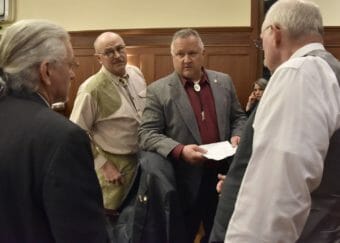
From left to right, Senate Minority Leader Tom Begich, D-Anchorage; Sen. Click Bishop, R-Fairbanks; Sen. Mike Shower, R-Wasilla; and Sen. Bert Stedman, R-Sitka, gather on the Senate floor to discuss budget amendments on Monday, May 9, 2022. (Photo by Iris Samuels/ADN)

JUNEAU — The Alaska Senate voted Monday to amend the budget to include $5,500 payments per Alaska resident, capitalizing on the oil price surge that brought billions in unexpected revenue to the state.

But the fate of the payments remains unknown as the Senate is set to finalize its budget Tuesday and send it to the House, which may reduce the payment amounts.

The payments approved by the Senate include both a full statutory $4,200 Permanent Fund dividend and $1,300 one-time energy relief checks meant to offset the rising costs of fuel.

That is significantly more than the payments the House approved in the operating budget they passed last month, which included a $1,300 energy relief check and a $1,300 dividend, for a total of $2,600.

The increase in cash payments to Alaskans obliterates a previous plan to cover education funding for the 2024 fiscal year, in addition to the upcoming 2023 fiscal year. Forward funding of education would have given schools needed stability and provided a cushion for future state spending, supporters argued.

Gov. Mike Dunleavy proposed earlier this year a dividend of about $2,600 on top of a supplemental payment of $1,250.

The energy relief checks were approved by the Senate on Monday in a 12-7 vote. The Senate also voted on Monday to increase the dividend from around $2,600 to $4,200, in a 10-9 vote. Sen. Natasha Von Imhof was excused from Senate proceedings.

The vote in favor of the dividend increase cut across party lines. Those in favor of the change included members of the Republican majority — Sen. Mia Costello, R-Anchorage; Sen. Roger Holland, R-Anchorage; Sen. Shelley Hughes, R-Palmer; Sen. Robert Myers, R-North Pole; Sen. Lora Reinbold, R-Eagle River; Sen. Mike Shower, R-Wasilla; and Sen. David Wilson, R-Wasilla. Members of Democratic minority — Sen. Scott Kawasaki, D-Fairbanks; Sen. Donald Olson, D-Golovin; and Sen. Bill Wielechowski, D-Anchorage — also voted in favor of the bill.

“The people could use a blessing right now in this state,” Reinbold said before voting in favor of the measure.

Those opposed included both Senate President Peter Micciche, R-Soldotna, and Senate Minority Leader Tom Begich, D-Anchorage.

“This is really saying, ‘We have the money today, let’s just spend it down,’” said Begich.

“You can’t sustain this,” said Senate Finance committee co-chair Bert Stedman, R-Sitka.

Shower, who brought the amendment to increase the dividend, said it would provide a higher vantage point from which to negotiate with the House, whose bipartisan majority sought a smaller dividend that would allow for more funding to be allocated to savings, state services and capital projects.

The dividend increase alone amounts to a $1.1 billion increase in spending and would require the state to dip into the Statutory Budget Reserve, leaving less than $1 million in the savings account, according to Stedman. The energy relief checks would cost the state over $800 million.

In order for the state to balance the budget with that kind of spending, oil prices would have to remain at $100 per barrel, Stedman said.

""
Senate President Peter Micciche, R-Soldotna (center) talks with Senate Finance Committee co-chair Bert Stedman, R-Sitka (left) and Sen. Lora Reinbold, R-Eagle River (right), during a Senate floor session on Monday, May 9, 2022. (Photo by Iris Samuels/ADN)

Forecasters at the Alaska Department of Revenue gave a spring forecast estimate of oil prices at $101 per barrel, an increase of $30 from December. But Stedman preferred to rely on a more conservative figure, he said, due to the volatility of oil prices.

The Senate Finance Committee previously voted to combine the operating and capital budgets.

Typically, the House crafts an operating budget and sends it to the Senate, while the Senate crafts a capital budget and sends it to the House. The decision to combine the budgets limits the House’s ability to add their priorities to the capital budget.

The Senate considered nearly 50 amendments to the budget crafted by the Senate Finance committee during a marathon floor session that went from 9 a.m. until past dinnertime. Many of the amendments came from lawmakers seeking to add capital priorities to the bill. The Senate is expected to discuss two additional amendments to the budget Tuesday before voting on whether to pass the budget.

Among the amendments still coming is funding for ports in Anchorage, Nome and the Mat-Su. The Senate has already approved of $25 million for the modernization of the Port of Alaska in Anchorage and $25 million for the construction of a deep sea port in Nome. The amendments Tuesday could add millions more at the behest of lawmakers hoping to bring a windfall to their communities.

Once the Senate passes the budget, it goes to the House, which must either accept or reject it. If they reject it, the budget will go to a conference committee, where members of the Senate and House must find middle ground.

Lawmakers have until May 18 to pass a budget or they will be forced to enter a special session.

This story was originally published by the Anchorage Daily News and is republished here with permission.

Correction: An earlier version of this story stated Senate President Peter Micciche was the state senator for Wasilla. Micciche is the state senator for Soldotna.

How a 150-year-old Lingít robe is inspiring Alaska’s next generation of engineers

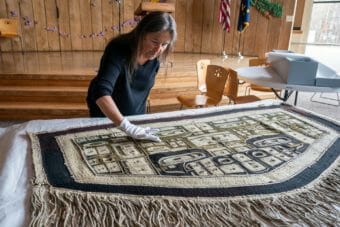
Detail of a 150-year-old Lingít robe on Tuesday at the Alaska Native Heritage Center. (Photo by Loren Holmes/ADN)

Early Tuesday morning, a group of teenagers from Anchorage, Bethel and Mat-Su gathered in a large room at the Alaska Native Heritage Center. In front of them was a delicate, intricately woven Lingít robe, believed to be around 150 years old.

The robe was recently given to the center but is in such fragile condition that extreme care must be taken anytime it’s handled. Pieces of the fringe, which swooshes when the robe is used in a dance, have already fallen off and are kept in plastic bags with the robe.

Most robes in this condition are laid flat and displayed under glass, but for Lingít weaver Shelly S’eiskaa Laws, that would mean its secrets would remain hidden. “If you’re a weaver, you always want to see the back of whatever you’re looking at, because what it looks like on the front doesn’t necessarily show you everything,” she said. “So for understanding the piece and for educational purposes, you really want to see the back, and that’s hard to do behind the glass.”

Lingít weaver Shelly Laws inspects the robe. (Photo by Loren Holmes/ADN)

Representatives from Trimble, an industrial technology company, were on hand to scan the robe with a 3D laser scanning system. Data from the scan will be used to create an interactive 3D model that will be displayed next to the robe.

After the scan was complete, the Heritage Center’s curator, Angie Demma, invited the students to examine the robe more closely. They quickly surrounded the table where the scan had taken place to get a closer look.

The high school students are participants in the Naaxein Teaching Partnership, a collaboration between the Alaska Native Heritage Center, the Alaska Native Science & Engineering Program and the Alaska Native Tribal Health Consortium. After the scan, the kids broke into smaller groups to learn more about 3D scanning, modeling and using drones to survey land and buildings.

Ben Jacuk wears Iñupiat mittens as student Daveon Parton makes a 3D scan of them on Tuesday. Some of the scans will be used in a sequel to the video game Never Alone, which is set in Iñupiat territory. (Photo by Loren Holmes/ADN)

In one room, four kids tried out different apps on an iPad, scanning Iñupiat objects from the Heritage Center’s collection. The 3D models created from the scans will be used in a sequel to the video game Never Alone, which is set in Iñupiat territory.

“Combining culture with technology is exciting for the kids,” said David Beveridge, senior director of environmental health and engineering at the Alaska Native Tribal Health Consortium, which works on building clean water and sanitation projects in rural Alaska.

Later in the week, the students would work with ANTHC to use modeling software to create a 3D computer-aided design model for a water treatment plant.

Lingít weaver Shelly Laws on Tuesday teaches engineer David Beveridge how to dance with a Lingít robe that she made. Beveridge is a senior director of environmental health and engineering at the Alaska Native Tribal Health Consortium, and his organization partnered with the Alaska Native Heritage Center and the Alaska Native Science and Engineering Program (ANSEP) during ANSEP’s career exploration week, where high school students were able to help create a 3D scan of a fragile 150-year-old Lingítrobe, on the table in the foreground. (Photo by Loren Holmes/ADN)

“This gives them an opportunity to practice skills and see the technology used in a cultural setting that will make it much more exciting,” said Beveridge. “These are the tools that they’ll be using in their careers as well.”

“Alaska is in a really good position to receive funding for sanitation through the Infrastructure Investment and Jobs Act,” he said. “The current students that are in this program right now will be the ones that will be designing and constructing the infrastructure that comes along with this once-in-a-lifetime opportunity.”

This story was originally published by the Anchorage Daily News and is republished here with permission.

State Supreme Court affirms Dunleavy decision that drained fund for Alaska college scholarships

The University of Alaska Anchorage held commencement ceremonies on Sunday, May, 1, 2022. (Photo by Bill Roth/ADN)

The Alaska Supreme Court affirmed Tuesday a lower court decision against a handful of Alaska college students who sued the administration of Gov. Mike Dunleavy, challenging a decision that drained Alaska’s $410 million Higher Education Investment Fund.

The decision means the Alaska Performance Scholarship program and WWAMI, the state’s equivalent of medical school, do not have a dedicated funding source and must compete with other programs in the state’s annual budget process, but a separate effort by the Legislature may reinstate a dedicated account.

“Although the plaintiffs tried to make this case about supposed policy calls made by the executive branch, the Court recognized that the State was just following the Alaska Constitution,” Deputy Attorney General Cori Mills said in a statement released after the court’s ruling.

“No one disputes that the performance scholarships are an important program, which is why Governor Dunleavy included appropriations to pay for the scholarships in his budget. But that does not mean that the Higher Education Investment Fund falls outside of the reach of the constitutionally required sweep into the CBR (constitutional budget reserve),” Mills said.

The scholarship programs remain funded through at least June 30, and the budget making its way through the Legislature has money to fund the programs in the next fiscal year.

The Legislature is separately considering a bill that would remove the fund from the state treasury so that it can’t be emptied by the end-of-session legislative sweep. That measure, House Bill 322, passed the state House on Monday, and is heading to the Senate for consideration.

“We are not giving up,” Pat Pitney, president of the University of Alaska System, said in a statement Tuesday. “We have been simultaneously working to fund HEIF and the programs it supports through legislative action.”

The fund “is too important,” Pitney said. “Our state’s future is inextricably linked to the success of our people and their access to high-quality workforce training and higher education.”

Pitney said the university will dedicate its efforts to “solving this issue by supporting HB322.”

That bill would create separate accounts for higher education scholarships and for the Alaska Marine Highway System.

“Ongoing crucial state services such as the Alaska Marine Highway System should not suffer the destabilizing effects that may result from the sweep of the funds,” said Rep. Dan Ortiz, I-Ketchikan. The bill would create “needed certainty” both for the ferry system and for the higher education investment fund, he said.

The bill originally applied only to the Alaska Marine Highway System fund and was amended to cover the education fund.

“It’s about our workforce. It’s about our future engineers, our future business accountants, our teachers. Many important jobs that need to be filled,” Rep. Andi Story, D-Juneau, said on the House floor, before the House voted 25-15 to pass the bill.

Lawmakers who opposed the measure said that creating separate accounts defied the state’s constitution.

In the Superior Court decision that was affirmed by the Supreme Court, Anchorage Superior Court Judge Adolf Zeman said that Dunleavy’s administration correctly classified the higher-education fund as part of the state’s general fund in 2019. That made it subject to a clause in the Alaska Constitution that requires leftover general fund money to be automatically swept into the Constitutional Budget Reserve, a special savings account.

The Alaska Legislature regularly votes to reverse that sweep, but it failed to do so in 2021 because of opposition by Republican legislators in the state House. That failure, combined with the administration’s classification, drained the fund.

This story was originally published by the Anchorage Daily News and is republished here with permission.

Republican lawmakers remove Rep. David Eastman from Alaska House minority caucus

David Eastman walks down a hallway in the Capitol
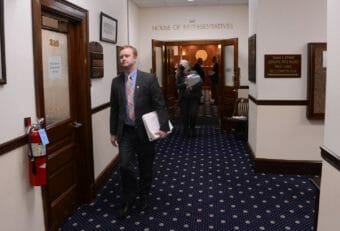
Rep. David Eastman, R-Wasilla, leaves the chambers of the Alaska House of Representatives on Wednesday, March 2, 2022. (Photo by James Brooks / ADN)

Wasilla Republican Rep. David Eastman was removed from the House minority caucus Thursday after most of the caucus members indicated they were in favor of the decision.

“I think it’ll help us be more productive as a caucus. Just sometimes, his demeanor gets in the way of trying to be productive,” Anchorage Republican Laddie Shaw said in an interview Thursday.

Eastman will be removed from the House Rules Committee and an ethics committee but will keep other committee assignments, said House Speaker Louise Stutes, R-Kodiak. That decision is subject to approval by the Legislature’s Committee on Committees.

The Legislature’s rules dictate committee membership based on the size of the minority, but Stutes said other members of the minority will not lose committee seats.

Eastman’s removal came on the heels of a resolution passed by the Alaska Republican Party during its convention on Saturday to rebuke the Foundation for Applied Conservative Leadership.

Eastman is an active member of the organization, which seeks to pressure Republican lawmakers to ensure they vote in certain ways. The group had attacked Rep. Kevin McCabe, R-Big Lake, after he tabled several budget amendments proposed by Eastman.

Minority Leader Cathy Tilton, R-Anchorage, said the resolution was not the sole reason Eastman was removed from the caucus.

“Representative Eastman has every right to represent his constituency in a manner that he thinks is the right way to do that. But unfortunately, that’s become too disruptive for us to have him in our caucus,” she said Thursday afternoon.

Tilton said she had polled all 18 members of the Republican House minority caucus, and most of them sought Eastman’s removal.

“They finally said, ‘Enough’s enough,’” said Shaw, noting that freshman members of the caucus were instrumental in the decision to remove Eastman.

The removal comes after years of altercations between Eastman and fellow lawmakers. In 2017, he was formally reprimanded by the House after claiming that women in rural villages try to get pregnant so they can get a free trip to a city for an abortion.

In 2020, the minority suspended him from legislative committees and placed him on “probation” after conflicts with fellow Republicans. In the following election, many of his fellow Republicans campaigned against him, but he won re-election anyway.

Earlier this year, the House considered taking action to punish Eastman for his reported membership in the far-right Oath Keepers, whose leaders were charged with seditious conspiracy in connection with the Jan. 6, 2021, riot at the U.S. Capitol.

As a consequence of Thursday’s decision, Eastman will no longer attend caucus meetings.

Eastman did not respond to a request for comment Thursday by email or phone.

“He can either do what he does on his own because he’s going to do it, or he can do it with us and hurt us. So we’d much rather he do what he does on his own,” said Shaw.

The Alaska Republican Party’s resolution against the Foundation for Applied Conservative Leadership states that the party will not provide financial support or party endorsements to candidates “who are practitioners of the egregious and divisive activist principles and processes” of the foundation. An overwhelming majority of convention-goers voted in favor of the resolution.

The resolution does not mention Eastman by name, but he is known to be active in the conservative organization.

The foundation, known as FACL, is “part of what is causing the divisiveness in the Republican Party and in the Legislature right now,” said McCabe, who introduced the resolution at the convention and said he has been targeted by FACL for his votes.

“FACL’s main thing is to try to hold other Republicans accountable for their actions. So they’re trying to drive Republicans to the uber-conservative or ultra conservative side of the spectrum. They do that by finding those that they think are a little bit more moderate than they are and attacking them, making them feel pain,” McCabe said in an interview Wednesday.

“I think that the Republicans need to do all they can to unite the party instead of what we call the circular firing squad,” McCabe added.

Iris Samuels reported from Anchorage and James Brooks reported from Juneau.

This story was originally published by the Anchorage Daily News and is republished here with permission.

Ballots start heading to Alaska voters this week in special US House primary election

Absentee ballots being scanned for tabulation at the Division of Elections Region II office in Anchorage on Tuesday, Nov. 10, 2020. (Photo by Bill Roth / ADN)

Ballots for Alaska’s first-ever statewide by-mail election will be sent to about 560,000 Alaska voters Wednesday.

In the special primary election, voters will be asked to pick one of 48 candidates vying to temporarily fill the U.S. House of Representatives seat vacated by the March death of Congressman Don Young. The top four vote-getters will advance to the Aug. 16 special general election, which will use ranked-choice voting to determine who will serve out the rest of Young’s term.

Ballots for the primary will begin arriving in the mailboxes of Alaska voters this week.

The nonpartisan, open primary is Alaska’s first under a new statewide election system approved by voters in 2020.

In this election, voters are being asked to pick one candidate, then mail their ballot back to the Division of Elections before June 11, the official election day. Ballots can arrive at division offices as late as June 21 and will still be counted, but only if they are postmarked on or before June 11.
Gail Fenumiai, director of the Alaska Division of Elections, said the division sent a postcard reminder last week.

Normally, Alaska voters who want to cast a ballot by mail must first request an absentee ballot from the division.

In March, Fenumiai and other state officials said there was no feasible way, given the suddenness of Young’s death and the short timeline required by state law, to conduct a traditional election.

Instead, the division is automatically sending ballots to all registered voters, and those ballots are going out 45 days before Election Day. The state is also paying postage.

Some in-person polling places will be available, Fenumiai said, and polling locations will be announced Wednesday. Many of those polling places will be open for multiple days.

Elections officials are encouraging voters to check their listed address online at myvoterinformation.alaska.gov. If the address is incorrect, update it at voterregistration.alaska.gov. Users will need an Alaska driver’s license or other state ID.

Though ballots will have already been mailed, the division will send a second ballot to the updated address, Fenumiai said. Officials will be tracking both ballots to prevent double voting, she said.

The online registry lists whether a ballot has been sent to a particular voter and whether that voter’s ballot has been received by the Division of Elections.

Fenumiai said that in the coming days, the division will be joining BallotTrax, a system that allows voters to get text, email and phone alerts when their ballot has been received by the division. (The Municipality of Anchorage used BallotTrax in this year’s city election.) Information will be posted on the division’s website when available, she said.

Elections officials will be posting incremental updates on the number of ballots received before Election Day, she said. The first results will be posted on the evening of June 11, and the final results will be available June 21, with final review and certification expected by June 24.

Alaska’s lone US House seat will be vacant until September. What happens in the meantime?

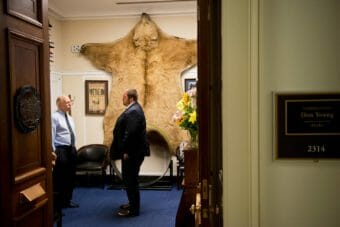
A grizzly bear hide greets visitors inside the entrance to Rep. Don Young’s office. Photographed on Thursday, June 25, 2015. (Photo by Marc Lester/ADN)

In the weeks since the sudden death of U.S. Rep. Don Young, the state has announced a special election to replace the 49-year congressman, and 48 candidates are running to replace him. But what happens until a successor is elected and sworn in?

Alaska is one of seven states that have only one seat in the U.S. House of Representatives (the others are Wyoming, Montana, North Dakota, South Dakota, Vermont and Delaware). And with Young’s death, Alaska will have no voting member in the chamber for more than five months.

But that doesn’t mean the state’s congressional office will be empty. All of the 16 staff members who served Young remain employed by what is now known as the office of Alaska at-large. Even without an elected representative at the helm, they will continue carrying out some of the office’s responsibilities, now under the supervision of Clerk of the House Cheryl Johnson.

The clerk’s office oversees daily tasks that are typically under the House member’s authority, including signing off on personnel changes, official travel and purchases of office supplies.

“One of the basic functions of our congressional office and any congressional office is we’re a listening ear,” said Zack Brown, who was Young’s communications director and now serves in the same role for the at-large office. “People will call us to talk sometimes, and we’re continuing to answer the phones.”

The office will continue to handle constituent services. That includes addressing requests that relate to federal agencies, such as assistance getting passports, Social Security benefits and Veterans Affairs benefits. The office will also continue to help constituents book Capitol tours.

“So we’re pretty much doing everything we did before, minus the legislative component,” Brown said.

Without a representative in the seat, the office cannot take a position on bills or advocate on issues. The office cannot introduce or cosponsor bills, nor can it advocate for bills that Young introduced or co-sponsored before his death, though those bills can still be considered by the House.

“We cannot act on the authority of a member, since we don’t have a member,” said Alex Ortiz, who serves as the chief of staff for the office of Alaska at-large, and previously served as Young’s chief of staff.

The office has also taken on new responsibilities relating to Young’s death. Staff members are responsible for setting up memorial services, which have so far included services in Anchorage, Virginia and the U.S. Capitol. Ortiz said there may be additional services in the coming months.

Staffers are also working to sort through and archive 49 years’ worth of documents and personal effects that Young accumulated, a process that Ortiz described as “incredibly complicated.”

Eventually, Ortiz said, the intent is to ship Young’s records from D.C. to Alaska.

Alaska’s at-large seat is not the only one currently vacant. Rep. Jim Hagedorn of Minnesota died in February. Rep. Vela Filemon of Texas and Rep. Jeff Fortenberry of Nebraska resigned in March. But such vacancies can have a greater significance in states with only one U.S. House member. Texas, for example, has 36 congressional districts.

In the absence of a House member from Alaska, the state’s two senators can work to ensure Alaska’s interests are represented, Ortiz said.

“While they are not members of the House, they have extensive working relationships on the House side, just as the congressman did. And they are deeply invested in Alaska’s interests being protected in the House,” Ortiz said.

Other House members have also picked up legislation that Young worked on.

“There is a very conscious and active effort in the House to make sure that in the congressman’s absence, there’s not going to be an immediate fallout of important legislation,” Ortiz said.

Legislation proposed by Young that’s still in the works includes portions of the BOATS Act, or Bringing Oligarch Accountability Through Seizure Act. Young introduced that bill in early March, less than three weeks before his death. The bill would allow the U.S. to seize yachts and ships owned by Russian oligarchs in response to the war waged by Russia against Ukraine. Portions of it have been incorporated into the Coast Guard Authorization Act, now named after Young. That act passed the House late last month, less than two weeks after Young died. It is now under consideration by the Senate.

“Young’s impact legislatively is still happening, even though our office is not actively working on it and he’s not there,” Ortiz said.

The special election to replace Young is set for Aug. 16, with a primary set for June 11. Election results won’t be certified until Sept. 2.

Until then — “we continue to be open. The phones are on,” Brown said.

Site notifications
Update notification options
Subscribe to notifications