Anchorage Daily News

Anchorage Daily News is our partner in Anchorage. KTOO collaborates with partners across the state to cover important news and to share stories with our audiences.
‘A historic milestone’: Alaska formally recognizes Native tribes

The governor seated at a desk, holding up a signed bill, while people stand around him and clap
Alaska Gov. Mike Dunleavy signs HB 123, the tribal recognition bill, at the Alaska Native Heritage Center on Thursday, July 28, 2022. (Photo by Bill Roth/ADN)

Gov. Mike Dunleavy on Thursday signed a bill that formally acknowledges the sovereignty of Alaska’s 229 federally recognized Native tribes.

The bill signing event was held at the Alaska Native Heritage Center in Anchorage, where a large and emotional crowd included tribal leaders, state lawmakers and candidates running for elected office. Amid tears and laughter, Native leaders spoke about the legislation as a way to heal a painful past and create more opportunities for productive partnership with state government in the future.

Tiffany Zulkosky standing and speaking into a microphone
Rep. Tiffany Zulkosky, D-Bethel, who sponsored HB 123, an Act providing for state recognition of federally recognized tribes, spoke to the crowd gathered at the Alaska Native Heritage Center to witness Gov. Mike Dunleavy sign the bill into law on Thursday, July 28, 2022. (Photo by Bill Roth/ADN)

The measure, sponsored by Rep. Tiffany Zulkosky, a Bethel Democrat, passed the Legislature in May with bipartisan support. Zulkosky, who is Yup’ik, on Thursday called the bill “a historic milestone” in advancing state-tribal relations.

The bill, she said, is “a statutory recognition of a simple truth — that tribes exist in Alaska.”

The bill states that “the history of tribes in the state predates the United States and predates territorial claims to land in the state by both the United States and Imperial Russia. Indigenous people have inhabited land in the state for multiple millennia, since time immemorial or before mankind marked the passage of time.”

It goes on to say that “it is the intent of the Legislature to exercise the Legislature’s constitutional policy-making authority and acknowledge through formal recognition the federally recognized tribes in the state. Passage of this Act is nothing more or less than a recognition of tribes’ unique role in the state’s past, present, and future.”

The Alaska Federation of Natives said in a statement that “the statute does not impact the existing legal status of Alaska Tribes, nor does it change the state’s responsibility or authority. However, it does recognize Alaska’s Indigenous people. This recognition will help unify our tribal governments with the state government.”

Zulkosky and other proponents of the measure say it will also ease a history of legal challenges between the state and tribes.

A row of people sitting in chairs and clapping
Two bills were signed into law at the Alaska Native Heritage Center on Thursday, July 28, 2022. (Photo by Bill Roth/ADN)

Native leaders said that tribes in Alaska are already responsible for providing services for tribal members and others, relying on designated federal funding to boost education, health and infrastructure, among other services. But the state recognition, they said, could pave the way for better government relations between the state and tribes.

“If you live in rural Alaska and you can flush the toilet, thank your tribe, because it’s our money that has come in and done that for everyone,” said Richard Chalyee Éesh Peterson, president of Central Council Tlingit & Haida Indian Tribes of Alaska.

“Tribes are an economic force in Alaska. Hugely so,” said Rep. Bryce Edgmon, a Dillingham independent who previously served as speaker of the House. In that capacity, Edgmon led the creation of a legislative tribal affairs committee in 2019. Zulkosky served as the committee’s inaugural chair.

“Today is, in some ways, a culmination of where we’ve been trying to get, but in other ways, it’s the beginning of a journey,” Edgmon said, adding that his vision is that “tribes are not only going to be at the table, they’re going to be at the head of the table.”

Alaska follows several other states that have recognized tribes within their borders, including Alabama, Connecticut, Delaware, Georgia, Louisiana, Maryland, Massachusetts, New Jersey, New York, North Carolina, South Carolina, Vermont and Virginia.

There are more than 570 federally recognized tribes in the U.S. — over a third of which are in Alaska. According to the National Conference of State Legislatures, federal tribal recognition carries with it federal funding opportunities, whereas state funding does not guarantee state funding.

Peterson was one of several Native leaders behind a ballot initiative that last year sought to put the question of tribal recognition to voters. The group collected the signatures needed to advance the question to voters, but the bill signing now means that initiative will remain off the November ballot.

“It was one of the quickest signature gathers we’ve ever seen. Why? Because Alaskans — not just Alaska Natives — knew it was time,” Peterson said. “Most were bewildered and dumbfounded that this wasn’t already in existence.”

The ballot initiative was launched after a legislative effort to pass a tribal recognition bill stalled in 2020 amid the pandemic that cut short the legislative session that spring. The following year, Zulkosky began advancing a new version of the bill.

“It’s really great Alaskans exercise their voice at the polls. But I think what’s more meaningful about legislative action is the Legislature is such a microcosm of different political philosophies, different perspectives,” Zulkosky said. Advancing the bill, she said, required having sometimes difficult conversations.

“We did not understand — some of us — how important this was to members of the Native communities of Alaska,” said Sen. Mike Shower, a Wasilla Republican, who helped advance the bill in the state Senate. “Moving forward, we will have the opportunity to expand and do so many things that we haven’t done.”

Attendees at the bill signing included some of the more experienced Alaska Native leaders — and a new generation.

A smiling woman holds two small children, who are clapping
Ida Nelson holds Royal, 1, and Chael, 3, while attending the bill signing at Alaska Native Heritage Center on Thursday, July 28, 2022. (Photo by Bill Roth/ADN)

Ida Nelson, a tribal member from Igiugig, attended the ceremony with her young children, ages 3 and 1. The bill, she said, ensures that they will “still have tribal sovereignty when they grow up.”

Willie Hensley and Emil Notti, who were instrumental in forming the Alaska Federation of Natives in 1966 and passing the Alaska Native Claims Settlement Act in 1971, also celebrated the passage of the bill.

“It’s important to recognize that the bill was introduced by a Democrats, passed with bipartisan support, and signed by a Republican governor,” said Notti.

While Alaska follows at least 13 states that have recognized tribes within their borders, Dunleavy presented the bill as one setting Alaska apart from the Lower 48.

“We’ve had a couple rough years in the Lower 48,” he said, “in which statues were torn down, history was rewritten. But I think it’s a testament to us that in Alaska — we add things for a more complete history.”

Rhonda Pitka, chief of the Native village of Beaver, said she was excited about Dunleavy’s willingness to work with tribes and was eager to work on partnerships between tribal and state government.

“I was going to ask for his scheduler’s phone number so I can set up my first meeting, so we can really get to work. It’s been a challenge to get anything done,” Pitka said. Now, she says she envisions more “government-to-government consultation.”

The governer, standing, with a row of people seated behind him
Tribal bill signing at Alaska Native Heritage Center on Thursday, July 28, 2022. (Photo by Bill Roth/ADN)

Alaska First Lady Rose Dunleavy, who is Alaska Native, also spoke Thursday, telling the audience that “we can’t forget that we aren’t just tribal members. We’re Americans and we are Alaskans.”

U.S. House candidate Mary Peltola, a Democratic former state lawmaker who was in attendance at the ceremony, said she was moved by Rose Dunleavy’s words. Peltola, who is Yup’ik, said she too felt the legislation highlighted her identity as both an Alaskan and a tribal member.

Peltola was not the only political candidate in attendance. Independent former Gov. Bill Walker, who is one of Dunleavy’s challengers in this year’s gubernatorial race, was also at Thursday’s bill signing.

Dunleavy on Thursday also signed a bill creating a state-tribal education compact, which is designed to give tribes greater control over education programs for tribal members.

Women and girls, some in traditional dress, dancing
Acilqug Yup’ik Dancers performed after the bill signing at the Alaska Native Heritage Center on Thursday, July 28, 2022. (Photo by Bill Roth/ADN)
A row of seated men playing skin drums
Acilqug Yup’ik Dancers performed after the bill signing at the Alaska Native Heritage Center on Thursday, July 28, 2022. (Photo by Bill Roth/ADN)

Sen. Gary Stevens, a Republican from Kodiak who sponsored the bill, said it would create opportunities to incorporate Native cultures and languages into tribal school curriculums.

“I can’t tell you how impressive this is,” Stevens said about the standing-room-only audience gathered to watch the bill signing. “The last bill I had signed by the governor was a week and held ago there were two of us in the room — the governor and me. So this is really impressive to see those who care about the legislation that we are passing.”

This story was originally published by the Anchorage Daily News and is republished here with permission.

Along Utqiaġvik’s eroding coast, hope that a seawall can help keep the community safe

A long row of sandbags piled up along a beach
Giant bags along the shoreline in Utqiagvik are intended to buffer against big waves and slow erosion. Construction of a rock revetment is planned (Photo by Marc Lester/ADN)

UTQIAĠVIK — Miranda Rexford-Brown walked atop the slowly disappearing sandy bluff between the Arctic Ocean and the house her father built. The late-June wind frazzled her hair as she looked out at the shore-fast ice and the approaching coastline.

“It gets our window wet,” Rexford-Brown said about the ocean. “And then the mist, it sprays our house.”

In Utqiaġvik, where the coast is eroding at some of the fastest rates in the nation, storms, flooding and thawing permafrost damage houses, roads and cultural sites. Ice forms later each year and storms are becoming longer and more severe.
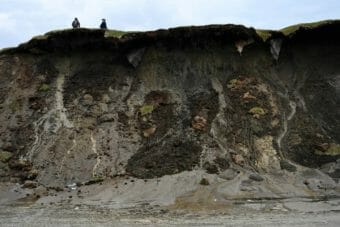
To protect residents — as well as more than $1 billion worth of critical infrastructure, access to subsistence areas and historical resources — the U.S. Army Corps of Engineers is designing a 5-mile-long rock revetment along the coast and raising a road that follows the coast at the city’s northeast. The design for the first 0.75 miles of revetment is nearly complete and going through final internal reviews, said John Budnik, the Corps’ public affairs specialist for the Alaska District. A construction contract will likely be awarded before the end of the calendar year.

North Slope Borough Mayor Harry Brower said that building a seawall will help protect the city from coastal erosion.

""
Miranda Brown, 15, daughter of Miranda Rexford-Brown, balances on a railing outside her home near an eroding bluff in Utqiagvik. (Photo by Marc Lester/ADN)
""
North Slope Bororough Mayor Harry Brower speaks with U.S. Sen. Lisa Murkowski about the coastal erosion situation in Utqiagvik on June 26 (Photo by Marc Lester/ADN)

“In a matter of years, we’ve lost a number of ice cellars, sod houses, we had to move homes that were aligned to the bank before,” Brower said, pointing to five houses on top of the bluffs at the south end of town. “All of these homes had to be moved.”

[Previously: Seawall planned for Utqiaġvik will help protect the Arctic Alaska city from increasingly extreme storms]

Rexford-Brown’s house was among those moved inland in the 1980s. Back then, the house was occupied by Rexford-Brown’s father, George Leavitt. During one storm, the ocean took out a big chunk of land beneath the house, and Leavitt needed to stay in Rexford-Brown’s apartment.

“Our back bedroom, there was nothing under there. The house was going,” Rexford-Brown said. “Pretty soon people were walking under our house.”

After waiting a few days for the storm to calm down, the borough and city employees came to move the house inland, equipped with a crane, tractor and two wide, flat tow ropes — “the kind (the community) uses to pull up the whale,” Rexford-Brown said. The city offered the family a piece of land near the Fred Ipalook Elementary School, to move their house even further inland, but Leavitt refused to relocate. He built this house from the floor up near the ocean where he could stay close to his family and the water.

“He said, ‘No way, I’m not leaving the beach,’” Rexford-Brown said. “We’ve already been here 60 years already. This is where we live. We were happy at home.”

After several houses on bluffs were moved away from the cliff, they are now located right against the road, which limits the amount of parking space available and leaves no place to relocate them farther inland.

“This is too close,” Rexford-Brown said, looking at her neighbors’ house near the edge of a cliff. “They don’t even got a walkway no more.”

A woman stands on top of a bluff by the sea
Miranda Rexford-Brown lives in a home atop an eroding bluff in Utqiagvik. Her home, built by her father, as been moved away from the bluff once before, she said. (Photo by Marc Lester/ADN)

Just a few steps in front of Rexford-Brown’s house, she pointed out the slowly sinking ice cellar her neighbors still use to store meat and fish. The land around the cellar has been falling off, exposing its walls, and parts of the bluff seemingly hang above the beach.

The bluffs are not the only place affected by coastal erosion in Utqiaġvik. The storms — which are becoming stronger and more prolonged — also regularly damage Stevenson Street, which runs along the beach and connects the main part of the village to the residential area close to the Naval Arctic Research Laboratory and Iḷisaġvik College. The street can be washed out and “completely cut off everybody who lives out there,” as it almost did during a storm in 2017, said Scott Evans, deputy director of capital improvement program management at the borough.

[‘What choice do we have?’ As the Arctic warms, Alaska Inupiat adapt.]

If the storm waves reach the lagoon area, they could contaminate the only freshwater source in the community, according to the 2019 Barrow Alaska Coastal Erosion Feasibility Study by the Corps. Sewer infrastructure and an old military landfill are also close to the coast, and if they are damaged, engineers said, contaminants could harm people as well as birds and marine animals.

A cemetery in the fog, with standing water encroaching
Utqiagvik no longer permits burials in its older cemetery, due in part to erosion and the inability to use heavy equipment. (Photo by Marc Lester/ADN)
""
Visitors from Seward Hannah Ortiz, Samantha Roth and Megan McGrath take a brief dip in the Arctic Ocean from the beach in Utqiagvik on June 24. (Photo by Marc Lester/ADN)
""
Justin Kanayurak, left, and Leroy Adams-Kanayurak ride their dirtbikes in Utqiagvik (Photo by Marc Lester/ADN)

The graveyards inland have been affected by permafrost thaw, and historically important sites along the coast have been washing away, said archaeologist Anne Jensen. Eroding ground in Utqiaġvik holds sod houses, meat cellars and human and animal bones, she said.

[From 2015: Barrow’s eroding coastline reveals human bones at Ukkuqsi site]

“There’s literally everything people used,” she said. “Lots and lots of bones that tell all kinds of information about what people were eating and about those animal populations. … There’s a lot of stuff there, particularly deeper earlier stuff, that hasn’t necessarily been looked at at all.”

Archaeological discoveries suggest that the bluffs, where houses are now facing the cliff, used to be the burial sites, usually placed on higher ground inland — a sign of the coastline eroding for hundreds of years, Jensen said. Until the early 1910s, a larger community was located at Nuvuk, the tip of Point Barrow, before the site was completely abandoned.

Two people standing atop a tall coastal bluff that is collapsing onto the beach
A bluff on the southwest end of Utqiagvik shows the ongoing effects of erosion. (Photo by Marc Lester/ADN)

The borough works to minimize the risk of flooding and erosion and yearly bulldozes up beach materials into temporary beach berms, Evans said. Every year the borough spends approximately $8.3 million on emergency response and uses most of the local gravel for obstructing and maintaining the temporary berm along the coastline. They also work to make sure the larger sacks with gravel are at the base of these bluffs to reinforce the shore and stop wave action, Evans said.

Rexford-Brown looked down from the cliff to the shore at the row of white sandbags, placed for protection from the waves.

“They can help for a few days, I guess. But September 26, it’s bad, the waves are big,” Rexford-Brown said. “Sandbags, they are trying to help, and I can see they are. But easily, they can be taken overnight.”

Four people on a beach, surrounded by part of a barrier made of large sandbags
Sen. Lisa Murkowski, at right in orange, talks with North Slope Borough Mayor Harry Brower about the coastal erosion situation in Utqiagvik on June 26, 2022. (Photo by Marc Lester/ADN)

On the beach in Utqiaġvik in late June, Brower spoke to Sen. Lisa Murkowski about how the bluffs had collapsed since her last visit, and why moving forward with the construction of the wall is more urgent than ever.

“We’ve been communicating with Army Corps, we’ve been patiently waiting,” he said.

Over the course of the last decade, Corps engineers have been planning a two-layer rock revetment at the bluff area and the lagoon, stretching from the airport past Browerville and to the Naval Arctic Research Facility. In their design, they have been taking into account the behavior of the waves, melting ice, eroding land — and the need of whalers, fishermen and other residents to access the ocean. Budnik said that the seawall will maintain all access points to the water residents now have.

“The Corps of Engineers will work with project stakeholders when designing these features to ensure whalers and fishermen have access to the ocean,” he said.

""
ATVs kick up dust along a road on the southwestern coast of Utqiagvik. Roads along the town’s coast are prone to flooding and erosion. (Photo by Marc Lester/ADN)
Houses at the edge or an eroding coastal bluff
Nancy Kagak Grant looks at the eroding bluff along the coast in Utqiagvik (Photo by Marc Lester/ADN)

In January, the construction of the Barrow Alaska Coastal Erosion Project in Utqiaġvik was fully funded with about $364.3 million from the Infrastructure Investment and Jobs Act.

“I’m looking at these guys and they’re probably thinking ‘I don’t have two years,’ not when you see how much has already crumbled away,” Murkowski said, looking at the houses on the bluffs.

“If you want to save the community, you want to save all this infrastructure, everything from the homes to the airstrip to your businesses, the utilities, everything that we’re going to be putting money into with this infrastructure bill. We can’t throw good money after bad by not making sure that this community isn’t literally washing away year over year over year.”

Utqiaġvik resident Robin Mongoyak said that the construction of the seawall is important to avoid the need to move coastal residents inland and to protect the city from strong ocean storms that sometimes surge inland.

“These past storms are little compared to what can happen suddenly overnight. A strong storm can take up to a week to subside, and by that time, a lot of infrastructure and land would be destroyed or underwater,” he said. “We may depend on our ocean for sustenance, but we must respect its nature.”

""
William and Isiah Aveoganna paddle around the open water on the Utqiagvik coast (Photo by Marc Lester/ADN)

This story was originally published by the Anchorage Daily News and is republished here with permission.

A creeping mass of insect larvae near a Denali lodge raises the question: ‘Am I hallucinating?’

Two photos, one a close-up, of a mass of larvae moving together like a snake
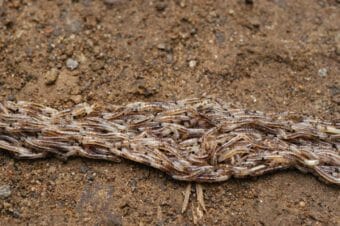
A Camp Denali staff member spotted this column of gnat snakeworm larvae on July 8. (Photos courtesy Jenna Hamm)

Elaina O’Brien ran back to staff housing on a busy morning at the Camp Denali lodge last Friday to grab the radio she’d forgotten at her cabin.

She looked down at the flagstone path, and what she saw made her think: “Am I hallucinating? Did I have some kind of psychedelic mushroom for breakfast? What. Is. That?”

Was it a slug? A desiccated animal body?

“But it was right on the staff trail!” she said. “And I looked and I was like, ‘Oh my God, am I seeing this for real? Like, it’s just a million bugs, being herded by these other bugs, in this slimy trail.”

O’Brien is the housekeeping and serving coordinator at the lodge, which is in the Kantishna area at Mile 89 of the road that cuts through Denali National Park and Preserve.

It turned out she was looking at a new, yet-to-be-named species of a type of fly called a gnat snakeworm. In that moment, they were traveling together as larvae in a “rare phenomenon,” said Derek Sikes, curator of insects and professor of entomology at the University of Alaska Museum of the North and the University of Alaska Fairbanks.

Hundreds of larvae, each almost a centimeter long, form the crawling column. Columns of larvae can stretch up to 2 or 3 feet, and they may gather in that formation only for a few hours, Sikes said.

Sikes has been studying these Alaska insects since a docent at the Museum of the North brought in a picture of the larvae and some specimens back in 2007.

“It was completely ‘X Files’ to me — I had never heard of or seen this phenomenon before,” he said.

And he wasn’t the only one. Despite how conspicuous the formation looked, longtime naturalists hadn’t seen it in the state either, Sikes said.

Since then, gnat snakeworms in this column-like formation have been reported near Fairbanks, in Katmai National Park and Preserve and in Kenai Fjords National Park. But the Denali National Park-area sighting was a first, Sikes said.

Many, many, work-like larvae forming what looks like a braided rope on the ground
Hundreds of larvae, each almost a centimeter in length, form a crawling column. Photographed July 13, 2007. (Photo by Derek Sikes / University of Alaska Museum of the North)

He then raised some of the larvae into adult flies, which allowed him to figure out what type of flies they were. By looking at their DNA and studying their anatomy years later, Sikes determined these gnat snakeworms were a new species, distinct from their closest relatives in Europe — which are also known to move in a similar mass procession.
“Some people find it sort of visually repulsive because it does look a little strange, but it’s not harmful to people,” Sikes said. “These things are not a problem for anybody. They’re not invasive. There’s nothing to worry about with them.”

It’s not yet known why there weren’t observations of these snakelike formations in Alaska before 2007, Sikes said. It’s likely someone would have reported it, but there’s no evidence of that, he said.

But even why the insects do it is a mystery.

“Nobody really knows exactly why they migrate in these great numbers together and also why they take this particular shape of a long column,” Sikes said.

There are a couple ideas about why they travel like that, Sikes said. It may be that since the larvae tend to live in moist, dark and cool areas, they try to stay closer together on a road or trail that’s exposed to sunlight so they lose less moisture.

Or, Sikes said, they might be traveling that way because it makes them look like a larger animal.

“It’s just a fascinating piece of nature that most people have never experienced or seen before,” Sikes said. “Even for most entomologists, it’s a really rare phenomenon.”

Sikes and colleagues plan later this year to publish their research on the insect and name the new species.

At the lodge on Friday, O’Brien said she “got way down close” to look at the gnat snakeworms and realized other people needed to see. She ran to the staff room and urged the guides to come and take a look. The group watched as the insects edged off the path.

And then, after it had materialized, the line of larvae soon disappeared without a trace.

“When we went to go back a couple hours later, there wasn’t even, like, a slimy slug trail or any, like, bits and pieces left behind,” O’Brien said.

This story was originally published by the Anchorage Daily News and is republished here with permission.

Two Alaska families file federal lawsuit against embattled child abuse doctor, Providence alleging child abuse misdiagnoses

Dr. Barbara Knox testifying on Sept. 14, 2017, at a murder trial in Huntington, W.Va. (Photo by Courtney Hessler/The (Huntington, W.Va.) Herald-Dispatch)

Two Alaska families who lost custody of their infants after what they say were flawed diagnoses of abuse by the state’s embattled former top child abuse physician are suing Dr. Barbara Knox, her former supervisor and Providence Alaska Medical Center in federal court.

The lawsuit, filed July 8, is the latest development in Knox’s brief but calamitous tenure as the head of Alaska Cares, a state-supported multidisciplinary clinic operated by Providence Alaska Medical Center that handles reports of child abuse across the state.

Providence Alaska Medical Center has not filed a response to the complaint in court.

The hospital is “unable to provide information on pending litigation. Additionally, under state and federal patient privacy laws and out of respect for our patients and family members, Providence cannot discuss specifics regarding patient care,” spokesman Mikal Canfield said Wednesday.

Knox did not immediately respond to an email asking for comment.

Knox, a nationally known child abuse physician, became medical director of Alaska Cares in fall 2019. She had recently been put on leave from a position at the University of Wisconsin as the medical school investigated allegations of bullying and misdiagnoses.

During her time at Alaska Cares, staff and families soon reported similar complaints of aggressive behavior and misdiagnoses. By fall of 2021, the entire medical staff of the clinic had resigned and Providence said it was investigating the workplace environment of Alaska Cares.

At the same time, Wisconsin Watch, a nonprofit investigative newsroom, found a dozen instances in which Knox’s diagnoses of child abuse were rejected by officials in court, child welfare workers and other medical professionals.

In January, Knox announced that she would resign days after the Daily News and Wisconsin Watch published a story about Emily and Justin Acker, a Fairbanks-area military family who said Knox wrongly diagnosed their newborn daughter’s brain injury as abuse, leading them to lose custody for nearly a year.

Emily and Justin Acker are among the plaintiffs of the federal lawsuit filed last week. The second family is a Sitka couple, named as John and Jane Doe in the complaint, who lost custody of their infant son after an abuse diagnosis by Knox.

Both families say injuries attributed to child abuse by Knox were actually the result of difficult pregnancies and traumatic births.

Knox conducted “inappropriate, incomplete and deeply flawed” examinations of the two infants named in the case, and a review of the doctor’s work “determined that some of her child abuse diagnoses failed to meet the standard of care,” the complaint alleges.

The Ackers’ daughter and son were in state custody for 11 months.

In a statement, Emily and Justin Acker said they were “deeply hurt” by their experience at Providence Hospital.

“We trusted them to protect and care for our daughter during a very difficult time, but instead, they allowed our family to be torn apart by the opinion of a doctor, who, quite honestly, has no business practicing medicine anymore. They chose to ignore her very disturbing history as a child abuse pediatrician and put us through unimaginable pain,” the couple wrote. “Their actions caused a domino effect of grief and trauma, not only for us but especially for our children.”

“We have suffered every day since this nightmare began,” the statement continued. “I mean yes, it would be very nice for us to win this case, but nothing will ever replace the times and memories that we lost with our children during that time, and that’s the part of this whole situation that hurts us the most. They could never give us back the joy that they took from us, and that’s the biggest reason why we chose to pursue this lawsuit.”

The Sitka family’s two children were out of their custody for more than five months, and both parents faced felony assault charges. Those criminal charges appear to have been dismissed or are otherwise not visible in state court records.

The plaintiffs’ attorney is Mike Kramer, a Fairbanks lawyer who specializes in litigation against government agencies.

The complaint alleges that Alaska Cares knew Knox did not report a “pattern of misdiagnoses” to the Alaska Medical Board. It also alleges that the hospital system has reached “settlements” and “secured nondisclosure agreements” with former staff members who quit because of Knox. And it asserts that Alaska Cares reviewed Knox’s work and “determined that some of her child abuse diagnoses failed to meet the standard of care.”

The lawsuit also named Bryant Skinner, Knox’s former supervisor at Providence, as a defendant, saying he negligently supervised her and failed to act on dozens of complaints about her behavior.

Providence Alaska Medical Center has not released information about the workplace investigation into Knox, and doesn’t comment on patient care allegations.

After leaving Alaska this spring, Knox was hired as a professor of pediatrics by the University of Florida in Jacksonville.

This story was originally published by the Anchorage Daily News and is republished here with permission.

‘He kept my head up. He’s the hero’: Three survive sinking of fishing boat in Southeast Alaska

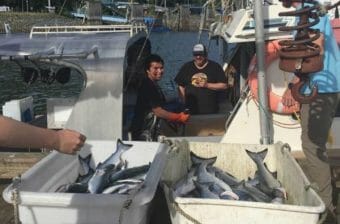
Two men on a fishing boat, with totes full of fish in the foreground
Chris Larsen (left) and Howard Starbard aboard the Miss Amy some years ago in Auke Bay. Starbard credits Larsen with helping him survive the boat’s sinking on Monday, July 4 2022. (Photo by Amy Starbard)

Howard Starbard knew he had a problem when the pumps couldn’t keep up with the water pouring into his 37-foot commercial fishing boat, Miss Amy.

The 63-year-old retired Alaska State Troopers commander couldn’t know he was about to spend 45 minutes in the sea, fighting to stay afloat before a relative, two good Samaritan vessels and the U.S. Coast Guard intervened to help him survive his boat’s sinking off the Southeast Alaska community of Pelican.

Starbard was power trolling for king salmon during a commercial opener Monday with his 13-year-old grandson and 35-year-old nephew about three miles off the west coast of Chichagof Island. It was the first day the Miss Amy had been out all summer.

Then the high-water alarm sounded.

A map of Southeast Alaska showing the area of the sinking

Within three or four minutes, Starbard said Wednesday, he issued a Mayday call on the VHF radio. Then he told the others — grandson Timothy Drake II and nephew Chris Larsen — to haul up the fishing gear and powered the Miss Amy for the Cirus, a salmon tender some ways off toward shore.

“From that moment until I was released from the ER here in Sitka, the perception of time was distorted,” Starbard said by phone as he and family members waited for a flight home to Juneau.

Starbard, who at one point in his career served as administrative Alaska State Troopers commander based in Anchorage, retired as a major in 2006.

He’d never been on the receiving end of a rescue before.

U.S. Coast Guard watchstanders picked up the report that the Miss Amy was taking on water near Porcupine Rock and Lisianski Strait off Chichagof Island, the agency said. They issued an urgent marine broadcast, directed the launch of a helicopter and rerouted a cutter in that direction.

The Cirus and another vessel, the power troller Lucky Strike, responded to the broadcast, the Coast Guard said.

The Miss Amy tied to a dock
The 37-foot Miss Amy, seen here in Hoonah, sank Monday July 4, 2022 off Chichagof Island in Southeast Alaska. (Photo by Howard Starbard)

It was the Cirus that Starbard was making for as his boat took on water. Starbard sped up, dragging gear after the hydraulics to raise it went down, to get closer to the tender.

They came alongside. By then, the water was halfway up the engines and the boat was listing as it filled even faster, Starbard said.

His grandson jumped over to the tender first, with help from the Cirus crew as the churning water slammed the boats together. Then Larsen made the jump.

But at Starbard’s turn, he missed, and plunged into the frigid 6-foot seas.

Somebody threw a rescue ring but there was no footing on the boat’s stern. The crew and his family couldn’t pull him up. A ladder extended down was too high to climb out.

Starbard, growing exhausted and hypothermic, wrapped his arms around a rung and was pummeled by waves. There had been no time to put on survival gear, he said. His only mission had been to get his boat to the tender as fast as possible.

The other boat, the Lucky Strike, came alongside. Someone tossed a line into the water.

“At that point hypothermia was kind of getting to me. I was unable to really do anything,” Starbard said.

That’s when Larsen jumped into the water and got the line around his uncle so the Lucky Strike crew could hoist him aboard with an electric boat winch.

“I couldn’t keep my head up,” Starbard said, pausing a few times as he became emotional. “Chris swam with me. He kept my head up. He’s the hero.”

Fog and limited visibility prevented the vessels from leaving the area, the Coast Guard said. The survivors were hoisted into a Coast Guard Jayhawk helicopter and transferred to Sitka for medical care.

Just after 7 p.m., Amy Starbard got a call: The Coast Guard was receiving a distress signal from her husband’s boat. Her daughter got a similar call. Someone mentioned one person was unresponsive. She knew that wasn’t Larsen, an experienced deckhand. It was either her grandson or her husband.

She and her daughter boarded a flight to Sitka right away. She finally heard from Drake just before leaving.

“He said grandpa was going to the hospital,” Amy Starbard said Wednesday. “But that he was OK.”

Her husband was treated for hypothermia, tested, and released.

Timothy Drake II, 13, survived the sinking of the 37-foot Miss Amy Monday July 4, 2022 off Chichagof Island in Southeast Alaska. He stands with rescuers in Sitka on July 5. (Photo by Katelynn Drake)

On Wednesday, Starbard was battered and bruised but thankful not only for his nephew’s help but the aid from the two Good Samaritan vessels that helped pull them all from the water.

“We’re all very very very grateful,” Amy Starbard said.

Howard Starbard doesn’t know what caused the boat to take on water. The Miss Amy sank in about 150 feet of water, carrying salmon as well as about 260 gallons of diesel and small amounts of motor and hydraulic oil — Starbard was careful to note the precise estimates.

The family on Wednesday was going over photos of a decade’s worth of memories and counting their emotional losses. Drake took his first steps aboard the boat. His PlayStation 5 was aboard when it sank.

Starbard’s Alaska State Troopers retirement badge was in there somewhere, too.

This story was originally published by the Anchorage Daily News and is republished here with permission.

As state COVID emergency ends, tens of thousands of Alaskans will see reduced food stamp benefits

""
Shelves at a small Anchorage-area grocery store on Wednesday, Jan. 5, 2022. (Photo by Emily Mesner/ADN)

Tens of thousands of Alaskans will lose access to expanded food stamp benefits in September after the state ends its public health emergency in July.

The end of certain additional benefits under the federal Supplemental Nutrition Assistance Program comes as food aid groups say need is reaching previous pandemic highs while prices are soaring. Plus, other pandemic-era benefits, like the child tax credit and rental assistance, are expiring too, said Cara Durr, director of public engagement at the Food Bank of Alaska.

“We know families are struggling and they are turning to services,” Durr said. “So this is really coming in the middle of what is kind of a perfect storm.”

The SNAP Emergency Allotment program, which has been in place throughout the pandemic, is set to end in Alaska after August. It will mean the loss of at least $95 in benefits per month for the 56,000 households in Alaska that receive food stamps. But some families could be losing hundreds of dollars more each month, at a time when roughly 13% of Alaskans are receiving benefits from SNAP.

The additional benefits will cease because the state of Alaska opted to end its public health emergency in July. For the money to be sent, both a federal and state-level order need to be in place.

A state spokesman said the emergency declaration was specific to COVID-19, and was not related to today’s economic challenges. The order was initially a way to respond to the pandemic, but is no longer needed since the private sector is providing much of that response now, he said.

The emergency allotment program gives people already receiving SNAP benefits the maximum amount for their household each month, Durr said. Benefits are calculated based on someone’s income and expenses, which means someone with more income would usually get lower benefits.

But under the emergency allotments, a single person in Anchorage who might normally receive the minimum of $26 per month could receive the maximum amount of benefits for their household, which is $322 per month, she said.

People who were already receiving their maximum benefit were able to receive an additional $95 each month beginning in July 2021 under the emergency allotment, Durr said.

“It’s been a really important boost for households,” she said.

SNAP benefits are available to some low-income families and come on debit cards issued to recipients so they can purchase food. While the benefits may not fully cover a month’s worth of food for families, they’re still an important resource, Durr said.

All told, some 97,000 Alaskans, among 56,000 households, were receiving SNAP benefits in April and are set to lose some amount of benefits come September.

That’s around 17,000 more people who received the benefit compared to January 2020, and is a number that’s been steadily rising since January 2021, according to data from the state’s health department.

At a press conference earlier this month, Shawnda O’Brien, director of the Division of Public Assistance, told reporters that the department will give notice to people receiving the additional money that the benefit will end.

According to a spokesperson for the U.S. Department of Agriculture, 16 states around the country have ended their emergency or disaster declarations while another four have said they will end theirs. States can extend the emergency SNAP benefits by a month after their emergency declarations end — which Alaska opted to do in order to send the benefits out through August once the order ends in July. The benefits will also extend a month after the federal emergency ends, according to the USDA.

For the states continuing their public health emergencies, the federal Department of Health and Human Services has said it will give a 60-day notice of when it plans to end the federal public health emergency, which by late June, it had not yet done — meaning the earliest the emergency could end would be late August, and the benefits for those states would continue through September.

The end of the emergency allotments will be “devastating” for people who rely on SNAP, predicted Heather Parker. She is a supervising attorney in Southeast Alaska with Alaska Legal Services, a nonprofit that provides free civil legal services to low-income Alaskans.

Parker said local food banks can be a stopgap measure for those who need food. She’s also told clients that to qualify for the maximum amount of food stamp benefits, they should make sure the Division of Public Assistance is aware of all expenses. But all in all, she said, there’s not a great safety net for people.

Leigh Dickey, advocacy director for Alaska Legal Services, noted that the federal dollars to pay the benefit still exist.

“By DHSS ending the state emergency, they’re basically just ending Alaskans’ access to the federal money earlier than they need to, which does seem cruel right now,” Dickey said.

An earlier disaster declaration that had been in place since March 2020 expired in February 2021, after Gov. Mike Dunleavy said the Legislature was the body that should renew it and it failed to do so. The current public health emergency set to end in July has been in place since May 2021.

In an emailed response, health department spokesman Clinton Bennett said that the emergency order was only possible under limited authorities given to the state’s health commissioner by the Legislature to help with the pandemic response.

The state public health emergency “is specific to COVID-19 and has nothing to do with the current economic situation,” Bennett wrote. “The tools provided for the COVID-19 response are no longer required, so it is appropriate to end the State Public Health Emergency Order.”

This story was originally published by the Anchorage Daily News and is republished here with permission.

Site notifications
Update notification options
Subscribe to notifications