Anchorage Daily News

Anchorage Daily News is our partner in Anchorage. KTOO collaborates with partners across the state to cover important news and to share stories with our audiences.

Numerals invented by Kaktovik students can now be used digitally

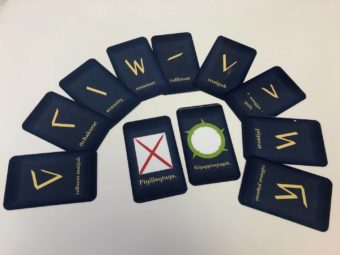
 A set of dark blue cards with symbols printed on them arranged in an arc
The cards with Kaktovik numerals are displayed on a table Oct. 5, 2022. The cards are used in a game called Tallimakipiaġutaiḷaq, which means “99.” In the game, you add the cards as they are played, with the goal to avoid being the person that brings the pile above 99. (Photo by Chrisann Justice)

Almost 30 years ago, a group of Kaktovik students invented a numbering system that reflected the way they counted in Iñupiaq and made math more intuitive for them. Soon, anyone in the world will be able to type Kaktovik numerals on a computer.

“It’s not just a number system. It’s not just math. It was created and developed by a teacher of our district and our Iñupiaq students,” said Tennessee Qaġġuna Judkins, director of Iñupiaq Education at the North Slope Borough School District. “When you use it in a classroom, it’s most relatable to those students, to that population. When it comes to Indigenous methods and understanding, it just clicks. It makes a lot more sense.”

Today, the interest in culturally responsive education — and studying Kaktovik numerals in Iñupiaq schools — is growing, and so is the need for an easy way to use the numbers digitally. Starting this September, an international encoding standard, Unicode, included Kaktovik numerals in its latest version, which means that the numbers will be now universally accepted by computers.

“That means that anybody anywhere in the world on a computer can have access to producing stuff using the numerals,” said former Harold Kaveolook School math teacher William Clark Bartley, whose students invented the system in the ‘90s.

Creating the numerals

When Bartley was a math teacher in Kaktovik in 1994, his middle school students came up with the numbers to represent the Iñupiaq oral counting system.

“Before we made these numerals, we used the Arabic numbers, and, visually, it didn’t connect to our language,” said Alicia Solomon, who was an eighth grader at the time. “And we started asking our teacher, ‘What about our own numbers? Our own system?’”

Most countries use the Hindu-Arabic base-10 numbering system where numbers range from 0 to 9. But in Iñupiaq — as well as other Inuit and Yup’ik languages — the numbers go from 0 to 19, which makes it a base-20 system.

“The Iñupiaq word for the number 20 is iñuiññaq, which represents a whole person,” Judkins said. “You have all 20 appendages — your 10 fingers and your 10 toes. A lot of the classroom activities that we use now with this numbering system is in relation to those body parts and those appendages.”

Kaktovik students came up with digits from zero through 19, composed of straight strokes joined at sharp angles that you can write without lifting a pen.

“We didn’t want them to look like any other numbers,” Solomon said. “It was our whole math class that did it together.”

A table showing the Iñupiaq counting system from 1 to 59
Kaktovik numerals from 1 to 59, as they are seen in Edna MacLean’s Inupiaq dictionary. The lower numbers, 1 to 59. The Kaktovik numbers in the tens’ and fifteens’ rows are graphically simpler than those immediately above and below them, and the corresponding Iñupiaq numbers are lexically simpler than those above and below them.

The Iñupiaq counting system did not have zero, so the school district suggested a couple of names for the digit. A student who had a disability came up with zero’s visual representation.

“She just raised her hands above her head crossing them,” Bartley said.

The numerals are built following the structure of numbers in Iñupiaq: for example, 16 is akimiaq atausiq in Iñupiaq, which translates as 15 and 1. The Kaktovik numeral 16 is also composed of 15 and 1.

“The kids really did come up with a brilliant system,” Bartley said. “The numerals, you just have to look at them, and you can see what the numeral means.”

Because Kaktovik numbers visually reflect the composition of the number, using them in math problems was easier than Arabic numbers, Solomon said. Just by looking at the Kaktovik numerals, students could see how to add, subtract and even divide. For example, for long division, students used colored pencils to match the strokes of the divisor in the dividend.

“The numbers almost gave themselves away,” Bartley said.

After students started working with Kaktovik numerals, Bartley said their interest in math grew. They would rush to get through the regular math book to save time for working with Kaktovik numerals.

“It’s their culture that got all the kids far more involved in it,” he said.

Digitalizing the numerals

The effort to make Kaktovik numerals available on computers began in 2021, when several linguists and language enthusiasts wrote a proposal describing the relevance of the numbering system.

NowUnicode has a spot reserved specifically for Kaktovik numerals starting with Version 15.0 released on Sept. 13. Because the update is so recent, today’s computers, smartphones and other devices don’t come with a font that can display Kaktovik numerals, according to Deborah Anderson, research linguist at the University of California Berkeley who also helps preview new Unicode proposals before they are submitted.

“To access the numerals, users need a font with glyphs and an input mechanism, such as a keyboard,” Anderson said.

In the past, Google has developed free fonts for new Unicode characters that are in modern use. If this is done for the Kaktovik numerals, a font may become available in the next few months, said Craig Cornelius, a software engineer at Google who contributes to Unicode. Eventually, a font will also be available on mobile devices such as Android, but the process will take at least a year, Cornelius said.

“The next step, to make this really usable, is to build a keyboard that can be used on a laptop or desktop directly,” Cornelius said. “If people can type the characters, then someone will be able to see them if the font is installed on their device.”

For now, Cornelius built a digital keyboard for those who want to start using numerals today. The developers are working on training the Iñupiaq Education staff on how to access and use the numerals before the fonts are publicly available.

“The people who did the hard work of getting the Kaktovik characters into the Unicode standard have started the process,” Cornelius said, “but like with any product, it takes time for it to roll out to all the stores.”

Teaching the numerals

Teachers across the North Slope used Kaktovik numerals in math classes for a period after their invention. Their use has since been scaled back, with the influx of out-of-state teachers and the growth of standardized testing in the late ‘90s, but more and more teachers in Iñupiaq schools are now considering bringing the system back.

Adults and children sit around tables looking at numeral system cards
From left: Teachers Kayutak Julie Itta, Anausuk Timmothy Ferreira, Tukak Vernon Elavgak and Atuqtuaq Chrisann Justice play a number game using Kaktovik numerals during Immersion gathering in May 2022. (Photo courtesy of Tenna Judkins)

Next fall, the North Slope Borough School District hopes to roll out several pilot immersion classrooms that will include teaching students math concepts and math activities, using Kaktovik numerals. Moreover, this immersion program will be built on a place-based culturally relevant curriculum that will offer students classes in the Iñupiaq history and local governance.

“There’s this huge wave of Indigenous education and culturally responsive teaching,” Judkins said.

Kaktovik numerals are part of the Iñupiaq language curriculum in the district, and students learn to count and describe dates and ages using them, said Chrisann Justice, the Iñupiaq Education Department Specialist.

But creating educational materials with Kaktovik numerals right now means drawing them by hand or, in Justice’s case, copying and pasting screenshots of each numeral, which often leads to a pixilated image.

“It would be so handy to be able to just type them in!” Justice said.

Digitalizing Kaktovik numerals can also help preserve the use of numbers in Iñupiaq.

“Our words are long, and it’s just easier to see the numbers instead of saying the numbers,” Solomon said. “I think it would be awesome to have the kids try to learn the numbers, sort of get a feel for them and learn our numeral system. Just to stay in touch with our culture.”

This story originally appeared in the Anchorage Daily News and is republished here with permission.

Federal observers flagged issues with Native language support in Alaska’s August election

“I Voted” stickers at the polls in Nome, August 19, 2014.
“I Voted” stickers at the polls in Nome, August 19, 2014. (Photo by Matthew F. Smith/KNOM)

Federal observers found several problems at rural Alaska polling places in the August election that attorneys say could disenfranchise minority voters and constitute violations of the Voting Rights Act.

U.S. Department of Justice observers were sent to several polling locations in the August special U.S. House and primary elections to assess whether the state provided adequate accommodations for Alaska Native voters. The observers were sent as part of a settlement in a lawsuit filed nearly a decade ago that found that Alaska election officials were violating the federal Voting Rights Act in failing to provide language assistance to Alaska Native voters.

Observers found what appeared to be continued violations of the law, including a polling place without bilingual language workers and election officials who lacked training in assisting voters who speak languages other than English.
The federal observers monitored polling locations in jurisdictions that are required to provide language assistance in Yup’ik in the Dillingham and Kusilvak Census Areas.

Gail Fenumiai, director of the Alaska Division of Elections, said in an email that the “the division makes every effort to comply with all of the requirements of the stipulated order in the Toyukak case,” including finding and hiring bilingual election workers, training them, and providing translated election materials.

Fenumiai said the division added a language assistance outreach coordinator to the team “to assist with our community outreach efforts.” She also said ahead of the November election, the division has provided more translated election materials, in addition to print, digital and radio ads in languages other than English.

“It is frequently difficult to recruit bilingual workers, particularly in places where the residents have informed the division that they do not need language assistance. But the division is committed to providing language assistance and it believes it has complied with the stipulated order and will continue to comply with the Voting Rights Act going forward,” Fenumiai wrote, adding that voters can request language assistance directly on the division website.

The settlement agreement was reached in the wake of a 2013 lawsuit filed by the Native Village of Hooper Bay and Traditional Village of Togiak along with two Alaska Native voters, charging state election officials with ongoing violations of the federal Voting Rights Act for failing to provide election materials and assistance in Native languages.

Under section 203 of the Voting Rights Act, states must provide language accommodations in jurisdictions where the rate of English proficiency is lower than the national average. In Alaska, the division currently produces election materials in Spanish, Tagalog, six dialects of Yup’ik, Gwich’in, Northern Iñupiaq, Nunivak Cup’ig and Aleut.

The plaintiffs and the state reached a settlement agreement in 2015 that ordered the Division of Elections to provide election materials in Yup’ik and Gwich’in where speakers of those languages make up a high proportion of voters, based on census data. Election officials are also required under the agreement to provide trained bilingual election workers in polling places where those languages are spoken. Under the settlement agreement, Department of Justice observers were routinely sent to observe election operations in predominantly Alaska Native regions of the state.

The settlement order was extended following the 2020 election, after observers found the state continued to violate the requirements set out under the agreement. And in August, observers again found what appeared to be evidence that the state was not in compliance.

At the Anton Johnson Village Community Building in Koliganek, federal observers reported that there was no Yup’ik speaker available to provide language assistance. There, observers asked election officials what they would do if a voter needed language assistance. An election official responded that “they were supposed to call the office but she wasn’t sure what office,” according to the report.

At the Dillingham City Hall polling station, federal observers documented that the lone bilingual poll worker had not completed mandatory language assistance training. The bilingual poll worker also told the federal observers that “the dialect of Yup’ik spoken in Dillingham is the dialect she does not speak.”

Federal observers found that in seven of the eight monitored polling stations, no election officials had completed required training on how to translate the ballot or provide procedural instructions.

Per the court order, the Division of Elections must provide poll worker buttons that say “Can I help?” in Yup’ik or Gwich’in in covered jurisdictions. They also must provide translated posters that identify bilingual poll workers and announce language assistance availability.

The observers reported that the only election materials in Yup’ik at the Dillingham City Hall were “I voted” stickers.

Some monitored polling stations had more translated election materials available. At the Togiak city office, for example, the polling station had signs in Yup’ik including two that said “language assistance is available for the election.” A bilingual poll worker also wore a “Can I help?” button and all four election officials spoke both English and Yup’ik. However, none of the poll workers completed language assistance training.

Poll workers at five of the eight polling locations assisted Yup’ik speaking voters. No Yup’ik speakers required assistance at the other locations, including at the Anton Johnson Village Community Building and Dillingham City Hall.

Michelle Sparck, director of strategic initiatives Get Out the Native Vote, said bilingual poll workers are “key” to building voter confidence, especially among older and disabled populations. However, many longtime bilingual poll workers are retiring or moving from their communities, making it hard to recruit new bilingual poll workers.

“We would like to see translators in every polling station, but it’s just not possible now,” Sparck said.

Margaret Paton-Walsh, who represented the state, cited similar challenges during 2014 court proceedings.

“The issue is not that we don’t care about them because there’s only 300 of them,” Paton-Walsh said of Alaska’s Gwich’in speakers at the time. “The problem is, when there are only 300 of them, there are only so many people who can provide the assistance.”

It remains unclear if the observer reports will lead to any enforcement action against the Division of Elections. An attorney for the Native American Rights Fund, which represents the plaintiffs in the case, declined to comment on the observer reports.

The Division of Elections is expected to file a report about language assistance in January, Fenumiai said.

Mara Kimmel, executive director of the American Civil Liberties Union of Alaska, said Alaska election officials have long failed to accommodate non-English speakers. Only after a legal settlement in 2010 did the state agree to begin translating election materials to Yup’ik and training bilingual poll workers.

The Alaska ACLU and Native Americans Rights Fund filed a separate lawsuit earlier this year against the Division of Elections over the lack of a ballot curing process, which would allow voters to correct their ballots if election officials identify mistakes that prevent the ballots from being counted. The lawsuit came after 4.5% of ballots were rejected in the June special primary, Alaska’s first by-mail election. Ballots were disproportionately rejected in regions with high numbers of non-English speakers, including where Alaska Natives make up a majority of the population.

Kimmel said the problems in June and in August were both related to the ongoing challenges in accommodating non-English speaking voters.

“We can’t be a functional democracy if not everybody’s voice can be counted in their votes,” Kimmel said. “It’s very, very essential to who we are as Americans and who we are as Alaskans. And it would be a real shame if every time we wanted to exercise the fundamental right we had to sue.”

In lawsuit, former assistant accuses Alaska governor candidate Charlie Pierce of sexual harassment

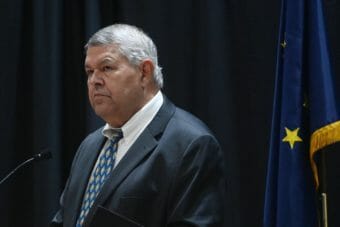
Charlie Pierce, wearing a suit, stands at a lectern next to an Alaska flag
Alaska gubernatorial candidate Charlie Pierce, former mayor of the Kenai Peninsula Borough, at a debate in the Egan Center in Anchorage on Oct. 11. (Photo by Bill Roth/ADN)

In a lawsuit filed Friday, a former executive assistant to Alaska gubernatorial candidate Charlie Pierce said Pierce sexually harassed her when he was Kenai Peninsula Borough mayor.

The complaint, filed in state court by Kenai resident Pamela Wastell, accuses Pierce of “constant unwanted physical touching, sexual remarks, and sexual advances” and says the borough government failed to protect her. The 19-page filing names Pierce and the borough as defendants and claims the borough provided no way to report harassment or discrimination without fear of reprisal.

Wastell worked as an executive assistant to Pierce including in 2021 and the first six months of 2022, according to the lawsuit.

Pierce is one of four candidates for governor, and one of two Republicans, to advance to the Nov. 8 general election under Alaska’s new voting system. Gov. Mike Dunleavy has urged voters to rank the fellow Republican second on ballots in the state’s new ranked choice voting system.

Pierce had one year left in his term as borough mayor when he announced his resignation on Aug. 26. He said at the time that he was leaving the job to focus on campaigning for governor.

The Kenai Peninsula Borough Assembly later revealed that Pierce had been the subject of a “credible” harassment complaint made in July, and had been asked to consider resigning. But the identity of the employee who made the complaint and the details of the alleged harassment were not made public until the lawsuit Friday.

Pierce did not respond to emailed questions about the lawsuit and Wastell’s accusations, and later referred questions to his attorney. The attorney whom Pierce told a reporter to contact, Richard Moses, said he could not comment until he had had time to review the complaint.

All four candidates for governor attended a forum Saturday at the Alaska Federation of Natives convention in Anchorage, where the subject of the lawsuit did not come up during the debate. Afterward, Pierce again declined to answer questions.

“I have no comments about future litigation,” he said.

Kenai Peninsula Borough attorney Sean Kelley wrote in an email Friday that he had not been served with the lawsuit yet and therefore could not comment.

In a state with the highest rate of sexual assault in the nation, several Alaska political leaders have resigned in recent years following accusations of inappropriate interactions with women, sexual harassment or worse.

Former Lt. Gov. Byron Mallott resigned in 2018 after a woman said he propositioned her at an Anchorage hotel. Former Anchorage Mayor Ethan Berkowitz resigned in 2020 after admitting to an “inappropriate messaging relationship” with a television news reporter. Attorney General Kevin Clarkson quit the same year after a Daily News and ProPublica investigation found he had sent hundreds of inappropriate text messages to a state employee. The attorney general appointee to replace Clarkson, Ed Sniffen, resigned six months later after a woman said he had sex with her when she was 17 and he was a coach for her high school mock trial team. A grand jury in September indicted Sniffen, who has denied any wrongdoing, on charges of sexual abuse of a minor.

The lawsuit by Wastell says the Kenai Peninsula Borough failed to protect employees from a pattern of harassment.

“When an elected official abuses their power and position to sexually harass public servants, they must be held accountable,” Wastell’s attorney said in an email.

It marks at least the third time the borough has faced legal fees or settlements over complaints involving Pierce. Two prior cases prompted the borough to pay former employees a combined $267,000 in settlements.

Those settlements did not involve sexual harassment, although Friday’s lawsuit suggests that if the new case goes to trial, additional borough employees might be called to testify about alleged sexual harassment by Pierce.

“KPB knew or should have known that Pierce was a sexual harasser and bully,” the lawsuit says. “Prior to Wastell’s constructive discharge, KPB, through Pierce, subjected at least four other employees to discrimination, bullying, harassment, retaliation, and/or termination.”

In the lawsuit, Wastell accuses Pierce of:

• Touching her breast.

• Sexual remarks.

• “False imprisonment in his private office.”

• Unwanted and unsolicited embraces and massages.

• Kissing her neck and face.

• Asking questions about the details of her sex life.

• Telling her that only he alone could fire her within the borough and that she would not want to say no to him.

After being largely absent from the campaign trail since the August primary, Pierce has been actively campaigning in recent days, including an appearance in a statewide televised debate Wednesday.

Wastell refused an interview request through her attorney, Caitlin Shortell. Neither Shortell nor the Kenai Peninsula Borough attorney would say how much the borough offered Wastell in any proposed settlements.

Previous complaints

Pierce is a former manager for Enstar Natural Gas who served on the Kenai Peninsula Borough Assembly before his election as mayor in 2017. (Wastell has worked for the borough since 2013, according to the lawsuit.)

In 2019, the borough’s former human resources director, Sandra “Stormy” Brown, filed a lawsuit accusing the borough and Pierce of gender discrimination, disability discrimination and creating a hostile work environment. Brown said in the lawsuit that Pierce fired her after she told him she had been diagnosed with terminal breast cancer.

Through mediation, the borough agreed to pay Brown $150,000 to settle the case. Of that amount, $15,000 was paid for lost wages and $135,000 was paid for “emotional distress damages,” according to mediation records obtained through a public records request.

The borough agreed to pay $117,000 to settle a Dec. 15, 2021, complaint from a subsequent human resources director. In exchange, the employee agreed he would not “make any further allegations of ‘illegal acts’ by Mayor Pierce” and would “withdraw and rescind any allegations of bullying.”

Wastell, who by then was working directly for Mayor Pierce, served as the notary for the agreement.

Calls for Pierce to drop out of race

Pierce entered the governor’s race the following month. According to the lawsuit, he increased the intensity and frequency of sexual harassment throughout the first half of 2022.

The complaint alleges that two other female borough employees were sexually harassed, including one who reported harassment to the borough attorney, Kelley.

Wastell made a complaint against Pierce on July 11. The borough placed her on paid administrative leave and hired a law firm to look into the allegations. On Sept. 1, the fifth-place finisher in the primary election, Rep. Christopher Kurka, R-Wasilla, called on Pierce to drop out of the race and allow him to take his place on the ballot.

“If Charlie doesn’t intend to run a serious campaign, he still has time to honor the wishes of his supporters who want a conservative alternative to Dunleavy,” Kurka said in a statement emailed by his campaign.

The deadline to withdraw passed, and Pierce stayed in the race and on the ballot.

A spokesman for Dunleavy, Andrew Jensen, did not respond to emailed and texted questions about whether the lawsuit Friday impacted the governor’s endorsement of Pierce as second choice on the ballot. When a Daily News reporter approached him after the AFN forum on Saturday, Dunleavy stopped talking to bystanders and walked out an exit. Jensen later wrote in a Tweet that by the time the reporter approached, Dunleavy had already finished speaking to everyone who had been waiting to speak with him. Another member of his staff said the governor was too busy to talk to a reporter.

The lawsuit says that the borough has urged Wastell — who has been on paid administrative leave since making a report of sexual harassment in July — to return to work. On Wednesday, Wastell received a notice telling her that if she did not soon return, the borough would “sever the employment relationship due to a refusal to work.”

Shortell said that returning to the office wasn’t an option.

“The borough has not made the workplace safe,” she said. “They have not implemented processes that would make employees, including Ms. Wastell, safe in the future from retaliation, bullying and other harassment.”

Daily News reporter Iris Samuels contributed to this article. 

This story originally appeared in the Anchorage Daily News and is republished here with permission.

Candidates for Alaska governor spar over abortion, crime, budget in televised debate

Seen from the side, four candidates for Alaska governor stand behind lecterns on a stage
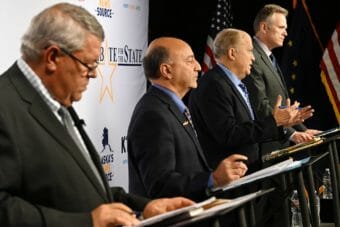
Gubernatorial candidates from left, former Kenai Peninsula Borough Mayor Charlie Pierce, former state Rep. Les Gara, former Gov. Bill Walker, and Gov. Mike Dunleavy participated in Debate for the State at Alaska Public Media on Wednesday, Oct. 19, 2022. (Photo by Bill Roth/ADN)

Alaska’s four candidates for governor sparred over crime, education, abortion access and the state budget Wednesday night in the only live televised debate ahead of the November election.

Independent former Gov. Bill Walker and Democratic former state lawmaker Les Gara devoted much of their responses to attacking Republican incumbent Gov. Mike Dunleavy for his record. Meanwhile, Dunleavy and fellow Republican candidate Charlie Pierce, former mayor of the Kenai Peninsula Borough, appeared to agree on most issues and urged their supporters to rank the other candidate second in the state’s first ranked choice general election.

Walker and Gara’s attacks centered on Dunleavy’s record of slashing state spending on services and failing to advance a fiscal plan to provide a dependable calculation for the Permanent Fund dividend and covering the cost of running state programs such as education.

The debate came a day after expected news broke that the Anchorage School District is considering closing six elementary schools in light of budget shortfalls, after the per-student state funding formula increased by only 0.5% since 2017, far below the 15% rate of inflation in the same time frame.

Gara blamed Dunleavy for creating what he called “the worst crisis in Alaska history” and argued in favor of providing teachers with a pension program to make the state more competitive in attracting teachers. Walker said the state should “fully fund education and make it the priority that it used to be.”

Dunleavy met the criticism by pinning school districts’ budget shortfalls — including the one in Anchorage — on district budget management.

“I’d be more than happy to sit down with a number of these school districts,” Dunleavy said, “and have a discussion as to why they are short on their budgets.”

Dunleavy painted a rosy picture of the state, saying Alaska crime is lower than before his tenure, the operating budget has been reduced, the dividend this year is one of the highest ever, and state debts this year were paid off.

Walker and Gara had a more grim picture in mind. While crime may be lower, key crime statistics still put Alaska as the most dangerous state for women; the larger dividend and debt payoffs this year were only possible thanks to temporarily high oil prices; and the state still lacks a fiscal plan to create long-term stability for services like education, they said.

The Permanent Fund dividend

""
Photo by Gov. Mike Dunleavy, right, listens to gubernatorial candidate former State Rep. Les Gara, left, speak during the Debate for the State at Alaska Public Media on Wednesday, Oct. 19, 2022. Former Alaska Gov. Bill Walker listens at center. (Bill Roth/ADN)

Dunleavy touted the dividend payments this year — one of the largest sums in the state’s history — as a victory. But his opponents pointed out that the dividend amount and the state savings that Dunleavy also touted were only possible due to higher oil prices largely driven in part by Russia’s war in Ukraine.

Gara promised to solve Alaska’s budget challenges by doing away with $1.2 billion in subsidies to oil companies — a promise that has been fundamental to his campaign. Gara said by doing that, the state would be able to afford a dividend and full funding of schools, including indexing the per-student funding formula to match inflation, which Gara said is necessary.

Walker said the formula used to calculate the dividend should be changed but didn’t commit to a particular path, instead saying he would work with the Legislature to come up with an alternate calculation and a fiscal plan for the state.

“With a high dividend, right now we’ve been put on the express lane for high taxes in Alaska, and that’s what I don’t want,” Walker said.

[Compare candidates for Alaska governor’s positions issue-by-issue]

Dunleavy also said he favored a new dividend formula, and also a constitutional spending limit that would put guardrails on the state’s expenses for services.

Dunleavy blamed Walker for “breaking” the dividend formula under his term as governor, referring to a 2016 decision by Walker to veto part of the dividend in order to cover the cost of state services in light of a multibillion-dollar budget deficit. Dunleavy, as a state senator, voted at the time in favor of the smaller dividend.

Pierce called the dividend “an Alaskan right” and called for the existing statutory formula to be followed or holding a constitutional convention to retool the formula.

Abortion

""
Gubernatorial candidates from left, former Kenai Peninsula Borough Mayor Charlie Pierce, former State Rep. Les Gara, former Gov. Bill Walker, and Gov. Mike Dunleavy participated in Debate for the State at Alaska Public Media on Wednesday, Oct. 19, 2022. (Photo by Bill Roth/ADN)

Asked about abortion access, Gara said he is the “only pro-choice candidate” in the race. The question has become a sticking point for Gara and Walker as they try to court voters for whom abortion has become a key issue after the U.S. Supreme Court this year did away with federal protections for accessing the procedure.

Gara is the only candidate in the race endorsed by Planned Parenthood. Walker, who has called himself “pro-life,” promised he would maintain the protections for abortion access currently guaranteed under Alaska’s state constitution. He said he would veto any legislation “that comes between a woman and her doctor.”

Dunleavy tried to sidestep the issue, accusing Walker and Gara of “fear mongering.” But Dunleavy is already on the record as opposing abortion access. After the Supreme Court’s decision overturning federal constitutional protections for abortion, he called for a vote on an amendment to the state constitution to remove statewide protections for the procedure. Ahead of the 2018 gubernatorial election, Dunleavy said he opposed abortion access in all cases, including in cases of rape and incest.

Dunleavy also gave an evasive answer when asked about the treatment of “marginalized students” in light of a policy implemented in the Matanuska-Susitna Borough targeting transgender students.

Dunleavy said “there will be no discrimination” and “hasn’t been” discrimination under his administration. Earlier this year, Alaska under Dunleavy’s administration joined a lawsuit against the U.S. Department of Agriculture over a rule that would cut federal meal funding for schools that don’t include LGBT-friendly policies.

Both Walker and Gara said they would work to protect LGBT students. Pierce expressed support for the Mat-Su policy that banned transgender students from using bathrooms and locker rooms that match their gender identity.

“The last thing I’d ever want to do as a governor is discriminate against an individual and their rights to choose,” Pierce said, moments after he said he is opposed to abortion access and would favor a vote on changing the state’s constitution to allow for abortion bans.

Crime

Asked about Alaska’s high rate of violence against women, Dunleavy responded by saying the rate of rape had gone down by 6% in a single year. That is inaccurate. The rate of rape has gone down by that percentage between 2018 and 2021, from 1,188 to 1,115. Alaska’s rate of rape remains significantly above the national average.

While Dunleavy has touted his record on reducing violent crime in the state during his tenure, critics and experts on criminal justice have pointed to the Alaska’s rate of violence against women, which remains shockingly high when compared to the rest of the country.

“The long term trend for rates of rapes, no matter how it’s measured in the state of Alaska, is that it is very much higher than the national average,” Troy Payne, an associate professor at the UAA Justice Center, said this month. “And it’s not by a little bit, it’s by a whole lot. Quite frequently it’s by a factor of two or more. So, that is an important part of any story where you’re trying to describe what’s going on in the past year or two.”

Both Gara and Walker attacked Dunleavy for Alaska’s high crime rate and the continued lack of policing in some rural communities — problems that predate Dunleavy’s tenure but have remained largely unchanged under his leadership.

Dunleavy sidesteps

As he did on the question of abortion, Dunleavy tried to evade providing details on his positions on the constitutional convention and ranked choice voting. In both cases, Dunleavy said the question should be left to voters, rather than providing his own position.

“The people put this into law so we have to respect that,” Dunleavy said on ranked choice voting. One of Dunleavy’s closest advisers, Brett Huber, ran the campaign opposing ranked choice voting before it was narrowly adopted by voters in 2020.

“I think people should decide what they want to do and not listen to the fear mongering being paid for out of Washington, D.C.,” Dunleavy said on the constitutional convention, referring to Outside funds raised by a group opposing the convention. Dunleavy’s comment is noteworthy because his own campaign is boosted by millions in Outside funds, including $3 million from the Washington-based Republican Governors Association.

At a recent candidate forum hosted by a resource development group, Dunleavy indicated he supports holding a constitutional convention and that he opposes Alaska’s new ranked choice voting laws.

Pierce, the other Republican in the race, was more overt in his answers, saying he is in favor of a constitutional convention and opposes ranked choice voting. He questioned whether the ballot initiative that implemented ranked choice voting “passed legitimately.” The election was audited, confirming it had passed.

“I think it’s clear that the people in Alaska have been ignored by their elected officials and I think that’s a good reason to have the constitutional convention,” Pierce said, citing abortion access limits, judicial selection reform, a new dividend formula and a state spending cap as issues he would like the convention to consider.

Gara and Walker both said they support ranked choice voting and oppose a constitutional convention.

The two have discussed their views on the issues at several of more than a dozen debates they have attended, many of which were snubbed by Dunleavy and Pierce. All four candidates are expected to meet again Saturday for another debate at the Alaska Federation of Natives Convention in Anchorage.

Daily News reporter Sean Maguire contributed.

This story originally appeared in the Anchorage Daily News and is republished here with permission.

As more Alaskans are rescued from wilderness, this is what happens once you hit SOS

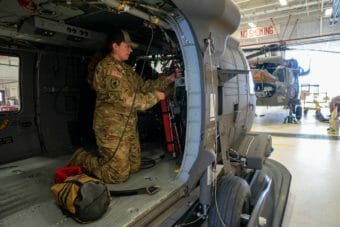
Sgt. First Class Mikana Halloran demonstrates the capabilities of the HH-60M Black Hawk medevac helicopter on Joint Base Elmendorf-Richardson on Sept. 7, 2022. (Loren Holmes/ADN)

By the time Sgt. 1st Class Mikana Halloran descended from a helicopter by way of a winch-fed cable toward the top of Crow Pass, her target, a single hypothermic hiker, was stripped down near naked.

“He left all his stuff on the ground. He was just wearing his underwear,” Halloran said of the August rescue.

Stuck in the wet and cold of the Chugach Mountains, the man gradually shed all his soaked outerwear trying to keep it from further freezing him, until, by the time help arrived, he was left in just base layers.

Halloran strapped him into a harness, and the pair ascended into the belly of a Black Hawk outfitted for medical care. There, she jammed heat packs under the otherwise-uninjured man’s armpits before swaddling him in blankets for the flight to an Anchorage hospital.

Halloran, who grew up in Healy, is a medic with the Alaska Army National Guard, one piece of the state’s elaborate web of agencies, organizations and individuals involved in searches, rescues, and recoveries — the technical euphemism for returning the body of a person who has died afield.

The number of search and rescue missions in Alaska is rising, gradually ticking upwards in recent years from a combination of proliferating safety devices, social trends and esoteric but effective reconfigurations in military-governmental bureaucracy. Officials say that taken all together, the changes generally mean less searching, more rescuing.

Still, few Alaskans, even those who know in the back of their minds they will be saved if they twist an ankle on a backcountry hike or flip a four-wheeler out moose hunting, know much about the intricate system that launches into place once they hit SOS on an InReach or text a spouse to send help.

The short version is: it depends where you get hurt.

Two HH-60M Black Hawk medevac helicopters sit in a hangar on Joint Base Elmendorf-Richardson on Sept. 7, 2022. (Loren Holmes/ADN)

‘There’s been a lot of airplane crashes for us this summer’

To a civilian, the jigsaw puzzle of jurisdiction and chains of command between federal, state, and civilian authorities involved in a search and rescue mission is nearly indecipherable, governed by intricate org-charts, jargon-laden acronyms and numerology bordering on the occult.

Where you get hurt or lost determines much of who will end up rescuing you.

Let’s say you are out on the north side of the Alaska Range when you trip over a tussock, falling down a steep stretch of tundra, breaking your leg badly enough there’s no chance you can stand, let alone walk yourself to help. Luckily, you recently spent a few hundred dollars on a safety beacon, and when you hit the SOS button it relays the signal to an array of satellites that then give your coordinates to an out-of-state private company, letting them know you are in trouble. They in turn contact officials in Alaska. And then the real work begins.

Some of the variables to consider as this rescue mission takes shape: are you inside a national park or on state land? Is the pitch of the hill steep enough to merit a helicopter hoist rescue? Is there a local search and rescue crew in the relative vicinity that the Alaska State Troopers can activate? Is it a holiday or weekend? How much daylight is left? Which rescue entities have enough personnel on hand for this particular call out?

The considerations are no more straightforward if your trouble occurs on water, where rivers and oceans are overseen by entirely separate chains of command.

In general, the Alaska State Troopers take the lead when a distress signal comes in and handle most of the search and rescues that happen on land. They work hand-in-glove with local SAR crews, volunteers, and regularly get help from helicopters, planes, and personnel under the military.

The Alaska Rescue Coordination Center, photographed Wednesday, Jan. 9, 2019 at Joint Base Elmendorf-Richardson. (Loren Holmes/ADN)

Plane crashes, though, fall under a wholly different chain of command. And even in a normal year Alaska sees a lot of aviation accidents.

“It’s been been pretty busy. There’s been a lot of airplane crashes for us this summer,” said Lt. Col. Christy Brewer who directs the Alaska Rescue Coordination Center.

The center is staffed around the clock by at least 12 members of the Alaska National Guard, and handles aeronautical search incidents, which in a state with so much aviation makes it a key player. The center functions like a football coach diagnosing a given situation and picking plays accordingly, but never actually taking the field. At the entryway is vintage map peppered with pins demarking airplane crashes. The display is a relic. Years ago, the Guard replaced it with a Google map.

A map at the Alaska Rescue Coordination Center shows the location of airplane crashes in Alaska, on Jan. 9, 2019. (Loren Holmes/ADN)

Much of the RCC’s work is parsing whether there’s a real need for help, or if there’s just been some kind of miscommunication. Signals arrive all the time that could suggest trouble, but are resolved with a phone call or runway check confirming the person in question is fine but, for example, accidentally bumped the emergency transponder in their cockpit.

This fall, the Guard launched a search for a moose hunter 60 miles northwest of Galena after a distress signal pinged from his airplane’s safety equipment. The RCC scrambled an air crew, which eventually located the man. He’d left his plane and rafted six miles down river, ultimately relaying by radio to the guardsmen that he didn’t need any help.

“He crashed and probably didn’t realize that the authorities are already notified. And we’re going to act and go rescue you, and treat it as distressed until we can be proven otherwise,” Brewer said.

For complex rescues, the center taps what is referred to as the “rescue triad,” three squadrons under the Air Guard’s 176th Wing comprised of helicopter teams, HC-130 Combat King II plane crews, and pararescuemen called almost exclusively “PJ’s.” Those are the elite Swiss Army knives of the search-and-rescue world, expected to parachute out of planes, hike up mountains, dive below water and either extract a patient or else keep them alive in inhospitable wilderness for days.

“We’re the only ones that would do what we do,” said Senior Master Sgt. Chris Robertson, a Colony High School grad with decades of experience on the kinds of rugged backcountry and combat rescues the PJ’s are known for.

“There’s a lot of stuff that we do that you just can’t find in doctrine, can’t find in regulations,” Robertson said.

From left, 1st Lt. Chris Bailey, Capt. Ben Van Alstine, and Senior MSgt. Chris Robertson discuss the Alaska Air National Guard’s rescue operations on Joint Base Elmendorf-Richardson on Sept. 7, 2022. (Loren Holmes/ADN)

Outside trends

Even though COVID-19 pushed more people to recreate outdoors, the pandemic actually led to a calmer-than-normal SAR season in Alaska during 2020.

“People weren’t at work, or were teleworking. But they were camping, they weren’t actually going further out. So our numbers (were) actually down a little bit. Not much, but they were down a little bit during COVID,” said Lt. Paul Fussey, the search coordinator for the Alaska State Troopers.

Along the road system there were fewer out-of-state tourists requiring assistance. In rural Alaska, many communities barred inter-village travel in order to curb viral spread. All that led to fewer rescues.

“A lot of the communities out in western Alaska were locked down. So that dropped the number of individuals visiting family members back and forth, or going to the larger hubs to get groceries. Same with southeast,” Fussey said.

But since then, the numbers have reversed course and kept with a longer-term trend of slowly ticking upwards. Between July 1 and Sept. 11 this year, Alaska saw 176 individuals rescued or recovered. During the same period last year it was 146, and 145 the year before that.

One of the factors Fussey and others point to is the steadily growing popularity of personal locator beacons and similar devices that can relay positioning and distress signals to officials. According to Brewer with the RCC, the number of such devices sold has increased by 10% each year since 2016. The effect for rescue coordinators is receiving more pings, whether or not the event generating them is serious. In earlier eras, a hunter or hiker in trouble might not have been reported missing until days after she was due back home. Or they might have been spotted by a good Samaritan, extricated from harm without a formal report ever reaching the RCC. Now, though, more people in the backcountry carry a piece of hardware with a satellite-linked SOS button.

The main frustration in the rescue community with locator beacons is that too often people don’t register them, omitting crucial information like the owner’s identity, where they live, an emergency contact, all of which can save searchers hours of hunting for clues about who might have pressed that help button.

“I can’t stress that enough,” Fussey said. “If you have an ELT or personal locator beacon, once you purchase it, register it.”

Various ELT’s on display at the Alaska Rescue Coordination Center in 2017. (Bill Roth/ADN)

‘Everybody knows somebody who’s been rescued’

Another substantial change in the state’s SAR system is an infusion of helicopters over the last half decade. Beginning in 2017, the Alaska Army National Guard changed how it used helicopters, from an offensive mission to general support aviation. That seemingly remote bureaucratic adjustment led the Army Guard to mix different helicopters into its fleet and build up its capacity for in-flight medical care. Members of the unit, many of whom were reared in Alaska, searched for ways to add extra capabilities to the state’s SAR system that were missing.

Capt. Cody McKinney is the deputy state army aviation officer for the Army National Guard, photographed on Joint Base Elmendorf-Richardson on Sept. 7, 2022. (Loren Holmes/ADN)

“What we try to do is to complement each other and not compete,” said Capt. Cody McKinney, an East High grad who up until a few months ago was the medevac commander for the Army Guard.

“Where we tend to excel is as high altitude, high angle, dynamic hoist profiles,” McKinney said of the Army Guard’s specialty, meaning rescuing people up high on steep mountains by scooping them into a helicopter hovering overhead, or sometimes in actively in motion to avoid the rotors blowing the injured patient off a cliff.

Overall, the shift in organizational priorities has added new hardware and personnel to rescue missions across the state. Not just in Southcentral where the majority of the Army Guard’s fleet is based, but also in Western Alaska where the unit tries to keep small numbers of personnel year-round in a few hub towns. That capacity was in high demand in the weeks after the Merbok storm slammed into communities along the Bering Sea coastline. During assessment and recovery operations, Army Guard Black Hawk helicopters stationed in Nome and Bethel flew thousands of miles ferrying public officials between communities and bringing in supplies.

“I would say up until maybe two years ago, we kind of got all the leftover missions,” said Chief Warrant Officer 3 Michael Miller, who grew up in Western Alaska and recently finished a two-year posting in Bethel.

As a relative newcomer to the state’s rescue community, the Army Guard picked up work other entities passed on for one reason or another. Often that meant back-filling capacity on weekends and holidays. Or missions like body recoveries that rarely bring positive attention or commendations, but helped hone the unit’s technical acumen.

“We’re all Alaskans, we all grew up here,” Miller said. “Everybody knows somebody who’s been rescued.”

Chief Warrant Officer 3 Michael Miller stands next to a HH-60M Black Hawk medevac helicopter on Joint Base Elmendorf-Richardson on Sept. 7, 2022. (Loren Holmes/ADN)

This story originally appeared in the Anchorage Daily News and is republished here with permission.

Federal inspectors fault assaults, escapes, improper use of locked seclusion at North Star youth psychiatric hospital

""
North Star Residential Treatment Center in Anchorage on Tuesday, Sept. 27, 2022. (Photo by Bill Roth/ADN)

Earlier this year, young patients at North Star Behavioral Health System — a locked, for-profit psychiatric hospital for children and teenagers in Anchorage — staged a small mutiny.

In June, a patient hit the fire alarm, unlocking doors. Four patients fled the hospital. The group roamed Anchorage for hours. By the time they were tracked down and returned by police, one patient was so drunk they had to be taken to a different hospital.

The next day, a staff member described the events to a visiting federal investigator with the Centers for Medicare and Medicaid Services as a “riot.” A physician later described the days as “the (worst) weekend the facility has had in years.”

During two hospital inspections in April and Junefederal investigators documented more than a dozen “deficiencies” at North Star Behavioral Health System’s Anchorage campuses, the only hospital in Alaska to be cited during that timeframe. Investigators found some problems at North Star to be so serious, like assaults, they were deemed “immediate jeopardy” situations at the time, meaning the health and safety of patients was at risk.

North Star CEO Anne Marie Lynch said she couldn’t say anything about the events documented by the federal investigators, citing patient privacy laws, when contacted this week by the Anchorage Daily News.

The same federal investigators visited in September and found “no deficiencies or recommendations,” she said. The hospital isn’t under any plan of correction with their powerful federal regulators, according to North Star.

“We continue to monitor our compliance with standards as well as the quality of our programs,” Lynch wrote. “When issues are identified we investigate thoroughly and create action plans to improve.“

The more than 150 pages of reports by federal investigators offer an official view of dysfunction that former patients and families of patients have long described at the East Anchorage hospital.

Among the findings:

  • Patients assaulted other patients, including an instance where two children were locked in a “quiet room” together accidentally. One attacked the other, leaving a child’s nose bloodied. The hospital didn’t investigate how the incident happened.
  • One patient was punched, slapped in the eye and kicked by peers but their parent wasn’t told, according to the investigation. “Mother stated she is really upset for not being notified when her child was attacked by another patient,” the child’s case notes read. She tried to discharge her child immediately, but ended up waiting overnight at the suggestion of staff.
  •  A young patient at North Star psychiatric hospital in Anchorage spent 40 days in the locked facility without receiving a single therapy session.

The investigation’s findings are no surprise to Angel Gonzales, the board president of Facing Foster Care in Alaska, a nonprofit advocacy organization. Gonzales was in and out of foster care from ages 7 to 16 and now works at Covenant House as a permanency navigator. She’s been hearing stories about escapes, seclusion and assaults from kids sent to North Star for years now. She remembers almost being sent there herself because the Alaska Office of Children’s Services didn’t have another placement, she said. She said she was terrified by the prospect.

“All of the things this investigation is going to highlight have been happening for years and years,” said Gonzales. “Nothing is new.”

North Star operates three campuses in Anchorage and one in Palmer: a hospital at 2530 DeBarr Road, a residential treatment facility at 1500 DeBarr Circle and the Chris Kyle Patriots Hospital, for adults, on Bragaw Road. North Star also operates a home in Palmer, for children. The report is mostly focused on the DeBarr Road locations but found that the Chris Kyle Patriots Hospital lacked a process for reporting allegations of abuse against vulnerable adults by staff or volunteers.

The Centers for Medicare and Medicaid Services, the federal regulator, is charged with ensuring hospitals are meeting standards for patient safety and care. Hospitals that fail CMS inspections and don’t fix serious problems can be decertified, which means they would no longer be allowed to accept Medicaid or Medicare payments. That’s usually a death sentence for hospitals that rely on the ability to bill federal programs.

It was that threat of CMS decertification that led officials, in 2019, to bring in an Outside consultant to help run the Alaska Psychiatric Institute after it repeatedly failed inspections, coming perilously close to losing its CMS certification.

Complaints about North Star pour into the Disability Law Center of Alaska, a nonprofit legal organization with a federal mandate to investigate whether Alaskans with disabilities are treated fairly.

“We get complaints from parents, foster parents, other folks that are concerned about the quality of care,” said Patrick Stocks, an attorney with the Disability Law Center.

At the same time, Alaska has so few options for hospital-level or outpatient psychiatric care, especially for kids, that North Star represents one of the only places available to families and agencies, Stocks said. Often, it’s the only in-state option available.

“We also get the calls … from families who are desperately looking for a place to comply with the level of care they need, and they’re just not finding anything and it’s a pretty terrible situation,” he said.

North Star is owned by Universal Health Services, a Pennsylvania-based corporation listed on the Fortune 500. It owns and operates hundreds of health facilities, including many behavioral health hospitals, around the country. Annual revenues exceed $11 billion, according to the company.

In 2020, Universal Health Services Inc. agreed to pay $122 million to settle allegations that it billed for medically unnecessary behavioral health services and failed to provide adequate care, among other allegations, the U.S. Department of Justice said at the time.

Many of the kids who spent time in North Star were in state Office of Children’s Services custody.

Alaska child welfare authorities have been criticized for sending children to North Star because other placement couldn’t be found, not because their problems are severe enough to warrant a stay in a locked facility. A 2022 class action lawsuit filed on behalf of children in Alaska’s foster care system describes the Office of Children’s Services placing a child at North Star simply because they couldn’t find anywhere else. In 2021, the U.S. Department of Justice’s civil rights division opened an investigation into whether the state of Alaska “unnecessarily institutionalizes” children with behavioral problems. That investigation remains open.

Mateo Jaime was 16 and in OCS custody when he was sent to North Star for about two months back in 2018. He says there was no reason for him to go other than lack of another foster home placement. The problems described by the federal inspectors were familiar.

”That was the whole experience,” he said. “You have not gone to North Star unless you’ve seen a fight. Unless you’ve seen people escape. Unless you’ve been locked into a quiet room.”

Jaime said he became “like a zombie” to get through the days at North Star. When he was released, a sense of fear that he could be sent back at any time lingered. He’s now a student at the University of Alaska Anchorage pursuing dual music and legal studies degrees. He ages out of foster care in a month.

He’s also become an activist for change in the foster care system, in part because of his experience at North Star.

”It needs to be addressed,” he said. “A for-profit organization should not have the most control over youth mental health in Alaska.”

North Star remains a licensed facility, and OCS continues to send children to the hospital, said Brian Studstill, communications director for the Alaska Department of Family and Community Services. As of Monday, there were “less than 10″ children in North Star who were in state custody, he said.

“North Star is one of only two facilities in Alaska that can accept children and youth experiencing mental health crises and need acute care treatment,” Studstill wrote. “The lack of in-state acute care treatment for children continues to pose challenges for both parents in our communities and OCS.”

In North Star’s inspections from this year, many of the investigators’ critiques revolved around the hospital’s use of locked seclusion rooms for children and teens acting out. The investigators found instances in which children were left in the rooms without any documentation in their records, or were not properly monitored. In one case, a child slept in the room overnight. A patient under the age of 9 spent more than an hour locked in seclusion, against policy, investigators found.

Managers told the inspectors that short staffing was a major problem at North Star, the reports say.

That’s not an issue confined to North Star, Stocks said. Elsewhere in Alaska and around the country, psychiatric hospitals have struggled to find enough workers, a longstanding problem made worse by the coronavirus pandemic and a generally tight labor market. North Star has a “robust recruitment program” and has been hiring staff, said Lynch, the CEO.

“Our institutions up here are really struggling to staff,” Stocks said. “One thing that happens is when a psychiatric facility doesn’t have enough staffing is they’re going to take shortcuts at the expense of their patients.”

Gonzales, who spent time in OCS custody, said the experience of a stint inside North Star is a common one among kids in the foster care system. That’s even clearer now that she works at Covenant House, helping young people who are homeless or living in shelters find permanent housing.

“A lot of them know each other from North Star,” she said.

This story originally appeared in the Anchorage Daily News and is republished here with permission.

Site notifications
Update notification options
Subscribe to notifications