Anchorage Daily News is our partner in Anchorage. KTOO collaborates with partners across the state to cover important news and to share stories with our audiences.

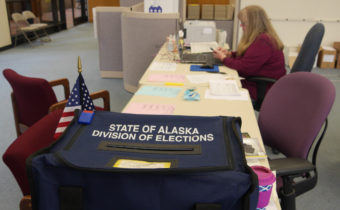
Election official Hali Denton runs a polling place for early and absentee voters in the State Office Bulding on Aug. 15, 2016. She said it’s been slow. (Photo by Jeremy Hsieh/KTOO)
Newly appointed Alaska Division of Elections Director Carol Beecher said Thursday that she was considering severing ties with a nonprofit that helps maintain voter rolls, after several Republican-led states announced earlier this month their intention to pull out of the effort.
Beecher told state lawmakers she was evaluating Alaska’s membership in the organization during a presentation to the Senate State Affairs committee. She cited the cost of the program as a reason for leaving despite the benefits it provides.
ERIC has been the target of false claims from Republican former President Donald Trump and his allies, who have pointed to funding the program received from George Soros, a liberal billionaire and investor, as cause for concern. Trump wrote earlier this week on his social media platform that Republican-led states should pull out of the system, saying it “‘pumps the rolls’ for Democrats.”
“We are definitely looking into it,” said Beecher, who is a member of the Republican Party and has donated money to Republican candidates, including to Trump, but has vowed to keep her own political views separate from her position as required by state statutes.
“There are some benefits to remaining in (ERIC) because it does help us with list maintenance. There are also some drawbacks,” Beecher said in her first presentation to legislators since she was appointed to oversee the state’s elections by Lt. Gov. Nancy Dahlstrom earlier this year.
Beecher said the organization helps the division remove individuals from Alaska voter rolls if they move to another state, but she added that given the cost of membership, she was considering alternatives.
“It’s expensive and we are a small state, so to the degree that it has a value monetarily based on our smaller population in the cleaning it does — are there ways that we could do it better ourselves? Those are the things that we’re looking into to see if this is a good return on investment for the state,” said Beecher, who did not provide the specific cost of the program during her exchange with lawmakers.
According to data provided by the Division of Elections on Monday, ERIC fees and dues in recent years have been less than $17,000 annually. Additionally, the state has spent between $10,000 and $24,000 per year on contacting voters by mail once the system identified issues with their registration.
Between 2016, when Alaska joined the program, and the midpoint of 2022, the state paid a total of just under $199,000 for both annual membership dues and mailing expenses. In that time, the service helped the state cancel the registration of 14,000 individuals who left Alaska and 1,565 individuals who died.
The program has also helped the state identify and contact more than 136,000 individuals who were eligible to vote but not registered between 2016 and 2022.
Election officials in other states, including some Republican-controlled states, have praised the system and reported that it has helped them identify thousands of names to be removed from voter lists.
Beecher’s comments were met with some concern by members of the Senate State Affairs committee, including Sen. Matt Claman, D-Anchorage, who urged Beecher to analyze alternatives before deciding to leave the organization.
“If somebody says ERIC is imperfect, I bet it’s imperfect. The question becomes, do we have a better alternative and if we were going to switch, do we have confidence that that alternative will actually work better?” Claman said.
The prospect of leaving ERIC is supported by Sen. Mike Shower, R-Wasilla. The conservative Republican — one of three who are not members of the bipartisan Senate majority caucus — said that he has opposed the organization because he believes that the state is illegally sharing voter information with ERIC, which he described as a private, non-governmental entity that is not subject to direct government oversight. Instead, Shower said he thought the state should rely on government departments to gather information for updating voter rolls.
“I hear people talking about the Soros funding and all the other garbage. I don’t care if it was the Koch brothers funding this, I am not comfortable with a non-governmental entity telling a state what it can and can’t do,” said Shower.
ERIC was founded in 2012, the same year a report found that one out of eight voter registrations in the U.S. were no longer valid. The organization uses voter registration information and motor vehicle department information from member states to identify when people move from state to state or within a state.
Both Claman and fellow committee member Sen. Bill Wielechowski, D-Anchorage, said after the committee hearing that they were not worried about Beecher’s comments because she had not committed to cutting ties with ERIC without identifying an alternative.
But Senate Majority Leader Cathy Giessel, R-Anchorage, has expressed concern about Beecher’s appointment to the role, given Beecher’s refusal to change her registration as a member of the Republican Party.
“It’s critical that that job is a nonpartisan person, so it does cause some concern that she’s not willing to be a nonpartisan person in her affiliation,” Giessel said Thursday. “Whether that affects her judgment remains to be seen.”
Alaska’s previous elections director, Gail Fenumiai, had not been a registered member of either political party. Fenumiai retired after administering Alaska’s 2022 elections. Dahlstrom, the lieutenant governor charged with appointing an elections director, announced in February that she had selected Beecher for the role, a few months after Beecher had donated to Dahlstrom and Gov. Mike Dunleavy’s campaign for office.
Giessel, who served as president of the Anchorage Republican Women’s Club more than a decade ago when Beecher was a member of the club, described Beecher as “a solid Republican.”
“I think that jeopardizes one’s judgment, which is why I think it’s important it’s a nonpartisan person who is willing to say, ‘I am nonpartisan,’” Giessel said.
Daily News reporter Sean Maguire contributed from Juneau.
The store in Stebbins is struggling to keep food and other supplies in stock. Photographed Feb. 23, 2023. (Photo by Daisy Katcheak)
It’s been nearly six months since the Alaska Division of Public Assistance first began to fall behind on processing federal food stamp applications, leaving thousands of Alaskans still waiting for benefits to arrive now.
In rural Alaska, where food costs can be astronomical and food banks or pantries are rare, residents are experiencing particularly dire consequences from the unprecedented backlog, advocates say.

While Alaskans all over the state have been struggling as a result of the delays, officials with the Food Bank of Alaska said they have been contacted by people in multiple villages in rural Alaska — particularly in Western and Northwest Alaska — asking for assistance with an urgency that reflected the lack of a safety net in many of these communities.
Stories are emerging of people digging to the bottom of their freezers for scarce game, relying on friends and neighbors to fill empty shelves, and even in some rare cases requiring hospitalization for malnutrition.
“People are literally starving,” Ron Meehan, Food Bank of Alaska’s policy and advocacy manager, said this week.
“They’re calling and saying ‘We have nothing,’” Meehan said, referring to the handful of communities where people have reached out for help. “But the reality is that there are probably far more than that experiencing this, they just don’t know how to reach us.”
Volunteer Andrea Stein stocked shelves in the agency shopping room at the Food Bank of Alaska off Viking Drive in Anchorage on Thursday, Feb. 23, 2023. (Bill Roth / ADN)
Food Bank staff said they are able to deliver food to struggling food pantries in some communities, but are limited by dwindling resources, rising food costs and fewer donations even as more people need help due to Alaska’s delays processing applications in the federal Supplemental Nutrition Assistance Program, or SNAP.
“So many of our food banks and food pantries simply do not have the capacity to meet this need,” Meehan said.
Food Bank of Alaska policy and advocacy manager Ron Meehan inside their food warehouse on Viking Drive in Anchorage. Photographed on Thursday, Feb. 23, 2023. (Bill Roth / ADN)
‘My community is suffering’
In Stebbins, a Western Alaska village where nearly all residents qualify for food stamps and few have gotten them, three elders have needed to be hospitalized for malnutrition, said city administratorDaisy Lockwood Katcheak.
The community, located roughly 120 miles southeast of Nome and home to more than 600 people, has suffered multiple devastating events in a short span of time, which Katcheak said have compounded on each other in combination with the SNAP delays.
The sole store in Stebbins burned early Tuesday morning, Nov. 29, 2022. (Photo by Linda Greta Camillus)
A historic storm battered much of Western Alaska in September including Stebbins, and severely flooded many homes. Then in November, the community’s only store burned down.
“We make-shifted a little store that’s been cut down to a third, and only sells shelf-stable foods,” Katcheak said Thursday. “On top of that, there’s such a delay with the food stamps, so my people are further being impacted by that.”
The store in Stebbins is struggling to keep food and other supplies in stock. The cart is for produce, which has not been seen for a while. Photographed Feb. 23, 2023. (Photo by Daisy Katcheak)
In recent months, Stebbins officials have had to rely on food donations from the Red Cross, the Food Bank of Alaska and the Alaska Native Tribal Health Consortium to keep residents fed.
“I just requested more food for our community because our people are not receiving the nutritional value,” she said. “My elderly and my children are being impacted. My community is suffering.”
The last bone
In Kivalina, 72-year-old Becky Norton struggled for months to feed her family of nine. There are no food banks or pantries in this largely Iñupiat village on a barrier island along the Chukchi Sea.
Norton’s family typically receives around $1,800 a month in SNAP benefits for her family that includes her three young grandchildren, she said.
Norton filled out her recertification application in November, and by January, still hadn’t heard anything back from the state’s Division of Public Assistance regarding the status of her application.
While Norton waited for her SNAP benefit application to be approved, she said she searched through her freezer for any caribou remnants from past hunts — a once plentiful but now scarce food source for her family with the decline of local herds.
“I found in the bottom of my freezer a single leg bone, enough to make soup,” she said.
Meanwhile, Norton said, she waited on benefits and budgeted carefully to keep the family’s monthly Social Security payments from running out. She knew that if she became truly desperate, she could post in a local Facebook group to ask for assistance from her neighbors.
“We are a caring community,” she said. “So if we know that someone is struggling, people will make little care packages. Not much, but to help them get by.”
Norton finally got help expediting her application from Alaska Legal Services. Within a few days, SNAP funds were deposited in her account.
Her sister, who applied for benefits around the same time she did, still hasn’t received any word from the state about the application she submitted over four months ago.
Norton herself is still waiting on her state application for energy assistance, one of several programs also experiencing delays. She applied for that in September, before the cold arrived. Last week, she got an electric bill for $423.
Significant delays continue
The extent of the food stamp application processing problem first surfaced in late December when multiple Alaska news outlets reported on major delays within the public assistance division, which processes the applications.
Thousands of Alaskans already been waiting months to receive SNAP benefits reported spending hours on hold with the state’s virtual call center only to be told there was nothing to be done to speed up the process. Many calling about food stamps are also experiencing delays for other types of public assistance, including senior benefits, Medicaid — and heating assistance.
State officials attributed the public assistance processing delays to a staff shortage, a cyberattack that disrupted online services for months, and an influx of recertification applications in early fall when an emergency pandemic-era program expired in September. The program made it easier for Alaskans to receive maximum benefits without annual recertifications. It ended with the state’s emergency declaration, which wound down in July.
Since December, the director of the Division of Public Assistance has been replaced, and 10 Alaskans have filed a lawsuit alleging that the delays were a violation of federal law.
Last month, Heidi Hedberg, the state health department’s commissioner-designee, said the department was hiring workers via an emergency contract to focus solely on food stamps and Medicaid as a way to get the agency back up to speed.
Since November, the department has hired 71 new staff members “in various stages of training,” department spokeswoman Sonya Senkowsky said in an email this week.
But as March approaches, the backlog still hasn’t been cleared. In an email this week, Hedberg said the state is still processing SNAP applications received in October. And on the front lines, advocates at the Food Bank say the majority of their clients still aren’t getting benefits in a timely way.
Staff with the Food Bank of Alaska this week, however, said they’re still working with clients whose applications are marked as received in September with no action taken since.
“We’re continuing to see significant delays in processing,” said Magen James, the organization’s SNAP coordinator.
‘Nothing we can do’
As the backlog stretches on, Food Bank of Alaska staff describe staffers exhausted after months of dealing with people going hungry around the state with limited access to food resources.
“The secondary trauma of dealing with people that are starving every single day has been taking such a toll on my staff,” James said.
Douglas Carothers moves a pallet of perishable donations to the refrigerator at the Food Bank of Alaska on Viking Drive in Anchorage on Thursday, Feb. 23, 2023. (Bill Roth / ADN)
The organization is struggling to keep up with the demand, Food Bank officials say. Even in places on the road system, like Soldotna, residents dealing not only with delayed benefits but inflation say the high price of fuel has made it difficult or impossible to drive into town to visit a food pantry, according to Greg Meyer, with the Food Bank in that community.
The organization has been driving out to smaller communities to distribute food in response but the demand hasn’t let up, and resources are limited:Meyer said the food bank there has gone through about 75% of its stored food since September, and has seen nearly a 50% increase in the number of families seeking food assistance each day.
The impact of rising food and fuel costs on top of delayed federal benefits has been particularly hard on elders and single parents, said Carey Atchak, food security coordinator for Bethel Community Services Foundation.
Atchak, who helps manage the city’s food pantry, said it’s been nearly impossible to keep up with the demand.
“I purchase about $1,000 worth of products on Monday, and by Wednesday, everything has been depleted,” she said.
The charity sector is not set up to replace federal benefits — Meehan said that SNAP benefits typically provide more than 10 times as much food as is typically distributed by food banks. Over the last year, the Food Bank of Alaska also experienced a drop in the amount of food it has been able to provide, he said.
In places far from a food bank or pantry, like the Yukon River community of Mountain Village, staff said they feel a sense of helplessness.
“We’ve seen a significant increase in the amount of clients from Mountain Village specifically asking about their SNAP benefits, and they’re still not getting approved, and then asking for food, and there’s no food bank or pantry or anything in that region,” James said. “And unfortunately, I had to tell people that they’re going to have to wait. There was nothing that we can do.”
Mike Cox looks through family photographs of his brother, James Rider, whose death by suicide was discovered at Mat-Su Pretrial Facility in September. (Marc Lester / ADN)
Last summer, it seemed like James Rider was turning a corner.
The 31-year-old from Wasilla had spent years struggling with drug addiction, accumulating a low-level criminal record and derailing a career in construction.
He’d finally started taking steps to address his substance abuse problem, and his family sensed change might be coming.
Then, in August, he was booked into the Palmer jail on charges that included trespassing and removing his ankle monitor. Ten days later, he was dead.
Rider’s older brother, Mike Cox, is still trying to piece together what happened. When Rider got to Mat-Su Pretrial Facility, he voiced feelings of hopelessness and was placed on suicide precautions. His brother says he was stripped and put in an anti-suicide smock in a padded cell.
In a jailhouse phone call, Rider told his brother he found the experience humiliating. He vowed to never mention feeling suicidal to jail staff again.
Mat-Su Pretrial Facility in Palmer, photographed on Feb. 15, 2023. (Marc Lester / ADN)
A few days later, Rider was taken off suicide precautions and — for reasons his family still doesn’t understand — placed alone in a cell. He hanged himself.
In 2022, a record 18 people died while in custody of the Alaska Department of Corrections.
Seven of those deaths, or about 40%, were suicides, according to the department. That’s also a record.
Until now, little has been publicly known about the circumstances of these deaths and the events that preceded them.
Corrections department officials have consistently said they can’t release details about individual deaths because of medical privacy laws.
But an analysis by the Anchorage Daily News sheds new light on in-custody deaths in Alaska. The Daily News obtained and reviewed Alaska State Troopers investigation reports and medical examiner records, and spoke with families, advocates and prison officials.
The analysis of in-custody deaths shows that of the seven suicides:
• Two occurred in housing units where inmates with mental health concerns are placed for heightened monitoring.
• Two people killed themselves while in solitary confinement in “segregation” or “special management” units.
• In one case, a young woman’s suicide went undetected by guards for more than three hours, despite seven “wellness checks” to her cell. She was being held in a unit meant to provide a hospital level of psychiatric care.
• Two men who’d recently been on suicide watch were moved to cells alone, a scenario the department’s own chief of mental health says is not recommended. One of the men had just been cleared from suicide watch by a psychiatrist.
The trooper investigation reports also reveal the circumstances of some of the deaths classified as “natural.” Those include five deaths due to terminal illness, a man who died from pneumonia related to COVID-19 and a man who died from a seizure disorder. The Alaska Department of Public Safety did not release six incident reports for cases that had not been finalized.
The suicides unfolded at a startling pace: In June alone, four people took their own lives in four different prisons, from Nome to Seward to Eagle River to Anchorage. One death per week. All of the suicides involved people who were on pretrial status in jail, accused of crimes for which they had not yet been convicted.
The sheer number of deaths is alarming, said A.E. Daniel, a Missouri-based forensic psychiatrist who has written several books on prevention of suicide in correctional facilities. “It should enable the administrators to take a look at their program and see where they went wrong.”
Officials with the Department of Corrections say they are reviewing Alaska’s policies on suicide prevention. But the review hasn’t identified a unifying issue, said Adam Rutherford, acting director of the Division of Health and Rehabilitation Services.
“I wish I could say that there was,” he said. “Because … then you could just fix that issue and prevent it from occurring again.”
The Department of Corrections had an independent investigative unit that made inquiries into deaths, including suicides, from 2016 to 2018. The newly appointed commissioner, Nancy Dahlstrom, eliminated the unit early in her tenure after the election of Gov. Mike Dunleavy, citing cost savings.
National increase in suicides at correctional facilities
Experts agree that prisons have a legal, medical and ethical duty to provide physical and mental health care for incarcerated people, including preventing suicides.
Yet suicide in correctional facilities is a mounting national crisis.
Self-inflicted deaths are the leading cause of death in jails nationally, according to a study by Florida Atlantic University, with a rate three times higher than among the general public.
Moreover, such deaths among incarcerated people have been rising over the past two decades, and have increased sharply around the country, according to data from the Bureau of Justice Statistics. Suicide rates among incarcerated people rose during the pandemic.
The reasons aren’t clear, said Daniel.
“One of the reasons could be the pandemic, which caused significant isolation” in jails and prisons, with quarantine rules limiting contact, visits and the kinds of classes and therapy available, he said.
The stretched labor market also led to staffing shortages for correctional employees that monitor inmates.
Correctional systems can — and must — prevent suicides through policies and training, Daniel said. The most common mistakes that corrections departments make come down to failures of screening and identification of a suicide risk, and of inadequate monitoring.
First, Daniel said, it’s important to have mental health professionals screen prisoners for suicidal risk — especially during the first few days in jail. People who are intoxicated or coming off drugs are at especially high risk.
Most of Alaska’s in-custody suicide deaths of 2022 were people who had only been incarcerated a relatively short time while awaiting trials. Some were detoxing from drugs or had a history of addiction, according to Megan Edge of the ACLU of Alaska, who has talked with families of some of those who died. And about 65% of all of Alaska’s inmate population has a diagnosable mental illness, according to corrections officials.
“Those are really complicated issues for somebody to have and go into such a traumatic setting, when they’re not going to get the resources that they need,” Edge said.
James Rider
Rider was a “typical Valley kid” who grew up in a rambling Houston home with two siblings, his brother said. His family also spent time living in King Salmon and Naknek, where they commercial fished in Bristol Bay. As an adult, he found work painting barges, cleaning boats, doing construction and working on motors. He liked to hunt, fish and ride four-wheelers. He had three kids, and a fiancee.
A box contains the ashes of James Rider, whose death by suicide was discovered in September at Mat-Su Pretrial Facility. It’s held by, from left, Rider’s fiancee Heather Fisher, his mother Theresa Martin and his brother Mike Cox on Feb. 15, 2023. (Marc Lester / ADN)
He was the baby of the family, a people-pleasing joker who loved attention, his brother said.
“He was so damn funny,” Cox said. “He made any situation something to laugh about.”
On Aug. 30, Rider was arrested by troopers for trespassing, cutting off his ankle monitor and violating the terms of his release in another case. Cox said Rider knew he had an outstanding warrant and cut off his ankle monitor on purpose, knowing he’d go to jail.
“He wanted to get in and start serving his time for his warrant,” Cox said.
He’d spent short stints in jail before, for low-level property crimes. But once he was at Mat-Su Pretrial, he learned he was facing serious felony charges that could lead to years in prison. Bereft, he told jail officials he was feeling suicidal and found himself on strict precautions.
“He said it was completely humiliating to be stripped down naked and put into a padded room,” Cox said. “He told me on the phone, he would never say s–t to these correctional officers about being suicidal again after the way he was treated.”
Off precautions, he was moved to a cell with roommates. Then on Sept. 5, Rider was transferred to a cell in the “Charlie Dorm,” where he was left alone. His brother isn’t sure why — the Palmer jail is notoriously overcrowded. Charlie Mod is a “segregation unit,” but it’s not clear if Rider was in punitive solitary confinement or he had asked to be placed in a cell alone.
James Rider, who died while in custody at Mat-Su Pretrial Facility. (Family photo)
That day, at 6:28 p.m. guards were alerted to a “possible suicide,” according to a State Medical Examiner’s Office investigator narrative shared by Cox. Rider had hanged himself from his bunk bed with a bedsheet. The narrative is the only documentation Cox has been able to get about the circumstances of his brother’s death. Rider was taken to Mat-Su Regional Medical Center.
Cox remembers the night well: The family had just gone to the Alaska State Fair.
“Troopers came out early in the morning and told us that there had been an accident at the jail,” he said. “James was in the hospital. By the time we got to the hospital, they told us that he committed suicide.”
At the hospital, his family found him with brain damage and no chance of recovery. They started the process to donate his organs.
As Rider was wheeled into the operating room, “the whole hospital lined up on both sides to pay their respects to him,” a tradition when an organ donation happens, Cox said. “The only good thing that came out of that whole thing was that one moment: James being the star again, making other people feel good with his donation.”
Lawsuits
Alaska’s corrections department has a history of failing to prevent suicides.
The most high-profile case: Israel Keyes, the federal inmate charged in the death of an Anchorage teenager and suspected of being a serial killer. Investigators with the FBI were in a monthlong process of interrogating Keyes in December 2012 when he was able to kill himself in a maximum-security cell at the Anchorage Correctional Complex.
The state paid hundreds of thousands of dollars in a lawsuit settlement and damages to the family of Mark Bolus, who died by suicide in the department’s custody.
Bolus hanged himself in solitary confinement at the Anchorage jail in 2014.
Maria Rathbun holds a picture of her son, Mark Bolus, in her lawyer’s office Friday, Dec. 1, 2017. Rathbun sued the state after her son, a paranoid schizophrenic, completed suicide while incarcerated at the Anchorage Correctional Center in 2014. A jury ruled on Nov. 22, 2017, finding that the state’s negligence led to his death. (Loren Holmes / ADN)
His family had thought Bolus, who had schizophrenia, would be safer in jail than anywhere else. Bolus’ mother, Maria Rathbun, sued. A jury found that the department was negligent, and that Bolus’ was impaired by mental illness and “not capable of exercising due care” for himself.
The department currently faces at least two current lawsuits on behalf of women who attempted or died by suicide while incarcerated in 2020. Both suits allege that the department failed to take adequate precautions.
Gabby Chipps was arrested for the first time on Aug. 23, 2020, in Homer, according to a lawsuit filed by her family. Despite being on suicide precautions and classified as “mentally unsound,” she was placed in solitary confinement, sometimes called “administrative segregation,” at Wildwood Correctional Facility in Kenai, the lawsuit says.
A correctional officer found her hanging from a bedsheet. It took more than five minutes for other workers to respond and cut her down. By that time she had suffered brain damage.
The lawsuit lays out her disabilities in stark detail: “Gabby has impaired vision and cannot see, Gabby cannot read, Gabby cannot speak, Gabby cannot feed herself, Gabby cannot walk, Gabby cannot bathe herself, Gabby requires a full-time caregiver for the rest of her life.”
The 21-year-old is now cared for by family members.
In December 2020, Natalie Andreaknoff had been in jail for less than a day when she took her own life at Hiland Mountain Correctional Center, according to a lawsuit on her behalf. She was placed in a cell beyond the range of surveillance cameras, the lawsuit alleges.
The corrections department “knew or should have known that placing Ms. Andreaknoff in inadequately monitored confinement would exacerbate her mental illness, drug withdrawal symptoms and risk for suicide.”
Both lawsuits assert that the women were misclassified by the department, and housed under conditions that made it easy and foreseeable they would attempt suicide.
The Alaska Department of Law said both cases are “active litigation.” The department didn’t offer a further response to the allegations in the lawsuits, saying it would answer in court.
Trooper investigations
Trooper investigations of the in-custody deaths that occurred last year obtained by the Daily News describe instances in which inmates were not monitored to the department’s policy of irregular 15-minute wellness checks, or when those checks didn’t reveal what was really happening in a cell — such as in the case of Kitty Douglas.
In March, Douglas, who was 20, was in Hiland Mountain Correctional Center’s acute mental health unit — one of two units statewide that’s supposed to offer a level of care comparable to the Alaska Psychiatric Institute.
Douglas, originally from White Mountain, had been in jail for six days on a misdemeanor criminal mischief charge. She was accused of breaking the windshield of a van in the Sullivan Arena parking lot. Her bail had been set at $100.
Video of Douglas’ cell showed her lying down in her bunk bed just before 4 p.m., according to the trooper report. Her last movements were captured about 10 minutes later, the report said. Over the next hours, correctional officers made seven “wellness checks” on the cell.
But no one realized she was dead for three hours, until 7:18 p.m., when a correctional officer came by to distribute snacks.
The Alaska State Troopers report says the suicide was missed in wellness checks because correctional officers thought Douglas was sleeping under sheets.
A note found in her cell said she wanted to be buried in White Mountain.
William Ben Hensley III was in a cell alone at Goose Creek’s high-security “special management unit” in October when a guard checked on him at 1:37 a.m., then returned to his office to do paperwork, according to a trooper investigation into his death.
The next check didn’t happen until 2:20 a.m. — some 43 minutes later. Hensley III had placed a sheet up to block the view before killing himself.
Every Alaska in-custody suicide death in 2022 involved a ligature used for hanging or asphyxiation. Nationally, about 90% of self-inflicted deaths in jails are due to hanging and self-strangulation, according to the Bureau of Justice Statistics.
The corrections department has taken steps to remove risks in the design of housing units, Rutherford said. Suicide precautions can also involve use of a “suicide prevention sleep system” and “suicide smock,” both made from tear-resistant fabric.
But the department probably can’t completely eliminate ligature risks, said Rutherford.
“Someone can harm themselves with their clothing,” he said. “You can’t go to the extreme of taking everything away.”
Change
Earlier this month, Department of Corrections Commissioner Jen Winkelman testified about the deaths to the Alaska Legislature in Juneau.
The 18 deaths are too many, she said. “They are somebody’s brother, somebody’s sister, they are somebody’s family member,” she said.
Edge, of the ACLU, heard reason for hope in Winkelman’s answers.
“She acknowledged that there were too many,” Edge said. “And she said they are investigating them.”
The ACLU wants to see the department return to having its own independent internal affairs unit. When the department had one, from roughly 2016-2018, deaths were viewed critically as a chance to improve procedures, in a way Edge says doesn’t happen today.
“When things like suicide happened, it wasn’t, ‘Well, that was a suicide. So there’s nothing we can do about it.’ They were investigating what happened to allow that to happen.”
“Like, what could have saved that person’s life?”
For their part, people responsible for health care in Alaska’s corrections facilities say they urgently want to find ways to prevent suicide.
The department has joined a national effort by the American Foundation for Suicide Prevention to decrease suicides by 20% by the year 2025 and training more staff in “mental health first aid.”
Rutherford also wants people to speak more openly about suicidal thoughts.
“Within a correctional facility there’s a myth that if you talk about (suicide) it will happen,” he said. “It’s actually just the exact opposite.”
Corrections officials also say they wish people on the outside could see more than they do: Only what goes catastrophically wrong inside a prison makes the news, said Dr. Robert Lawrence, the chief medical officer for the department. Not the routine health care that inmates get, not the suicide attempts thwarted.
Mike Cox says his brother’s death has made an unlikely activist out of him.
He still has questions. Basic ones, about what exactly happened to Rider and why. And broader ones, about what the Alaska Department of Corrections will do to prevent deaths of despair within its facilities.
“I think even if I got the answers I would still be angry,” he said.
Snow covers a chair, tents and tarps near woods close to Old Airport Road on the west side of Fairbanks on January 30, 2023. Charlie Ahkiavana was found frozen in a snowbank nearby on Dec. 23, 2022. Ahkiavana lived unhoused in Fairbanks for years, a family member said. (Marc Lester/ADN)
FAIRBANKS — Charles Ahkiviana died here, just beyond the lights of a Fred Meyer parking lot.
Two days before Christmas, a man on a smoke break found the 55-year-old’s body frozen in a snowbank bordering a scrap of spruce forest.
It was cold in Fairbanks that day — a low temperature of 32 degrees below zero, with a windchill at one point of 54 below. Alaska State Troopers determined Ahkiviana died of hypothermia.
Ahkiviana had been homeless in Fairbanks for years, his sister Kiatcha Nyquist said.
He was diagnosed with schizophrenia and had long struggled with drugs and alcohol. Whenever he visited her, he brought a small gift — an eyeglass chain, a trinket.
“He wanted to feel like he had something to offer,” Nyquist said.
Charles Ahkiviana, who lived unhoused in Fairbanks for years, died in December 2022. Troopers say his body was discovered in a snowbank. (Courtesy Kiatcha Nyquist)
He drew the public’s attention in death more than he had in life.
Local news media published stories based on the troopers’ account, making public a quiet reality: Unhoused people sometimes die in the Fairbanks cold.
Fairbanks is the coldest city over 25,000 people in the United States, said Rick Thoman, a climate expert at the International Arctic Research Center.
Ahkiviana’s death was a moment for community reflection, and for “fury and shame,” Jennifer Jolis, the former director of the soup kitchen, wrote in the Fairbanks Daily News-Miner.
“How many other camps are there?” she wrote. “How many others are in danger?”
Activists in Fairbanks, a city of 30,000 people, describe a caring, creative community that helps its vulnerable homeless residents with a patchwork of offerings.
But the Fairbanks safety net has a gaping hole.
Despite an average January temperature of 8 below zero, the city lacks a low-barrier emergency shelter. No place consistently offers an open door and an unconditional warm cot to anyone, at any time, no matter how frigid outside.
So the estimated 50 to 100 unsheltered people who live in Fairbanks find ways to survive. They walk all night in bunny boots, trying to stave off frostbite. They crowd into motel rooms 10 at a time. They build forested encampments and dig snow caves. They squat in abandoned houses and sleep in cars.
An unoccupied tent appears recently used in an encampment on the east side of Fairbanks on January 30, 2023. (Marc Lester/ADN)Robyn Demientieff, who lives unhoused in Fairbanks, smokes outside the Project Homeless Connect event in Fairbanks. She said she didn’t know where she’d stay that night. (Marc Lester/ADN)Niko Thompson looks through an abandoned building in Fairbanks for unhoused people while conducting the Point-In-Time count of unsheltered people. (Marc Lester/ADN)
Six weeks after Ahkiviana’s death, a man who said his name is Ryan perched on the curb of the busy Fred Meyer parking lot holding a sign: “NEED HELP God Bless.”
He was just down the block from the empty lot where the body had been found. A rumpled nylon tent remained in the lot, buried by new snow.
Ryan said he’d spent years intermittently homeless in Fairbanks. He’d known several homeless people who died.
How did they die?
“From freezing,” he said.
Golden Heart city
Fairbanks Rescue Mission emergency services director John Coghill, left, and executive director Pete Kelly, both former Alaska state senators, talk in an office. (Marc Lester/ADN)
Upstairs at the Fairbanks Rescue Mission, Pete Kelly and John Coghill examined a shiny plastic bunk bed designed and constructed locally. It was built to resist infestations of bed bugs and other menaces of close-quarters living.
“This is space-age plastic,” said Kelly, the executive director.
The Rescue Mission is the biggest provider of emergency shelter in Fairbanks and a longtime Fairbanks institution. It can house up to 200 people in a disaster.
The mission has plenty of space, with comfortable rooms that look more like a college dorm. About 90 people, including women and families with children, stayed overnight on a recent weekday, Coghill said.
But some say the mission’s rules — you have to be sober and drug-free to enter — mean it isn’t sheltering the people who need it the most.
The men who run the shelter were among the most powerful lawmakers in Alaska for decades.
Kelly, the Rescue Mission’s executive director, spent more than 14 years representing Fairbanks in the Alaska Senate, including four as Senate president.
John Coghill served for more than 20 years in the Legislature, with a stint as Senate majority leader. He’s in charge of the day-to-day operations of the shelter.
Both say their faith guided them to shelter work. Each had recently lost a bid for reelection when they joined the shelter staff.
The skills of politics have transferred to their current work at the Rescue Mission, Kelly said.
In Juneau, he said, he learned, “Don’t promise things you can’t deliver.”
It’s the same at the Rescue Mission, he said.
Fairbanks Rescue Mission executive director Pete Kelly shows one of several kinds of sleeping arrangements at the facility. (Marc Lester/ADN)
Under their leadership, the shelter runs with a tight set of rules: To enter, prospective guests must pass a breathalyzer test and submit to a urinalysis for drugs. Clients are expected to move through a structured program toward self-sufficiency.
“If you’re willing to help yourself, we’re willing to help you,” Kelly said.
The rules are in place because the shelter needs to be an orderly, secure place, especially for people who are newly in recovery, Kelly and Coghill say. Women and families with children also stay there.
The mission can’t help everyone, they say.
“We have been criticized because there’s a level of mental illness that we just can’t take care of,” Kelly said.
Both talk about “extending grace” — allowing a man who stole back in, letting people ride out extreme weather in the foyer — but there are limits.
“If we have to tell (someone) to leave, we make sure they have hats, gloves, good boots, winter clothes, sack lunches,” Coghill said. “We’ll send them out with as much as we can.”
A handwritten message is left on a sign warning against trespassing in a wooded area on the east side of Fairbanks. (Marc Lester/ADN)Dusk falls in downtown Fairbanks in this view overlooking Second Avenue. (Marc Lester/ADN)
Advocates say the Rescue Mission does important work — but it shouldn’t be the only option for emergency shelter in Fairbanks.
“I understand why they have the limitations they do. I really do,” said Hannah Hill, executive director of Stone Soup Kitchen. “And we need to have low barrier shelter. … It’s very much about the lack of alternatives.”
Sobriety as a precursor to housing “just isn’t how homelessness works,” said Brynn Butler, housing coordinator for the city of Fairbanks. People can’t really work on their addictions, she believes, until they have stable and secure housing.
A person camps on a walkway in front of Stone Soup Cafe, which provides meal service to many unhoused people in Fairbanks. (Marc Lester/ADN)Daylight fades in Fairbanks in this view from Golden Heart Plaza downtown. (Marc Lester/ADN)
She was once an addict and homeless herself, living in cars and abandoned houses. Later, in recovery, she worked in encampment outreach and got to know people who lived without shelter in Fairbanks. She became the city’s housing coordinator in December, less than a month before Ahkiviana’s death.
Lynda Purvis, a case manager with the Tanana Chiefs Conference, hears a lot about Anchorage’s current version of a large, low-barrier shelter: Sullivan Arena. To her, it sounds like what Fairbanks needs.
“I really wish that we had something like that here,” she said. “Somewhere you could throw cots down, give you something warm to drink and just get out of the cold.”
Barriers
Robyn Demientieff, who lives unhoused in Fairbanks, said she slept in a motel hallway on a recent night and woke up early to avoid detection. (Marc Lester/ADN)
Robyn Demientieff soaked up the warmth inside the Centennial Center, a conference space at the city-owned Pioneer Park.
Demientieff, with short hair and a sprinkling of tattoos under her eyes, spent the previous night huddled in a hotel hallway grasping a few hours of sleep, then disappearing before anyone could kick her out, she said. She’d made her way to Project Homeless Connect for snacks and an application for a Housing First apartment. Her old friend Starla Adams sat with her.
Around them, behind folding tables, sat representatives of Fairbanks’ many social service groups, offering snacks, free haircuts and applications for housing and ID cards. A yearly event, Project Homeless Connect is meant as a one-stop shop for unhoused people to connect with services in a single location.
Demientieff said she’d been homeless on and off in Fairbanks for years. There was a strange logic to the way emergency shelter worked here, she thought:
“To go to the mission you have to be sober,” she said. “To go to the sobering center you have to be drunk.”
People get drunk simply to qualify for admission to the sobering center to dodge a night in the cold, she said. Demientieff was hoping her application for a Housing First apartment would be accepted.
“At least I’d have somewhere to go at night,” she said. “They won’t judge me.”
Starla Adams, left, talks with Robyn Demientieff during Project Homeless Connect in Fairbanks. The event gathers social service organizations in one place to help unhoused people. (Marc Lester/ADN)
The friends agreed that surviving homelessness in Fairbanks involves strategy and hard work. A “warming center” is open sometimes, but not always. People can be taken to the downtown crisis recovery center but can’t stay more than 23 hours. The soup kitchen is open 7:30 a.m. to 9:30 a.m. A food pantry serves meals on Wednesdays.
On this afternoon in January, the temperature was dropping into the teens and single digits. Demientieff wore snow overalls with no shirt underneath, a sweatshirt and a thin jacket.
“I can get you a jacket if you need one,” Adams quietly offered from across the table. She was staying at a women-only shelter.
Demientieff slid out of her chair and headed for the bus stop, lugging a bag. She had no idea where she’d spend the night. The Rescue Mission wasn’t an option for her, she said. Maybe she’d head downtown.
“If you could walk a mile in my shoes and survive, I commend you,” she said.
Scott Walston has spent years living unhoused in Fairbanks off and on, he said. On recent nights he walked all night to stay warm, he said. (Marc Lester/ADN)
Scott Walston was standing at the bus stop, carrying his belongings over his shoulder with a stick. Walston is from Utah but said he’d been homeless in Fairbanks for about five years, on and off. His shelter options are limited: He’d been to the Rescue Mission but had been kicked out.
“I couldn’t stop drinking,” he said.
He spent all night walking. He does that sometimes. He prefers the big-box stores of East Fairbanks, he said. Safer to be among the Walmarts and Safeways. He’s practically become nocturnal, he said: Walk all night, ride the bus all day. In the coldest weather, he’s passed nights in empty houses. You curl up against your friends, hedging body heat against freezing.
“Been there, done that,” he said.
Searching for camps
Niko Thompson walks into a wooded area of Fairbanks to look for encampments while conducting the Point-In-Time count of unsheltered people on January 30, 2023. Thompson runs programs for veterans for the Fairbanks Rescue Mission. (Marc Lester/ADN)
Niko Thompson trudged through heavy snow, his path lit by a headlamp. He was searching for the camps of unhoused people he knew existed in Fairbanks. They were proving elusive.
At one trail into a greenbelt, he saw only fox tracks in the new-fallen snow.
At the northeast edge of town, he called toward an empty tent in the trees. He stepped into a dilapidated building.
“Anybody there?” he hollered. “I have some bus passes, McDonald’s gift cards.”
No one answered.
Thompson, a veteran who got out of the military in Fairbanks and stayed, runs a program through the Rescue Mission that aims to help homeless veterans but extends help to all unhoused people. Tonight, his job was to survey camps as part of an annual point-in-time count of unhoused people.
In Fairbanks — unlike in Anchorage — the camps tend to stay hidden, invisible from roads. Usually, the camps are small. The biggest he’d seen was seven people living in one place: a junked bus.
After hours of searching, he’d found only one active camp. Nobody seemed to be there.
“Doesn’t mean they aren’t out here,” he said.
Morning
Wherever the unsheltered in Fairbanks may have secreted away for the night, about 100 people showed up for breakfast the next morning at the Stone Soup Cafe, a no-judgments grassroots soup kitchen.
The philosophy of The Bread Line, which operates Stone Soup Cafe, is different from the Fairbanks Rescue Mission: It’s a come-as-you-are place, with minimal rules. It also offers a place to be indoors for two hours a day.
On this January morning inside the building near downtown, volunteers served apricot oatmeal with lentil stew and pork chops available to go.
Rachel Garcia, left, and Teena Henry serve visitors to Stone Soup Cafe, whose morning meal service recipients include unhoused people in Fairbanks. (Marc Lester/ADN)
Ahkiviana’s death may have momentarily raised community consciousness about the dearth of shelter, said Matt Davis, a longtime cook at the Stone Soup Cafe. But he wondered if it would be long-lasting enough for action. The suffering was everywhere if you noticed it. Look around, he said: Lots of the guests eating breakfast were missing fingers due to frostbite.
“We bring (concerns about adequacy of shelter) to the attention of our local governments. And every time we do, it’s, ‘Well, we have a rescue mission.’”
After breakfast, people filtered outside to splinter into smaller groups or to walk off alone.
Kenneth Cooper, who has been homeless on and off in Fairbanks for years, said he sometimes stays with friends. On occasion he has made a dugout in a snowbank, he said. (Marc Lester/ADN)Kenneth Cooper, who is homeless in Fairbanks, said frostbite had damaged his fingers. (Marc Lester/ADN)
Kenneth Cooper, in fatigues and a long white beard, smoked a cigarette with fingertips made tender by repeated bouts of frostbite. On the best days he crashes with friends, he said, though he tries to avoid staying for more than a night at a time.
He’s no longer welcome at the Rescue Mission, he said. Now, in the coldest weather, Cooper sometimes burrows into a snowbank and makes a dugout shelter, big enough for just himself, he said. He runs a PVC pipe up through the snow to create a vent and burns a candle for warmth. Or he waits until the coldest, darkest hours to nurse a single cup of coffee at the only all-night diner in town.
Several other people said they stay in abandoned houses.
People come and go and others camp inside an apparently abandoned house in Fairbanks. (Marc Lester/ADN)
One such house was midnight dark in midmorning, the walls mildewed and molded. The only source of warmth was an electric oven left open and glowing red. Trash and random belongings — piles of clothes, a power drill, fast-food cups, towels — were heaped hip-deep on the floor. Someone was sleeping on a mound of detritus, partly covered with a blanket.
Back in the parking lot of the soup kitchen, Lakota Head, tall and wearing capri leggings in the cold, was in mid-beef with the occupant of an idling truck.
“Fuck you, Donna!” she shouted.
Anger tends to dissipate fast in a place this cold, Head said a few minutes later. People need each other too badly. The ethos would extend to Donna, the woman she had been cursing out.
“She could come to me later today or tomorrow or next week or, you know, whenever and just be like, ‘Dude, I’m cold,’ or ‘I’m sick.’”
Head, who sometimes comes to the soup kitchen for breakfast, said she’d help her however she could.
“If we’re mad at each other, it don’t matter — that just evaporates. Because what becomes important is the fact that we have to survive.”
Lakota Head said homeless people in Fairbanks help each other survive in the cold. (Marc Lester/ADN)
Momentum
Butler, the city’s housing director, senses there’s momentum for change. She doesn’t see Fairbanks directly taking on a low-barrier shelter as the Municipality of Anchorage has in the form of Sullivan Arena. But at minimum, the city could develop a cold-weather plan that might allow it to activate emergency shelters in extreme weather.
She thinks the need for more shelter may be becoming obvious enough that if a funding source can be secured, a site located and workers hired, it could become a reality. Not this winter. But maybe next.
“That’s my hope,” she said.
Brynn Butler, Fairbanks housing coordinator, who has experienced homelessness, said she’s hopeful an agency will establish a low-barrier shelter. She stands in front of Fairbanks City Hall. (Marc Lester ADN)Snow covers an encampment on the east side of Fairbanks. (Marc Lester/ADN)
There’s still a belief among some in Fairbanks and beyond that homelessness, and the addiction that often presages it, are essentially self-inflicted conditions, Butler said. It’s a pull-yourself-up-by-the-bootstraps perspective that’s at odds with what Butler says is now known about addiction as a disease.
The idea is that “if they just wanted it bad enough, they could have a house,” Butler said. “And that’s just not the case.”
“Addiction … is a trauma response,” she said. “It’s not going to heal until you’re safe and secure. And then you can start to focus on that.”
In January, Charlie Ahkiviana’s family held a funeral service and placed an obituary in the News-Miner describing his independence and pride. Instead of flowers, they asked for donations to the Fairbanks Native Chapel. Or the Fairbanks Rescue Mission.
Scott Walston walks the streets in Fairbanks. Walston, who has spent years, off and on, living on the streets, said he sometimes walks all night to stay warm. (Marc Lester/ADN)
On a Tuesday night at the end of January, Scott Walston walked into a pool of light from a streetlamp on Gaffney Road.
He’d taken a bus to a spot where he had cached supplies in an encampment, only to discover someone had ransacked it. No great loss, he shrugged.
In the distance, he watched two figures walking bunched together. At this point he knew the streets of Fairbanks and their inhabitants so intimately he could recognize people by the shape of their silhouettes, he said.
Walson didn’t know where he’d end up, whether a door would open to a warm room or if he’d wander the streets until morning.
“Well, I’d better keep walking,” he said.
Scott Walston crosses Cushman Street in downtown Fairbanks. Walston, who has spent years off and on living unhoused in Fairbanks, said he sometimes walks all night to stay warm. (Marc Lester/ADN)
Dave Bronson, left, at a news conference on May 24, 2021, after being elected mayor of Anchorage, alongside Larry Baker, who was one of the leaders of his transition team. (Marc Lester/Anchorage Daily News)
In August 2021, two Anchorage city officials toured the wood-paneled halls of the Golden Lion Hotel, known for the 200-pound taxidermied lion that once stood among the teal lounge chairs in its lobby.
At the time, Anchorage was seeing a soaring number of overdoses. The city faced a deadline to use proceeds from a utility sale to launch a new treatment center and needed a place to put it. The hotel, built in the 1970s, had 85 rooms, including suites that might house visiting doctors. The ballrooms could serve as meeting areas or host group therapy sessions. There was even an old salon that could be used for job training.
Best of all, the city already owned the building. A previous mayor had bought it as part of a plan to overhaul homeless services in Alaska’s largest city.
But the city’s new mayor, Dave Bronson, had ridden a wave of support from voters frustrated by COVID-19 mandates and those opposed to the city’s approach to homelessness. Among his supporters were people who lived in the neighborhoods surrounding the Golden Lion, and Bronson promised on the campaign trail to sell the building.
Municipal Real Estate Director Christina Hendrickson and Operations and Maintenance Director Saxton Shearer held out hope that they could make a case for using the hotel based on savings to the public, according to a letter Hendrickson later sent to the Anchorage Assembly. After visiting the hotel that August day, they began working on a proposal.
The next day, Shearer appeared at Hendrickson’s office, alarmed, she said in an interview. “He sits at my desk and closes the door.”
Shearer had been at City Hall for a meeting on another matter and excitedly told the mayor’s good friend and top adviser, Larry Baker, about the potential to transform the Golden Lion into a treatment center run by the Salvation Army, according to Hendrickson’s letter.
Hendrickson said Shearer told her that Baker said the project was a no-go. Baker “told him not only ‘no,’ but ‘hell no, that’s not happening,’” Hendrickson said in an interview.
“He didn’t want a treatment center in his neighborhood,” she said.
The hotel remains empty. It became neither a shelter nor a treatment center, though Bronson recently reversed himself and said the hotel would be used for housing.
The former Golden Lion Hotel, now owned by the Municipality of Anchorage, as seen on April 27, 2022. (Loren Holmes/ADN)
Baker’s role in the Golden Lion decision and other actions taken by the Bronson administration has been at the center of a burgeoning scandal at Anchorage City Hall, in which numerous top officials have been fired or resigned. Hendrickson was fired in September 2021, two days after delivering a whistleblower complaint to the city Assembly accusing the mayor of violating the city code. She has filed a lawsuit accusing the city of retaliation.
The city has denied that Bronson fired Hendrickson for acting as a whistleblower, and it said in an answer to the lawsuit that she had been insubordinate and that “the decision to terminate Hendrickson was made prior to the Mayor’s office learning of her ‘whistleblower’ complaint to the Assembly.”
Municipal Manager Amy Demboski was fired in December, and she subsequently wrote an 11-page letter to the city accusing the mayor and his administration, including Baker, of corruption, illegal contracting and blatant sexism. Bronson has never publicly said why Demboski was fired.
Demboski, Hendrickson and other City Hall employees speaking on the condition of anonymity to protect their jobs allege that the mayor allowed Baker to further his self-interests using the power of City Hall. Among the allegations is that Baker and the mayor attempted to use their influence to protect a man accused of domestic violence and pressured Shearer to sign off on millions of dollars of construction work in violation of city code.
Bronson and Baker are so close that the mayor boasted to employees that he personally drove to Baker’s home with a gun to help with a trespassing call on Nov. 26. The mayor’s office later asked the police department to review 911 dispatch tapes of the incident to see why police didn’t respond sooner.
Since a December interview about her firing, Demboski has declined to speak to reporters and has not answered questions about her letter; Shearer did not respond to requests for comment. Baker initially referred questions to a spokesperson for the mayor and has not responded to phone calls, texts or emailed questions.
Bronson declined to be interviewed and did not answer specific questions about Baker and the accusations involving his top adviser. The mayor, through a spokesperson, instead sent reporters a statement on Jan. 10:
“Larry Baker was asked to join the Administration on a contract basis due to his vast background in both the executive and legislative branches of our government. Mr. Baker has served as an Anchorage Assembly member, state legislator, and Chief of Staff under former Mayor Dan Sullivan. There are very few people who have this amount of experience. The Mayor thinks that having this historical perspective is invaluable.”
Municipal Manager Amy Demboski speaks with Mayor Dave Bronson during the Anchorage Assembly meeting at the Loussac Library on Tuesday, June 7, 2022. (Emily Mesner/ADN)
Since receiving Demboski’s letter, Bronson has refused to talk about Baker, the domestic violence cases or any of the accusations leveled by his former municipal manager. Through a spokesperson, he has said that the acting city attorney advised him not to comment on “potential litigation.”
The questions have thrown Anchorage City Hall into turmoil for the second time in recent years. In October 2020, then-Mayor Ethan Berkowitz resigned after a television news reporter revealed he had texted her a photo of his naked backside. Berkowitz acknowledged his “unacceptable personal conduct” in messaging the reporter. At the time, he was the top elected Democrat in Alaska.
What’s happening at City Hall is affecting the city’s operations, insiders say. In one example, the city Finance Department, hobbled by vacancies, is asking the Assembly for an extra $2 million to hire contractors to help with routine bookkeeping. The department had operated without a permanent chief financial officer for months, until a new CFO was confirmed in January. Many departments are working under acting supervisors, including the Law Department, which hasn’t had a permanent city attorney since June.
The mayor’s human resources director resigned Monday as this story was being prepared for publication.
“I can no longer continue to serve in what has become an increasingly toxic, hostile, and demoralizing work environment,” Niki Tshibaka wrote.
A lifetime in business and politics
Baker, now 80, has played many roles in Anchorage over the years. He opened the first Burger King franchises in Alaska in 1975 and ran them until his business declared bankruptcy in 2003. Worried that a rival burger chain owner might run for city office, he ran for the Anchorage Assembly himself and served five years before an unsuccessful run for mayor. He was a state legislator and, for six years, chief of staff to former Anchorage Mayor Dan Sullivan (not to be confused with the Alaska U.S. senator with the same name).
For decades, Baker has lived in a Midtown neighborhood known as Geneva Woods. A collection of houses built in the late 1960s and early 1970s — old by the standards of the 49th state — the subdivision is also home to a former Assembly chairman who helped run an independent expenditure group for Bronson, as well as a former Republican mayor, a retired president of one of the largest oil companies in Alaska and an owner of state’s biggest shopping mall.
Baker’s home is a few hundred yards from the former Golden Lion Hotel.
Some of the homeowners became alarmed in June 2020 when they learned of a proposal by then-Mayor Berkowitz to buy the Golden Lion and turn it into a substance abuse treatment center.
The city had recently sold its publicly owned power utility. As part of the sale, the municipality agreed to spend $15 million of the proceeds to create an addiction services center. In the meantime, the COVID-19 pandemic had created new urgency among service providers to house hundreds of residents, with drug and alcohol treatment considered a crucial step in reducing homelessness.
Baker and five others in August 2020 formed a nonprofit called Alaskans for Real Cures to Homelessness, which opposed the plan. Baker served as a director.
Berkowitz’s resignation in October 2020 created a leadership opening. Enter Bronson, a former U.S. Air Force and commercial pilot whose campaign drew momentum from a backlash against city leadership.
When Bronson won the election in May 2021, he chose Baker to co-chair his transition team.
Anchorage Mayor Dave Bronson and then-senior policy adviser Larry Baker after the Anchorage Assembly voted 9-2 to override the mayor’s veto of the emergency ordinance requiring masks in public places on Oct. 14, 2021. (Bill Roth/ADN)
Until recently, Baker had his own office on the top floor of Anchorage City Hall. But he isn’t a city employee.
Under Bronson, the city has awarded Baker three $29,500 contracts to work for the mayor as a “policy adviser.” In each of the contracts, the city signed the agreements after Baker had already started working and took the unusual step of removing an indemnity clause that would have made Baker legally liable for his work.
As a result, any lawsuit settlements or judgments against the city of Anchorage, based on Baker’s actions on behalf of the mayor, would be paid by the public rather than Baker himself. Working as a contractor, instead of as an employee, could also allow Baker to argue he is not subject to the city ethics code, which says “a public servant shall place the public interest above any financial or private interest when taking official action.”
For Bronson, who had no experience in municipal government, Baker brings an understanding of its inner workings. Where Bronson fought all-or-nothing battles with the progressive Assembly, Baker worked behind the scenes as a peacemaker. City Hall executives say the two men talk every day.
“Unlike Bronson, he knows he needs to get along with people and relationships matter,” said Assembly member Austin Quinn-Davidson, who filled in as mayor for several months after Berkowitz resigned.
“I like him,” she said of Baker. “I think he relies on that, which is smart. People sort of trusting him or liking him as a person to get things done.”
“Not an Honest Communication”
Baker’s most public role was to help decide where to place shelters, housing and services for homeless people.
Unhoused people had fewer options for emergency shelters after Bronson closed the city’s main low-barrier entry, the Sullivan Sports Arena, for three months last summer and moved homeless people to a campsite that attracted black bears.
All the while, the Golden Lion remained vacant.
In August, the Bronson administration arranged to meet with the regional director for the state Department of Transportation at Baker’s office to discuss a highway project that had been planned for more than a decade and happened to be located right next to the Golden Lion.
Bronson’s chief of staff asked DOT to write a letter describing the status of the project and how it might impact the hotel. The final draft of the letter included a key sentence that Bronson used to justify denying the treatment center: that the highway work would likely result in a total “take” of the hotel property. It was signed by Wolfgang Junge, the DOT’s central region director.
What he meant, Junge said in an interview, was that because the road project would gobble up some of the hotel’s parking spots, it would likely no longer be viable as a commercial hotel, which would affect its resale value.
“Based off of this new information from the DOT&PF to eventually take the Golden Lion Hotel property, it does not make sense to set up a treatment facility in a location that will be taken away,” Bronson said.
Junge said that the mayor’s description of his letter was not accurate.
“The way the (Bronson) administration communicated to the Assembly was not, it was not an honest communication,” he said. “If my letter was weaponized or used as a pawn somehow in trying to achieve an outcome of an administration, that’s a choice that the administration used.”
In addition, in her demand letter, Demoboski said Baker and the mayor pressured Shearer, the maintenance and operations director, to sign off on up to $4.9 million in construction work on a mass homeless shelter and navigation center without Assembly approval. Demboski alleges that sidestepping the approval process amounted to a “knowing violation” of city law. (A navigation center provides low-barrier access to a variety of resources and homeless services, like case management, health care, food and housing programs.)
Construction was underway on Sept. 14, 2022 for the East Anchorage homeless navigation center and shelter, adjacent to the former Anchorage Police Department headquarters near the intersection of Tudor Road and Elmore Road. (Loren Holmes/ADN)
Bronson and Baker assumed that if the illegal activity was discovered, Shearer would “take the fall” as the subordinate city worker, she claims.
According to Demboski, Bronson said that the city couldn’t wait for the proper approvals to start pouring concrete on the project, and that “we can’t stop once the pour is started.”
The administration green-lit millions in construction work over the summer under what was initially a $50,000 contract. In October, a Bronson official conceded the administration had made an “error.”
The Assembly later rejected Bronson’s belated request for approval of the contract upgrade, citing doubts about the project and the administration’s competence. That, essentially, left the partially constructed project dead.
Now the city must pay millions for a project that may never be finished or risk a lawsuit, city attorneys say.
A business partner accused of domestic violence
Though Baker and Bronson are close political allies, Baker’s closest business associate is Brandon Spoerhase. Baker and Spoerhase together created a trio of limited liability companies in 2015. All are named BSI for Baker Spoerhase Investments.
When the companies were created, Baker had just finished working as chief of staff to Sullivan, the mayor at the time. Spoerhase had been working for several years as a commercial real estate broker and had been named one of state’s “Top Forty Under 40″ by the Alaska Journal of Commerce. Sullivan had appointed Spoerhase to the influential city planning and zoning commission.
Baker and Spoerhase were partners in BSI Commercial Real Estate, according to cached versions of the company website. (The website went dark in January as reporters asked for interviews with Baker and Spoerhase.)
Demboski alleges that with the mayor’s “support and blessing,” Baker tried to get the city attorney to drop domestic violence charges filed against Spoerhase. The victim in the cases was a member of the mayor’s own executive team at City Hall.
Spoerhase was accused of kicking in the bedroom door of a woman he’d been dating in June 2019. The victim, Kolby Hickel, described the night in a request for a protective order. (She has given the Daily News permission to use her name given it was already in the public record.)
Hickel woke that night to Spoerhase hitting her in the face “with a piece of processed game beef stick,” city prosecutors later wrote in a probable cause statement charging Spoerhase with misdemeanor assault and criminal mischief. Spoerhase grabbed Hickel’s wrist and tried to stop her from walking to another room, the charges said.
At a hearing at which she requested a restraining order, Hickel said she went back to her room and locked the door.
“He said, ‘I’m going to kick it in,’ and he did,” she testified. “He broke the door and the hardware. And the inside of the door frame.”
A judge granted Hickel the long-term protective order on July 19, 2019. Spoerhase was charged with violating that order six days later.
All told, Spoerhase was charged in three separate city cases of domestic violence and one state case of felony first-degree stalking. (In Anchorage, city prosecutors typically file misdemeanor charges while felonies are charged by the state.)
After one arrest, Baker paid his partner’s bail using the name Larry Willis, according to the receipt filed in state court. He later acknowledged using this name when paying the bail but said Willis is his middle name and disputed that it was an alias.
All four criminal cases were pending against Spoerhase when Bronson announced Baker would be the co-chair of the mayoral transition team.
Since then, one city case has been dismissed entirely. Spoerhase pleaded no contest to criminal mischief (for kicking in the bedroom door) and to violating a protective order, in an agreement with city prosecutors to resolve the two remaining cases. Prosecutors dropped four other charges: counts of violating conditions of release, unlawful contact, stalking and misdemeanor assault.
The state felony first-degree stalking case against Spoerhase is awaiting trial.
Hickel, Spoerhase and his current attorney, Michael Branson, have all declined to comment, citing the ongoing felony case.
Around late May or early June of 2021, Municipal Attorney Patrick Bergt first told Demboski that Baker had asked him to dismiss the pending criminal charges against Spoerhase, according to Demboski’s letter to the city.
“Patrick Bergt … reported to Ms. Demoboski that he was approached by Baker — both during the transition and after the administration took office — to get these charges dismissed,” Demboski wrote. “Mr. Bergt came to Ms. Demboski expressing shock and discomfort about Mr. Baker’s request.”
Patrick Bergt, Anchorage’s newly appointed municipality attorney, speaks during a press conference held by Mayor-elect Dave Bronson, right, on June 8, 2021. (Emily Mesner/ADN)
According to emails obtained through a public records request to the city, the municipal attorney sent or received at least 88 pages of emails related to the Spoerhase cases between September 2021 and February 2022. It’s unclear what most of the emails said. The city redacted all but 19 pages of the messages, including 14 separate emails between the city attorney and prosecutors on his staff who were handling the Spoerhase cases.
The few unredacted emails show a back-and-forth between Bergt and Spoerhase’s defense lawyer that appears to start midconversation, in which the defense attorney sends the city attorney pages of court documents outlining the charges against Baker’s business partner. Bergt responded to one of the emails by asking for a copy of the felony indictment in the state’s case against Spoerhase.
Bergt declined to say whether Baker pressured him to drop or reduce the city charges against Spoerhase, citing concerns that he could break legal rules protecting confidential communications between attorneys and clients.
In his first public statement about Demboski’s claims, Bergt provided a written statement last week.
“I can assure the public that at no time during my tenure as Municipal Attorney did I direct or attempt to influence criminal prosecutions for unethical or improper purpose,” he said. “I took very seriously my ethical obligation to my client — the Municipality of Anchorage — and always acted in its best interest.”
Demboski wrote that Baker also had tried to prevent her from hiring Hickel, the victim in Spoerhase’s cases. It didn’t work, Demboski wrote, and the new mayor announced Hickel as his new director of enterprise services.
City Hall employees said Bronson was well aware Spoerhase was awaiting trial and talked openly about the cases. Bronson said he knew he might one day be forced to “choose” between Hickel, his new executive, and Spoerhase, the business partner of his friend and adviser.
The conflict triggered a confrontation among the crowd at Bronson’s inauguration day celebration. In an email to an Office of Victims’ Rights attorney, Hickel wrote that Spoerhase appeared at the event on her first day on the job despite court orders to stay away from Hickel at all times.
“(Spoerhase) saw me, smirked, looked over at me, stood around for a few minutes and then engaged in conversation with Larry Baker,” Hickel wrote that night in the email.
Hickel said a friend asked Spoerhase to leave the event. After initially protesting, he departed, she wrote to the Office of Victims’ Rights. (The office is an agency of the state Legislature that provides legal services to crime victims and advocated for Hickel in the cases.) No charges were filed.
In October, Spoerhase was quietly appointed to a city advisory committee created by the mayor, despite his pending trial on the felony stalking charge. The mayor was aware of the appointment, according to the chairman, and Spoerhase remained on the committee until the Daily News began asking questions about it the week of Jan. 9, when he resigned.
“It’s almost magical to behold”
Bronson once told a city Rotary Club that the best thing about coming to City Hall each day was watching his handpicked team at work.
“We’ve got young, we’ve got old, and they work together,” Bronson said. “We’ve got a 21-year-old who’s virtually a genius and I watch him and Larry (Baker) work together day in and day out and it’s almost magical to behold.”
“And I’ll be honest with you,” he said. “I don’t run the city. Amy Demboski runs the city.”
Now, key pillars of Bronson’s team are either gone or threatening to sue him. Other executives and City Hall staff are actively seeking new jobs while attempting to stay out of the fray. All asked for anonymity, saying they feared retaliation if they spoke on the record.
After Demboski went public with her allegations, the city ombudsman warned that one of Bronson’s staff might have been spying on employees to see who was talking to investigators and referred the accusation to prosecutors for investigation. The ombudsman described the complaints city staff had lodged against a Bronson executive in a public memo.
Bronson’s young “genius,” Deputy Chief of Staff Brice Wilbanks, who is now 23, resigned in mid-January — as multiple City Hall workers alleged he had spoken openly about reviewing surveillance footage to see who might be whistleblowing to the ombudsman or Assembly members.
Brice Wilbanks photographed during an Anchorage Assembly meeting at the Loussac Library on Tuesday, June 7, 2022. (Emily Mesner/ADN)
After quitting, Wilbanks immediately tried to rescind his resignation and demanded paid administrative leave in a letter from his lawyers. The letter accused the ombudsman of acting inappropriately and of denying Wilbanks due process and violating confidentiality — even though the ombudsman never publicly named Wilbanks as the accused executive.
At the time, Wilbanks did not respond to interview requests and one of his attorneys declined to comment. His attorneys did not return another phone call and request for comment last week
Many City Hall workers have continued to describe an ongoing atmosphere of low morale, fear and suspicion in the top levels of Anchorage government.
The ombudsman, Darrel Hess, said he is investigating six or seven open cases lodged by current and former employees. He also said that between November and the end of January, he’d received 12 to 14 complaints from current and former city employees, all raising a variety of concerns. Some made allegations of purposeful violations of the city code by staff. But by far, the most common concern raised by complainants is a hostile work environment — in unusually high numbers, he said.
Hess has been the ombudsman for 10 years.
“I would say in the last year, we’ve seen more allegations of a hostile work environment than the other nine years put together,” he said.
As Hess spoke to a Daily News reporter last week, he glanced at his email inbox and said, “As we’re speaking, I just got an email from a municipal employee alleging a hostile work environment.”
Claudette Zepeda, Rachel Barril, Beau Schooler, Amara Enciso and Aims Villanueva-Alf cook in the kitchen of In Bocca al Lupo for their event “Dinner with Friends: Womxn of Power edition” on June 26, 2021. (Photo by Lyndsey Brollini/KTOO)
Three Alaska chefs and one restaurant owner have been nominated for James Beard Awards, considered a top honor in the food world.
Laile Fairbairn of Locally Grown Restaurants was named as a semifinalist for restaurateur of the year for the outstanding restaurateur award in a field that includes other nominees from across the United States.
Nathan Bentley of Anchorage’s Altura Bistro was nominated in the best chef of the Pacific Northwest region category.
“We’re so honored,” said Bentley, who was also a semi-finalist last year. “It’s motivating.”
Beau Schooler of In Bocca Al Lupo in Juneau, previously nominated several times, and Rene Trafton of Sitka restaurant Beak were nominated in the same category.
Trafton learned about her place on the James Beard nomination list from a restaurant supply store representative. She’d been emailing him about purchasing a new commercial refrigerator, and he congratulated her, she said.
It was still a little surreal: On Wednesday afternoon, the first-time nominee was busy in the kitchen, heating salmon chowder for dinner and pickling carrots. It was the first time, to her knowledge, that a Sitka restaurant had been nominated.
“I guess it’s real!” she said.
Trafton moved to Sitka a decade ago after working in Michelin-starred restaurant in New York. She opened Beak, which shares a historic building with the local public radio station, in 2017.
The food is focused on Sitka’s fresh seafood and Alaska-sourced ingredients and uses a no-tipping model in which higher menu prices allow Trafton to pay her employees what she says is a more livable wage than many restaurants.
One of Trafton’s favorite dishes on the Beak menu is rockfish — an underrated fish Alaskans appreciate, she thinks — topped with her version of an “everything” bagel seasoning and topped with a briny pickled vegetable salad featuring bull kelp.
The James Beard winners will be announced March 29.