Chen Chen

Community Reporting Fellow, KTOO

Curious Juneau: How far has the Mendenhall Glacier retreated in the last 12 months? 

The Mendenhall Glacier seen from the near the visitor’s center on Oct. 6, 2022. (Photo by Ian Dickson/KTOO)

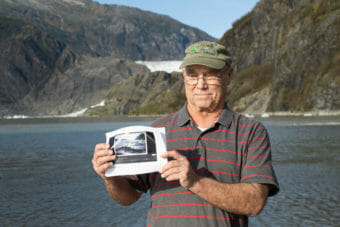
Longtime Juneau resident James Wycoff noticed on his regular walks to Nugget Falls that the face of the Mendenhall Glacier seemed to be retreating faster this year than any year he’s seen before. 

“I arrived in Juneau in 1974 as a young pharmacist from Kansas,” Wycoff said. “I had no idea that country as beautiful as that around Juneau even existed. I still haven’t got over it. Every morning I wake up, I feel like I’m in Disneyland.”

For Wycoff, the Mendenhall Glacier is “just such a good example of Juneau — it’s constantly changing.”

When he first saw the glacier in 1974, he remembered that Nugget Falls “poured into the top of the glacier and flowed out through a giant cave in the face of the glacier.” Today, visitors can barely see a corner of the glacier from the falls. 

Tourists catch a glimpse the now-distant Mendenhall Glacier from the beach at the end of the Nugget Falls Trail on Oct. 6, 2022. (Photo by Ian Dickson/KTOO)

Glaciologist, outdoor guide and Juneau resident Mike Hekkers also noticed that more rock was being exposed at the face of the glacier this year. 

“We’re losing that whole left side pretty dramatically in the past 12 months,” Hekkers said. 

 So how much has it really retreated?

Alaska Science Center geophysicist Christopher McNeil used publicly available satellite imagery to find an answer: between Aug. 30, 2021 and Aug. 18, 2022, the Mendenhall Glacier’s terminus retreated more than 800 feet. 

The big picture

For the last two decades, the glacier has “pretty consistently” seen over 160 feet of retreat per year, Hekkers said. From 1999 to 2022, the glacier’s terminus retreated a total of nearly 4,600 feet. 

“Nearly all of that retreat occurred along the western half of the terminus, where the west Mendenhall trail leads,” McNeil said. 

Hekkers speculated that the seemingly drastic loss of ice in the past twelve months is likely due to the water depth in that part of the lake.

“The ice is flowing downhill, and there’s shallower water on the far left where the remnant ice is stranded and not being re-fed anymore,” he said. 

In the next year or so, the glacier will likely retreat out of the lake, Hekkers said. At that point, it will likely slow down because its face won’t be regularly calving into the lake.

“We’ll probably still have small icebergs, but the really big icebergs are going to be a thing of the past within a year or two,” Hekkers said.  

Wycoff says seeing icebergs in Mendenhall Lake has always felt special to him. “That’s something you expect to see around Antarctica,” he said.

A seal slips between icebergs in Mendenhall Lake on Friday, July 6, 2012.
A seal slips between icebergs in Mendenhall Lake on Friday, July 6, 2012. (Photo by Heather Bryant/KTOO)

While the terminus retreating is the most obvious change, the glacier is also thinning, and the margins of the glacier are also retreating. Scientists like McNeil use three dimensional models of the glacier’s surface to measure thickening and thinning. A total of 85 feet of thinning was observed between 2000 and 2020. 

There is a seasonal and annual cycle to how a glacier changes,” McNeil said. “They advance forward in the winter because there’s no melt, but hotter, longer summers counteract that. Overall, melt is winning.”

Beyond what visitors see from the trail, McNeil said that the glacial retreat also directly affects the ecosystem as nutrient levels fluctuate and are delivered through freshwater and carried to the ocean. Ultimately, fish populations like salmon are impacted because of changes in water temperature and in the food chain, he said. 

What this means for Juneau

Hekkers’ team at University of Alaska Southeast was hired by the U.S. Forest Service to help redesign the Mendenhall Glacier Recreation Area. They determined that the glacier may not be visible from the visitor center in the next few decades and even considered having a “mobile modular visitor center” — taking visitors across the lake on electric boats to have a peek at the glacier.

The impacts of the glacier receding are “on a scale from local to global,” McNeil said. Global sea levels are on the rise, and here in Juneau, McNeil noted that glacial changes mean the ice caves are no longer accessible. 

“For a town like Juneau, those activities are keystone activities people like to do,” he said. 

Halfway up the Nugget Falls Trail, Wycoff talks about how things might have looked here, long ago. 

“This could be the face of the glacier here, standing 150 feet tall, and at one point dropping off all these boulders around here,” he said.

James Wycoff gestures toward the glacier while talking to KTOO reporter Chen Chen on Oct. 6, 2022. (Photo by Ian Dickson/KTOO)

He pointed to a boulder by the trail, which he identified as an ‘erratic’ — a boulder carried down by glacial ice. 

“That’s a high-riding boulder, and if it could talk, boy it would have a story to tell about what it was like coming down the valley on the glacier, getting ripped off the side of the mountain,” Wycoff said.

Wycoff says that in time, people in Juneau will have to reminisce about the Mendenhall Glacier.

“Bring out all the stories and say anything you want about the way it used to be,” Wycoff said. “Because the glacier is gone.” 


Curious Juneau

Are you curious about Juneau, its history, places and people? Or if you just like to ask questions, then ask away!

From Iran to Alaska, godson and godmother weigh in on current global protests

It’s the fourth week of protests in the Islamic Republic of Iran, sparked by 22-year-old Mahsa Amini’s death after she was detained by morality police over what she was wearing.

From Berlin to Los Angeles, thousands around the globe have marched in solidarity with the Iranian people. And for some Alaskans, these protests hit close to home. 
Finding refuge in Alaska

Samuel Bayanineek left Tehran in 2005. After spending more than four years in Turkey, he arrived in Anchorage as a refugee. 

He was greeted by Minoo Minaei, a long-time Anchorage resident, who was volunteering at Catholic Social Services and was assigned as his interpreter.

 “Sammy looked at my eyebrows and asked who did them,” Minaei said. “I told him I did. He said, ‘you do such a lousy job.’ And I just loved that, so I called my husband and said, ‘I think we have inherited a son.’”

Minaei left Iran when she was 13. She first arrived in Anchorage in 1980 and spent 33 years teaching in the Anchorage School District.

She eventually became Bayanineek’s godmother. He was a barber back in Iran and she helped him go to beauty school in Alaska to get his cosmetology license.  

A new generation in Iran

“[My father] got us out before the revolution,” Minaei said about her journey out of Iran.  “I have never really gone back, so I have never seen the change. I just read about it and it’s just heartbreaking. We have really gone backwards so far, and I don’t know if it’s ever going to go forward.”

Minoo Minaei and Samuel Bayanineek in Anchorage, Alaska. (Photo courtesy of Samuel Bayanineek)

By mid-October, 185 people — including 19 minors had been killed in Iran, along with many injuries and thousands of arrests at the hands of government security forces. Videos of women and schoolgirls at the frontlines of the protests have circulated the internet.

“It is really heartbreaking to see how the women try so hard to fight with nothing in their hand except their brain,” Minaei said of the students protesting.

Bayanineek is hoping that this time, the protests can end in a “good revolution.” 

“This was going to happen sooner or later because when you have a systematic religious government, this is exactly what’s going to happen,” he said. “For most of the younger generation of high schoolers and even younger than high school, people are tired and raising their voices.”

Minaei pointed to social media as another factor. She said the older generation witnessed the revolution, but never tasted freedom. 

“If they are educated, they can see how much opportunity they could have,” she said. “I feel really sorry for them. I just really hope that the Western world would do something to help these people. And I don’t know if that will ever happen, if it’s just a can of worms that nobody wants to open.”

Fighting for their future

Every day, Bayanineek speaks to his mother in Tehran on the phone. And every day, she tells him that there are protesters on the street.

“The government should belong to the young generation today,” Bayanineek said. “They are the ones that should have the voice and run it.”

He said generations of witnessing the government “suck out all the resources from the country and get rich” while most citizens were suffering from recessions and bankruptcy has pushed the younger generation to the brink. 

“Let’s hope the young generation and these women are going to change that because they have to,” Bayanineek said. “It’s a matter of the next generation.”

Protests have periodically erupted in Iran since the 1978 revolution, but none have successfully overturned their regime.

“The majority, the public, wants freedom and they can’t get it,” Bayanineek said. “But it doesn’t matter how long it takes, they will get it.” 

 “Home sweet home, Alaska.”

Bayanineek estimates that there are no more than 200 Iranians in Alaska, but the community of around 50 in Anchorage is tight-knit.

“We do need more protesting,” he said. “In Charlotte, California, D.C., they have protesters. I know because we don’t have a big community, it’s not going to be a big protest, but what we can do is to pass our voice in the media.” 

During past protests, Minaei has written letters to U.S. senators — ranging from Ted Stevens to Lisa and Frank Murkowski — encouraging them to condemn the Iranian government and end the sanctions on Iran. 

“The sanctions that we are constantly putting on that poor country are killing the poor,” Minaei said. “And the only thing we can do is basically encourage [the protesters] to be strong and to stay together.”

Bayanineek is hoping that he can go back and visit Iran once the regime is changed.

“Not permanently, though,” he said. “Alaska is my permanent home. I will never leave — home, sweet home, Alaska.”

In the meantime, Bayanineek tries to support from afar and hopes that people around the world will help too. 

“For once in history, we should see the feminist revolution, and I hope it starts in Iran,” he said.

It’s the last day to vote in Juneau’s municipal election — here’s what locals had to say

Victoria Stickle hands her ballot to election worker Larae Jones at the city hall vote center on Oct. 4, 2022 in Juneau, Alaska. (Photo by Tasha Elizarde/KTOO)

Voting in Juneau’s local by-mail election wraps up on Tuesday, but results won’t be final for a few weeks.

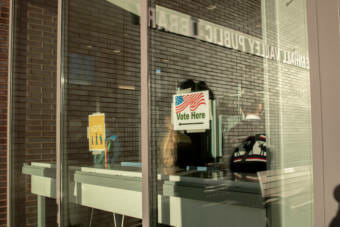
Ballots must be returned by 8 p.m. on Tuesday. They can be placed in one of the ballot dropboxes at the Douglas Library or Statter Harbor parking lot in Auke Bay, or returned in person to the vote center at the Mendenhall Library or City Hall downtown. 
Mailed ballots must be postmarked by the end of the day. 

Last year, more than 700 ballots were rejected – many of them showed up after election day without a postmark.  

This year, some voters opted to bypass the machine processing and had their mail-in ballot stamped in front of them, a process called hand-cancellation. 

“I did hand-cancel [some] to further put a date on it,” said Kelsey Riker, who was working at downtown gift shop and post office Kindred Post on Tuesday. “But there are also folks who just hand it off and have trust that it will go out today — which it will — at 4:30 p.m.”

This is Juneau’s third by-mail election, but the first where ballots will be processed entirely within the borough. In 2020 and 2021, ballots were sent to Anchorage and processed in the municipal processing center there. 

With a largely uncontested election and four propositions on the ballot, some voters weren’t enthused. 

“I felt strongly on proposition four, but the others were more of a ‘no, no, yes, yes’ sort of thing,” local resident Victoria Stickel said. “I also wasn’t thrilled that there weren’t choices.”

All three assembly members ran unopposed, as well as the two candidates running for the two school board seats.

“There basically was just one person running — not that I have time to do it and I have no criticism for that — but I would have loved to have had a choice of who to vote for, aside from writing in a name,” Stickel said.

Even with a rather unexciting election, some voters still expressed their gratitude for this election day.

“We had a voter come in who dropped off zucchini bread for other voters and wanted to show appreciation for us,” said Larae Jones, a poll worker at Juneau’s city hall. 

The city had already processed more than 4,000 ballots at the new ballot processing center off Thane Road by last Friday. 

The city will publish preliminary results on its website Tuesday night. Election staff will continue processing ballots and publish updated results again this Friday and next Friday.  The canvas review board plans to certify election results on Wednesday, Oct. 19.

Still need to cast your ballot? KTOO’s Juneau Elections guide has candidate profiles and explanations of the ballot measures.

This story has been updated. 

White House grants $13 million to help combat Alaska’s opioid crisis

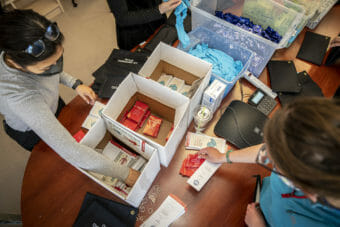
In May 2022, the state packed 3,000 opioid overdose emergency kits and sent them across Alaska. In September, President Biden announced $13 million for Alaska to address opioid epidemic. (Image courtesy of Project HOPE.)

As part of National Recovery Month in September, the Biden Administration announced $1.5 billion in funding for states and Tribes to address the opioid epidemic.

Fifteen Tribal organizations across the state were granted a total of $9 million. The Alaska Department of Health and Social Services will be getting $4 million.

The state’s plan for using the money includes increased syringe exchange programs and distribution of the overdose reversing drug naloxone. There are also plans for educating youth about substance abuse, including trauma-informed programs specifically for Alaska Native youth. The project is expected to serve a total of 300 clients and 2,240 providers over the course of two years.

Site notifications
Update notification options
Subscribe to notifications