Claire Stremple

"I support KTOO reporters and guide coverage that informs our community and reflects its diverse perspectives."

When she's not editing stories or coaching reporters, you can find Claire outside with her dog Maya.

The Aleutian tern may be Alaska’s most imperiled seabird

An Aleutian tern perched on a log
An Aleutian tern. Biologists say Alaska’s known population of Aleutian terns has declined more than 90% since 1960. (Photo by Nate Catterson/USFS)

Biologists say Alaska’s known population of Aleutian terns has declined more than 90% since 1960. The data they have says it’s the fastest decline of any seabird species in the state, but they want to make sure they have that right. Now a coalition of scientists is working on a statewide count to make sure they aren’t overestimating the decline. 

“It certainly feels like we are watching the species slowly disappear,” said Heather Renner, a biologist for the Alaska Maritime National Wildlife Refuge. “Really, the problem has been that nobody’s been studying them.”

Renner’s research from 2015 showed only about 5,000 Aleutian terns in the state. It helped prompt a collective effort to understand and conserve the threatened species. 

Studying a migratory bird in a place as big as Alaska is not easy. Aleutian terns spend only three-to-four months here, and their range extends nearly 10,000 miles to places like Indonesia, the Philippines and Borneo. 

“Aleutian terns are notoriously hard to study because they nest in pretty small colonies,” Renner said. “We also know that they tend to move around, so our little short-term snapshots are challenging to interpret.”

The same characteristics that make them hard to study also make them a sought-after find for birders and outdoor enthusiasts.

“Aleutian terns are a really special bird that not everybody gets to see. They’re not well known to many Alaskan birders because many of the colonies are off of the road system,” Renner said.

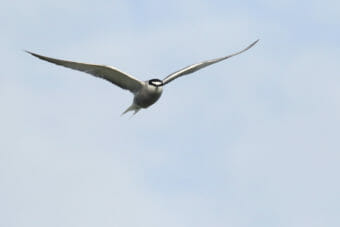
Aleutian terns only breed in Alaska and the Russian far east. They’re coastal birds that feed by plunge-diving into the sea after small fish, with a global population estimated at just 30,000 birds. They look a lot like Arctic terns, with silver-gray bodies and a black head, but Aleutian terns have a distinctive white patch on the forehead. Most tern calls are harsh; birders say the Aleutian tern’s call is softer. 

An Aleutian tern standing amid some low ground cover, with purple flowers behind it
“The challenge is that we don’t have a local threat that’s known, a single thing that we can fix,” said Heather Renner, a biologist for the Alaska Maritime National Wildlife Refuge. (Photo by Nate Catterson/USFS)

Renner says biologists don’t know what’s causing their precipitous decline. But it isn’t unusual anymore for a bird species’ population to crash. One study says that the bird population in North America has declined by about a third since the 1970s. The National Audubon Society reports that about two-thirds of the continent’s bird population face major challenges, including extinction.

“The challenge is that we don’t have a local threat that’s known, a single thing that we can fix. My best guess is that it’s related to something in the marine environment,” Renner said.

One study pinned a die-off of Arctic terns to algal toxins that get to terns through the fish in their diet. Renner says even though Aleutian terns also eat those fish, it’s hard for her to imagine that could account for such broad-scale, range-wide declines over several decades. 

Yakutat has the largest known breeding colony of Aleutian terns in the state, at Black Sand Spit.

Susan Oehlers is a biologist for the U.S. Forest Service there. She says there’s a lot of variability in the yearly population count, even at what’s considered a stable nesting area.

“In 2013 we had 2,000, and then in 2019-2020, we had 1,000. And then the last couple years, it’s been only several hundred,” she said.

Oehlers says when numbers drop, it could mean that some of the birds are nesting elsewhere. But the dramatic downward trend has spurred action among bird biologists statewide. 

A statewide working group has members from several different state and federal agencies. They’re doing direct counts, but also using tools like drones and song meters to get a better count. They plan to have a solid population estimate in the next couple of years.

An Aleutian tern, flying
Yakutat has the largest known breeding colony of Aleutian terns in the state, at Black Sand Spit. (Photo by Nate Catterson/USFS)

Juneau’s regional hospital names new CEO

A mostly empty hospital hallway
A nearly empty critical care unit at Bartlett Regional Hospital on April 7, 2020, in Juneau, Alaska, shortly after the start of the COVID-19 pandemic. In July 2022 Bartlett named a new CEO, after nearly a year without a permanent leader. (Photo by Rashah McChesney/KTOO)

The Bartlett Regional Hospital board announced its CEO selection at a meeting Tuesday night. David Keith will lead Juneau’s hospital beginning next month.

He will replace Jerel Humphrey, who took over the hospital as interim CEO in October. That’s after former CEO Rose Lawhorne abruptly resigned and was fired by the board in September.

David Keith is currently in a leadership role at a regional health center in McAlester, Oklahoma. He has more than three decades of healthcare leadership experience, including Alaska experience at Providence Alaska Medical Center and Alaska Native Medical Center in Anchorage.

Mr. Keith will begin August 15th. His annual salary will be $400,000 — $80,000 more than what Lawhorne made.

Village public safety officers get opioid response training in Juneau as statewide overdose rates climb

Two men in a classroom studying a piece of paper
Michael Betts and Logan James-Lee discuss CPR compression techniques at an opioid response training at the Generations Southeast building in Juneau, AK. July 21, 2022. (Photo by Claire Stremple/KTOO)

Michael Betts is a village public safety officer for the community of Hydaburg on Prince of Wales Island. Under the fluorescent lights of a classroom, he knelt in front of a life-sized dummy that he was told was overdosing on opioids.

Betts checked his pulse.

“Hey man,” he said, giving the dummy a shake. “He’s not breathing.”

Betts quickly unwrapped a package of naloxone nasal spray, stuck it in the dummy’s nose and sprayed.

“You’re always going to want to call 911 once you administer that Narcan,” a trainer from the fire department tells him. “When it kicks in, they’re going to go into immediate withdrawals.”

Betts is the only first responder who lives in the community of 400 people. He said he knows a lot of opioids are trafficked into Hydaburg and then distributed to the rest of Prince of Wales Island, but he hasn’t had to resuscitate a real person with naloxone yet.

“Everybody probably has Narcan in their purse, in their glove box, somewhere in their house in a drawer,” Betts said. “A lot of times we don’t even get called. We hear about it the next day.”

Betts and eight other people came to Juneau to take part in an opioid overdose response course offered by Central Council of Tlingit and Haida Indian Tribes of Alaska with funds from a federal grant. The classroom role play is meant to prepare him and other VPSOs for an overdose situation, where they’re likely to be the first person on the scene.

Alaska has the fastest rising opioid overdose rate in the nation. More than 200 Alaskans died from overdoses in the last year.
""
Participants prepare to give Narcan to a dummy. (Photo by Claire Stremple/KTOO)

Jason Wilson runs the public safety department for the Central Council of Tlingit and Haida. He says VPSOs are the definition of first responders. 

“They’re not just law enforcement,” he said. “They’re also EMTs. They’re also the ambulance drivers. They’re the fire chief, or they’re a part of the fire department. They’re a big part of the search and rescue within a community. They’re animal control within a lot of our communities.”

The Central Council of Tlingit and Haida runs the VPSO program for the Southeast Alaska communities of Kake, Angoon, Pelican, Saxman, Hydaburg, Thorne Bay and Kasaan.

“Being able to respond to overdoses is really important to the Tribe, and in our communities. So we’re pretty excited about this,” Wilson said.

They’re not just learning how to treat a health emergency; they’re also learning how to police narcotics. One of the instructors Central Council brought in is Chris Cuestas, a former police detective and a national drug expert.

He said Alaska is seeing a peak in opioids, especially fentanyl, and that the state has the same distribution patterns and the same underground market network of narcotics as he sees nationwide.

“The challenge is how do we minimize their influence in communities and villages in Alaska,” he said.

That’s a challenge because these remote communities are small and have few law enforcement resources. But Cuestas said it’s also a strength. He thinks the VPSO program is ahead of the national curve because individual officers  have so many roles.

“You are actually able to participate in some of the prevention and intervention,” he said. “Even the community education components to reduce some of the risk factors in the community.”

He said that’s the direction he expects a lot of law enforcement agencies in the Lower 48 to take.

Birdwatchers spend more and stay longer than other Alaska tourists, study says

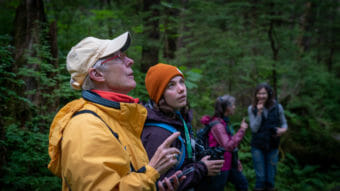
Out-of-town Birder Lynn Hartmann and Audubon intern Mali Tamone listen for bird calls on Rainforest Trail with the Audubon Society on July 15, 2022 in Juneau. (Photo by Paige Sparks/KTOO)

Most of the birders who pulled into Juneau’s Rainforest Trail parking lot at 8 a.m. on Friday were locals, but docent Brenda Wright set some expectations for out-of-towners and newbies.

“This is a really hot spot for red-breasted sapsucker,” she said.

“You’re kidding — that’s why I’m here!” said tour-goer Lynn Hartmann.

She and her partner, Martha Johnson, are visiting Juneau from Minnesota. Hartmann came for the birds: red-breasted sapsuckers, red-throated loons, Pacific wrens and the Pacific-slope flycatcher. She’s among the growing number of tourists who come to Alaska each year to look for birds.

A recent study out of the University of Alaska Fairbanks shows that birders like them could be a boon for the economy and for conservation efforts — especially in rural and remote areas.

Birders stay longer and spend more

The couple is in town for a week, staying at a bed and breakfast. They’ve been to the Mendenhall Glacier to see Arctic terns, took a whale-watching tour for more seabirds, and now they’re on a guided walk through the temperate coastal rainforest with the Audubon Society.

A group of birders hiking down the Rainforest Trail with the Audubon society on July 15, 2022, in Juneau. (Photo by Paige Sparks/KTOO)

But they’re doing other things, too. Johnson goes to the municipal pool every morning, and she says they’ve been sampling the local restaurants.

“We’ve been trying to take advantage of local culture — you know, we can’t bird 12 hours a day! So it’s been sort of a multifaceted trip,” Johnson said.

Birders are the world’s largest group of eco-tourists. And according to the new study, they’re a real moneymaker in Alaska — and the state has only begun to cash in.

“Birders, compared to non-birders, stay twice as long, and they’re considerably spending more money than the average, or non-birding, visitor to Alaska,” said Tobias Schwoerer, one of the study’s authors and a research professor at UAF’s International Arctic Research Center.

“All the people who said they watched birds, if we sum up their spending, it was over $300 million dollars in 2016,” Schwoerer said.

The more than 300,000 birders a year that visit Alaska generate more than 3,000 jobs in the state, according to the study. Schwoerer likened the jobs figure to the total number of Alaskans employed by other single industries, like telecommunications.

An intact ecosystem

They’re coming because Alaska is home to the world’s largest concentration of shore birds, and it’s a globally significant breeding ground for migratory birds. Alaska has the most Important Bird Areas of any state — and yes, Important Bird Area is an international metric, overseen in the United States by the Audubon Society.

“We have these hotspots, and they’re still intact,” Schwoerer said. “Alaska is kind of the last little bit of wild where they can have a very intact ecosystem to support their populations.”

He says that climate change is increasingly threatening wilderness and biodiversity, but Alaska can capitalize on wildlife tourism through conservation and infrastructure. That means opportunity statewide, but especially in rural places.

Brenda Wright leads a group of birders to the beach to look for flora and fauna at the end of the Rainforest Trail. (Photo by Paige Sparks/KTOO)

Natalie Dawson, another of the study’s authors, says she got the idea for it while guiding in remote parts of Alaska.

“If I was in a community and there was a rare bird that had blown over from some other place in the circumpolar north, I would find people that had traveled thousands of miles just to see individual birds,” she said.

She said birders are motivated to get out where the birds are — places like the North Slope to see eider ducks or out west to the Pribilof Islands for seabirds.

Southeast festivals are a big draw

But Dawson says the study showed that more than half of the birders’ money is spent in Southeast Alaska. She credits that in part to bird festivals like the Hummingbird Festival in Ketchikan and the Bald Eagle Festival in Haines.
“Those festivals do seem to actually, yes, be congregations for birding, tourism and birding related travelers,” Dawson said. “This study shows that if you can come together with a vision for a community and an activity that can draw people in and provide them information about how to experience that wildlife, then it does seem to draw people to your area.”

Audubon volunteers and attendees discover flora and fauna at the beach near the Rainforest Trail on July 15, 2022 in Juneau. (Photo by Paige Sparks/KTOO)

Cordova’s Copper River Delta Shorebird Festival has lured birders off the road system for decades. The local chamber of commerce estimates that more than 100 visitors this year spent nearly $175,000 in town, jump-starting the local businesses reopening after a quiet winter.

Back on the Rainforest Trail in Juneau, Lynn Hartmann stood in the trees, listening. Varied thrushes were whistling their haunting notes over the melodic song of the Swainson’s thrush.

“It’s like, hearing 20 languages all at once,” Hartmann said.

There was no red-breasted sapsucker, but she and Martha spotted a Pacific slope flycatcher and heard his signature song. And there was still time for the sapsucker — they were in town for a few more days.

Juneau school board extends food service contract and signs off on floor sealant investigation

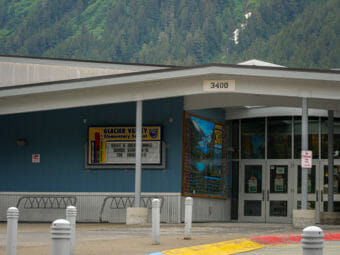
Sít’ Eetí Shaanáx–Glacier Valley School on June 14, 2022. (Photo by Paige Sparks/KTOO)

The Juneau school board voted Tuesday to pay for a private investigation into the floor sealant incident, where a dozen students were served chemicals instead of milk at a summer school program.  

The district’s third party investigation could cost the district up to $45,000.

The board also extended its contract with the district’s food service vendor, NANA, for six months. That extension is meant to allow the board to review the results of its third party investigation prior to renewing the contract for the full year.
NANA Food Services senior leadership says the company has taken strong steps to ensure students’ safety after a pallet of floor sealant was delivered to a district warehouse where food is stored

“We’ve done several things to assure this doesn’t happen again,” said Derrell Webb, the company’s vice president of operations. “We did an in-depth investigation, we brought in our safety people, as well as several members on our management team and reviewed all the processes. Anywhere we felt there was a hole in the process, we rewrote that process.”

He said the company created a new shipping and receiving protocol and retrained their employees on several processes, including one for product tracking.

Superintendent Bridget Weiss said the company’s response to the incident has been diligent, and the extension is the district’s best option this close to the start of the school year. 

New report outlines Juneau’s climate future, and what we can do about it

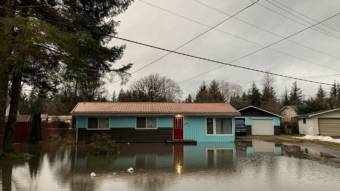
Several homes along Jordan Creek are partially inundated by rising water on Wednesday, Dec. 2, 2020, after record rainfall in Juneau, Alaska. (Rashah McChesney/KTOO)

In Juneau, precipitation has already increased by 20 inches a year in the last century and will continue to rise. Ocean warming will stress local marine ecosystems. More landslides will happen as the region gets warmer and wetter.

These are just a few of the takeaways from a Juneau-specific climate report released Monday by the University of Alaska Southeast’s Alaska Coastal Rainforest Center.

The report says it’s important that the City and Borough of Juneau already has plans in place to combat climate change, but it must make good on them and then go even further in its efforts.

“There are two messages: One, there are many impacts. Two, we are doing something about it. For a small community, that’s pretty impressive,” said Jim Powell, a UAS research professor and the lead author of the study.

Powell says the findings come with ideas for solutions that are within our reach on a local level.

“When polarization is occurring on the national side and the state side, local governments are making it happen,” Powell said.”We’re looking at the impacts as well as the things we can do and things that we’ve done.”

The city’s already taken some steps to address climate change. In 2001, Juneau was the first port in the world to connect cruise ships to hydropower — and it’s considering expanding that program from one dock to three.

The study recommends going even further than that: investing in 100% shore power for all cruise ships, limiting the number of ships in port to five, and monitoring ship emissions while in port.

Powell praised the city for setting a goal to have 80% renewable energy by 2045 and for having a climate action plan in place. But the study recommends the municipality go further by creating metrics to report progress on its goals to the public.

“If you don’t have indicators, you can’t manage. If you don’t have goals, you can’t manage,” Powell said.

The study was made possible by volunteer effort from more than two dozen Alaska scientists, the majority of whom are local to Juneau. Funding came from CBJ and the Department of Interior’s Alaska Climate Adaptation Science Center, which is managed by the USGS National Climate Adaptation Center

Some study authors will host a webinar about their work at 9 a.m. on Thursday, July, 14.

Site notifications
Update notification options
Subscribe to notifications