Andrew Haden of Wisewood, Inc., a Portland-based design firm, explains how the Ketchikan Airport’s biomass boiler works as it begins running in June 2016. It was partially funded by a U.S. Forest Service wood innovation grant. (Photo by Leila Kheiry/KRBD)
The U.S. Forest Service is offering another round of grants promoting wood-energy projects in Alaska.
Earlier grants have helped design boilers and plan wood-pellet mills in Southeast and Interior communities.
Forest Service Wood Innovation Coordinator Dan Parrent said they’re meant to expand use of blowdowns, mill scraps and similar material.
“We’re looking at ways of utilizing wood that needs to come out of the forest to reduce hazardous fuel loading or for forest health purposes,” he said. “We’re trying to create markets for that material that doesn’t otherwise have strong markets.”
He said most Alaska grants, for up to $250,000 each, go to wood-energy projects. But the program also helps develop new timber products, such as laminates, or expand existing markets.
Grants can go to businesses, organizations and government agencies. Recipients must contribute part of the funding.
Parrent said program guidelines limit how the money can be used.
“It’s mostly for the softer costs. It’s for project development, it’s for designs, it could be used for permitting. … But not for actual construction,” he said.
Applications must be submitted by Jan. 23. Awards will be announced in April.
A number of organizations have been promoting wood-energy projects around the state. One is the Southeast Conference, a regional economic-development group.
The conference’s energy coordinator Robert Venables said the grants have been valuable.
“It’s been used from Ketchikan to Haines to help some of these projects get vetted out and ready for either implementation or not, if that’s what the feasibility [study] shows,” he said.
Wood has been promoted as a low-cost energy source that causes less environmental damage than fuel oil.
But critics point out that it still releases carbon into the air, contributing to climate change. They also say forests should not be cleared of blowdowns and woody debris, which decays and helps build up soil and feed future trees.
The new bipartisan House majority caucus includes Juneau’s Sam Kito III, far left, Juneau’s Justin Parish, second from the left, Sitka’s Jonathan Kreiss-Tomkins, center, and Ketchikan’s Dan Ortiz, second from the right. (Photo by Andrew Kitchenman/KTOO/APRN)
After years in the legislative minority, all Southeast representatives are in positions of power.
The new bipartisan House majority and Republican-led Senate majority have named regional lawmakers to chair six committees. There, they can influence budgets, pass legislation and kill bad bills.
It’s been a rough road for Southeast legislators and their constituents under the outgoing legislative leadership. Only two of the region’s six lawmakers had key roles in their chamber’s organizations.
That’s changing.
“I think this bipartisan majority is only a good development for the interests of Southeast Alaska,” said Ketchikan independent Dan Ortiz, one of four Southeast representatives in the House’s new organization.
House District 36 Rep. Dan Ortiz addresses the Ketchikan Chamber of Commerce in 2014. (Photo by KRBD)
He’ll have a seat on his chambers’ Finance Committee, which, with its Senate equivalent, writes state budgets.
Ortiz said he’ll do what he can to protect and advance the region’s priorities. They include the Alaska Marine Highway System and the Department of Fish and Game.
But there are limits.
“We’re not in a period where I’m going to be part of handing out lots of goodies for Southeast Alaska, that’s for sure. But hopefully, I’ll be able to do the best I can at protecting the interests as much as possible of Southeast Alaska,” said Ortiz, who is headed into his second term.
The outgoing Southeast Finance Committee member is Juneau Republican Cathy Muñoz, who lost her re-election bid.
Southeast’s newest lawmaker, Juneau Democrat Justin Parish, won that race. He’ll start off his first term sharing the chairmanship of the Community and Regional Affairs Committee. It considers bills related to local government and rural issues.
“From my seat there and with the help of my co-chair, I’ll able to quash any possible thought of a capital move,” he said.
House District 34 Rep.-elect Justin Parish, right, speaks at a candidate forum as incumbent Reps. Cathy Muñoz and Sam Kito III listen Oct. 13, 2016. (Photo by Jeremy Hsieh/KTOO)
Parish, who lived in Tenakee and Haines, said he’ll also try to help small communities keep the support they have.
Sitka Democrat Jonathan Kreiss-Tomkins begins his third term heading up the new majority’s State Affairs Committee. It handles many state government issues.
So he’ll also be in a position to slow or block capital- or Legislature-move measures, as well as other bills the region opposes.
“Daylight savings time has come up in the past as an issue that for many in Southeast has been a bit of a bugaboo. And that falls within the jurisdiction of the committee,” he said.
Many Southeast tour businesses oppose the change because it would reduce the number of summer evening daylight hours.
Juneau Democratic Rep. Sam Kito III, elected to his second full term, will chair two committees.
One is Labor and Commerce, where he’ll investigate Alaska’s rising insurance costs.
“I’m looking at working … with other states and with national organizations to try and see if there are ways we can capitalize on things that they’ve done, as well as possibly enlarging our pool of health-care recipients,” he said.
Sens. Dennis Egan, left, Bert Stedman, center, and Donny Olson talk on the floor of the Alaska Senate in 2014. (Photo by Skip Gray/Gavel Alaska)
Kito will also chair the Legislative Council, which oversees House and Senate business between sessions. He said he’ll look for ways to lower the cost of legislative operations.
One other Southeast lawmaker has a chairmanship as part of the Senate’s GOP-led majority.
Sitka Republican Bert Stedman, headed into his fourth term, will head up the chamber’s Transportation Committee.
The panel will likely address a plan for changing the state ferry system’s management structure. Stedman said he’ll proceed cautiously to protect the system.
“The concern there is there will be groups within the legislative body that wouldn’t be concerned about whether the marine highway functions or doesn’t function and to just get rid of it,” he said.
Southeast’s other senator, Juneau Democrat Dennis Egan, is in the chamber’s minority. He will sit on its Labor and Commerce and Transportation Committees. He’s in the middle of his second full term.
Stedman said the new House majority’s rural and coastal leadership will help balance out the Senate’s mostly urban focus.
Rep. Kreiss-Tomkins said it will also try to reduce partisanship – especially in his committee.
“I’d really love the first bill that we hear to be a minority Republican bill. Because I think that upends legislative tradition that you try to turn your eyes away from those that don’t happen to be in power at any given time, even if the ideas are good,” he said.
Other committee assignments will be announced at a future date.
Democrat Jonathan Kreiss-Tomkins, center, campaigns with supporters in Sitka on Election Day, Nov. 8, 2016. (Photo courtesy Jonathan for State House)
Democrat Jonathan Kreiss-Tomkins has won his third term in the state House of Representatives. Voters in Sitka, Petersburg and most Southeast villages gave him a 60-40 victory over Republican challenger Sheila Finkenbinder.
Kreiss-Tomkins said he felt optimistic about his re-election chances. But he didn’t want to be overconfident.
“I work really hard and I do my job well and that record, I think, will be ultimately be reflected in elections,” he said.
His first race was his tightest. In 2012, he beat incumbent Republican Bill Thomas of Haines by only about three dozen votes.
He did better two years later, defeating Petersburg Republican Steven Samuelson by a 60-40 margin. It was about the same this time around.
Republican candidate Sheila Finkenbinder waves to passing cars in Sitka on election day. (Photo by KCAW)
Finkenbinder, his opponent, said she thought she’d do better than she did.
“I had a lot of positive feedback from people who were supporting me. And I was more hopeful than it turned out,” she said.
Finkenbinder campaigned as a candidate who would join a Republican-led House majority, giving her more strength than the incumbent.
And Kreiss-Tomkins has been in the minority for the past four years, which limited his political clout. But a new majority coalition of Democrats, Republicans and independents has formed and he will play a stronger role.
The Sitka Democrat said he doesn’t have a specific to-do list — because he’s a generalist.
“I guess my interest is good ideas – and good ideas of every kind. That might seem like a non-answer. But if I were to look at the bills I’ve introduced over the past four years they’re really kind of A to Z,” he said.
This was Finkenbinder’s first run for public office, but she wasn’t a political newcomer.
She worked as a legislative aide to Rep. Peggy Wilson, a Wrangell Republican whose district used to include Sitka and Petersburg.
She also ran the Greater Sitka Chamber of Commerce and was active in the city’s Republican Party organization.
I Voted Today stickers were popular accessories on Election Day in Alaska. (Photo by Maggie Schoenfeld)
But the future? She’s not sure whether she’ll run again.
“I’m really not ready to answer that at this point. I’m not sure where my life will take me in the next two years. That’s a lot of time,” she said.
Finkenbinder said she wishes Kreiss-Tomkins well. But she hopes he’ll take on her top priority, promoting economic development.
“You can’t just raise taxes and take in each others’ laundry. You have to have an economy,” she said.
She said that should include continued oil development. But there should be a wider focus.
“We need to encourage timber, fisheries, mining, sea otter (products), seaweed. Whatever it is, we need to develop our resources and grow the economy,” she said.
Kreiss-Tomkins said he too wants to create jobs. But they might not be in the same professions.
“I’ve been particularly focused on new small-business entrepreneurship as well as fisheries and maximizing the value of the Alaska fisheries for Alaskans. But that interest extends to all sectors of our resource economy,” he said.
As in all elections, questioned and absentee ballots must still be counted. But that won’t change these results.
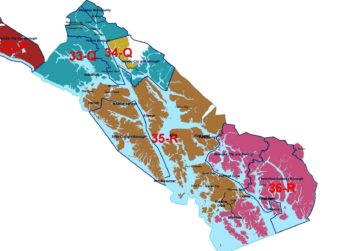
Southeast Alaska House and Senate districts are shown on this map. (Courtesy Alaska Redistricting Board)
Southeast Alaska’s nine legislative candidates have raised close to half a million dollars for this year’s campaigns. Five, including a barely-challenged incumbent, have brought in about $50,000 each.

Not all the numbers are in yet. But as of Friday afternoon, the most recent campaign finance disclosure reports showed the total raised at about $440,000.
That’s about 6 percent higher than the 2014 election. But it helps illustrate the long-term growth of campaign fundraising in Southeast.
Juneau’s Christopher Clark said, “I think it’s keeping up with the inflationary trend.” Clark tracks and analyzes state elections.
“There was a time when we looked at $25,000 as being enough to win a House seat provided you were a decent candidate. And now, we’re seeing much, much more money raised,” added Clark. He has worked as a journalist and as a staffer for legislators of both major parties.
Two of Southeast’s five legislative races have no opponent on the ballot, so you’d expect less fundraising.
That’s true for incumbent Juneau Democrat Sam Kito III, a civil engineer and former lobbyist, who is seeking a second full term. His House District 33 represents about half of Juneau and the rest of northern Southeast’s cities.
Kito has raised close to $16,000 but has spent only about a quarter of that money.
But the other incumbent without an opponent on the ballot, Sitka Republican Senator Bert Stedman, has brought in more than $47,000.
The investment manager has a write-in challenger, Petersburg handyman Michael Sheldon, who has only raised $100 running for his Senate District R campaign.
All the Southeast races had competition two years ago. But Clark said unopposed candidates aren’t uncommon.
“Southeast does have some history. Pretty much, if you like the guy who’s in there or the woman who’s in there, then you will see they don’t get that opposition,” he said.
Financial disclosure forms show Stedman, who’s seeking his fourth full term, has spent most of what he’s raised. A lot went to campaigning with two fellow Republicans who are challenging a Democrat and an independent for House seats in his district.
One is Sitka GOP member Sheila Finkenbinder, a former legislative aide and executive director of her city’s chamber of commerce.
Finkenbinder has brought in more than $35,000 so far and most has been spent.
It’s less than half of the $75,000 raised by incumbent Sitka Democrat Jonathan Kreiss-Tomkins, who has worked with his town’s fine arts camp.
He’s seeking his third term representing House District 35, which includes his hometown, Petersburg, Kake, Angoon and about 15 other villages.
Kreiss-Tomkins has spent about 70 percent of what he’s raised.
Stedman has also been campaigning with Ketchikan Republican Bob Sivertsen, a retired city employee who’s challenging independent incumbent Dan Ortiz, also of Ketchikan.
Sivertsen has raised a little more than $35,000 on his own. But another $40,000 has gone into a separate committee supporting his candidacy. The main contributor is The Accountability Project, a conservative, Anchorage-based political action committee.
Clark can’t recall that happening before.
“In some ways, that’s almost par for the course up north, up in the Southcentral area, in those highly competitive races that are happening right now,” he said. “But here in Southeast, that’s something we haven’t seen. I think they are indicative of what people see as probably the closest race we have here.
House District 36 one-term incumbent Ortiz, a retired teacher, called the PAC contributions “dark money.” Campaign finance reports show he brought in a little more than $70,000 and he has spent the majority of that amount.
Constitution Party candidate Ken Shaw raised about $330 and spent about a third of it.
The final Southeast race, in House District 34, pits Republican incumbent Cathy Muñoz, a former gift-shop owner, against Democrat Justin Parish, who works with special-needs students.
The district is based in Juneau’s populous Mendenhall Valley and includes some other capital city neighborhoods.
Muñoz, who is seeking her fourth term, has the fundraising lead with $82,000. She’s spent about 70 percent of that amount.
Parish has raised close to $40,000, about half of Muñoz’ total. The latest finance reports, filed with the Alaska Public Offices Commission, show he’s spent about half of that.
Rep. Sam Kito III is running for re-election to his downtown Juneau-based House seat. (Photo by Ed Schoenfeld/CoastAlaska News)
Juneau Democrat Sam Kito III is running for his second full term representing state House District 33. That includes the capital city’s downtown, Douglas, Haines, Skagway, Klukwan, Excursion Inlet and Gustavus.
Kito was appointed to his House seat in 2014 after then-Rep. Beth Kerttula stepped down.
The 18-year Juneau resident, who was born in Anchorage, is a civil engineer who has worked on transportation projects around the state.
He’s spent this year’s election season talking about state budget issues.
During a forum at this fall’s Southeast Conference meeting in Petersburg, he said that includes a variety of taxes and capping Permanent Fund dividends.
“I do appreciate the work that Gov. Walker has put into his fiscal sustainability plan, because we need to look at a lot of different sources of revenue to try and balance the money that we’ve lost because of low oil prices,” he said.
Rep. Sam Kito III addresses the Alaska House of Representatives in 2014. (Photo by Skip Gray/360 North)
Kito said it’s important to continue essential services, such as schools, the university and the state ferry system.
He said action must be taken during the upcoming legislative session to bring in new revenue. That, he said, will help keep the state out of a recession.
“If we do have increases in oil prices down the road, and we already have a sustainable fiscal plan, then that money can be used to bolster our Permanent Fund and result in increased Permanent Fund dividends,” he said.
The Juneau Democrat said any new revenue must be spent responsibly.
But reduced PFDs, new taxes and other options buy the state time.
“Balancing the budget doesn’t mean providing a whole lot of extra money for state agencies to do what state agencies do, which is to provide public services through the state of Alaska to residents,” he said. “It raises enough money so that we can have those discussions about whether or not we’re spending adequate money on education, spending adequate money on health care or spending adequate money on transportation.”
The past few years’ state budget cuts have hit municipalities and school districts.
“It’s something that I think we need to honor, in order to make sure that in these financial times that are getting difficult, we’re not putting excess or undue pressure on the local governments,” he said.
This is Kito’s second time on the ballot. He won a contested election in 2014. But this time around, he has no officially recognized opposition.
Haines Libertarian William ‘Bill’ McCord has announced a write-in campaign for the seat. But elections officials say those votes won’t be counted, because he hasn’t lived in Alaska long enough to qualify for the ballot.
Reports on other Southeast Alaska House and Senate races:
A state Department of Fish and Game staffer works on sampling fish for a study on toxic metal concentrations in Tulsequah and Taku river fish. (Photo courtesy Department of Fish and Game)
State biologists say a study shows pollution from an abandoned Canadian mine upstream of Southeast Alaska does not harm fish.
A chief critic of the Tulsequah Chief Mine says the research doesn’t tell the whole story.
The Tulsequah Chief, about 40 miles northeast of Juneau, has been closed for more than a half-century.
Two companies tried to reopen the copper, zinc, lead, gold and silver mine in the past decade. But both failed, the most recent earlier this year.
So, polluted water has continued to leach into the Tulsequah River, which flows into the Taku River, which enters the ocean near the capital city.
That’s raised concerns among Taku fishermen that salmon runs are being damaged – or that the fish might be unsafe to eat.
Dissolved metals, such as copper, which can affect aquatic life, were of particular concern.
A Department of Fish and Game study, released in late October, said that’s not the case.
“What we found was that the metals concentrations in the fish that we captured at the mine were real similar to the fish upstream and downstream of the mine,” said Jackie Timothy, Southeast regional supervisor of the department’s Habitat Division.
Tests sites used in the 2012 Alaska Department of Fish and Game Dolly Varden study are shown. (Map courtesy ADFG)
The study she co-authored updates similar research released by the department in 2012. The difference is additional sampling of the test fish, Dolly Varden char.
Critics of transboundary mines, including the Tulsequah Chief, say the study could leave a false impression, because it doesn’t answer all the questions.
“This is just one very small, very discreet little piece of data,” said Guy Archibald, who runs the Inside Passage Waterkeeper Program for the Southeast Alaska Conservation Council.
He and other critics point to earlier research estimating 15 tons of dissolved metals flow out of the mine each year.
Archibald, who helped write the study’s funding proposal, said it should also have looked for dead fish.
“When you collect fish, you’re collecting only the survivors. You have no idea of what that effluent is killing,” he said.
Another concern is that the study tested Dolly Vardens, not salmon.
Fish and Game’s Timothy said Dollies are year-round residents, while salmon are not.
She also stressed that the study had a very specific focus.
“We weren’t looking at whether or not there was a problem with the mine and whether there was pollution at the mine. That has been well-documented,” she said. “What we were looking at was whether or not fish were being impacted because that was the concern of the fishermen.”
Metals found in the sampled fish come from the general environment, she said. They occur naturally in the Tulsequah River, and other areas with mines and large ore bodies.
Close
Update notification options
Subscribe to notifications
Subscribe
Get notifications about news related to the topics you care about. You can unsubscribe anytime.